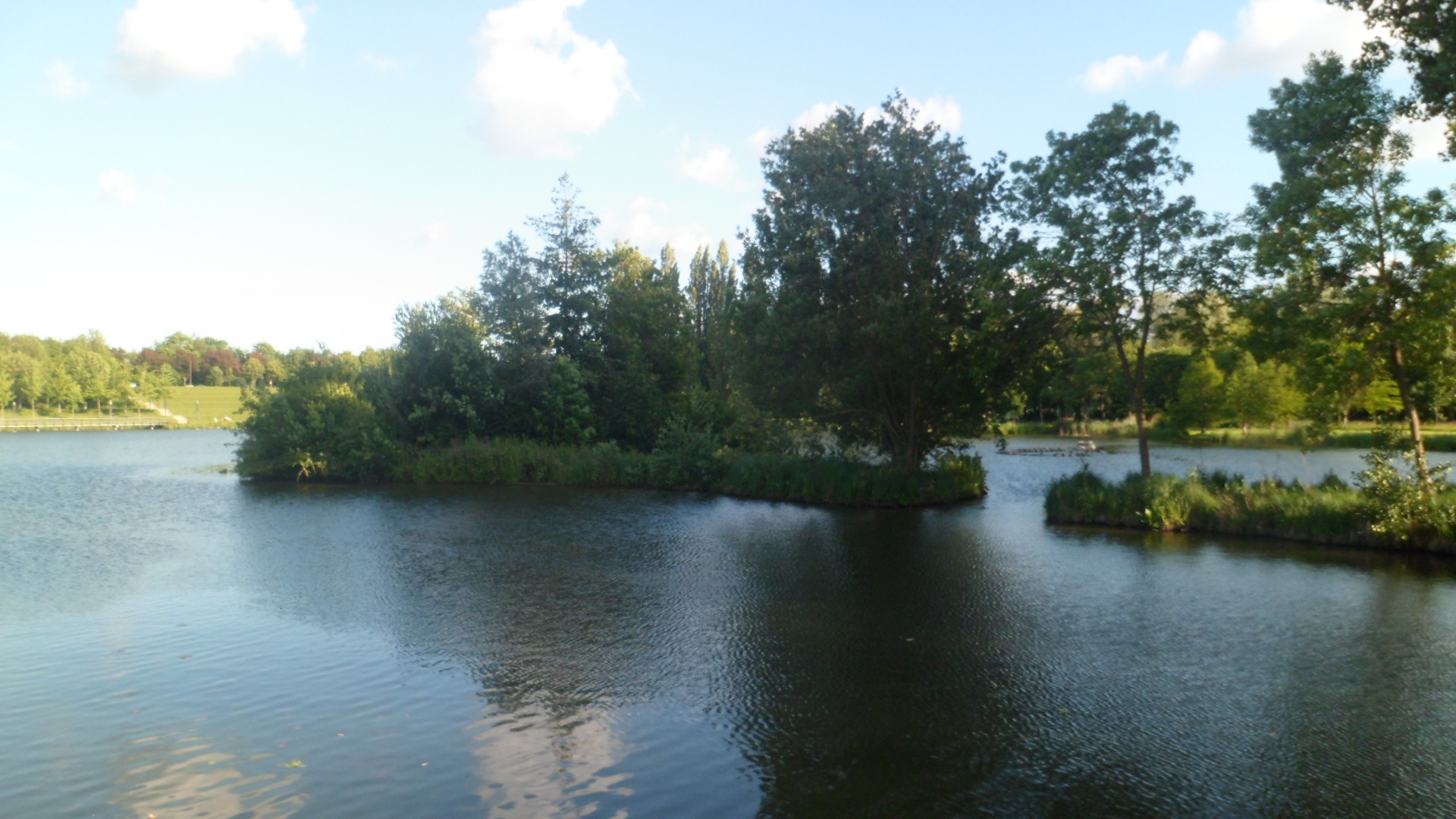
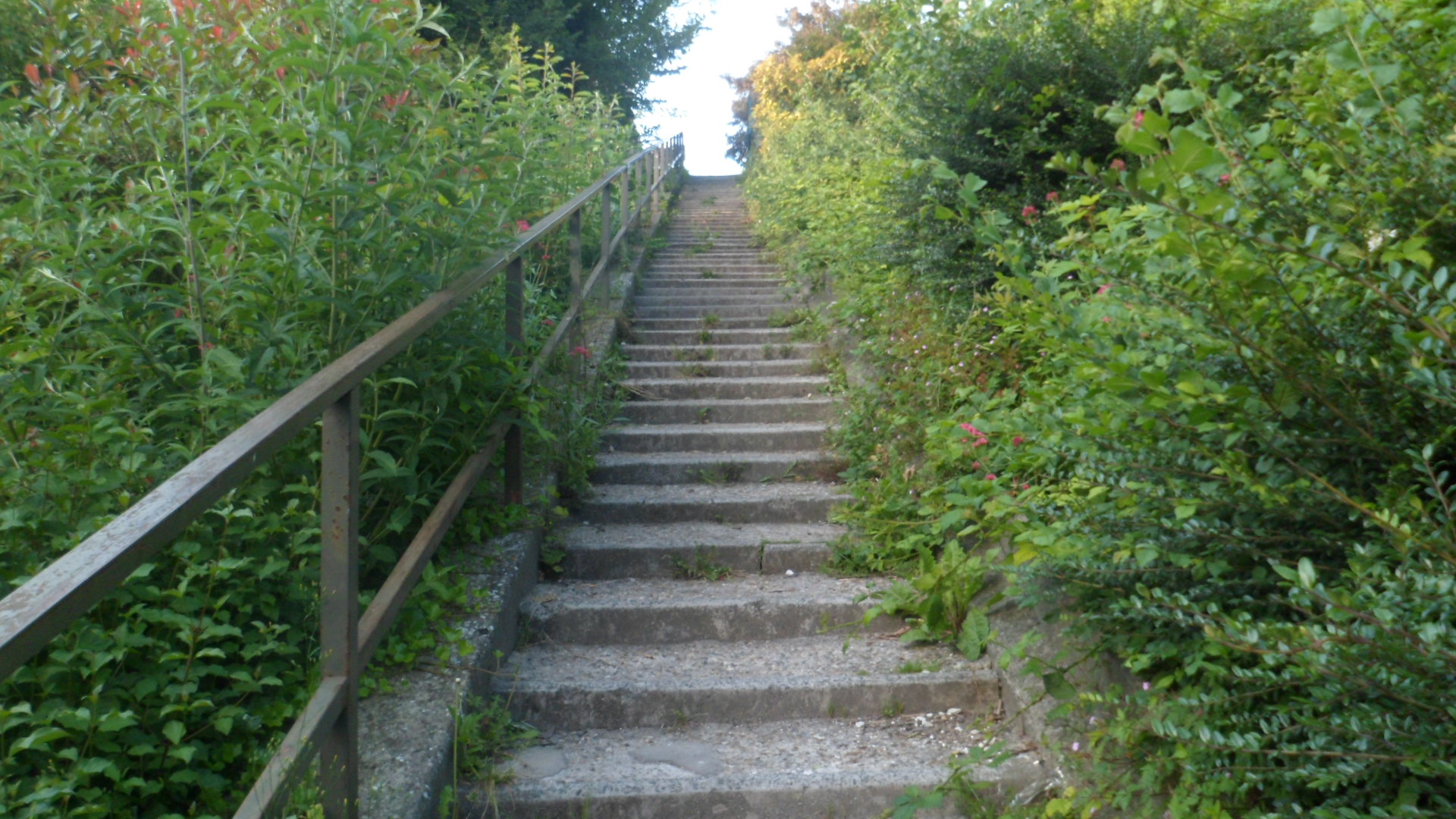
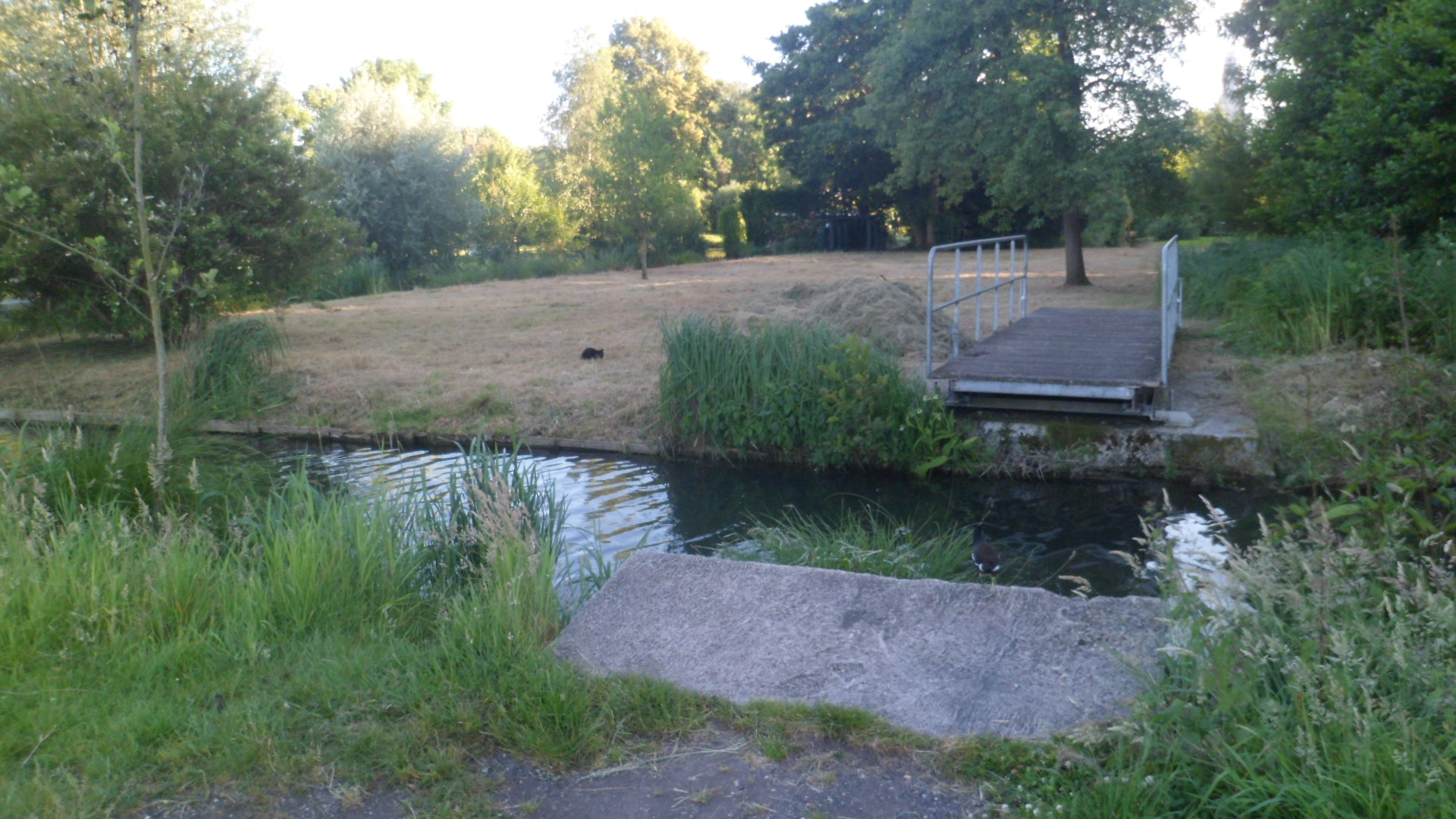
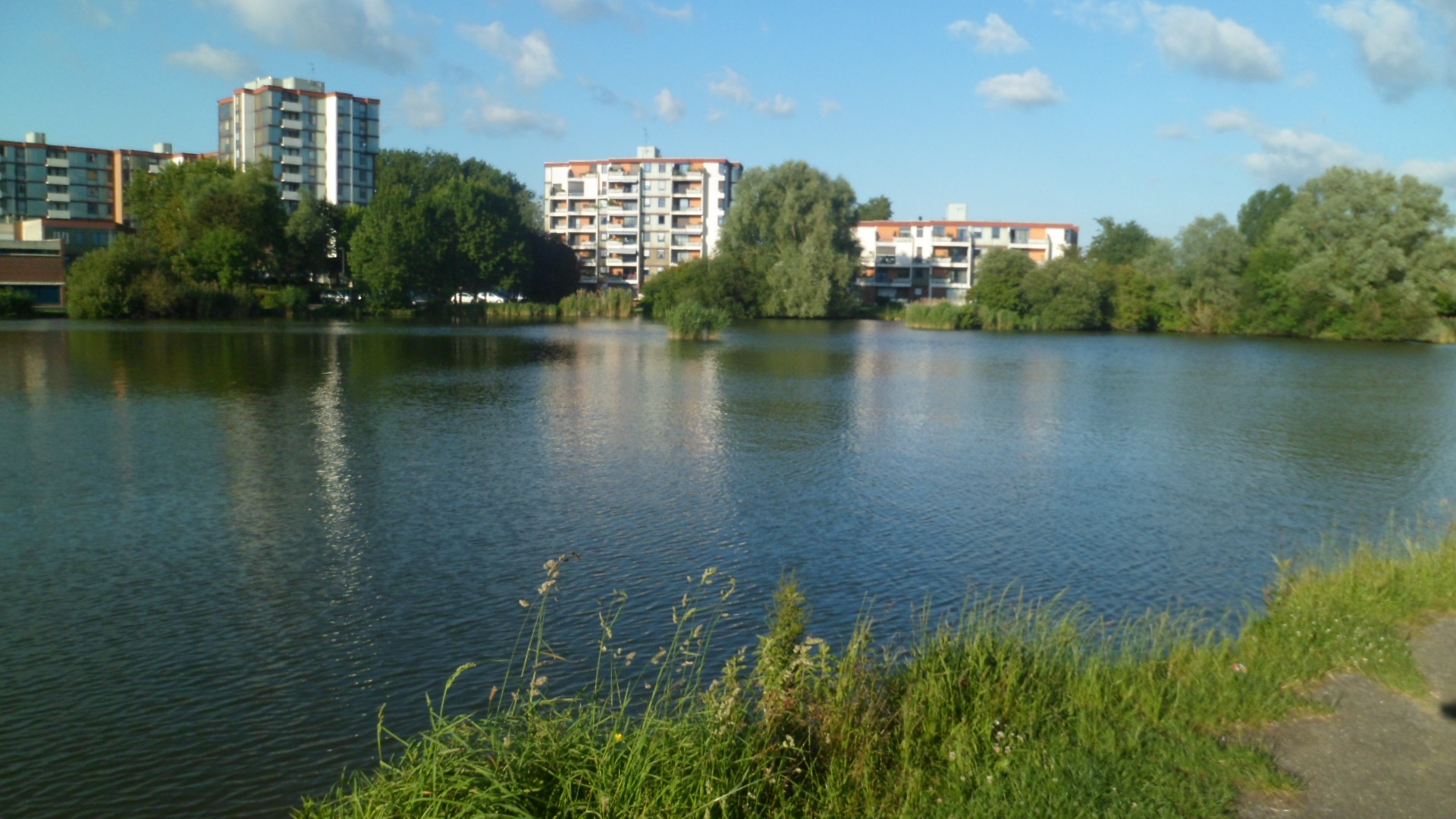
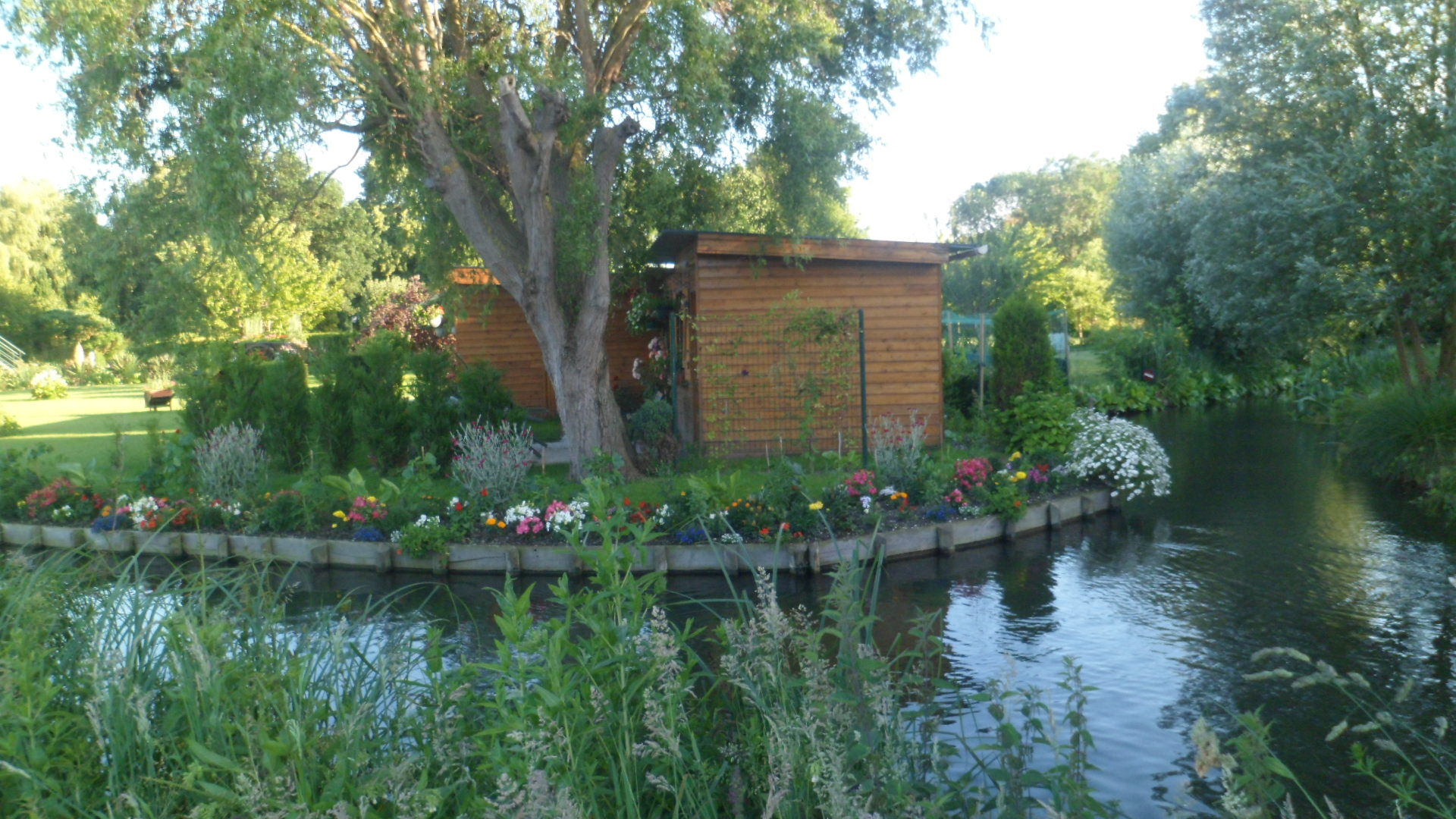
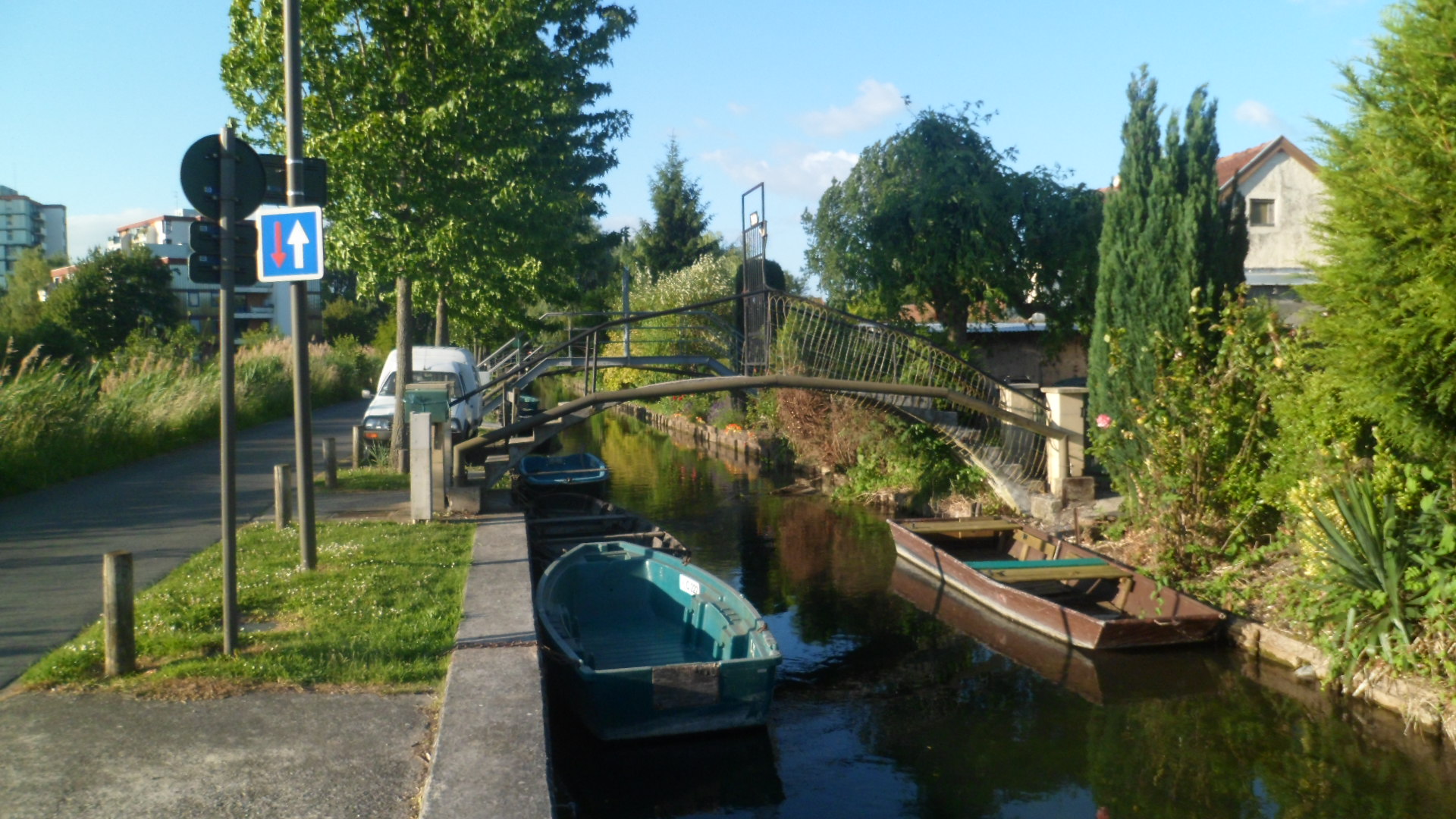
An Eastward Homage, Day 22, Part I: Gravensteen, Hall of Counts

0

June 17, 2014- The Flemish are nothing, if not feisty.  A group of girls, who appeared to be 14-15 or so, boarded the bus to St. Pieters Platz, from St. Baaf’s, with the intention of getting off at Rabot, the area of Ghent’s eastern gate. Being preoccupied with teen matters, they noticed their stop, about 30 seconds after the driver had halted.  They rushed to the exit, were ignored by the driver and the bus resumed to a spot near my hotel.  The more vocal of the group called out an epithet, in Flemish, which evoked chuckles from some of the other passengers.  They got off at my stop, and took off, pell mell up the street.  I work a lot with teens, so the whole thing was very familiar.

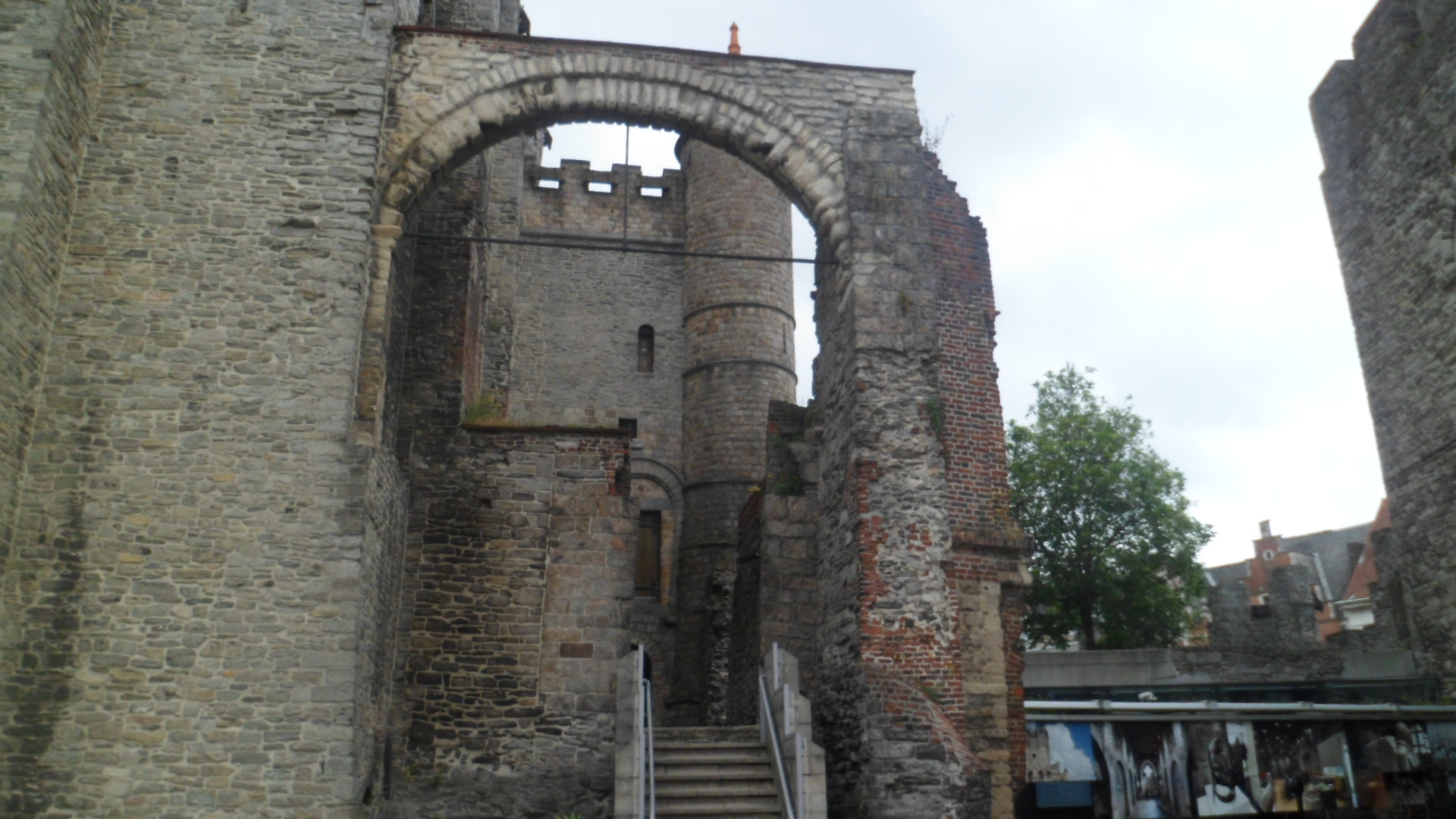
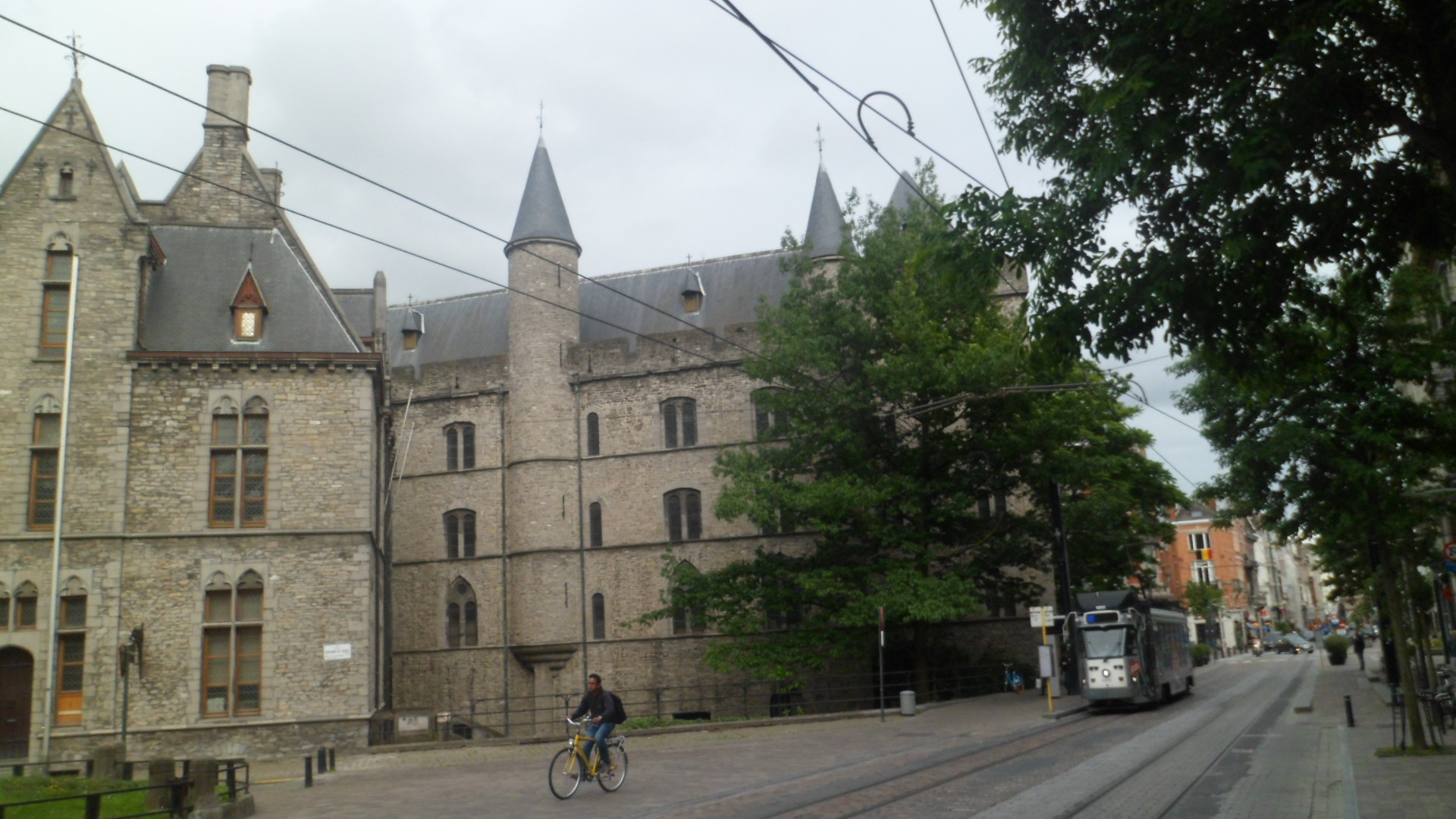
This brings me to Gravensteen, my main focus of that Tuesday morning.  It is a well-preserved medieval castle, built to serve the Counts of Ghent, during the era of Flemish city-states.  It’s overriding concern, from the looks of things, was providing space for imprisonment and torture.  Having set the tone for an interesting visit, I promise not to over-present the Museum of Torture .(Yes, that’s on the bottom floor).

Here is the home of the counts, in its entirety.

SAM_1049

The balustrade and turrets are essentially as they were in the fourteenth century.
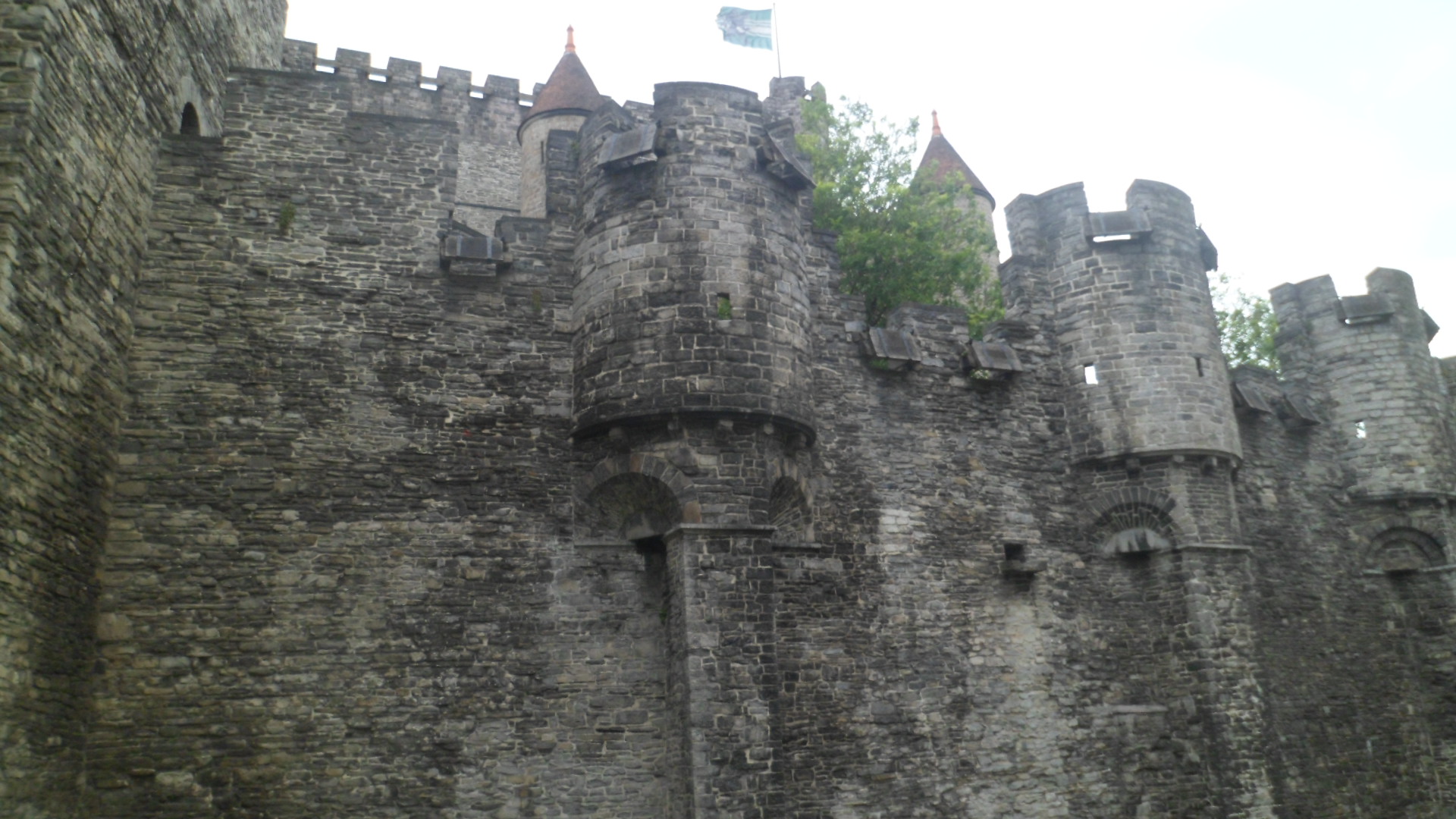
SAM_1051

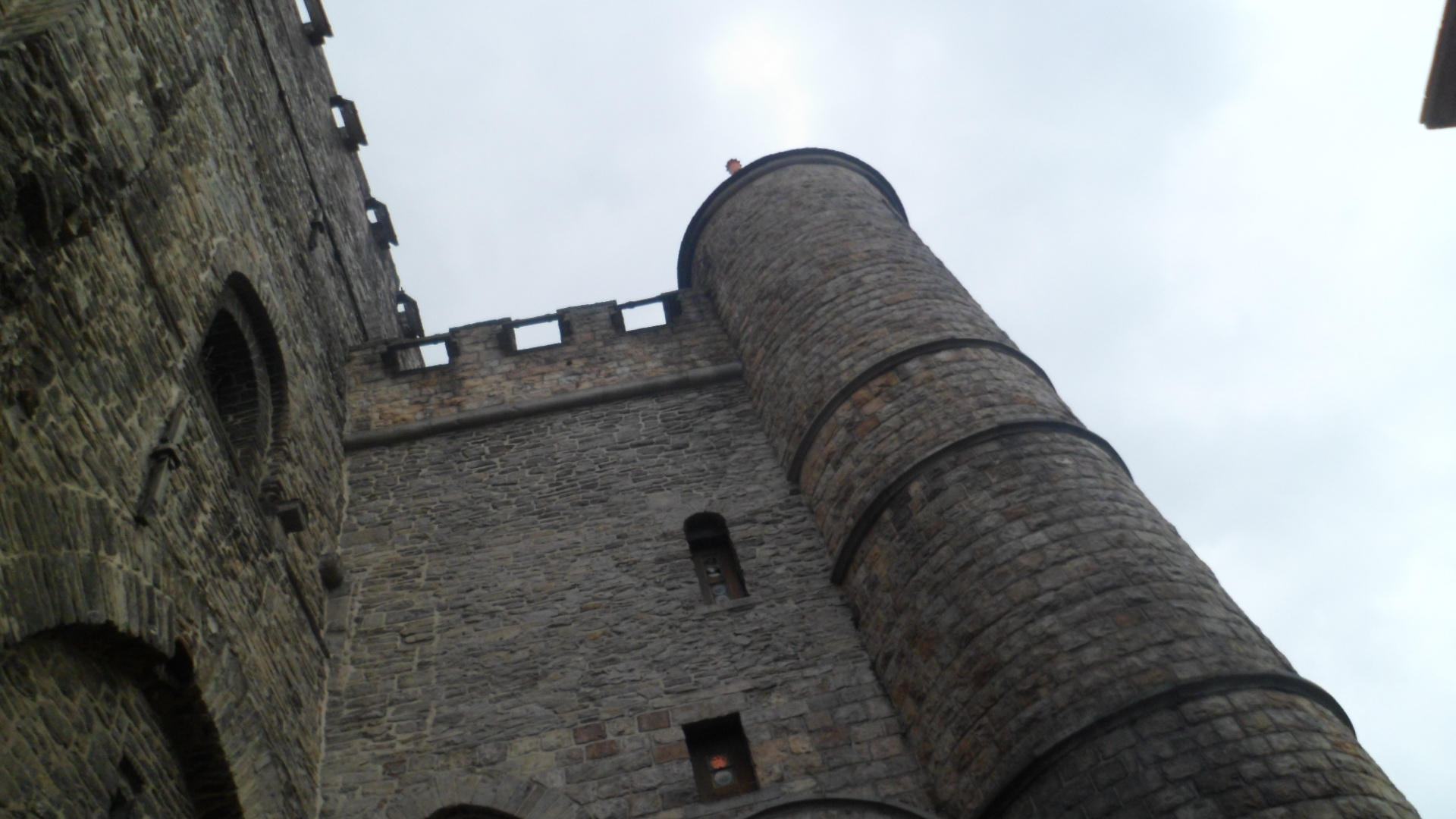
These turrets were the homes of the counts, when they stayed in Ghent.
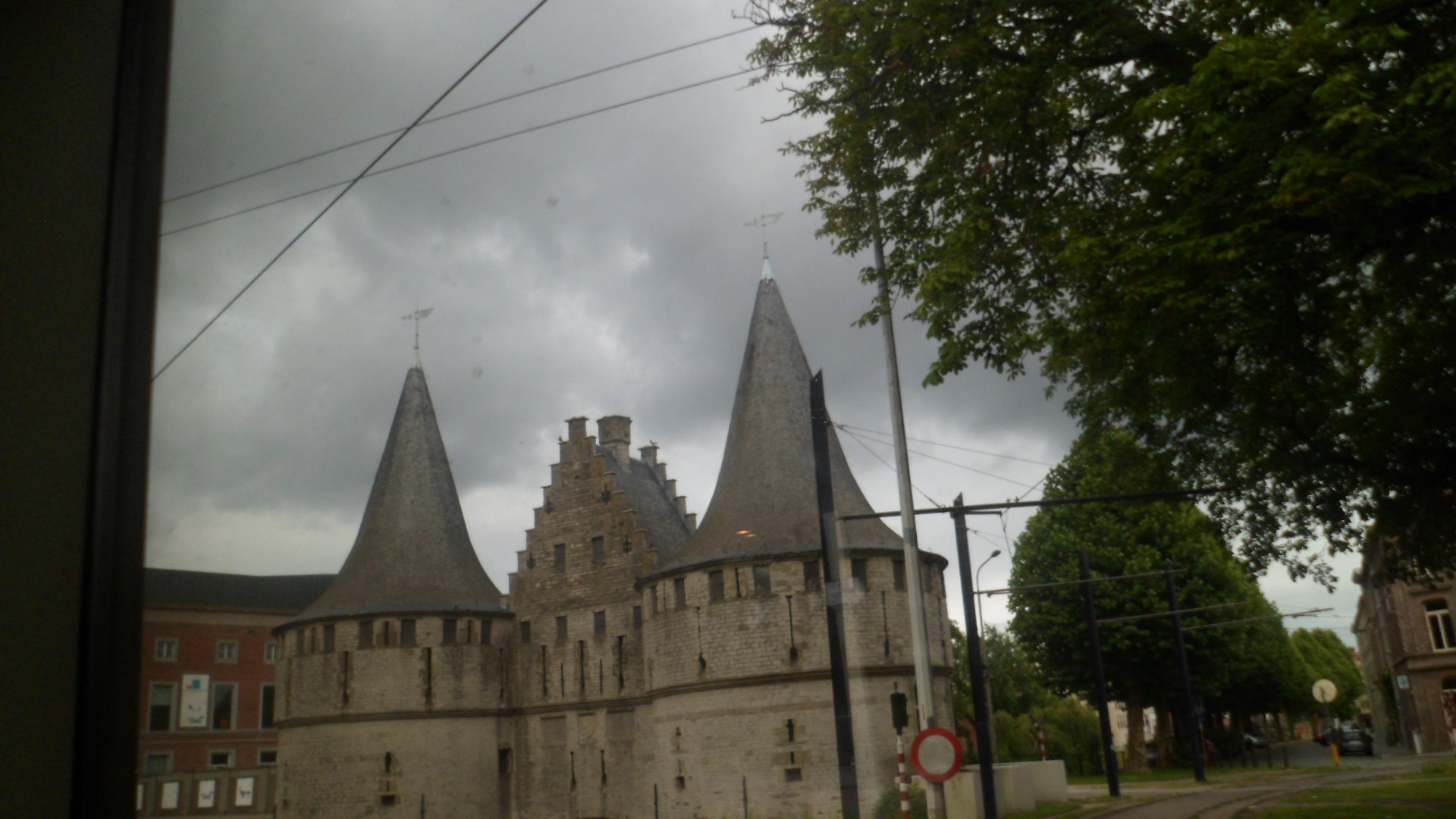
SAM_1099

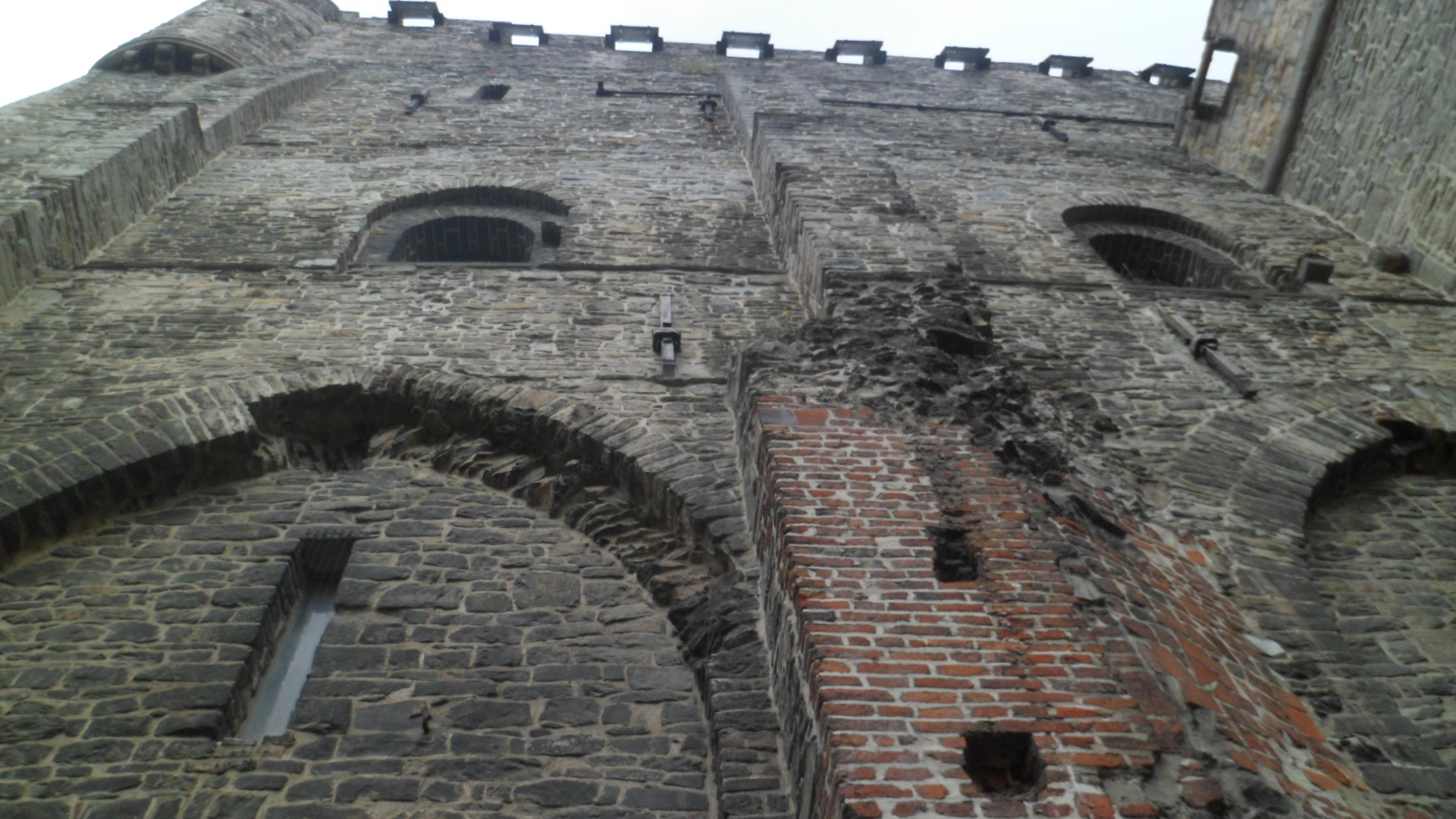
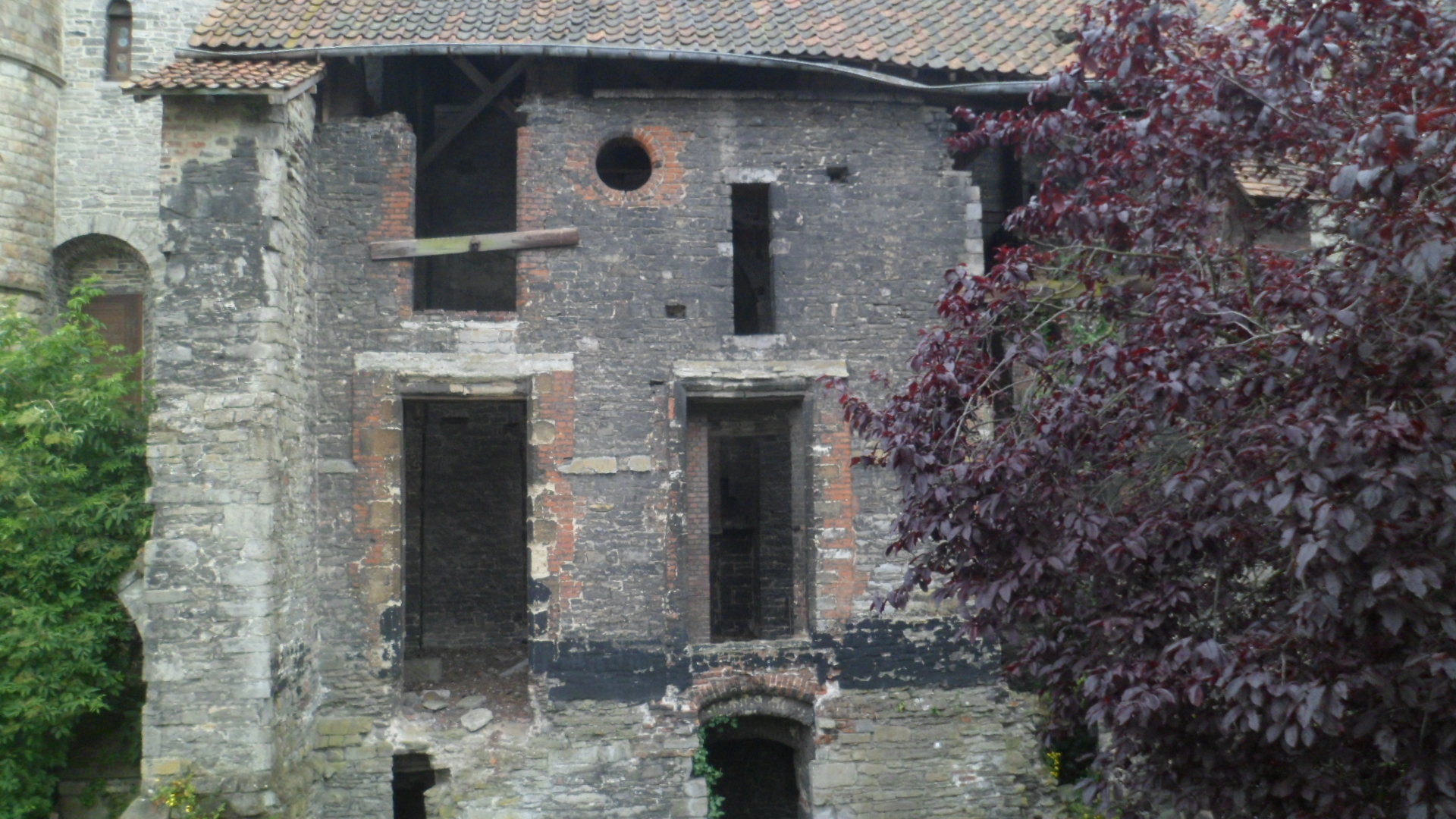
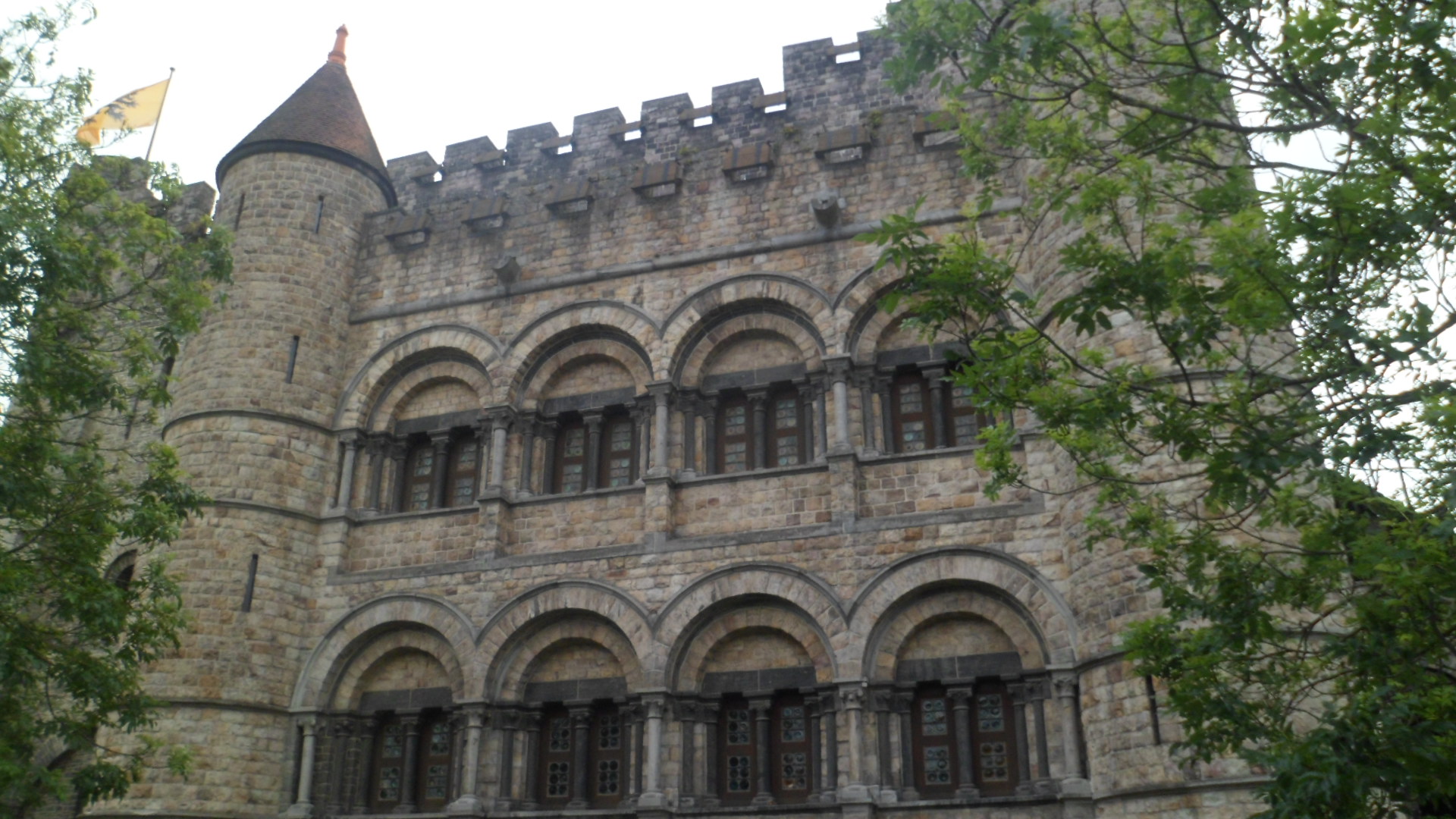
Here are several views of the castle’s exterior.

SAM_1105

SAM_1107

SAM_1108

SAM_1109

SAM_1110

SAM_1168

Now, it’s time to go inside.  This meeting hall is now used for school groups.  On this day, there were two such groups in the castle.
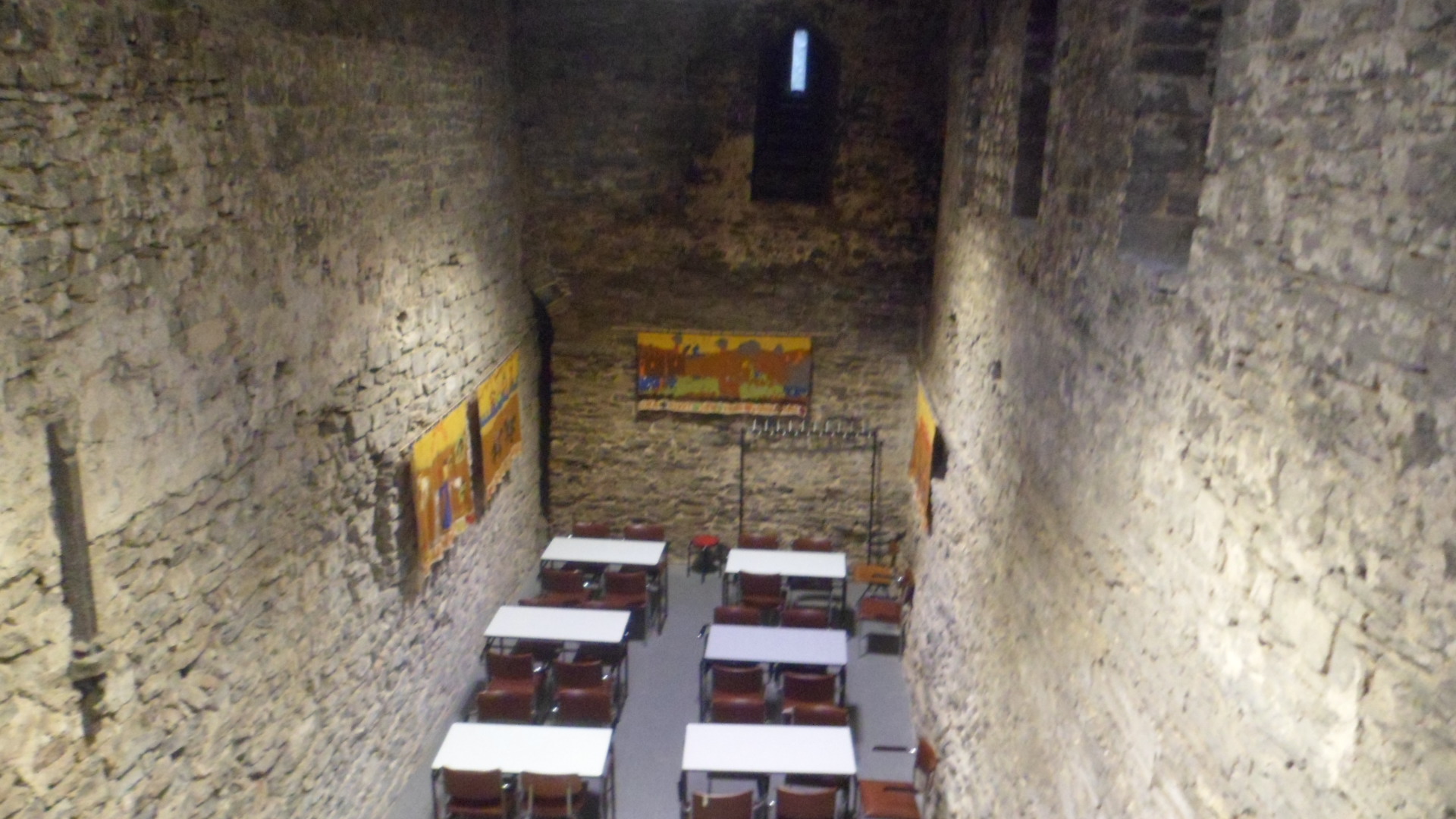
SAM_1113

This was the Governor’s Residence.  There was no polished wood, until the 17th Century.
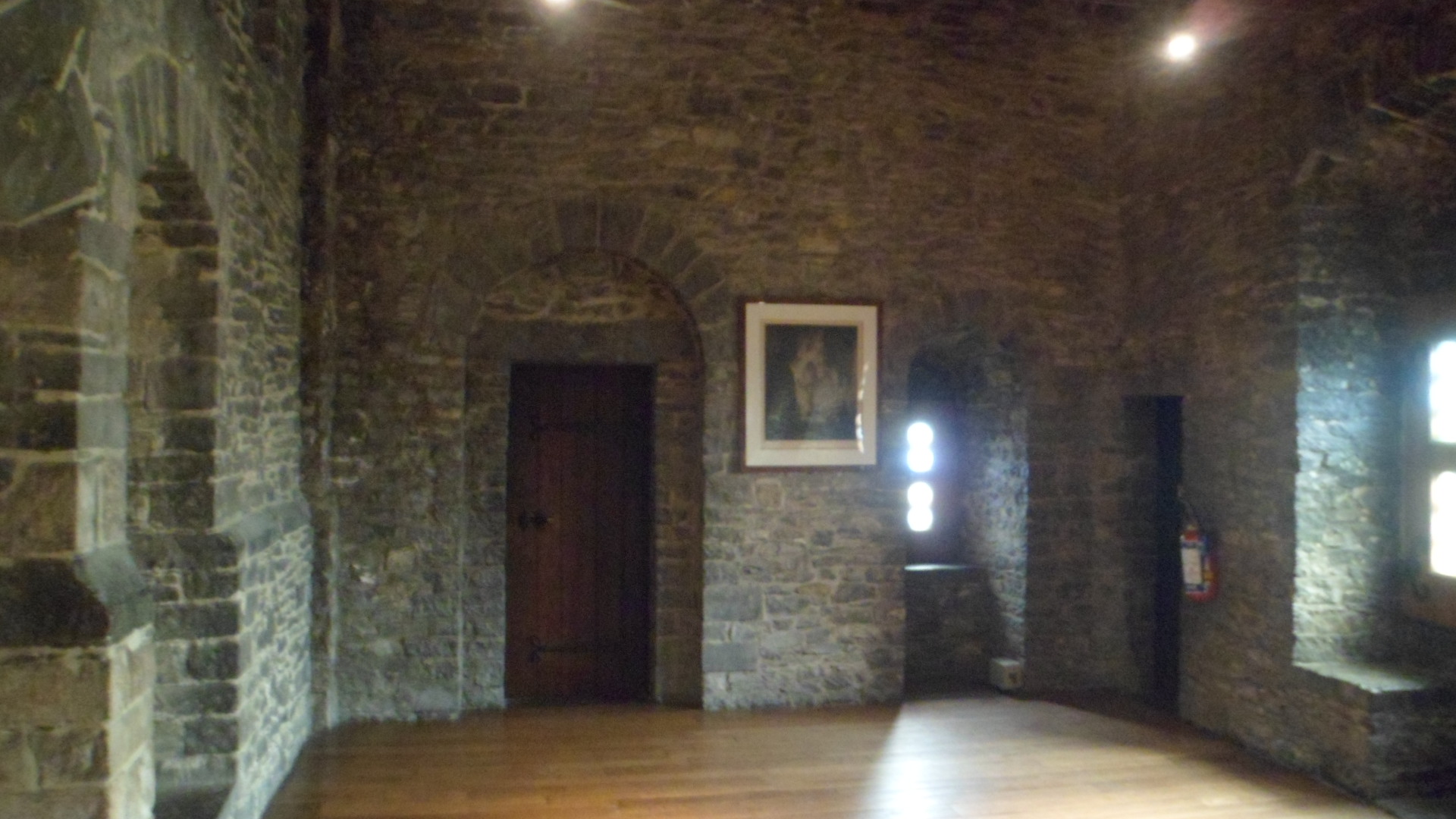
SAM_1115

I proceeded from there, to the Hall of Armor and Weaponry.  Below, is the closest thing a man had to a bullet-proof vest, in those days.
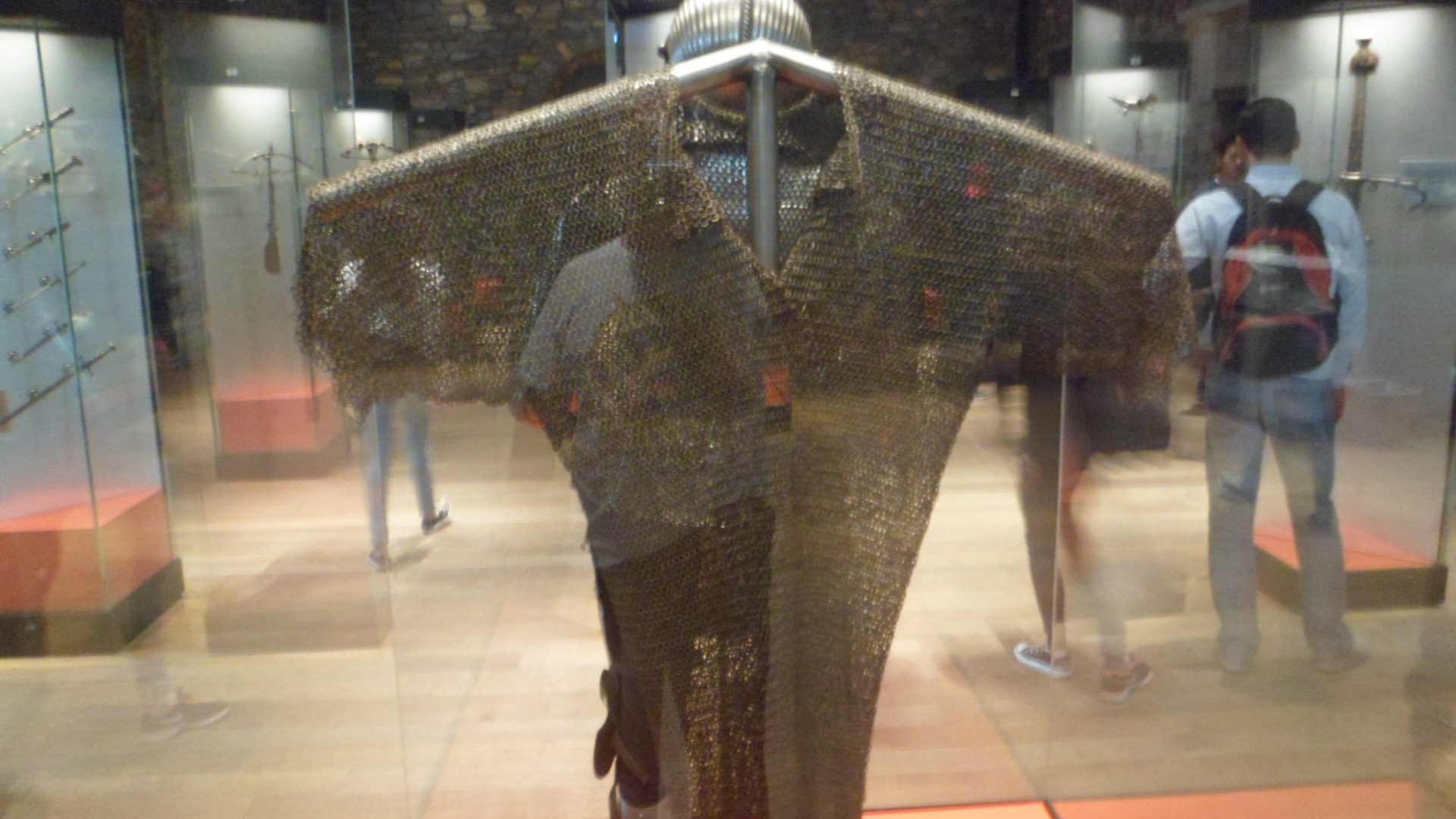
SAM_1117

Of course, knights got  to face combat in this.
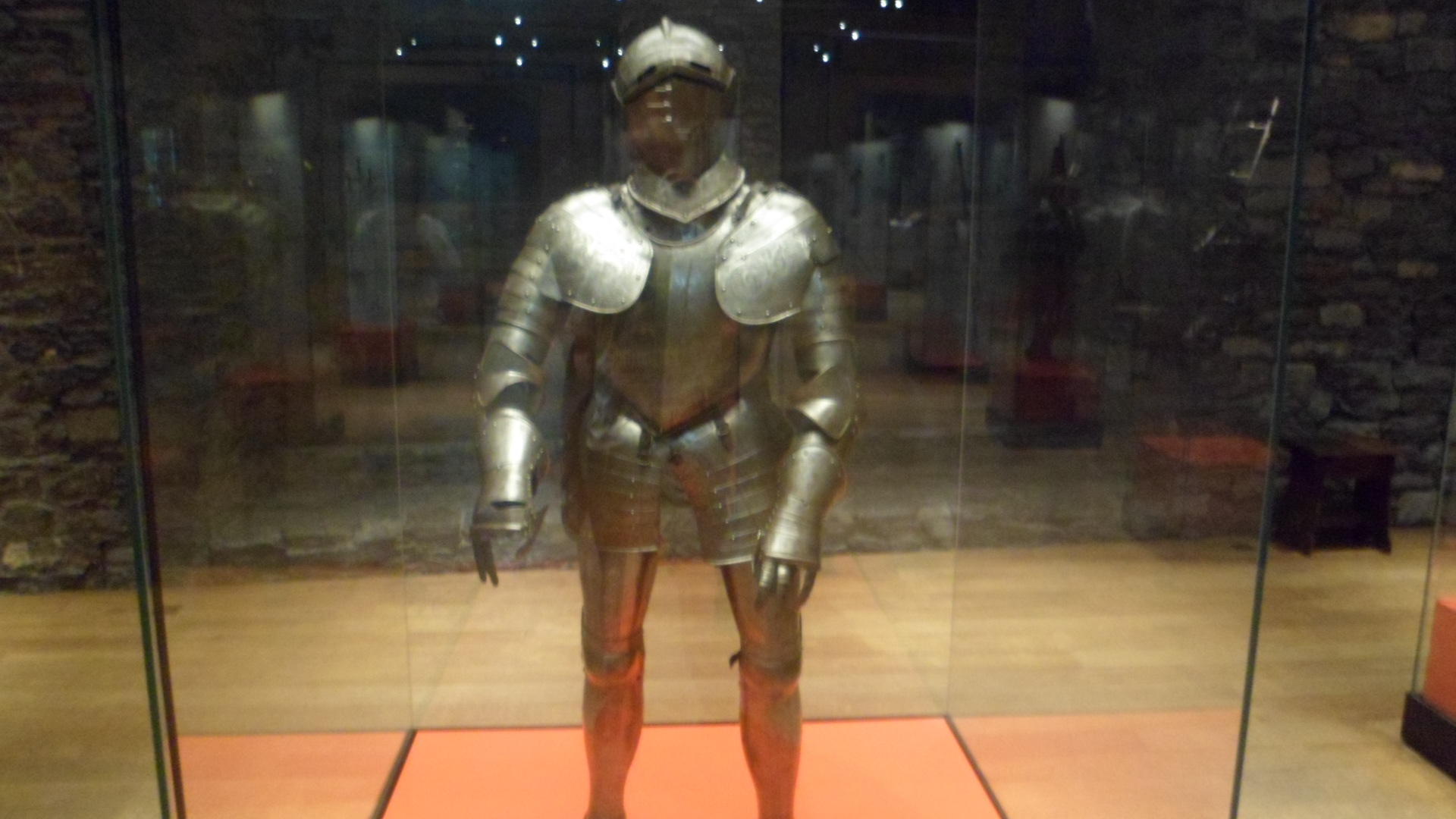
SAM_1125

A couple of views of weapons reminds us how things really were, if one strayed too far from the norm.SAM_1118
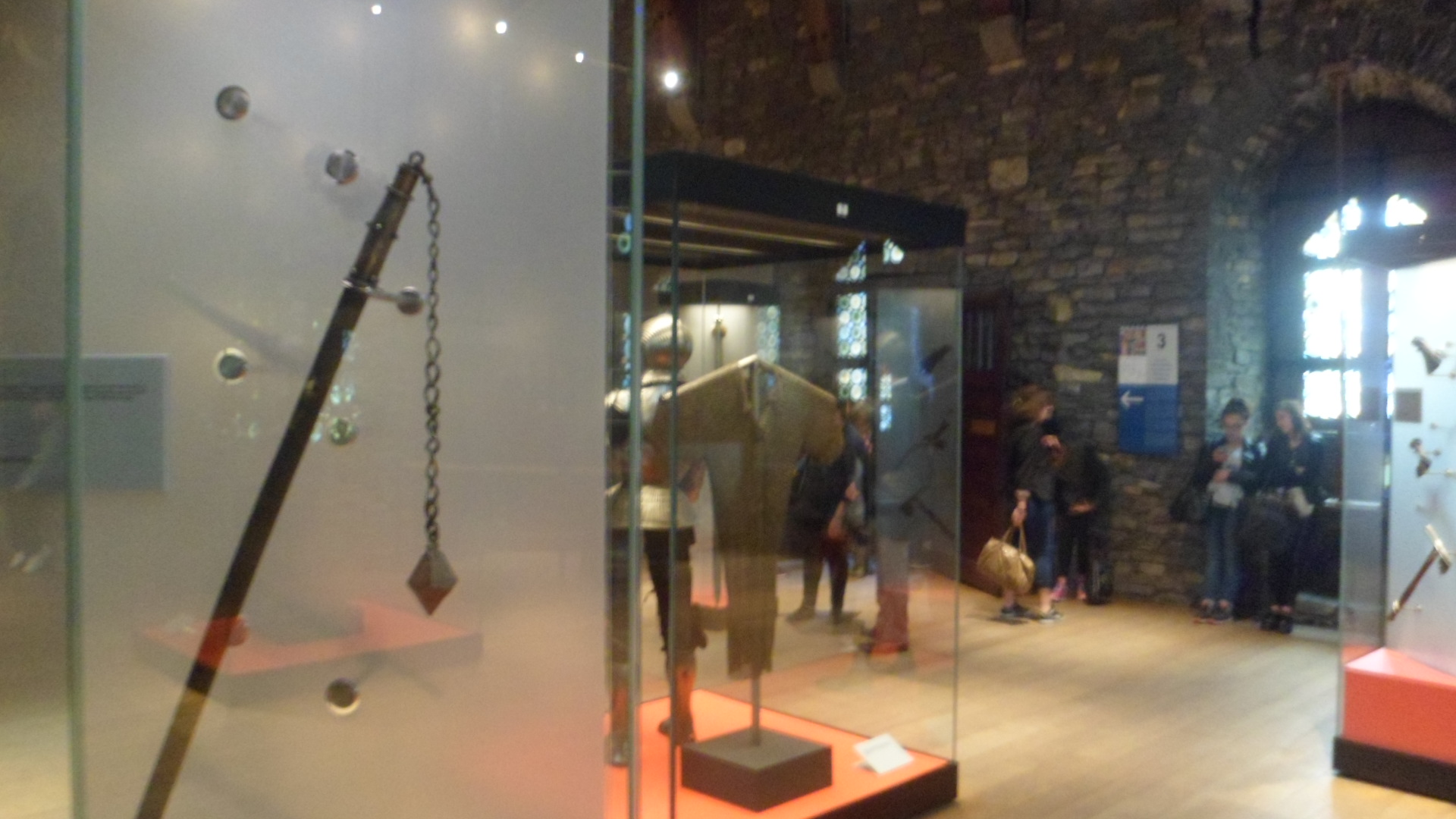
SAM_1122

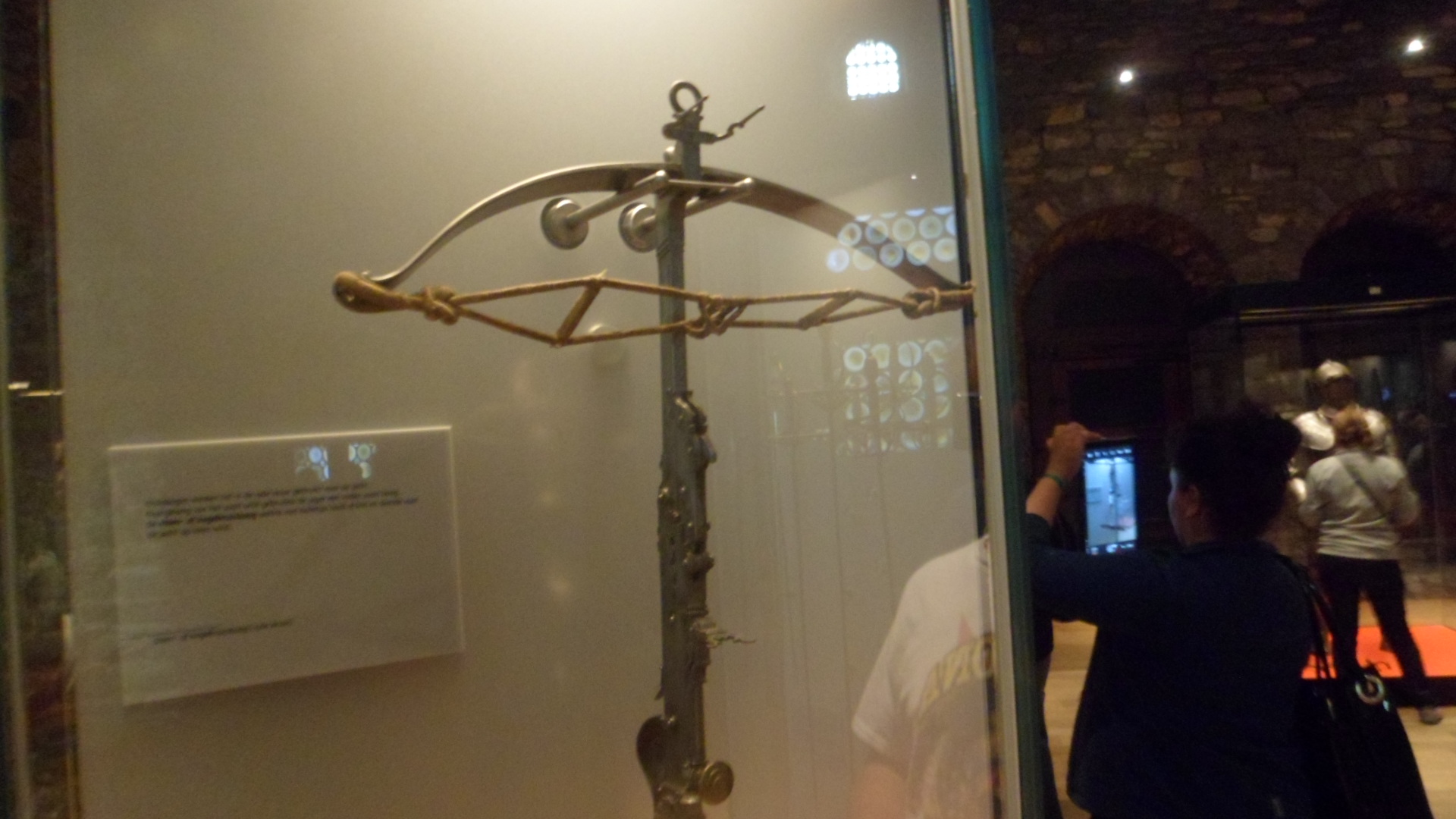
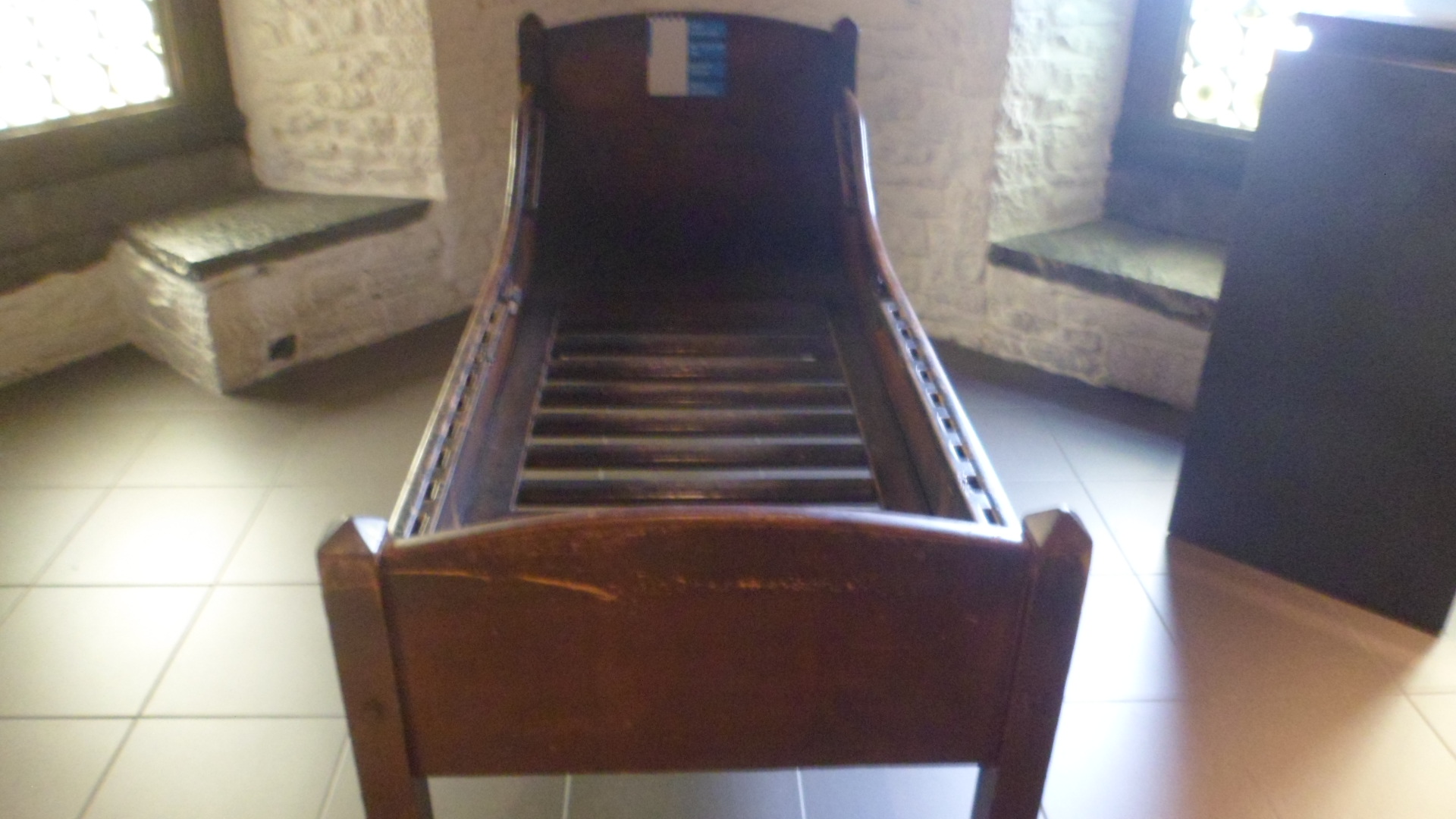
There was the hall of retribution, which featured the rack.
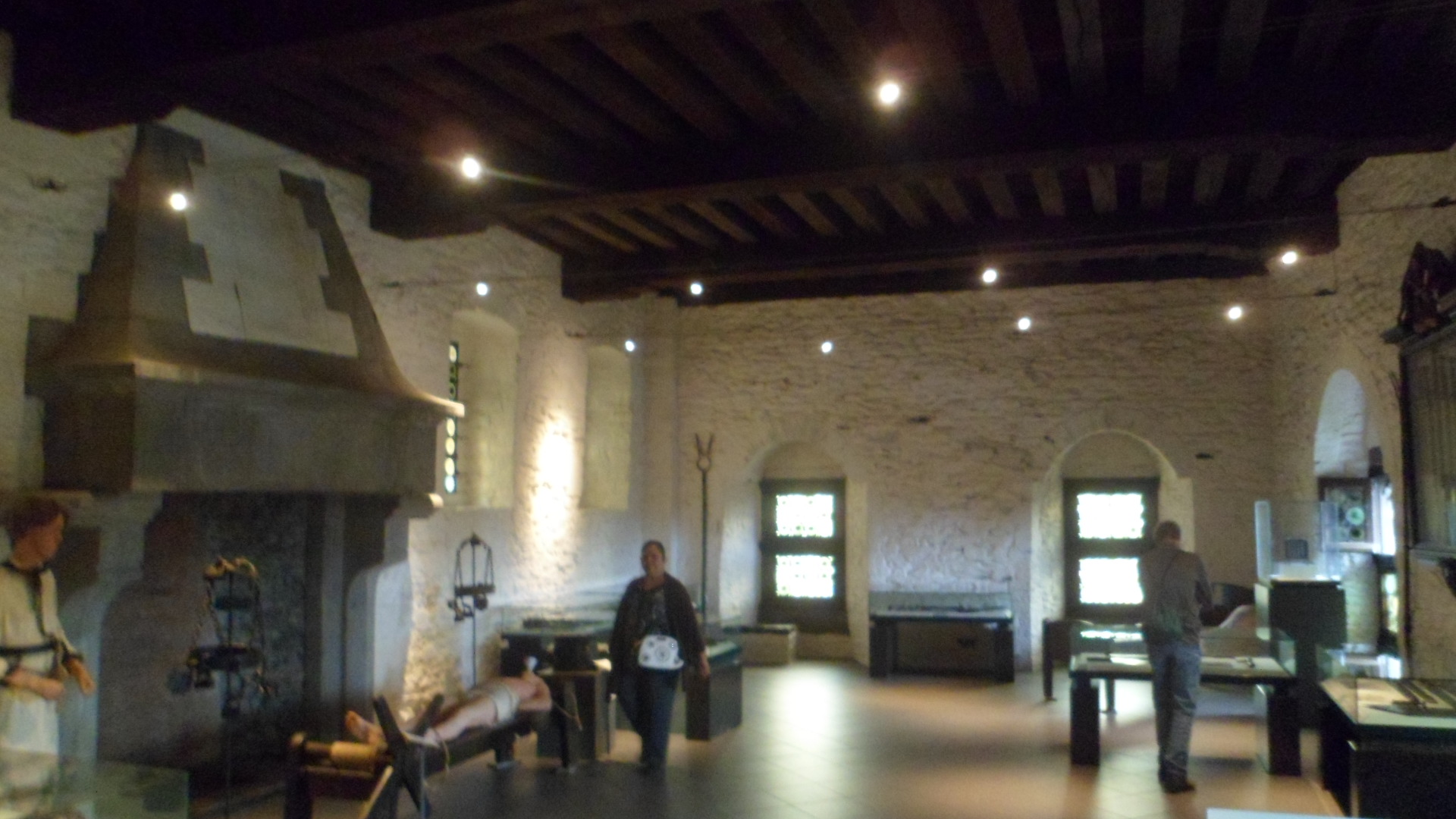
SAM_1149

SAM_1155

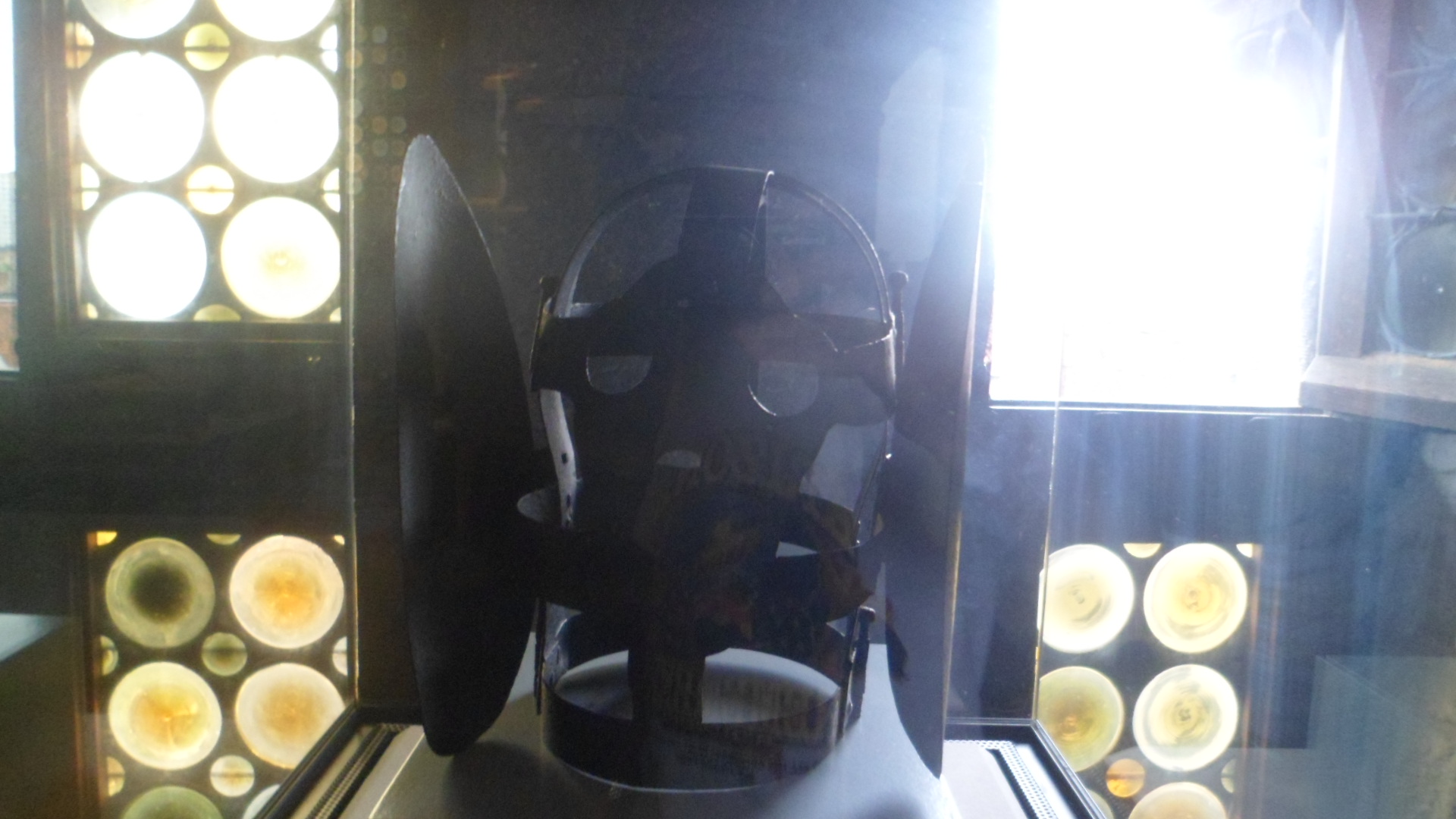
The iron mask was also a real instrument of control.SAM_1151
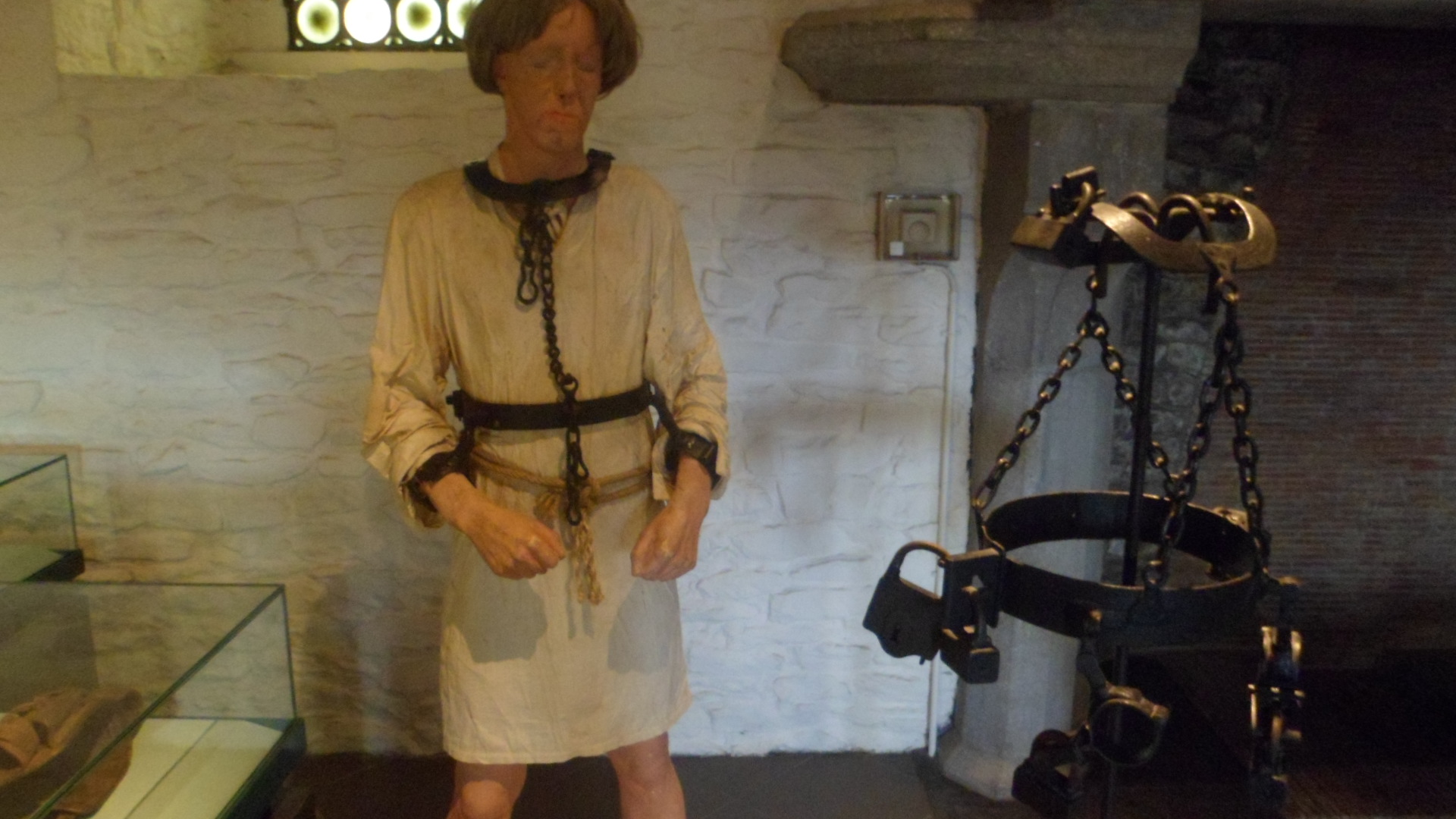
SAM_1153

The rooms were not as stuffy as one would think, though.  It was a good thing, as bathing wasn’t a top priority.

SAM_1159

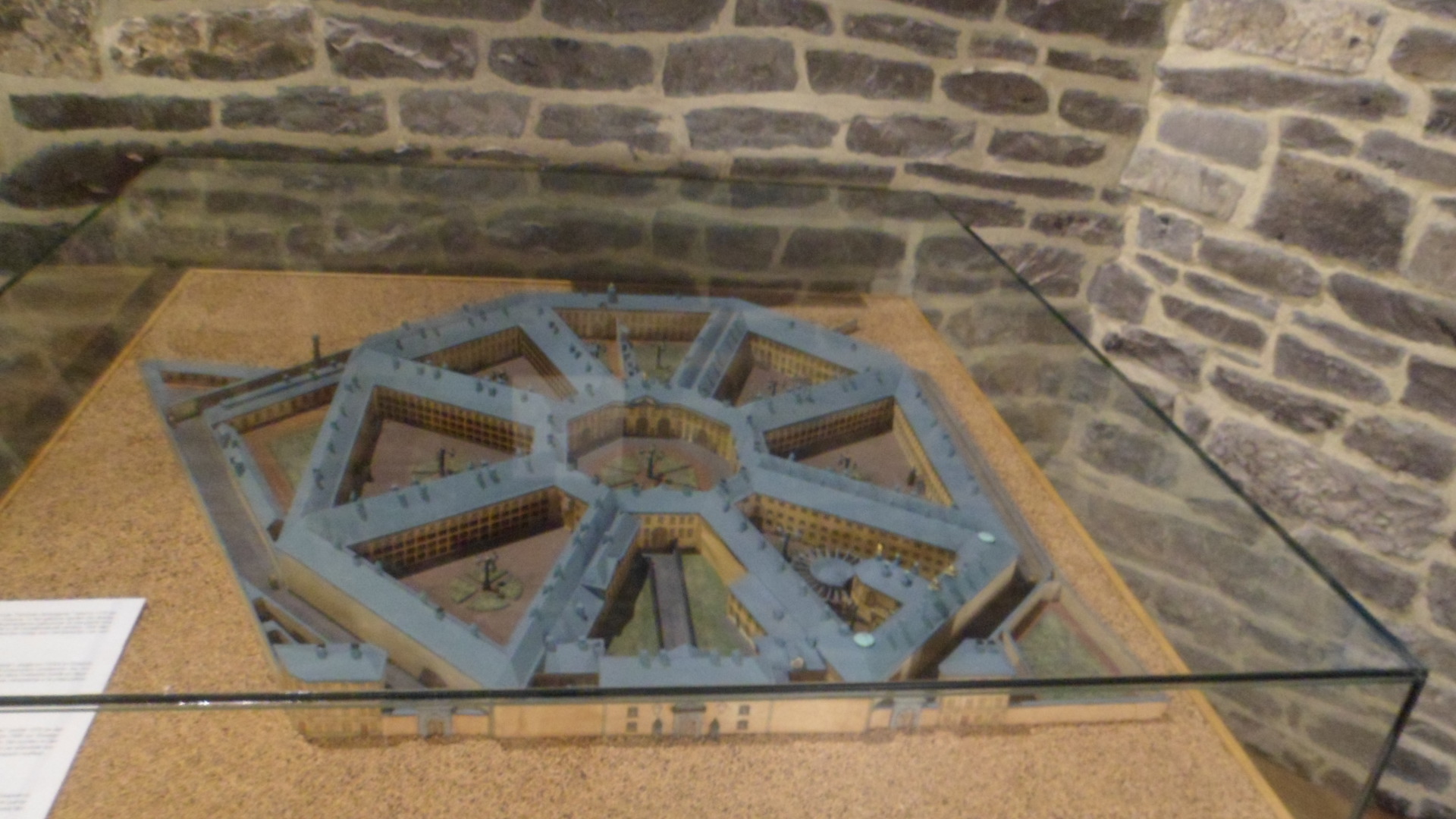
Here is a scale model of the grounds.SAM_1146

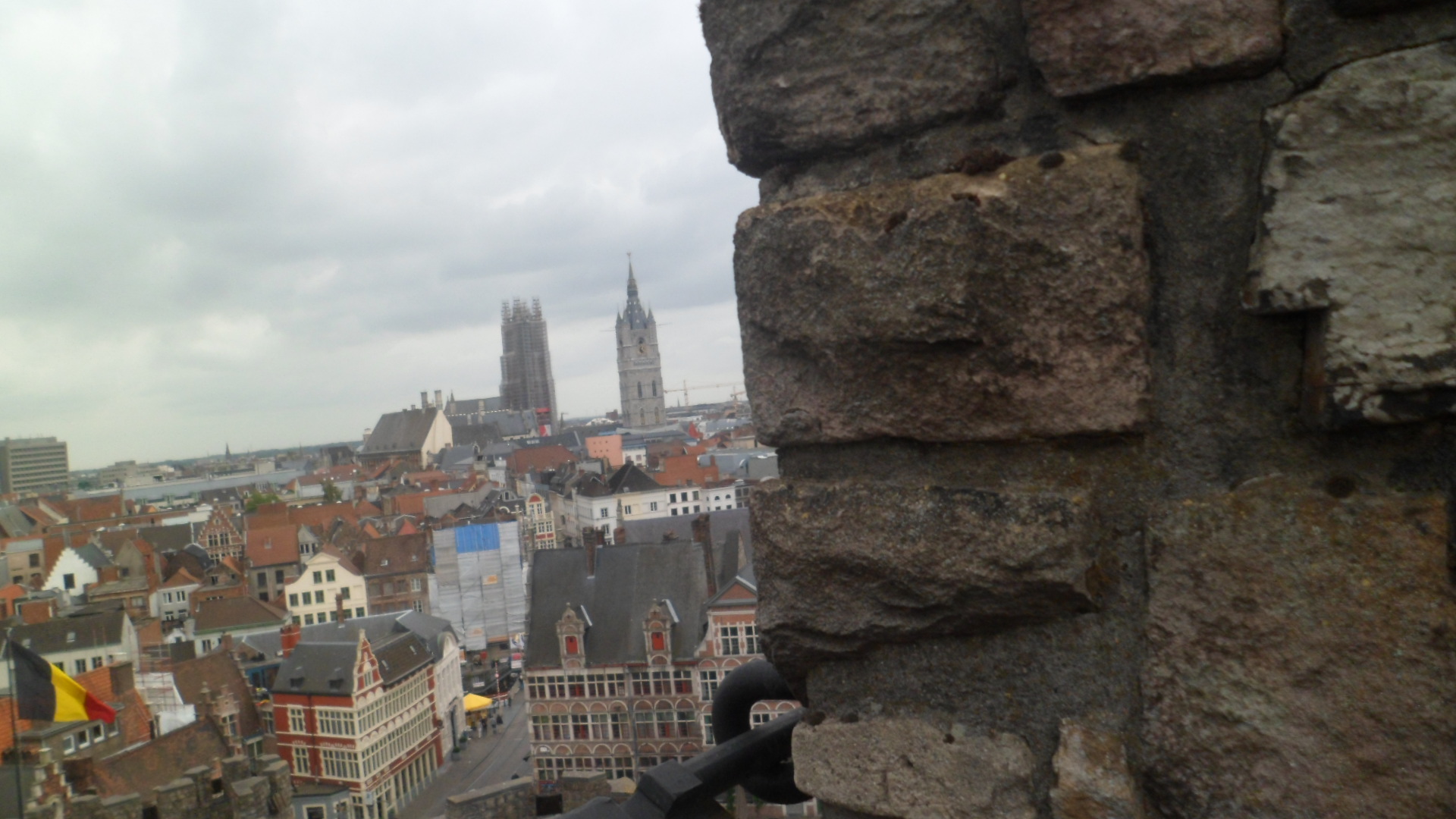
The views from the balustrade made being in the counts’ good graces a nice thing.
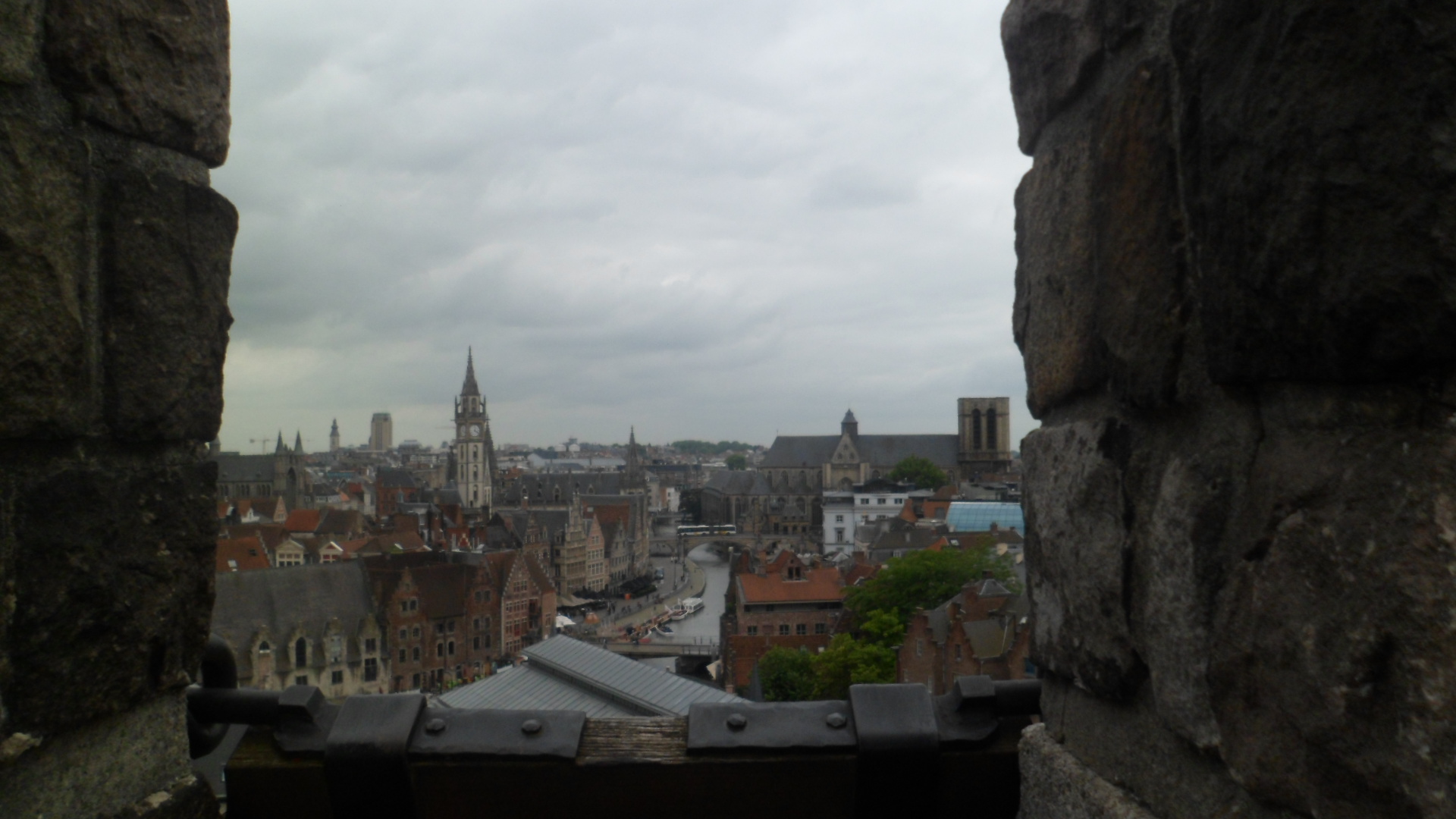
SAM_1135

SAM_1138

SAM_1140

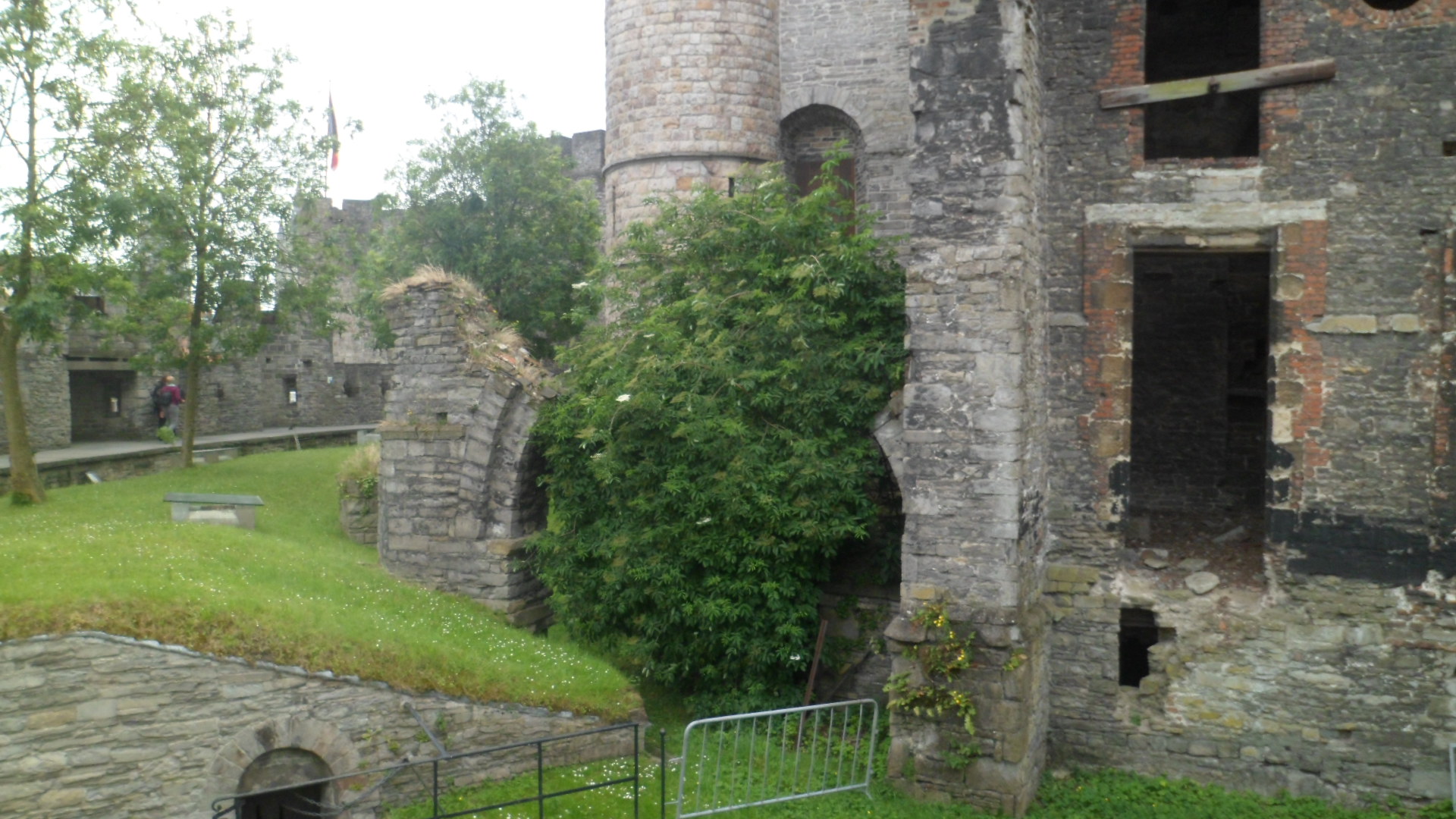
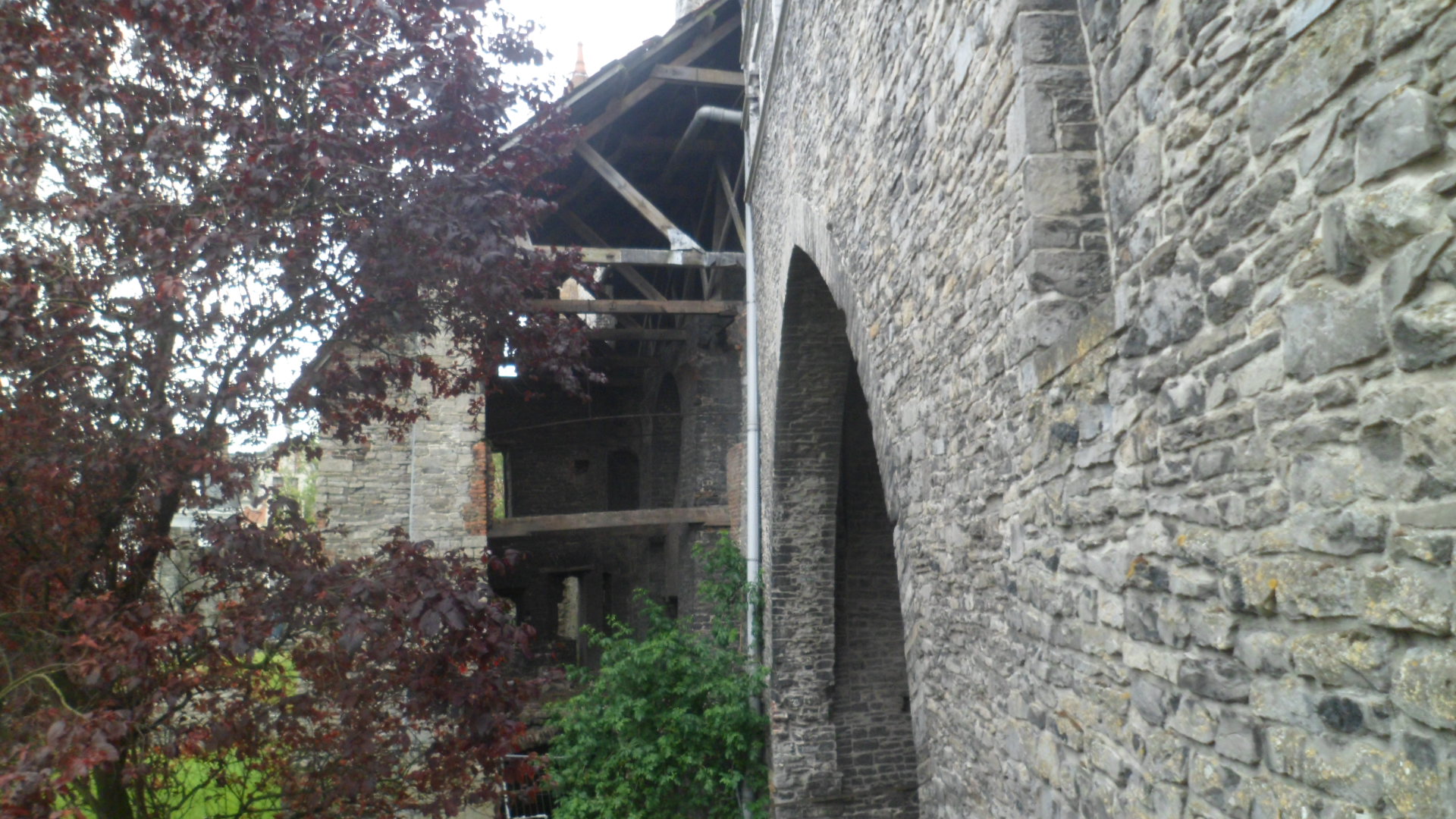
Being at the ground level wasn’t bad, either, as long as one was above the dungeon.
SAM_1166

SAM_1170

SAM_1172

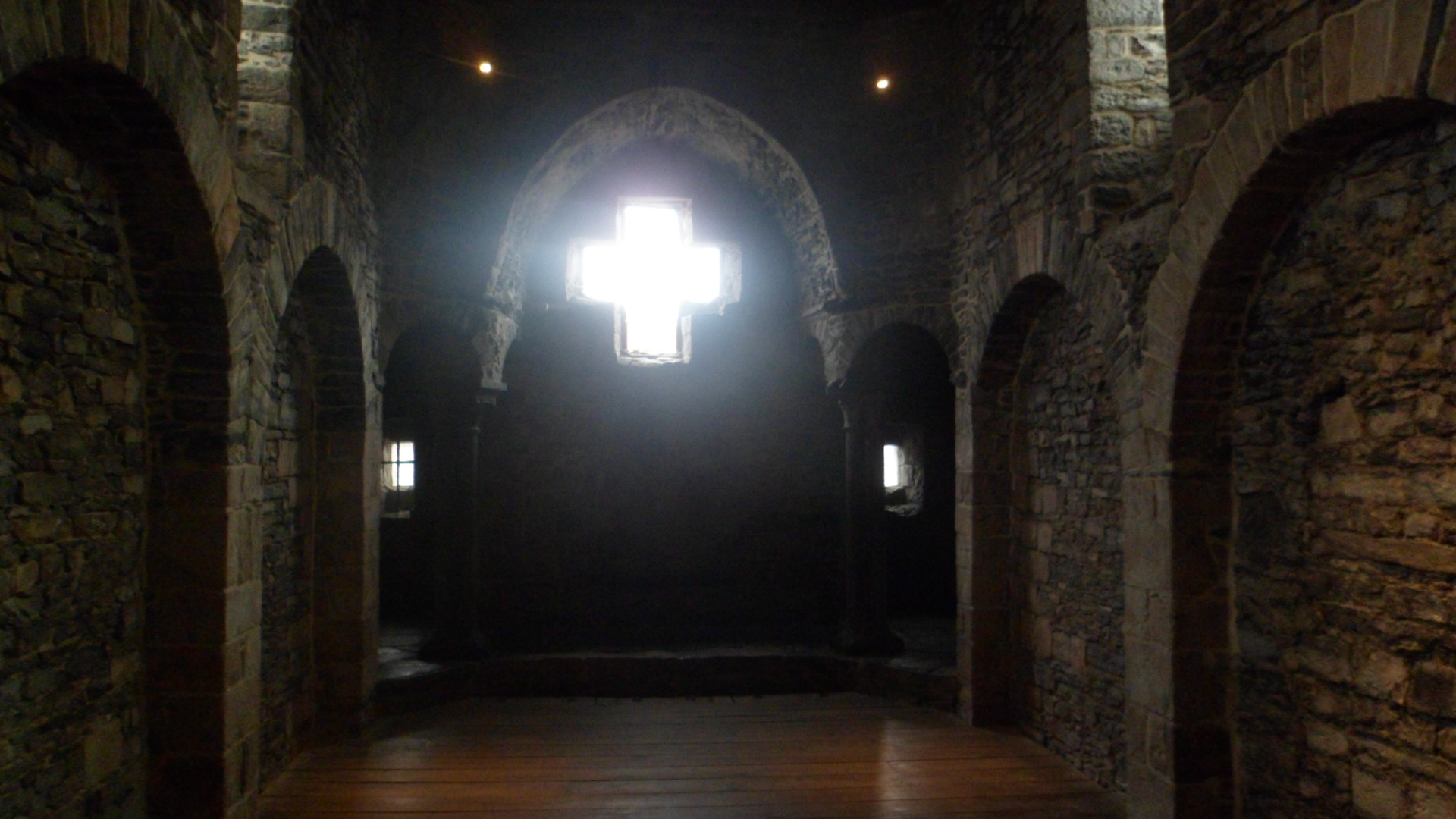
On the other hand, if one WAS in the dungeon, this was his lot.  It was converted into a chapel, in the 18th Century.
SAM_1177

Special visitors stayed here.

SAM_1180

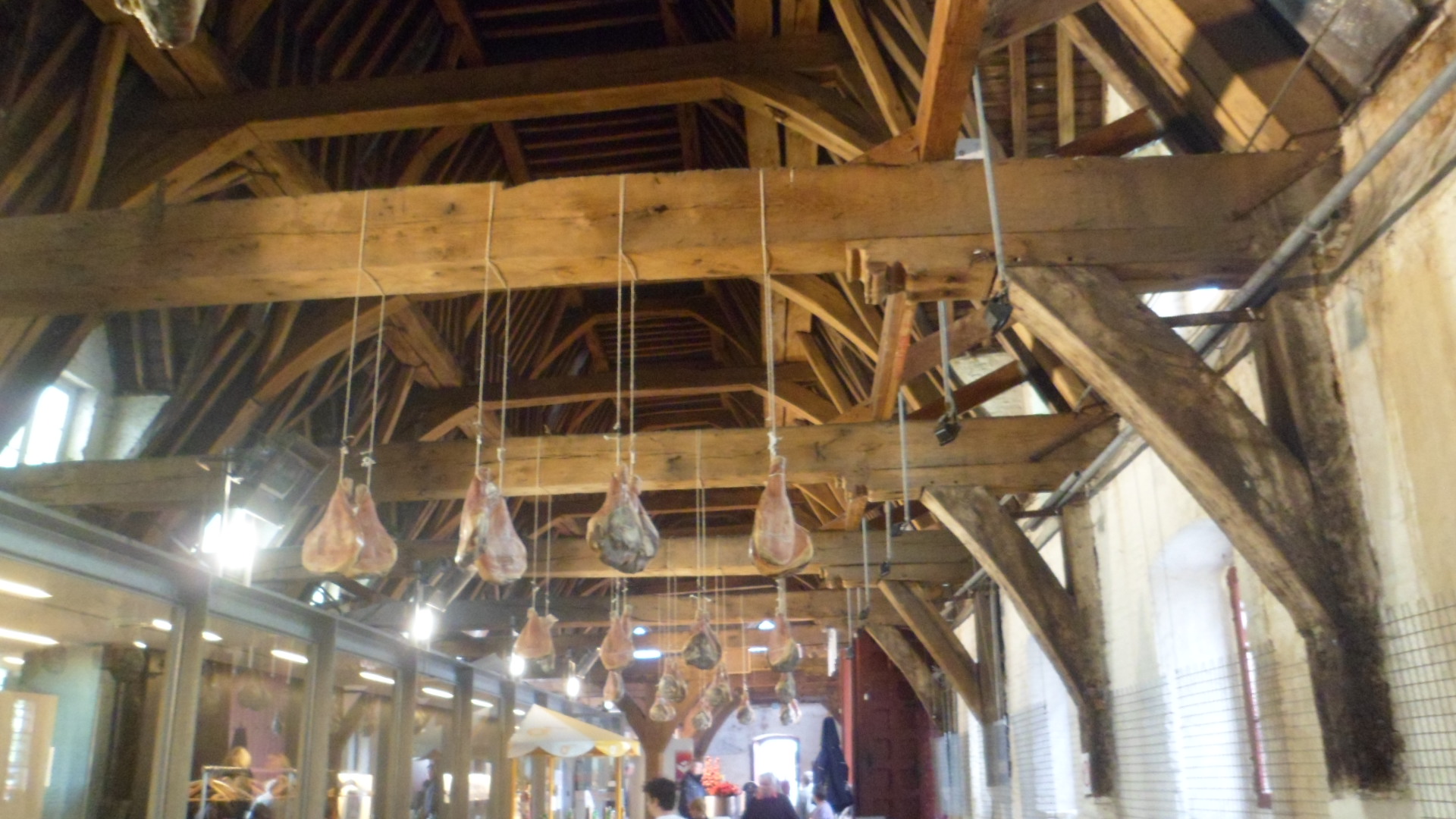
This gave me a good idea of life in a self-contained royal universe.  Being in a rather irreverent mood, and it being lunchtime, I dropped in at the Butchers’ Guild, in the Central Market, which reminded me a bit of Boston’s Fanueil Hall- with one big difference:
SAM_1191

It is refrigerated, and there were no flies.  I opted for ham with Gouda, on dark rye.

NEXT:  Navigating Brussels
An Eastward Homage, Day 21, Part III: Ghent and Its Canals

2

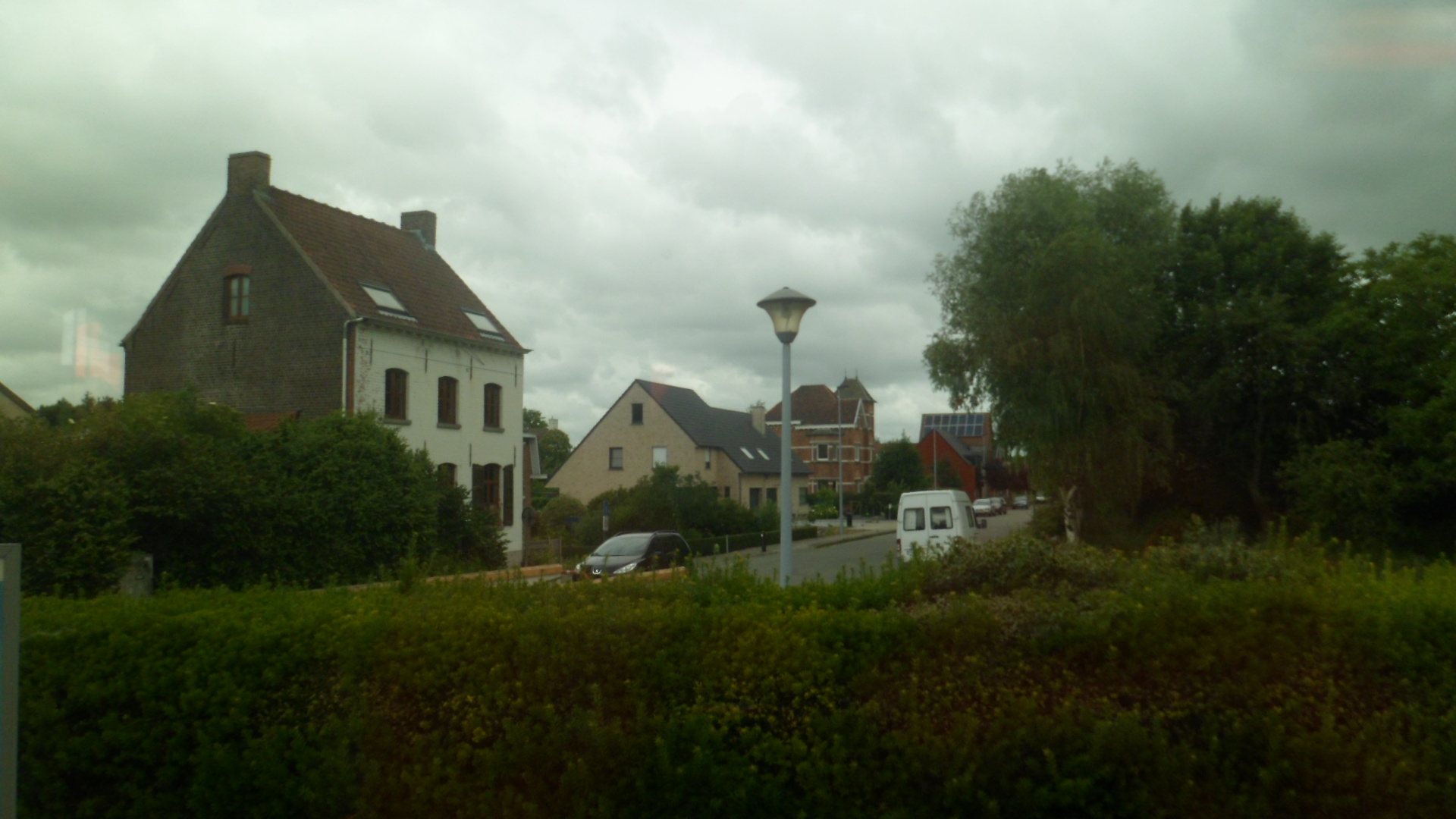
June 16, 2014- The train from Brugge to Ghent, on this cool, blustery afternoon, took us through serene villages and lush meadows.  The train was nearly deserted.  So, it was with some amusement that I was admonished by an officious young conductor, to “leave this First Class Car, AT ONCE!  Your ticket says SECOND CLASS!! Kindly go downstairs.”  I kindly went downstairs.

SAM_1013

SAM_1014

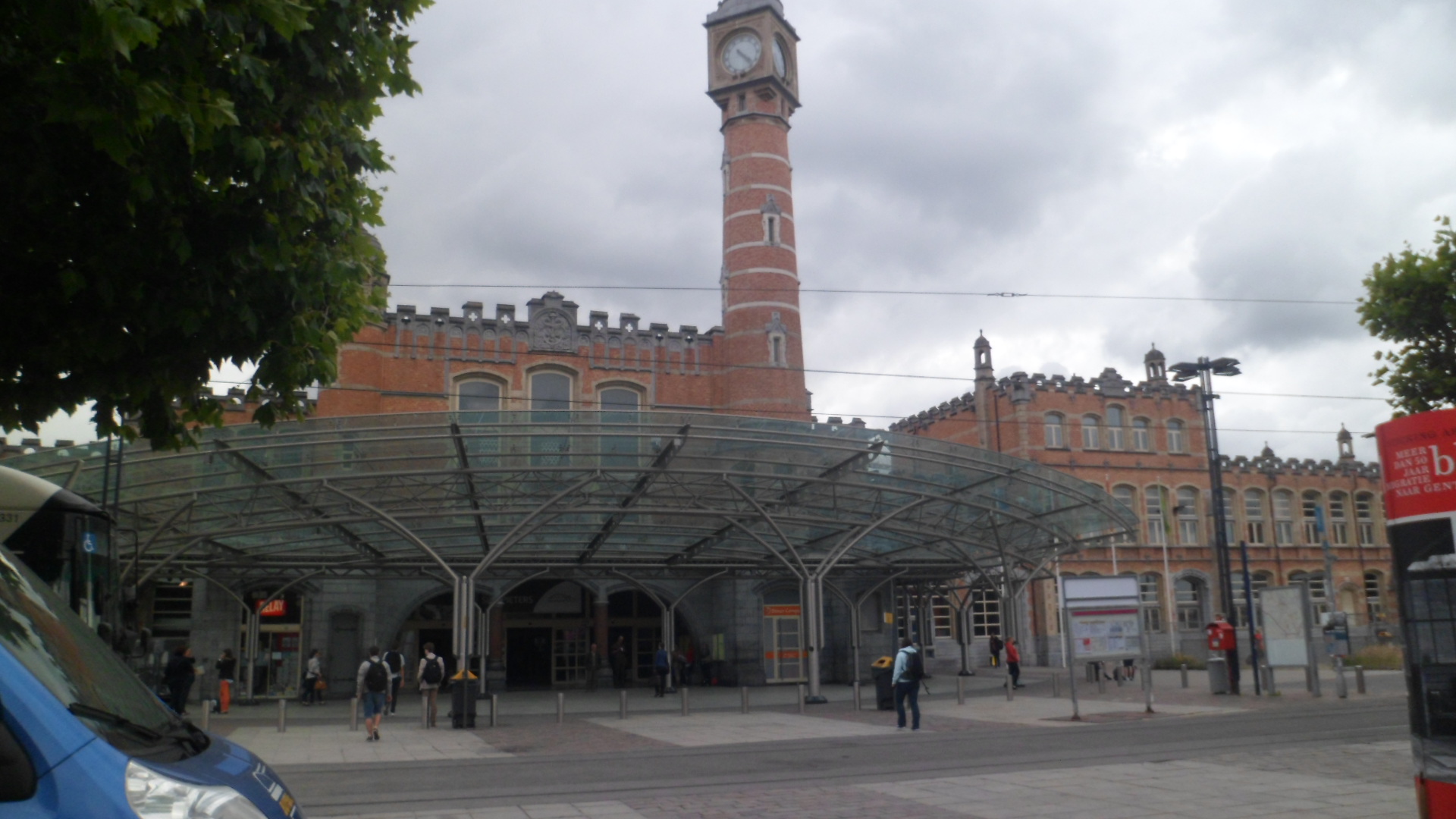
As we were departing, at Ghent Sint-Pieters Station, the conductor proudly told his supervisor that he had managed to roust an interloper from First Class.  The older man just smiled, as if mentally patting his underling on the head, and walked into the station.  I went on to NH Ghent Sint Pieters Hotel, another lovely establishment, with a very helpful staff.  Below is the train station.

SAM_1020

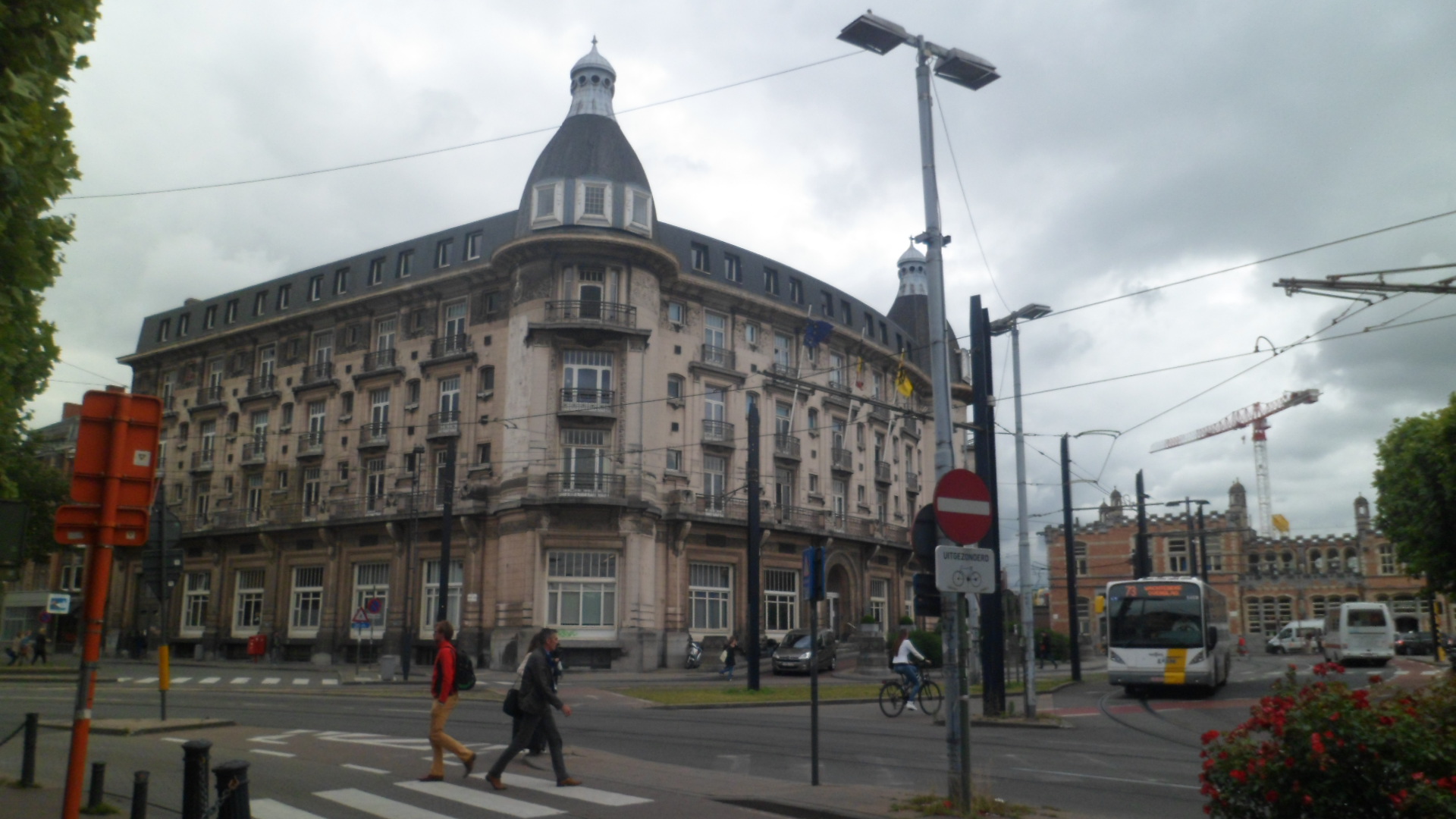
Here are the squares in the area from the train station to the hotel.

SAM_1018

SAM_1021

NH Sint Pieters Hotel is in the middle, above.

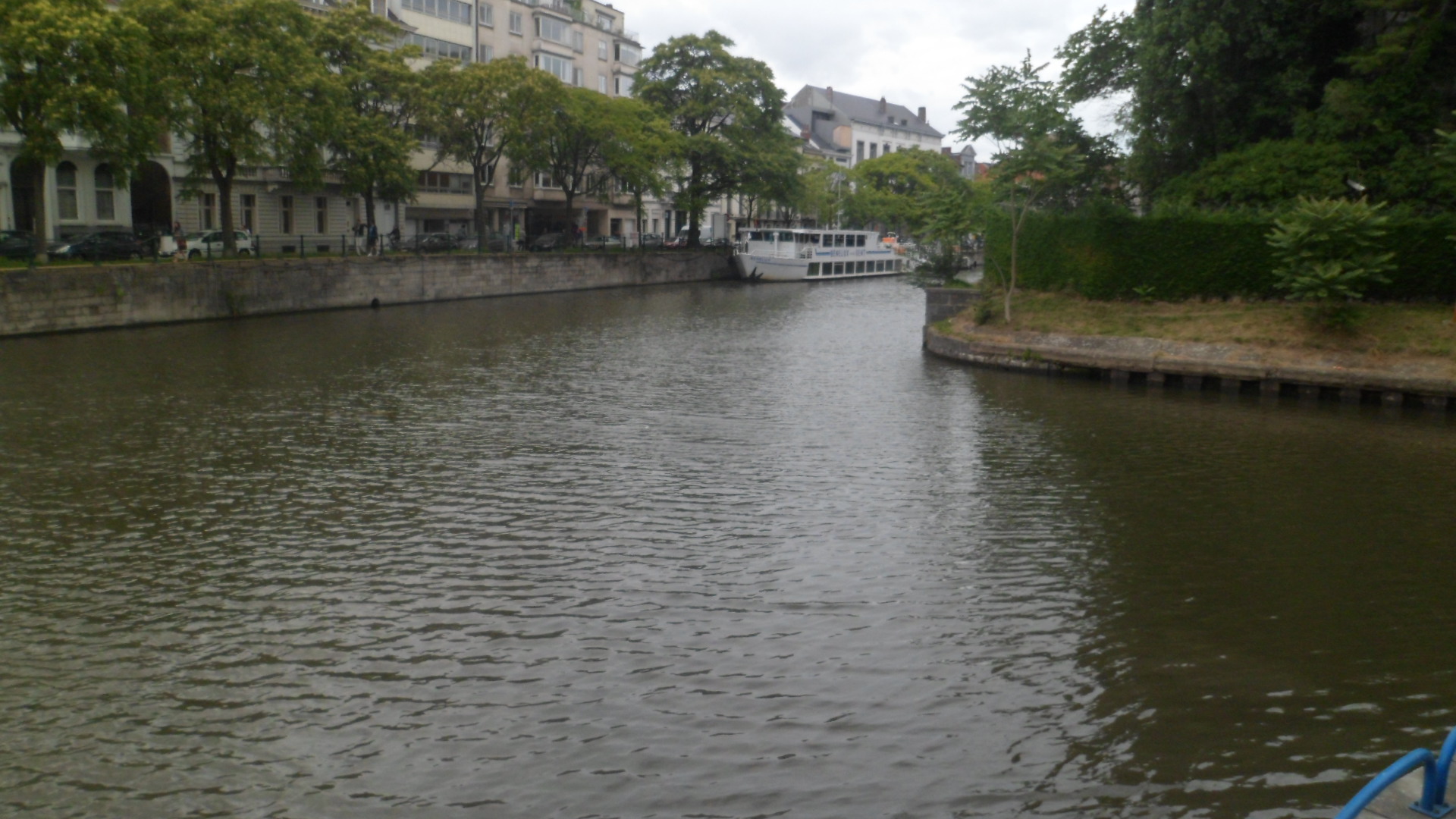
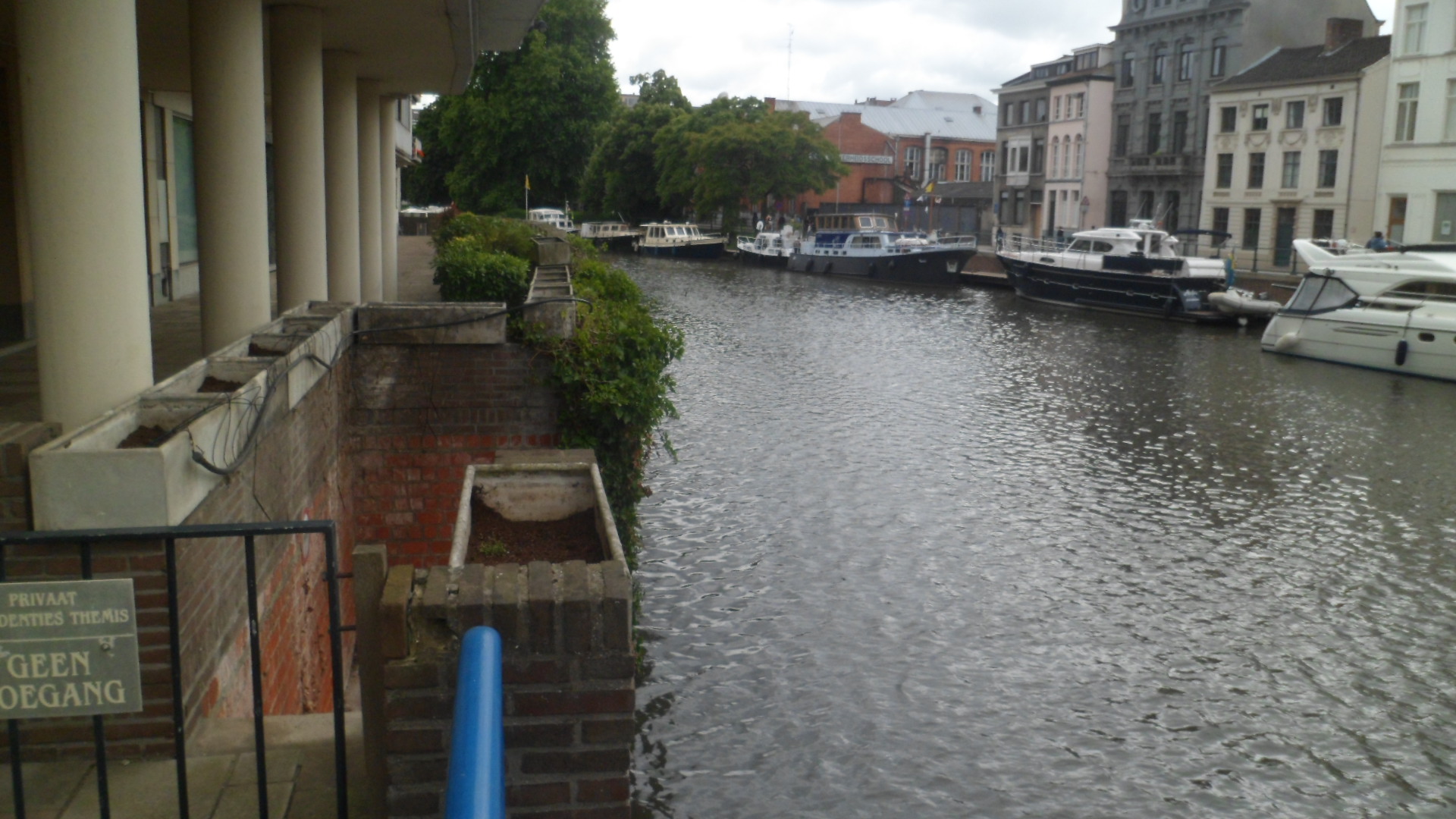
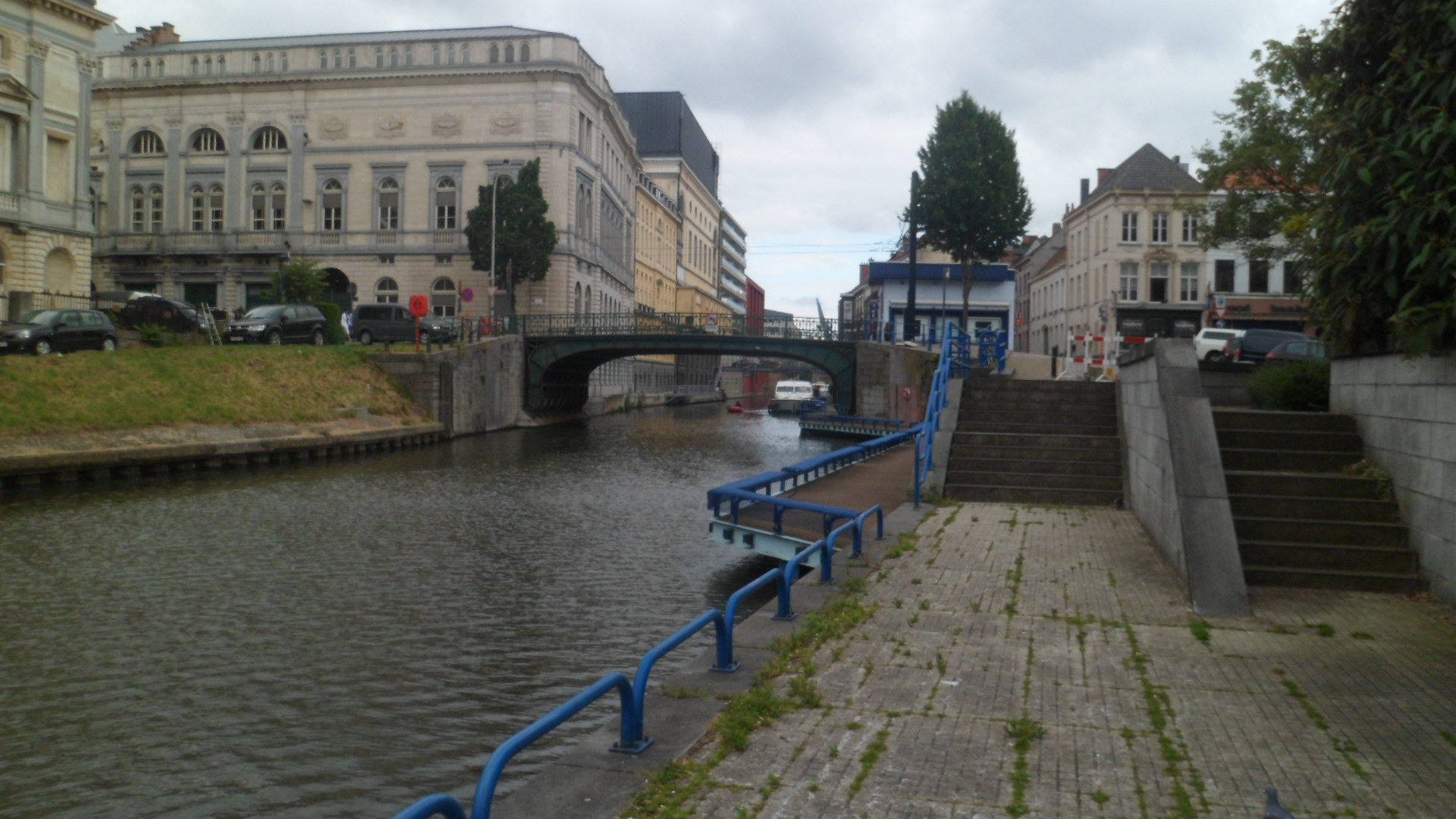
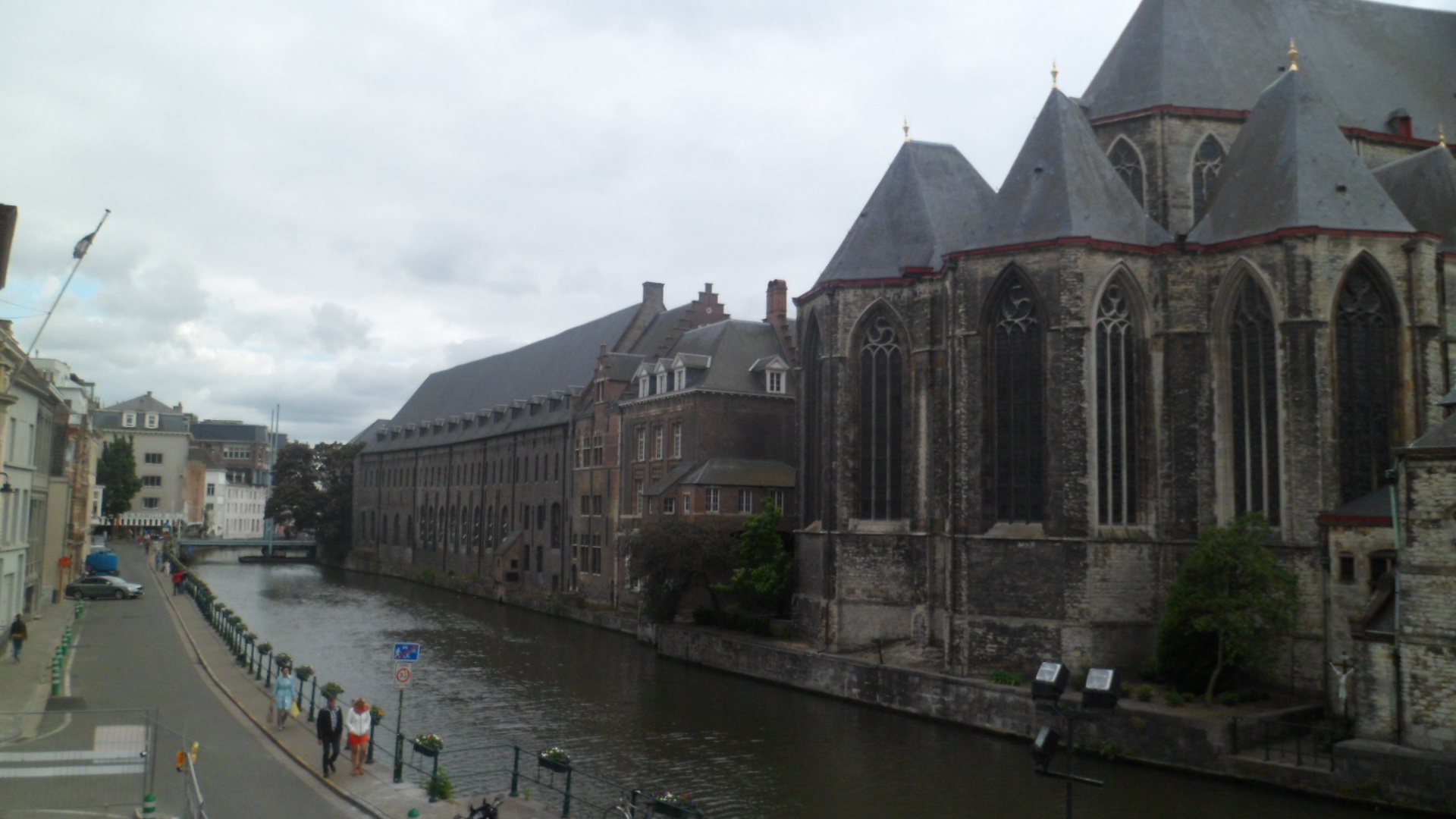
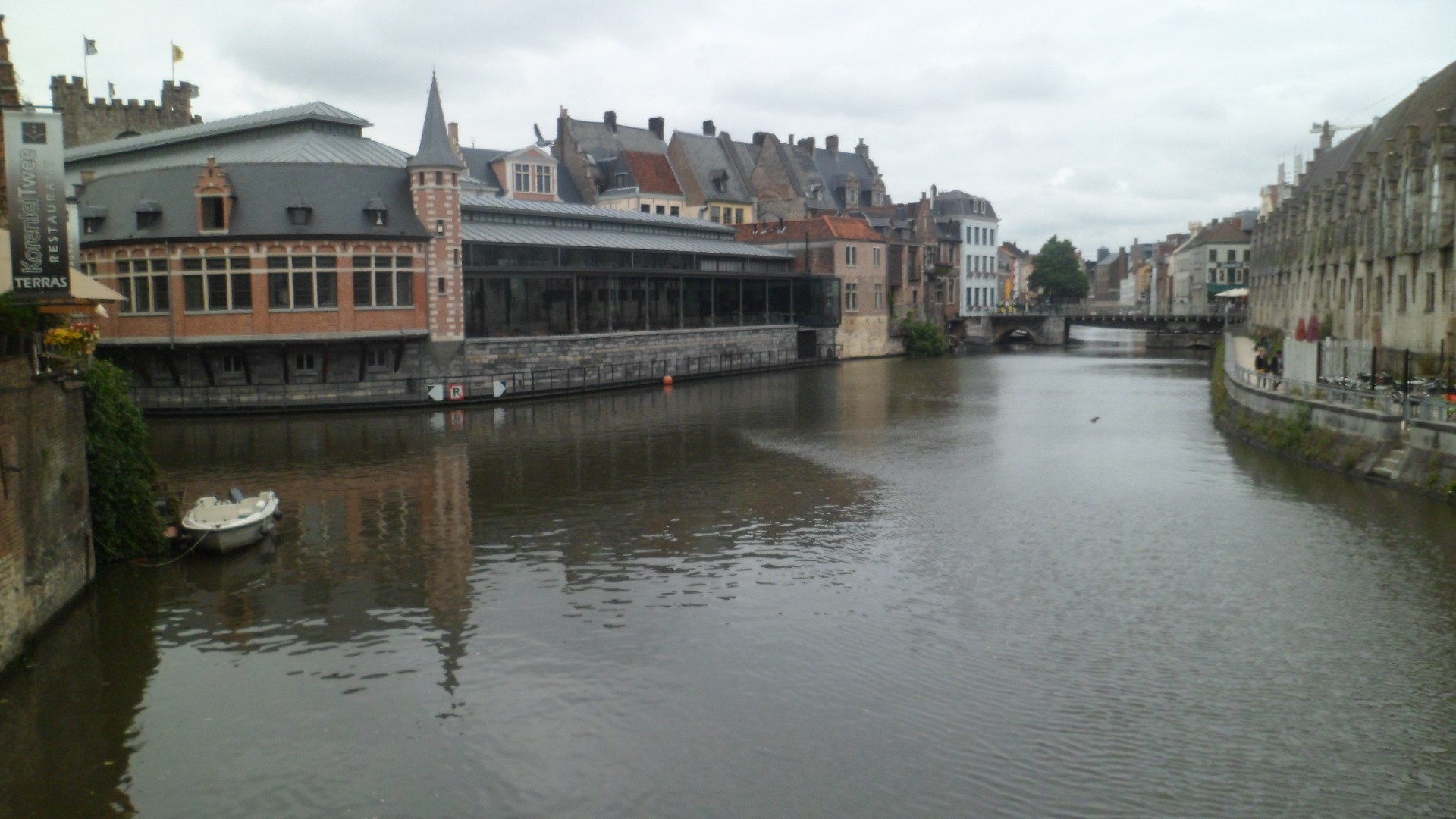
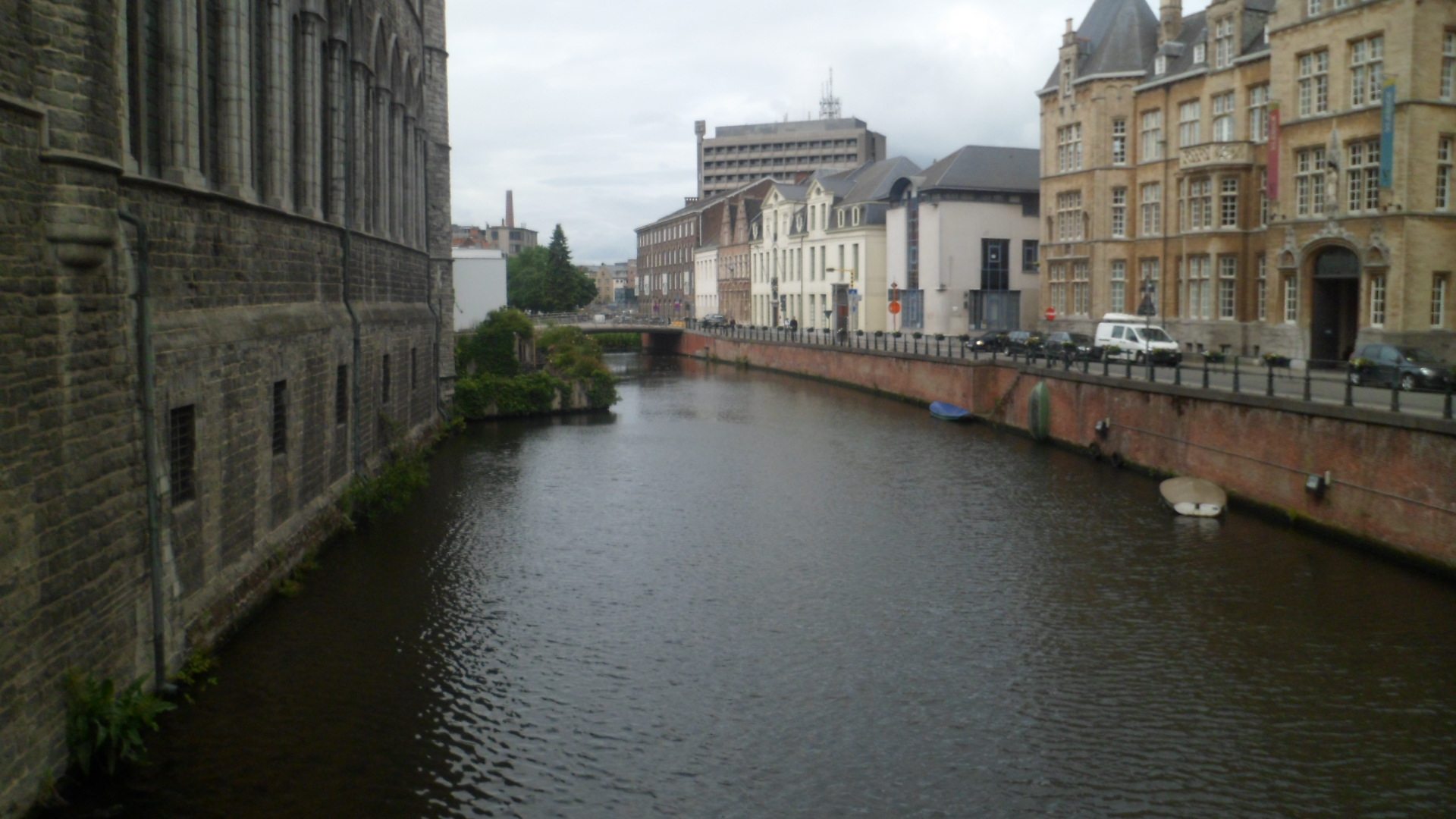
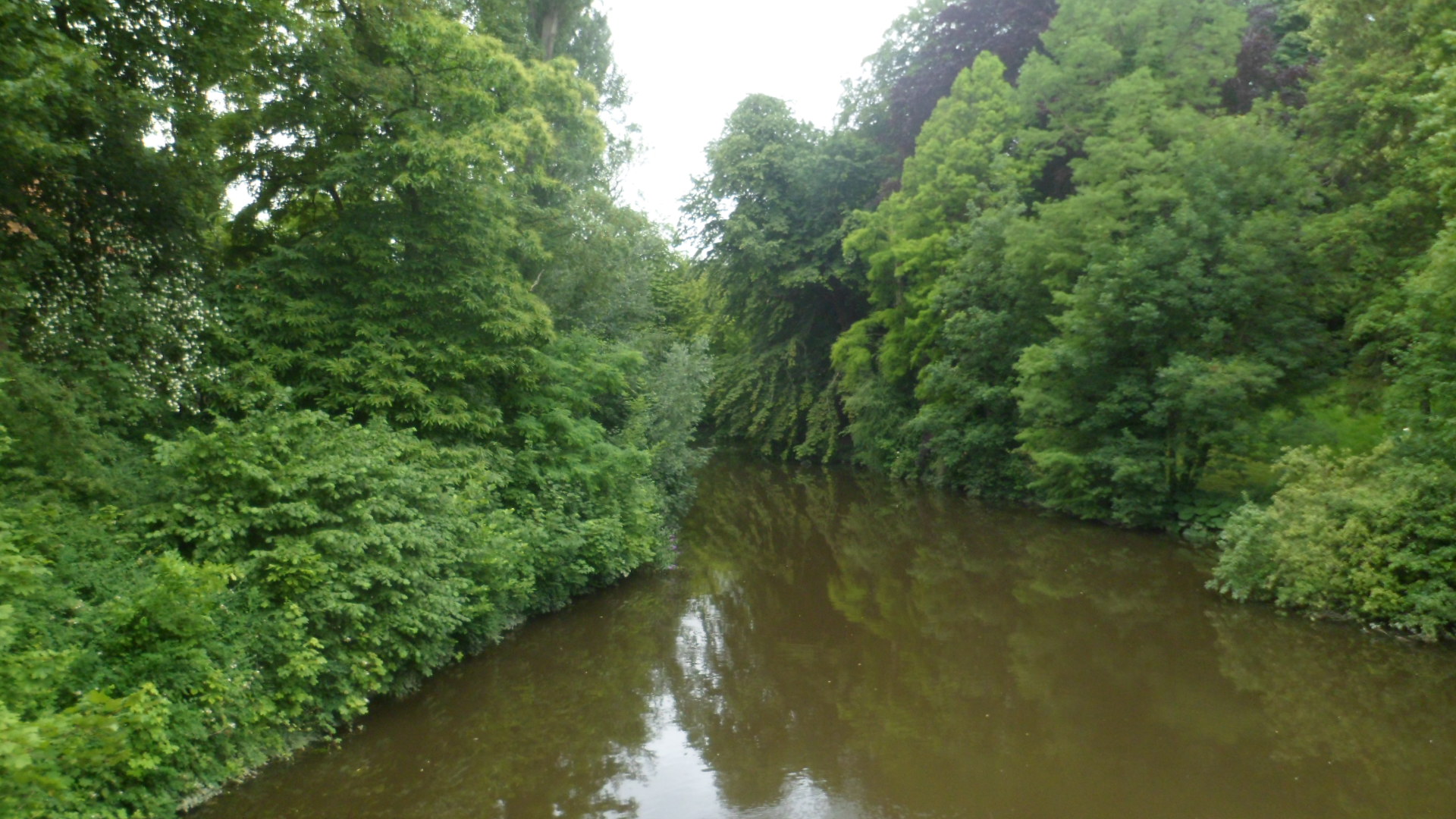
Now, let’s have a look at Ghent’s loveliest feature:  Its canal system.  The canals here are more extensive than those of Brugge, and rival those of Amsterdam, I’m told.  They certainly were serene and impressive.

SAM_1022

SAM_1023

SAM_1024

SAM_1025

SAM_1030

SAM_1026

SAM_1045

SAM_1048

SAM_1054

SAM_1097

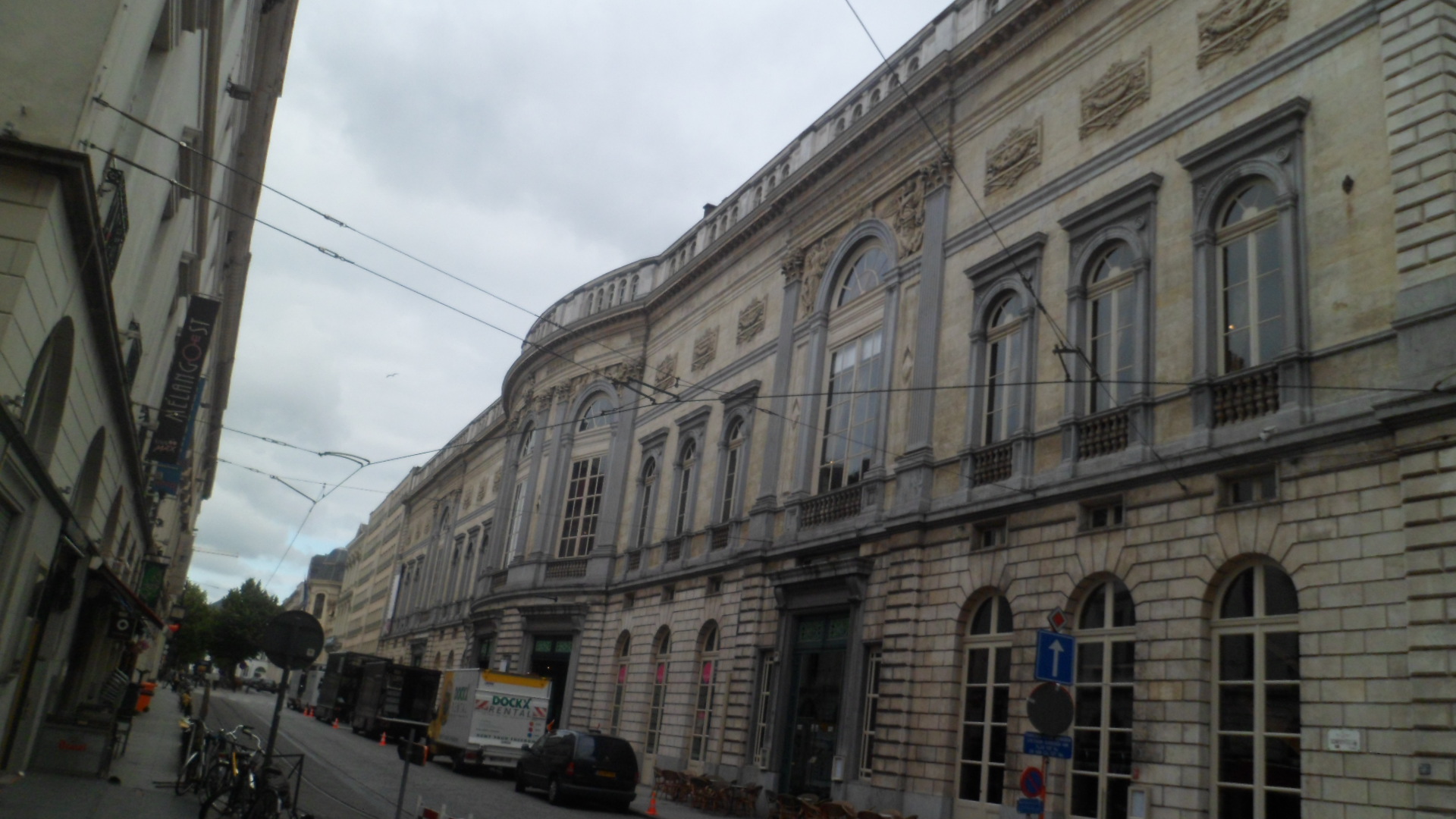
Now that you are waterlogged, a few words about some of the buildings that are near the canals:

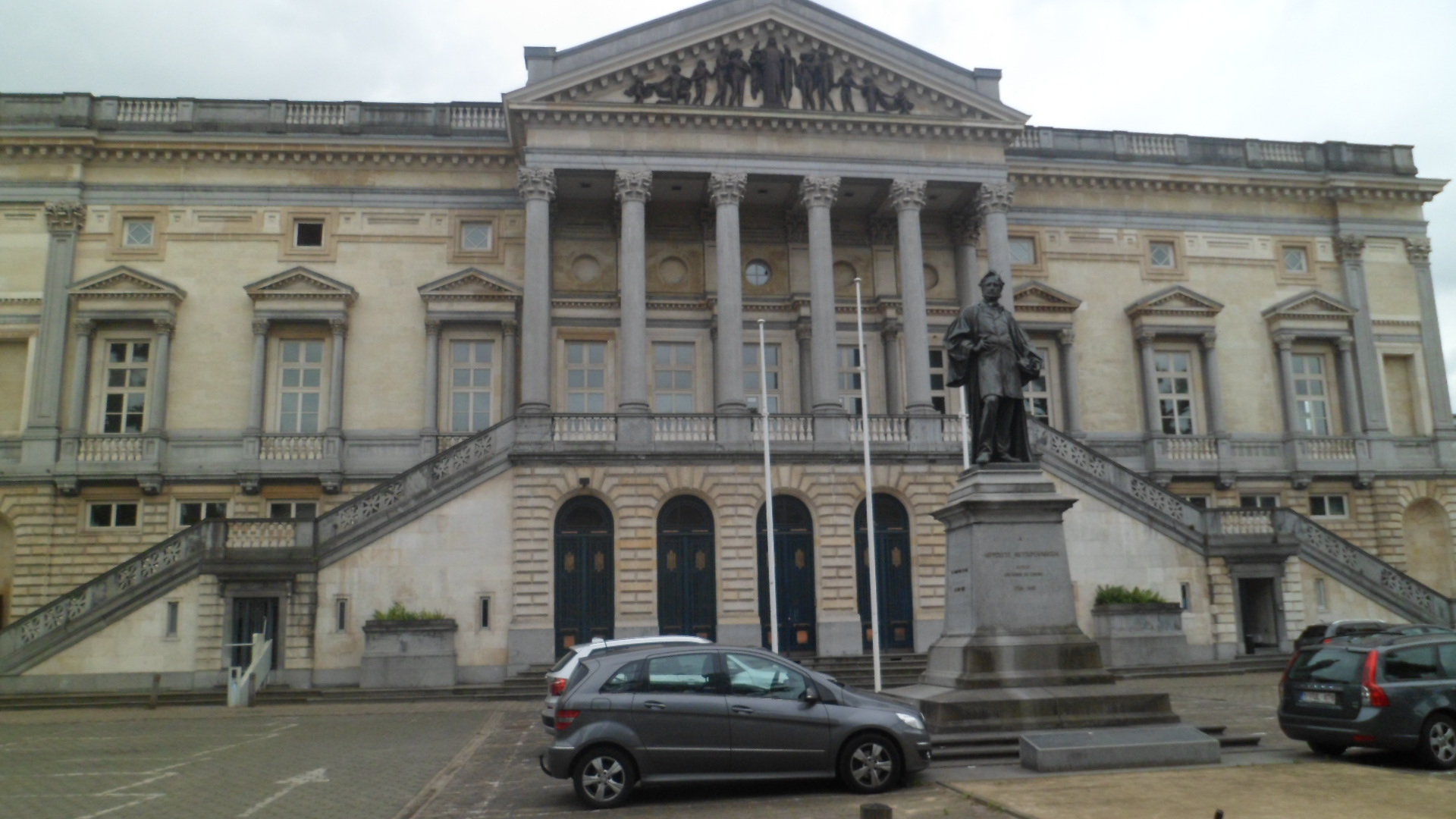
Here is the Hall of Justice (Justitiepaleis).

SAM_1027

SAM_1029

There are several churches, and St. Baaf’s (St. Bavo’s) Cathedral.  The latter was in scaffolding.  Some practices have spread north from France.

SAM_1083

No mind, it is still an impressive structure.SAM_1086

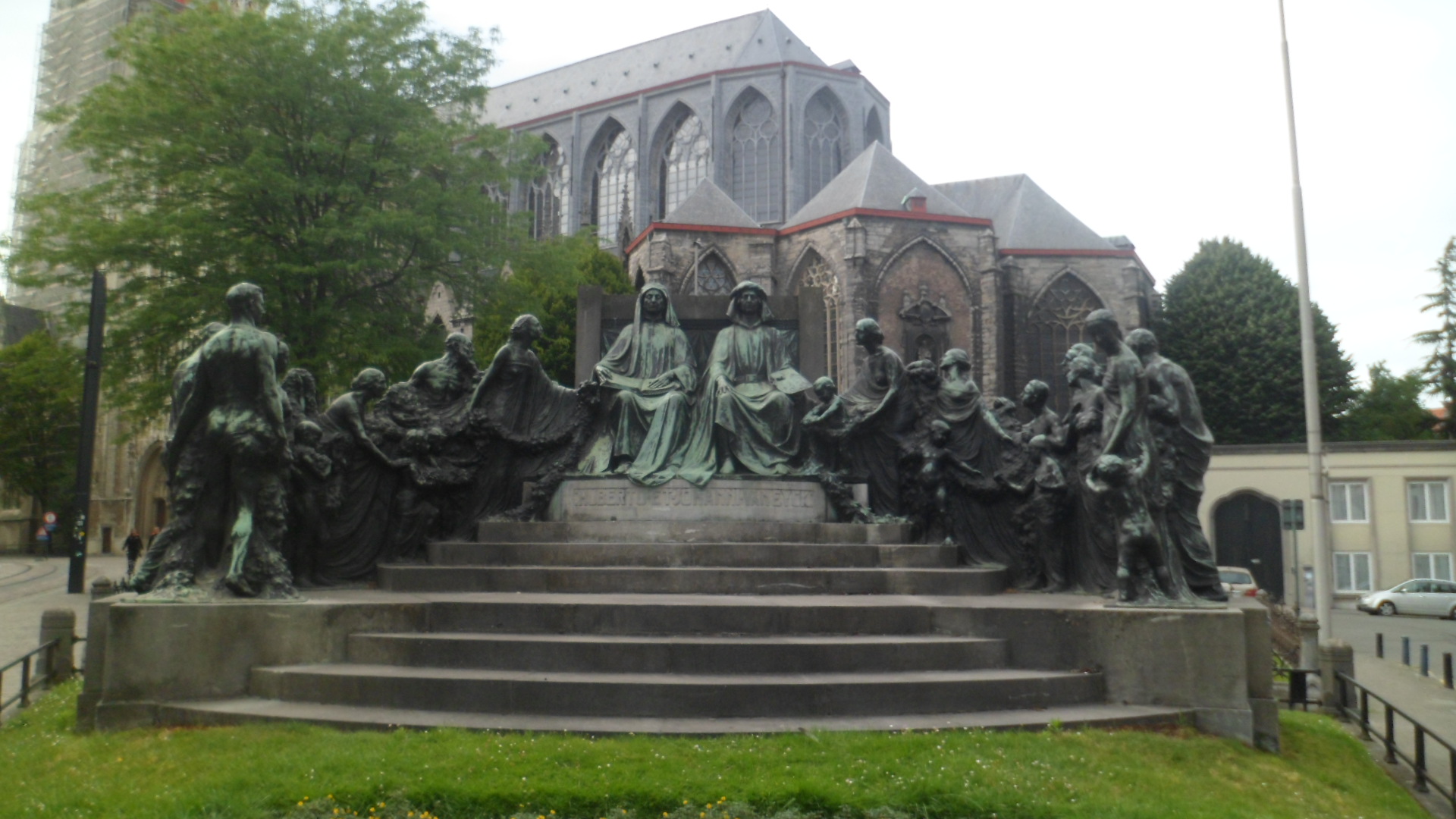
A marvelous sculpted scene by Jan van Eyck greets visitors outside St. Baaf’s.

SAM_1091

Near St. Baaf’s is Kerk Sint Niklaas.

SAM_1089

It is the cathedral, however, which will dominate Ghent’s Centrum, when the renovations are completed.

SAM_1079

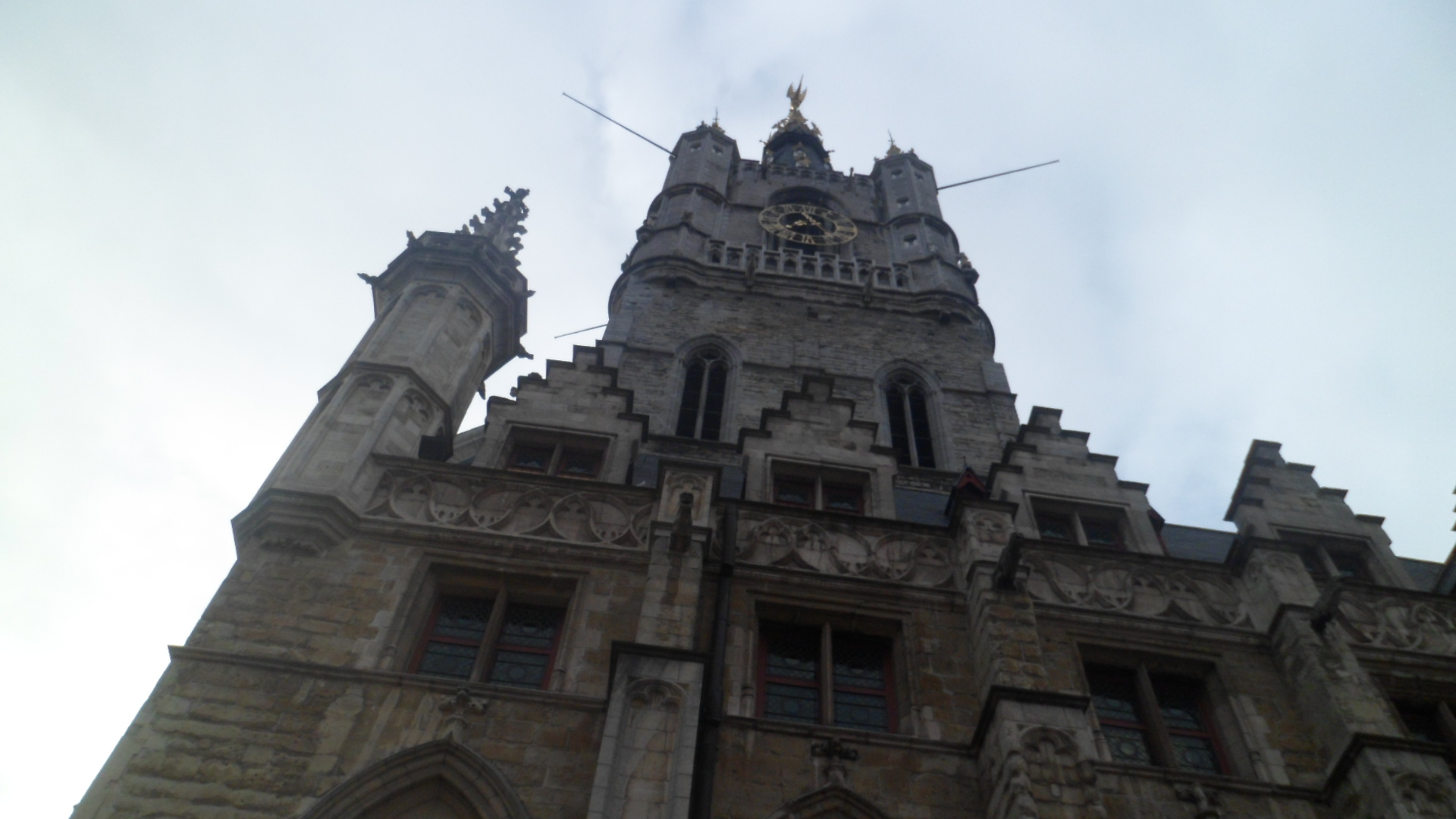
As with all medieval cities, Ghent has an impressive clock tower.SAM_1072

Lastly for the recounting of that enjoyable evening, I leave you with the statue of Lieven Bauwens, the promulgator of mercantilism in East Flanders, of which Ghent is the capital and Antwerp, to the north, is a major port.

SAM_1098

Lots of money was made by the burghers of Flanders, including the Counts of Ostflanders, whose castle, Gravensteen, I will showcase in the next post.

An Eastward Homage, Day 21: Brugge, Part II- The Centrum

2

June 16, 2014-  As spread out as the green space and quiet neighbourhoods of Brugge are- its city centre, Centrum,is dense and compact.  I had lunch in a small cafe, featuring American-style fare.  Thus, in the midst of a medieval burgh, I sat and enjoyed a Philly Cheese Steak.  Hey, at least the fries came with mayonnaise- a true Low Countries tradition.

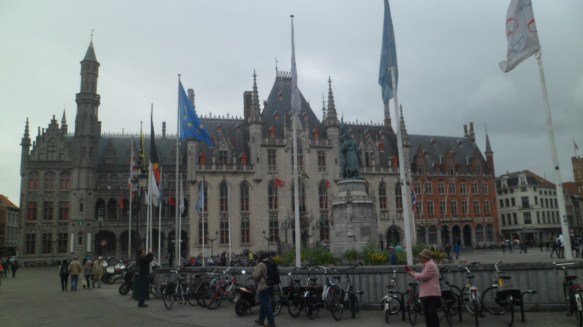
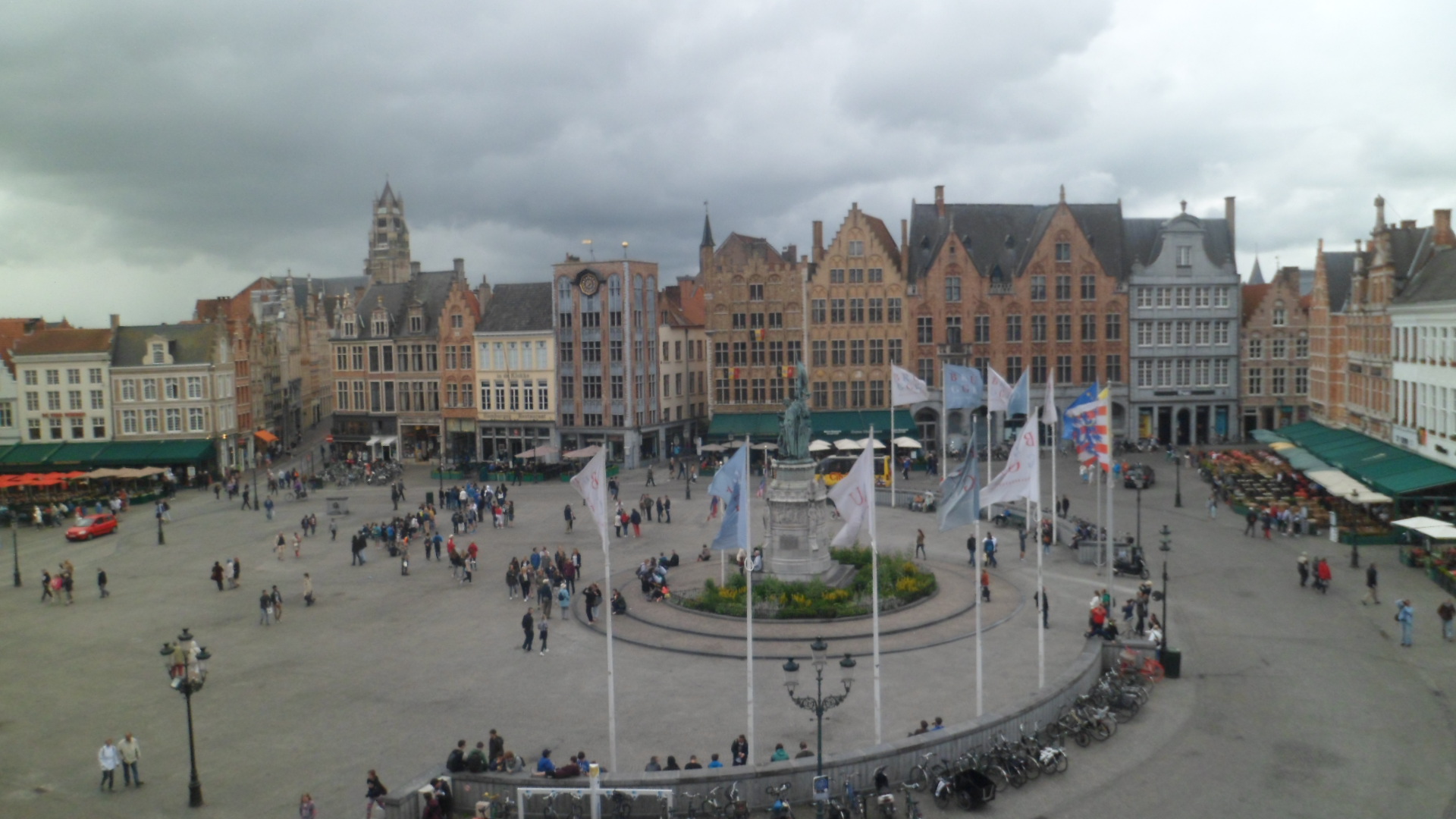
Each city-state in the Flanders, and Holland, of the 12th-15th centuries was a self-contained unit.  Some, like Brugge and Ghent, would freely associate on some matters, but were just as likely to squabble.  This was the lot of most of Europe, at that time, with only a few nations, like France, England and Denmark making an actual go of cohesiveness.  Those nations, though, were constantly at war with one another.  The city-states had one mission:  Make a bundle, and fast.  So, Stadt Huisen (State Houses) sprang up, wherein the Counts and Dukes who ruled the city states, and the burghers who cashed in on the products coming through the city, could conduct their business.  Below, we see the Stadthuis of Brugge.

SAM_0979

SAM_0980

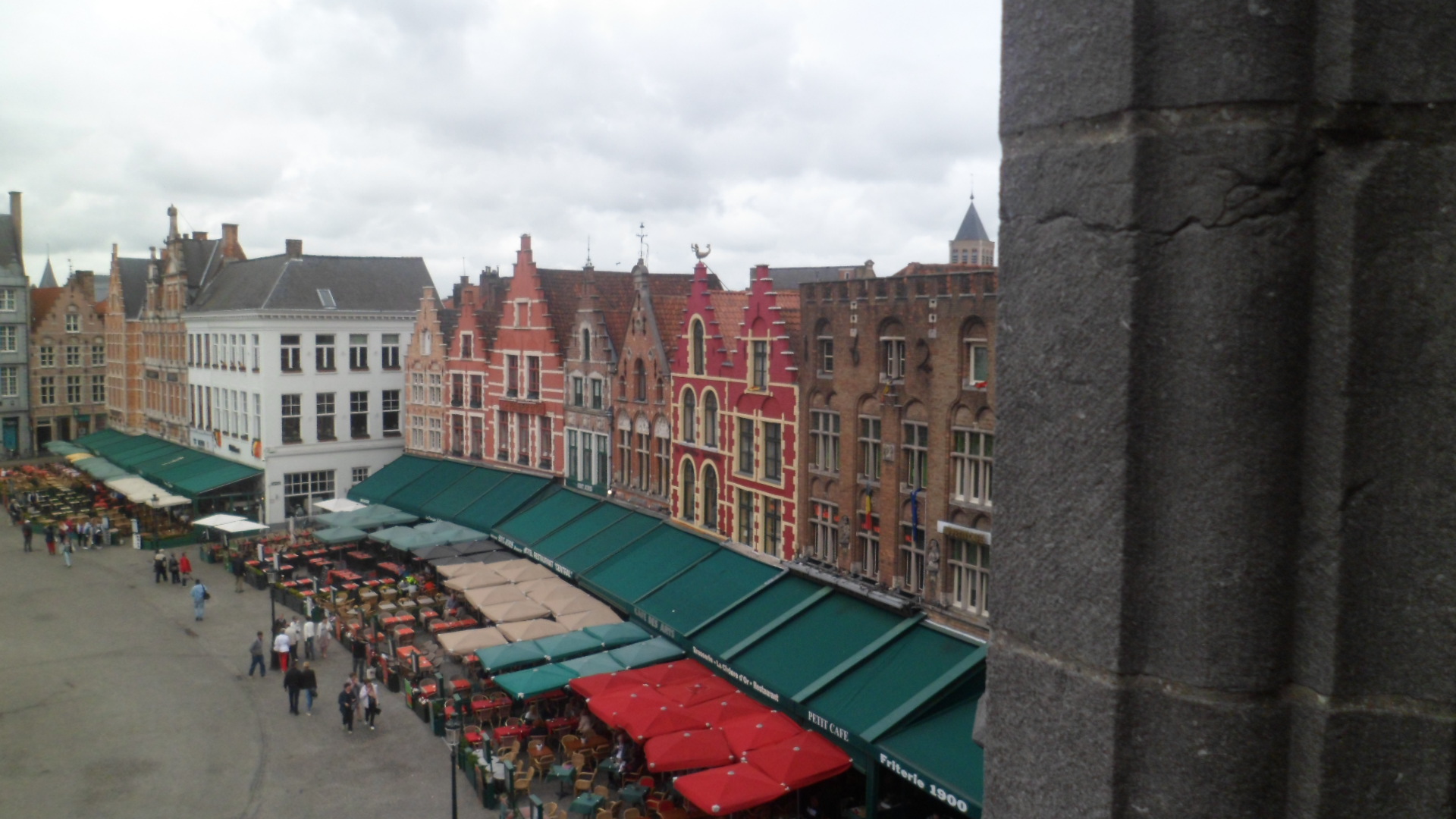
Draft horses pull cartloads of visitors through the Centrum, now as in the Middle Ages.SAM_0981

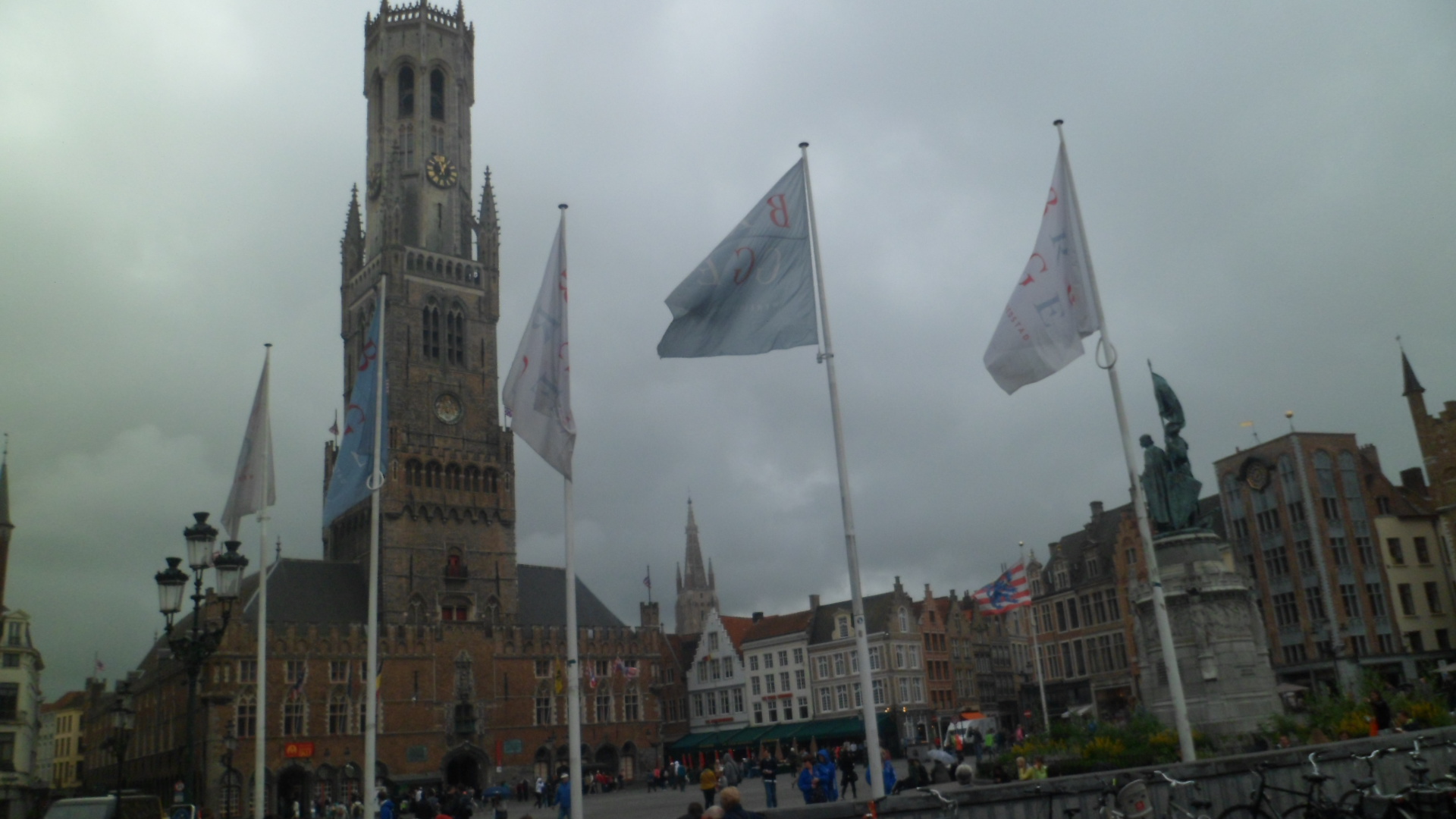
Brugge’s Belfort is now the city’s Historical Museum.  In the city-state’s heyday, it was a belfry and a fort.SAM_0982

SAM_1001

SAM_1006

Next to Belfort is the Bourse.

SAM_0997

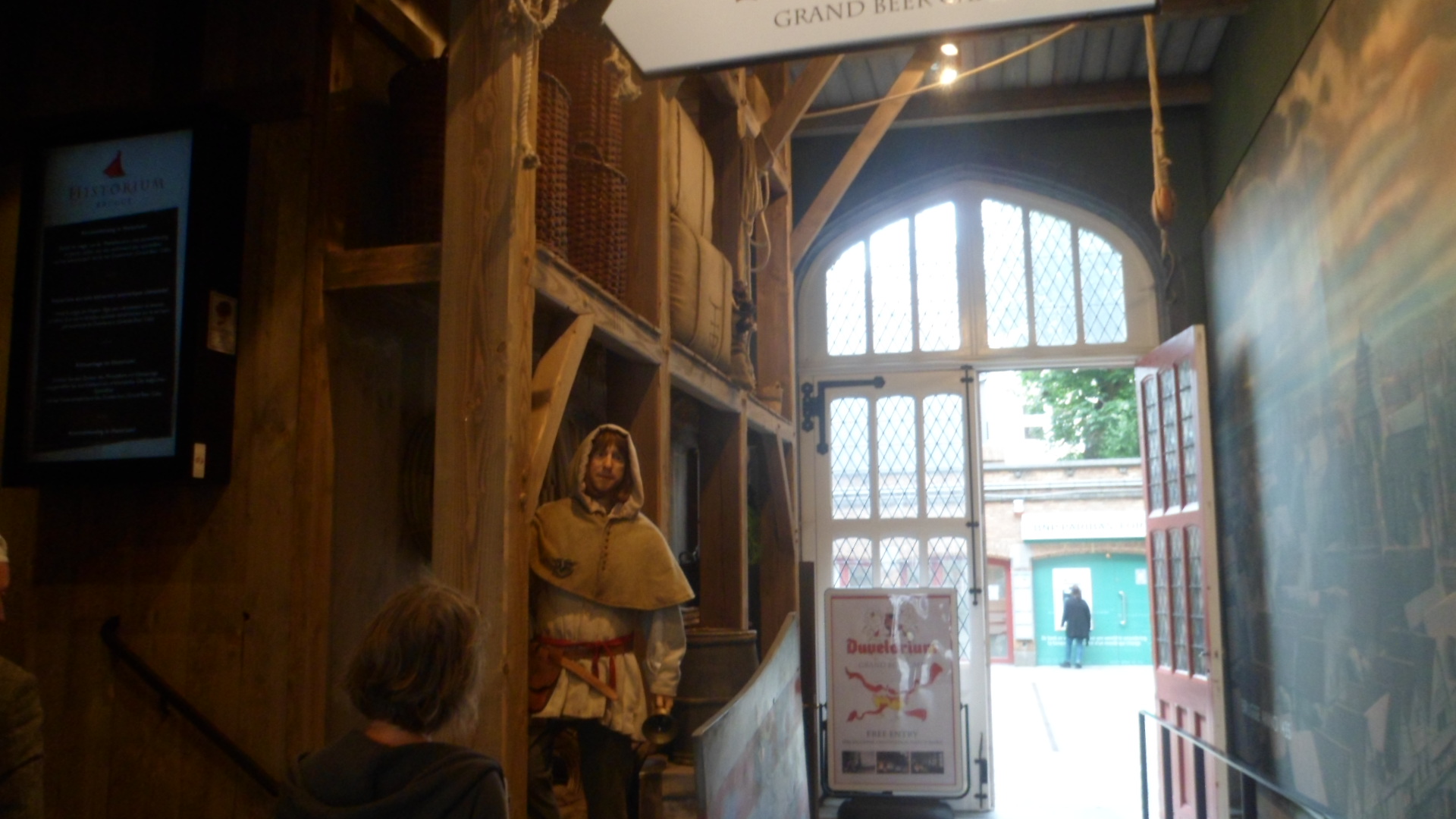
Next to the Bourse, on the other side, is Historium, a multimedia presentation on medieval life in Brugge, using the process pursued by Jan van Eyck to complete a painting, as an example of a transaction.  Art in Europe, as many are aware, was a matter of great financial import.  Artists survived only through the largesse of wealthy patrons.  They hired several young men to act as couriers and procurers of supplies.  Thus, Van Eyck hired “Jacob”, whose hapless search for a certain green parrot, and a girl named “Anna”, to serve as a model for the Madonna in Van Eyck’s painting, plays out over several minutes.  Thugs try to steal Van Eyck’s supplies, Jacob is threatened with dismissal, and the streets of Brugge are full of drama.  I will let you guess how all turned out, but here are some photos of Historium.

First, we meet “Jacob’.

SAM_0984

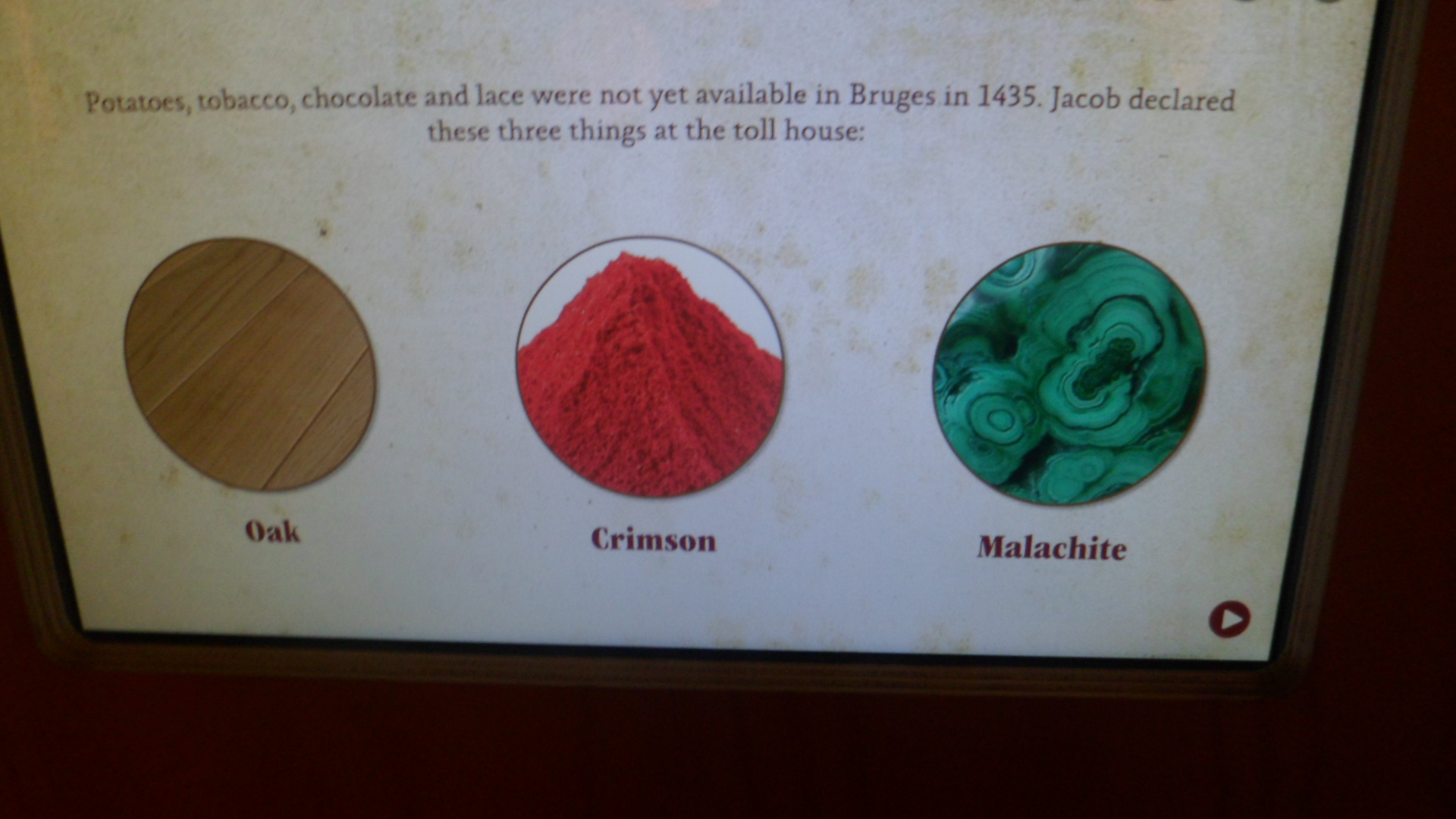
He shows us the items he had to procure, besides the parrot and Anna.

SAM_0987

We get parrot’s eye views of the Centrum.SAM_0988

SAM_0989

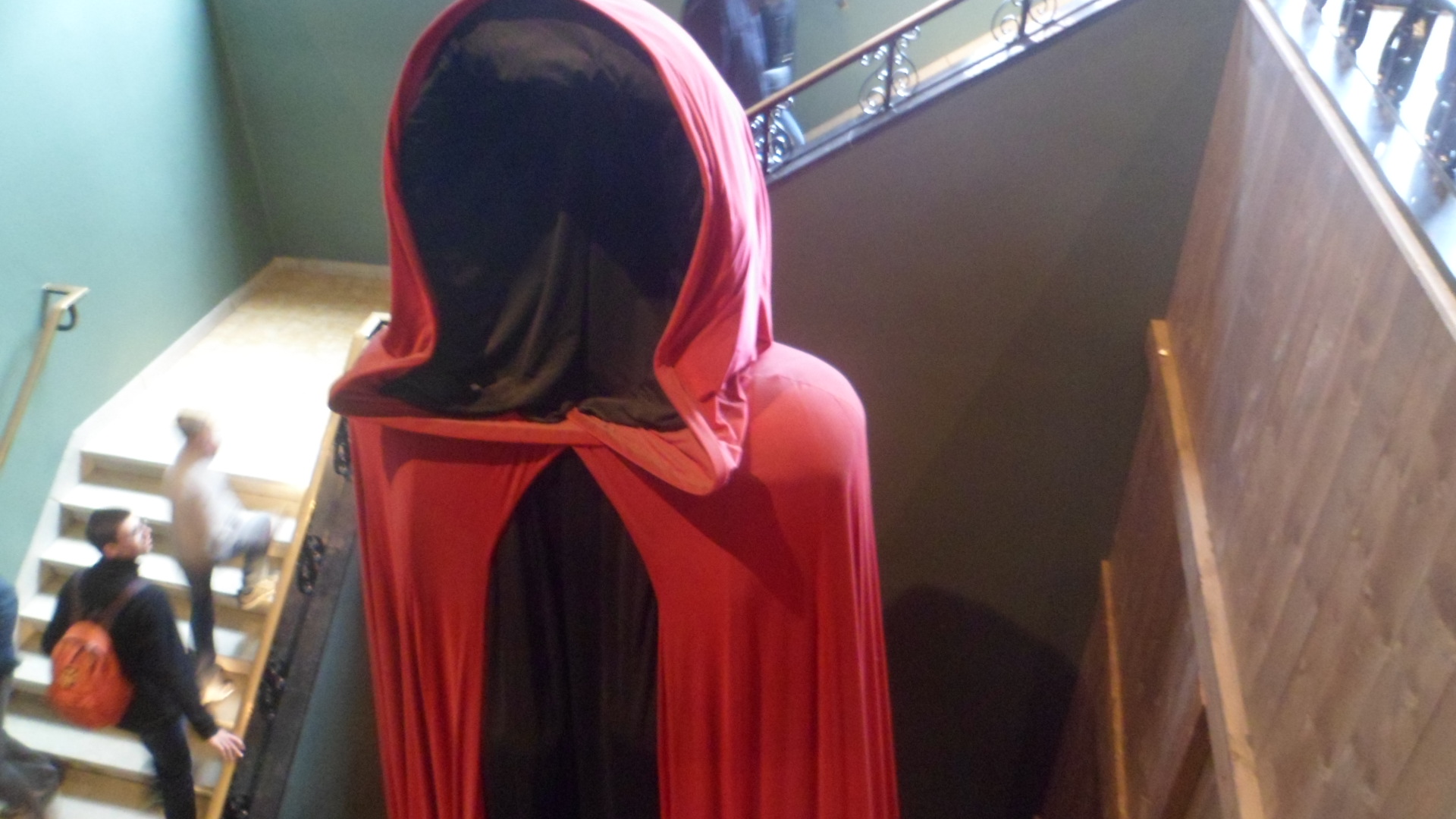
Here is Anna’s cape.

SAM_0994

As luck would have it, Van Eyck stages a painting party.

SAM_0993

It appears the patron is pleased.

Some of my fellow travelers that day were definitely pleased.  A class of high school students put on a delightful, impromptu dance, in the Centrum.  Youth were a recurring source of joy, wherever they turned up during my journey.

SAM_1009

I was getting close to departing for Ghent, but got a couple of last-minute shots.  Here is the Duke’s Palace.

SAM_1011

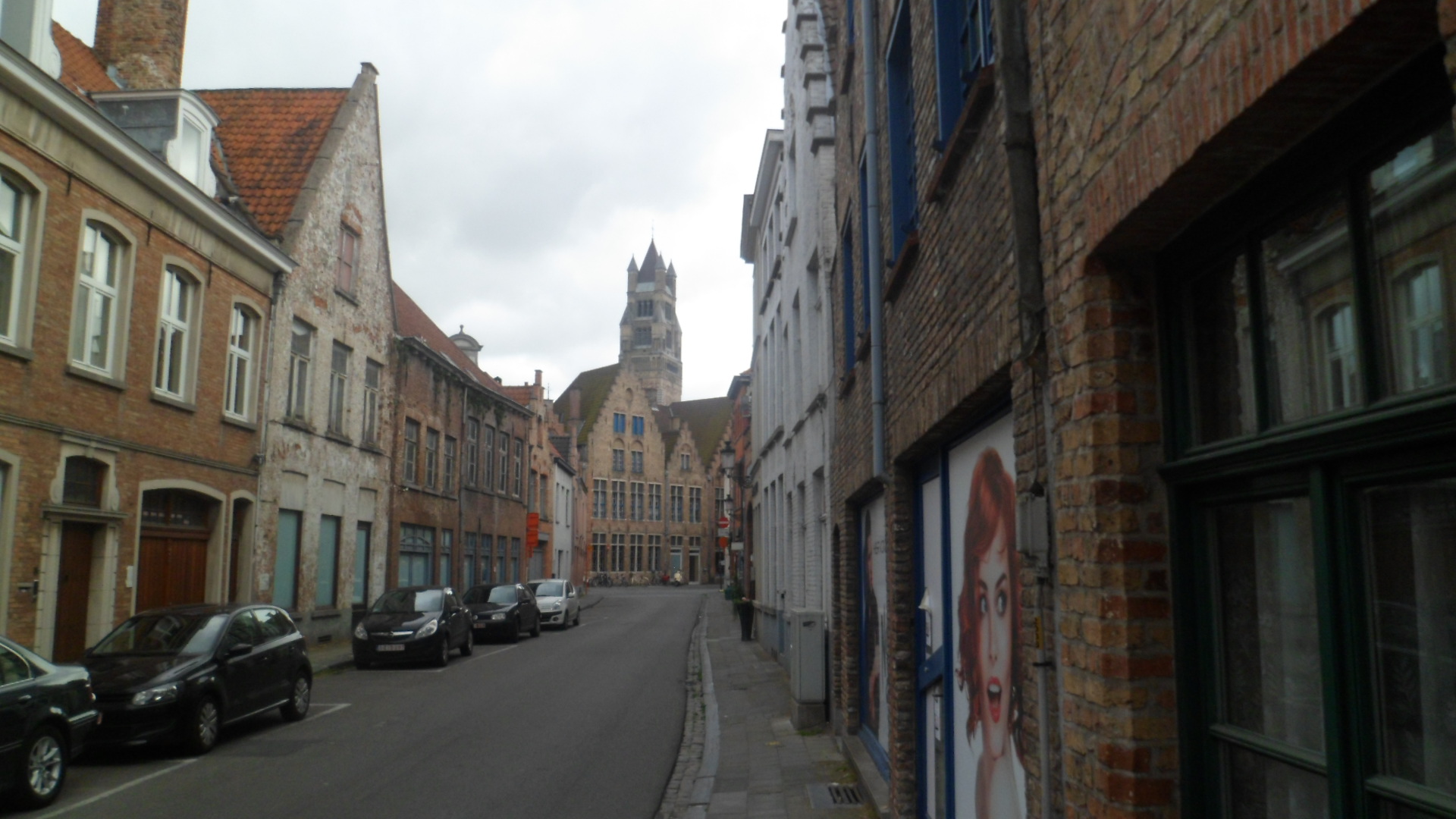
Lastly, I got a view of Sint-Salvatorskathedral.  This would bring me back to Brugge, another year.

SAM_1012

My all-too-brief visit here left me with a good appreciation of why the Flemish are loath to go it alone as mini-country.  These hard-working people have seen, first-hand, the drawbacks of the city-state and the small duchy.  Belgium, the nation, seems a much better proposition.  I left Brugge genuinely liking the Flemish, a feeling that would only be augmented by my time in Ghent.

Shattered Mirth

4

NOTE:  I will continue with my posts on Europe, later this evening.  In light of today’s tragic loss, however, these words need to be said.

When I was ten years old, I asked a neighbour if I could borrow her copy of “Look Magazine”.  It had a feature on Red Skelton, then a very popular television comedian.  Mr. Skelton had a host of personas, which he trotted out, week by week, to help others feel happier.  I liked many of them, and often sat up past nine, to catch his latest performances.

The article dealt with his struggles-alcoholism and depression.  It worried the heck out of me, and was a bit confusing to my ten-year-old mind.  How could a man who was so excellent at entertaining others be so downtrodden, in his own life? My Dad’s answer was very clear:  “This is Red’s job.  Actors often have a hard time, when they go home and have to deal with the same messes and dilemmas we each have to face.”  I lit  a candle for Red Skelton, the next time I went to church.  He lived a fair number of years afterward, so maybe the outpouring of well wishes from many of us, after that article, had a positive effect.

Humour and sadness; light and shadow; front and back- the traditional theatrical memes of European theater show a laughing face and a sorrowful face.  We each get to go through plenty of both.  For most of us, though, there is a lifeline:  Faith; friendships; life partners.  Those who, as the departed Robin Williams expressed it “Have people who make you feel alone”, are so often at far more risk than the busy beavers who surround them seem to realize.

So, we are left to pick up the pieces of our shattered mirth.  Mr. Williams’ wife, daughter and extended family will, one would hope, have time to grieve, to process and to know that, underneath all the pain, which itself was buried under the humour, there was the most intense love for humanity- ever struggling to get out and to find its way to the surface.

In his work, I saw that of Robin Williams, in his “Patch Adams”, “Good Will Hunting”,  “Mrs. Doubtfire”, “Dead Poets Society”- even in his minor works, like “Hook” and “One Hour Photo”.  Love for mankind, however quirkily or obliquely presented, was the man’s cornerstone.  This is what one ought recall and remember.

For us who have another day, another year, another fighting chance- perhaps, just perhaps, there will be an outstretched hand to someone who is known to be struggling, someone who feels alone in the crowd.  Maybe then, the tears shed by many of us this day will meet with fertile ground.  Rest in Peace, Robin.  You were a better friend to many of us than most realized, before today.
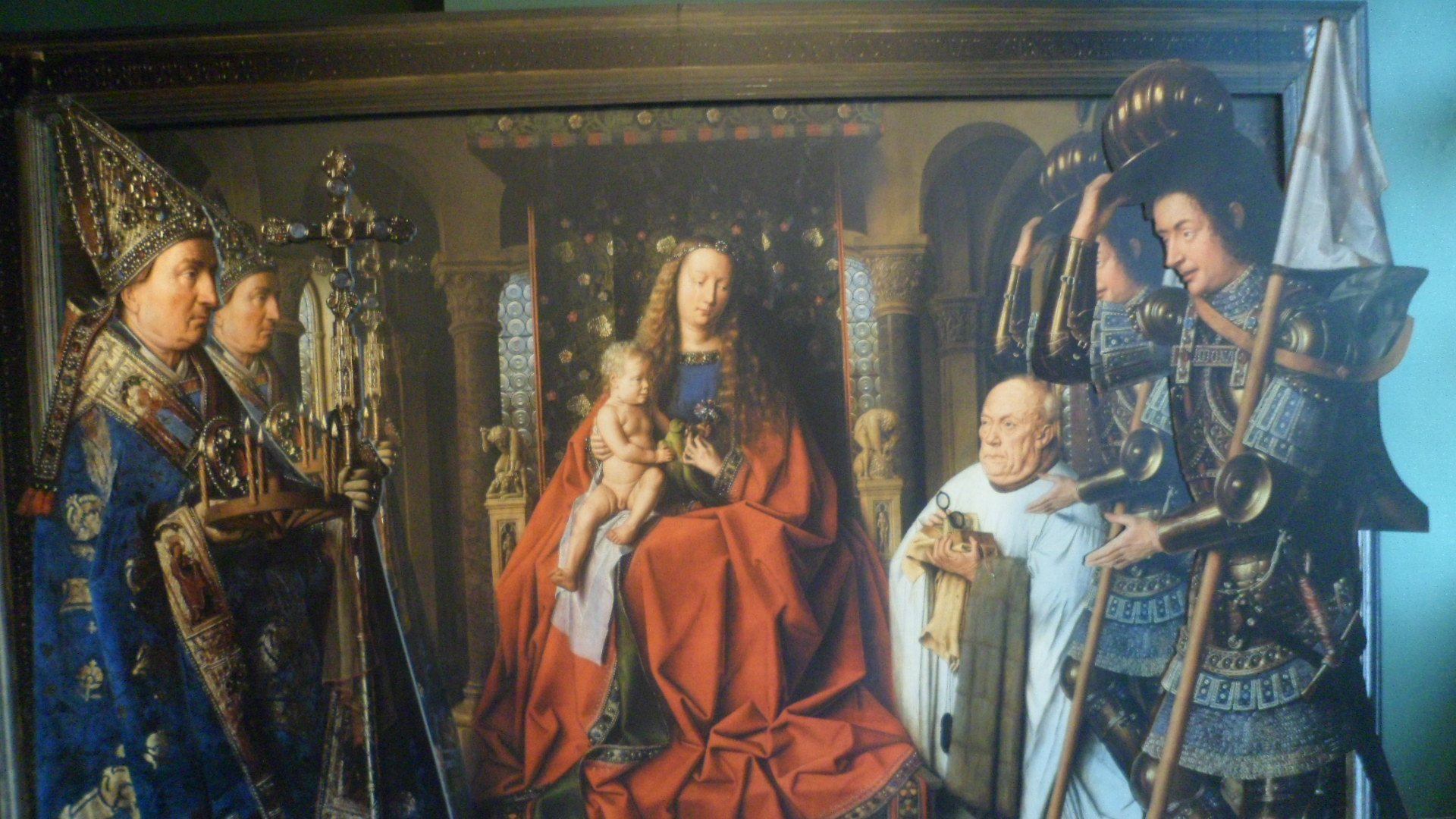
An Eastward Homage, Day 21, Part I: Brugge’s Gateway and Spiritual Heart

6

June 16, 2014- The magic Monday dawned, cloudy and cool.  I left Lille, with the knowledge that THIS time, I would not need to go back to Paris, in order to catch the train to my next destination.  I boarded the train around 10:30, and headed unceremoniously across the Belgian border, at Tourncoing/Mouscron (Moeskron).  For the next three days, all signs would be in French and in Flemish (Dutch).  Today, I would visit two siblings, and rivals:  Brugge (Brooj, or Bruhh; your choice, but the majority Flemish like the second, more guttural sound) and Ghent.

Belgium does not, however come across as schizoid as some have had it look.  The French and Flemish make an effort to get along, at least in public.  The best thing I saw to do as a visitor was to listen carefully to the Flemish, make an effort to use some words in their language, and let our mutual English do the rest.  Since I was already doing this among the French-speakers, it was more of the same.

I found Brugge cool, temperature-wise, but quite cordial in terms of greeting.  I was able to easily place my bags in a storage locker, and devote several hours to this seedbed of capitalism. Here is the main train station.

SAM_0912

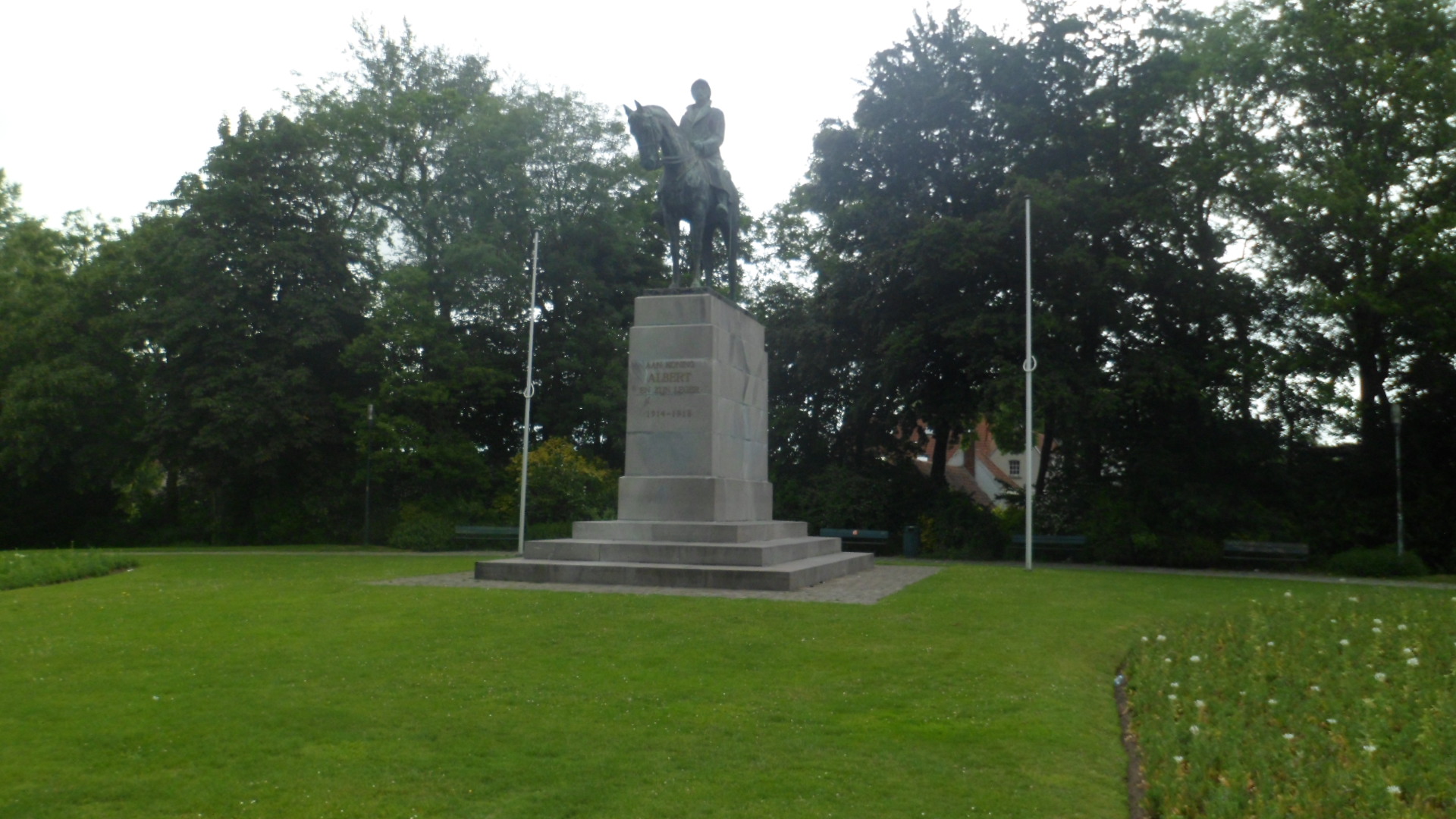
I crossed the Stationplatz, and found Kong Albert Park waiting to greet everyone with a pleasant green space.  Greenery did not matter so much to the early masters of commerce, but it matters now, to their descendants.

SAM_0913

The streets in this UNESCO World Heritage Site are narrow, but workable, and a system of canals goes everywhere.
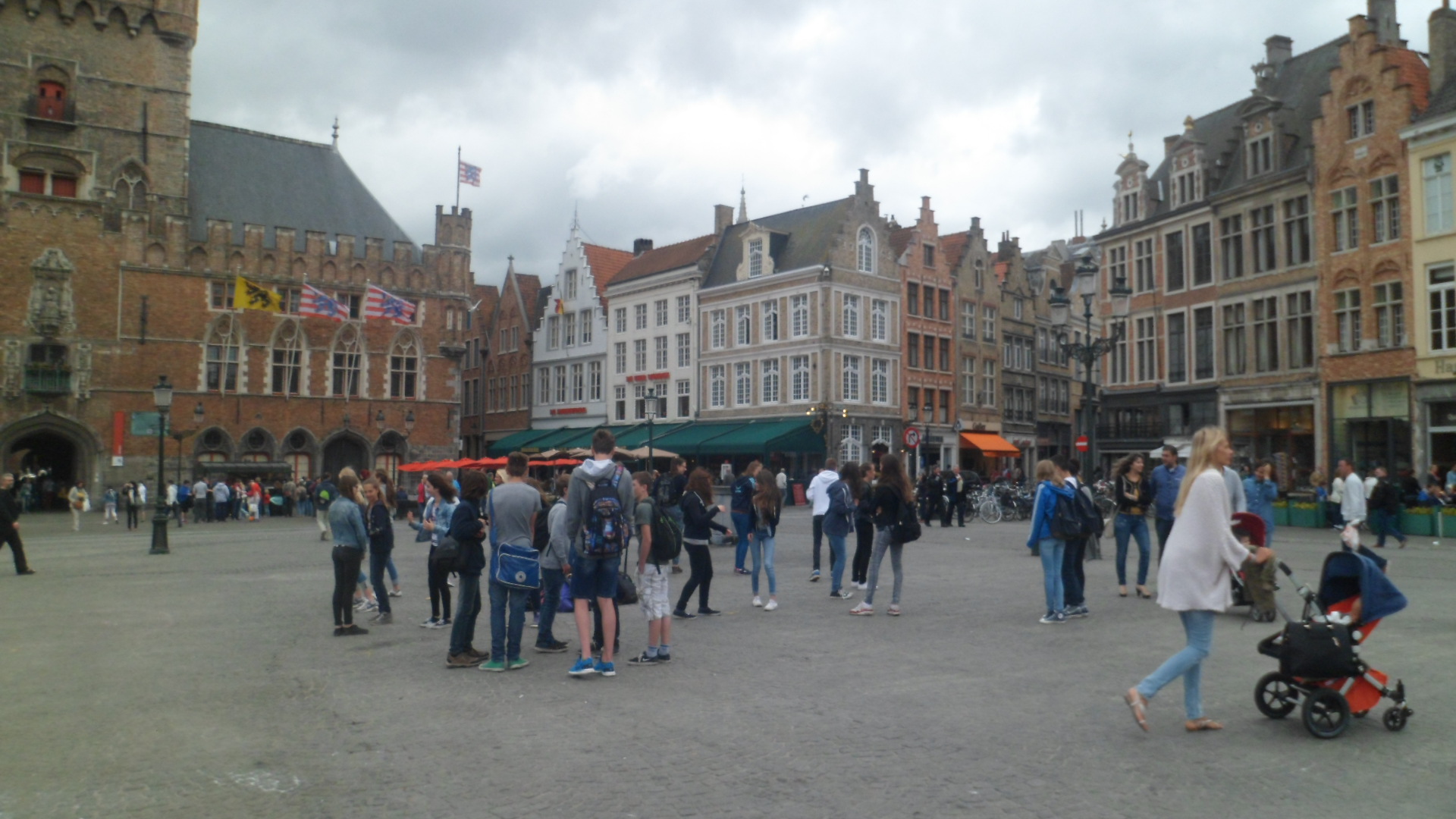
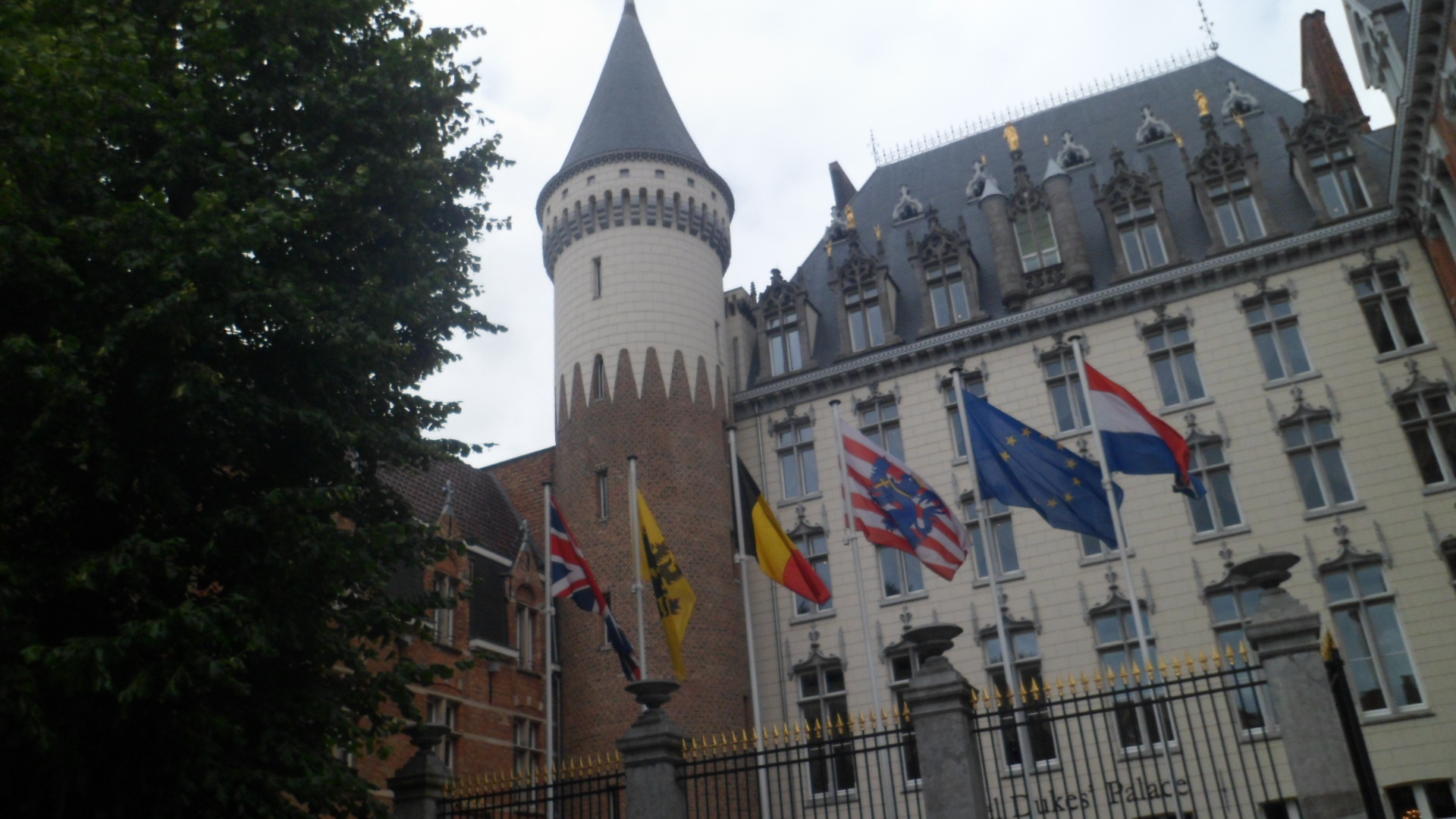
SAM_0916

SAM_0921

SAM_0925

Smedenpoort is one of the gates that kept Old Bruges on guard, at all times, as the city state grew.

SAM_0926

Hanssenspark, a greenspace on the east side of town, lends an air of solace to Brugge, even as the city shows some modern honours to those who fought in the World Wars, for which Belgium suffered greatly.

SAM_0927

SAM_0932

SAM_0920

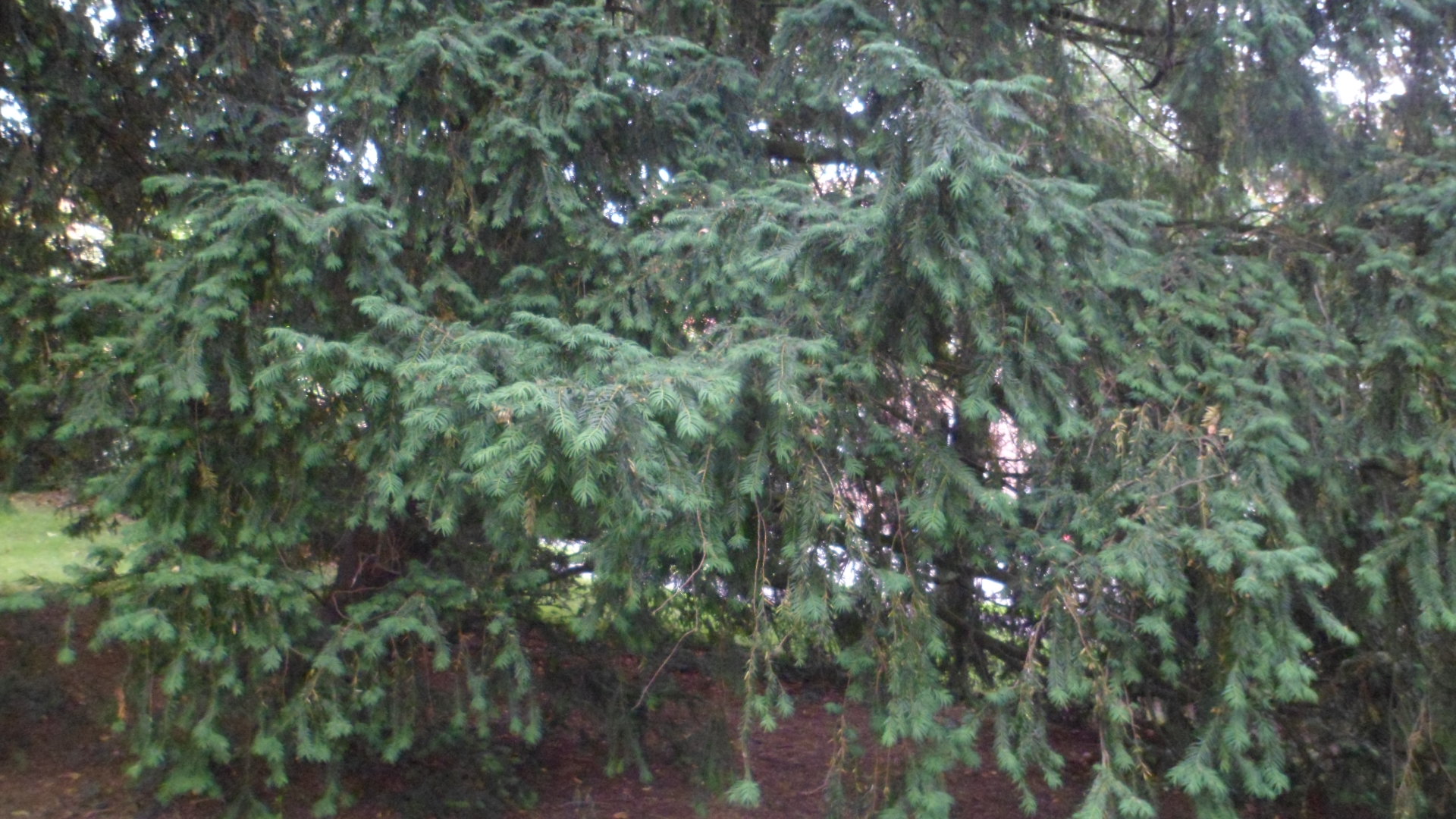
Belgium is far enough north for some evergreens, which brought back memories of my New England boyhood.

SAM_0933

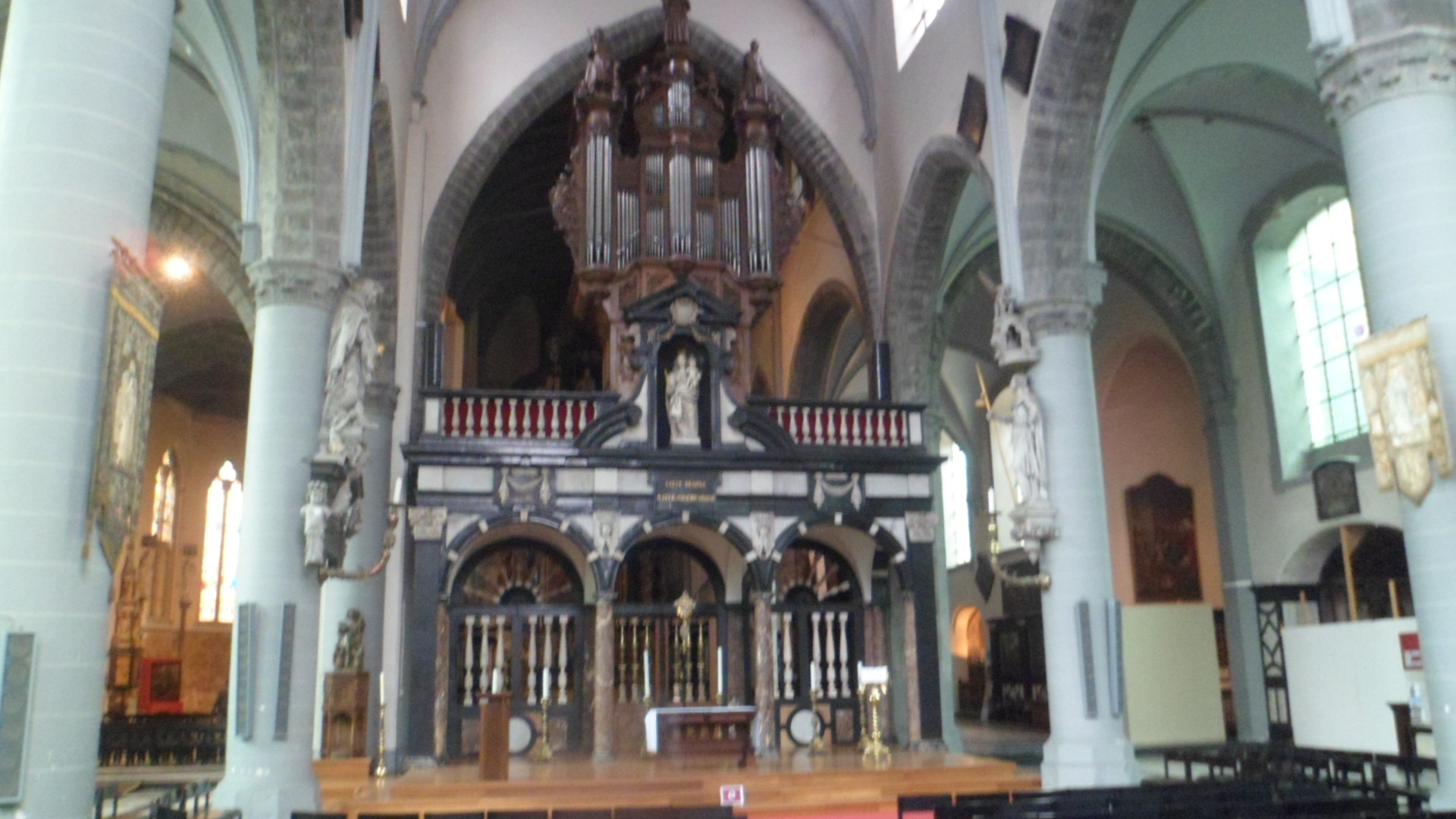
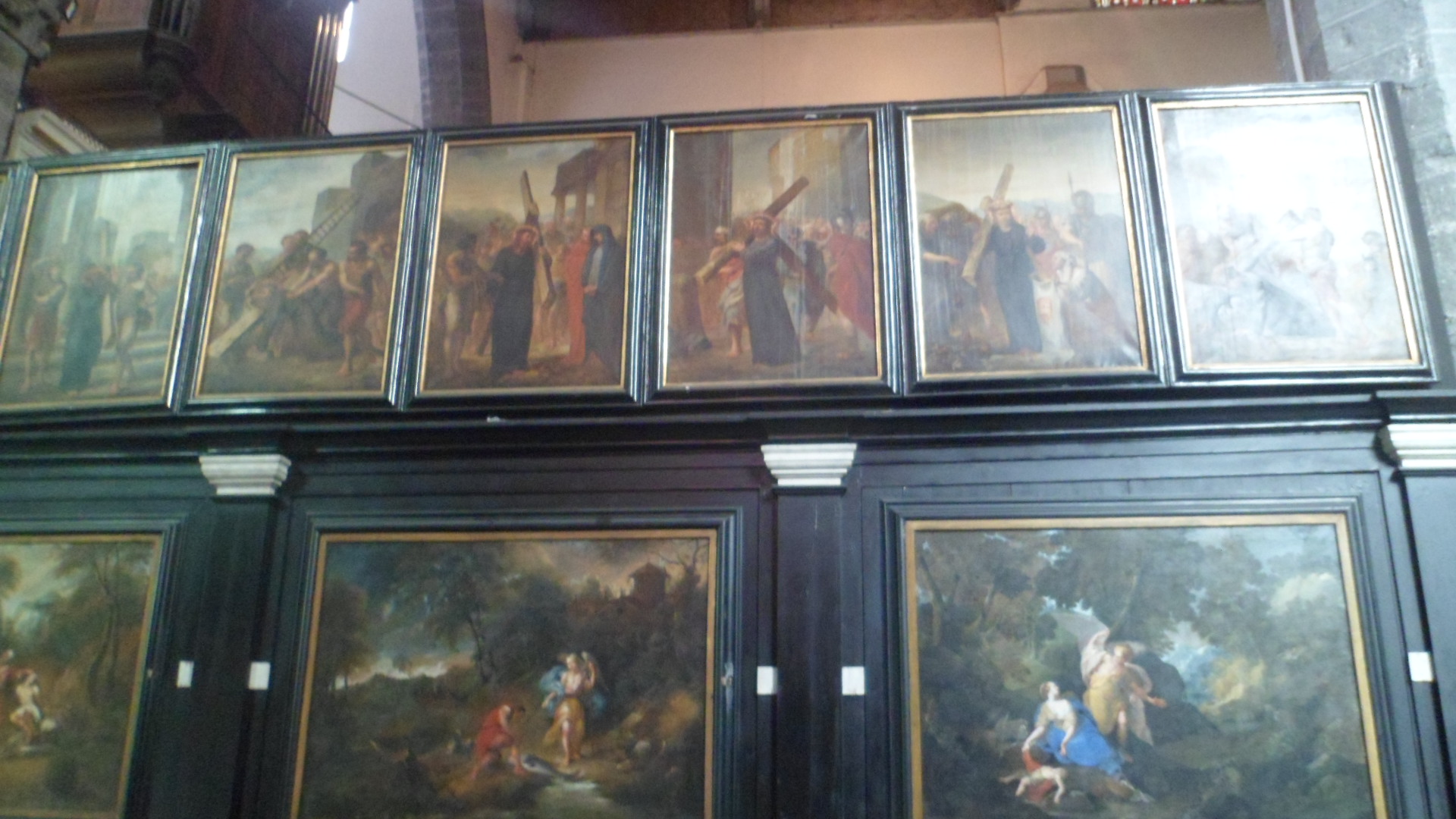
I came upon Kerk Sint-Jacob, built by the people of West Flanders in honour of St. James the Elder.  A series of panels in the church depicts his martyrdom.
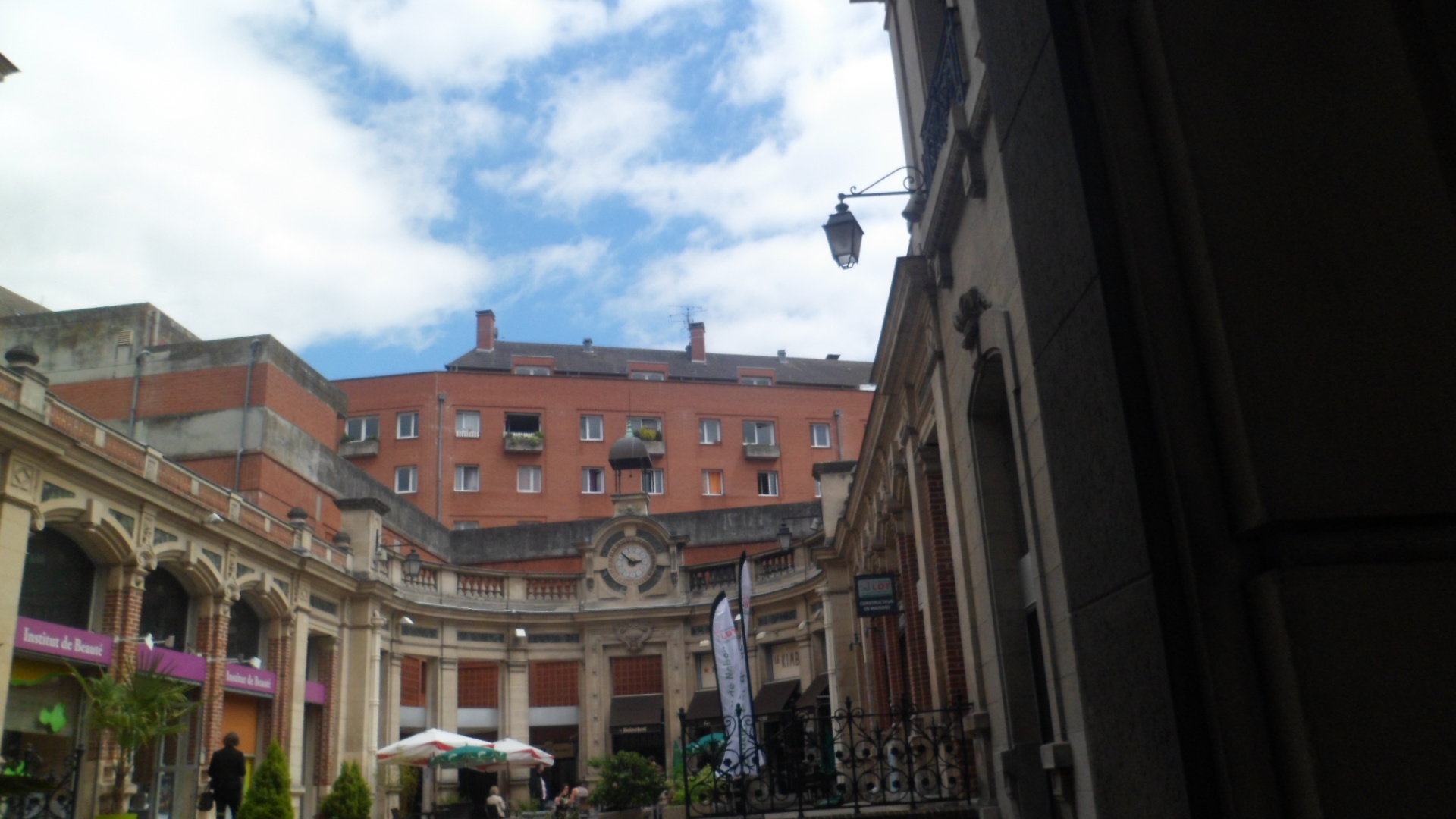
SAM_0942

SAM_0948

SAM_0951

SAM_0954

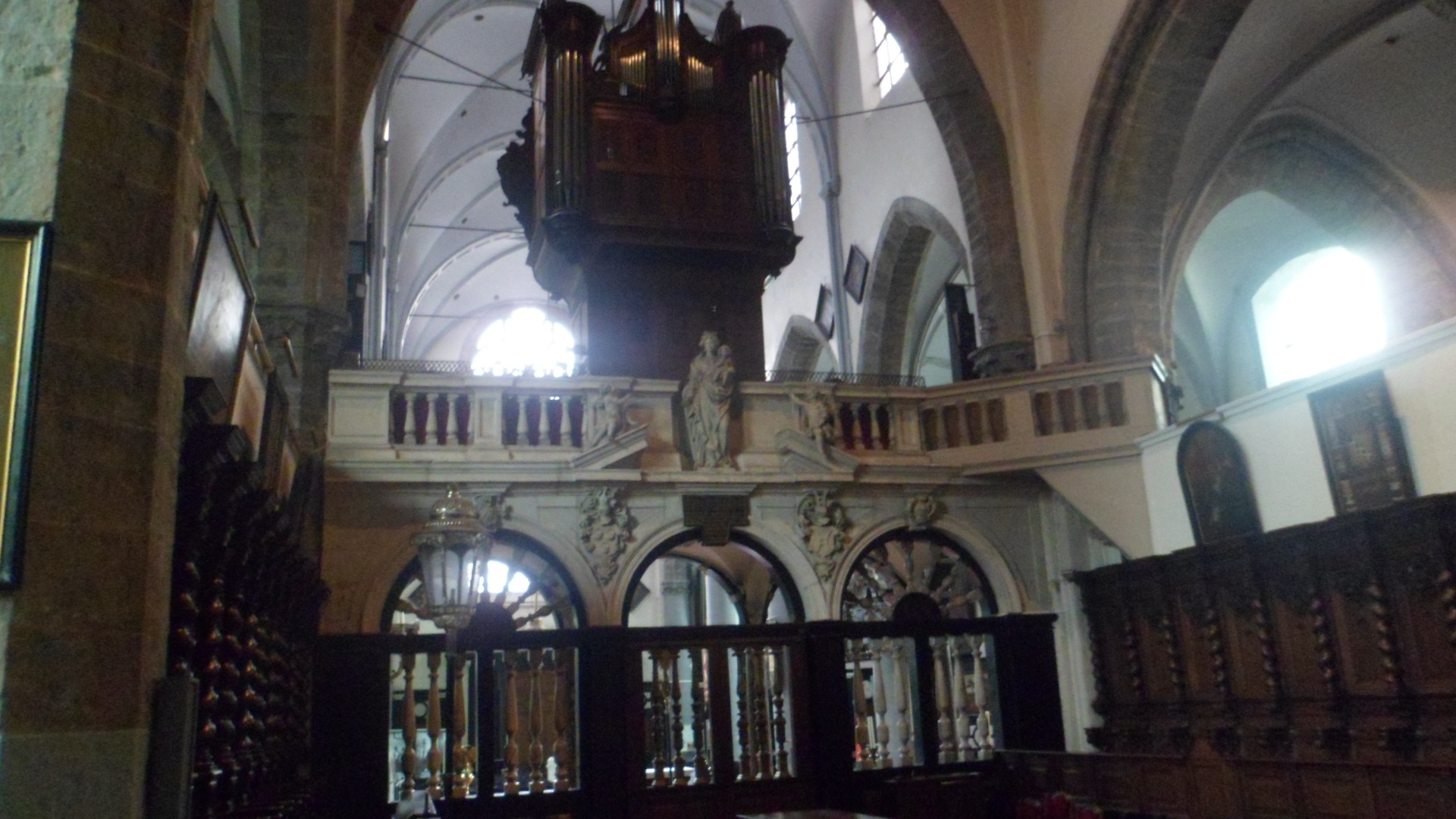
The choir loft rises just before one sees the homage to St. James.SAM_0959

This series is similar to that found in El Prado, in Madrid.

SAM_0963

The Deacon’s Mount is just south of the Main Altar.

SAM_0966

SAM_0970

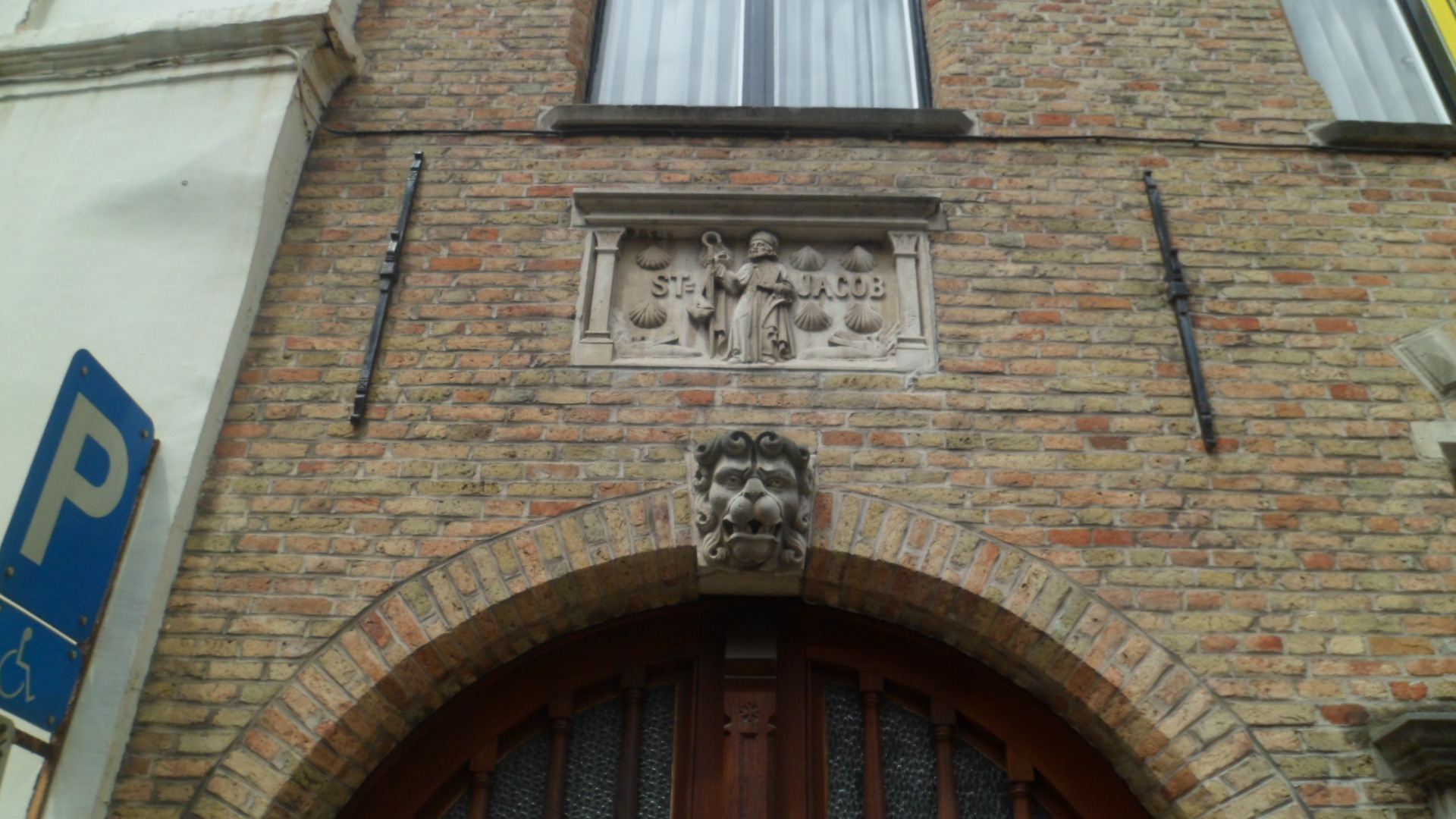
As one leaves the church, there is a tympanum, with St. James watching over a lion.

.SAM_0973

This is fortuitous for Brugge, which was faced, for several centuries, with taming its mercantile beast- maintaining prosperity, while at least somewhat minding the passions of its soul.  In Part II, I will focus on the Centrum- the heart of Brugge.

An Eastward Homage, Day 20: Lille of the Valley

4

SAM_0849

June 15, 2014-  This date was significant to me, in two respects.  One, it was the first Father’s Day on which I could neither converse with my son nor listen to the homespun wisdom of my father-in-law.  Two, it was my last day in the northwest of France, at least for a few years.

After the obligatory run-back to Paris from Amiens, given me at a discount rate because of the ongoing train strike, I boarded a train for Lille.  At least I only used Gare du Nord this time.  It was pleasant, actually, in that there was a string section in the station, playing for all the fathers who were passing through.

The ride to Lille, France’s resilient northern gateway, was quite brief, with only one stop, at Arras.  We debarked at Gare Lille-Europe, the more modern of the city’s two train stations, seen above.

My hotel,  Balladins, was close to the other station, Gare Lille-Flandres.

SAM_0853

Hotel Balladins turned out to be another very welcoming hostelry, and with Le Morand and Hotel de France, one of my three favourites in the northwest of France. Perhaps it was that the diligent desk clerk seemed like one of my nieces, or that she went out of her way to find a Cyber Cafe- Laundry, but my settling in here was the smoothest thus far.

I spent a very pleasant evening, after doing laundry and getting messages at the launderette, dining sumptuously at a brasserie a block east of  Balladins and then taking a walkabout around the clean and very proud centre of Lille.

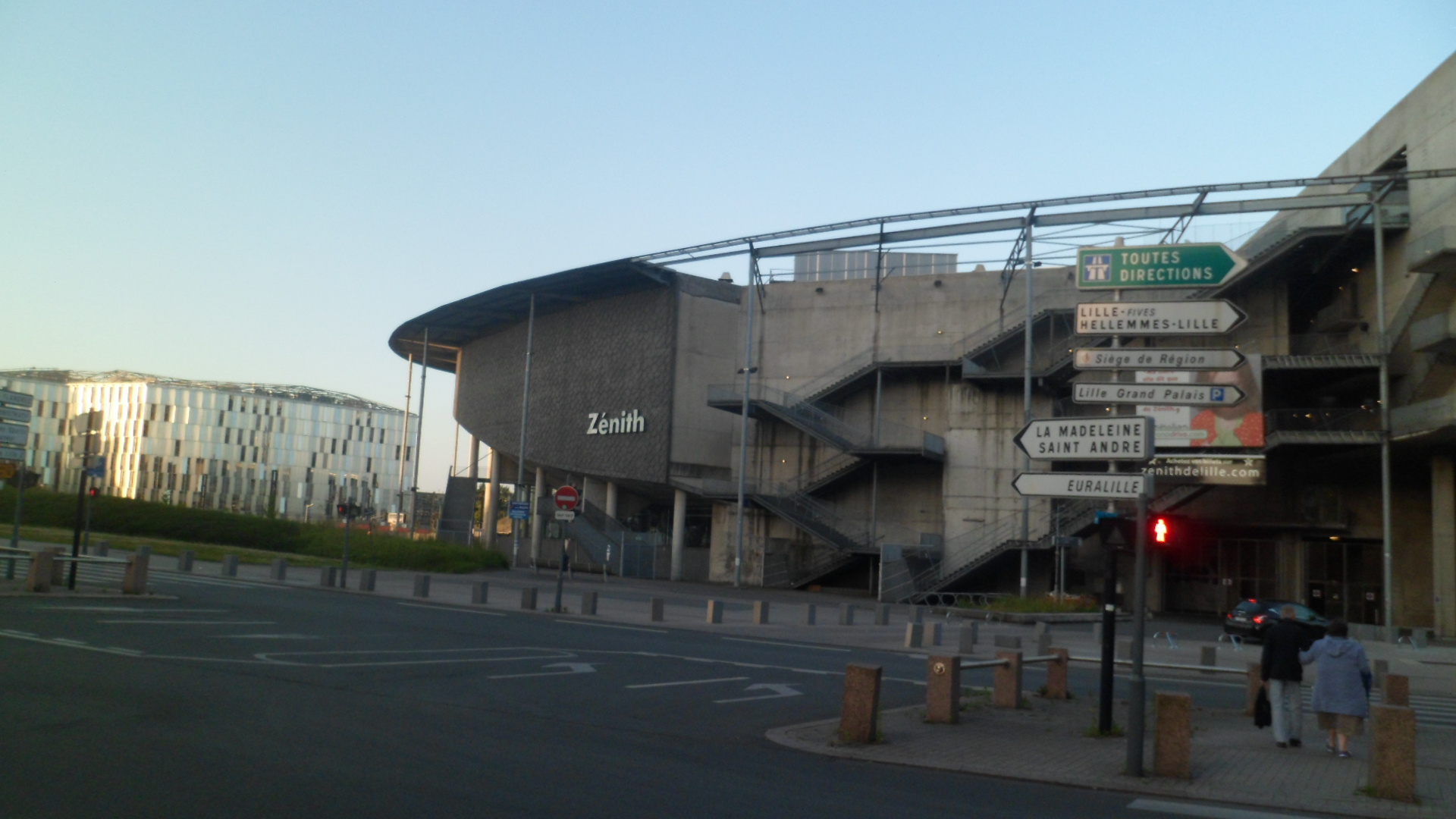
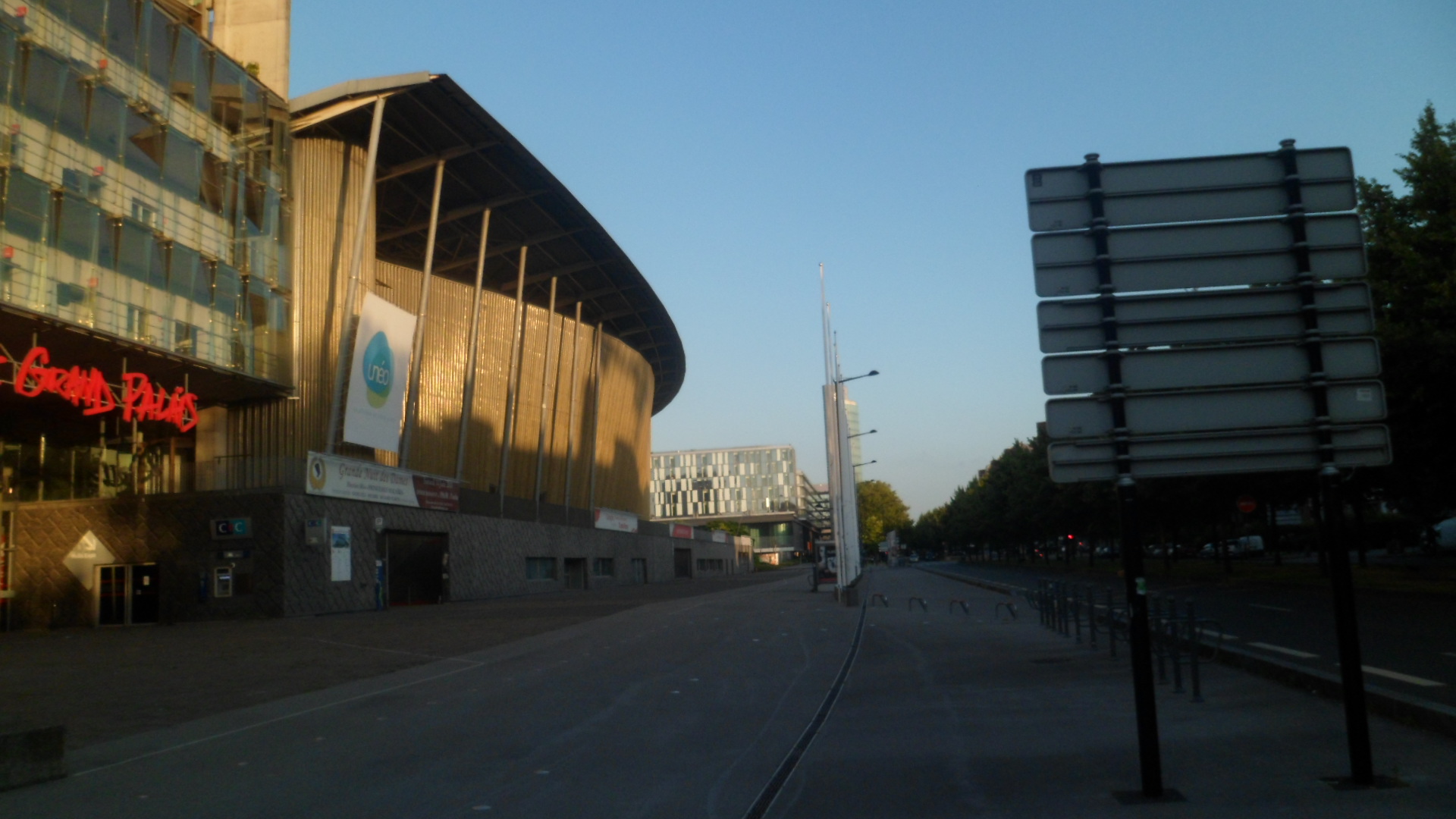
The first stop was at the city’s modern marvel, Zenith-Grand Palais, the performance hall.

SAM_0860

SAM_0862

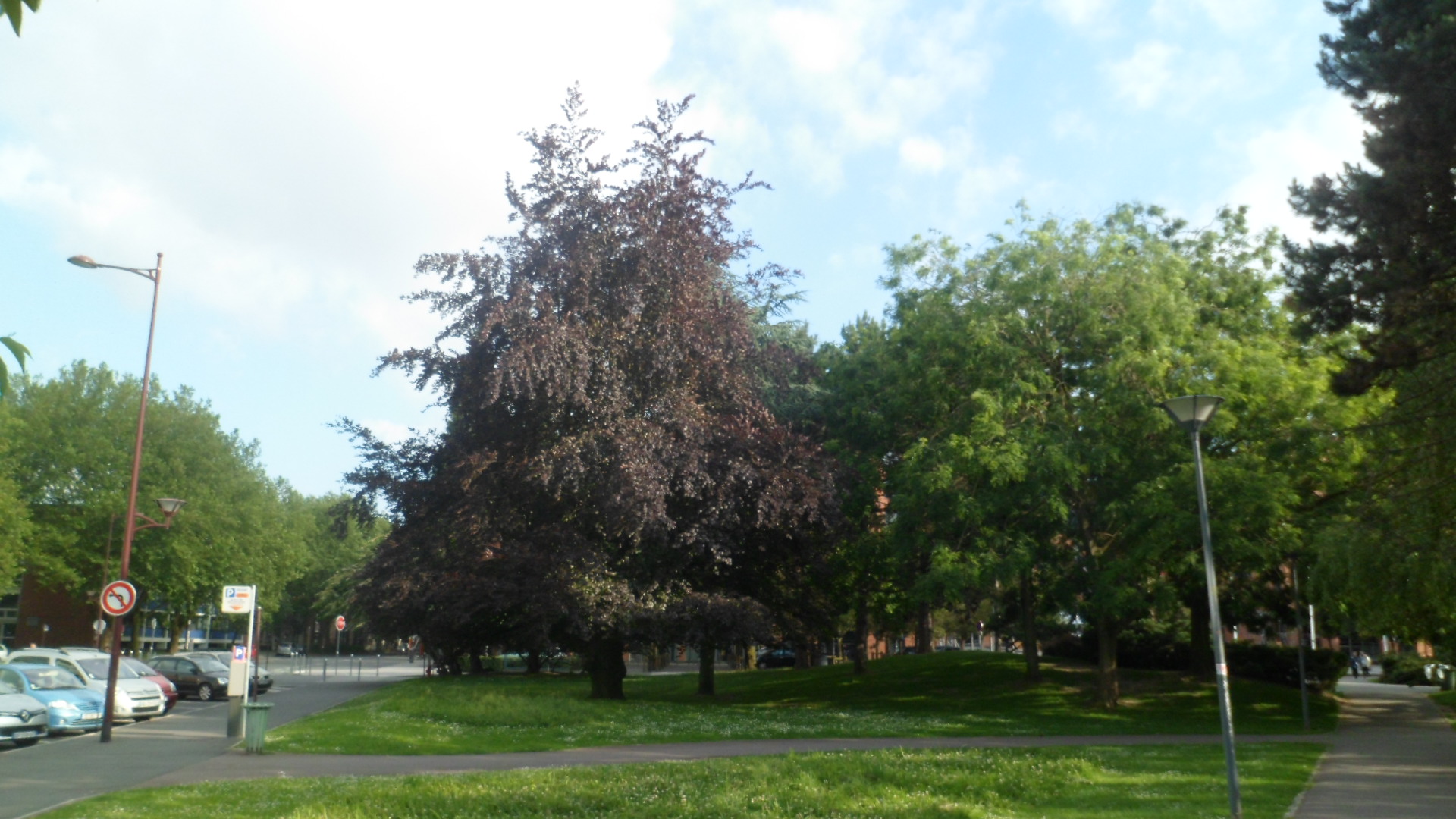
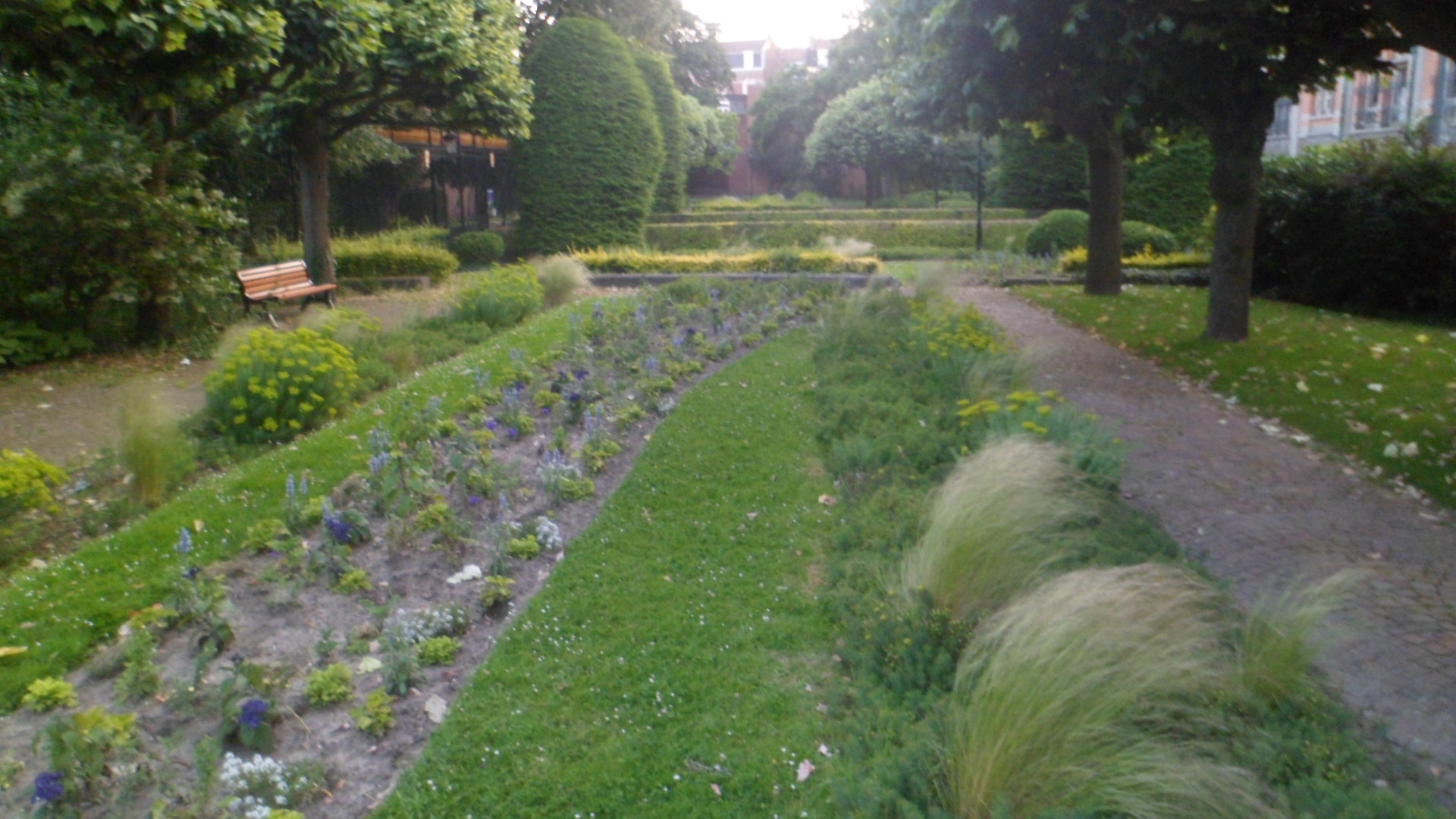
Between this magnificent center and Vieux Lille lies a lovely greenspace.  Even the industrial towns pay a mind to their gardens, across France.

SAM_0857

In the center of town, I came first to Noble Tour, the city’s memorial to the fallen of all wars, from the Franco-Prussian War, through World War II and the Algerian Conflict.  It is a bedraggled sight, but all the more poignant a reminder of war’s toll, because of its rough condition.

SAM_0867

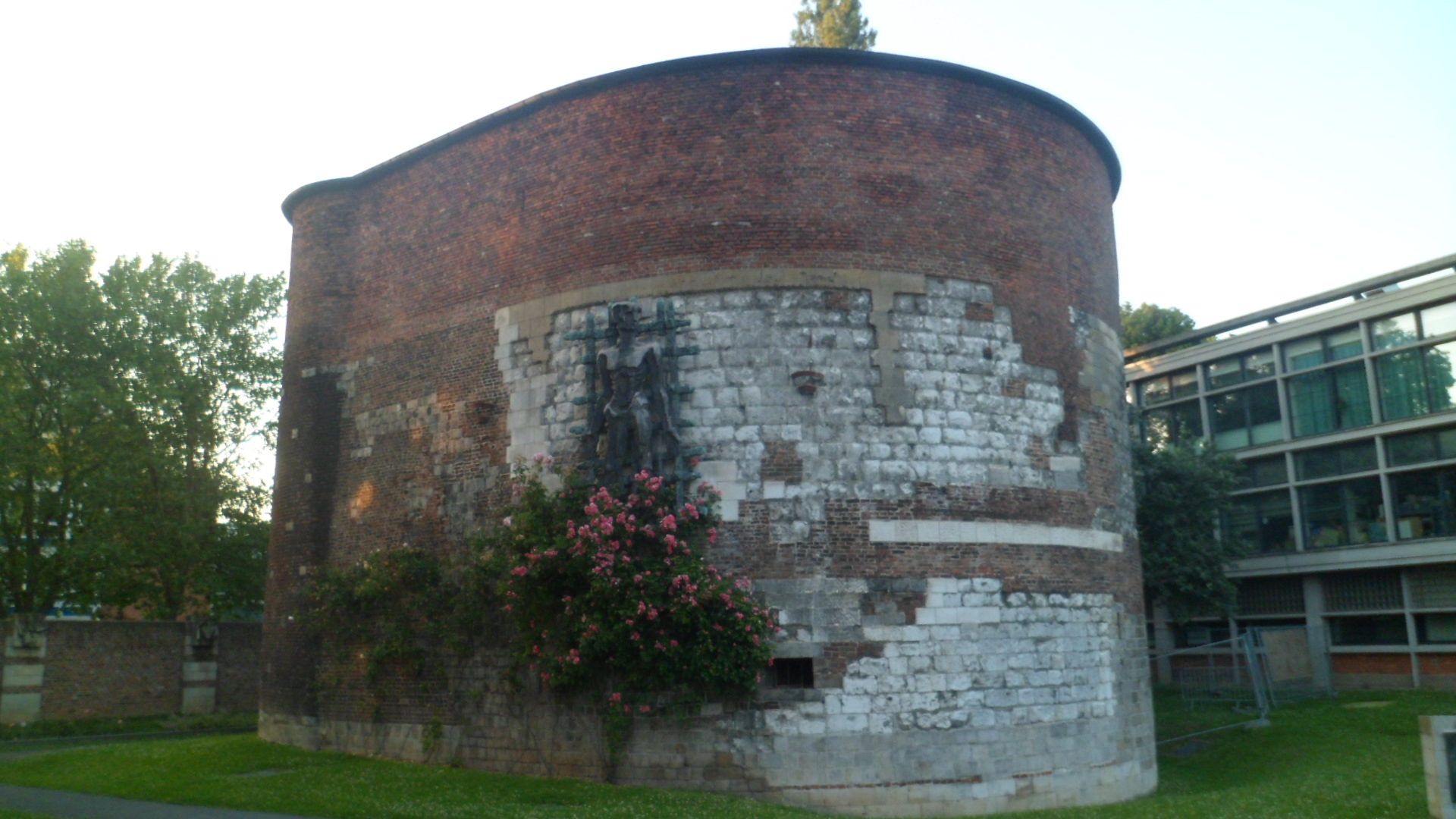
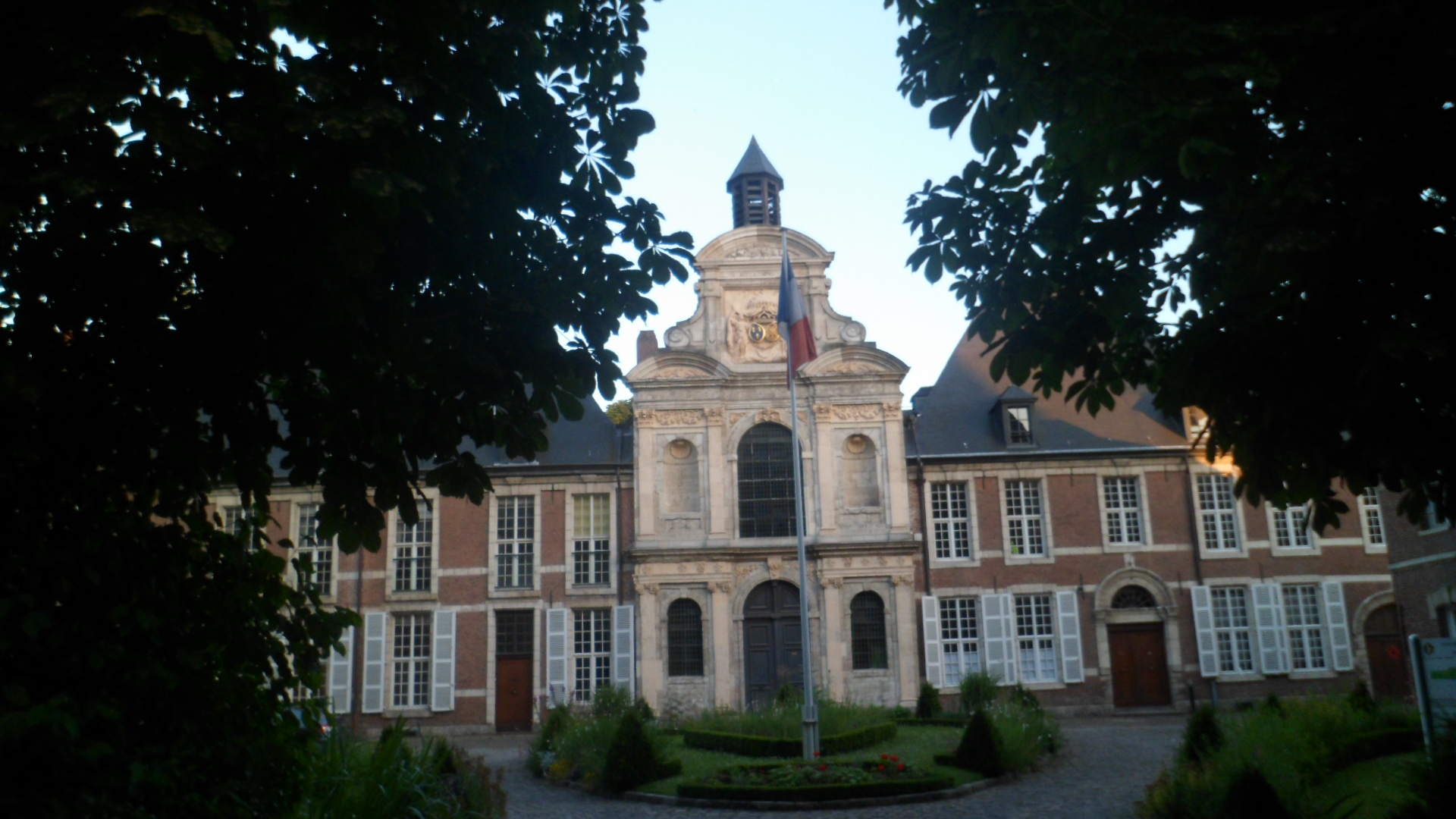
Vieux Lille has several apartment complexes, with large immigrant populations.  One of these housed the cyber launderette which I used.  Another fronts Noble Tour.  At no time during my stay in the west of France, however, was I accosted or made to feel intimidated.  I went on, quietly, to Chapelle Reduit, with its fine gardens.  The redoubt and its church were built by the great Vauban, in the 17th Century, to bolster French defenses against England- and Spain, which ruled most of Flanders at that time.  The panel at the bottom of this triptych honours Vauban.

SAM_0875

SAM_0876

SAM_0883

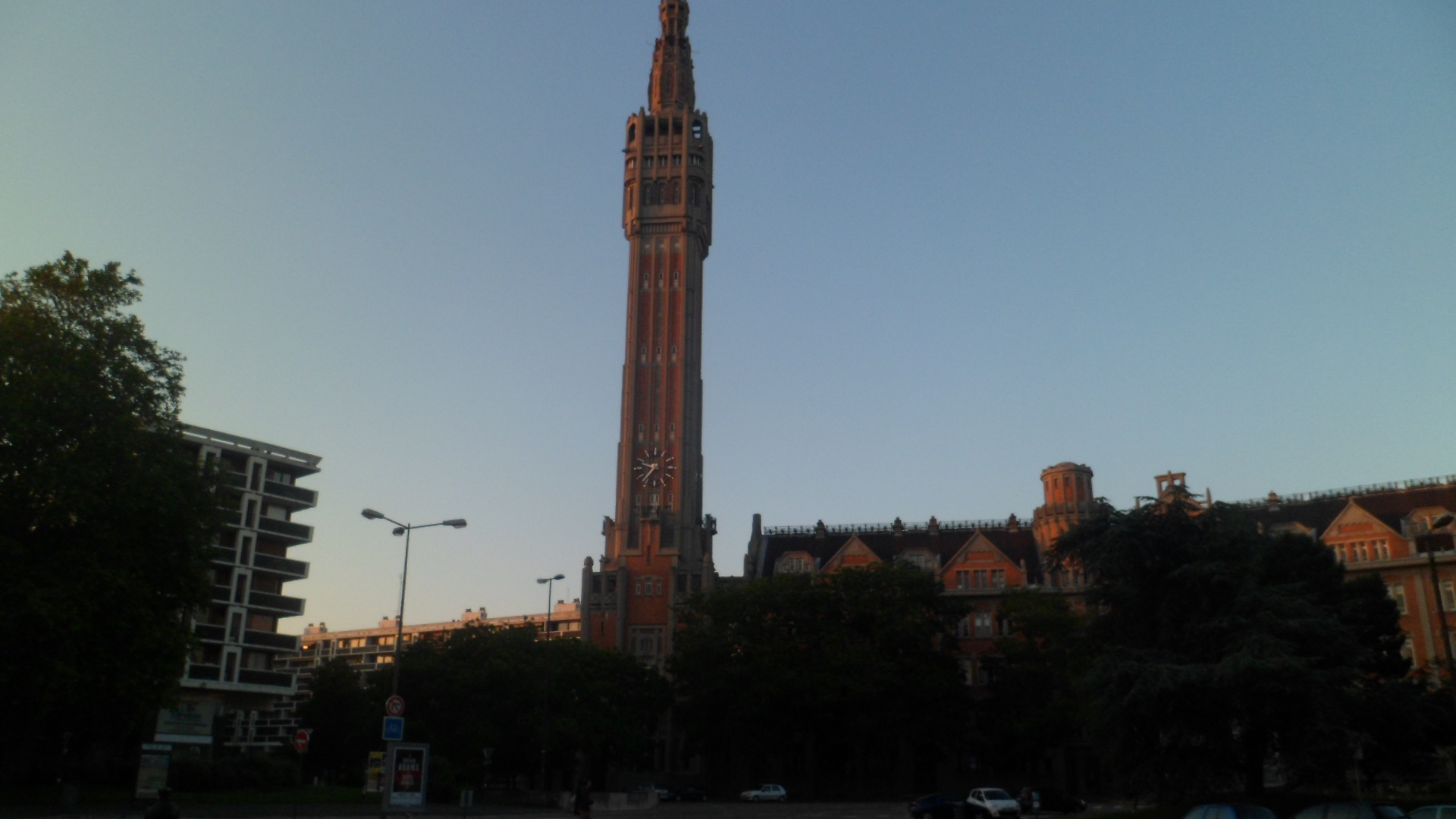
Across the street from Fort de Reduit is the immense Hotel de Ville, with its magnificent belfry.

SAM_0885

SAM_0872

SAM_0896

This grand structure served as a customs centre for French Flanders, during the 19th Century, as well, thus requiring much more space than the average French city hall.

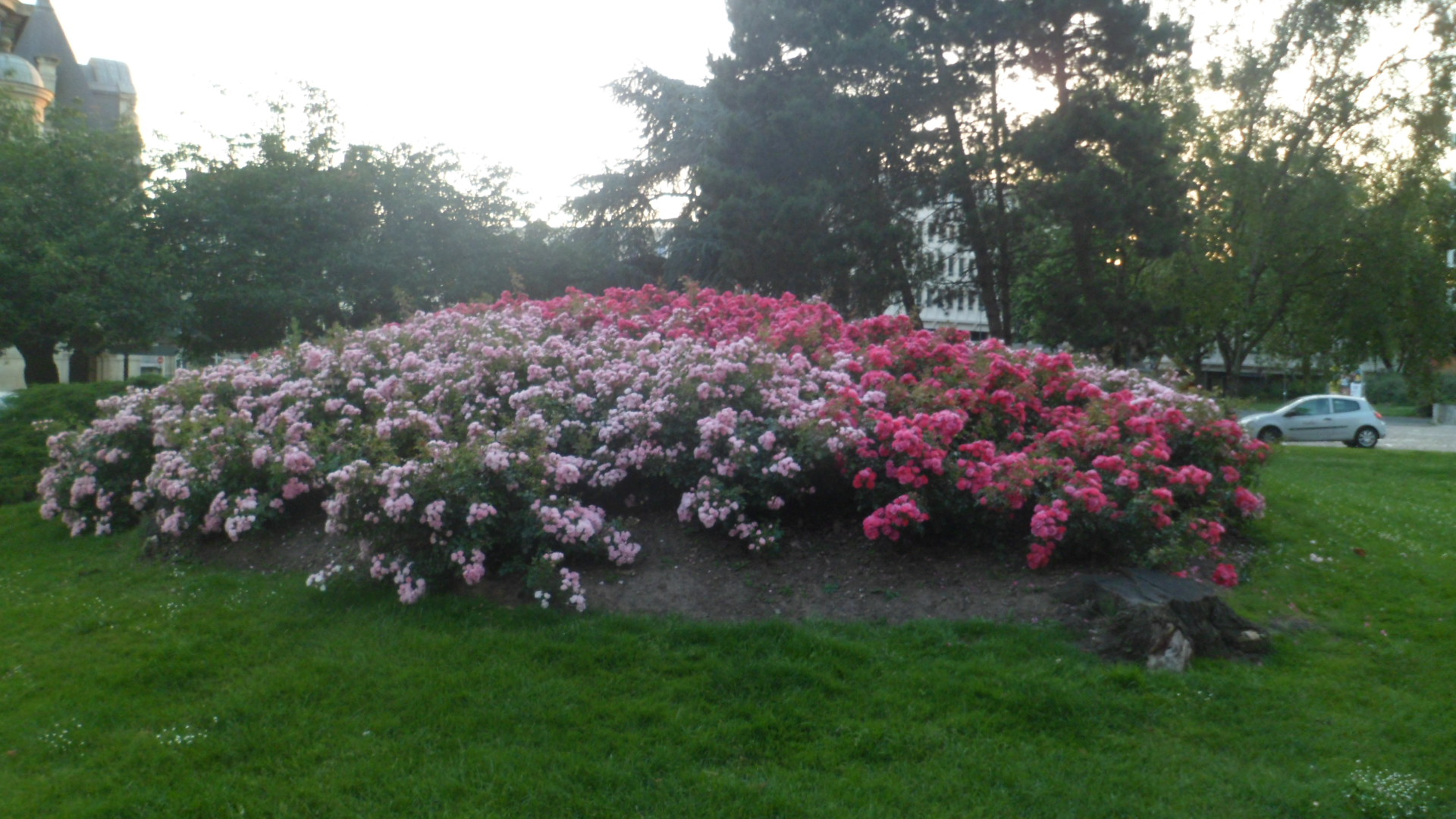
Between Hotel de Ville and the southern gate of Lille, La Porte de Paris, is a small flower bed.

SAM_0887

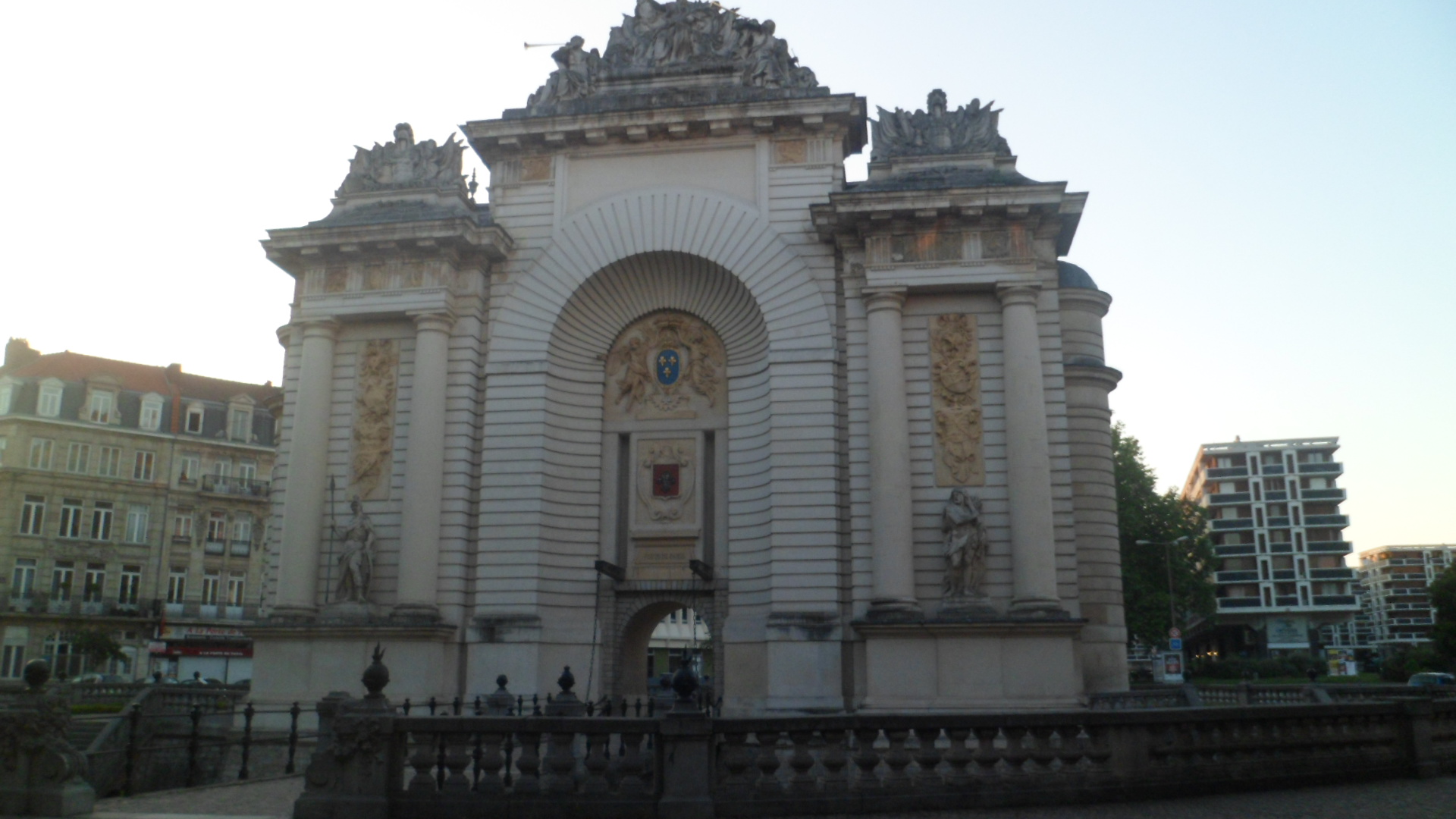
La Porte de Paris (below) is one of two gates to Lille.  The northern gate, which I did not visit, is La Porte de Roubaix.

SAM_0888

SAM_0895

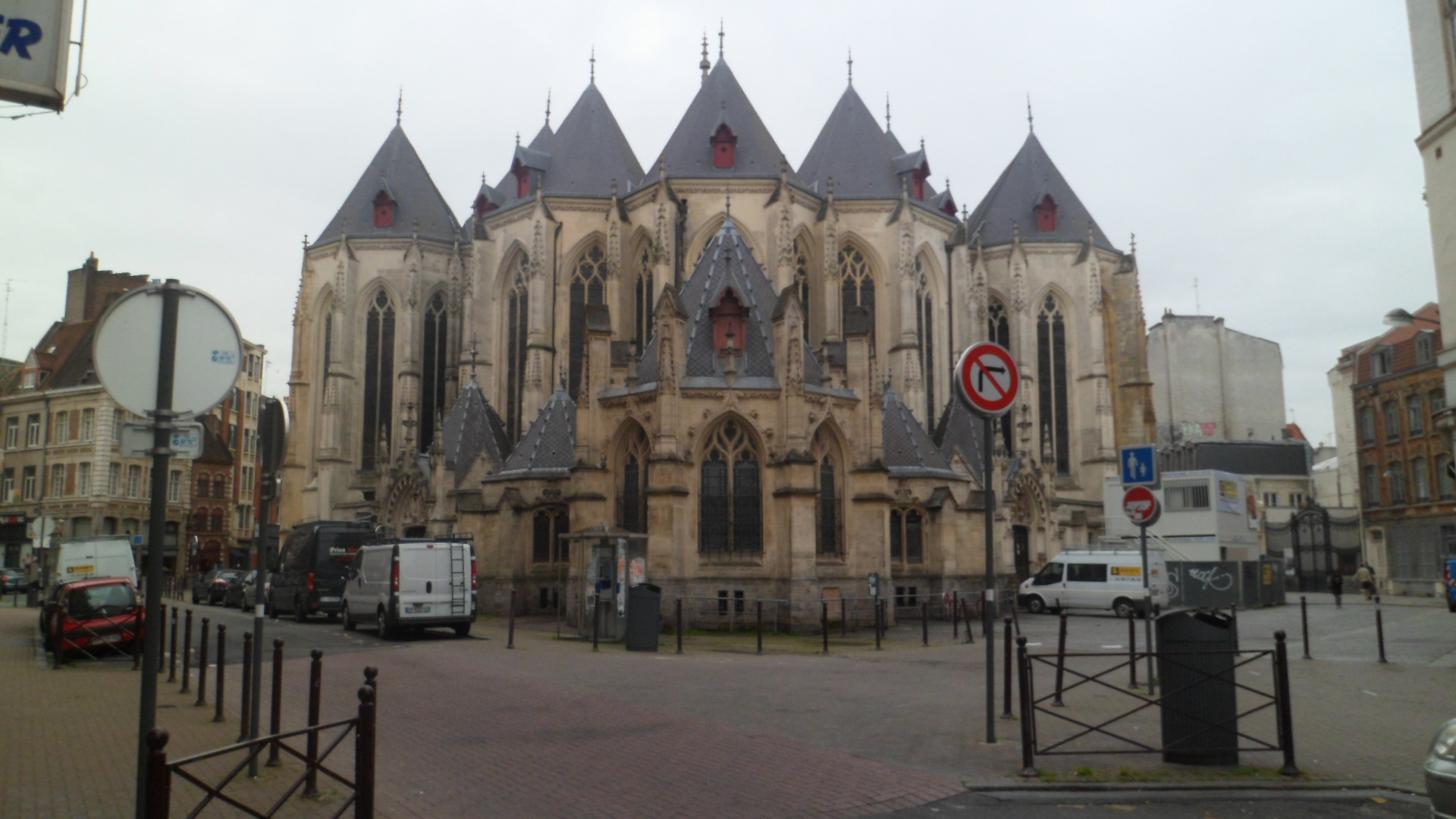
I ran out of time on that Sunday night, before getting to see Cathedrale Notre Dame de Lille.  I did, however, get a glimpse of it the next morning.  For simplicity’s sake, I include it here.

SAM_0897

This great church was under total renovation at the time of my visit, so going inside would have been problematic, regardless.

Lille was fairly quiet on that Sunday night, almost a counterpoint to raucous Amiens.  Still, the people I met here seemed happy and relaxed, glad to be in the commercial hub of French Flanders.

So, my time in northwest France was drawing to a close.  There was nowhere where I felt unwelcome, and nowhere I would refrain from visiting again.  My French home is Rouen, and its good neighbours are Rennes, Mont St, Michel, Brest, Amiens, Lille-and Le Cite Lumiere, Paris.  I am glad for each day, each place I had the pleasure of seeing and each person who graced my path.

NEXT:  Brugge, Parent of Commerce

An Eastward Homage, Day 19: Amiens, Part III- A Circular Jaunt

5

June 14, 2014-  Having framed Amiens’ natural boundaries, which are its lifeblood, and its spiritual symbol, the great cathedral, it’s a good time to take a circular visit to the nuts and bolts of the city.

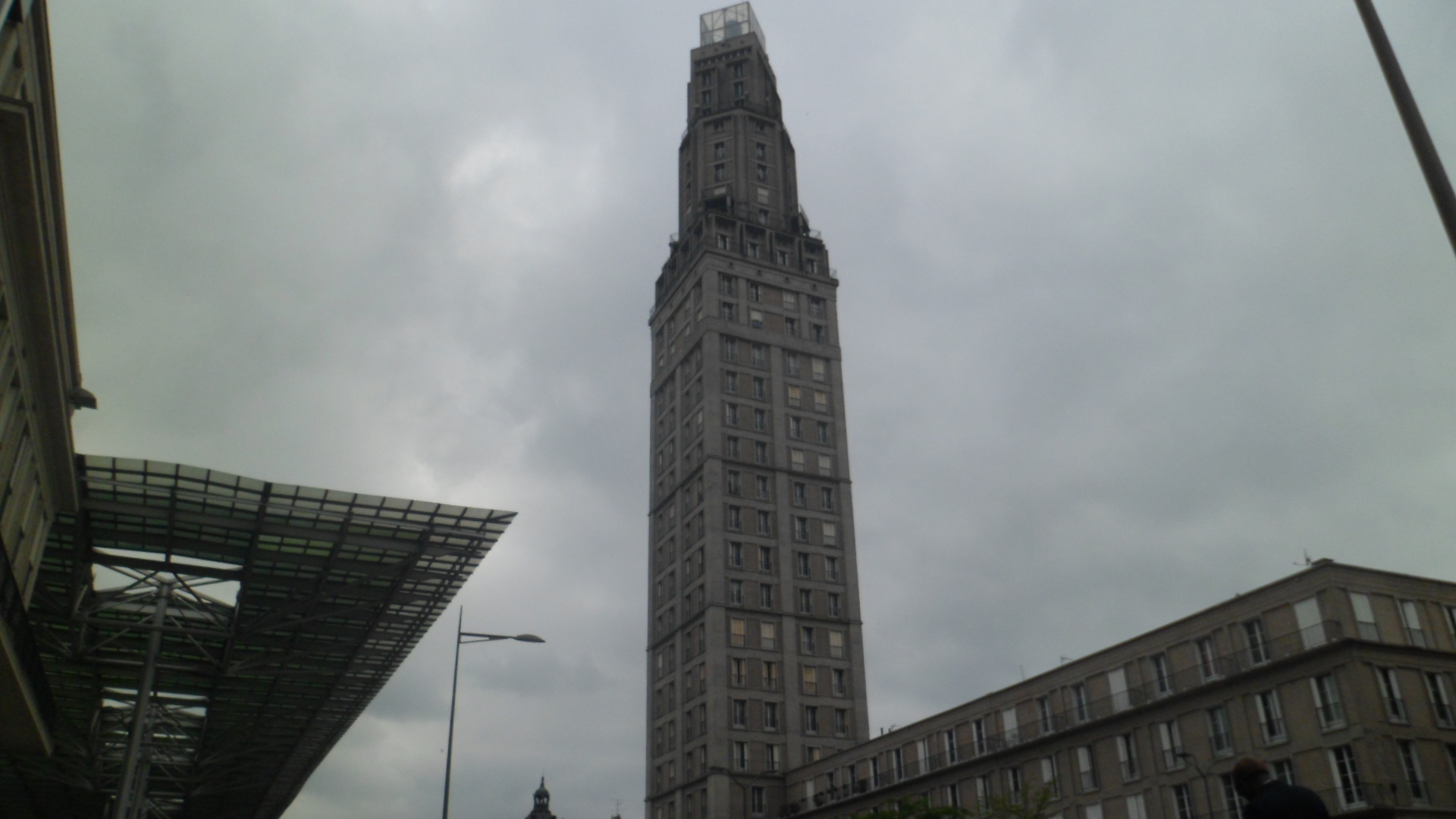
From my hotel (on the left, below), I took a walk down to Tour Perret- an apartment complex that is given gravitas, by dint of its tower-like design.

SAM_0669

SAM_0672

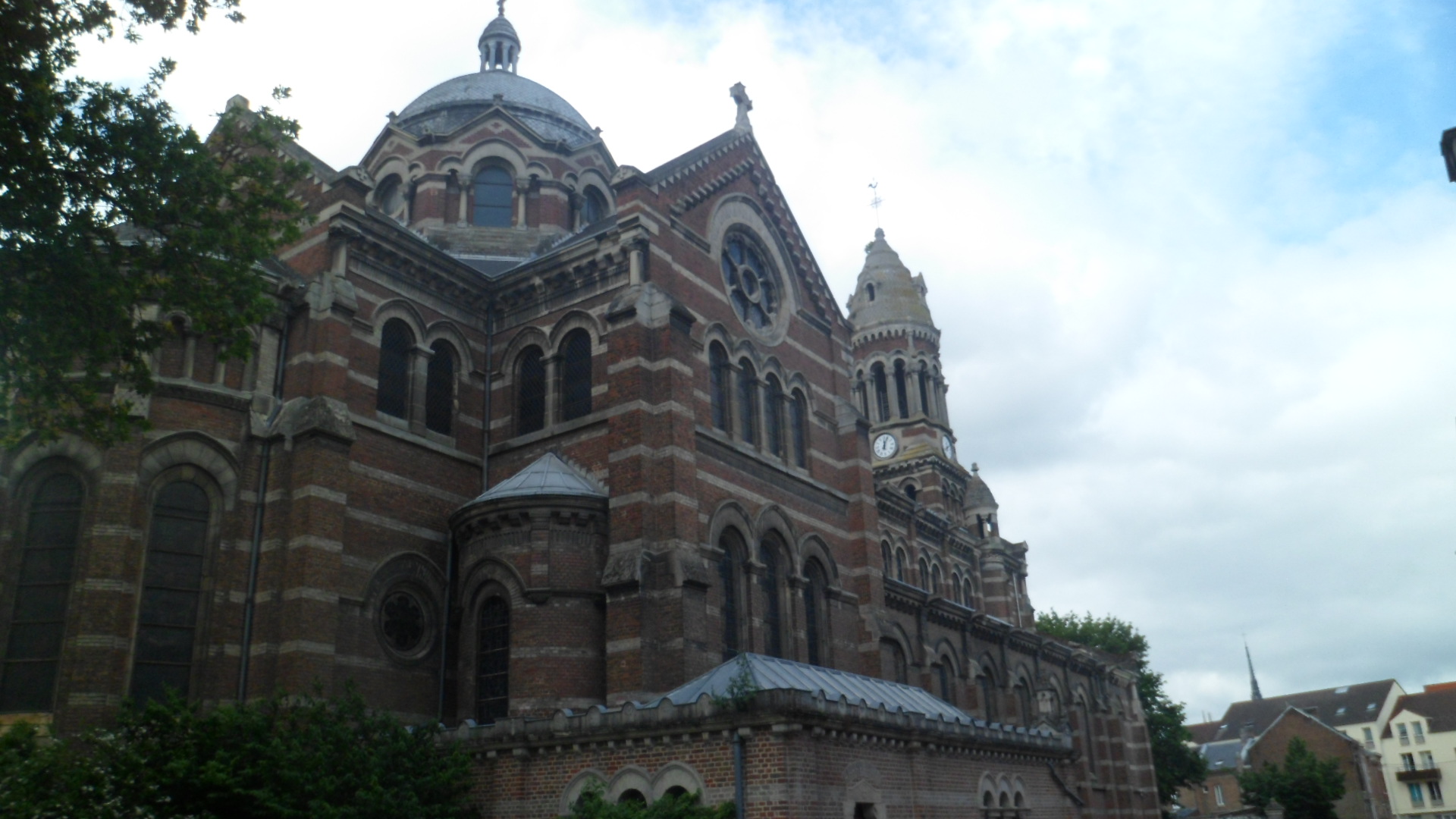
Among the many lovely churches on my route was L’Eglise Sacre Coeur (Sacred Heart), a center for the near north side of town, behind the train and bus stations.  This area is home to many immigrants and lower income French folks.  It’s lively, and I did not feel either unwelcome or unsafe, during my walkabout.

SAM_0674

After saying a few prayers in the courtyard, and greeting a couple of residents, including a child on a skateboard, I went past the train station, and took note of Hotel Carlton, a British import.

SAM_0678

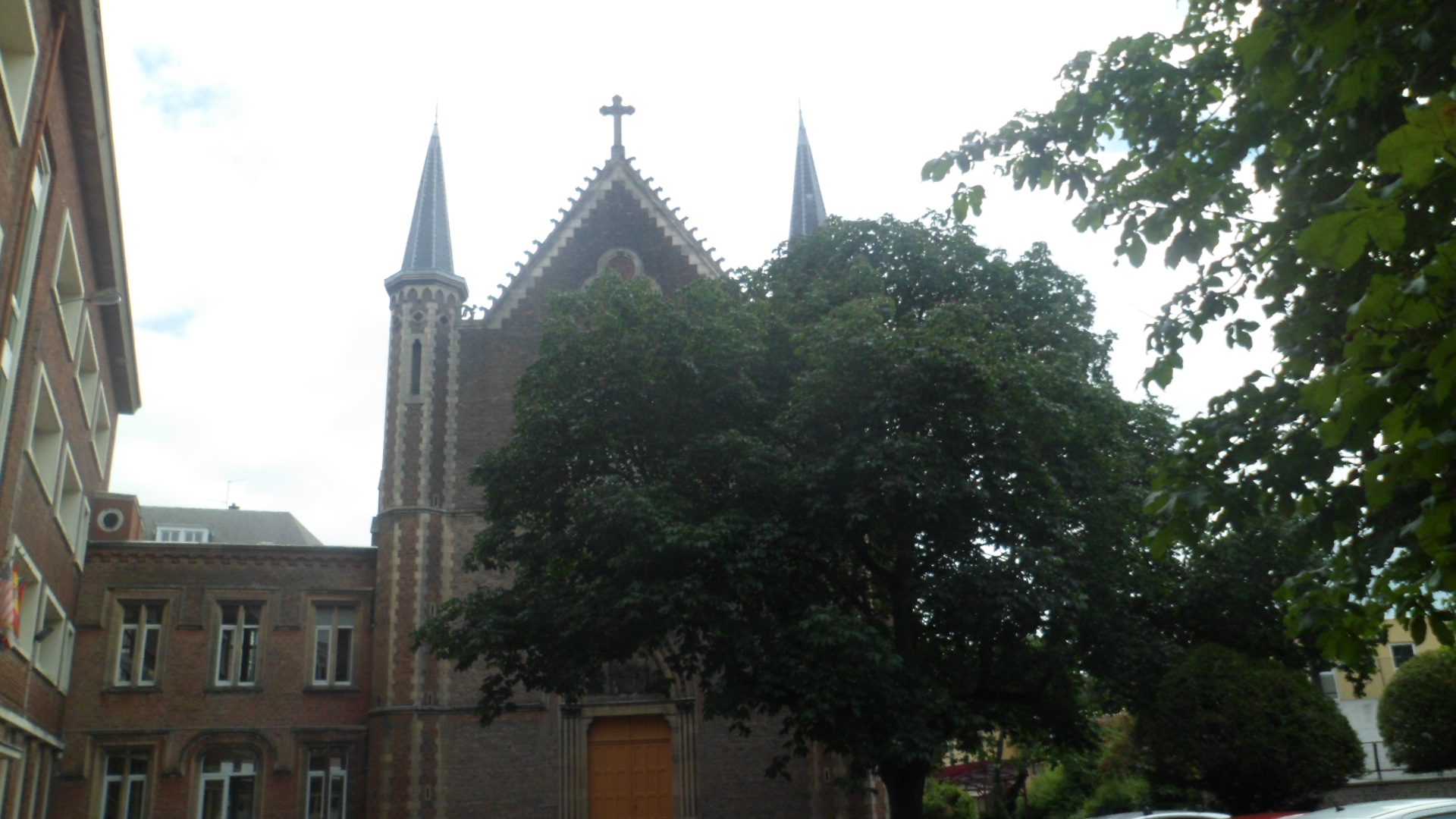
To the east of the train station, there is a different parish, even more needy than the area around Sacre Coeur.  This is Le Parrois Sainte Famille.  Here, there is an active Food Bank and Soup Kitchen, with a Catholic High School attached.

SAM_0681

I was impressed that there were so many in school on a Saturday morning.  Then, I remembered that this is routine in France.

Those African  and Caribbean people of letters who have had an impact on the people around  them are remembered in France, though they may not have felt so honoured during their lifetimes.  I recall reading the works of Frantz Fanon, the conscience of Martinique, misunderstood during the De Gaulle era as a “Stalinist”.  Aime Cesaire, also from Martinique, was an exemplary man of letters and served as a mentor to Fanon, as well as mayor of Fort-de-France.  Although he was drawn to Marxism, Aime turned away from that philosophy after the Soviet crushing of the Hungarian revolt, in 1956.

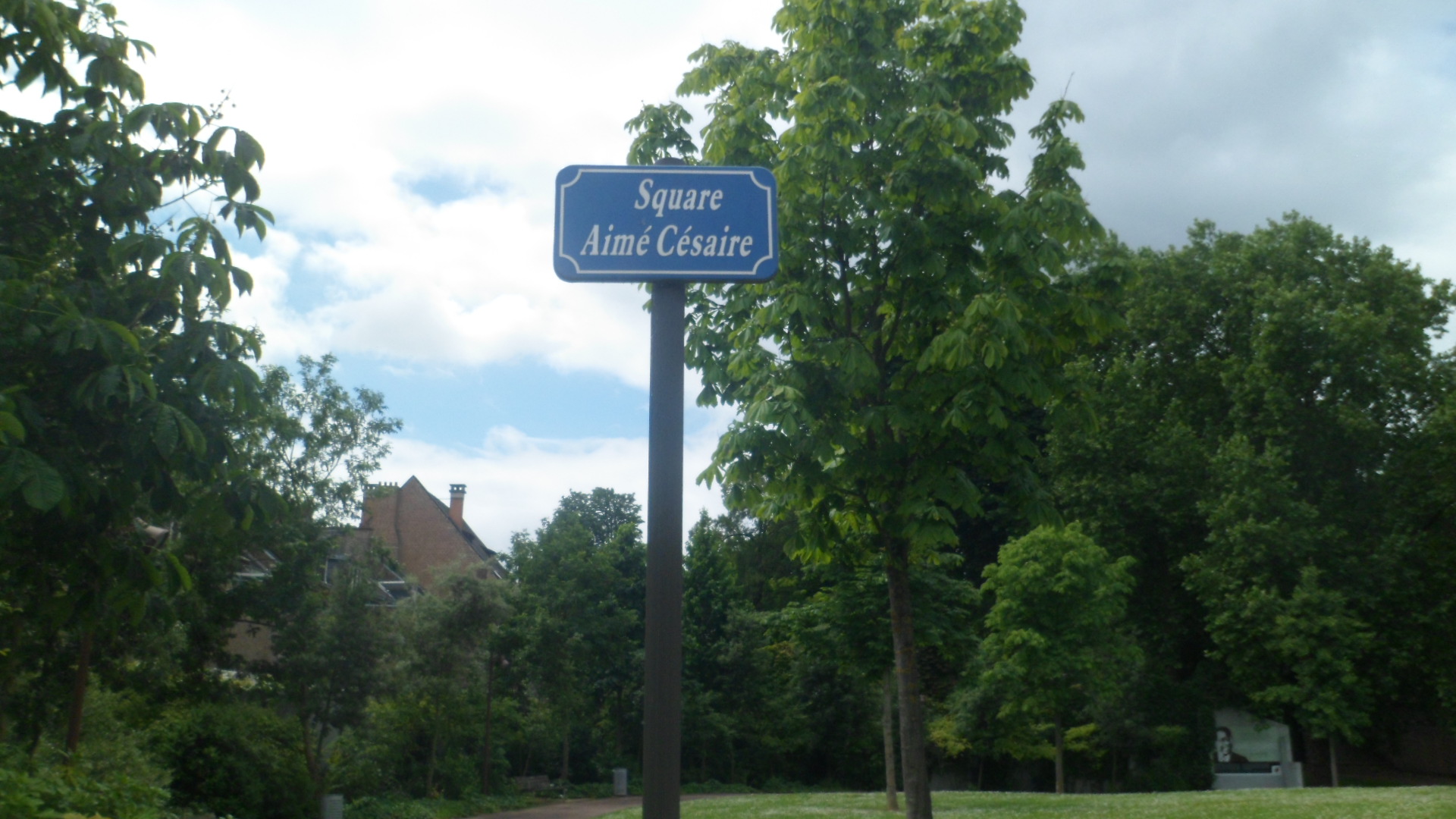
A square in north Amiens honours him today.

SAM_0683

SAM_0685

After heading east from Square Aime Cesaire, I found the preserved house, and a square dedicated to, the masterful Jules Verne.  Here, I had  one of my less laudable moments.  In a few minutes of intense concentration, I was approached by an enthusiastic young man, whom I mistook for a beggar.  He was politely, but firmly, dismissed.  In retrospect, I might have learned something about the place from him.

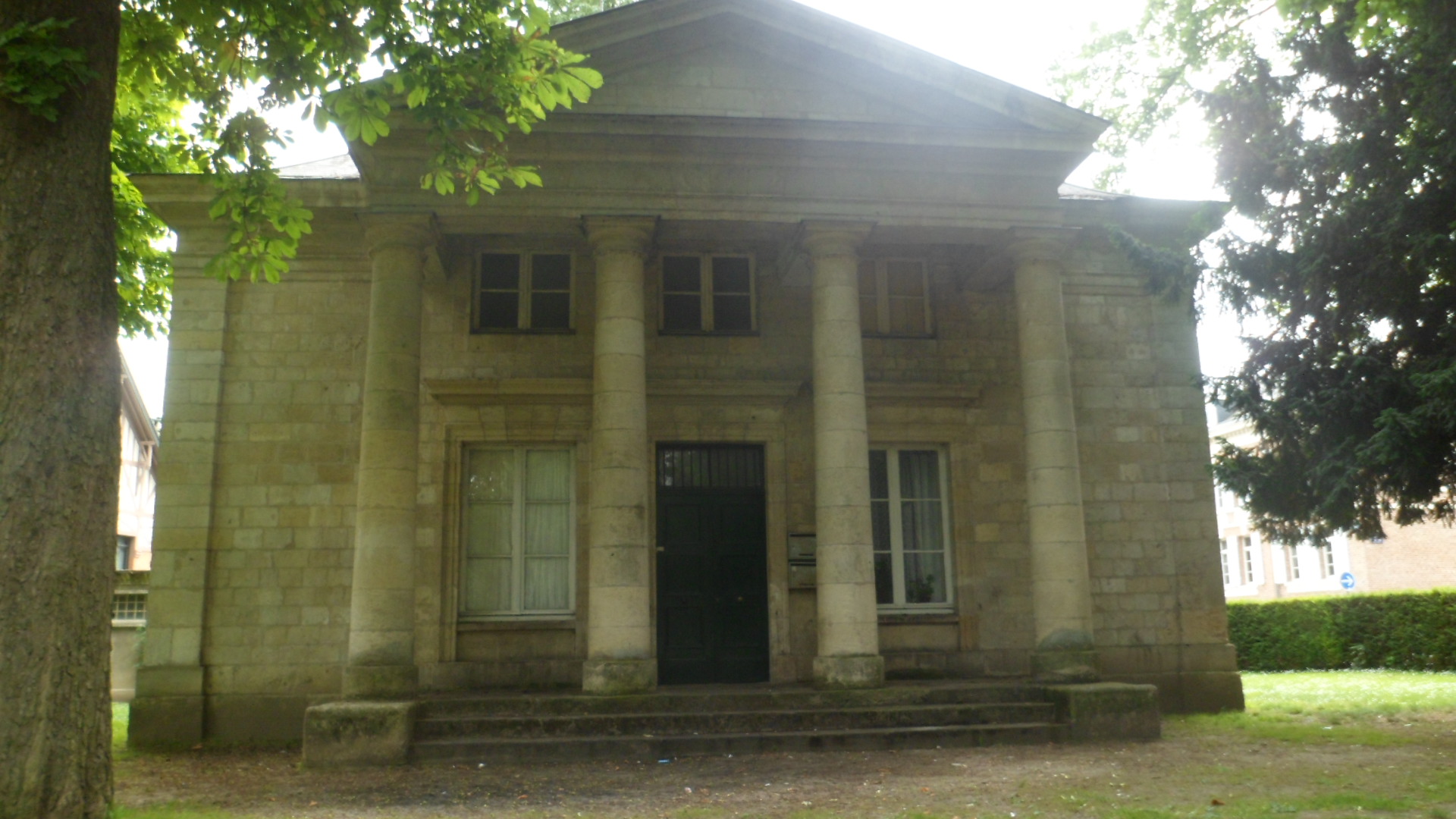
Here, though, is the preserved home of Monsieur Verne.  He spent his last years here, and passed away in Amiens, in 1905.

SAM_0687

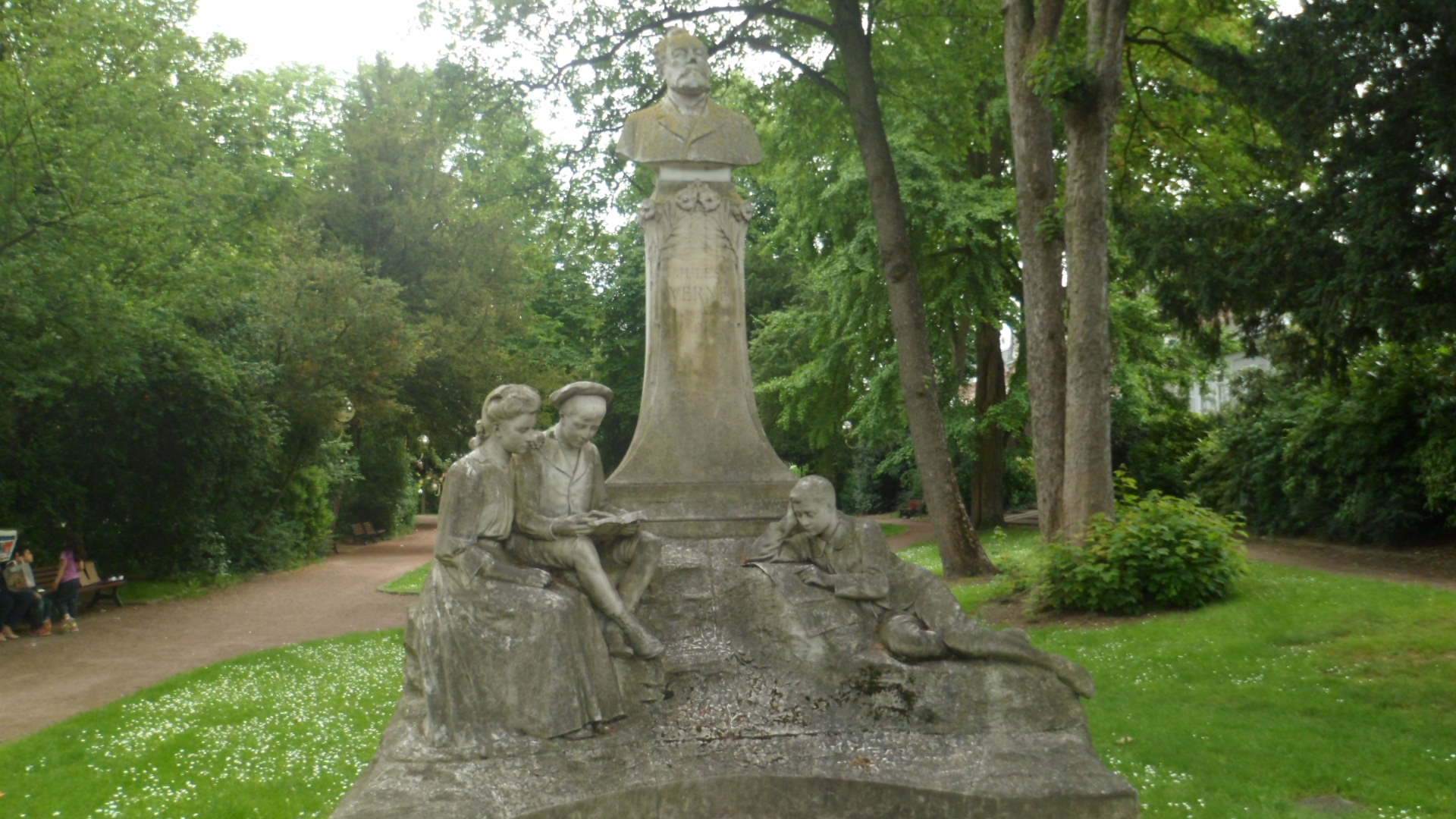
Jules is shown with young people reading, in the memorial sculpture of the square.

SAM_0689

A pleasant addition to the squares of Amiens is the gingko tree.  This much was pointed out to me, by the aforementioned student.

SAM_0690

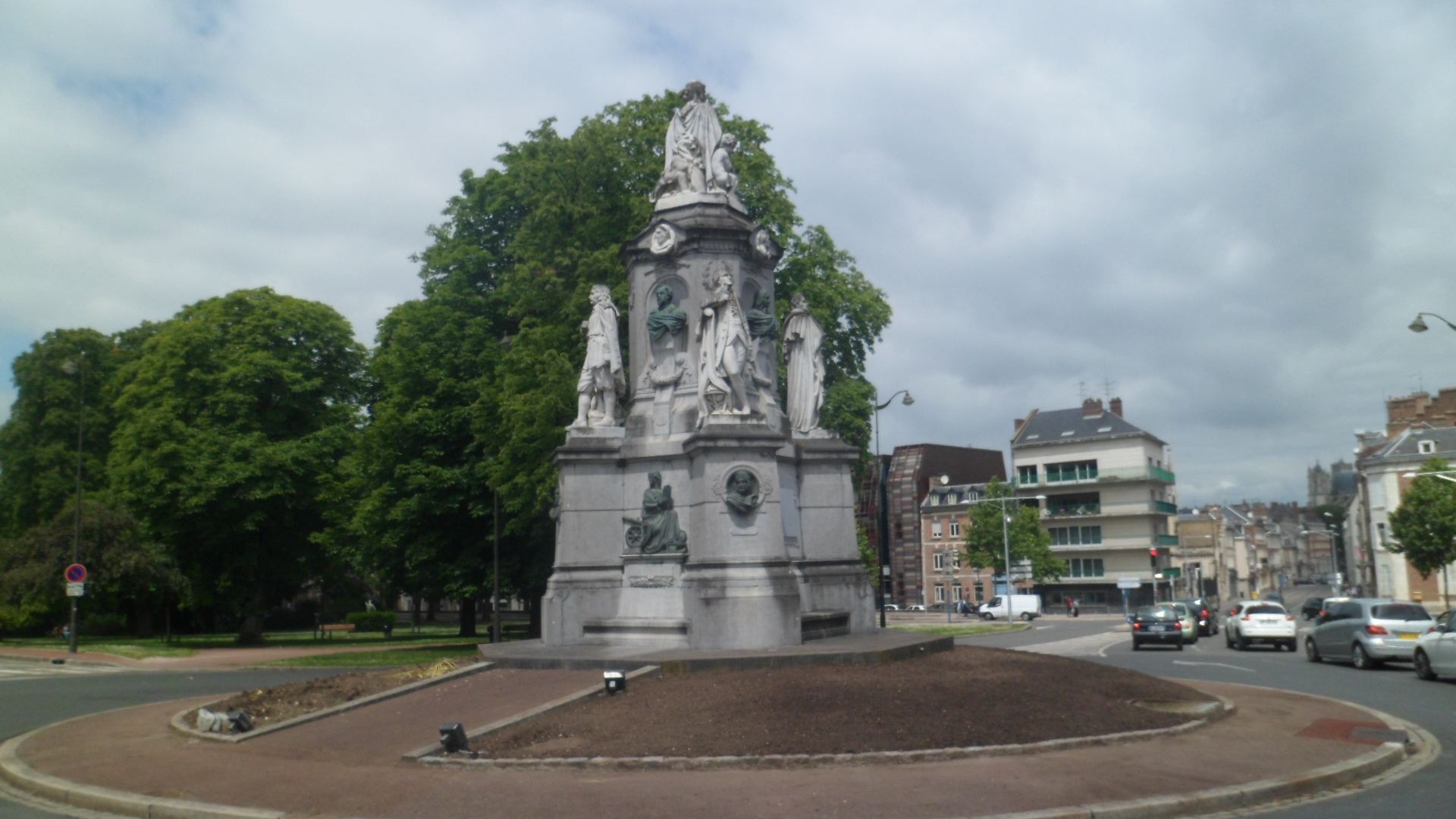
Leaving Square Jules Verne, I came upon this roundabout, with figures of the Jacobin period standing vigilant watch on the traffic.

SAM_0692

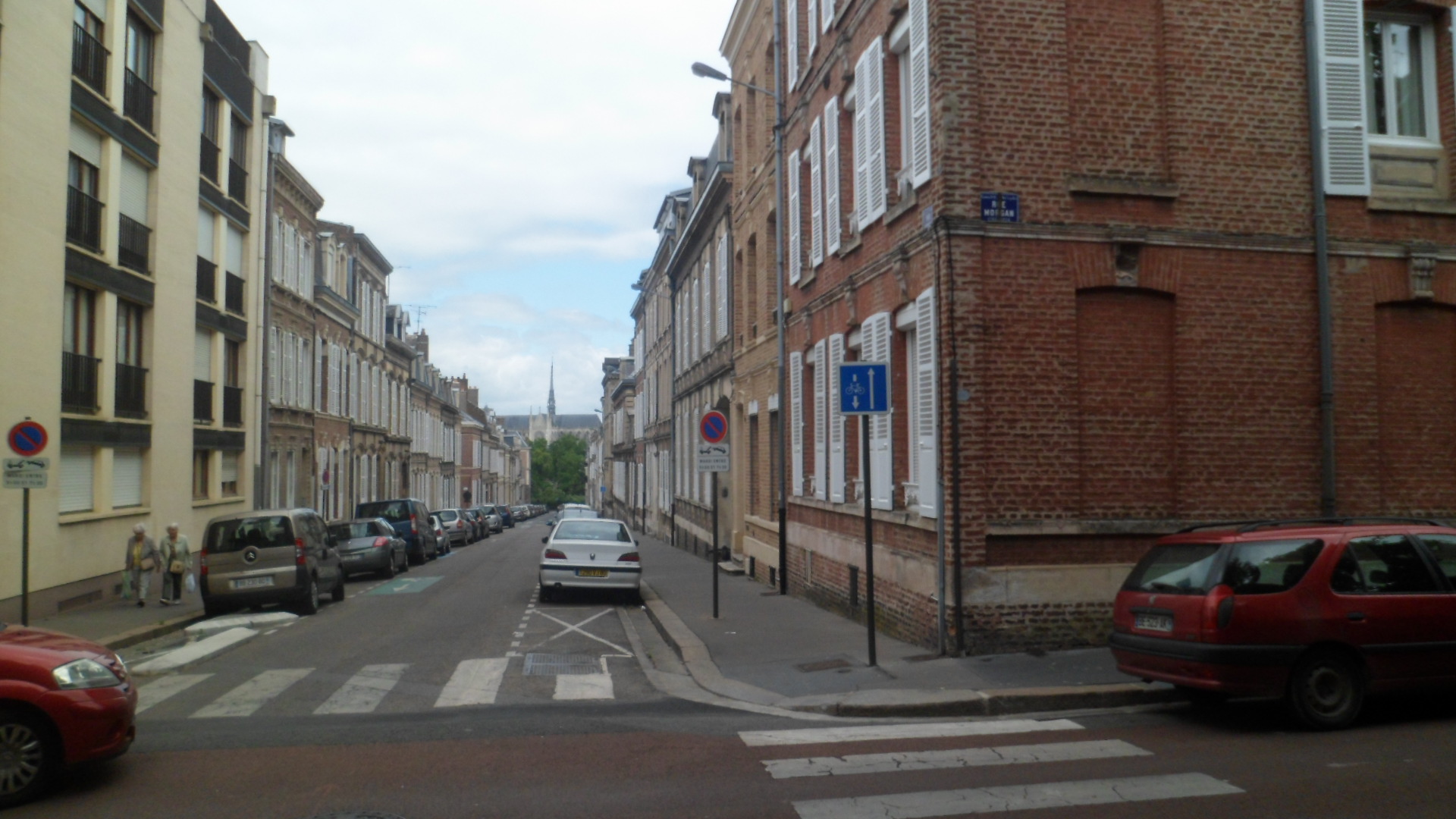
I crossed Boulevard Jules Verne, and headed for La Coupole.  En route, this slice of Amiens’ northeast side invited a photo.

SAM_0695

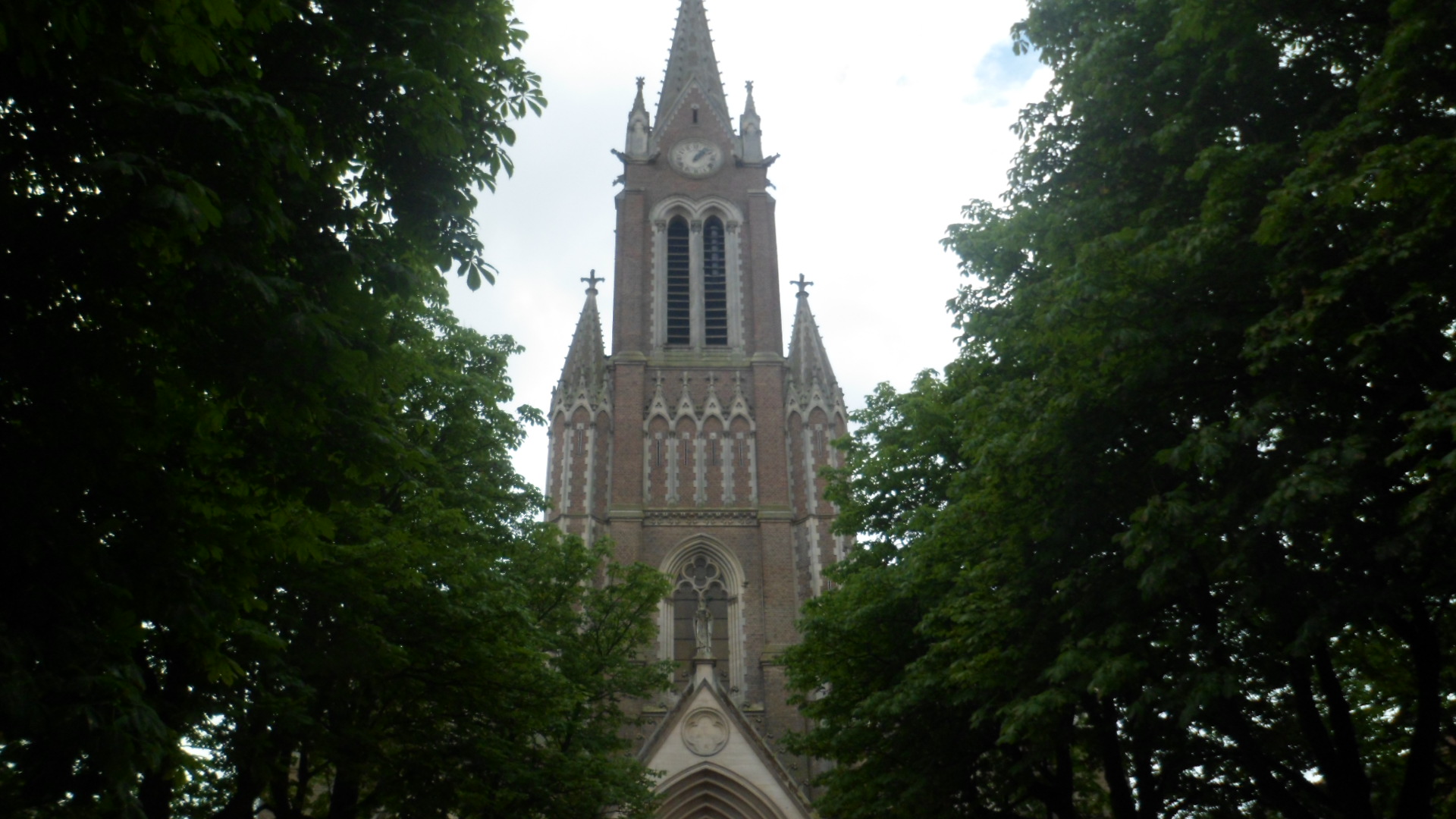
I also spotted L’Eglise St. Esprit.

SAM_0696

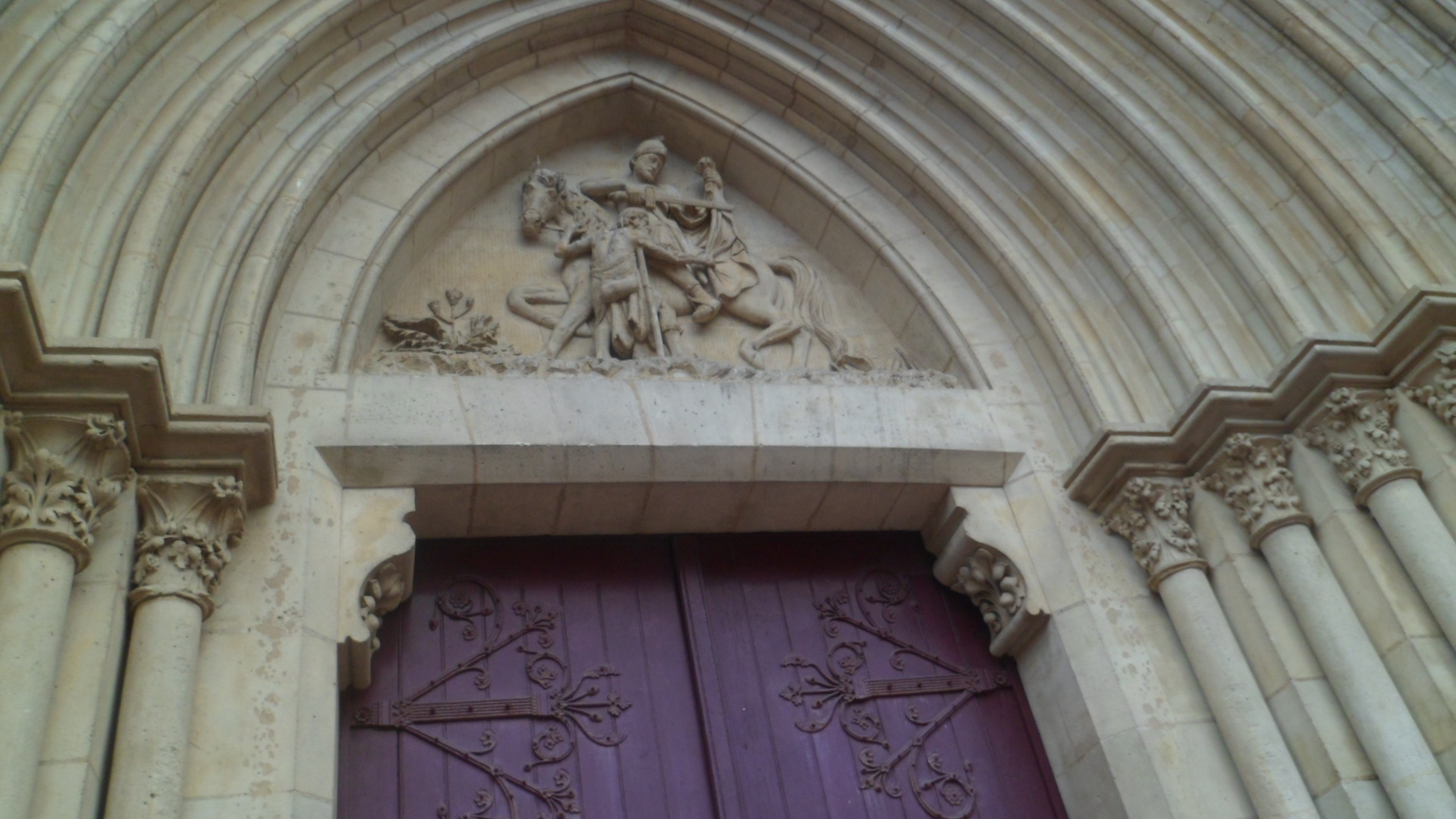
The tympanum shows St. Martin of Tours.SAM_0699

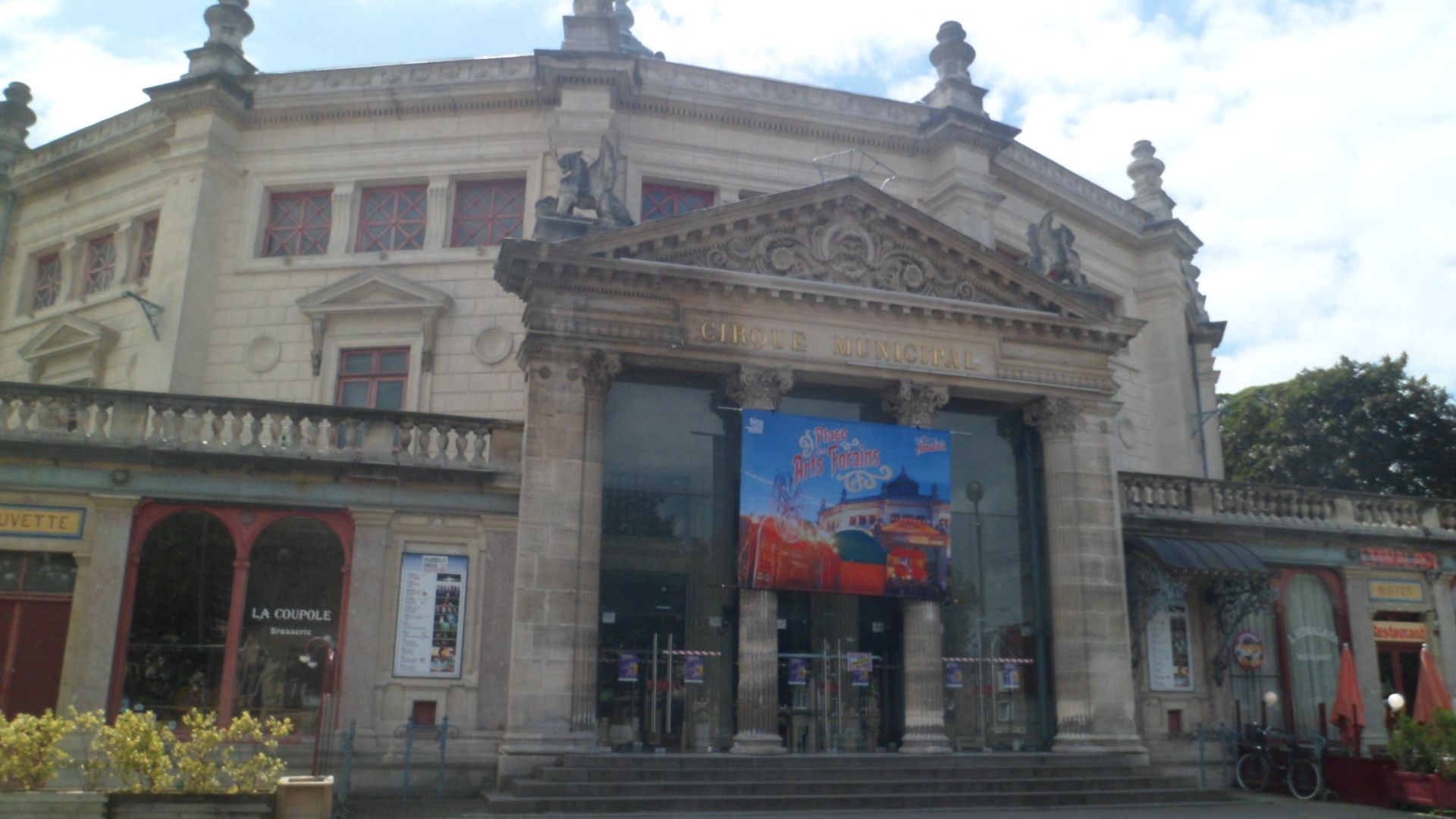
Lunchtime was coming, though, so on to La Coupole it was.

SAM_0704

Here is a gem:  Restaurant Himalaya.  Indian cuisine, served in the French style, is second to none.  Madame Celine, the French wife of the establishment’s Indian chef, is a most energetic and gracious hostess.  I thoroughly relished the Lamb Vindaloo, naan with various spreads, and separated milk dessert, in this lovely atmosphere.  I would find out later, from an Indian couple who were headed home to Lucknow, via Paris of course, that there is a strong connection between France and India- and not just in Pondicherry and Mahe.

SAM_0705

SAM_0706

It was nearing 2 PM, and time for the hard-working proprietors to rest, so I walked through Cirque Jules Verne, and squares dedicated to Annie Fratellini and Arlette Gruss.  Mlle. Fratellini was one of France’s most famous circus clowns, and a talented singer and actress, as well. Mlle. Gruss was also a circus performer, who taught the performing arts for several years, across France. The circus in France, during their heyday, was more focused on the prowess of humans than the forcible humiliation of animals.

Across from the Cirque and La Coupole, is L’Eglise de la Paix.  Here, a young girl was teasing her little brother, stopping when she saw me approaching.  I was glad to be a source of relief to the poor child, and was also gratified by these sights.

SAM_0708

SAM_0712

Perhaps most gratifying of all was this plaque, memorializing Corine Seguin, who was murdered by Peru’s Shining Path guerrillas, in 1988.

SAM_0709

I also passed a Polish church:  L’Eglise Matki Boze Czestochowski, en route to the Grand Marche.  This is hardly surprising.  Immigrants from east central Europe have flocked to French mill towns for over a hundred years.

SAM_0717

I knew the end of my afternoon walkabout was coming, upon reaching Hotel de Ville d’ Amiens (City Hall).

SAM_0718

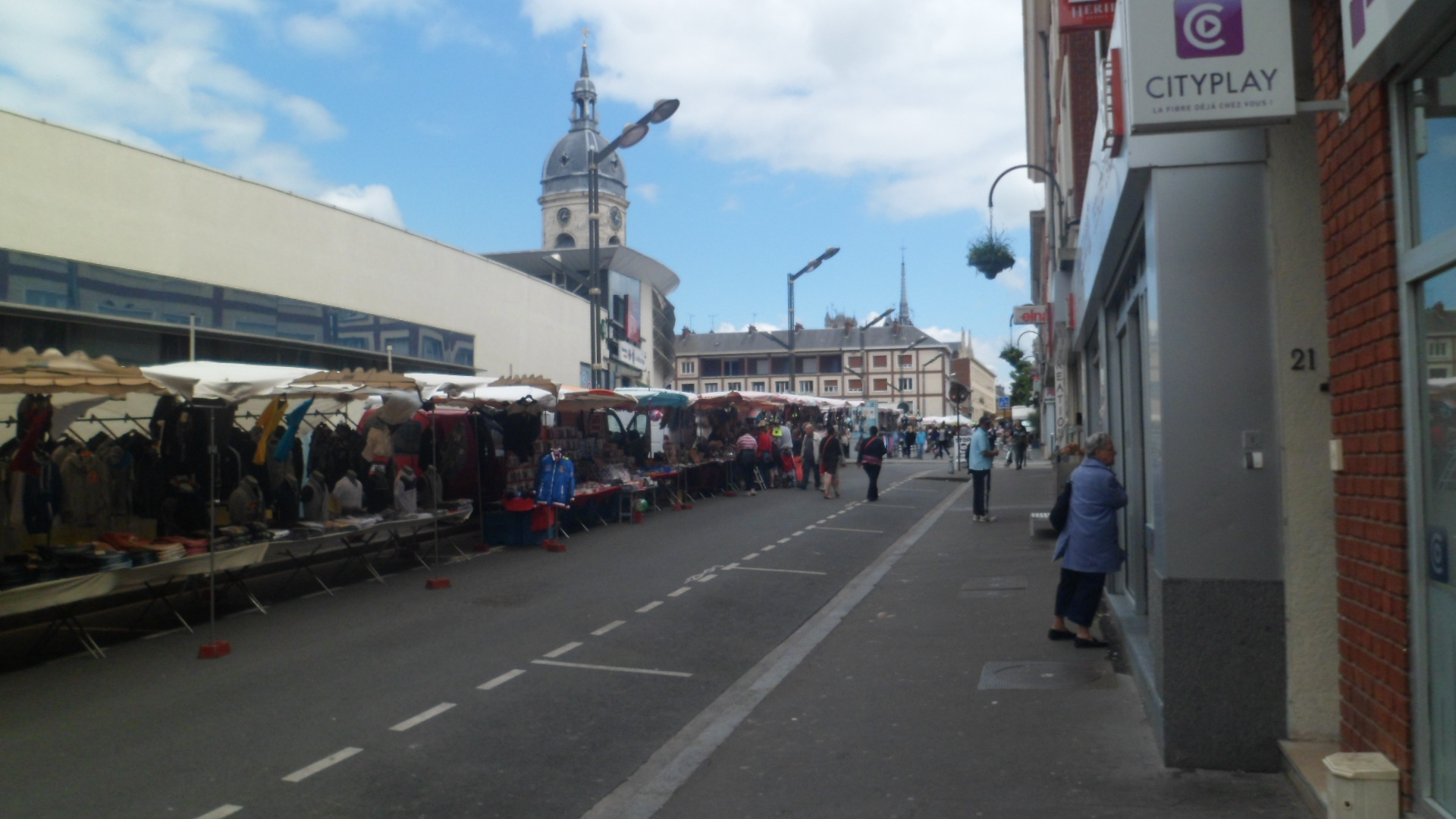
This is also the area of Grand Marche, which includes the Flea Market.

SAM_0722

SAM_0724

SAM_0725

Amiens is filled with many great landmarks, but has not neglected the present, or the future.  L’Universite de Picardie is a full-service, research-oriented institution.

SAM_0791

So it went, and I found yet another eclectic and cosmopolitan community, taking the bull of life by the horns, and welcoming visitors with great gusto.  I could easily come back to Amiens, for a slice of life at its finest.

An Eastward Homage, Day 19: Amiens, Part II- St. Firmin’s House

7

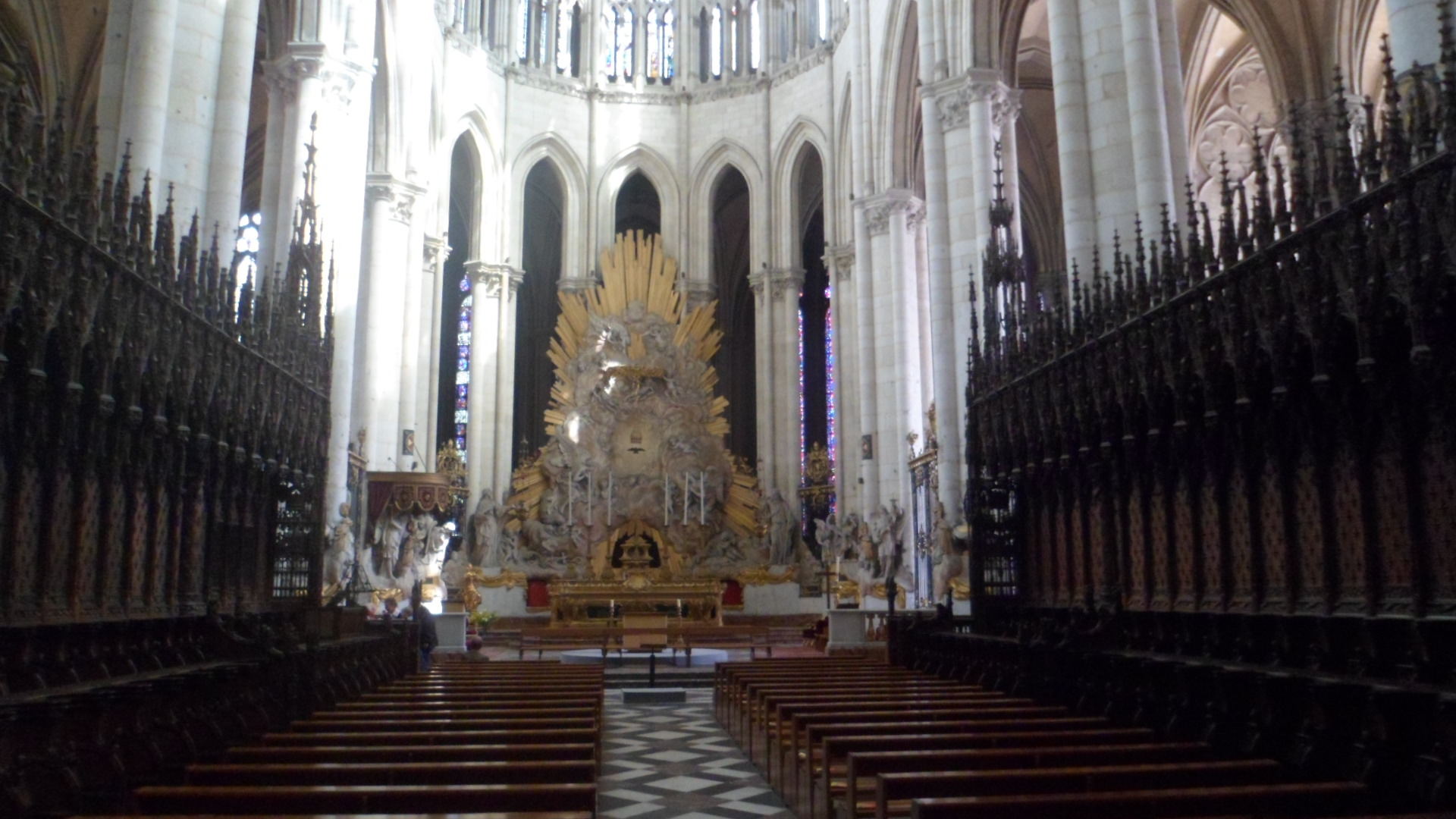
SAM_0625

The cathedrals of France, and of all Europe, present a grandeur, individual and collective. While offered ostensibly to pay homage to Christ, they were usually also intended to show the power and largesse of their patrons.  Lost in time and space, frequently, are the stories of the founders.
St. Firmin taught Christianity to the Picards, and put up the first church in an area outside the walls of Amiens, in the early Fourth Century AD.  For his pains, he was beheaded by the Romans.  The Picards, though, brought his church and its implements into the city, and by 1269, the main cathedral that we see today was in place.

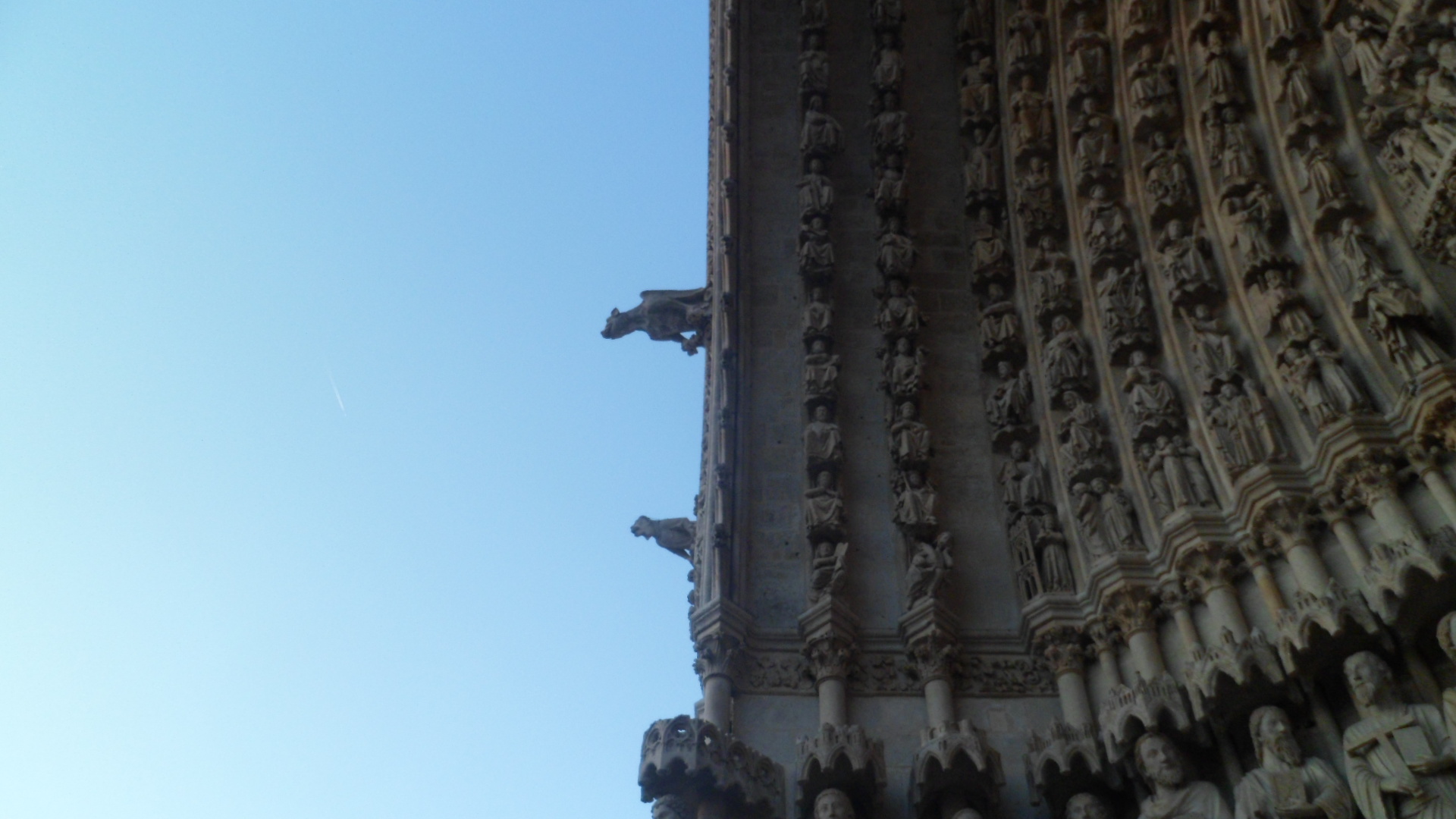
I began my visit, as usual, by circling around the exterior.  The spires, tympanum and outer shell exude the magnificence that reflected Amiens’ exemplary position between Flanders and Paris, and its relative proximity to the English Channel.  The city’s canals are also an outgrowth of the prosperity enjoyed by Picardy, during and after the Crusades of the 12th-14th Centuries and during the Renaissance of the North.

SAM_0628

The cathedral is bounded by gardens, on the west side.

SAM_0632

In this area, a young lady had a successful interview for an office position.  That it happened in an outdoor setting says much of Amiens.  That her poised and confident manner bore fruit says even more.  I saw little, if any, objectification of people here, or anywhere else in Europe.

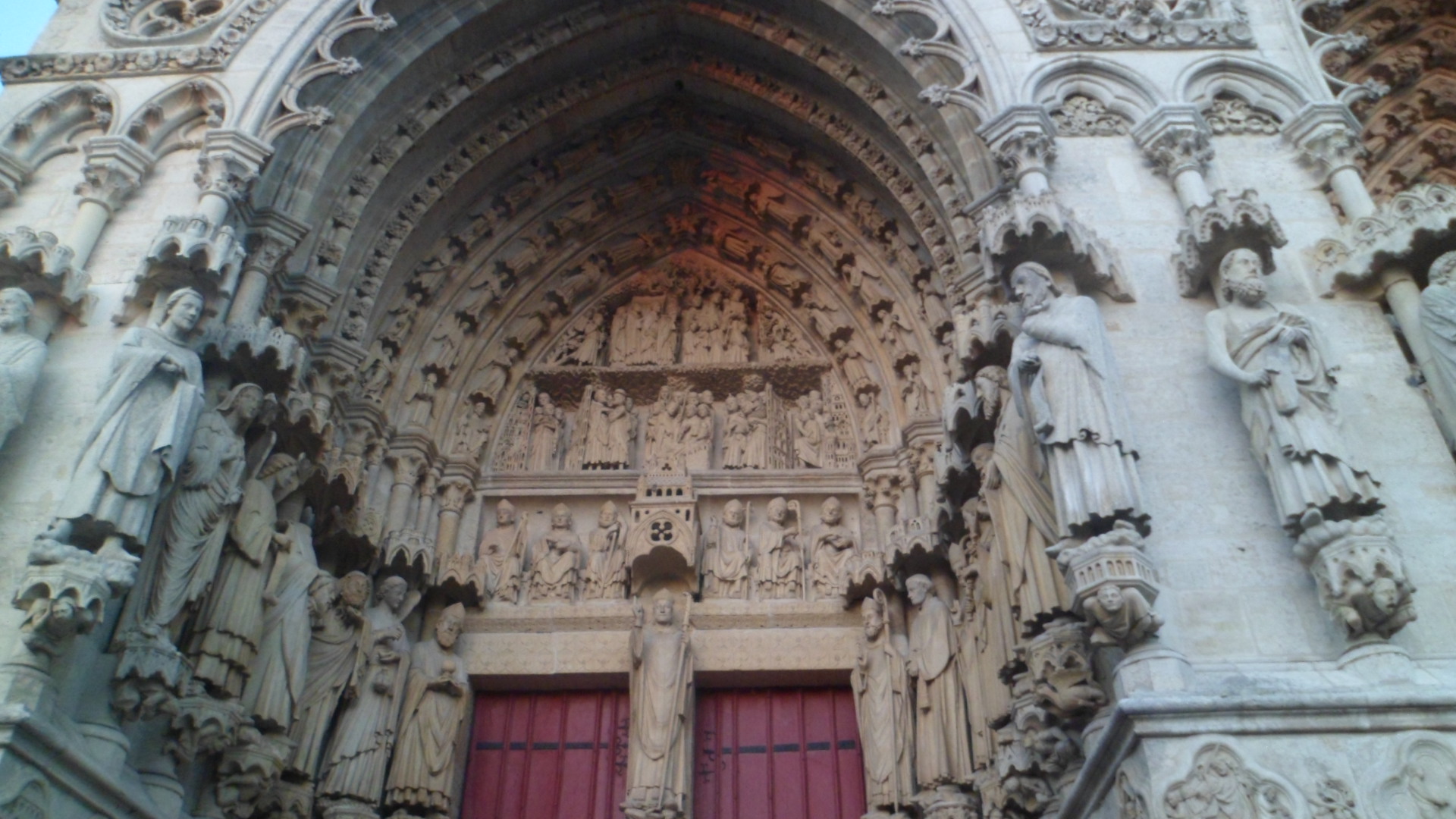
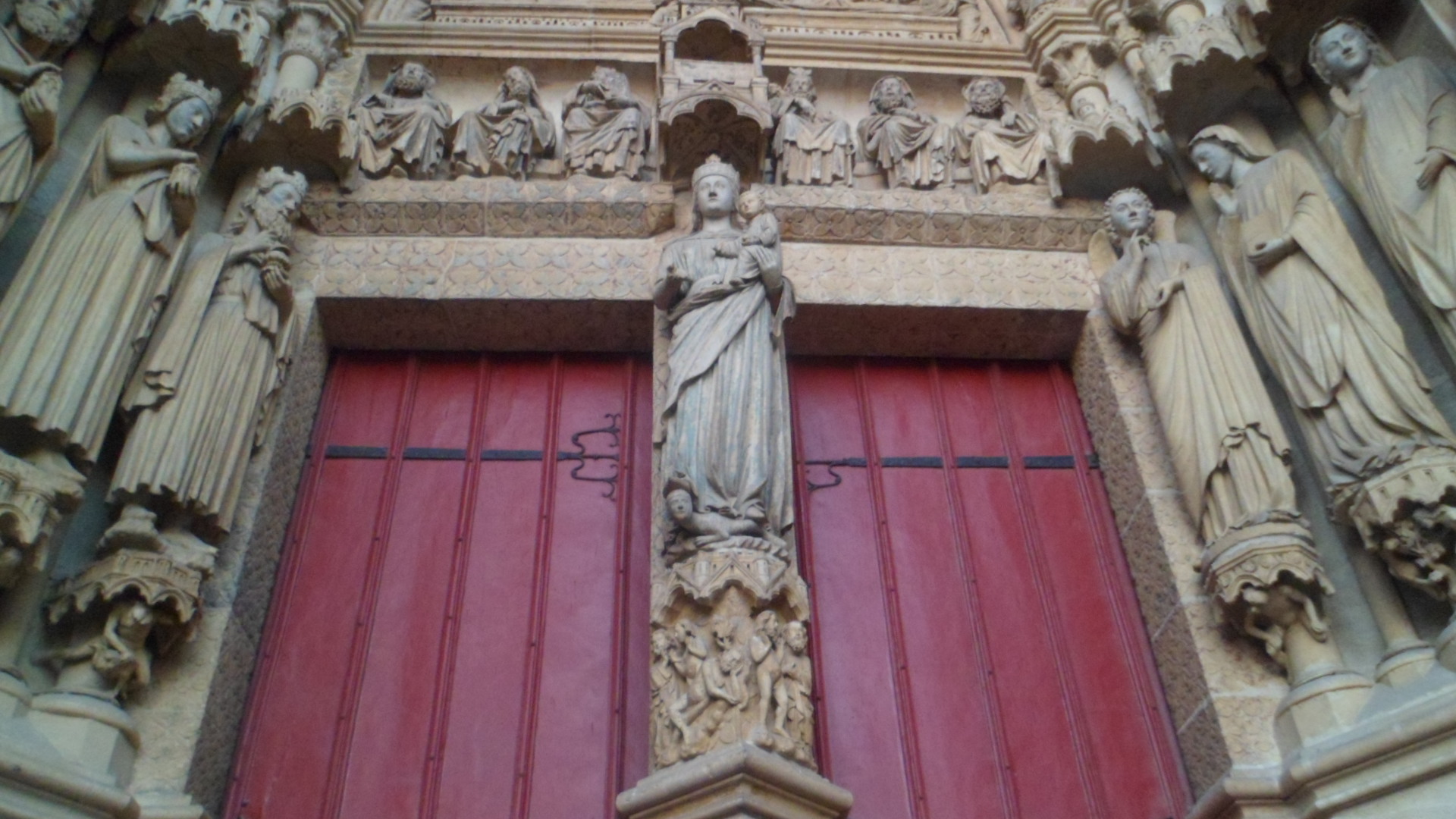
The tympanum, below, is dedicated to  St. Honore, whose relics were shown around, as a fund raiser for the 1260 iteration of the Cathedral.  His image is seen in the center of the front entrance.

SAM_0638

The tympanum is also graced by several of the great prophets of Judeo-Christian tradition.SAM_0641

Dragons abound here, representing the challenges of the world.SAM_0645

SAM_0650

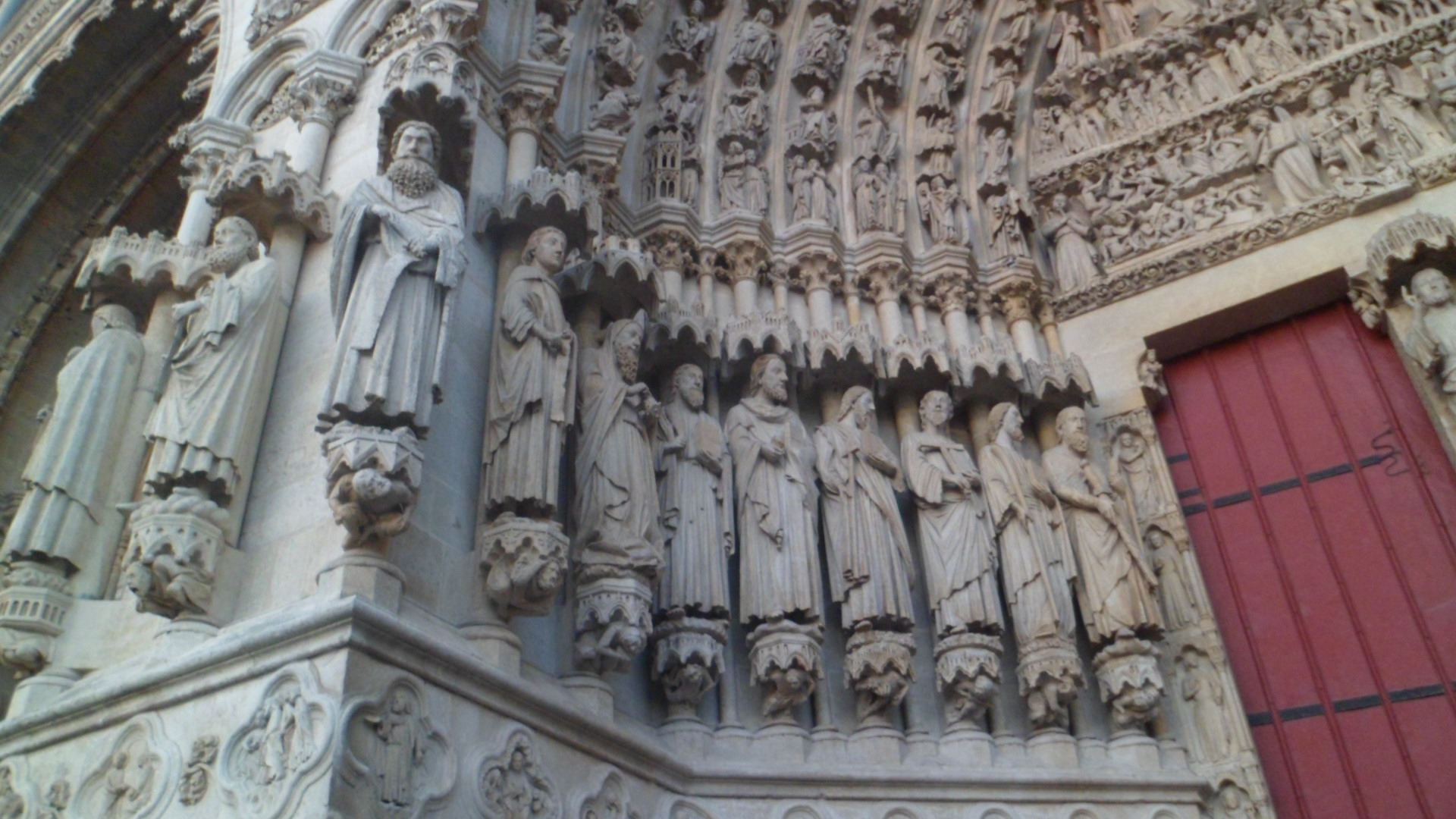
Before we go inside, here is a glance at Mother Mary, bounded by the saints of both genders.SAM_0647

The women of faith are quite prominent here.SAM_0648

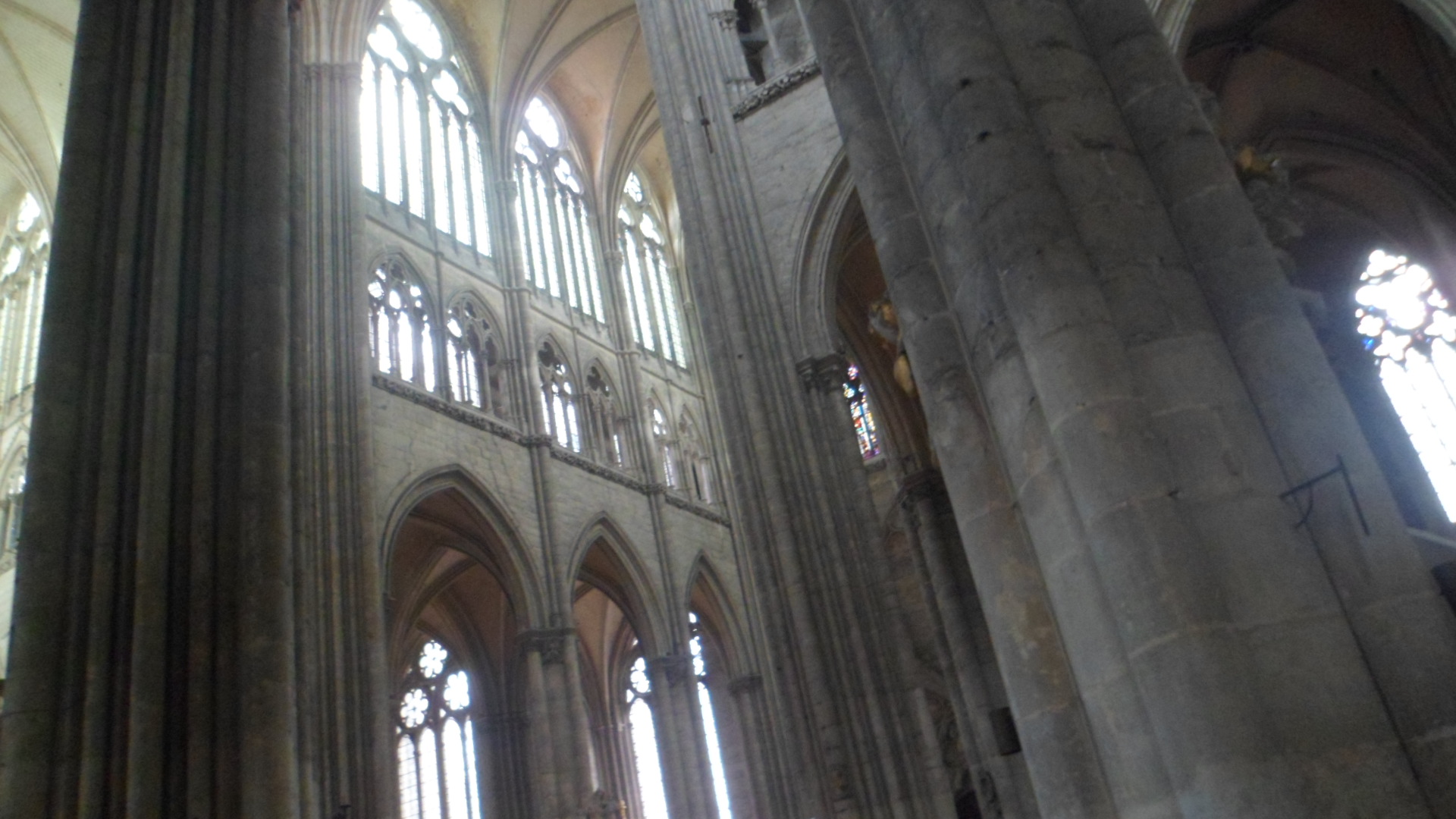
Now, on to the nave.  The worshipers show the scale of this venerable hall.

SAM_0734

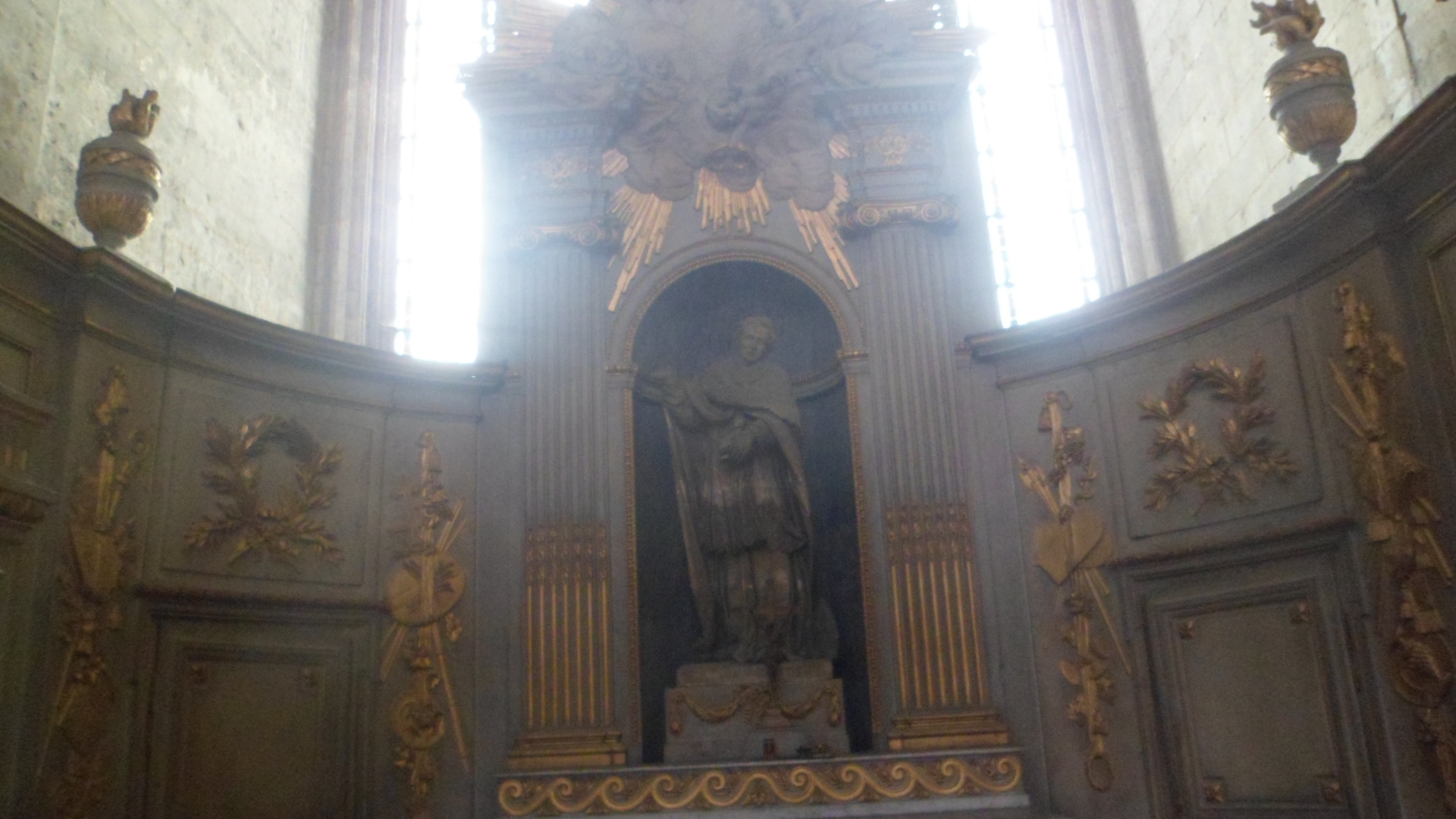
The Chapel of St. John the Evangelist is found immediately to the left, upon entering the Cathedral from the south.

SAM_0738

There is always a feeling of space, and of loftiness, in the hall.SAM_0742

Paint was used more extensively in cathedrals the north of France, perhaps reflecting the influence of the Flemish.  The scenes below are a reliquary of John the Baptist.

SAM_0744

SAM_0749

The Blessed Virgin is given her own Chapel, thus certifying the cathedral as Notre Dame d’ Amiens.SAM_0753

The preserved Church of St. Firmin acts as a bolster, spiritually, to the greater cathedral.

SAM_0756

Below, Mary and Jesus are honoured by a saint.SAM_0757

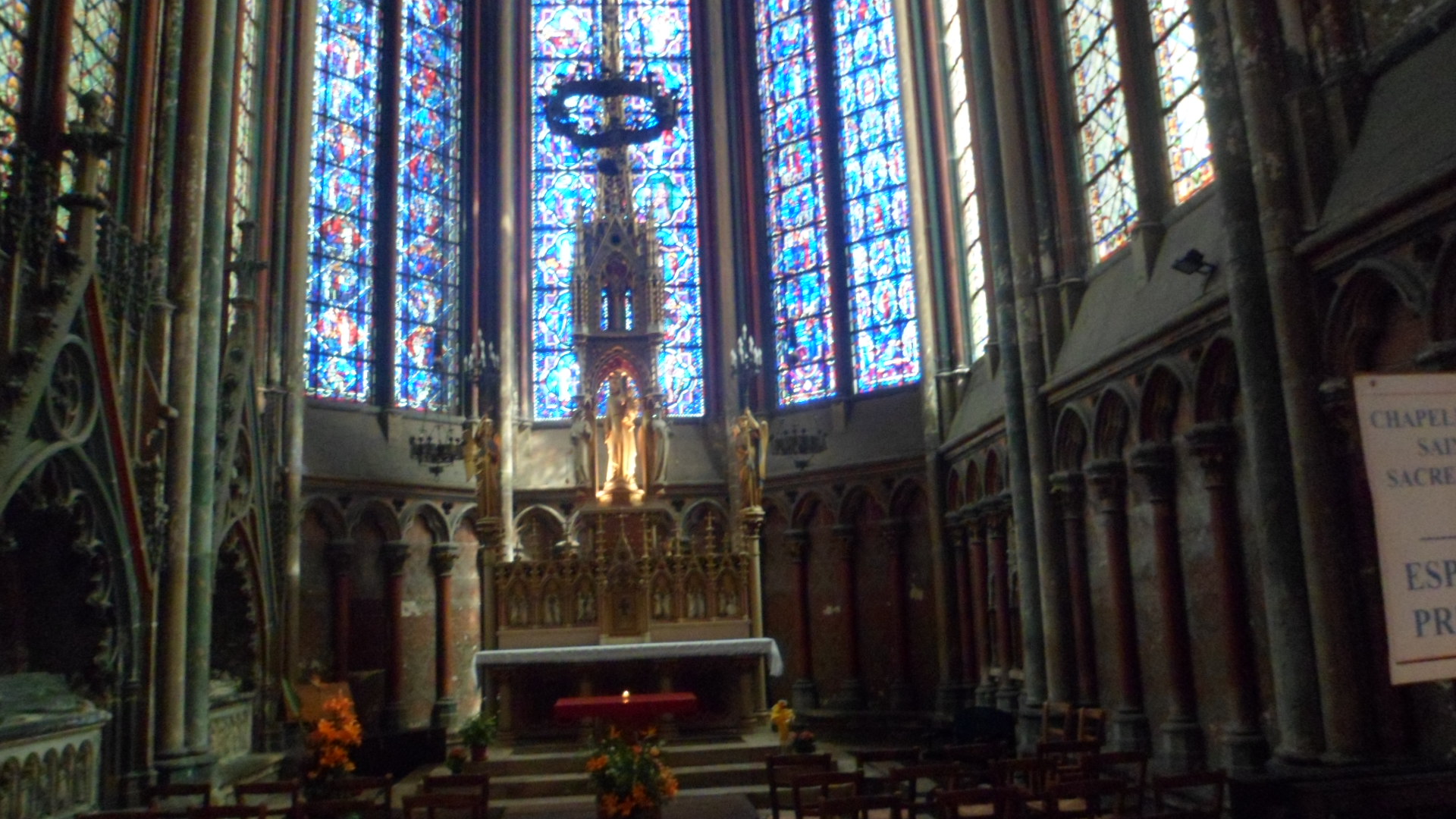
I came to the Chapel of the Virgin Mary, once past the Church of St. Firmin.SAM_0758

This is the Chapel of St. James the ElderSAM_0761

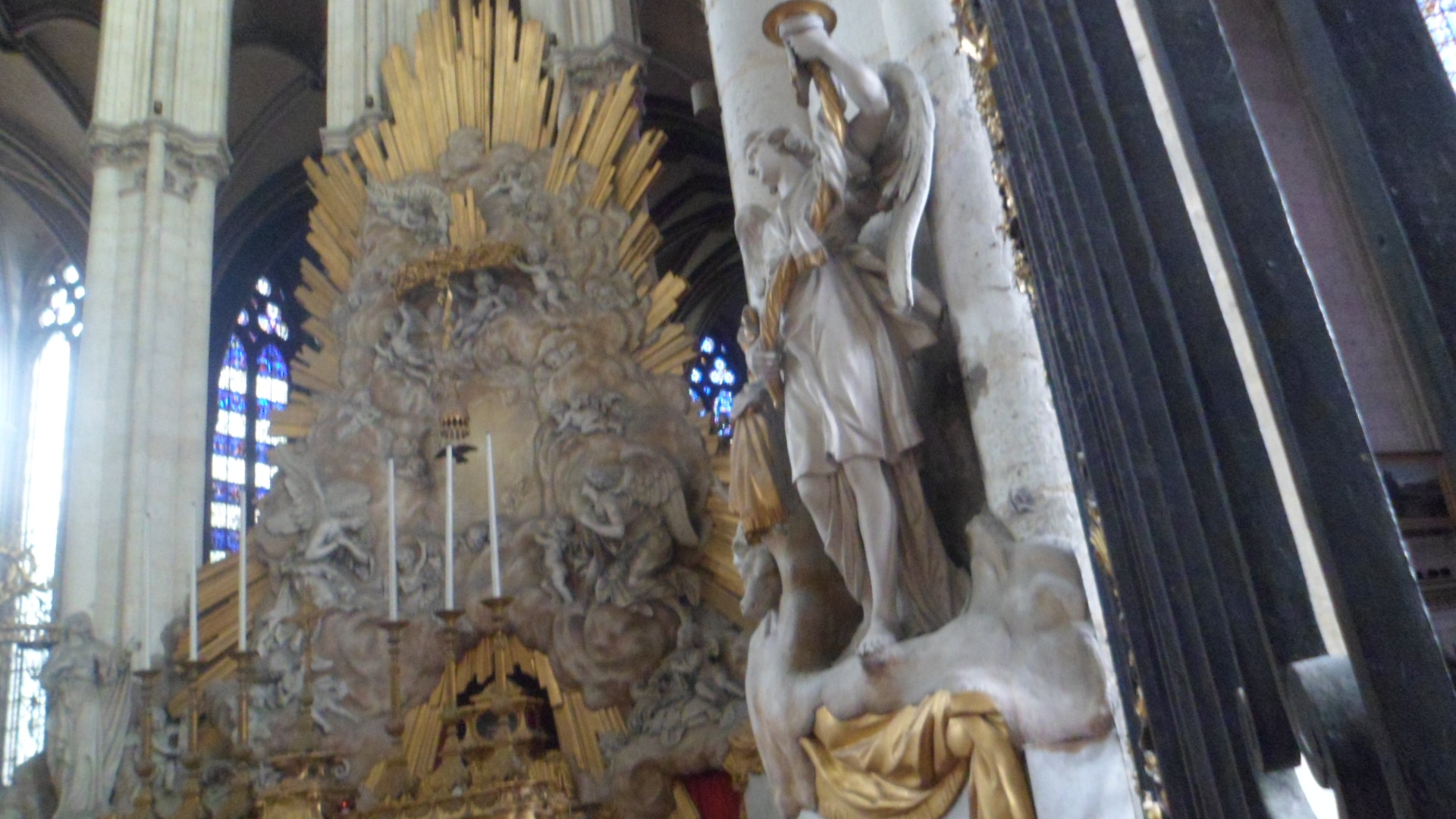
The Grand Altar, and its gold, stem from the time of Louis XIV.SAM_0764

A chapel devoted to St. Jeanne d’ Arc is found to the right of St. James’ chapel.SAM_0768

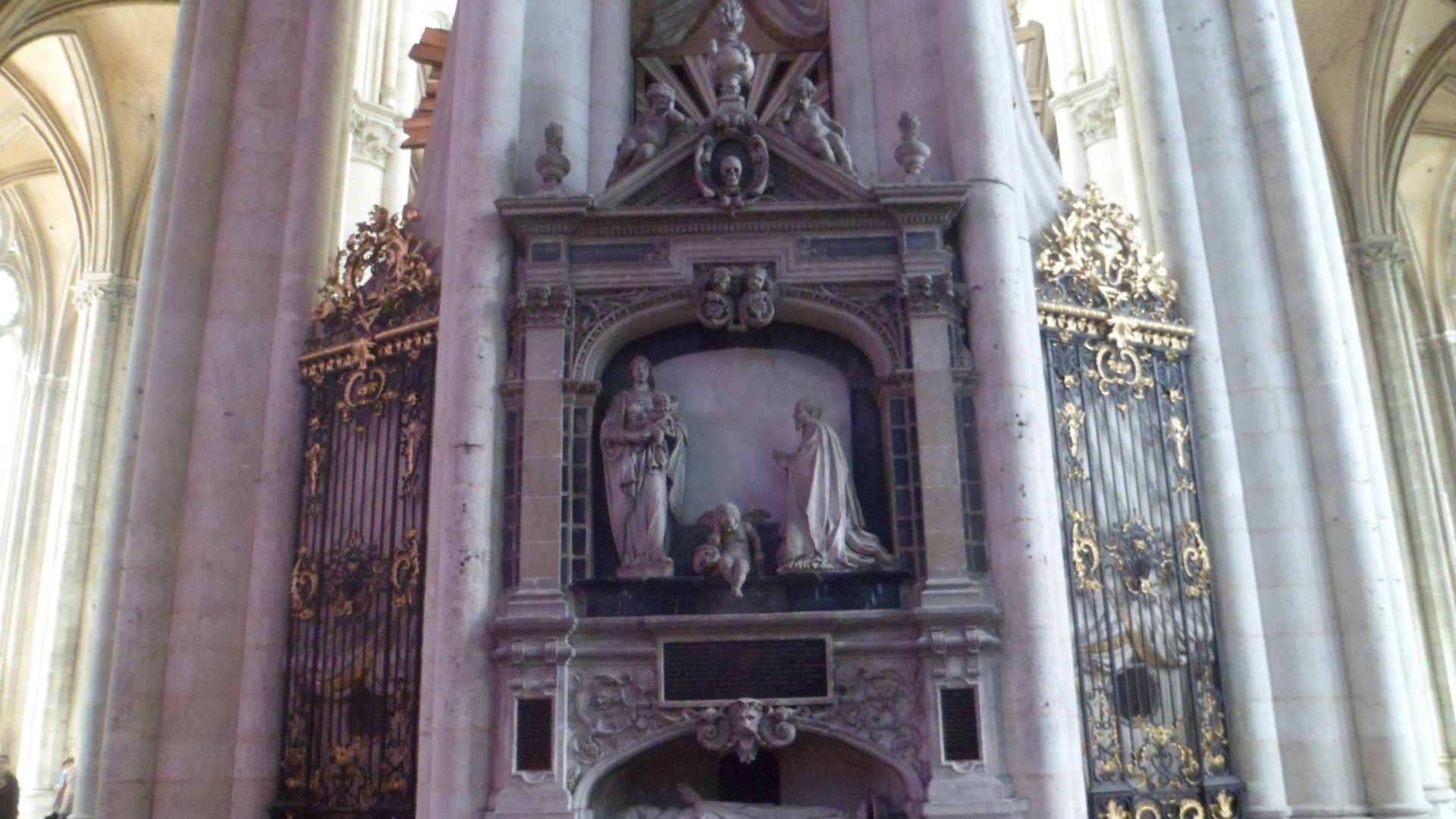
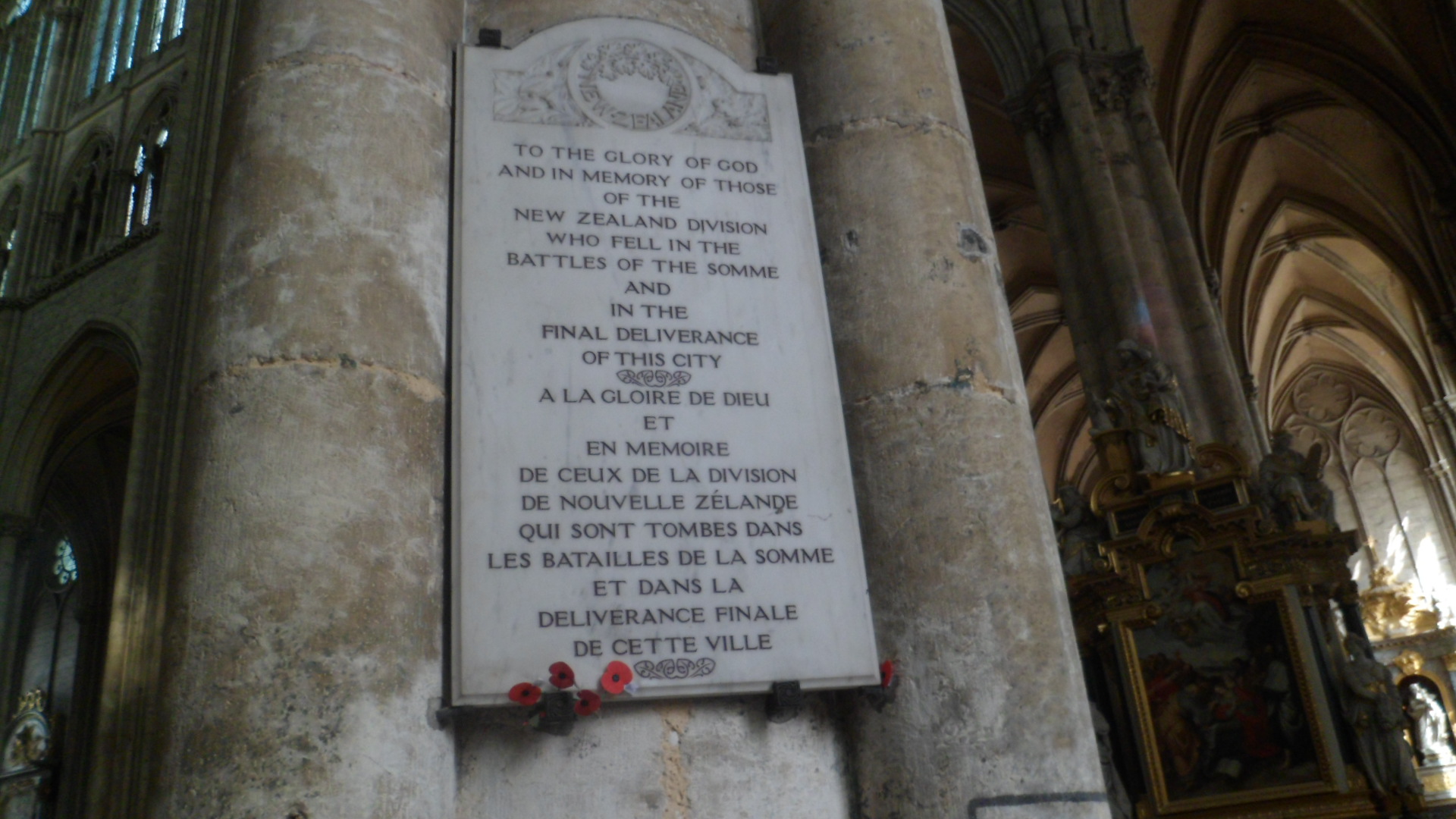
A trio of memorials to the fallen soldiers of World War I occupies the area to the right of the choir loft. The first honours the Canadian Dragoons.

SAM_0775

The second is dedicated to the fallen from New Zealand.

SAM_0778

There is a large memorial to the soldiers of Australia, at Villers Bretonneux, 16 km east of Amiens.  Hopefully, I will pay my respects there in 2017, along with visiting sites associated with American forces of that conflict.

The Grand Altar, in its glory, was my final view of Notre Dame d’Amiens, St. Firimin’s House.  It is another bit of magnificence.  Yet, as another observer mentioned, no one cathedral can be compared with another.

SAM_0782

NEXT: A Circular Tour Around Amiens

An Eastward Homage, Day 19: Amiens, Part I- The Queenly Somme and Her Canals

4

June 14, 2014-  In planning my trip to France, I was drawn to Amiens by two factors:  The Somme, and its role in World War I, the Centenary of which  we begin to observe this year; and the fact that some of my online friends have a friend living in the capital of Picardie.

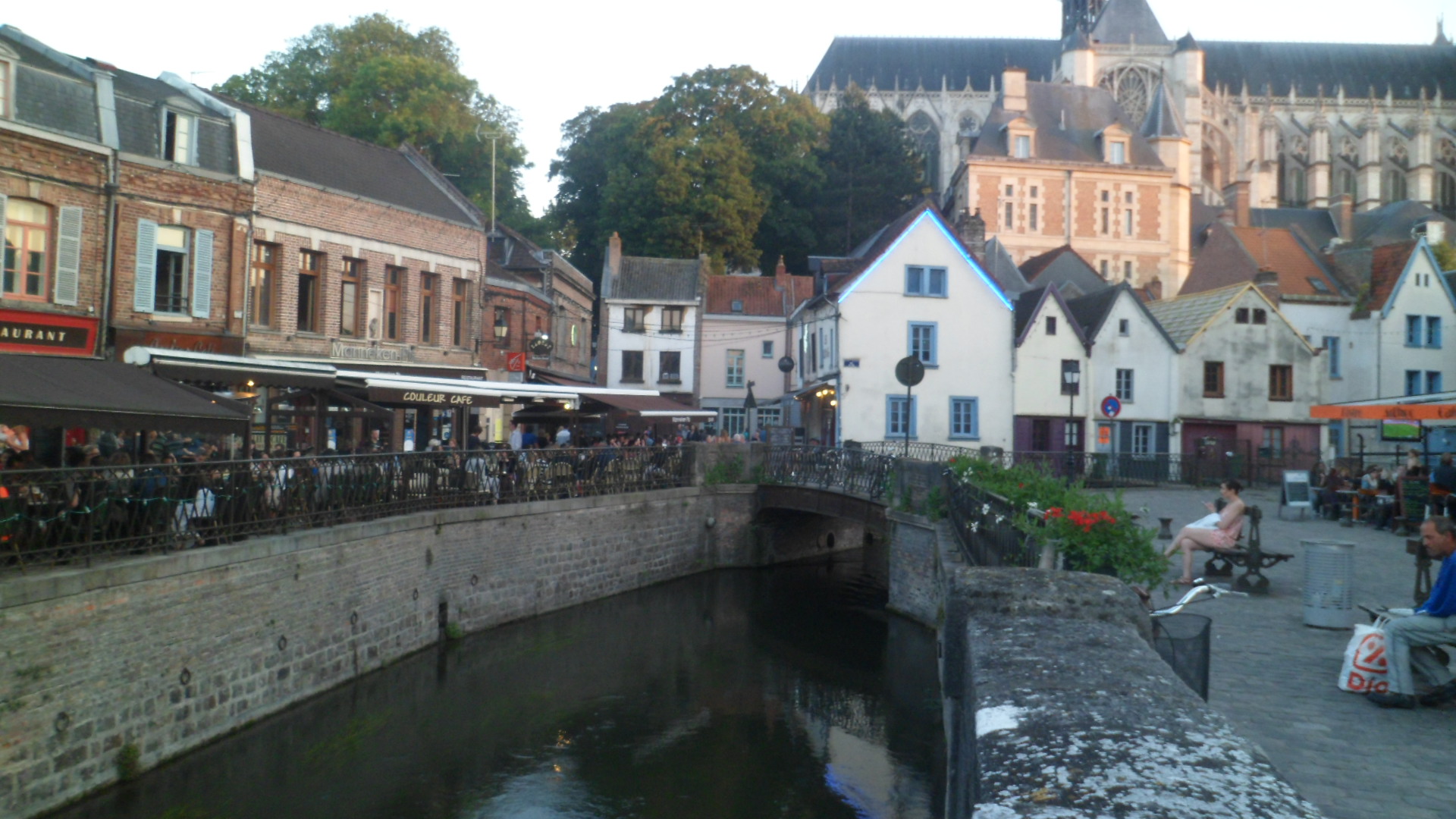
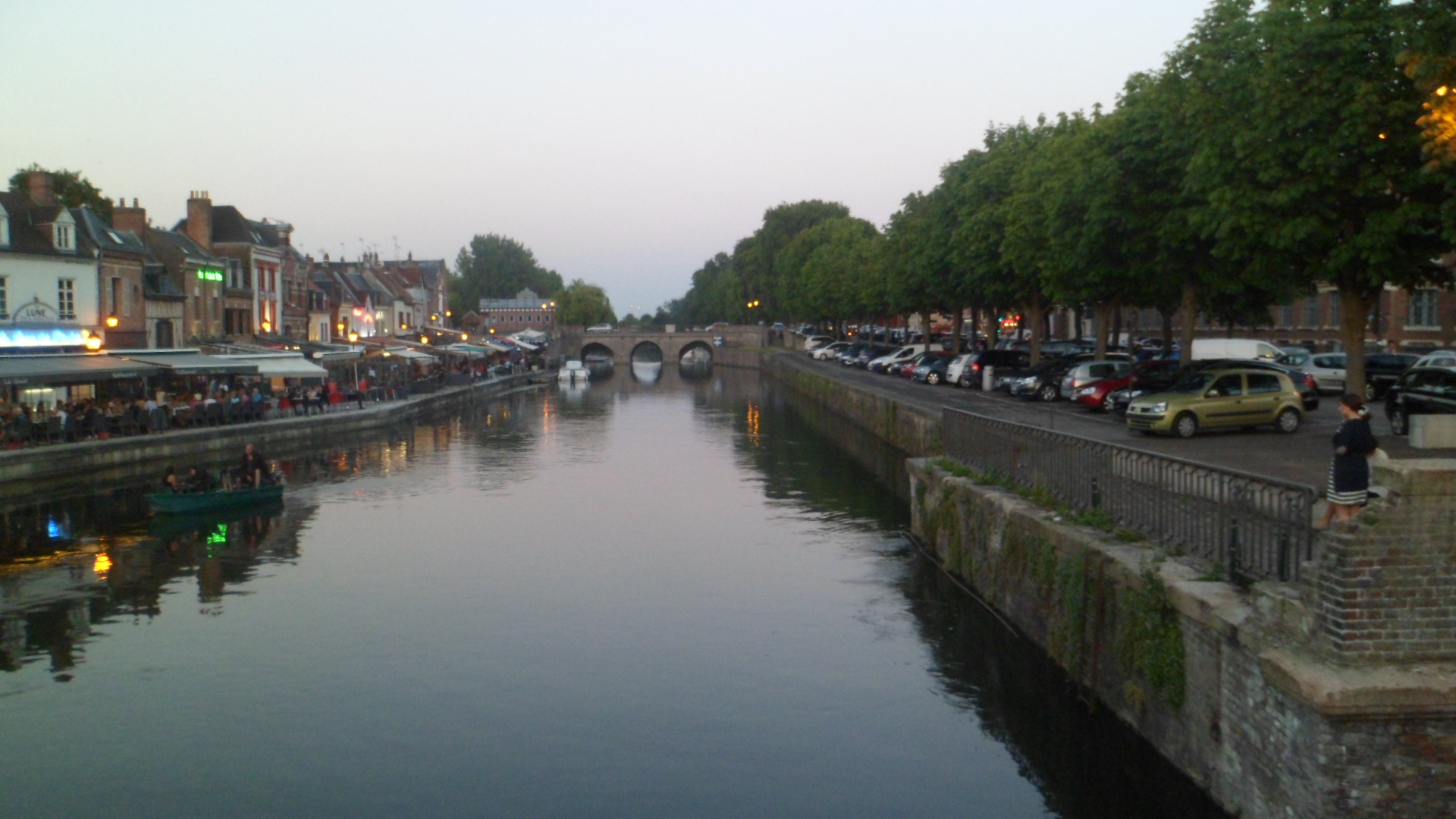
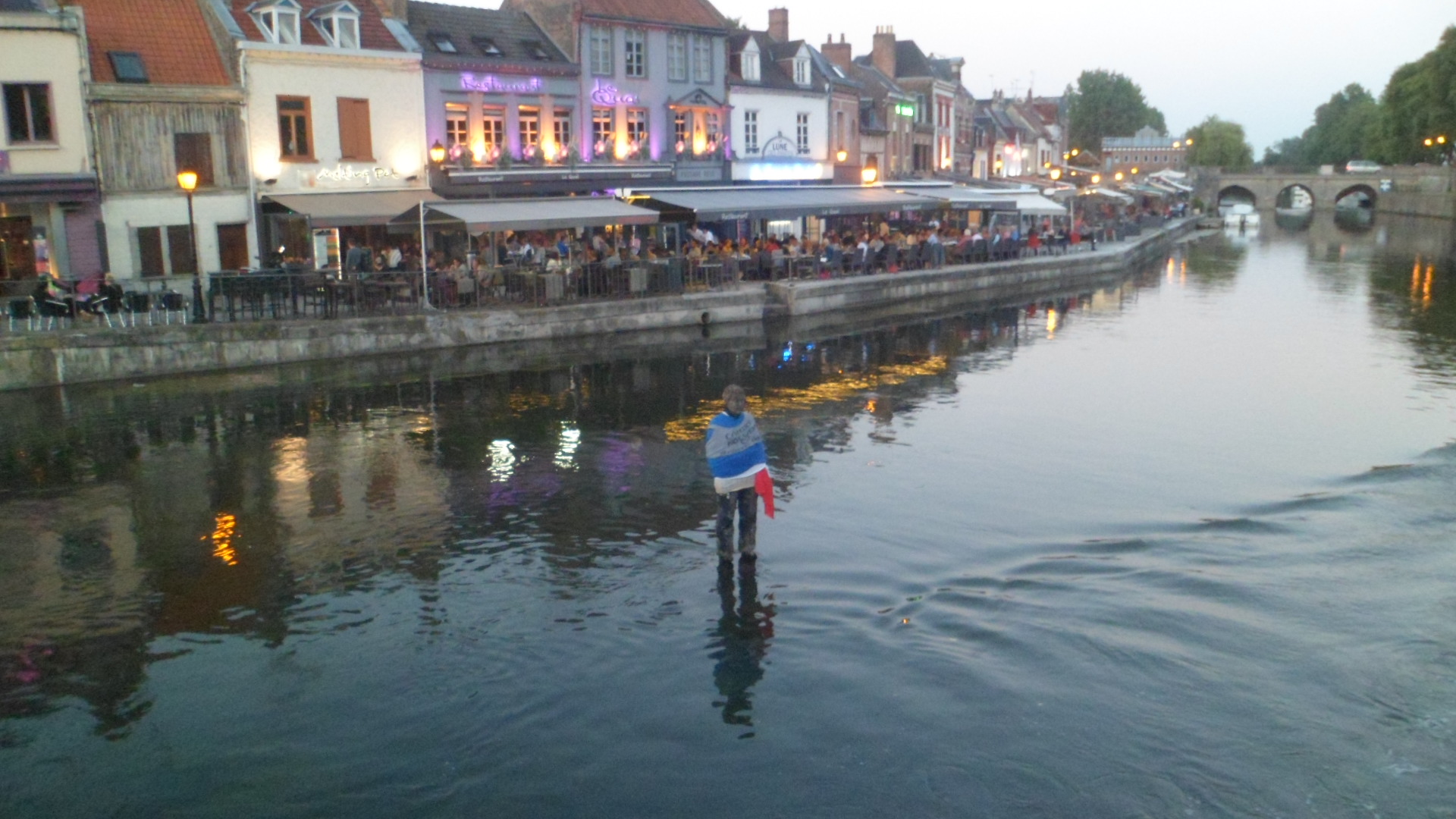
When I arrived in Amiens, it was a Friday night, with the bars and restaurants quite alive- at 11 PM.  I found the Picard spirit of friendliness, coquetry among the young ladies and a “Where’ve ya been, Bud?” atmosphere pervading the Grand Canal and the district called St. Leu.  My huge hotel was a tomb, by comparison- despite the gracious welcome by desk clerk Therese and the raucous group of Turks next door to my room.

I headed along the canal, and the edge of the Cathedral District.  I will present Amiens in three parts:  The water, both river and canal; the cathedral, interior and exterior; and the city centre, both medieval and modern.   Friday night and all day Saturday were one very full ride.  Never mind that I was walking- you get my drift!

Here are the canals and the towpaths in their midst.  It was a fabulously hoppin’ Nuit du Vendredi.

SAM_0621

Even though it looks quiet below, there was no silence for miles around.SAM_0662

As in much of Europe, the sidewalks don’t get rolled up much before 1 AM, if then.

SAM_0663

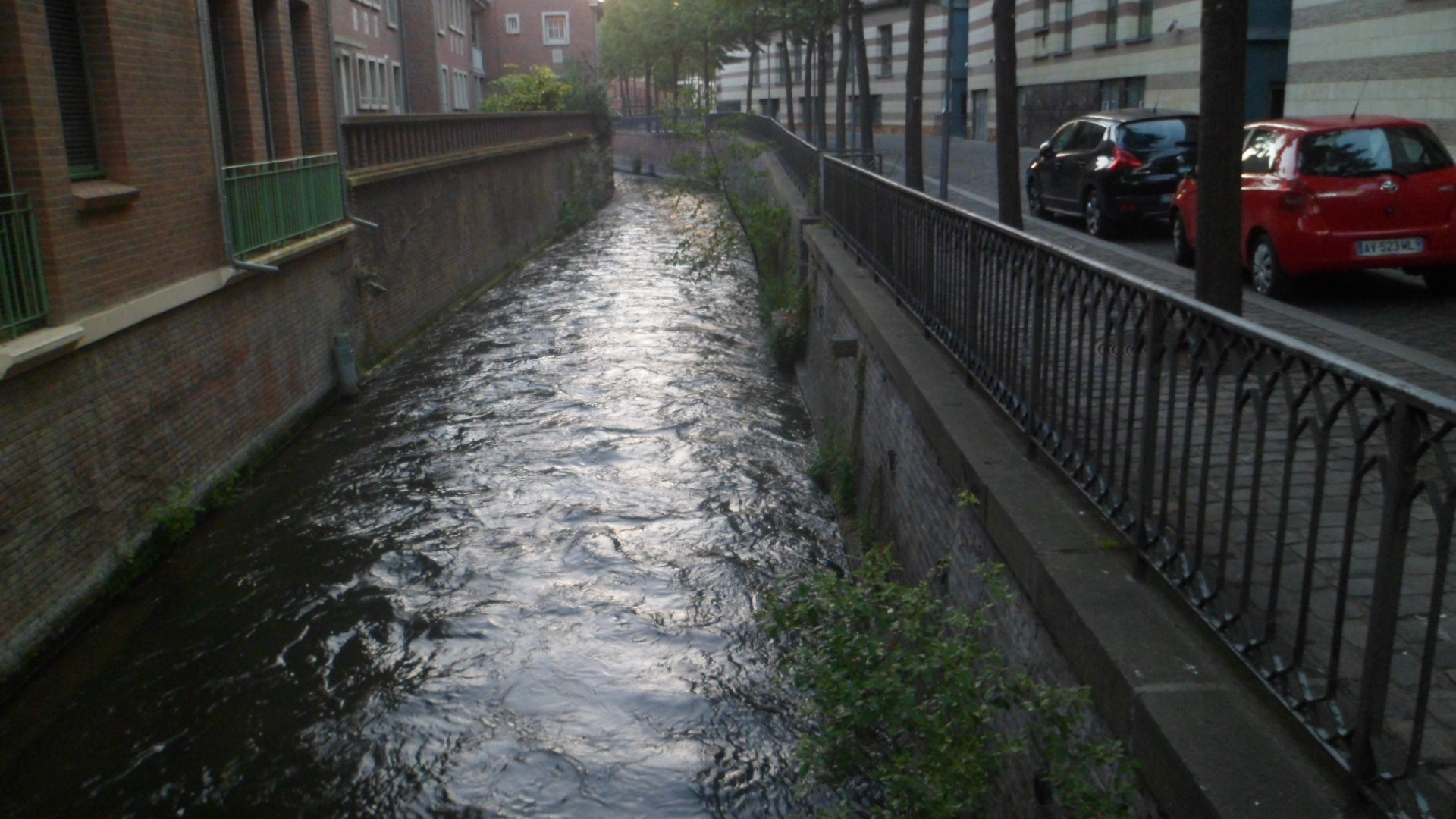
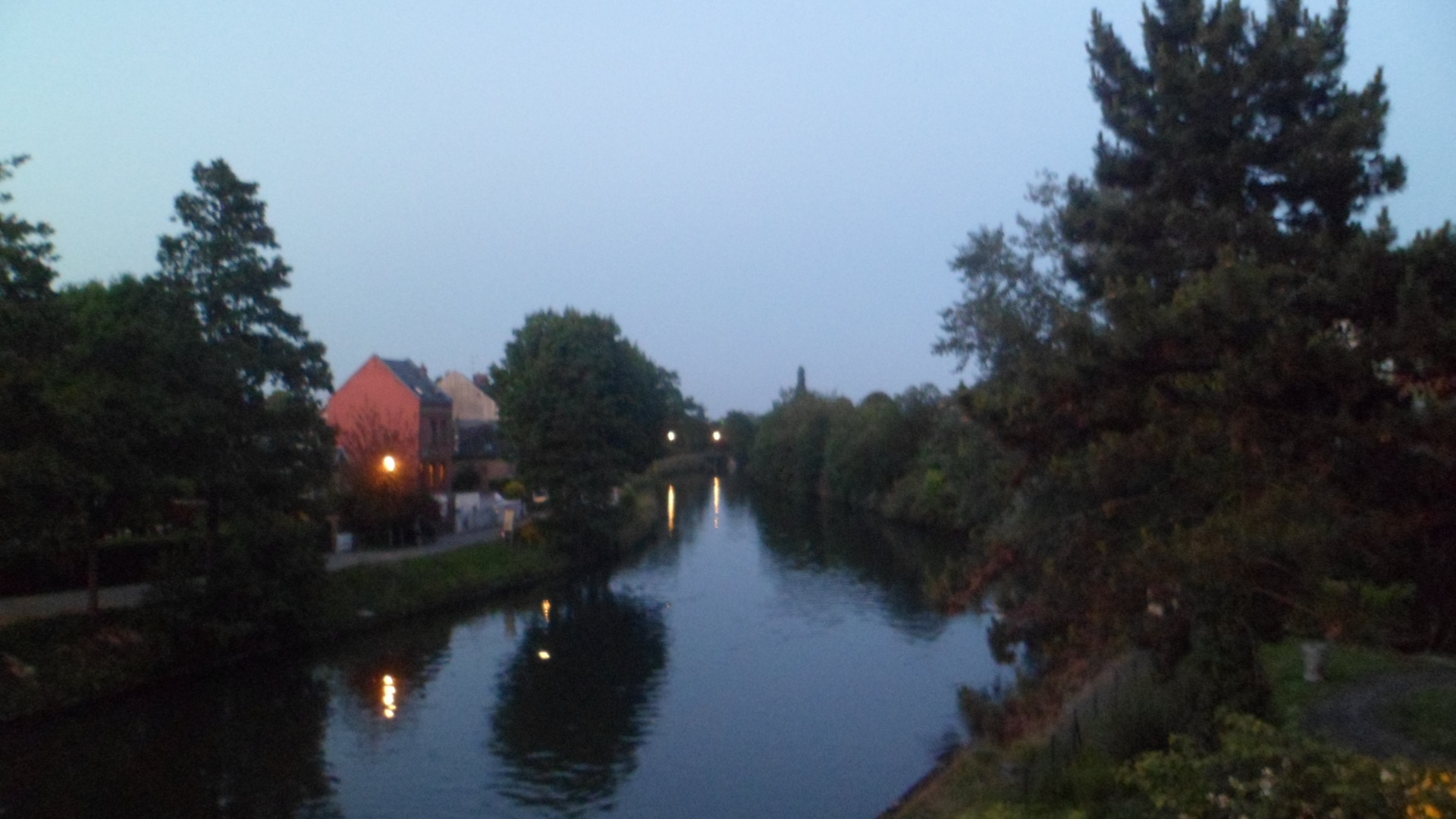
The canals look deep.

SAM_0622

SAM_0660

GOTCHA!

SAM_0661

Picard humour is evident everywhere, and I was drawn in a few times, as I will recount.  A local insisted I must be of Picard extraction, as my nose is prominent, like his and those of his family members.  I wouldn’t be surprised.  Picards would have naturally been swept along with the Normans, when they swept down out of the North Sea lanes, through Holland and Flanders.

SAM_0671

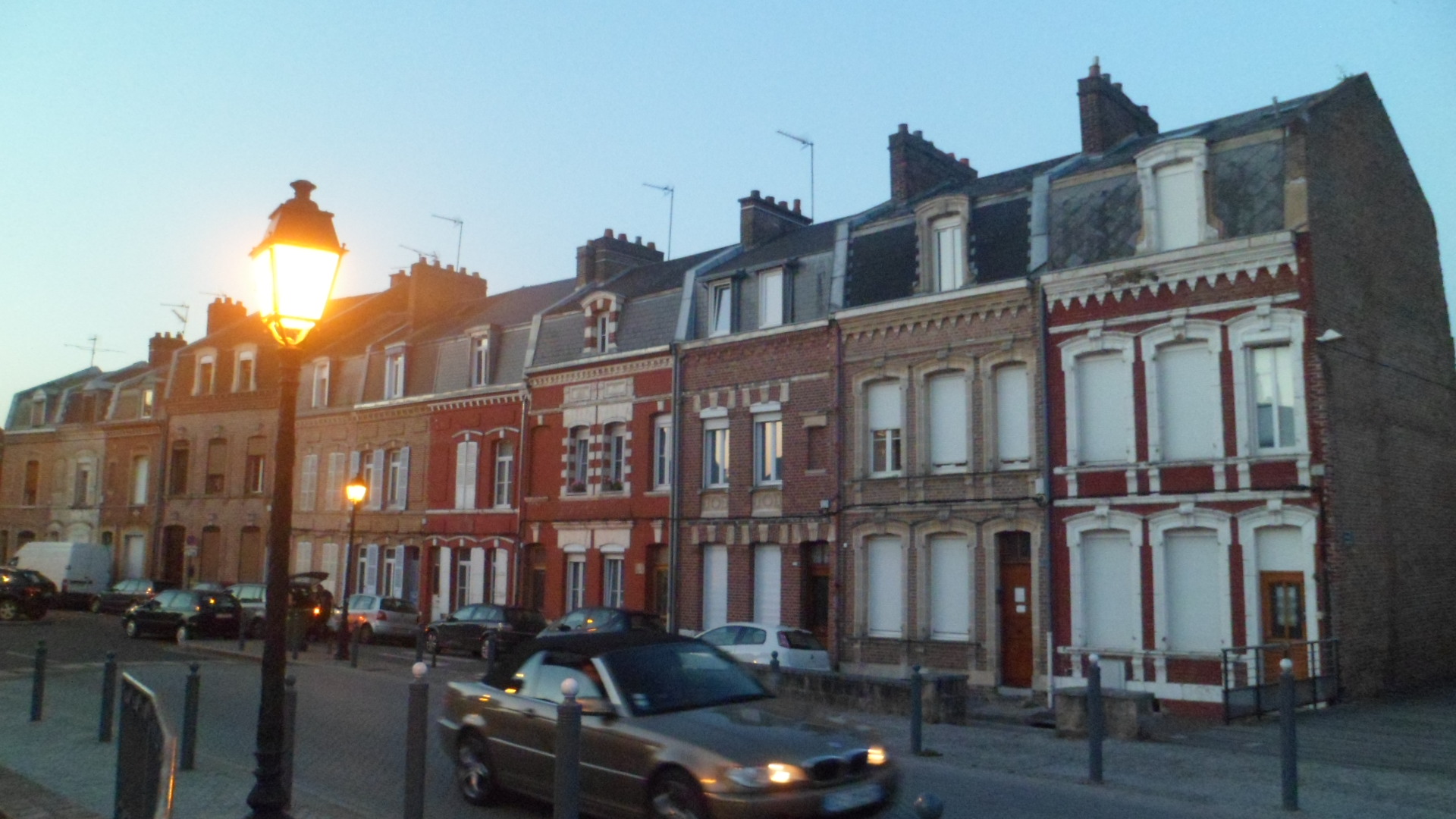
Amens, like many French towns, adopted the row house to billet workers, at the dawn of the Industrial Revolution.  This row is close to St. Leu.

SAM_0665

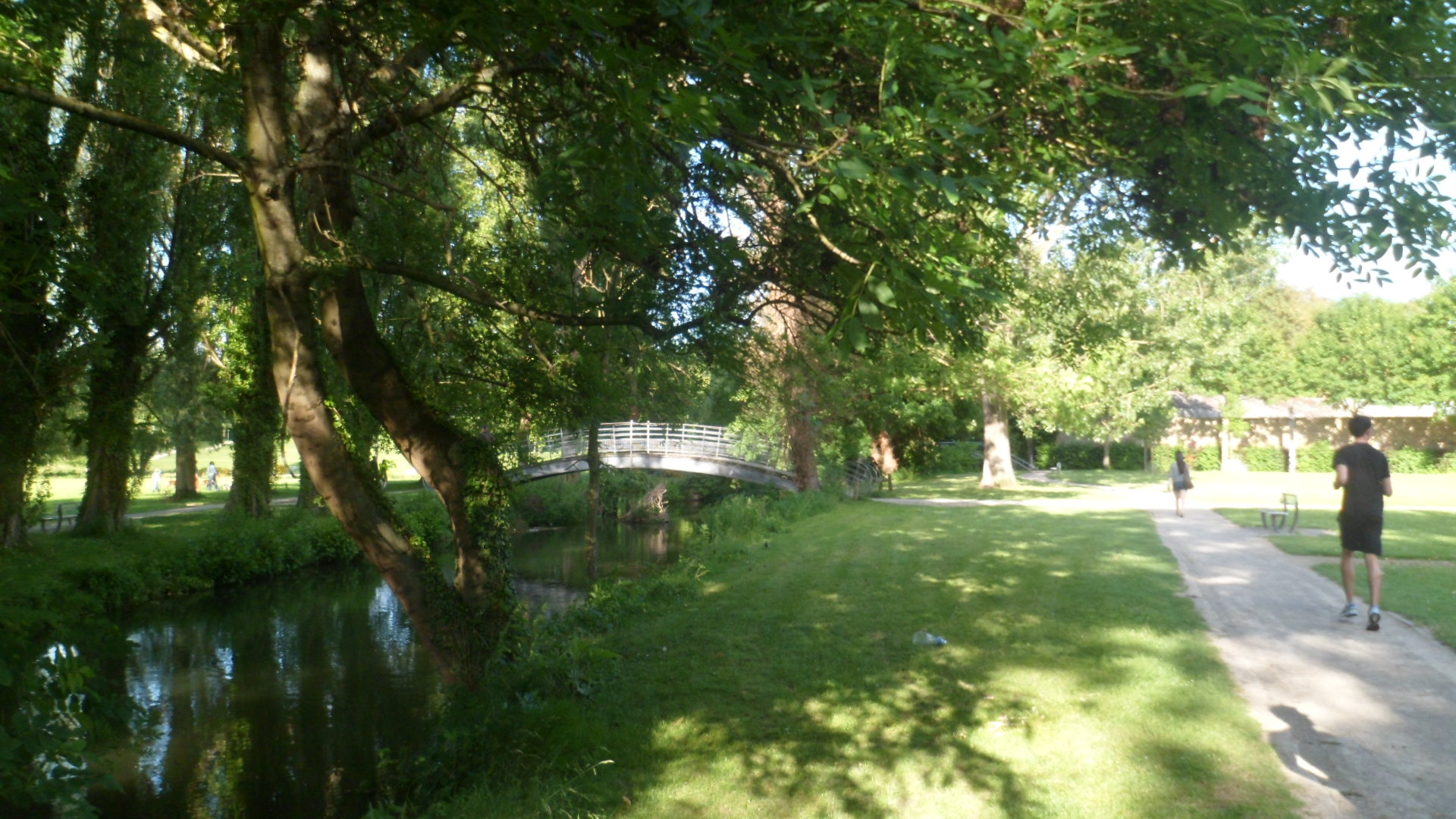
The linchpin of the Somme and its canals is Parc Saint Pierre.

SAM_0794

SAM_0795

The true radiance of the water, this far north, and at this time of day, comes from its interplay with light.

SAM_0797

SAM_0804

SAM_0806

SAM_0810

SAM_0813

A bit “sideways” and to the north, a tad, is the crown jewel of this part of the Somme:  L’Hortillonage.  Let’s have a look.  Down the stairs we go.

SAM_0815

There is more cat and mouse, between light and shadow.  This is where the natural flora of the Somme is preserved.

SAM_0819

SAM_0822

A cat is feigning stealth.

SAM_0834

The Somme emerges from its canals and small locks.

SAM_0829

SAM_0843

Here, the farmer and the naturalist have made a peace.

SAM_0836

SAM_0839

I met a farmer, walking his dog, near here.  He reminded me of the friend of my Xanga friends, a man I have seen only in his profile picture when he responds to aforementioned mutual Cyberpals.  Amiens has kept its natural profile quite well.

NEXT:  The Ins and Outs of Amiens Cathedral