March 20, 2024- An old friend, who I haven’t seen in thirteen years, gave me a call, and said that, among other things, she has a journal that Penny wrote, whilst we were on Pilgrimage to the Baha’i Holy Places, as well as to Jerusalem, Bethlehem and the Galilee, in 1982. I will retrieve that treasure, when I go to northern Nevada, en route to the Pacific Northwest, in July.
In our conversation, friend also referred to her deceased husband, sending her messages that he was engaged in productive work, in the world beyond. Penny gave me a similar message, in her last appearance in my sleep, about two months ago. The souls progress, and they do not slumber.
I’m pretty much convinced that all the good that has happened to me, in the past twelve years-and especially in the last five, has largely been due to personal growth, in which I have been guided by the spirits who love me. I have survived auto mishaps and a few personal attacks, because of their intercession. The same is true of all the journeys I have safely undertaken and the friends made. They have helped me shed baggage and demons, as I’ve mentioned a few times.
The work of the spirits continues-as we observe the Baha’i New Year, that is called, in Persian, Naw-Ruz. May this busy 181 B.E., that falls mostly in 2024, be a safe and healthy one for all.
March 19,2024- “The test guide says there is no water on the Moon, so that’s what we need to go by, for now.” So I was told by a colleague, not long ago, when I pointed out that water had been discovered on Luna, in small amounts. Oh, how we deal with the cognitive dissonance that fact often brings our way, when it clashes with previously-held concepts and shibboleths. After all, it wasn’t that long ago that Celene Dion had a minor hit song called “Water from the Moon”.
The late, great Harry Nilsson once did a spoken word piece on his album, “The Point!”, in which his message was “You see what you want to see, and you hear what you want to hear.” This has never been truer, for many people, than now. Those who have particularly strong convictions are apt to discount, and in many cases vehemently disparage, alternative points of view, even when presented with factual information that is at variance with their own deeply-held beliefs. One Congressman, during the Watergate hearings, actually blurted out the famous quote from Plato: “I’m trying to think; don’t confuse me with facts.” The philosopher, at the time, was not discounting the facts. He was simply trying to see where they fit into his line of reasoning. That may have been true of the Congressman, during that heated time in American life, but it appeared ludicrous back then.
This is true of many of us, even among those who are known for an open mind and open heart. We each have at least a few beliefs that are unshakable-usually with regard to personal Faith or concerning our views of human nature, or individualism vs. collective action. My late maternal grandfather was a stalwart believer in individual responsibility. He imparted this to each of his nine children, who in turn passed it on to us-and we, to our own children-and so on. My paternal grandfather also believed in living up to one’s duties, but also took time for joie de vivre. He passed both on to his eleven children, and on down the line. Papa was not a dour man, and Grampy was not frivolous. They each had their core beliefs, which our grandmothers more or less shared, though the dear women seldom spoke of their own convictions.
We were raised to work hard, but also to think for ourselves, and when we were able to present facts to back up our statements, we had the respect, sometimes grudging, of our elders. I miss that environment.
March 18, 2024- Always, to the best of your ability, finish what you start-and strive to correct mistakes. I learned this, over and over, from my parents. Making amends for wrongdoing wasn’t always immediately possible. Some effort, though, was usually appreciated. Follow through, when something was lost or broken, was mostly essential. Giving up was never an option.
Today was a good one, because of follow-through. Something that I was missing prompted a call to a place I had been on Saturday. The person on the other end vowed to look for the item. It took seven hours, but the missing item was found, and will be returned to me by mail. Nothing ventured, nothing gained-or retrieved.
The same goes for regular communication. “If you care about someone, let her/him know-consistently.” I am not stellar perfection, in this regard, but I’m getting there-and there isn’t anyone in my circle, to the best of my knowledge, who feels abandoned. I don’t provide for some people’s financial requests, but that doesn’t mean I have forgotten them. Sometimes, leaving a person to struggle a bit will help him/her rise up stronger. Some people I love very much did that for me, at various points in my life. I’m still here, and have never seriously contemplated giving up.
Life is always about making an effort to finish what you start.
March 17, 2024- In 1946, a decorated soldier came back to his hometown of Galesburg, IL, and went with his friends to a downtown movie theater. They were directed, by an usher, to sit in the “Mexican section”. The honourably discharged soldier refused, saying that he wished to speak with the manager. When that wish was granted, the soldier told the manager that he had just finished serving their country, and fighting against Fascism, for nearly three years. He expected the same rights as any other citizen of the United States.
That began the end of racial segregation in Galesburg, and across Illinois. It would take another ten years for the practice to end across the northern and western states, as well as in Canada. It would be another 18-25 years for it to end in the southern states.
In 1917, as American men went off to fight in World War I, there was a vast labour shortage. Corporate representatives recruited Mexican men, by the thousands, to fill the vacant positions. These men were housed in re-purposed railway boxcars, as many of the positions were with the railroads. Boxcar villages, near towns like Galesburg, were established near the railyards.
The same thing happened, on a smaller scale, in World War II. By then, men were allowed to bring their families along, and more permanent “barrios”, many with row houses, were established by the railway companies, and other employers. Thousands of Mexican workers and families were thus brought into the United States, not by “liberal politicians”, but by business and industry leaders, seeking to accomplish their missions.
A century earlier, much the same process unfolded, on the East Coast and in the cities of the Midwest, as Irish (the boyos, they called themselves) and Italian workers, fleeing chaos in their homelands, arrived in the United States, having heard of opportunities here. They, too, encountered prejudice, and were enticed to quarrel with one another, so as to keep a united front from forming among the refuge-seekers and the dispossessed. That tactic would resurface, when each new group: Poles, Hungarians, Greeks, Arabs, Japanese, Chinese, Filipinos, arrived here and sought their chance at a new life. Then came newly freed people of African descent, fleeing the Jim Crow laws of the former Confederate states-and Mexicans, fleeing the repression and chaos of the Diaz years. Braceros, or manual labourers, did the work that few Americans wished to engage.
This is the backdrop, as the wall goes up and scapegoats are sought, by wirepullers, for the overlooking of homeless veterans and others. Two equally worthy groups of people need the help of their fellow humans, and yes, charity begins at home. It beginsat home, and family members get first dibs, then community members-like those who served their country and are now getting short shrift, in many cases. It doesn’t endthere, however. Only a truly unified human race can resolve the issue that stem from the mindset that some people are less than others, because of differences in their make-up, strengths and weaknesses, appearance, national origin, religion, personal predilections- you name it. Only seeing that there really is no other, just a mirror of ourselves, will lead to a systematic solution to all that has gone wrong-starting with family, then community, then state/province, country and region, until the entire globe gets the idea.
Maybe then, there will be no cross-border caravans, no twenty-foot walls, no former police/military officers seizing power in their destitute countries, no mindless interplay between ideological rivals, rather than each sharing viable solutions to deep-seated social ills.
Smoke is smoke, fire is fire. An explosion in a small town, affecting two or three families, can implode an entire community. A General Alarm fire, on the street of a large city, can generate headlines, and bring onlookers, even politicians, making promises, which may or may not go over with those of the stakeholders, who were not asked of their views, on cost and benefit, of recovery efforts, to the greater good. All tragedy, all mishap, decimates body and soul, whether one is directly affected, or only connected in passing. To the former, it’s as if a life is shattered, though only for a time. To the latter, it’s like a pebble in a shoe, but not so easily shaken loose. “No man is an island”.
So, I got up early, and went to the small town of Seligman, a ninety-minute drive to the northwest, and helped with a smoke detector installation project. Our team encountered a heavy smoker, who had no such devices in his house. He now has four. He was chastened, and grateful.
March 15, 2024- Today being the Ides (Divides) of March, I am taking a few minutes to look at one element of life that may lead to division.
Among the entries on my e-mail serve, this morning, was one from a local woman, bemoaning socialism. That comes as no surprise, with so many who view any sort of collective as an affront to those whose well-being has come, in their honest assessment, from the sweat of their own brows. It does not, however, recognize that both socialism and individualism are continuums, varying in degrees.
Socialism can be as compatible with individual effort as are the systems in place in countries as diverse as Sweden, New Zealand and Costa Rica-all of which have, or recently have had, conservative leadership. Those conservative leaders have not seen fit to wholly dismantle the economic system; instead viewing small tweaks that stimulate individual ingenuity and drive, when the State appears to be overly dismissive of those two qualities.
Socialism can also be overly deterrent of individual initiative and drive, when ambitious reformers get ahead of their own agenda, as has happened in Cuba, Nicaragua, and in the former Soviet Union. Ego can end up destroying whatever good might have initially come from the attempt to correct excessive individualism. Then, we will see the very thing that the artist Pete Townshend described in his song, “We Won’t Get Fooled Again”- “The parting on the Left is now parting on the Right…”
No one size fits all, and human beings are, by and large, hard-wired to draw inspiration, and affirmation, from their own imaginations, interests and talents. Baha’u’llah teaches that “It is made incumbent on every one of you to engage in some occupation, such as arts, trades, and the like. We have made this—your occupation—identical with the worship of God, the True One. Reflect, O people, upon the Mercy of God and upon His favors, then thank Him in mornings and evenings.” (Bahá’u’lláh: Bahá’í World Faith, p. 195) (Programmer’s note: ‘Tablets of Bahá’u’lláh revealed after the Kitab-i-Aqdas’, p. 26).
We were each created to live to our fullest individual capacity. Even many developmentally disabled persons can do some form of work that contributes to the public good. Being discouraged from this, by anyone in authority, can only do harm to society, over time-which is why a balance between liberal idealism and attention to the collective need to be balanced with conservative preservation of values and the honouring of individual initiative. Left to themselves, either ideology can become over-active, and end up stifling the populace.
I could offer several specific examples of both, but suffice it to say that no human institution can thrive, in perpetuity, without rigourous oversight by the people it purports to serve. That’s why even enterprises and social groups, formed with the purest of motives, need to be subject to scrutiny. Publicly-held companies, school systems (both public and private) have Boards of Directors for a reason, and founders of those institutions have been asked to leave, when they depart from their own original plan of operation. Government, too, operates best with a system of checks and balances.
Belief in one’s own primacy can never take the place of commitment to the public good.
March 14, 2024- I felt rather the middle of a sandwich, the sprinters going down ahead and the lone woman, about my age, hanging back-especially when I stopped to take a photo-which is when she would dart out of sight, only to emerge when I was several steps ahead. Fun fact: We all got back to the parking lot, at Estes Canyon trailhead, at about the same time.
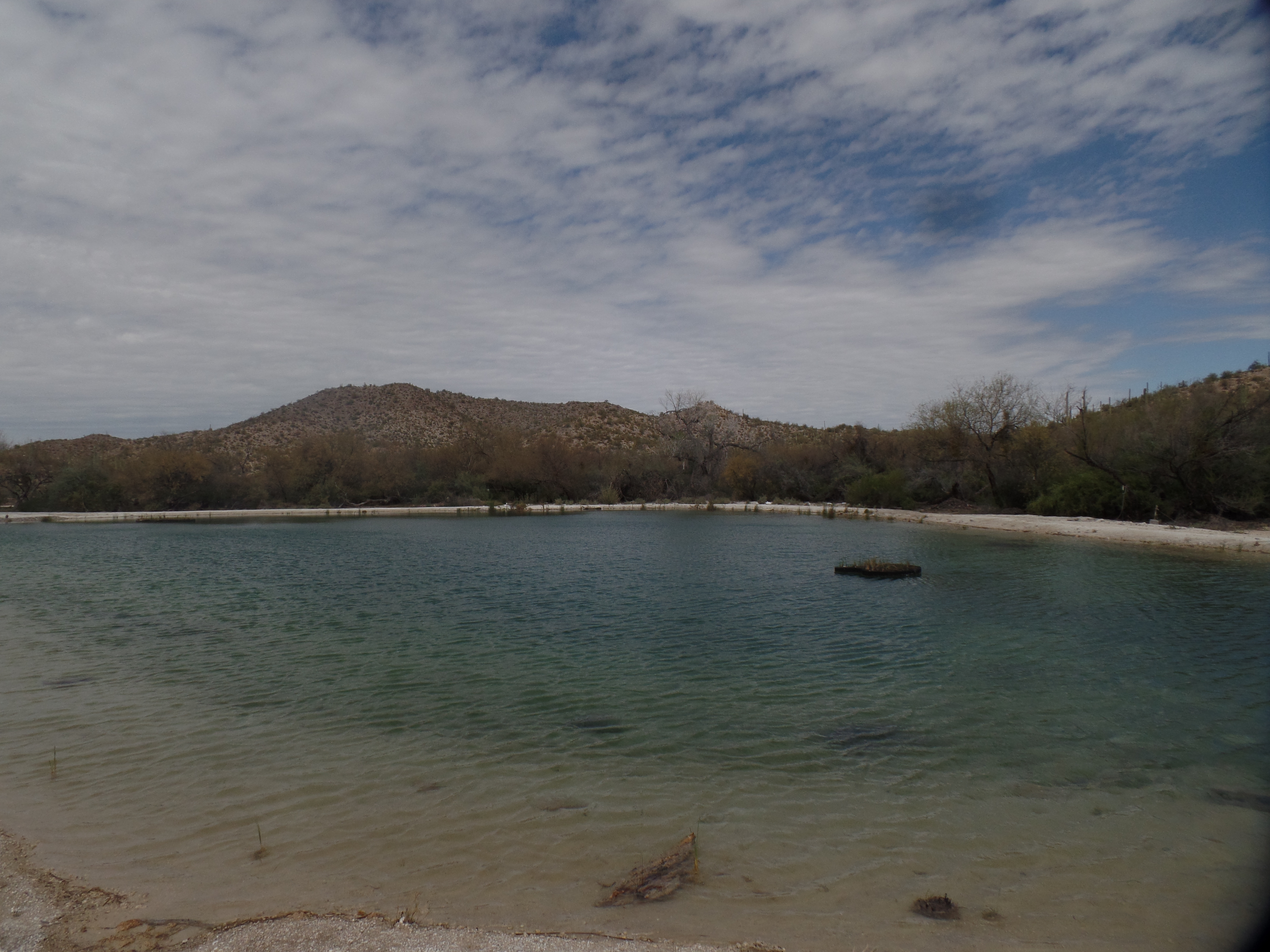
My first order of re-visiting business, to the places my late wife, Penny, and I visited, in 1983, was Quitobaquito. This spot is reached, either by driving down from the Visitor’s Center, via the North Boundary route, or by way of Highway 85. I chose the latter, first stopping for a few minutes in Lukeville, then following the unpaved, but graded, South Puerto Blanco Drive, for fifteen miles. The border wall is visible, to the south, for most of this route. There were no migrants visible, during my visit. Border Patrol agents were on site, at three spots along the wall.
Quitobaquito has no clear meaning, in English, but may be a hybrid Spanish-Tohono O’odham phrase meaning “little spring”. It as several springs, and a small rill to the east, feeding it. When Penny and I were here, it was shallow, and the water looked brackish, although the nearest salt water, in the Sea of Cortez, is still 6o miles to the southwest. Today, though, the pond was well-formed, and had been shored up by stone border-lining.
Trailhead, for short walk to the pond.Quitobaquito (above and below)
I wonder, though, about the lack of birds, which is an unusual state of being for a pond in the Southwest-or anywhere in North America. It was, in fact, once a very rich environment for birds, amphibians and fresh-water fish. Other than a trio of fellow travelers, I was the only soul around.
Next up was a return visit to Ajo Mountain, which has several stops of interest, along a 19-mile loop. Penny and I hiked to Bull Pasture, a fairly rigourous jaunt, when in her late twenties and my early thirties. It was a good follow-up, for me, to yesterday’s hike in Montezuma Canyon, 215 miles to the east. Although I have always been somewhat a dawdling hiker, I still made the walk up and back, in about 2 1/2 hours-taking about the same time as those who appeared to be moving much more quickly. They seemed to need more breaks, though, so that evened things out. I like to take a lot of photos, so here are five:
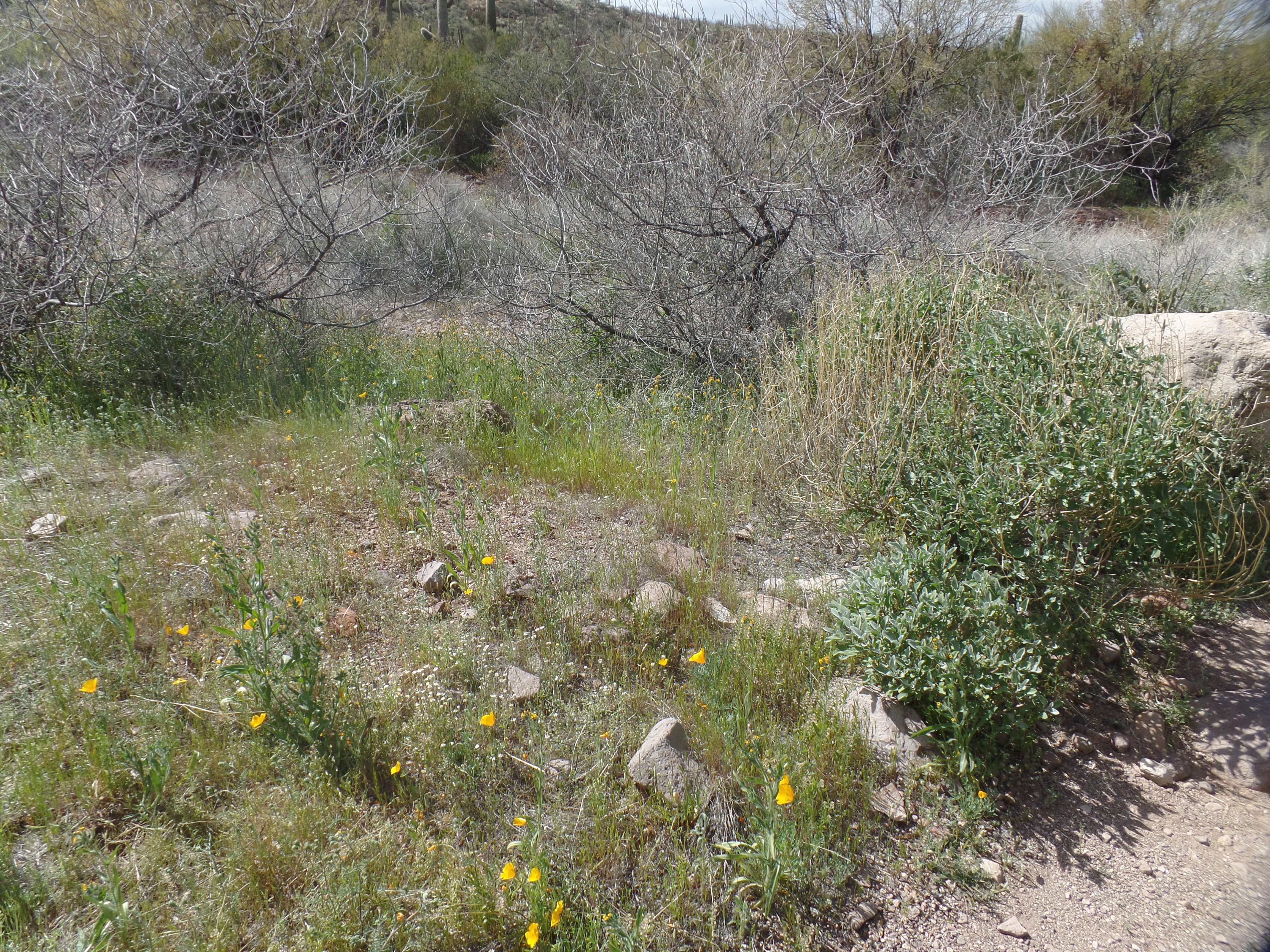
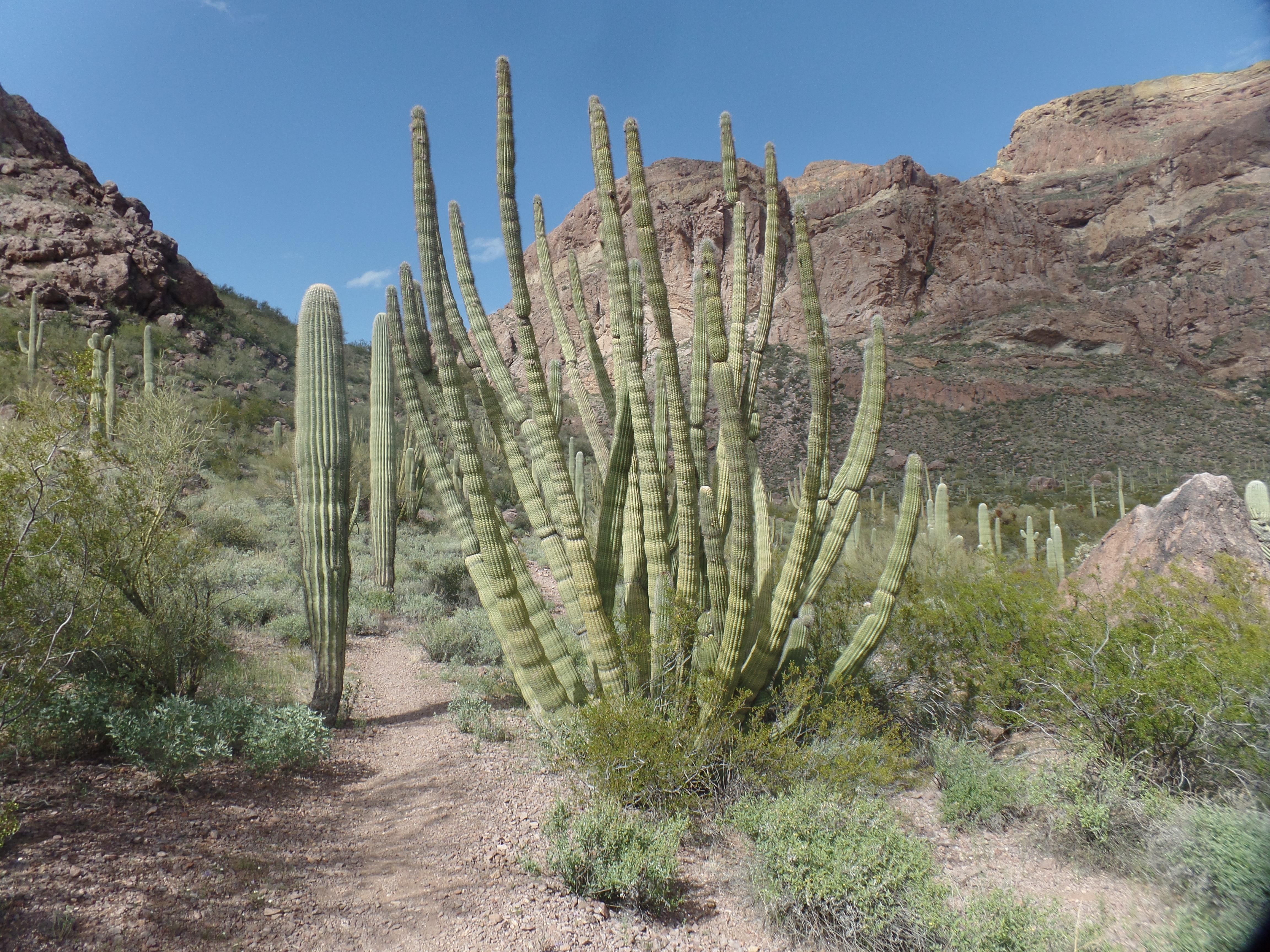
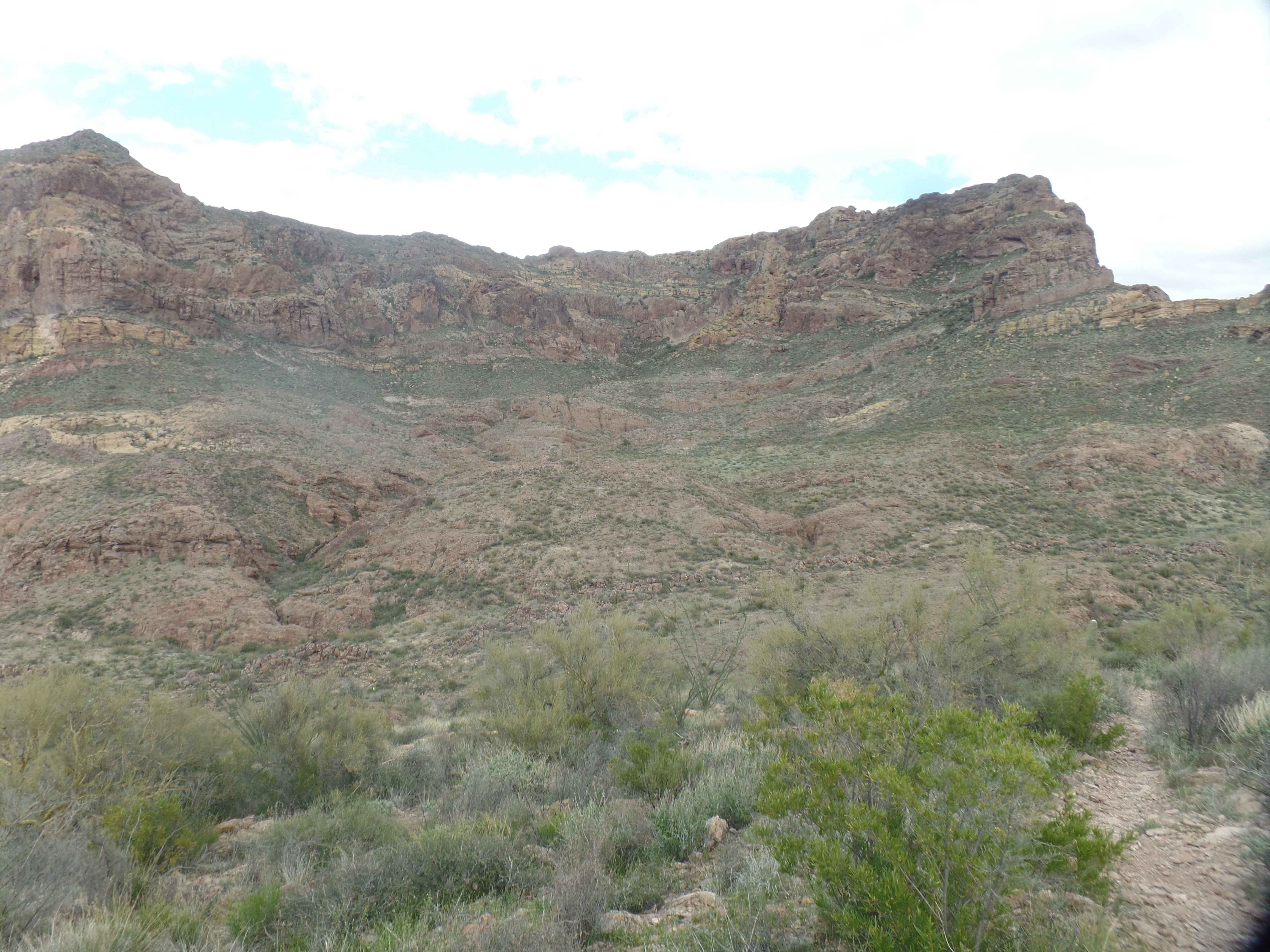
The west face of Ajo Mountain.Buttercups, the small delights of vast Estes CanyonOrgan pipe cacti are only found in southwest Arizona, Baja California and a swath of northwestern mainland Mexico. Seedlings thrive and grow on rocky hillsides, and then only when protected, for a time, under “nurse trees”, such as mesquite.There is a sprawling nature to Estes Canyon, a worthy hiking destination, in and of itself.Whilst in Estes Canyon, I met a couple heading back. The woman said that, in her view, Bull Pasture was more like bull pucky and that Estes Canyon was more pasture-like. Upon reaching the top, I can see that she may not have gone far enough. Here is the view from Bull Pasture itself.The actual area where Spaniards grazed cattle. Bull Pasture trail continues down from the sign, to a couple of springs. A party of college students and their professor came up from the springs, overtaking me, after a brief conversation. We still met up again, back at the trailhead.It was, nonetheless, a lovely return to an old gem.
March 14, 2024- Traffic was bustling, at the Lukeville/Sonoyta Crossing. The place had been closed, a few months ago, with the Federal government bemoaning lack of resources to handle a surge in migrants trying to cross into the United States. It turned out this was mainly a processing issue, and the Arizona National Guard was dispatched to help with ancillary duties, so that the Border Patrol agents could focus on clearing up the processing of those who were seeking asylum, from any one of two dozen countries, and returning those not qualifying for refuge, to Mexico, or to their countries of origin.
The United States/Mexico border, at Lukeville/Sonoyta.
Lukeville had plenty of traffic, going both ways, but the restaurant was closed and the gas station convenience market’s shelves were half empty. I saw little evidence of the crisis of the past few months, other than an active Border Patrol work station, on South Puerto Blanco Drive, that had a few tents set up-either for detained migrants or for agents to get out of the sun. It is likely that they are used for a little of both. These events come in waves, though, so unless Congress and the President can reach an understanding, soon, it is likely to be a long summer of ebbs and flows of both desperate and opportunistic people trying to enter the U.S.
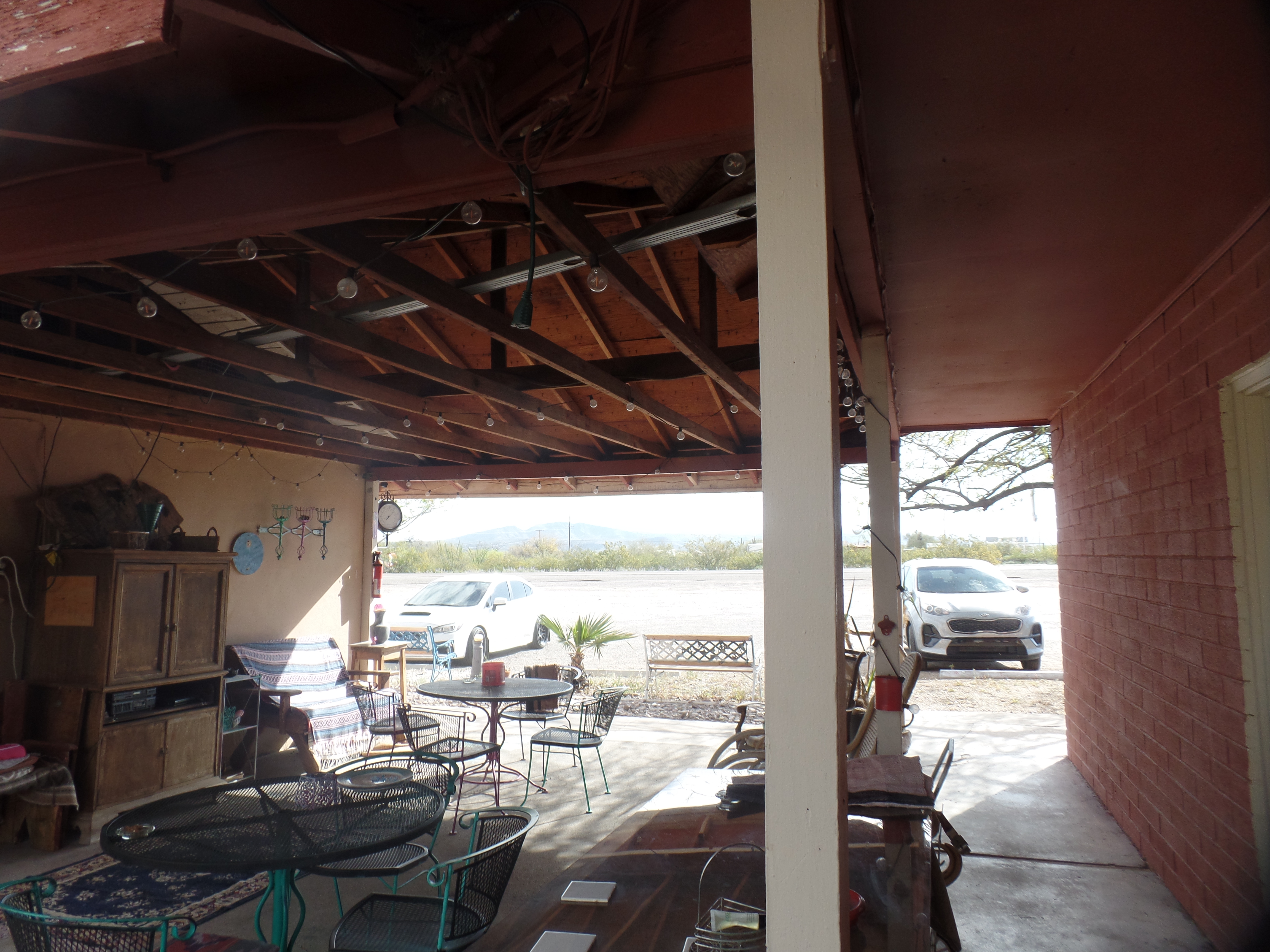
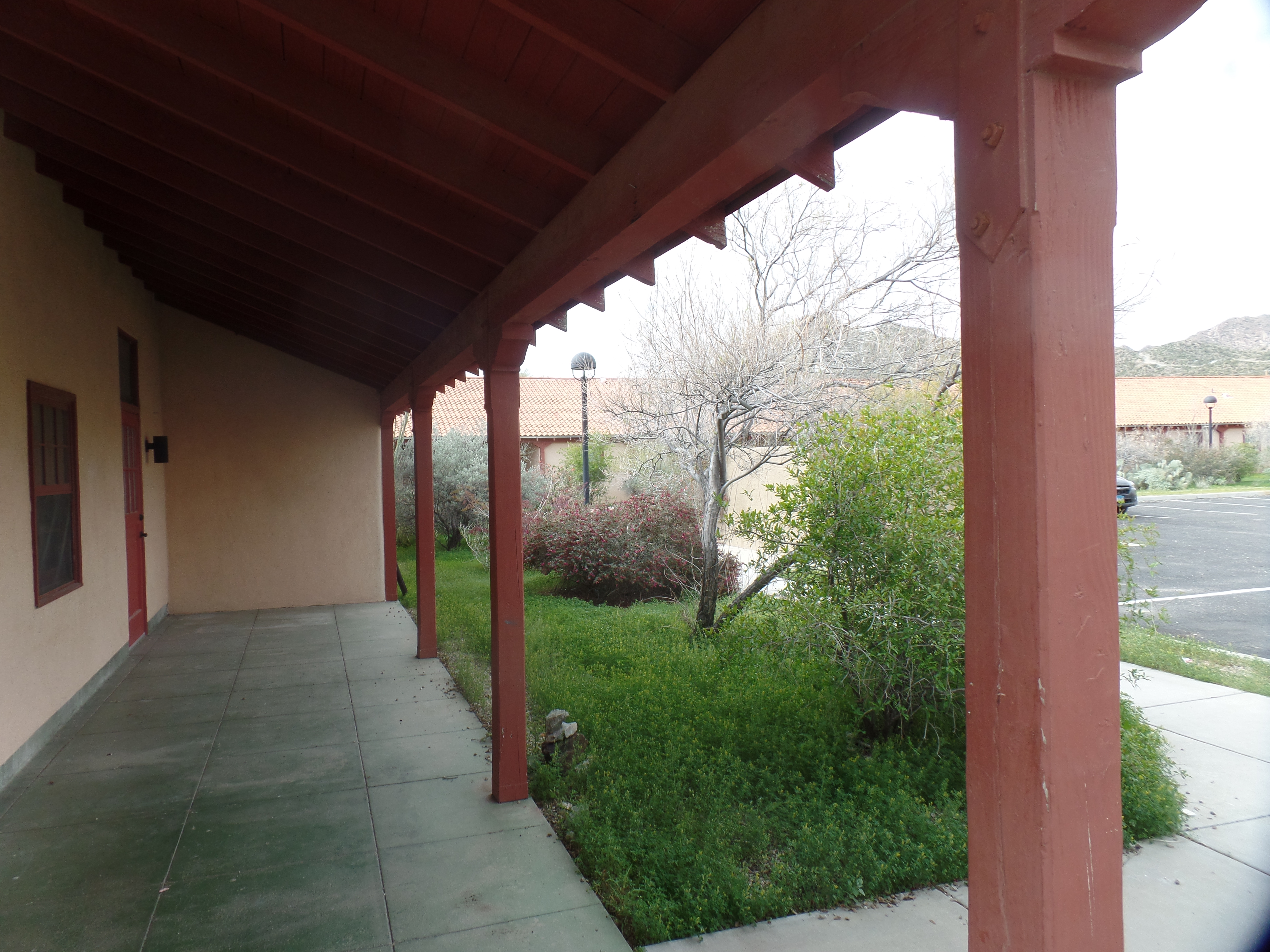
Before all this, and my return to Quitobaquito and Bull Pasture-both within Organ Pipe National Monument (Lukeville also lies within the Monument), I took some time to look around Ajo. Morning’s light, at Copper Sands Motel, revealed this courtyard.
Relaxing spots, at Copper Sands Motel, Ajo (above and below)
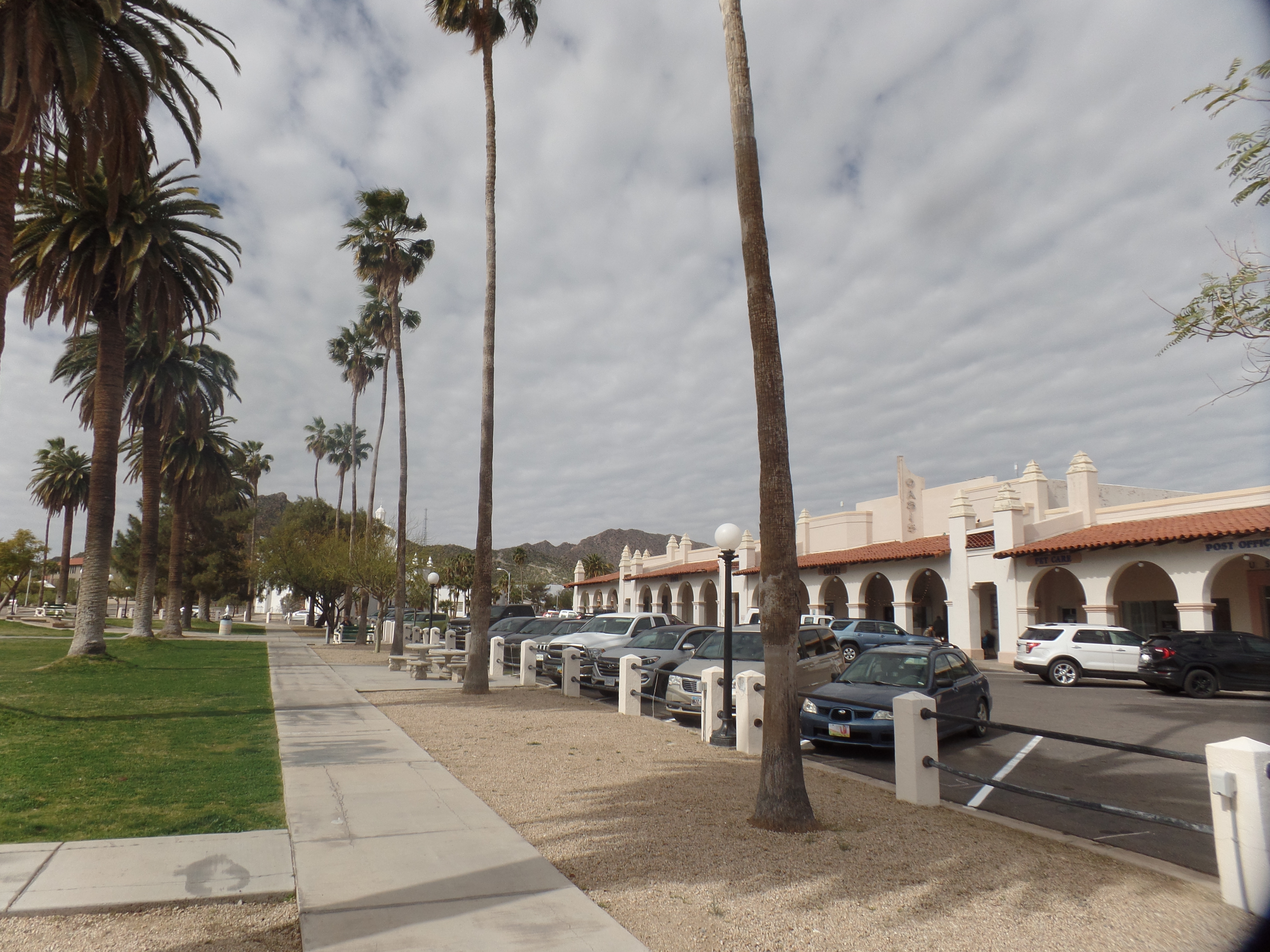
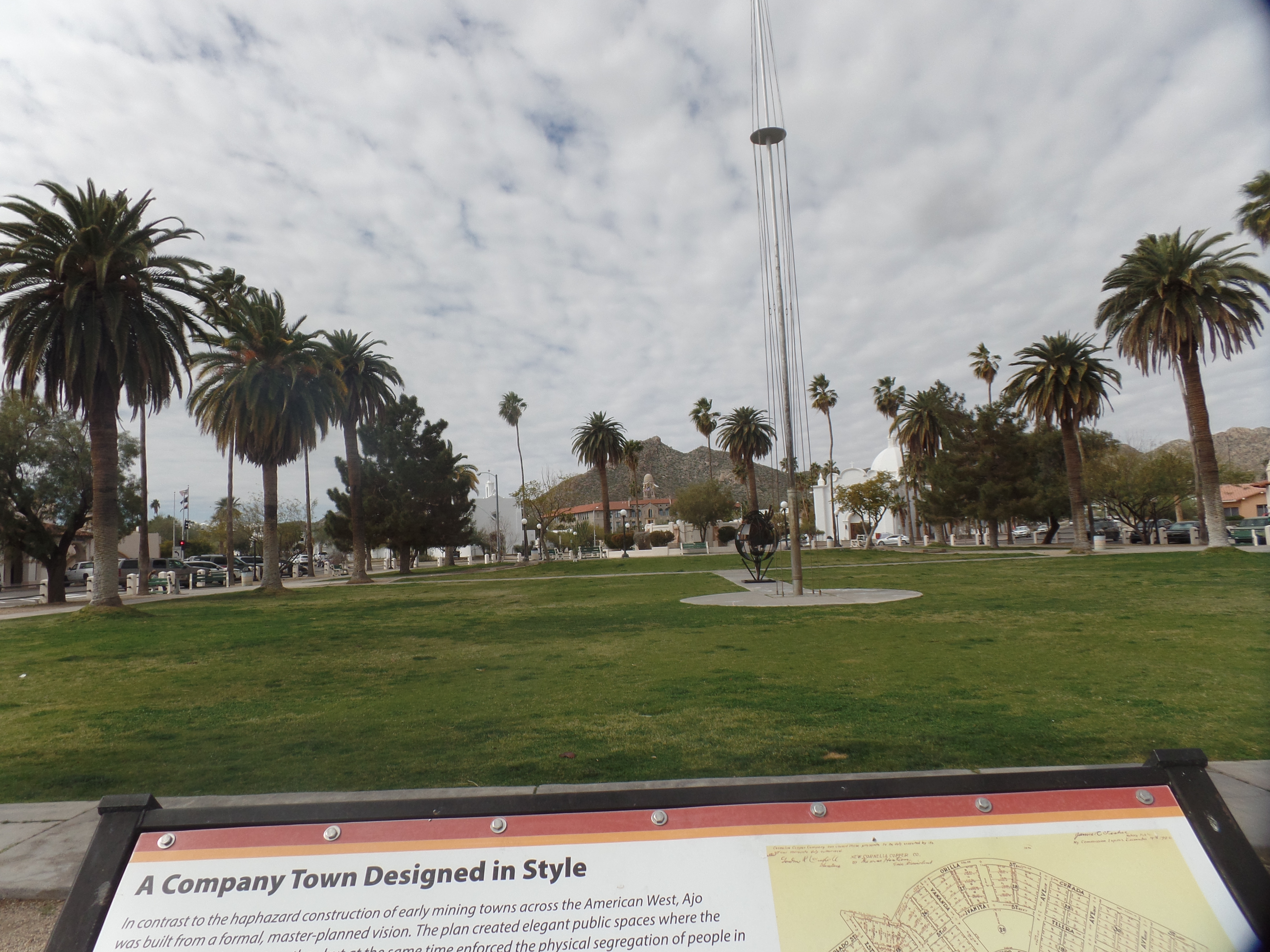
In town, there are two stand-out areas of note: The Plaza, and Curley School. Both were built in the 1920s, when Phelps-Dodge Corporation began to realize the peak operation of its copper mines in the area. Curley School is named for the company’s regional manager: Michael Curley. Ajo Plaza, in the style of a Spanish community gathering place, was the one area where the three otherwise segregated ethnicities, Anglo, Mexican and Tohono O’Odham, could mix freely. Today, of course, there is no segregation. I saw people of all racial groups here, as elsewhere in the country-and in each case, they were working in responsible positions.
Here are two views of Ajo Plaza, where several people were gathered, to relax over coffee and tea, or to discuss business.
East side of Ajo PlazaNorth side, Ajo PlazaAjo Plaza’s Greenspace
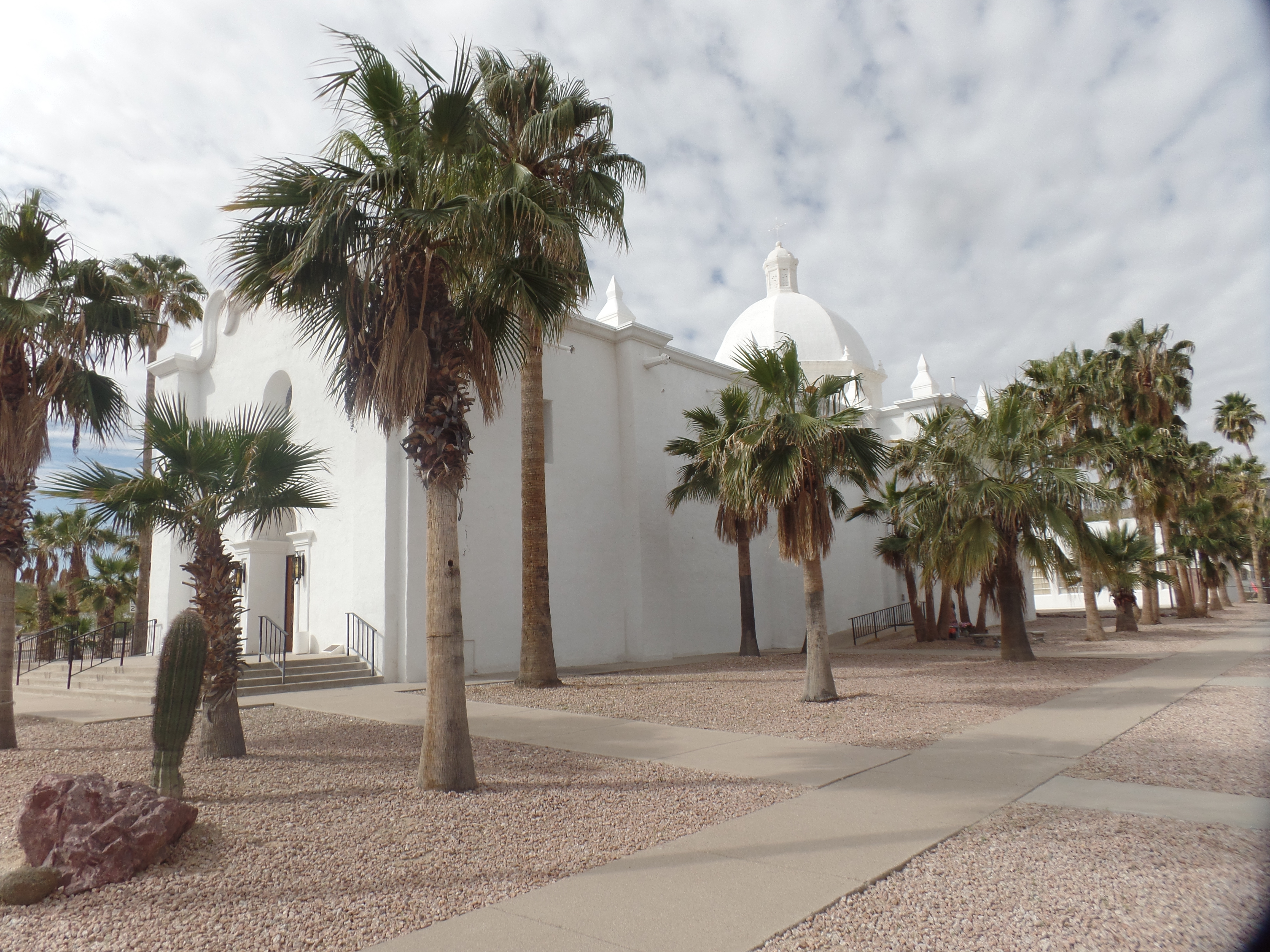
Across from the Plaza is Immaculate Conception Catholic Church, also a marvel in white.
Immaculate Conception, from the east side.
Curley School educated all Ajo area students, from 1919-1997. When it was found to be in disrepair, a group of Ajo residents, working with the University of Arizona, developed a renovation plan, and the facility, consisting of nine buildings was refitted as artisan apartments and up-to-date classrooms, for the practice and study of the Fine Arts. Here are three views of the facility.
Main Building, Curley School, AjoInner Classrooms, Curley School, AjoStanding Duck Cairn, Curley School, Ajo
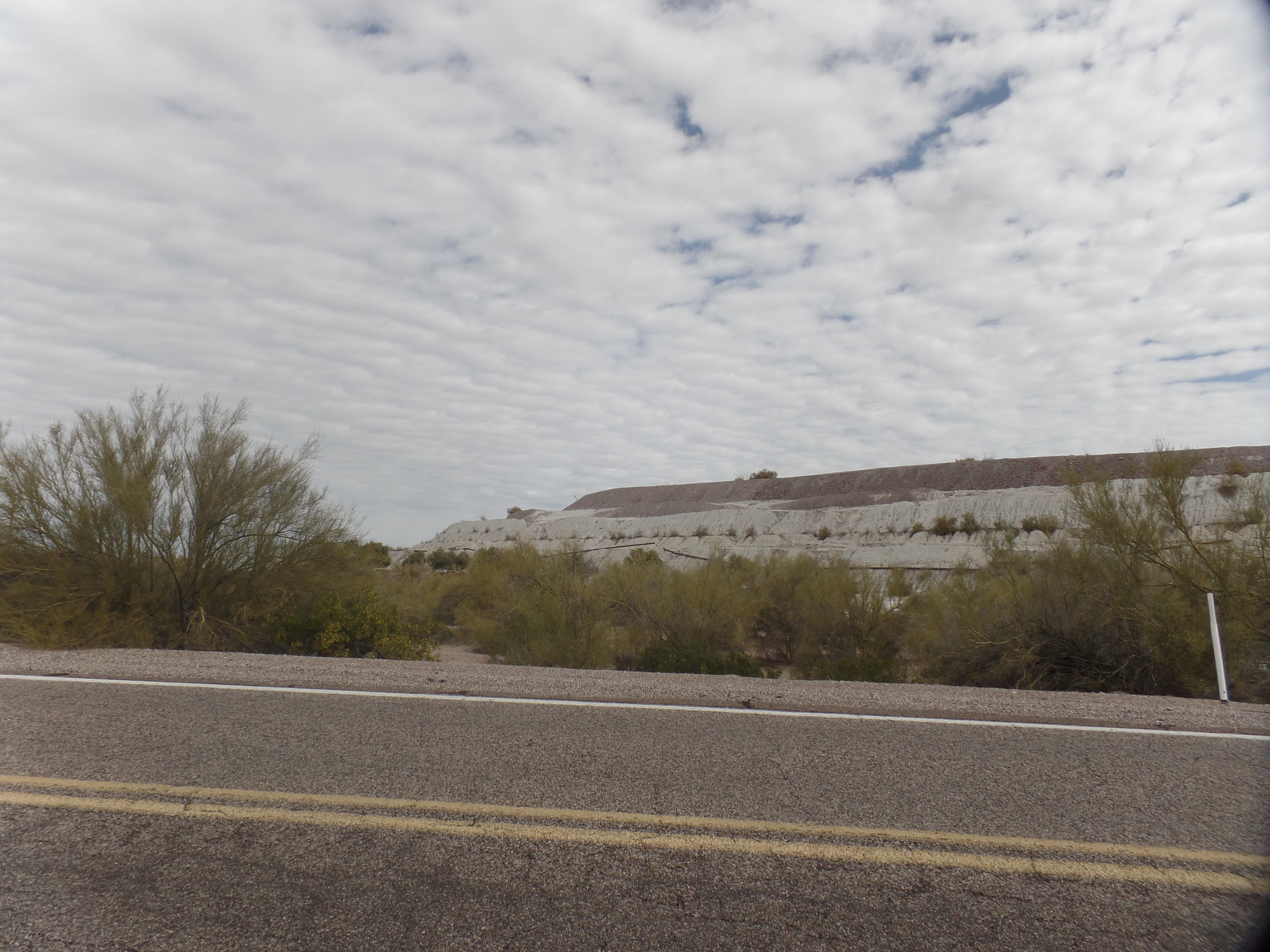
As with all such operations, the New Cornelia Open Copper Mine ran out of its product, and has left tailings in its wake.
Tailings from New Cornelia Mine, east side of Arizona Highway 85, south of Ajo.
Hopefully, the area can be cleaned up and restored as a natural area, useful to both people and wildlife. The same ingenuity that saved Curley School would be beneficial here.
March 13, 2024, Ajo- The motel owner came to the door, after I left a voice mail on her phone, and cheerfully welcomed me into the office. After I paid, she went over and showed me the room, proudly pointing out the improvements she had made to it.
Earlier in the day, as I checked out of Knight’s Inn, the clerk thanked me, profusely, for having stayed the night. There is always a pleasant stay to be had, at a Knight’s Inn-and the price has always been reasonable.
Between these two bookends of love and light, there was plenty of good cheer. When I went over to a nearby Speedway station, to get a cheap bit of breakfast, the clerk signed me up for a Speedy Rewards card, which I got to put to use, right away, when filling Sportage’s tank, an hour or so later. I had been a bit lazy, in getting onto such a discount program, up to now, but it’s time.
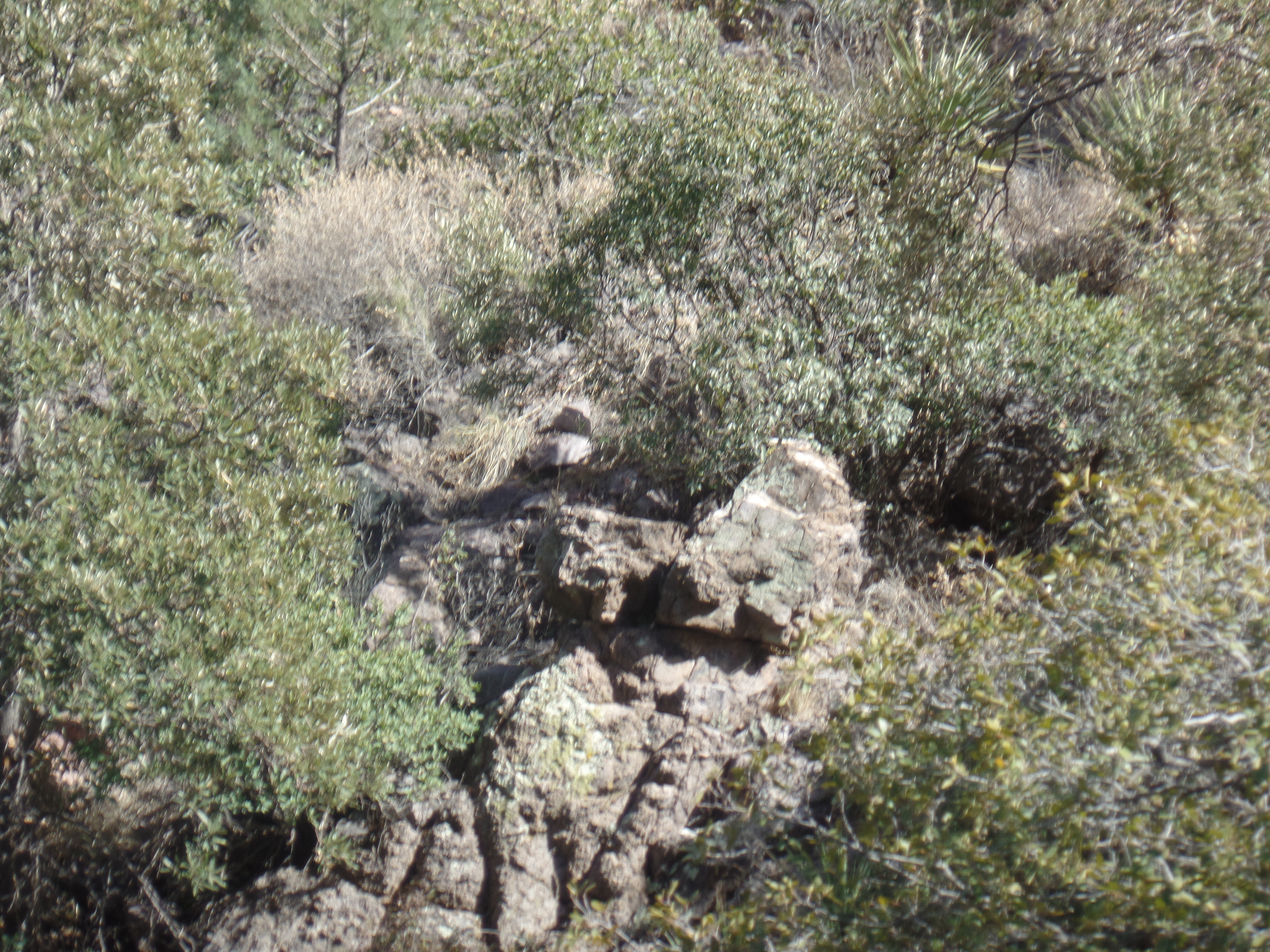
Making a pilgrimage to Bisbee, I found High Desert Market and Cafe was closed on Wednesdays, so another new spot was in order. I chose Main Street Bistro, which has a similar, if smaller, menu to HDMC’s. The wait was longer, with only one person staffing the patio area, but the wait was well worth it. I took a stroll downtown, after, and looked at the area where two buildings burned, a month ago. Of course, it was roped off, and pictures were not in order. I did take a shot of this rock formation, above the patio at Main Street Bistro.
Mr.Toad guards the Bistro.
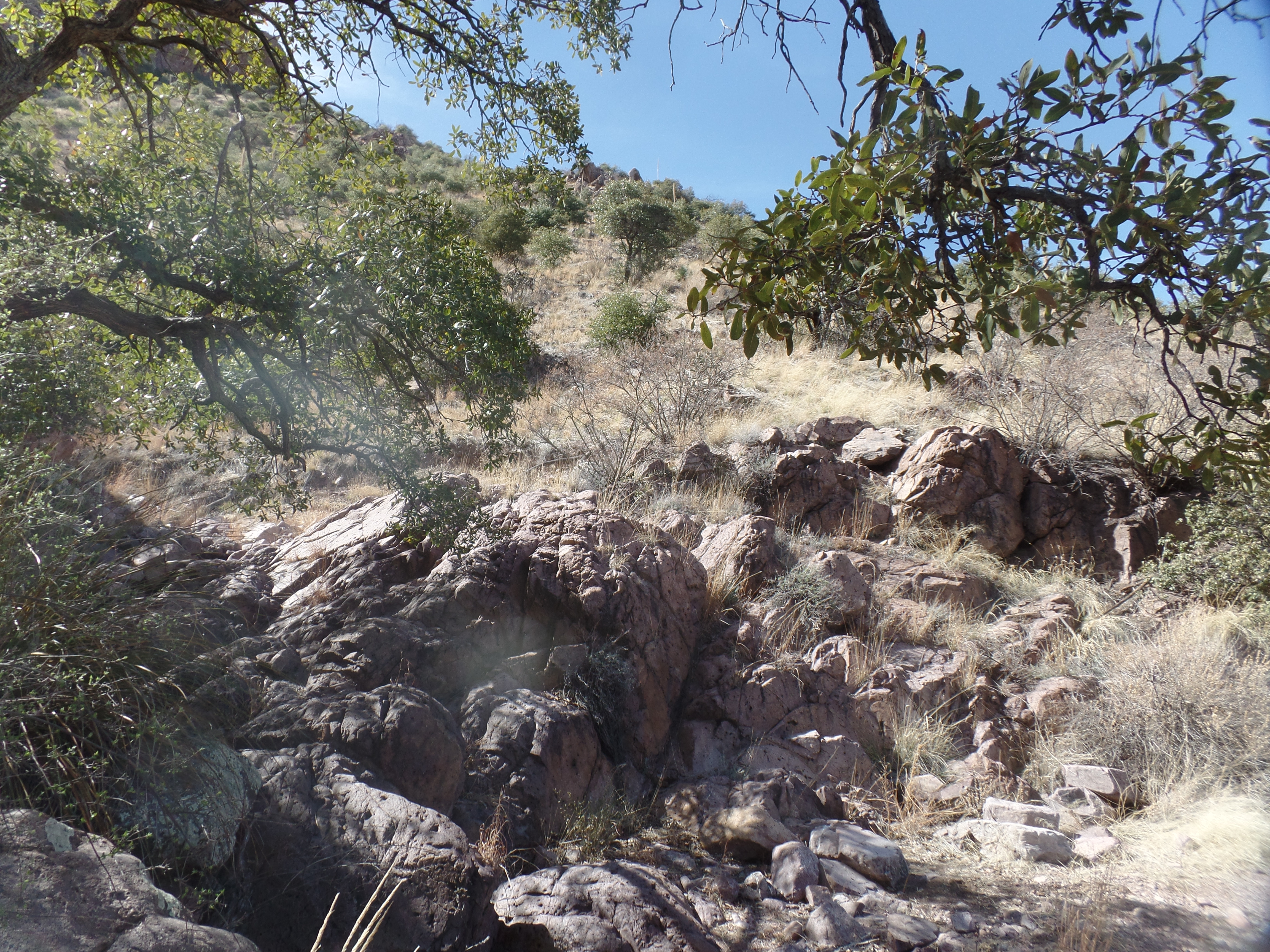
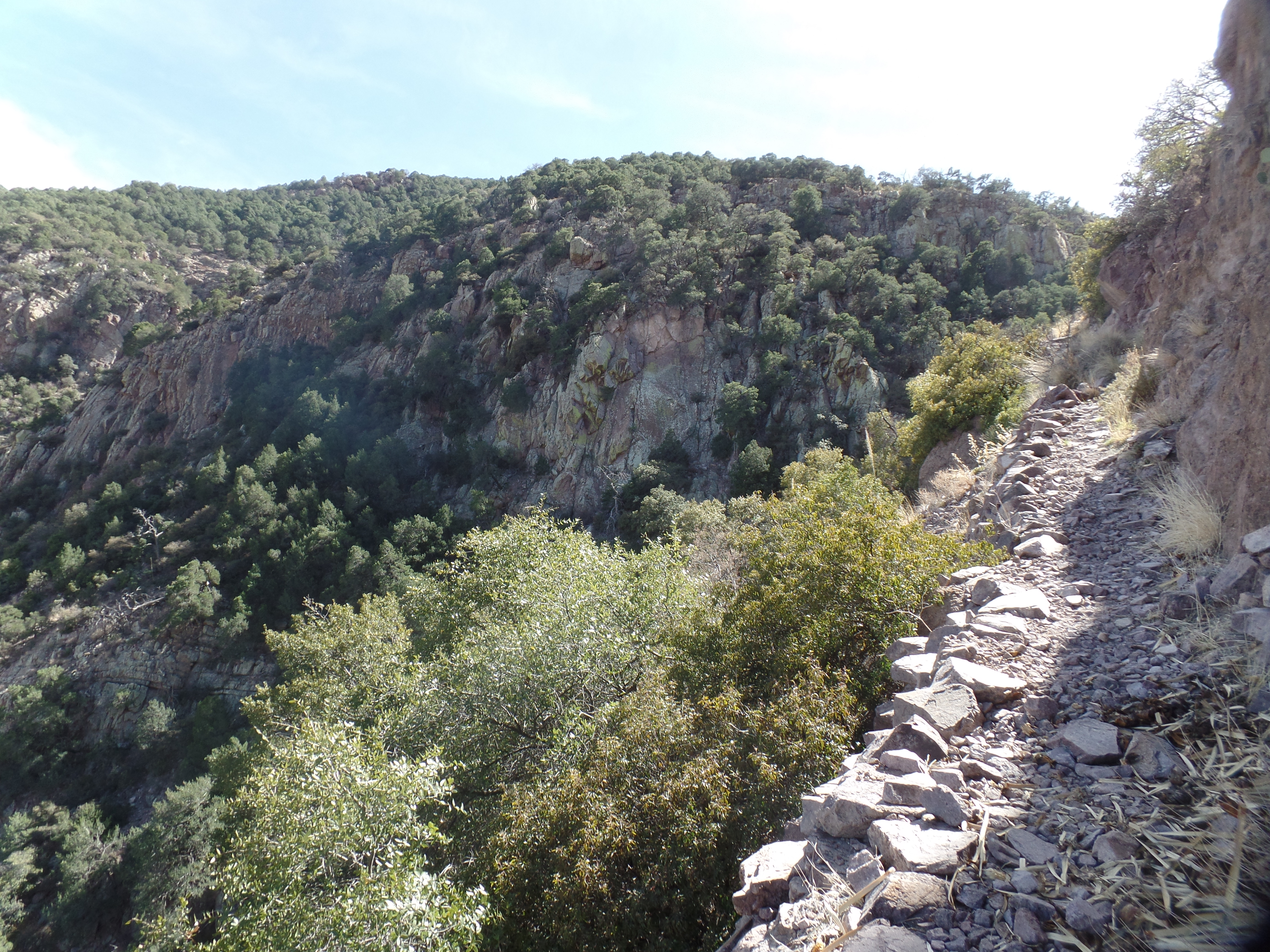
It was now time to return to Coronado National Memorial, high on the border, near Hereford, AZ. This time, I wanted to hike at least 3/4 of the way up Joe’s Trail, which runs from just west of the Visitor’s Center to the fourth ridge of Coronado Peak, where there is space for several vehicles. I left my SUV in the parking lot at the Center, and managed to get 3/4 of the way, turning around and hiking back, with the hope of finding a place en route to Ajo, in time to make a Zoom-based meeting. (This didn’t pan out, and was my one disappointment of the day). The hike, though, in Montezuma Canyon, was sheer delight.
View from the base of Joe’s Trail, Coronado National Memorial.Outcropping, lower Montezuma Canyon.A jolly old king, Montezuma Canyon.View from a narrow trail, Montezuma CanyonAt my turn-around point, with a view towards the canyon rim, Montezuma Canyon, Coronado National Memorial
I headed inexorably west, then north, and west again, after leaving the Memorial. The road called Ajo Way is one that Penny and I took, 41 years ago, to visit Kitt Peak, Organ Pipe National Monument and Puerto Penasco, Sonora. I would visit Organ Pipe, this time around, and drop in at the border town of Lukeville-but those are for tomorrow. Kitt Peak and Puerto Penasco are for another time, and possibly I won’t be visiting alone, but we’ll see.
For now, the border at Coronado is quiet, no sign of any mass incursions, surreptitious or otherwise, and the rangers suggested it’s been that way there, for a while. In Ajo, meanwhile, the Copper Sands Motel, and its owner, Linda, are delighted to have guests who mind their manners. Copper Sands kind of reminds me of Gram’s Place, the hostel where I stayed in Tampa, two years ago-lots of bric-a-brac and a funky patio or two.
I am getting ready to rest, bathed in love and light.
March 12, 2024- The Old Pueblo shimmered in the morning light, and invited me to stay a while. First was a dinner invitation, which I wouldn’t dream of passing up, then there was all that lay in front of me, in El Presidio, and nearby Jacome Plaza, the gateway to the University of Arizona. I would not have enough time to visit U of A, but more on that in a bit.
Pima County Courthouse, Tucson
My first stop was the Pima County Courthouse, the domed gem of downtown Tucson. Five To Oh Coffee is a small stand, inside the building, with plenty of seating in the patio just outside. In the Sonoran Desert, “outside” is comfortable all day long-from mid-October to the end of May. So, I took my large coffee and blueberry empanada to a shady spot near the yet-to-open Southern Arizona Visitors Center.
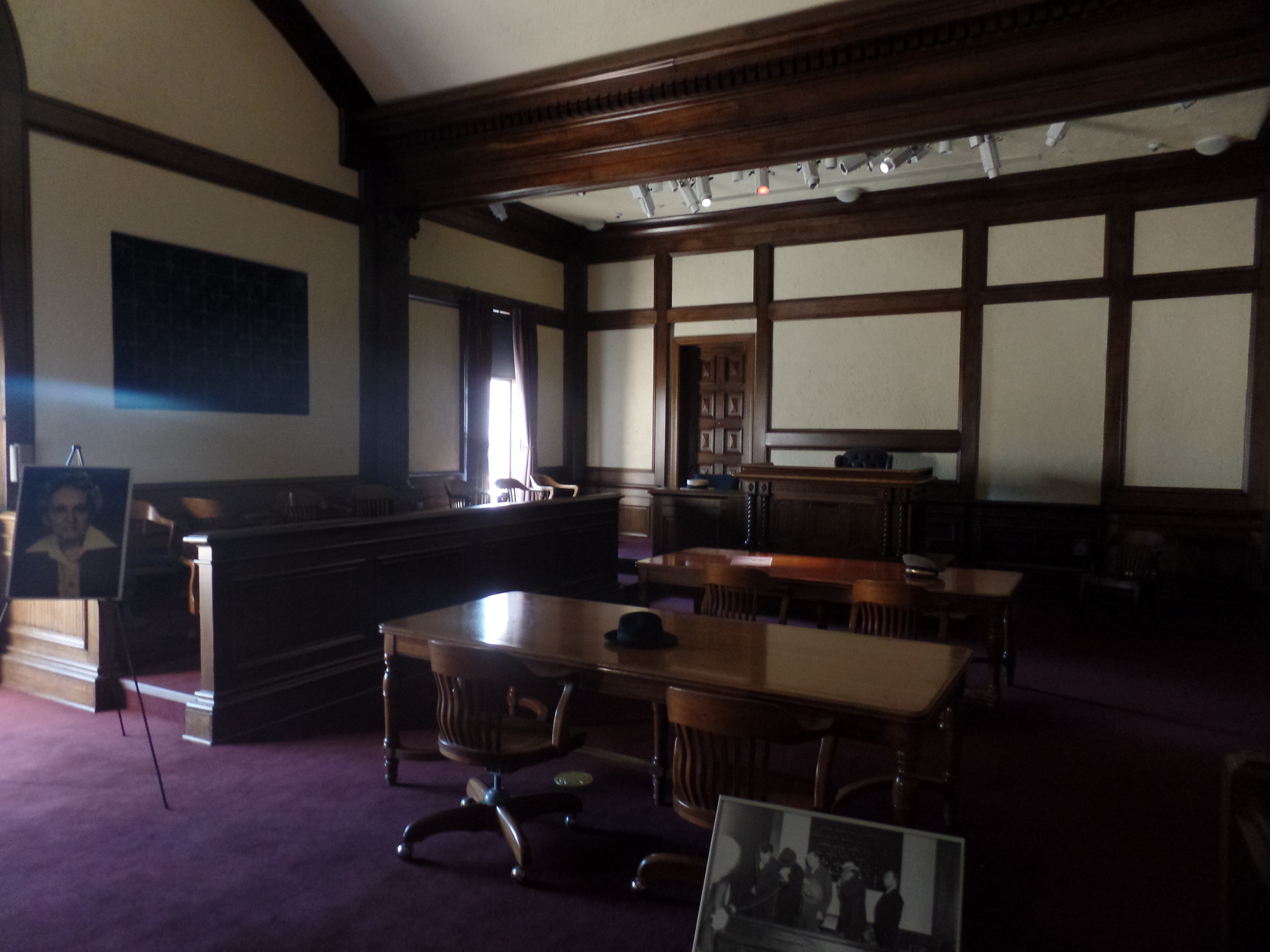
A few minutes later, it was upstairs to the Dillinger Courtroom, where John Dillinger and his accomplices were tried and convicted-after the Tucson Police duped Public Enemy # 1 and the gang into a baited trap.
Dillinger Courtroom, Pima County Courthouse
Dillinger was still a media sensation, and his craftiness was matched by that of the Pima County Sheriff, who sold tickets to people wanting to see the killer bandit in his jail cell. After his conviction, Dillinger was sent to a prison in Indiana, from which he again escaped, and was later killed in Chicago.
Once I had read the displays outside the courtroom ,including information on Wyatt Earp, it was time to check out the Visitors Center. There, I noted a diorama of southern Arizona, with various buttons that lit up cities, highways, rivers, mountain ranges (Pima County has nine of those) and Native American reservations (Arizona has 23 of those).
On the west patio of the Courthouse is a Memorial Park honoring the victims of the January 8, 2011 shooting, in a northeast Tucson shopping center. They ranged in age from 9 to 76, and included a sitting Federal judge, a Congressional aide and a girl who had been born on September 11, 2001. Left paralyzed by the attack was the shooter’s prime target: United States Representative Gabrielle Giffords, still alive and in recovery.
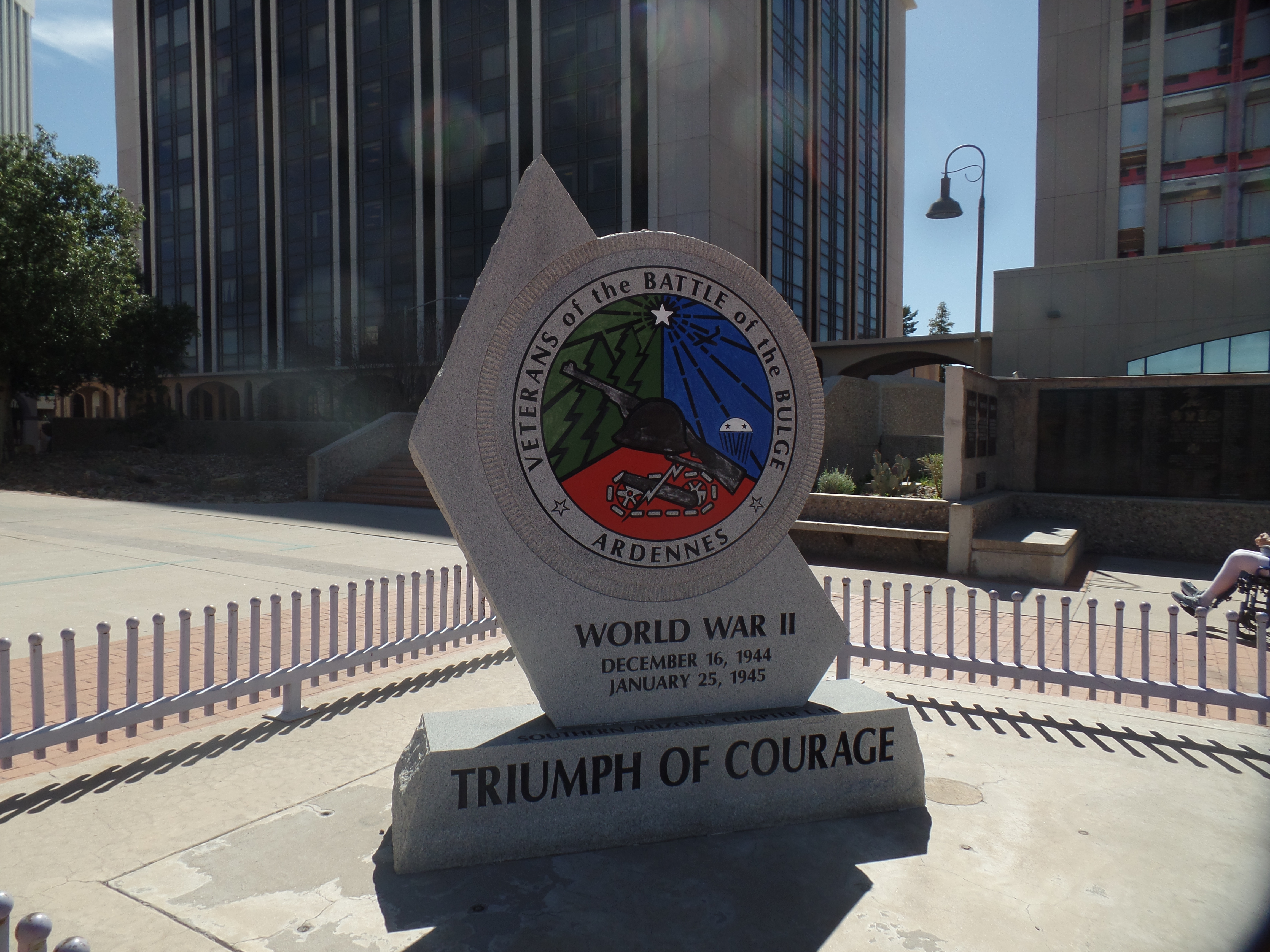
Christina Taylor-Green, the 9/11 Baby who died in the 2011 attack, was an avid swimmer. Thus, this fountain became a centerpiece of the memorial.Heroes of an earlier time of difficulty are also honoured here. Among them was my late father-in-law, Norman Fellman, captured by the Nazis near the end of the battle, in January, 1945. He survived six months in the concentration camp at Berga, where he was placed because he was Jewish.
Lunch time brought me to a small food truck, parked at Jacome Plaza, just east of the Courthouse. Carlos Jacome, Sr, and his wife, Dionicia, raised thirteen children-and the downtown Tucson business core-with help from a former rival, Harold Steinfeld. Jacome’s Department Store, along with Steinfeld’s, was a staple of downtown, for decades. In honour of the Jacome family, all of whom had a keen interest in the business, Jacome Plaza stands in front of the central public library. OaxaRio Food Truck serves fresh, delectable Oaxacan and Sonoran style treats. Next to it is Special Eats, which contributes to autism and Down’s Syndrome assistance programs. Here is a view of Jacome Plaza:
“Sonora”, by David Black (1991), restored by Trevor O’Tool.
Once lunch was enjoyed, under “Sonora’s” watchful gaze, I spent a nerve-wracking, but ultimately fruitful hour-long learning experience, in Joel D. Valdez Library, attempting to get online, and finally figuring out, with the aid of two library clerks, that my VPN was blocking access to the WiFi. Good to know, for the future: Get online first, then activate VPN-so long as the network is secure, as this one was. This experience used up the time I would have spent walking over to the University of Arizona, but no matter.
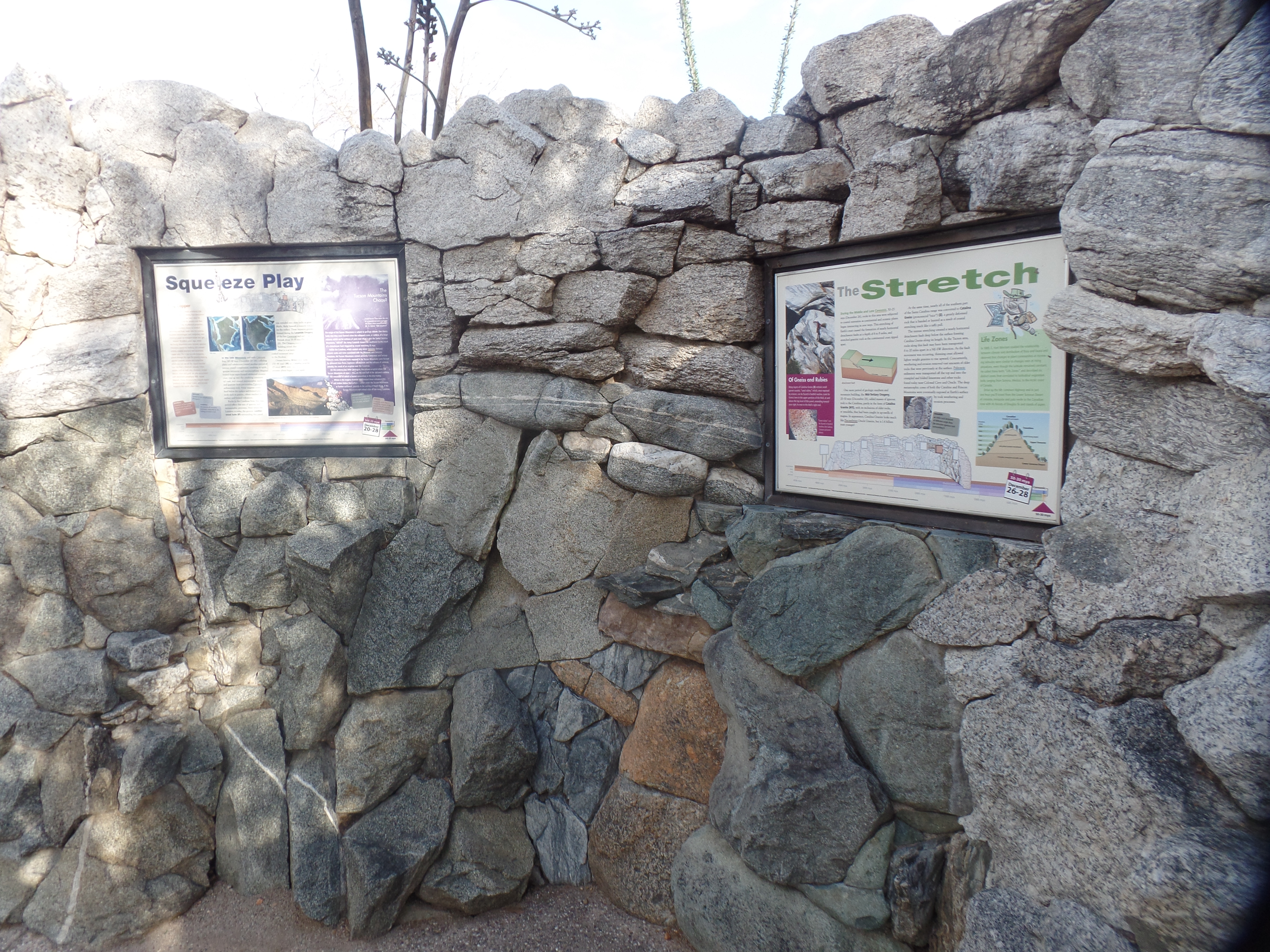
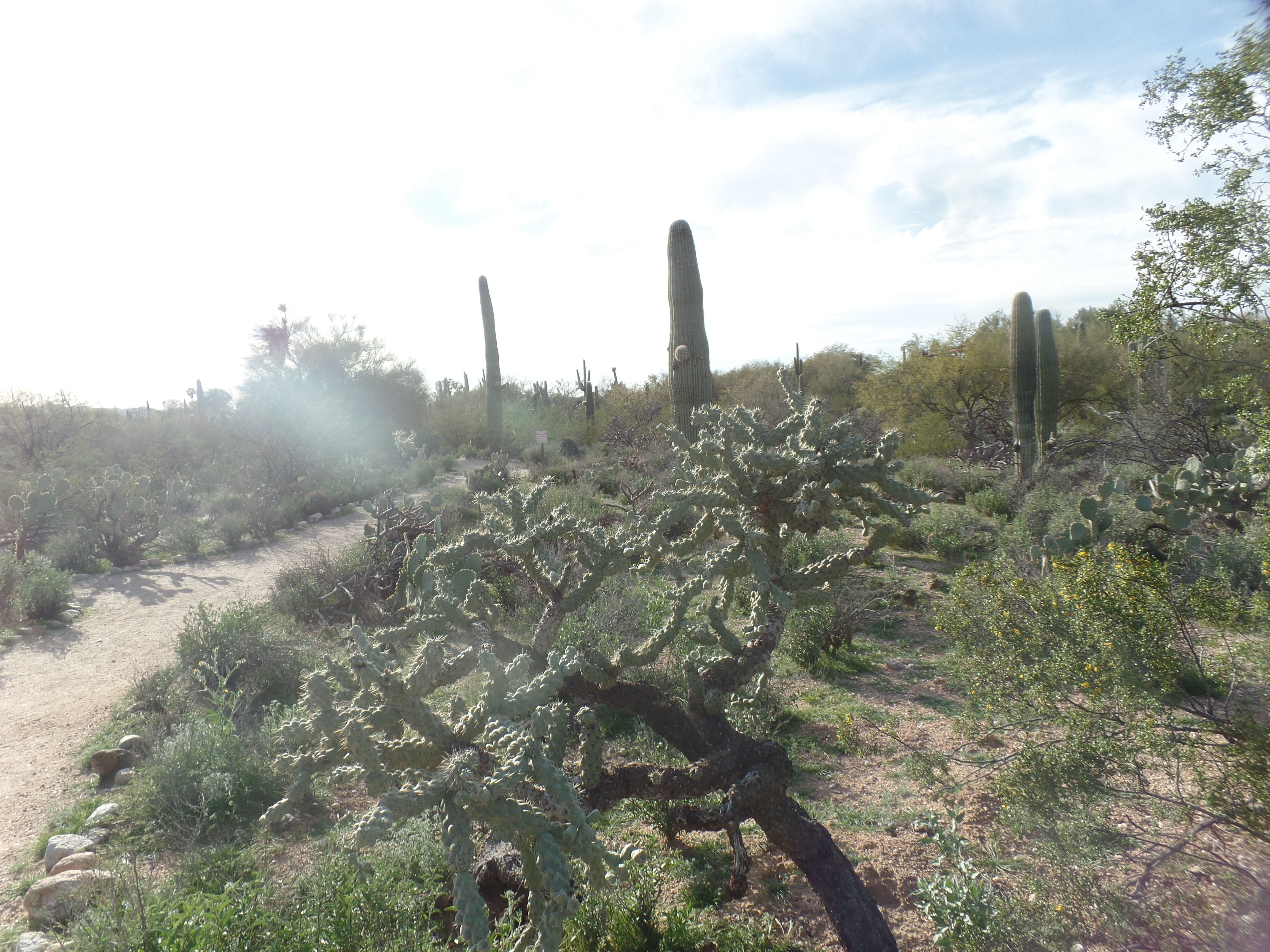
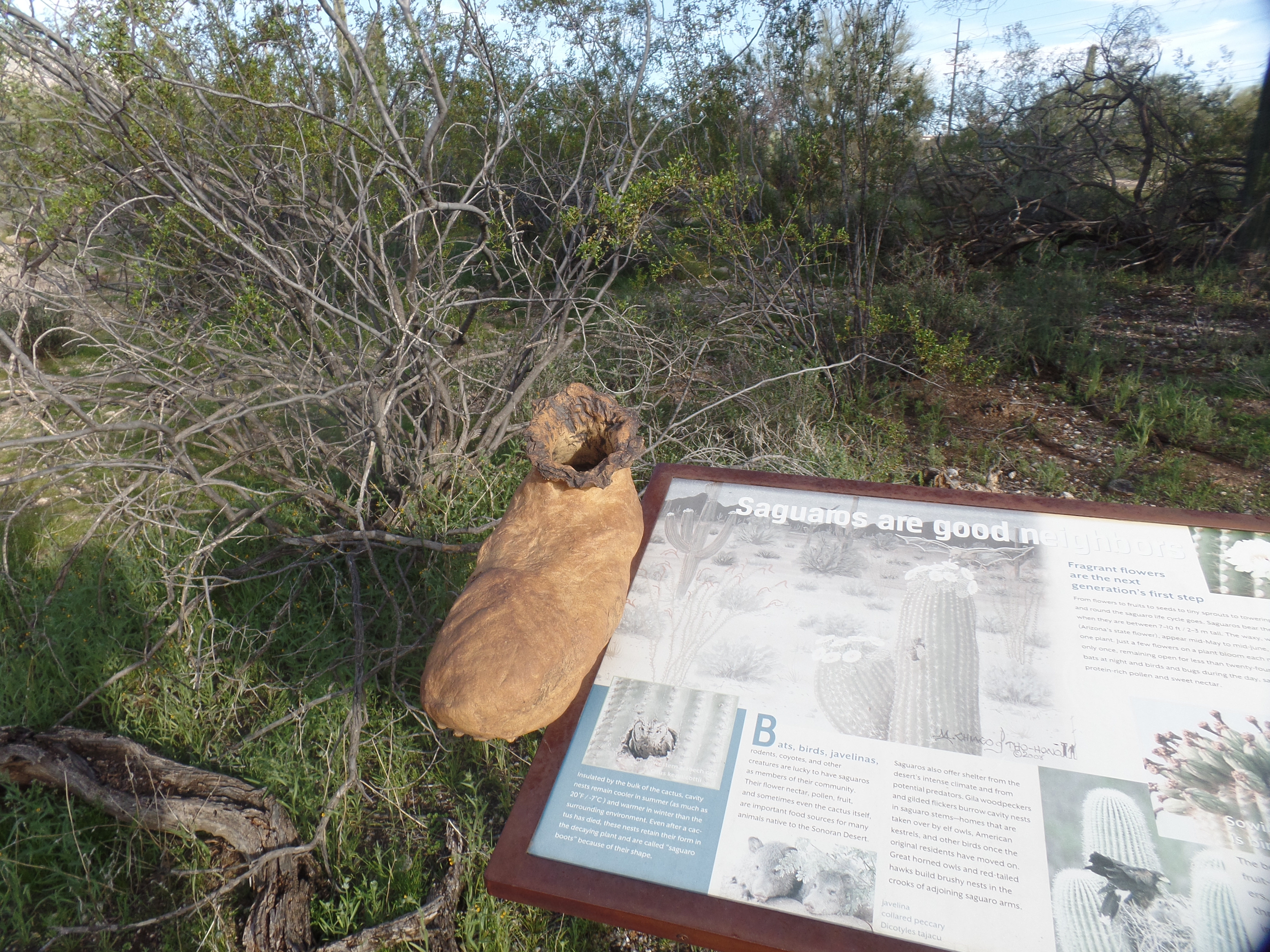
After checking e-mails, creating the previous day’s post and enjoying a refreshing Shamrock Matcha, at Ike’s Coffee, across the street from Jacome Plaza, it was time to go up to Tohono Chul, Tucson’s signature northeast green space. “Tohono Chul” means “desert corner”, in the language of the Tohono O’odham, whose own name means “Desert Dwellers”. It is a prime botanical garden, preserved by Richard and Jean Wilson, in the late 1960s. The Wilsons owned nearby Haunted Book Shop, from 1979-97, and gradually pieced Tohono Chul together, until the present 49 acres resulted in today’s bright oasis. Today, Jamie Maslyn Larson and her team maintain the vision set by the Wilsons, and Tohono Chul is a bright spot in the Catalina Foothills neighbourhood.
Tohono Chul Botanical Garden, north TucsonGeology Wall, Tohono Chul Botanical GardenJumping Cactus, aka cholla, Tohono Chul Botanical Garden.A “boot” left by a sahuaro, serves as a nesting site for various birds and small mammals.
It was soon dinner time, as well as quitting time for the Park staff, so off we all went, at 5 p.m. I headed down to a Red Lobster, on the southwest end of town, and joined a couple of old friends for a pleasant 90-minutes of catch-up and great food.
Finally, the drive southeastward, to Benson, then Tombstone, and finally to Sierra Vista-where my favoured Knight’s Inn was ready with a comfortable room. Thanks, Old Pueblo, for once again showing more of your many good sides!
















 A Sagittarian Seeker