December 14, 2025- I did not go to Bellemont, and climb up a long flight of stairs, six times, in order to store six boxes of books in an already crowded room which few people will enter until next summer. I had considered that option, until early this morning.
My late wife appeared to me in a dream, as if she were right beside me. That was a nice sensation, and though I realized it was a different level of reality, some insights came to me. I got the message to check with our public library, to see if they would take 2 boxes of the books. They did so, gladly, thus bringing a more meaningful Baha’i presence to either their general stock, their saleable book collection, or both.
Regarding the actual move, consultation with my son led me to contact a possible moving assistance service, comparing their price with what it would cost me to do the move on my own. There are timing issues, as well, so I will see what their answer is. This is the U-POD system that is growing in popularity. It makes sense for people who have a high volume to move. I do not, but rather am just in that gray area, with a few too many keepsakes for one trip.
Reason made this day a nice one. I did not have to leave town, saving my energy for what lies ahead this week. I can get a lot more done tomorrow, and won’t have to worry about letting my family down, come next week.
December 7, 2025- Another holiday party/annual meeting/farewell gathering featured inventive, delicious organic and vegetarian fare-including my mixed greens and sunflower sprouts, with a dressing of lemon curd, Sicilian lemon balsamic and Persian lime olive oil, with a hint of paprika. The dressing was a particular hit with the group- and the host, a Master Chef, asked to keep what was left. Success!!
Part of the business meeting involved discussion of whether to donate funds to a Garden School in Africa, that serves HIV-ridden orphaned children. The group has helped the Director, herself uninfected, for the past three years, so it was not difficult to vote for continuance. We voted to double the amount suggested by our executive committee, with no objection from them. One of our members has been to that school twice, and will visit again, sometime next year.
It is hard for many people here to comprehend, but the conduit member said that HIV is still rampant in that particular part of Africa, as many men are unwilling to use hygienic protection in their intimate activities, leaving their women open to infection, which naturally gets passed on to any progeny. This situation was the basis for HIV-fighting funds from USAID. Now that the prevailing view in our government is that these funds just “reward bad behaviour”, the funds have been reduced, or eliminated, and it will take time for the miscreants to realize that no one is going to rescue them. The children are the ones who end up suffering. So, private groups like ours are taking up the slack-helping women and children directly.
Collective action is far more effective than assorted individuals trying to take up the mantle. Besides, I have to be on deck to focus my energies and resources on family first. I am grateful that projects like this are getting an organizational response.
December 5, 2025- The earnest young man said, with a straight face, that he fully intended to finance a new vehicle, using his available income from a part-time job cleaning office buildings around his town. We went over the cost of the desired vehicle, the number of months it would take to pay off a loan-if one were even available and the amount of money he would have to set aside each month, just to pay the loan amount, never mind insurance, registration and maintenance. It didn’t take him long to pivot to calculating the monthly costs involved with purchasing a used car, for 1/4 the amount of a new vehicle.
When I was a similar age, I had a grand uncle who would calmly disabuse me of similar outlandish dreams. He never tried to actively talk me out of any pipe dream, but used facts, numbers and the sort of logic that said “This is all achievable-just some day, not right away.” In running this morning’s round table discussions with juniors and seniors at a local high school, regarding financial planning, I used the same mentoring tools. The students could see that I am still standing, even through a fair number of missteps and setbacks. My ending point was that it is not the mistakes that matter, in the end; it is the aggregate of lessons learned.
This morning, regarding grandparenting, I was reminded that the elder’s greater wisdom shines brightest from the ability to listen to the grandchild; to be the safe haven and by extension, the greatest emotional support. It takes nothing away from parents, but does offer the child another place where s(he) can feel validated. It is that affirmation that builds the emotional strength a person needs, to successfully withstand all manner of negative pressures.
Today’s seminars were a good round of practice in that regard.
December 1, 2025, Tucumcari- My friend sat across from me, in a crowded coffee shop, on the west side of Amarillo. He referred, a couple of times, to things he’d seen on Tik-Tok, a medium he finds amusing. A few minutes later, he told of posts on said medium that he found revolting.
I have never been a fan of Tik-Tok,nor of Snap Chat, Reddit or any other medium that relies, for its existence, on mass, conformity-based consumption of whatever drivel the worst among its contributors serves up, particularly in the form of “challenge”. Whoever dreamed up the nightmare that was “Tide Pod Challenge” (before Tik-Tok, in fairness) deserves to be consigned to the scrap heap of historical opprobrium. Its successors, some of which have found their way to Tik-Tok (i.e. Jam Jar Pulse Jet), likewise deserve nothing short of universal condemnation, for the resulting harm they cause both those who attempt them and their loved ones who are left to pick up the pieces of the person(s) left in relative ruin.
Tik-Tok could have become the purveyor of presentations that elevate humanity, the way Wikipedia and, for the most part, TED Talks and You Tube have become. Instead, we have the media promoter of the ethos that is reflected in that most odious of sentiments, “It’s better than Crack!” End of rant.
The day was, all in all, very nice. I bid farewell to my little family, for a few weeks, then found it fairly easy to exit Dallas-Fort Worth Metroplex. The drive along Northwest Passage was easy, and I found my lunch stop, Valley Pecans, rather deserted. Somehow, I was about the first customer at that lovely cafe-emporium, and was, thankfully, followed by about a dozen other people. It was Noon, so high time for travelers to surface.
After my visit with friend, Wes, In Amarillo and a fuel stop, I made it to this high desert gem, taking this room at Rodeway Inn and heading to Del’s Diner, one of Tucumcari’s best. Del’s has been around since 1966, and the crowds, such as the one there tonight, are proof of its excellence. Martha and crew treated everyone special, tonight. The regulars attest that this is no fluke. It’s how the crew is every day, every meal. Viva Del’s; viva Tucumcari!
November 29, 2025, Grapevine- The order of the day was bringing some items to the Plano house, including my major camping stuff and some of the items purchased for the good of the household. It was then off to assess furniture, including my trying out several mattresses. I like firmness on a sleeping surface, and will determine where I will lay my head, at least for the next nineteen years, after a bit more investigation.
The rest of the items are more a matter of style and utility. We stopped in one furniture MegaStore, where I was amazed to see the wooden desk equivalent of stylish torn jeans: Painted wooden desks, with scuffed trim-“on sale” for $289. In fairness, most of the other office furniture was nicely constructed and looked state of the art.
It is a joy to watch my son and daughter-in-law meet the challenges of home ownership, taking each major step seriously, with no sense of being overwhelmed. It is all seen in perspective, and 1-3 matters are handled per day. They are also sober-minded, loving parents, actively planning to nurture the whole child, from the moment she is born.
That brings me back to the subjects of firmness and style. Granddaughter will be getting direction, first and foremost, from her parents, with back-up from me, when needed. My style of grandparenting will evolve, but it will be centered on consistency and giving her feelings of security and self-confidence. Some grandparents are known to take on the role of disciplinarian. I will not. Others take on the role of rescuer. I do not have a life-sized picture of that being necessary, with this family. The bottom line is that I will not live through my children and grandchild(ren). It is not something with which I have ever comfortable, and I am not about to start now.
I will be another sure bet in the little girl’s life.
November 27, 2025, Grapevine- My grandchild gave a small kick, when I spoke to her through her mother’s belly. Her coming birth is surely the shiniest blessing, overarching this year and the next. Grandparenthood is already a feeling far different, in a beautiful way, than anything I have ever experienced, and it will only get more so, upon her arrival. Those who are already grandparents know this all too well.
Thankfulness cannot be relegated to one day a year, though I am supremely thankful to have been brought into the world, myself, in a season of collective thanks. Many years, my birthday has fallen on Thanksgiving Day, making my mother thankful that I loved roast turkey, stuffing, butternut squash and green bean casserole, while being tolerant of mashed potatoes. This Thanksgiving Day, the last day before my diamond jubilee, was Aram’s first turn at actually carving a turkey-so he asked me, at long last, to show him how. I am grateful for fatherhood, and the ways that it never ends.
I had lengthy conversations with both of my living brothers today. Both are living embodiments of what it means to persist and redefine success. My sister is that, as well, and has forever defined, for me, triumph over adversity. They have each walked their trails to strength and purposeful living. I am grateful for siblinghood, and the ways that it never ends.
This afternoon,looking at the house where we will be a family of four, gave me a sense of both fulfillment and wonder. I would not have predicted this state of affairs, even a year ago. It is a sizable place and my area is almost as large as my present apartment, save my current kitchen. It will be a comfort being in a house that is a home, from the get go. I will let go of most of what I presently own-including about 80 % of my books. In return, I will have the knowledge that my little family is secure, day to day, and that things can always be replaced. I am grateful for shelter, and the ways that it is always available.
I will be leaving Arizona soon, after an at times topsy-turvy life of service to children and teens, that has only deepened my commitment to their well-being, In the course of things, lifelong friendships have been built, old and counterproductive concepts and habits from my youth have been cast aside and a commitment to Faith has arisen. I am grateful for all the friends who have stood by me, over the past thirty-three years. I am grateful for Divine Guidance, and the ways that it has never let me down.
Over the next 2-5 years, I will be more settled than I have been in the past fourteen. I will need my health and stamina to meet different needs, some of which can only be surmised at this point. Travel has its bounties and strengths; building family also has its share of both. Living consciously and maintaining equilibrium have been an enormous blessing. I am grateful for flexibility, and the ways it has guided me through so much change over the years, and will continue to guide.
Now I have reached a point attained by many elders and by several of my cousins before me. I am grateful for having safely achieved the age of seventy-five. More on that, tomorrow, but let me thank all of you, my family and friends, across this continent and across the planet. You are my life’s grandest blessing.
I am closing with a song that I consider one of the most beautiful of this, or any century. This one is for my Mom and Dad, for whom I have the most gratitude of all.
November 25, 2025, Amarillo- Having been interested in prehistoric life since I was around 6 years old, I had to seize the opportunity to visit a place which I had sped past, about two dozen times, over the last 25 years: Mesalands Dinosaur Museum, in Tucumcari, New Mexico.
“Tucumcari Tonight!” was a billboard slogan that was shown as far west as Gallup and as far east as Clinton, OK., in the 1980s and ’90s. The little town’s motels and restaurants were billed as a fine halfway point between Albuquerque and Amarillo, in a bid to recover from the loss of traffic, after I-40 replaced U.S. Highway 66, as the prime east-west conduit in the upper South.
I’ve stayed in Tucumcari a couple of times and stopped for dinner there once. I found it a welcoming place-just a bit too far west, when I was going from Gallup eastward and a bit too far east, when going from Oklahoma City or Amarillo, westward. Today gave me the reason to take in the museum, as my itinerary was Moriarty to Amarillo.
The day started with a wonderfully flavourful “Classic Breakfast” at a Country Pride restaurant, on Moriarty’s west side. After about ten minutes, I was the lone diner in the place, a shame, as this Country Pride’s cooks and server seem to care about their customers. K looked bored stiff, but was pleasant and attentive to me and to those who were about to leave. I felt sorry for her, but she said this is the way in Moriarty, from October to April-slow traffic at the Travel Center. I wouldn’t have guessed it was Shoulder Season last night, though, as the nearby Nachos Mexican Restaurant was packed.
I left Moriarty around 9:15 and headed towards Tucumcari and Amarillo, stopping for gas at some friends’ station in Milagro, a rural stop about halfway between Moriarty and “Tuke”. About five miles west of Tucumcari, there was a one car accident, closing the highway fro about twenty minutes. Some people decided to cross the grassy median, and drive west to the frontage road at Cuervo, then head back east. I thought better of that and stayed put, not being in any particular hurry.
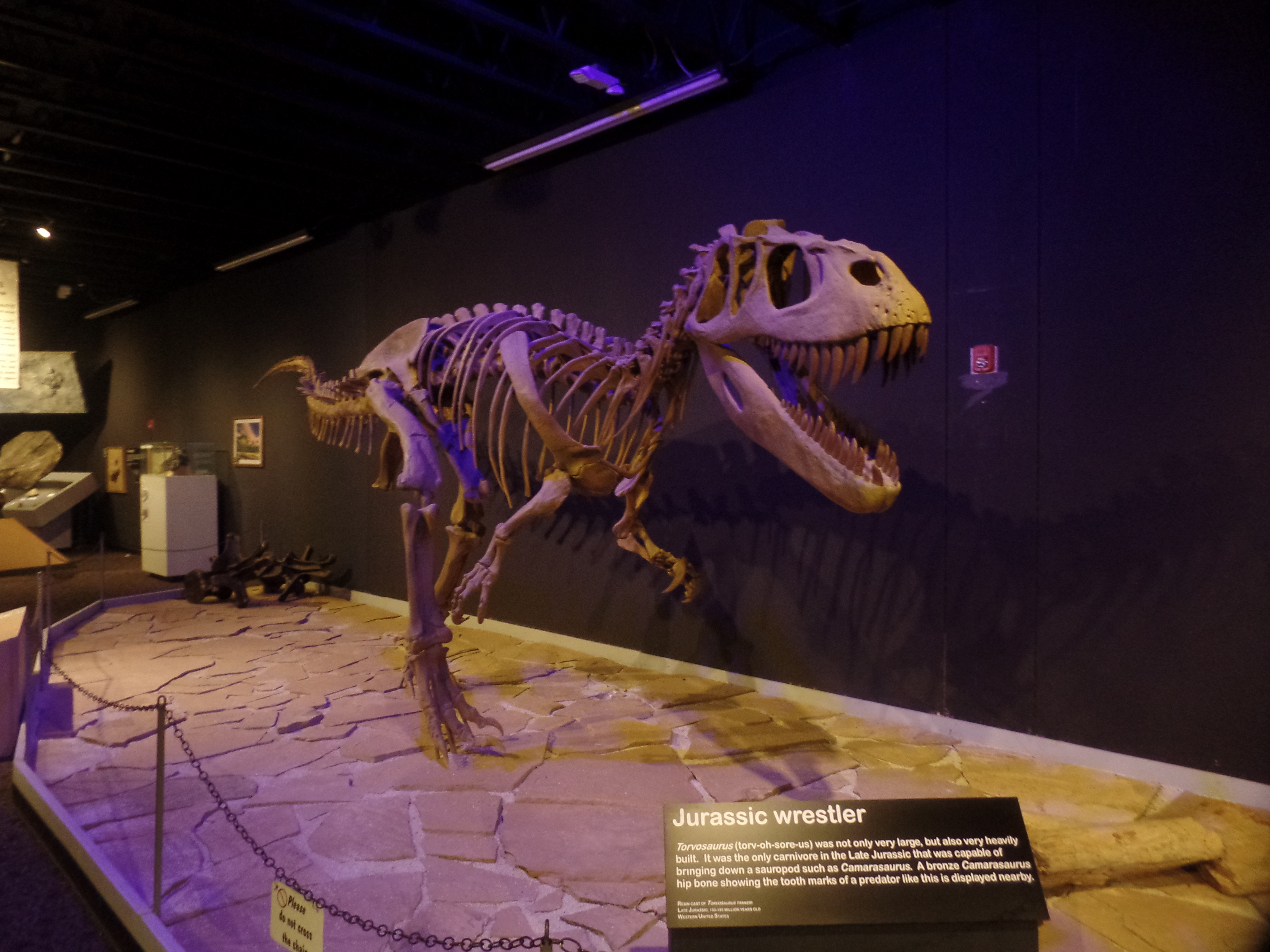
Once traffic resumed, it was not long before I was in the first section of Mesalands, the Early Life exhibit, focusing on ancient sea life: Trilobites, ammonites and prehistoric insects are prominent in the collection of fossils from the Cambrian and Carboniferous Ages, the time before the emergence of amphibians in the Permian Era. There are then open rooms displaying fossils and bronze castings of dinosaurs and related reptilians, early avians and some mammalian megafauna. The Triassic, Jurassic and Cretaceous Eras are all well-covered. A small section is devoted to the Cenozoic Era, the modern time of mammals, including us humans.
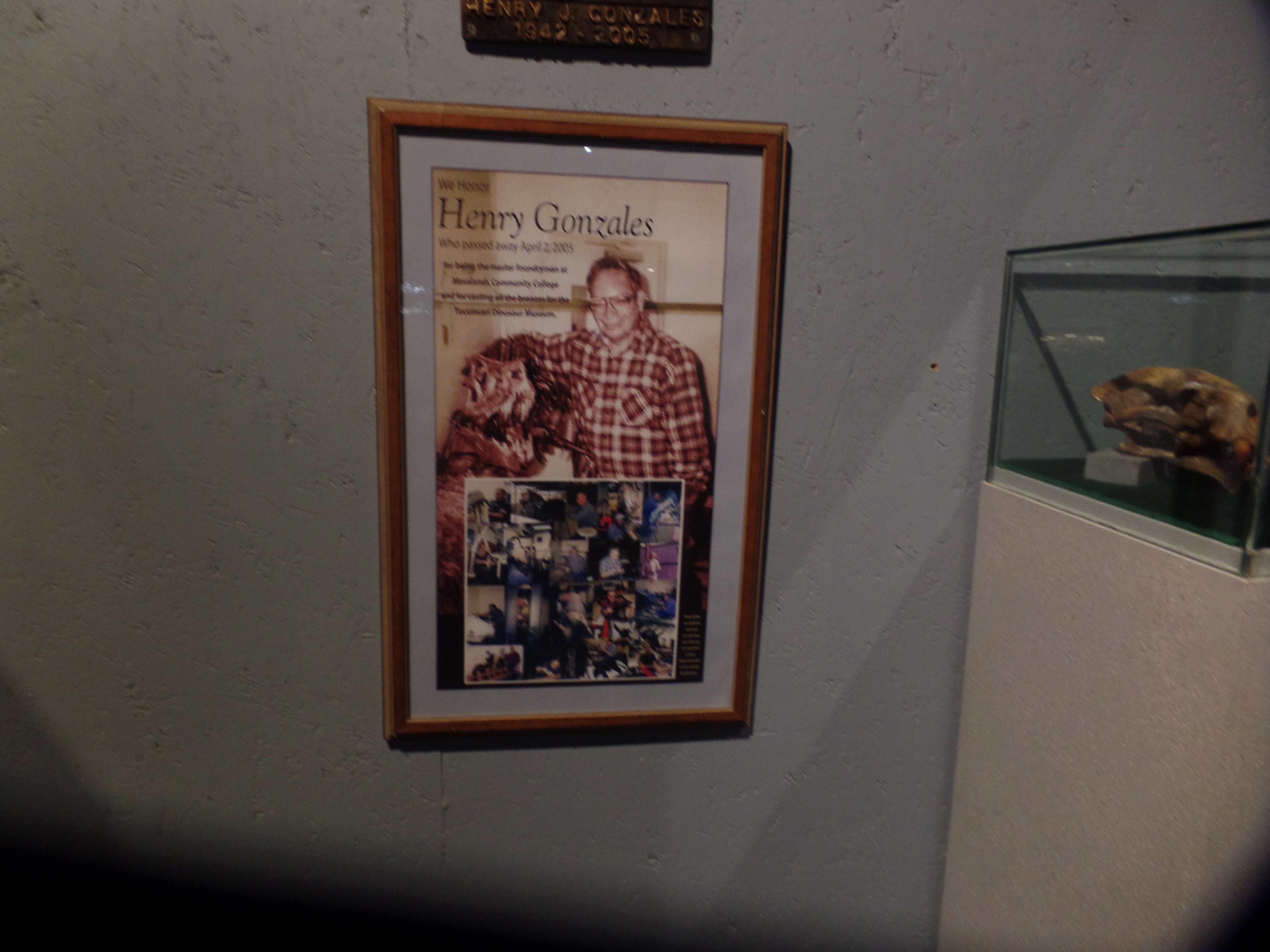
This being a largely fossil-centric institution, minerals have their place in the exhibits, including the Shanks Collection, one of the loveliest mineral exhibits this side of Jerome State Park, in Arizona, which to me is the Gold Standard for mineral displays. Howard and Laura Shanks were keenly interested in the mineral and fossil troves of the Quay County area, collecting sizable amounts of all manner of unearthed gems, minerals and petrified animals and plants. These were donated to Mesalands Community College, in 2004, and the Museum was born. Paleontology has continued apace, with bronze castings and careful restoration of even large dinosaur fossils finding their places in this marvelous collaboration between Mesalands Community College and the people of Tucumcari.
Here are five photos from today’s visit to Tucumcari, Back Then.
Henry Gonzales, professional bronzecaster, who created the dinosaur marvels of Mesalands Dinosaur Museum and taught others his craft.Coelophysis, one of the terrors of the Triassic Period, was an ancestor of velociraptors, and of birds.An Apatosaurus got stuck in the mud, and left this for us.Torvosaurus, an apex predator of the Jurassic Era.A variety of petrified material, in one stone.
There was enough in this Best Kept Secret of northeastern New Mexico to keep me enthralled for two hours. Many more photos will be posted on my Flickr account: https://www.flickr.com/photos/86298326@N07/, over the next several days.
Now, I am resting at a Motel 6, on the west side of Amarillo. After breakfast, tomorrow, in this city’s “Fun Zone” (Old 66), I will make my way down to my little family’s home.
November 16, 2025- The American bison has long been the stuff of both reverence and legend. It was also, following the late Pleistocene die-off of other Megafauna ( Cave bears, American camels, giant ground sloths, American rhinoceroses and giant beavers), the largest source of protein for First Nations people.
It is true that First Nations people offered thanks to each animal they killed for food and sustenance. It is true that many tribes, especially in the Plains region, used as many parts of the animal as they could salvage, for food or for tool-making. It is also true that many tribes employed the technique of the Bison Jump, forcing large numbers of a given herd off fairly shallow cliffs, to their deaths or to severe injury that incapacitated many animals, who then could be slaughtered. This was mainly a late autumn/early winter practice, done for the express purpose of ensuring a food supply in winter. The practice is explained here:https://www.youtube.com/watch?v=qDjUHPzLn5E.
I learned these facts from the film “Singing Back the Buffalo”, which was shown this afternoon, at Sacred Heart Roman Catholic Church, in downtown Prescott. The film, by Tasha Hubbard and Jason Ryle, explores efforts by First Nations people, in Canada, Mexico and the United States, to restore healthy bison herds, primarily in plains and prairie regions. Ceremonies are held, often within hearing distance of bison herds. (The name “buffalo” is used by some First Nations groups, interchangeably with the more correct term, bison.) There is much singing and dancing at these ceremonies, which both thank the bison for their sacrifice and appeal to them to gather and procreate. It is said that, when a specific group of five juvenile male bison were the focus of a dance, and were too far away to hear the songs, another group of five juvenile male bison came to the site and presented themselves to the assembled Band. This is documented by the film-makers.
It is gratifying that these efforts to promulgate healthy bison herds are gaining traction. Sustainable hunting is also going on, in areas where the bison herds are large and healthy. There are, however, no more “buffalo jumps”. Discussion afterward extended to efforts at promulgating other species, “rewilding” in both North America and Europe. Indeed, I noticed that efforts at protecting and re-introducing the beaver and the lynx are well underway in Scotland. British wildcats are a focus of re-wilding efforts in England and Wales. The lynx is also a focus of re-introduction in Spain and Portugal.
As we learn how to co-exist with wild animals, there is hope for a mutually beneficial solution to the problems of conflict between species. (Of course, we also need to devote a great deal of energy to solving conflicts between humans!)
November 13, 2025- It may well have been the last time I work in Chino Valley High School, but everyone made it count. The Career Exploration students took up the bulk of the day, researching and applying concepts like job descriptions and the expectations that go into their creation. The Drama students were more involved with a production that they are staging, in a few days.
“Twelve Angry Jurors” is an updated version of “Twelve Angry Men”, a film that was done, in 1957 and again in 1997, and which graphically illustrates the intensity of jury deliberations, especially in ambiguous cases. It is more than just a mixed-gender version of the film. Being audience-facing, the play thus appeals to the sensibilities of those watching, as well as acting out the viewpoints of any given juror. There are other, more subtle differences, briefly discussed here: https://www.youtube.com/watch?v=q58Wxi20Frk&t=152s.
I haven’t attended nearly as many plays, over the years, as I might have liked. Small efforts, done in the round, have been my favourites among those I have experienced. A performance of “King Lear”, earlier this year is probably my favourite, if only because it stayed truest to the play as I remember having read it, in my senior year of high school. The themes of mistrust of a loving critic and the clouds of madness, followed by rage at being deceived are most cautionary. The human tendency to reward even the most transparent sycophancy also hits home.
The most appealing thing about live theater, though, is that the efforts of the performers-and of the stage crew may be seen close up. Human effort, at changing the scenery and moving about the room, even having to navigate the audience at times, also makes the play more intimate than even the most exhilarating IMAX presentation of a motion picture.
Movies can be fabulous, but for intimacy and connection, yet, “the play’s the thing”. Long may high school and college drama programs endure. Shakespeare may have used the term as a vehicle for Hamlet to trap his father’s killer, but it certainly sums up, in general, the appeal of the medium.
November 12, 2025- Someone I care about, here in town, mentioned recently that several health challenges lie ahead in the coming year. Having faced similar issues, within the past six years, I offered some recommendations and left it to friend to follow up. Caring has to be tempered with a respect for dignity.
I have learned, as a caretaker in the 2000s, and as a person in resilience in the 2010s and early part of this decade, that lack of attention to detail can very often come back to haunt-and at very unexpected times. Besides, being more present has helped relieve the level of autism that has gotten in my way. With less off-center behaviour, I also have less tendency to offer excuses for missteps-or to blame others for things that only I can control.
That is as true of physical ailments as it is of psychological issues. A lot of the progress I have made in both areas is also due to a greater focus on natural supplements. I have benefited greatly from do Terra products. Others use different companies’ fare, with results that work for them. The important thing is that a person knows self well enough to choose the right physiosocial regimen that meets her/his needs.
Each of us is important to the world, and the Universe, in some way. May details be seen as parts of a road map, and not as nuisances.




 A Sagittarian Seeker