December 15, 2025- There is only one constant, when transitioning from a long-time residence to taking over someone else’s long-time residence. It helps to have money set aside. I have found it will be in my best interests to invest in a U-Pod, which will mean two stages of the move, owing to Hana’s birth and the U-Pod’s schedule being on two separate wavelengths. I am only grateful that I can manage to do justice to both.
I divested myself of about half my wardrobe, saying goodbye to things that I have kept, but not worn and things that no longer fit. I have done the same to my book collection. Those volumes that I am unlikely to ever read, or that I have read and think will be enjoyed by others, have been passed on. Finally, the furniture: I have scant need for anything that is in this apartment, save a folding card table, once I am in Plano. Most will go to one thrift store or another. One piece is likely to be bought by someone in town.
Today was my last visit to the Coffee Klatsch, and last time volunteering at the Soup Kitchen. Both groups are filled with fond memories and people who will miss me as much as I do them. Life will go on, though, and a friend has already stepped up to take my place on the serving line. He will be an excellent fit for that operation, and made a good impression this evening.
So, the wall art and the small knick-knack keepsakes will be covered in bubble wrap. The family archives will be prepared for transport, some at the end of the week and the rest in the middle of next week. Our darling will appear in between it all. I am all in for the whole process.
December 14, 2025- I did not go to Bellemont, and climb up a long flight of stairs, six times, in order to store six boxes of books in an already crowded room which few people will enter until next summer. I had considered that option, until early this morning.
My late wife appeared to me in a dream, as if she were right beside me. That was a nice sensation, and though I realized it was a different level of reality, some insights came to me. I got the message to check with our public library, to see if they would take 2 boxes of the books. They did so, gladly, thus bringing a more meaningful Baha’i presence to either their general stock, their saleable book collection, or both.
Regarding the actual move, consultation with my son led me to contact a possible moving assistance service, comparing their price with what it would cost me to do the move on my own. There are timing issues, as well, so I will see what their answer is. This is the U-POD system that is growing in popularity. It makes sense for people who have a high volume to move. I do not, but rather am just in that gray area, with a few too many keepsakes for one trip.
Reason made this day a nice one. I did not have to leave town, saving my energy for what lies ahead this week. I can get a lot more done tomorrow, and won’t have to worry about letting my family down, come next week.
December 13, 2025- Two farewell gatherings took place today. One was small and short, taking place after my last work effort with Prescott Farmers Market. I got a thank you card and a special little round of hugs and handshakes.
The second was a full-on dinner party, a gathering of Baha’is, at the home of a couple who have been here for about three years. We shared several of our experiences, as well as focusing on the challenges present in our lives. Every person alive today has challenges and unmet needs. Camaraderie both eases those and offers a way by which they can be overcome.
I was recently advised, by someone whose counsel I value, that once I leave the area, no one will give me a second thought. Yes, and no. Everyone has lives to live and must go forward, regardless of who else leaves or stays. There was today, however, an overwhelming consensus that my presence will be missed. Yes and no, for me as well. I will focus on what is in front of me, in Plano-as I have in Prescott, these past fourteen years, and as I did in Phoenix before that. That focus, and commitment to being honourable, are what earned the respect of so many in this community. They are also what lead me to see the same qualities in others. I will never forget my time here, and all that ended up moving forward, because of our teamwork.
I will pack those things that I feel the need to bring with me, and I will carry the love of people in my heart.
December 12, 2025- The sunbow appeared in the northern sky, as I walked downtown from HB I. It was an affirmation that all had ended well, after a tumultuous day. It was Acker Night, time to walk about and enjoy the lights, music and camaraderie that foreshadow Christmas here. I ran across several friends and walked around with Hiking Buddy Akuura and another one of her friends. The musical fare ran the gamut from hip hop to novelty Country. The latter included a revision of “Take Me Home, Country Roads”, with Arizona taking the place of West Virginia and US 89 replacing the generic country roads. There were fewer Grinches, and no Krampases in sight. There were plenty of children and dogs wearing deer antlers, though. It was also warmer and more serene than the pushing and shoving that has sometimes characterized the crowds downtown.
I had entertained thoughts of heading up to Bellemont, with six boxes of books, earlier this morning. It occurred to me, though, that time was getting short to advertise and sell the sofa hide-a-bed. So, I took the measurements and a couple of photographs, and posted on Craig’s List. It didn’t take long for the grifters to come out of the woodwork. Offers of purchase on Venmo and Zelle came via text. Needless to say, after ridding myself of three or four such pests, (one of whom sounded quite convincing, until his “coach” came on in the background and was heard telling him what to say), I found it necessary to call my bank. If the thieves had my contact info, they might have been able to hack my account. So, proper measures were taken to safeguard my assets. Nothing was compromised, in the end. I will sell the item for cash and nothing else. It was a good day of learning about private sales of items.
I will use Sunday as a Books to Bellemont day. It is a lot less stressful now, knowing that there are alternatives to driving back and forth from Prescott to Plano, twice. I will talk with U-Haul reps on Monday, for transport of what might not fit in Sportage.
These things, too, shall pass and Christmas in Prescott will remain a bright and shiny memory, for years to come. Plano, and the Metroplex, have their own holiday festivities. My family will enjoy them all, as a unit.
December 11, 2025- A few of us gathered for a regular gathering, this afternoon, with illnesses and work trimming our numbers. There was a fair amount of interest in my schedule for departure and what might await me on the other end. Friends here are universally happy for me and family, while wistful about what it all means for the community. I know that I am hardly the be all and end all of anything, yet it feels nice to be so appreciated.
One friend gifted me with a small device that, inserted in the left ear, will alert with a buzz, if it senses a driver starting to doze off. This has not been a problem for me since the lowest point of my caretaking days, but it is best to be forearmed. I will use it faithfully, in the journey that lies ahead.
My morning had been occupied with cleaning out the spice cabinet. All those items that I had dutifully kept, from time immemorial, ended up discarded. Most glass bottles and metal boxes were carefully cleaned and placed in recycling. The worn out contents were properly placed in trash. Similar processes lie ahead for the office desk drawers, the clothes closet and the dresser. Then, there is the carport storage, either next Wednesday or Thursday. The book shelves are separated between “keep” and “donate”. Friends will come to look at the furniture, probably over the weekend, knowing that the sofa and the bed frame are headed elsewhere.
All this occupies me and generates solutions. There was a suggestion that I rent a large truck and tow Sportage. That would obviate any need for a second trip back and forth, but which is the absurdity and which, the solution, is still a matter of dollars, and sense. Aram and I will work that part out next week.
At least one medical provider has a counterpart in the Plano-Frisco area, and I can drive to that office, using a surface road. I’m hardly afraid of freeways, mind you, but have always made it my business to know the layout of secondary streets.
I go through this process, in the only way I know how, seeking solutions by talking things over with family and friends, and taking concrete steps forward, each day. I would like to see the same thing happen, in affairs of state, but there are so many who, it seems, are given over to absurdities. Eventually, solutions will present themselves, and not take “No’ for an answer. I prefer to have found them in a timely manner.
December 10,2025- In the Fall of 1979, a co-worker at Villa School, in Eloy, had a vehicle and wanted someone to go with her to Oak Creek Canyon and Sedona. My hand went up, as I was actively visiting as much of Arizona as I could on weekends, without the benefit of owning my own vehicle. So, northward we went, first to Flagstaff’s Fort Tuthill (fairgrounds), then down along U.S. 89, stopping next at an overlook and purchasing a few items of Dineh jewelry. (She, for herself and I, for another co-worker, whose birthday was approaching).
Then, the magic started to unfold-a riotous blend of colours: Blue sky, green trees and grass and red rocks presented their unique co-existence all along the windy canyon road, carved long ago, by Oak Creek. The creek itself served up a hearty torrent, at Slide Rock, which hosted a popular Arizona State Park. We looked for a bit at the happy families, kids squealing in delight and teen boys on the ledge above, daring one another to jump off into the creek. (None did, given that their fathers were close by, wielding veto power). We soon went on, down towards Sedona, creeping along behind a bicyclist, who was half arrogantly occupying the center of the lane and half scared to death that his brakes might fail. The slow pace only amplified the majesty of the place. We took in Cathedral Rock, Courthouse Butte and Bell Rock, all from their bases. I was an avid hiker, but my co-worker was not. I made a mental note to return to each of these, and explore further.
Over the years, Sedona has been a regular destination-either alone, or when accompanied by Penny, by our son, Aram, by his wife, Yunhee, by members of the NAU Hiking Club or, most recently, by my present Hiking Buddy, Akuura, the area has not once failed to present the most majestic of views. Those views change with the position of the Sun. Light and shadow are everything in the Southwest, and nowhere more so than in this most wondrous of places, where canyon meets mountain.
Akuura and I took in Red Rock State Park, for one final excursion, before I devote myself full tilt to dispersing many possessions and packing up the rest. It was an exquisite day, weather-wise, and so we took in Eagle’s Nest and Javelina Overlook-and several points along the way.
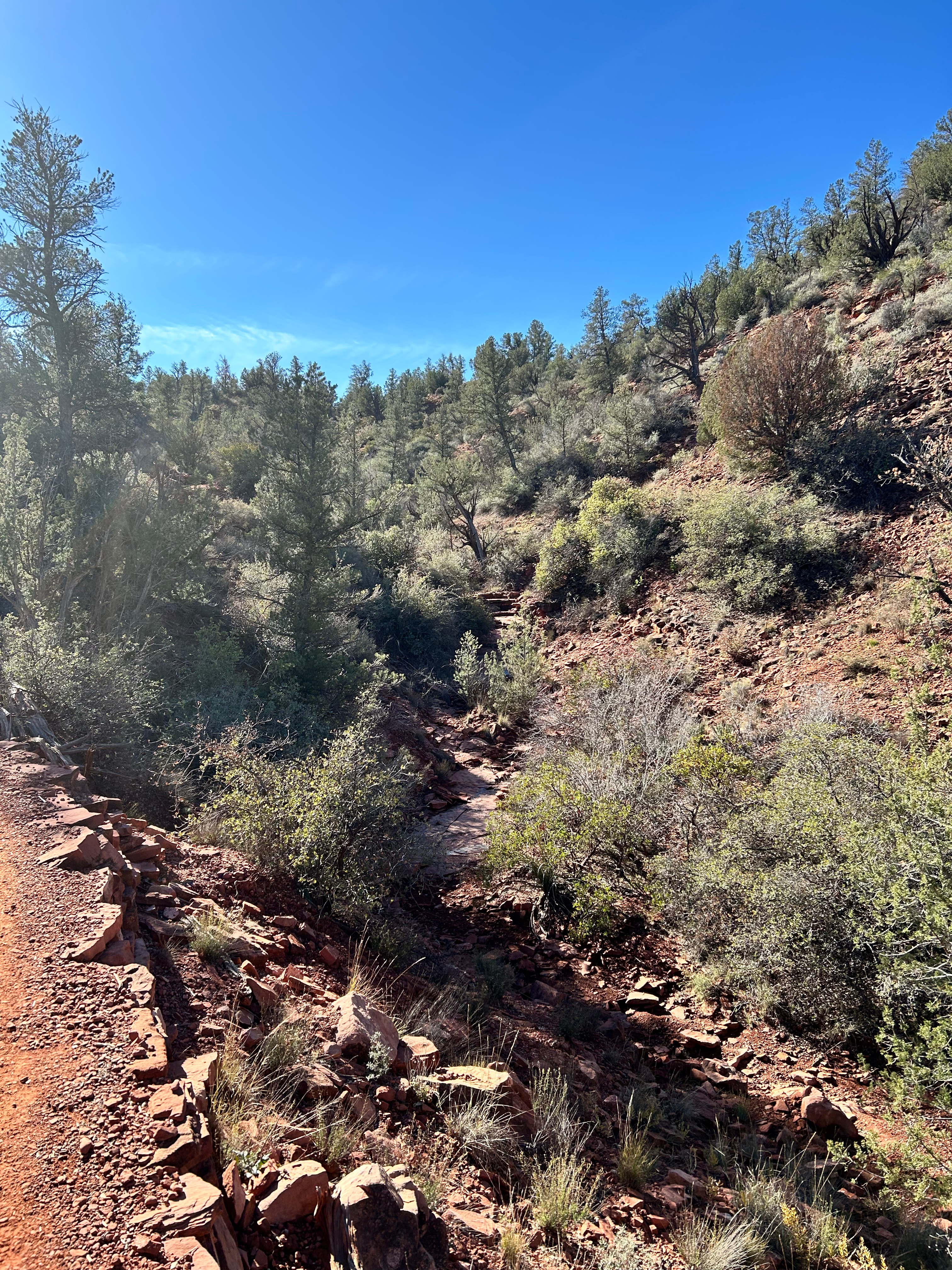
The blue and green were gearing up; the red a bit subdued, yet, at the base of Eagle’s Nest Trail.
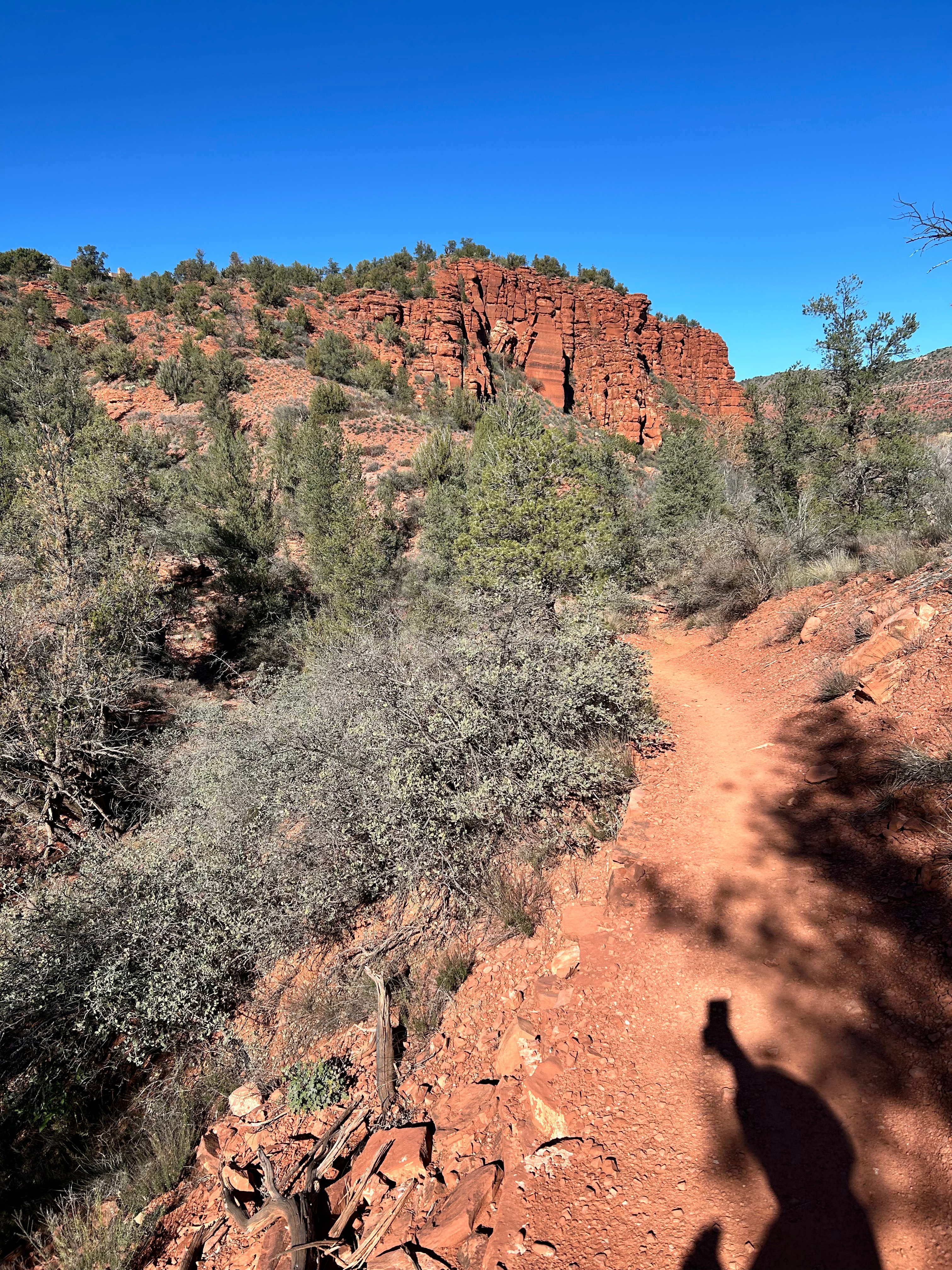
The hues deepened, though, as my shadow and I walked towards the switchbacks that led to the overlook.
It may not look treacherous, but the sign is quite accurate.
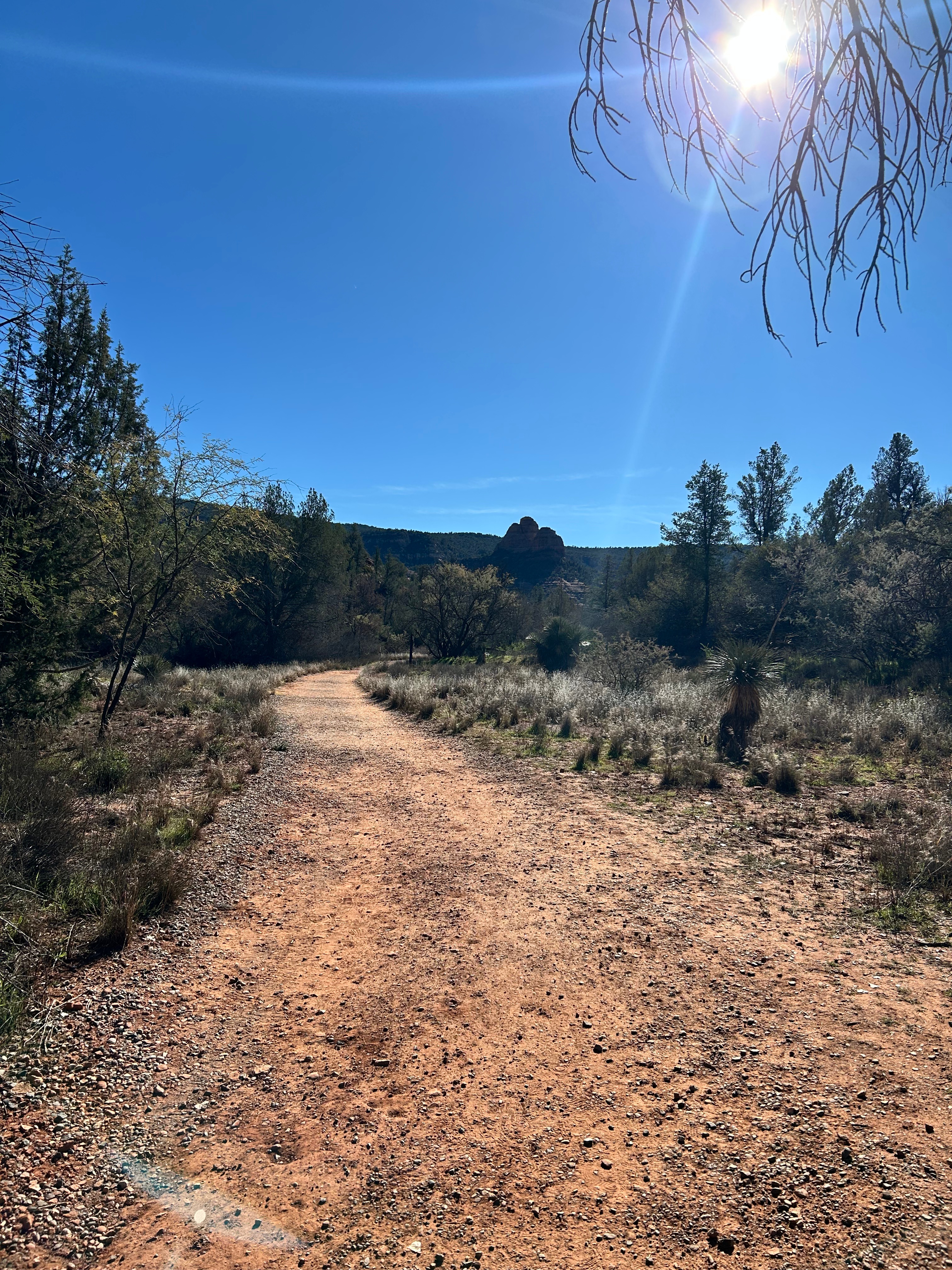
The first phase of Javelina Trail passes by an area where several mule deer were grazing and another area, where a lone javelina was moving away from a small assembled group of bird watchers/deer oglers. We would encounter the deer again, towards the end of our hike, but that was the last we saw of the boar. This magnificent little spire could be called Love Rock, for all I know, but it is a standalone outcropping, along the flat trail, just before Apache Fire Loop rises off to the right.
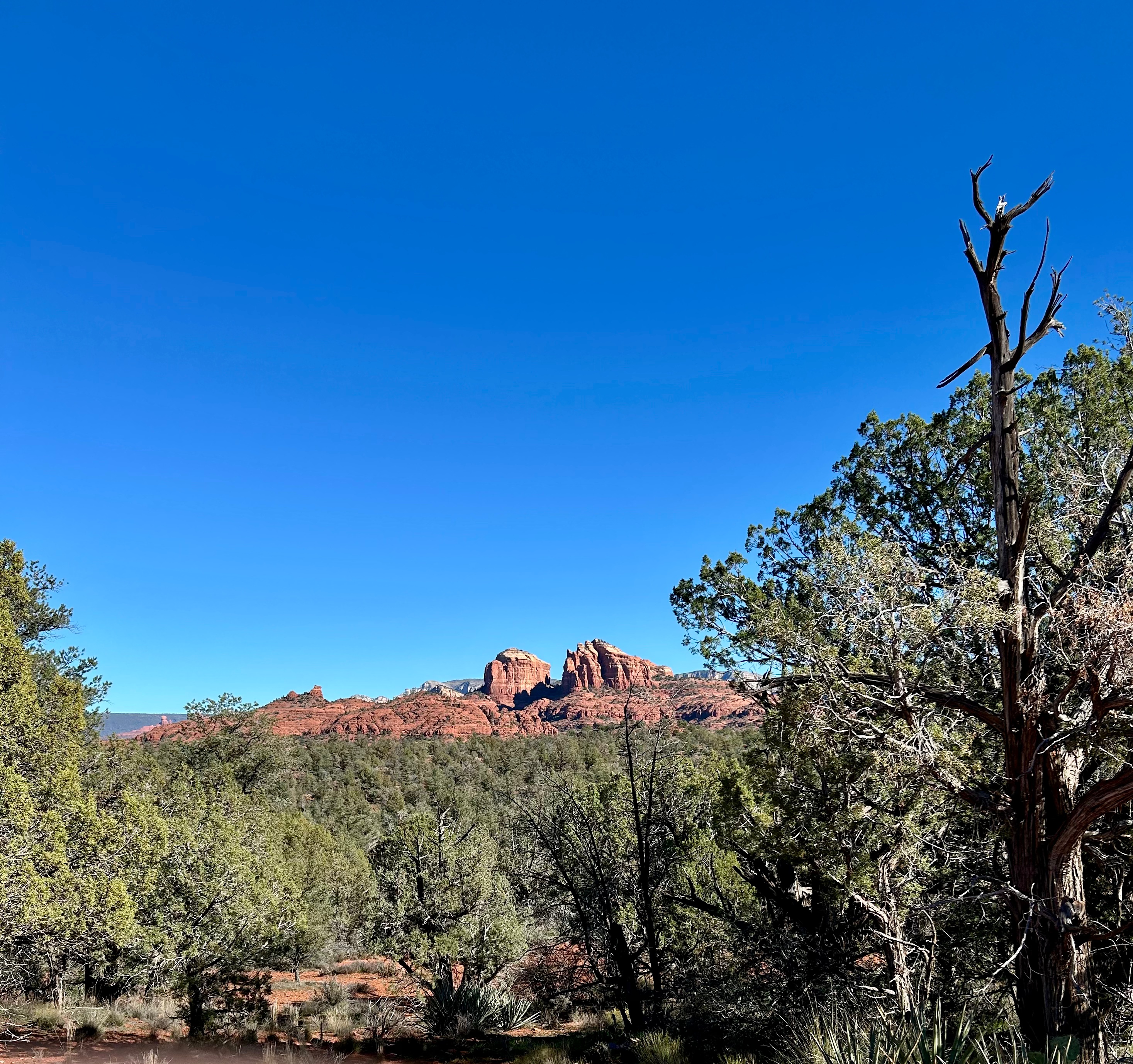
Once atop the Javelina Trail, the iconic view of Cathedral Rock offered itself.
We briefly pondered the trail east to another part of this majestic expanse, but then opted to head back down to the Visitors Center-and on to lunch. Just before getting to the Visitors Center, we encountered the family of resident mule deer, enjoying their lunch.
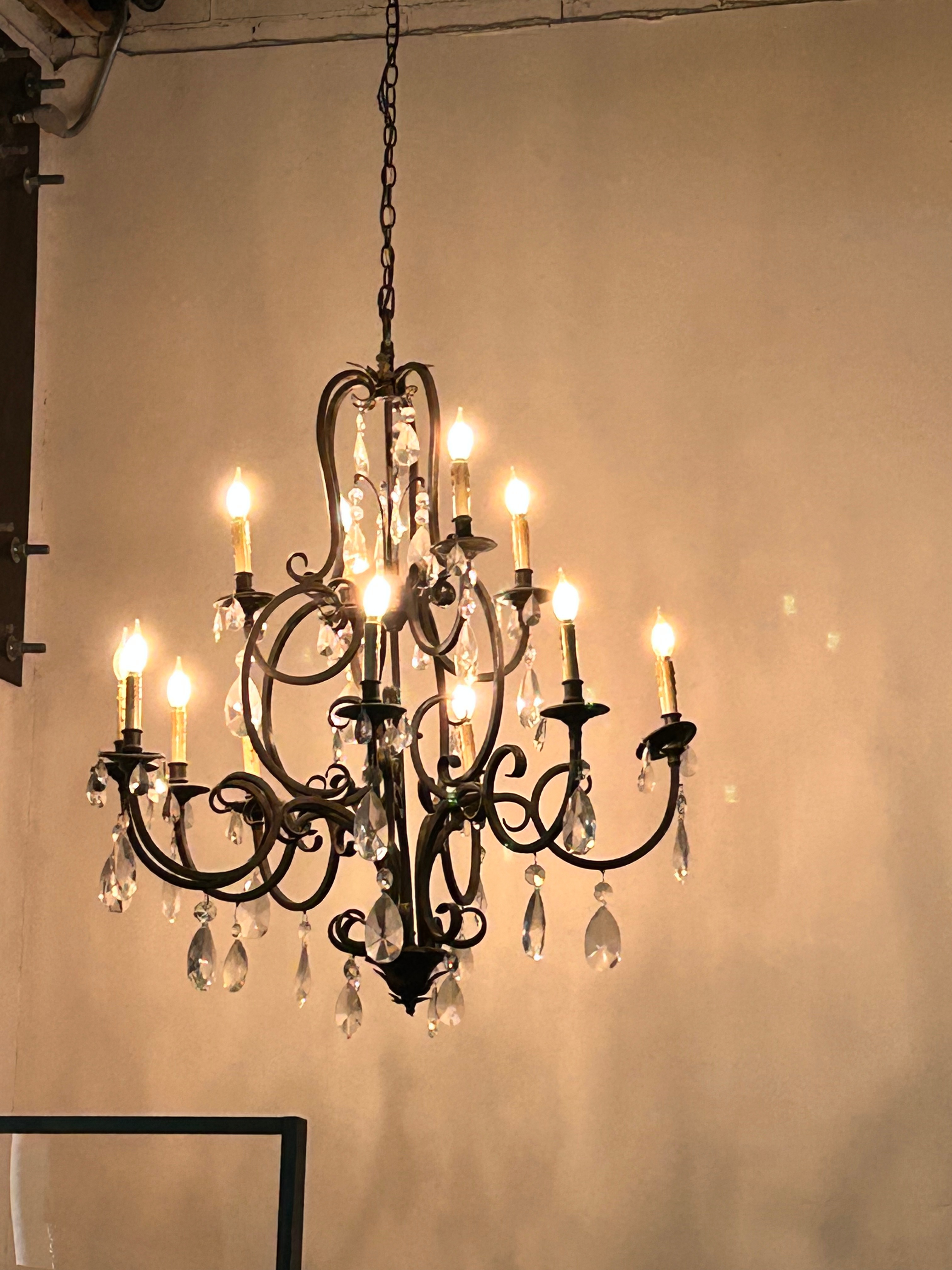
The final visit to Sedona, of this year at least, came to an end, with a celebratory lunch at The Belfry, at the entry to Old Town Cottonwood. I long ago swore to spare my readers any food photos, but this chandelier is worthy of praise.
I will someday be back in Sedona, and God willing, I might even have a wide-eyed granddaughter along.
December 9, 2025- In 2012, I drove out to San Diego, a favoured destination since 1978. Having befriended several bloggers from Los Angeles and nearby Orange County, I arranged to meet four of them on this first westward outing, since the death of my wife, Penny, a year earlier. Three have moved on from our acquaintance, and one has remained, a faithful, supportive older sister. She has seen me outgrow a lot of self-imposed limitations and cast off a lot of baggage.
Ever gracious, my friend rose from the park-style bench and greeted me with a side-hug, on this last visit to southern California for a while. (Except for a possible pit stop at LAX, next month, which hardly counts.) We then headed into the Ladera Ranch branch of Corky’s, a lovely chain of breakfast and lunch spots across Orange County, eastern Los Angeles and the Inland Empire. Our respective years were shared, as well as what lies ahead for each of us, in very different spaces. J is always a voice of reason, so I value her insight into my impending move to Texas.
The greatest driving force in my life, this month, is honouring the friendships that have grown over the decades that I’ve been in Arizona, and the nearly twenty years that I’ve been active online. So it was an easy drive to Orange County; it will be a joyful hike at Sedona’s Red Rock State Park, tomorrow and a blissful, if a bit wistful, series of gatherings from Thursday to next Wednesday. I have an enormous amount of gratitude to this state in general and to Prescott in particular, for having helped me come out of an oversized shell. It has helped me develop a sense of fulfillment.
I made it from Banning to Ladera Ranch, thoroughly enjoying our two-hour visit, then made a farewell drive down I-5, thanking the ocean for being such a comfort and an affirmation of all that matters in life. Over the hills of northern San Diego County, up I-15 along with hordes of home-bound commuters and along the stretch of Highway 79 north, through suburban Temuecula and rural French Valley to Hemet and back over to I-10, it was back towards Arizona.
At midnight, I’m back at Home Base I. Another promise remains to be fulfilled-and that makes all the difference.
December 8, 2025, Banning- Two small piles of notebooks, coloured pencils, a therapeutic colouring book and post cards which had accumulated over the past fourteen years were offered to those gathered at the weekly Soup Kitchen. It took exactly fifteen minutes for six people to go through the offerings and take what suited them, in a discerning manner.
I will be doing more of that, over the ten days left to me to prepare for the move to Plano, especially as most of what I am giving was itself given me, following Penny’s passing, in 2011. Of course, it will largely go to Thrift Stores or to Habitat for Humanity, but new uses will be found for even the most well-worn items.
First, though, is my final visit to Orange County, at least until my granddaughter, whose birth is fourteen days away, attains toddlerhood. With that in mind, I took advantage of an easy clean-up after Soup Kitchen and headed west, through Arizona’s Outback and the Colorado Desert of eastern California. Only a couple of brief incidents coloured the generally smooth trip.
Between Aguila and Wenden, along US 60, there happened to be two rather large deer standing in the road. As Sportage approached, one deer went north and the other dashed south-no collision tonight!
Later, after I topped off the gas tank at Ehrenburg, a Honda Accord appeared to my left, as I was leaving the station-the driver bulling his way onto the road, to get ahead of me. Since he had been right behind a pick-up, I figured they were traveling together and he didn’t want to get separated. That was, until he zipped past the pick-up. Oh, well, we all got to stop, a half-mile further west, at the Ag Inspection. CHP also had a Safety Zone set up, for five miles through Blythe and just beyond, so we were all limited to 60 mph. Sometimes, taking ends up becoming giving, in terms of personal freedom. It’s often better to just go with the flow, at least when it comes to traffic.
From Wiley’s Well onward, the trip was uneventful, and I pulled into a different motel, the Margarita, around 10:15, PST. Tomorrow, I will meet my Orange County friend at Ladera Ranch and share my joys of this past year and the year to come.
December 7, 2025- Another holiday party/annual meeting/farewell gathering featured inventive, delicious organic and vegetarian fare-including my mixed greens and sunflower sprouts, with a dressing of lemon curd, Sicilian lemon balsamic and Persian lime olive oil, with a hint of paprika. The dressing was a particular hit with the group- and the host, a Master Chef, asked to keep what was left. Success!!
Part of the business meeting involved discussion of whether to donate funds to a Garden School in Africa, that serves HIV-ridden orphaned children. The group has helped the Director, herself uninfected, for the past three years, so it was not difficult to vote for continuance. We voted to double the amount suggested by our executive committee, with no objection from them. One of our members has been to that school twice, and will visit again, sometime next year.
It is hard for many people here to comprehend, but the conduit member said that HIV is still rampant in that particular part of Africa, as many men are unwilling to use hygienic protection in their intimate activities, leaving their women open to infection, which naturally gets passed on to any progeny. This situation was the basis for HIV-fighting funds from USAID. Now that the prevailing view in our government is that these funds just “reward bad behaviour”, the funds have been reduced, or eliminated, and it will take time for the miscreants to realize that no one is going to rescue them. The children are the ones who end up suffering. So, private groups like ours are taking up the slack-helping women and children directly.
Collective action is far more effective than assorted individuals trying to take up the mantle. Besides, I have to be on deck to focus my energies and resources on family first. I am grateful that projects like this are getting an organizational response.
December 6, 2025- I was blessed with an extra helper today, at the Farmers Market breakdown: A National Honor Society member, who proved to be a self-starter and did about half the workload, without missing a beat. This is a one-off, but I told management that I think it would be a good idea to reach out to the high school, for assistance from Future Farmers of America and Junior Achievement, both of whom have chapters there.
I only have one weekend left in Prescott, after this one, so it is of concern to me that the groups I have been helping are covered, going forward. There is a lot of youthful energy in this town, and in this area. I have watched the children of several friends here, grow from infancy to pre-teenhood. Others, who were students of mine when I first came here, in 2000, are now among the leadership in the community, and the Classes of 2011, onward have proven equally talent-laden.
I was asked tonight, at another gathering, how I felt the youth were doing, relative to our generation. There are lots of forces that are exerting a downward pressure on the rising generations; but that has always been the case. Advances in technology make these seem worse, especially to older folks who might not be well-versed in said advances. Human nature, though, is still the same. Young people will take some of the changes into their cultural framework, and resist or roll back others. I have spoken with a cross section of youth, in recent weeks. There are both conservatives and liberals in Generation Z and Generation Alpha, as there have been throughout the course of human history. Both groups have a concern for individuals maintaining health and adhering to a moral framework. With individual responsibility increasing, there is also more of a tolerance among the younger generations for engaging with those whose viewpoints are different.
This trend, to me, is of great importance. High honours redound to the person who is willing to look beyond own perspective. No one has a corner on the truth.



 A Sagittarian Seeker