December 5, 2025- The earnest young man said, with a straight face, that he fully intended to finance a new vehicle, using his available income from a part-time job cleaning office buildings around his town. We went over the cost of the desired vehicle, the number of months it would take to pay off a loan-if one were even available and the amount of money he would have to set aside each month, just to pay the loan amount, never mind insurance, registration and maintenance. It didn’t take him long to pivot to calculating the monthly costs involved with purchasing a used car, for 1/4 the amount of a new vehicle.
When I was a similar age, I had a grand uncle who would calmly disabuse me of similar outlandish dreams. He never tried to actively talk me out of any pipe dream, but used facts, numbers and the sort of logic that said “This is all achievable-just some day, not right away.” In running this morning’s round table discussions with juniors and seniors at a local high school, regarding financial planning, I used the same mentoring tools. The students could see that I am still standing, even through a fair number of missteps and setbacks. My ending point was that it is not the mistakes that matter, in the end; it is the aggregate of lessons learned.
This morning, regarding grandparenting, I was reminded that the elder’s greater wisdom shines brightest from the ability to listen to the grandchild; to be the safe haven and by extension, the greatest emotional support. It takes nothing away from parents, but does offer the child another place where s(he) can feel validated. It is that affirmation that builds the emotional strength a person needs, to successfully withstand all manner of negative pressures.
Today’s seminars were a good round of practice in that regard.
December 4, 2025- While mostly enjoying a gathering this afternoon, I got the sense that two of the higher-ranking people, in the group with which I have been involved, were not exactly thrilled with my decision to leave the area. A mutual friend said that was off the mark and that the management is actually supportive of my decision and is happy for me. One of the administrators hugged me before leaving, so my reading of the room was not quite on point.
One of the things that has indeed held me back, over the years, is a difficulty in reading people. I came to the conclusion, a while back, that oftentimes when I sense hostility or dislike from someone else, it is more a matter of how I am feeling about myself at the time. Many, if not most, people are neutral-to-supportive. Very few, actually, are hostile-and even if they are, the question begs, “Do I reflect something they don’t like about themselves?
I went to another gathering, this evening, putting these ideas to the test. A person who I previously had considered hostile was actually quite agreeable, jovial. Most of the people at the gathering were engaging and took an interest in one another. I felt at home, and recognized that any tension inside myself right now is likely processing the matter of leaving a place that has been home for fourteen years, and a state that has been home for all but six of the past forty-seven years.
It’s best to let the feelings flow, and know that all will be well, in the weeks to come and in the years that follow. I am getting better, at reading the room.
December 3, 2025- I arrived back at Home Base I around Noon. Newspapers were neatly stacked and the mail had been delivered from the holiday hold. My hardy houseplant did just fine, with a week’s supply of water and some access to sunlight. The re-upholstered couch looks fantastic and the place is cozy and warm. I plotted the December calendar, and found that there is something on tap for each day, until I leave, on or near the Solstice.
Yesterday, I stopped in for lunch at Double C, in Moriarty. Riely has moved on with her life, but a nice young lady, who the owner identified only as “Employee 9”, served the seven of us who showed up at once-without batting an eyelash. The chili cheeseburger is thick and sumptuous.
Later, in Winslow, once ensconced in the Beatles Room, at Delta Motel, I headed down to “the Corner”, where Glenn Frey never stood, and enjoyed fabulous birria tacos at Shorty’s Cafe. Shorty is a nice lady, assisted by two lovely young women. Marisella, who served me, is effusive and glad to see all who enter the premises.
This morning, the owner of Delta made sure that I knew not to try and navigate Highway 87-“already having problems there with snow and ice.” Figuring she knew something I didn’t, I stuck to the Interstates and had only dry roads to navigate. There was scant snow in the air and none on the ground, between Winslow and Camp Verde. Here in Prescott, the situation was no different and it actually cleared up, this afternoon.
We will have fair and dry weather, while I am getting the place packed up and various items distributed here and there. My jaunt out to southern California, Monday night and Tuesday, and Sedona visit on Wednesday, will also be blessed with perfect weather. I am grateful to be able to tie up loose ends properly. Life continues to proffer blessings on this peripatetic soul.
December 2, 2025, Winslow, AZ- A friend who thinks deeply about the course of human behaviour made a cogent point today- People who often get assessed as being “broken” or “lost” are more often creatures of dependence. They seek approval or guidance from those they view as more powerful or worthy of control over their affairs, and leave their own power on the sidelines.
Through my life, I have often been right, when I trusted my gut and my heart. The bloopers, which have also been many, have come when I tried to “honour” requests or demands made by those who I, erroneously, deemed “heavy hitters”, “hard chargers”, or more adept at life than yours truly. They came when I absorbed their insults and diatribes into my own psyche. Mathematically, this translates into (Dependence) X (Sycophancy)= Self-defeat.
Here is what I would like to see increased: Each person takes stock of how the gut feels, how the heart feels and how those feelings are in sync with common sense, before deciding upon a course of action and certainly before carrying it out. Committing myself to these has definitely decreased the number, and severity, of bloopers that cause so much pain and annoyance to me and to those around me.
This morning, I had a brief urge to go from Tucumcari to Pecos National Historic Site-which would have been a two-hour, thirty-five minute diversion. Gut told heart that there is simply much to be done back in Prescott, once I return there tomorrow. When the turn northward, towards Pecos, presented itself, I kept on driving west, and other than a brief stop at Continental Divide, continued on until I decided that a Winslow break was in order. Top notch birria tacos, at Shorty’s and a night’s stay in The Beatles Room, at Delta Motel, the music-themed inn that is one of my favourites have helped set the tone for the rest of my return to Prescott and getting started on the month of transition ahead.
As for the exploration of New Mexico and other areas, I am looking forward to helping, slowly and gradually, introduce the world and its beauty to my grandchild.
December 1, 2025, Tucumcari- My friend sat across from me, in a crowded coffee shop, on the west side of Amarillo. He referred, a couple of times, to things he’d seen on Tik-Tok, a medium he finds amusing. A few minutes later, he told of posts on said medium that he found revolting.
I have never been a fan of Tik-Tok,nor of Snap Chat, Reddit or any other medium that relies, for its existence, on mass, conformity-based consumption of whatever drivel the worst among its contributors serves up, particularly in the form of “challenge”. Whoever dreamed up the nightmare that was “Tide Pod Challenge” (before Tik-Tok, in fairness) deserves to be consigned to the scrap heap of historical opprobrium. Its successors, some of which have found their way to Tik-Tok (i.e. Jam Jar Pulse Jet), likewise deserve nothing short of universal condemnation, for the resulting harm they cause both those who attempt them and their loved ones who are left to pick up the pieces of the person(s) left in relative ruin.
Tik-Tok could have become the purveyor of presentations that elevate humanity, the way Wikipedia and, for the most part, TED Talks and You Tube have become. Instead, we have the media promoter of the ethos that is reflected in that most odious of sentiments, “It’s better than Crack!” End of rant.
The day was, all in all, very nice. I bid farewell to my little family, for a few weeks, then found it fairly easy to exit Dallas-Fort Worth Metroplex. The drive along Northwest Passage was easy, and I found my lunch stop, Valley Pecans, rather deserted. Somehow, I was about the first customer at that lovely cafe-emporium, and was, thankfully, followed by about a dozen other people. It was Noon, so high time for travelers to surface.
After my visit with friend, Wes, In Amarillo and a fuel stop, I made it to this high desert gem, taking this room at Rodeway Inn and heading to Del’s Diner, one of Tucumcari’s best. Del’s has been around since 1966, and the crowds, such as the one there tonight, are proof of its excellence. Martha and crew treated everyone special, tonight. The regulars attest that this is no fluke. It’s how the crew is every day, every meal. Viva Del’s; viva Tucumcari!
November 30, 2025, Grapevine- My sole tasks today were recording measurements of two rooms in the Plano house, using the Notes application on my i-Phone, and doing my laundry. It was not a hard day. Son had to navigate traffic across the Dallas-Fort Worth Metroplex, as he does almost every day. He had the harder job. There is a fair number of unfocused, impetuous motorists here, as there are in nearly every major city on the planet. He got the job done just fine.
Much of the difficulty facing the human race has come from one or more people, in any given situation, becoming distracted. There are plenty of diversions competing for anyone’s attention, at any given time of the day: Sunrises and sunsets; cute animals; cute babies; text messages; phone calls; road accidents; attractive members of the opposite sex; billboards; alluring announcements on the radio or streaming device; even someone riding a horse on the side of the road. The tasks, though, remain the same: Drive safely; pay attention to the person in front of you; finish what you start.
I think of this, as I plan out one of the most tightly-choreographed months in quite a while. Not since July, 2011 have I had to face a sea change in my living situation. It will need to be done carefully, and attentively, both because of time frame and because the feelings of so many people, who mean a great deal to me, need to be kept in mind. The most important, of course, are my little family. Others also matter, and so December will see lots of hugs and handshakes and “Thank you for being my friend, all these years.” The saving grace, in each instance, is the continuity offered by social media.
All I can promise anyone is that I will stay on point, and get the tasks of transition done, to the every best of my ability, doing justice for all concerned.
November 29, 2025, Grapevine- The order of the day was bringing some items to the Plano house, including my major camping stuff and some of the items purchased for the good of the household. It was then off to assess furniture, including my trying out several mattresses. I like firmness on a sleeping surface, and will determine where I will lay my head, at least for the next nineteen years, after a bit more investigation.
The rest of the items are more a matter of style and utility. We stopped in one furniture MegaStore, where I was amazed to see the wooden desk equivalent of stylish torn jeans: Painted wooden desks, with scuffed trim-“on sale” for $289. In fairness, most of the other office furniture was nicely constructed and looked state of the art.
It is a joy to watch my son and daughter-in-law meet the challenges of home ownership, taking each major step seriously, with no sense of being overwhelmed. It is all seen in perspective, and 1-3 matters are handled per day. They are also sober-minded, loving parents, actively planning to nurture the whole child, from the moment she is born.
That brings me back to the subjects of firmness and style. Granddaughter will be getting direction, first and foremost, from her parents, with back-up from me, when needed. My style of grandparenting will evolve, but it will be centered on consistency and giving her feelings of security and self-confidence. Some grandparents are known to take on the role of disciplinarian. I will not. Others take on the role of rescuer. I do not have a life-sized picture of that being necessary, with this family. The bottom line is that I will not live through my children and grandchild(ren). It is not something with which I have ever comfortable, and I am not about to start now.
I will be another sure bet in the little girl’s life.
November 28, 2025, Grapevine- The road to diamond ended where it began, in the company of my little family, here in Texas’ Christmas City. There was a sense that life would continue as ever, for the three of us, and in preparation for my third visit to the Philippines, I seriously contemplated moving there, being very strongly drawn to a lovely woman and having made several friends during my first two trips to that beautiful, struggling, supremely hospitable country.
I sojourned a lot this year-to the Philippines in February; back to the eastern U.S., in May and across a wide swath of Europe in September and October. In between, my commitment to Prescott continued unabated and many hours of service were recorded. These were the fruits of twelve years of building relationships and friendships, across sectarian and even ideological lines.
The finest thing about both travels and community service came in seeing people take the reins of empowerment to themselves. Filipinos rejuvenating a local Baha’i Center, building a pavilion for an elementary school, and women standing up and saying “Enough” to abusive significant others made my spirit soar. The initial phases of a Baha’i House of Worship, north of Manila were an added bonus.
Northern Arizona became a distinct Red Cross Chapter again this year. I had little to do with the actual achievement, but was able to establish ties between the organization and at least one rural community, east of Prescott. We also reached out to formerly isolated communities in the far northern reaches of the state-albeit as an outcome of a horrific fire that ravaged the magnificent North Rim of the Grand Canyon.
Getting to spend time with friends in several European countries fulfilled an eleven year old promise. Visits to Sweden, Croatia, Ireland and the United Kingdom accomplished that goal. Paying homage to the victims of the Holocaust, at Auschwitz-Birkenau and to those massacred at Srebrenica, Bosnia & Hercegovina was the fulfillment of what I regard as a duty of a citizen of the world. In most places, my presence was evanescent, yet I felt at home, and would not be unwelcome if I returned.
I have reached my diamond jubilee. The day, and this Thanksgiving visit, have been focused on the coming move of my little family and I into a permanent home. Doing things like meeting the tradesmen who will help prepare the house, going over specs and pointing out things that need to be repaired/replaced, shopping for new furniture to replace items that are, in my case at least, nearly fourteen years old-have taken precedence. Once I get back in Prescott, in the middle of next week, the process of dismantling Home Base I begins in earnest. Furniture will need to be sold or given away, as will clothing, books and a variety of household items. Farewells will be said, at gatherings in the Prescott area, in southern California and in the Phoenix area. Farewell, though, is not an eternal goodbye.
Our little one will arrive, sometime in the second half of December. A new era thus starts, along with the beginning of my “fourth quarter”. Other than a visit to the Philippines, at the start of 2026, itself dependent on the baby’s healthy start and her mother’s health, my time at the new Home Base I, from March onward, will be primarily focused on my granddaughter’s care. Gradually, Plano will become my new community. It will not be Prescott-but then again, Prescott was not Jeddito, and Jeddito was not Jeju. Every Home Base has had its draws, its strengths and its undying memories.
The promise of 75 is the promise of guiding a new life, a new human being, who may very well be the embodiment of much that I have wanted to offer the world. The choice, though, will be up to her alone. All her parents and I can do is guide her with love.
November 27, 2025, Grapevine- My grandchild gave a small kick, when I spoke to her through her mother’s belly. Her coming birth is surely the shiniest blessing, overarching this year and the next. Grandparenthood is already a feeling far different, in a beautiful way, than anything I have ever experienced, and it will only get more so, upon her arrival. Those who are already grandparents know this all too well.
Thankfulness cannot be relegated to one day a year, though I am supremely thankful to have been brought into the world, myself, in a season of collective thanks. Many years, my birthday has fallen on Thanksgiving Day, making my mother thankful that I loved roast turkey, stuffing, butternut squash and green bean casserole, while being tolerant of mashed potatoes. This Thanksgiving Day, the last day before my diamond jubilee, was Aram’s first turn at actually carving a turkey-so he asked me, at long last, to show him how. I am grateful for fatherhood, and the ways that it never ends.
I had lengthy conversations with both of my living brothers today. Both are living embodiments of what it means to persist and redefine success. My sister is that, as well, and has forever defined, for me, triumph over adversity. They have each walked their trails to strength and purposeful living. I am grateful for siblinghood, and the ways that it never ends.
This afternoon,looking at the house where we will be a family of four, gave me a sense of both fulfillment and wonder. I would not have predicted this state of affairs, even a year ago. It is a sizable place and my area is almost as large as my present apartment, save my current kitchen. It will be a comfort being in a house that is a home, from the get go. I will let go of most of what I presently own-including about 80 % of my books. In return, I will have the knowledge that my little family is secure, day to day, and that things can always be replaced. I am grateful for shelter, and the ways that it is always available.
I will be leaving Arizona soon, after an at times topsy-turvy life of service to children and teens, that has only deepened my commitment to their well-being, In the course of things, lifelong friendships have been built, old and counterproductive concepts and habits from my youth have been cast aside and a commitment to Faith has arisen. I am grateful for all the friends who have stood by me, over the past thirty-three years. I am grateful for Divine Guidance, and the ways that it has never let me down.
Over the next 2-5 years, I will be more settled than I have been in the past fourteen. I will need my health and stamina to meet different needs, some of which can only be surmised at this point. Travel has its bounties and strengths; building family also has its share of both. Living consciously and maintaining equilibrium have been an enormous blessing. I am grateful for flexibility, and the ways it has guided me through so much change over the years, and will continue to guide.
Now I have reached a point attained by many elders and by several of my cousins before me. I am grateful for having safely achieved the age of seventy-five. More on that, tomorrow, but let me thank all of you, my family and friends, across this continent and across the planet. You are my life’s grandest blessing.
I am closing with a song that I consider one of the most beautiful of this, or any century. This one is for my Mom and Dad, for whom I have the most gratitude of all.
November 25, 2025, Amarillo- Having been interested in prehistoric life since I was around 6 years old, I had to seize the opportunity to visit a place which I had sped past, about two dozen times, over the last 25 years: Mesalands Dinosaur Museum, in Tucumcari, New Mexico.
“Tucumcari Tonight!” was a billboard slogan that was shown as far west as Gallup and as far east as Clinton, OK., in the 1980s and ’90s. The little town’s motels and restaurants were billed as a fine halfway point between Albuquerque and Amarillo, in a bid to recover from the loss of traffic, after I-40 replaced U.S. Highway 66, as the prime east-west conduit in the upper South.
I’ve stayed in Tucumcari a couple of times and stopped for dinner there once. I found it a welcoming place-just a bit too far west, when I was going from Gallup eastward and a bit too far east, when going from Oklahoma City or Amarillo, westward. Today gave me the reason to take in the museum, as my itinerary was Moriarty to Amarillo.
The day started with a wonderfully flavourful “Classic Breakfast” at a Country Pride restaurant, on Moriarty’s west side. After about ten minutes, I was the lone diner in the place, a shame, as this Country Pride’s cooks and server seem to care about their customers. K looked bored stiff, but was pleasant and attentive to me and to those who were about to leave. I felt sorry for her, but she said this is the way in Moriarty, from October to April-slow traffic at the Travel Center. I wouldn’t have guessed it was Shoulder Season last night, though, as the nearby Nachos Mexican Restaurant was packed.
I left Moriarty around 9:15 and headed towards Tucumcari and Amarillo, stopping for gas at some friends’ station in Milagro, a rural stop about halfway between Moriarty and “Tuke”. About five miles west of Tucumcari, there was a one car accident, closing the highway fro about twenty minutes. Some people decided to cross the grassy median, and drive west to the frontage road at Cuervo, then head back east. I thought better of that and stayed put, not being in any particular hurry.
Once traffic resumed, it was not long before I was in the first section of Mesalands, the Early Life exhibit, focusing on ancient sea life: Trilobites, ammonites and prehistoric insects are prominent in the collection of fossils from the Cambrian and Carboniferous Ages, the time before the emergence of amphibians in the Permian Era. There are then open rooms displaying fossils and bronze castings of dinosaurs and related reptilians, early avians and some mammalian megafauna. The Triassic, Jurassic and Cretaceous Eras are all well-covered. A small section is devoted to the Cenozoic Era, the modern time of mammals, including us humans.
This being a largely fossil-centric institution, minerals have their place in the exhibits, including the Shanks Collection, one of the loveliest mineral exhibits this side of Jerome State Park, in Arizona, which to me is the Gold Standard for mineral displays. Howard and Laura Shanks were keenly interested in the mineral and fossil troves of the Quay County area, collecting sizable amounts of all manner of unearthed gems, minerals and petrified animals and plants. These were donated to Mesalands Community College, in 2004, and the Museum was born. Paleontology has continued apace, with bronze castings and careful restoration of even large dinosaur fossils finding their places in this marvelous collaboration between Mesalands Community College and the people of Tucumcari.
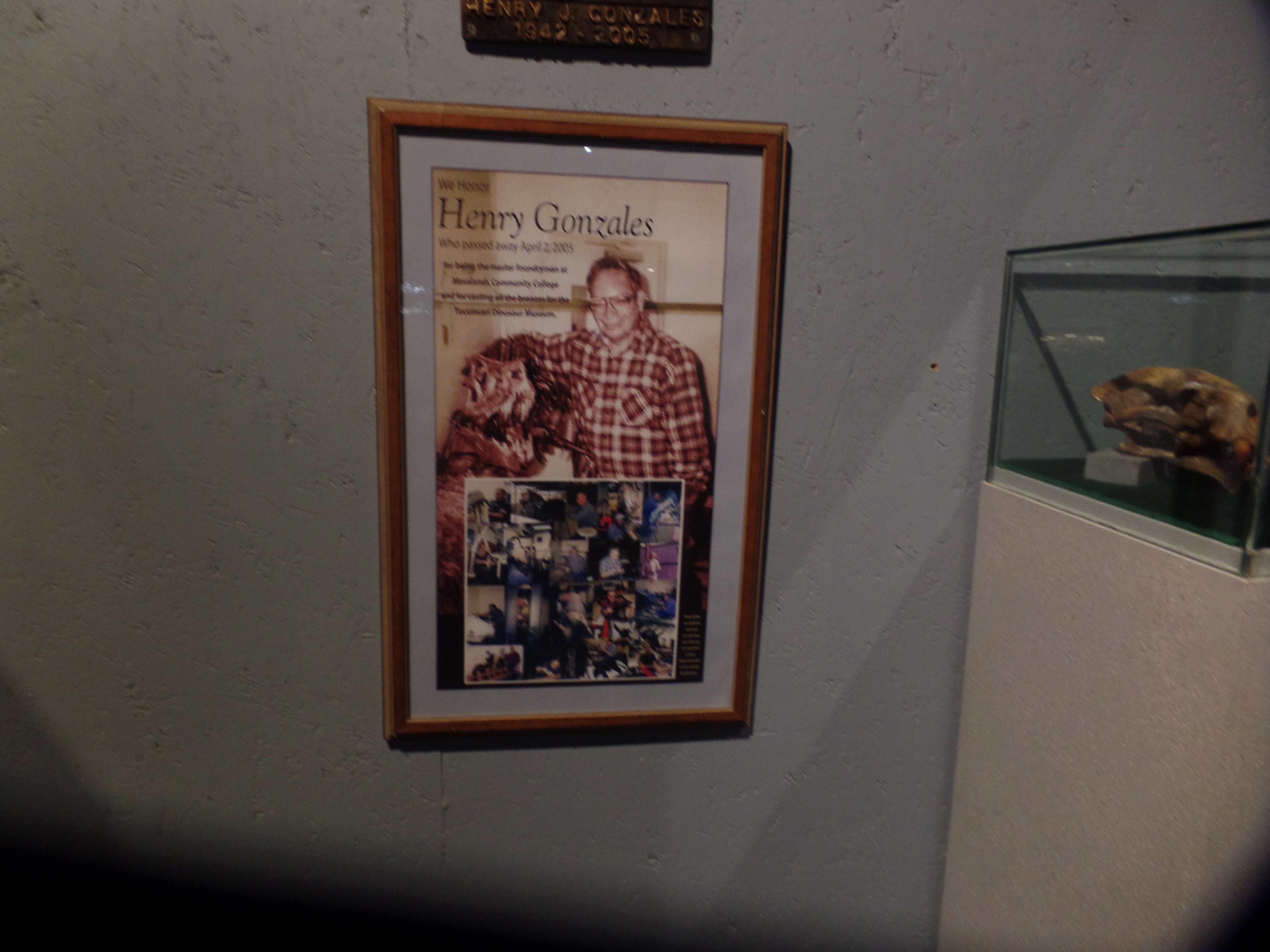
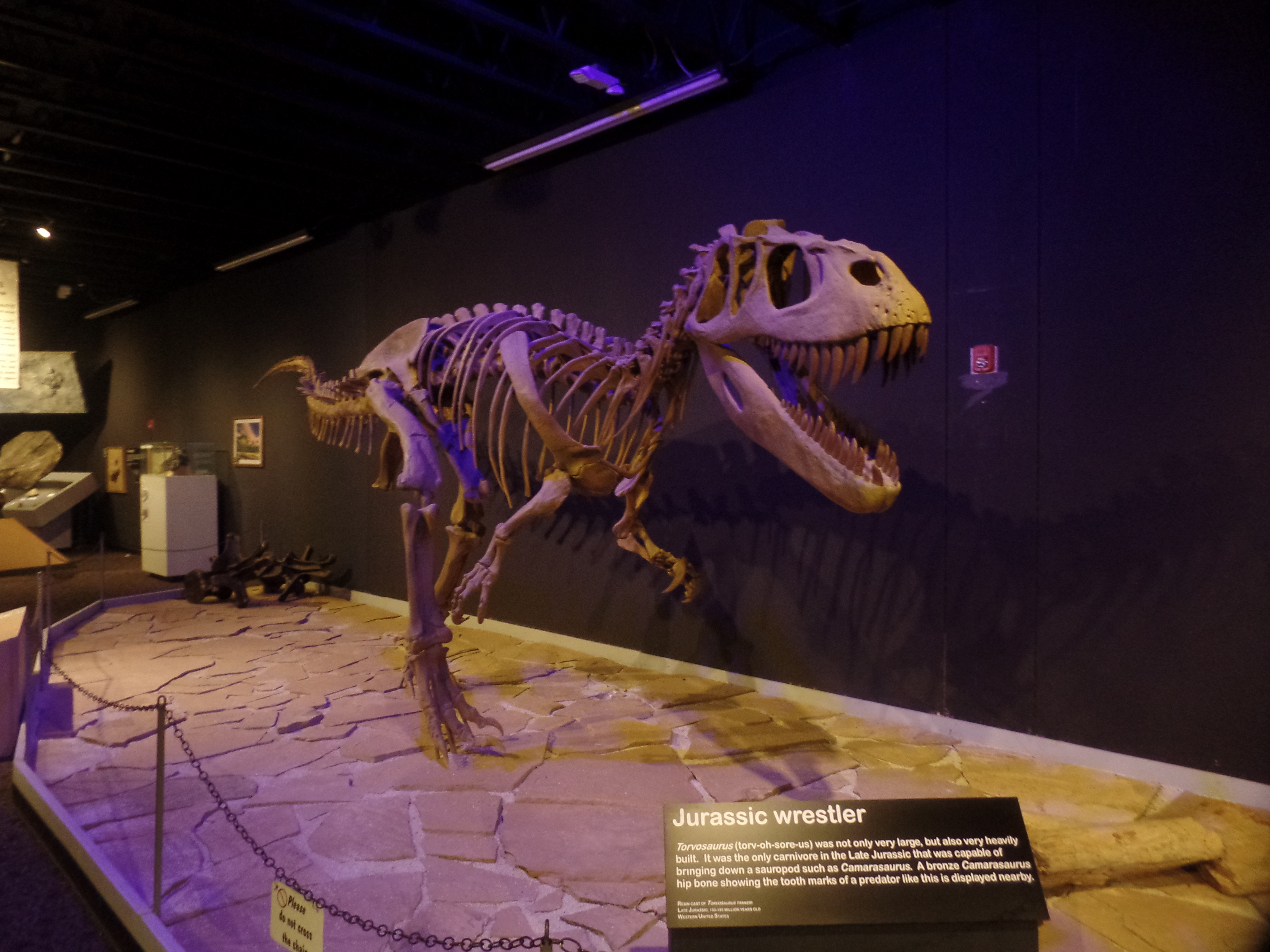
Here are five photos from today’s visit to Tucumcari, Back Then.
Henry Gonzales, professional bronzecaster, who created the dinosaur marvels of Mesalands Dinosaur Museum and taught others his craft.Coelophysis, one of the terrors of the Triassic Period, was an ancestor of velociraptors, and of birds.An Apatosaurus got stuck in the mud, and left this for us.Torvosaurus, an apex predator of the Jurassic Era.A variety of petrified material, in one stone.
There was enough in this Best Kept Secret of northeastern New Mexico to keep me enthralled for two hours. Many more photos will be posted on my Flickr account: https://www.flickr.com/photos/86298326@N07/, over the next several days.
Now, I am resting at a Motel 6, on the west side of Amarillo. After breakfast, tomorrow, in this city’s “Fun Zone” (Old 66), I will make my way down to my little family’s home.




 A Sagittarian Seeker