The 2018 Road, Day 34: The Door Never Closes

6

June 28, 2018, Salisbury, NC-

I first encountered W, in 2002, when he arrived in Phoenix, from his native Liberia.  At that time, he was recovering from a severe injury and was one of thousands of refugees from his then-war torn homeland.  He had been a journalist, writing for Monrovia’s daily newspaper, when his injuries occurred.

Like more than a few Africans living in Phoenix, he became a trusted friend and we have maintained a correspondence, ever since.  He has left Arizona and is now comfortably settled in a simple home, in this pleasant city of the Piedmont.  Salisbury is about an hour northeast of Charlotte, and seems to not have, as yet, become saddled with major urban sprawl.

I woke to a calm morning, in Timmonsville, about two hours further southeast of here.  As I suspected, there is an unnamed breakfast and lunch counter, inside the Mobil Station.  I walked across the street and discovered The Hot Plate- more than the microwave stand I had suspected would be there.  Instead, an effusive man of about 35 and a shy girl, who seemed to be about 15, were behind a full-service breakfast & lunch counter.  The man took my order and both set to work, he on the sausage and the girl on the eggs and pancakes.  She brought a fabulous breakfast plate to my small table, in eight minutes’ time.  Several other people- mostly customers, plus two women who seemed to have some role in running the show, came in and out during my leisurely breakfast.   After paying my bill, and giving the bemused girl a healthy tip, I reflected that places like The Hot Plate are what keep small-town America connected with the open road.  I would go in there again, were I to find myself in Timmonsville-or, as this sign would have it, in

20180628_075533[1]

I headed, in earnest, towards Salisbury, and arrived at W’s place in a couple of hours.  There, a comfortable bed for the night, and a steaming pot of Liberian pork stew, with heaping portions of rice, awaited.  African hospitality is second to none-even in the simplest of homes.

On the way there, I picked up a few more gift items, as a few families in the small town of Mc Bee, SC were holding a fund-raiser and the bake sale was too good to pass up.  Mc Bee is also notable for this:

SAMSUNG CAMERA PICTURES

Salisbury has several solid Federal period and Beaux  Arts era architectural gems.  I stopped to note  a few of these, whilst driving towards W’s apartment.

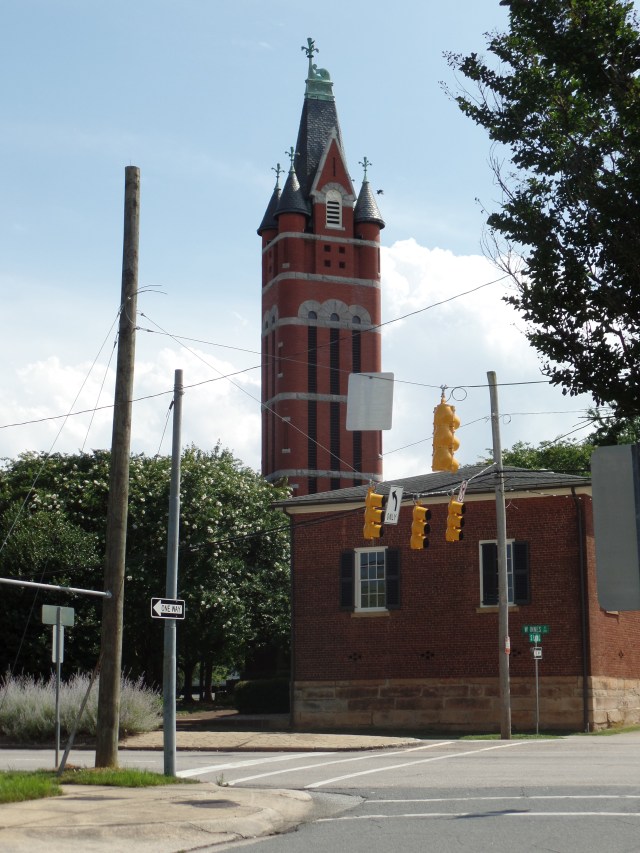
Perhaps most prominent, from the east, is the Bell Tower of First Presbyterian Church.
SAMSUNG CAMERA PICTURES

Driving westward, St. John’s Lutheran Church becomes equally impressive.

SAMSUNG CAMERA PICTURES

In Salisbury’s Veteran’s Cemetery, this memorial to World War II dead is at the western gate to the grounds.

SAMSUNG CAMERA PICTURES

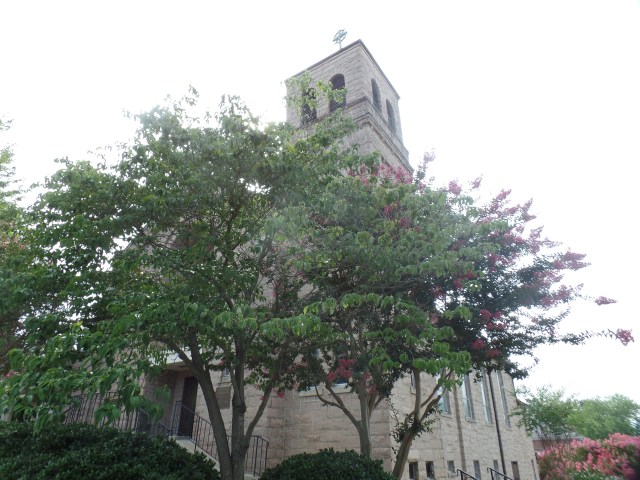
This is the old Sacred Heart Roman Catholic Church, west of the cemetery.
SAMSUNG CAMERA PICTURES

I found a most happy W, waiting outside his apartment complex.  It’s been a while since he had any visitors from out of town.

SAMSUNG CAMERA PICTURES

Here is a view of the park, down the street from his complex.

SAMSUNG CAMERA PICTURES

After my hearty lunch of stew and rice, W and I walked to a Walgreen’s where I could get a spare dental care kit, as mine was possibly lost. I also got a spare razor and blades, while W talked of his joyful walks along Salisbury’s main commercial street.  He keeps away from the Confederate Memorial that greets the traveler coming in from the East.  Otherwise, he has walked all over the town, making friends as he goes.

I found, however, that there was little evidence of racial tension here, as W’s  White cross street neighbours were quite cordial, and there was plenty of friendly interaction during my own downtown visit.

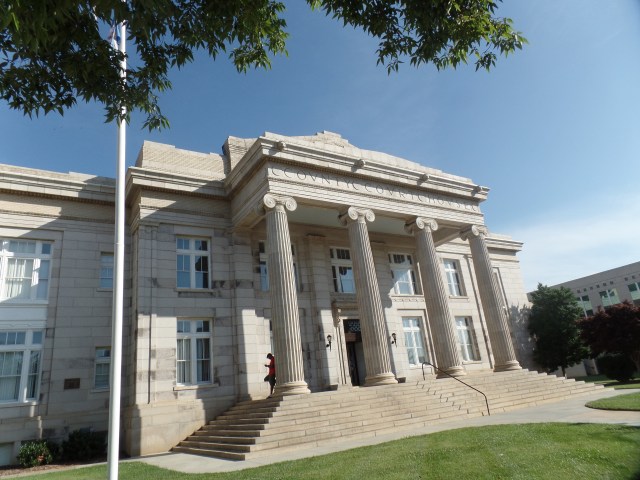
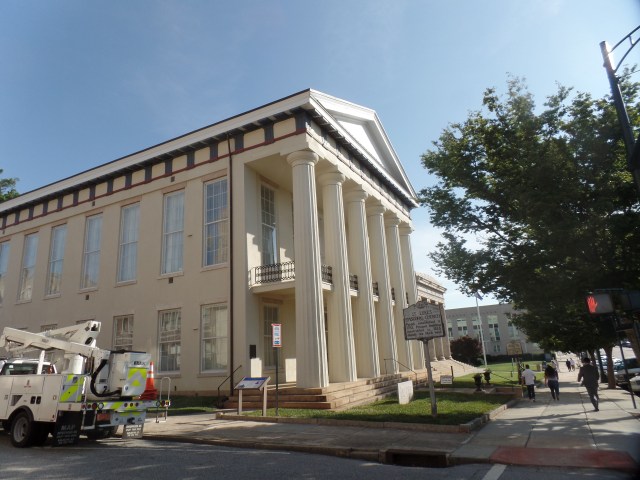
Rowan County Courthouse is an impressive Federal Era structure.  This block celebrates George Washington’s visit here, following the American Revolution.
SAMSUNG CAMERA PICTURES

SAMSUNG CAMERA PICTURES

SAMSUNG CAMERA PICTURES

The same detail has kept the County Administration Building in good repair, for over 150 years.

SAMSUNG CAMERA PICTURES

Away from downtown, the west and south sides feature several older gems.  Below, is Chambers House, from the Revolutionary Period.

SAMSUNG CAMERA PICTURES

Here is another view of the Bell Tower, as it is near Chambers House.

SAMSUNG CAMERA PICTURES

This tiny salt box house was the Henderson Law Office, built in 1796.

SAMSUNG CAMERA PICTURES

I spent a few moments checking out a south side block, from whence there is another fine view of the Bell Tower.

SAMSUNG CAMERA PICTURES

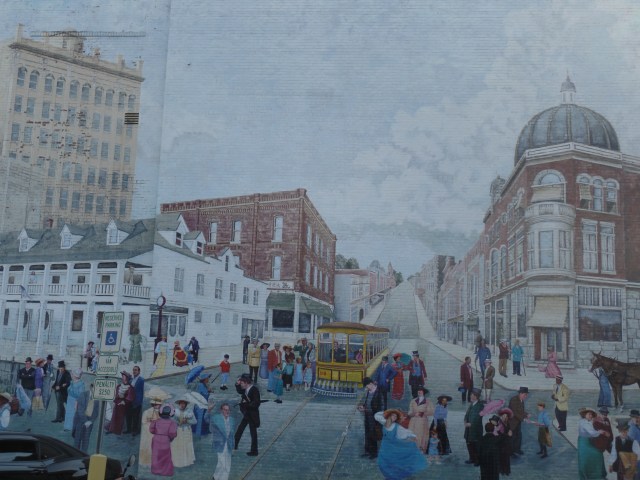
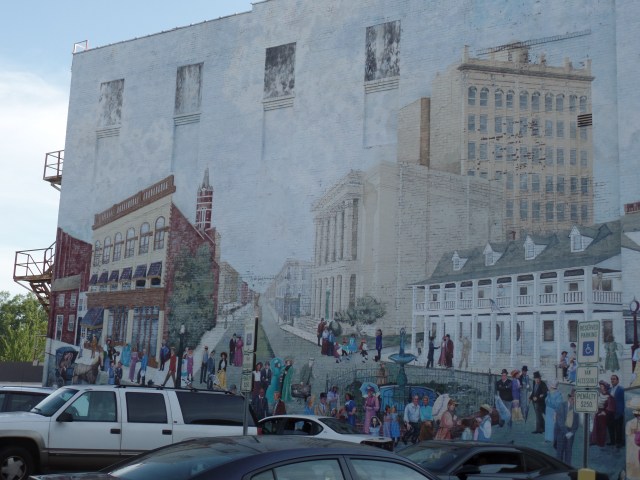
Here is a three-part look at the south side’s finest mural, entitled “Crossroads-Past Into Present”.  It shows Salisbury life, circa 1900 and was completed in 2001.  The artists are Cynvia Rankin, Earle Kluttz and Raines Thompson.  Ms. Rankin was the primary artist on this project, commissioned by  Rowan Art Guild.
SAMSUNG CAMERA PICTURES

SAMSUNG CAMERA PICTURES

SAMSUNG CAMERA PICTURES

W and I spent a great deal of time just talking of life in Arizona, as compared to North Carolina.  The latter is certainly a less frenetic and cheaper place to live, by and large.  He also told me much about Liberia, and his journalistic experience during the country’s Civil War.  We watched a lengthy Baha’i video, as well.  Our conversation tended to be more far ranging than those we’ve had over the phone. W speaks at a fast clip, so line of sight works better for me, in understanding him.

It has been another relaxing day, though, knowing I am in a place of friendship.

NEXT:  Across the Great Smokies, to Crossville


Sixty-Six, for Sixty-Six, Part LVIII: Return to Down East, Part 3- The Heritage of Agamenticus

4

July 16, 2017, York, ME-

My penchant for delving into the past, of any given community in which I find myself, is fairly standard by now.  As a native New Englander, I will always look at the reasons for people’s settlements.  Maine began as a county of the colony, and later, of the Commonwealth, of Massachusetts.  Most initial settlement in the region was, naturally, along the coast.  The Penacook Abenaki people, who predated Europeans here, called their settlement Agamenticus.  There is no specific definition given, for that name- but it refers to what is now known as the York River.

In 1624, Sir Fernando Gorges, representing the British Crown, established a settlement here and made it the administrative center for the District of Maine.  He called it Gorgeana.  Upon his death, the Massachusetts Bay Colony laid claim to Maine, and the town was renamed York.

I set out, this afternoon, to visit the three museums, over a 2 1/2 hour period.  Upon the advice of the chief curator of Old York, I first went to Old Gaol (jail), as it would close first.

SAMSUNG CAMERA PICTURES

It was, as one might expect, a rather unwelcoming place.  The jailer lived in the facility, and was also a weaver.  His loom and his sleeping quarters were in one room, on the first floor.

SAMSUNG CAMERA PICTURES

The miscreants, of course, did not have such comfortable digs.

SAMSUNG CAMERA PICTURES

“Have a seat”  also meant something different, back then, when addressed to, say, the town drunk.

SAMSUNG CAMERA PICTURES

The punishments of the day were a fair bit more severe than what we might exact for a similar offense, today.  Note that there were two ways of writing the letter ‘s’.a

SAMSUNG CAMERA PICTURES

The walkway between cells was not intended for easy passage.

SAMSUNG CAMERA PICTURES

I would then, as now, preferred to observe the laws of the land.

Having been convinced of the earnestness of justice in Old York, I headed to Emerson- Wilcox House, which is an example of a residence which was leased from the First Parish Congregationalist Church of York, by one town merchant, Edward Emerson, a granduncle of Ralph Waldo Emerson, in 1766, for 999 years.  After Mr. Emerson died, his son inherited the house, but was unable to maintain himself financially, and died penniless.  The surviving women remained in the house, which was purchased by the town magistrate and constable, David Wilcox, hence Emerson-Wilcox House.  Mr. Wilcox expanded the home, out of necessity, so there are two period styles of architecture in the home:  Georgian and Federal.  Photography is not permitted inside the home, but here are some views of the exterior.

SAMSUNG CAMERA PICTURES

SAMSUNG CAMERA PICTURES

SAMSUNG CAMERA PICTURES

After a friendly and informative guided tour of the house, I passed by the Old Burial Ground,SAMSUNG CAMERA PICTURES

and browsed the Remick Collection of York memorabilia, which include original bed hangings from one of the first homes in York.  Again, there was no photography permtted inside the collection, but here is a look at the outside.

SAMSUNG CAMERA PICTURES

The adjoining Jeffords Tavern, however, is photo-friendly, and gives a view of the casual side of colonial life.  Maine was nowhere near as Puritanical as Massachusetts Bay Colony, being more concerned with maritime commerce, from its inception.  There were several churches, which were mostly concerned with keeping the Sabbath and ownership of land.

Ladies and gentlemen, the Jeffords Tavern.

SAMSUNG CAMERA PICTURES

You can see that not all the furniture is from the Georgian Period.  The modern fare is for the convenience of researchers and other visitors.

SAMSUNG CAMERA PICTURES

Lastly, here is the Old York Schoolhouse, now-but not then- placed adjacent to Jeffords Tavern.

SAMSUNG CAMERA PICTURES

York has a plethora of places of interest, many of which are natural preserves.  In the next post, the last in this series, Hartley-Mason Preserve, and York Harbor, are the focus.


Tales from the 2016 Road: West Virginia’s “Pot Handle”

13

July 13-14, 2016, Martinsburg-  My processing and purchase of a 2013 Hyundai Elantra became final at 12:30 PM.  I gathered my stuff at Days Inn, went over to Sugar Hill Auto and transferred everything from the Altima, paid up, said goodbye to the Old Trouper and went for lunch at Blue Colony Diner.  It was time to head south.

SAMSUNG CAMERA PICTURES

Blue Colony Diner, Newtown, CT

The very Russian waitress was rather brusque, and hurried, something to which I’m not accustomed.  The Reuben was nicely prepared, though, so I made do.

Southward became a bit of a slog, at first.  An enormous pile-up, involving three tractor-trailers and eight cars, had taken place on I-84, between Newburgh and Middletown.  I stayed in queue, until the State Police ushered us all off, at Exit 5-A.  I went south when most everyone else headed north.  The road from Goshen to Middletown was relatively empty,and I was back on I-84, in less than an hour. I was in Pennsylvania, a short time later, stopping at a Rest Area in Mountaintop, where my eldest brother and his family once lived, and enjoying the other half of my Reuben.

There was a second pile-up, near Hershey, but it was on the eastbound I-78.  I took the westbound, to I-81, near Chambersburg.  Then, it was a short hop, through a narrow stretch of Maryland, to Martinsburg,WV.

After a very restful sleep, followed by continental breakfast, it was time to spend a bit of time taking in Martinsburg’s downtown.  There are several Federal Period structures here, as there are across both West Virginia and Virginia.

SAMSUNG CAMERA PICTURES

First Presbyterian Church, Martinsburg,  WV

SAMSUNG CAMERA PICTURES

Berkeley County Courthouse, Martinsburg, WV

SAMSUNG CAMERA PICTURES

Martinsburg Arts Centre

The center of town is marked by a landscaped little square.

SAMSUNG CAMERA PICTURES

Central Square, Martinsburg, WV

The house built by General Adam Stephen, founder of Martinsburg, is preserved on the city’s southeast side.  General Stephen’s residence was built of native limestone.

SAMSUNG CAMERA PICTURES

Adam Stephen House, Martinsburg

SAMSUNG CAMERA PICTURES

Root Cellar and Spring House, Adam Stephen House, Martinsburg

SAMSUNG CAMERA PICTURES

Native Limestone, Adam Stephen House, Martinsburg

The brick house next door was built by Philip Showers, in 1874, and housed railroad workers and their families.  It is called the Triple Brick House, and was divided into three dwellings.  Today, Triple Brick House serves as Martinsburg’s Historical Museum.

SAMSUNG CAMERA PICTURES

Triple Brick House, Martinsburg

This city was a Western outpost of Revolutionary forces during the War for Independence, and has had a key role in subsequent conflicts, from the War of 1812 to the “War on Drugs”, of the Reagan Era.  It is now home to major offices of the Department of Homeland Security.  Yet, on this quiet morning, it was a place of restfulness and reflection.  There is much in the “Pothandle” of eastern West Virginia to explore and enjoy, so I will come through here again.  It was time, however, to get as far south as possible by this evening.

NEXT:  Harrisonburg of the Shenandoah