A Picasso Immersion

2

March 17, 2022, Newnan, GA- The conflict in Ukraine brings up images of Pablo Picasso’s Guernica, at least for me. Thus today’s visit to the Picasso Immersion, at the Pullman Warehouse Exhibition Hall, in Atlanta’s Five Points area, was particularly poignant. Guernica, for the unitiated, is the large painting in the center of this montage of Picasso’s cubist works.
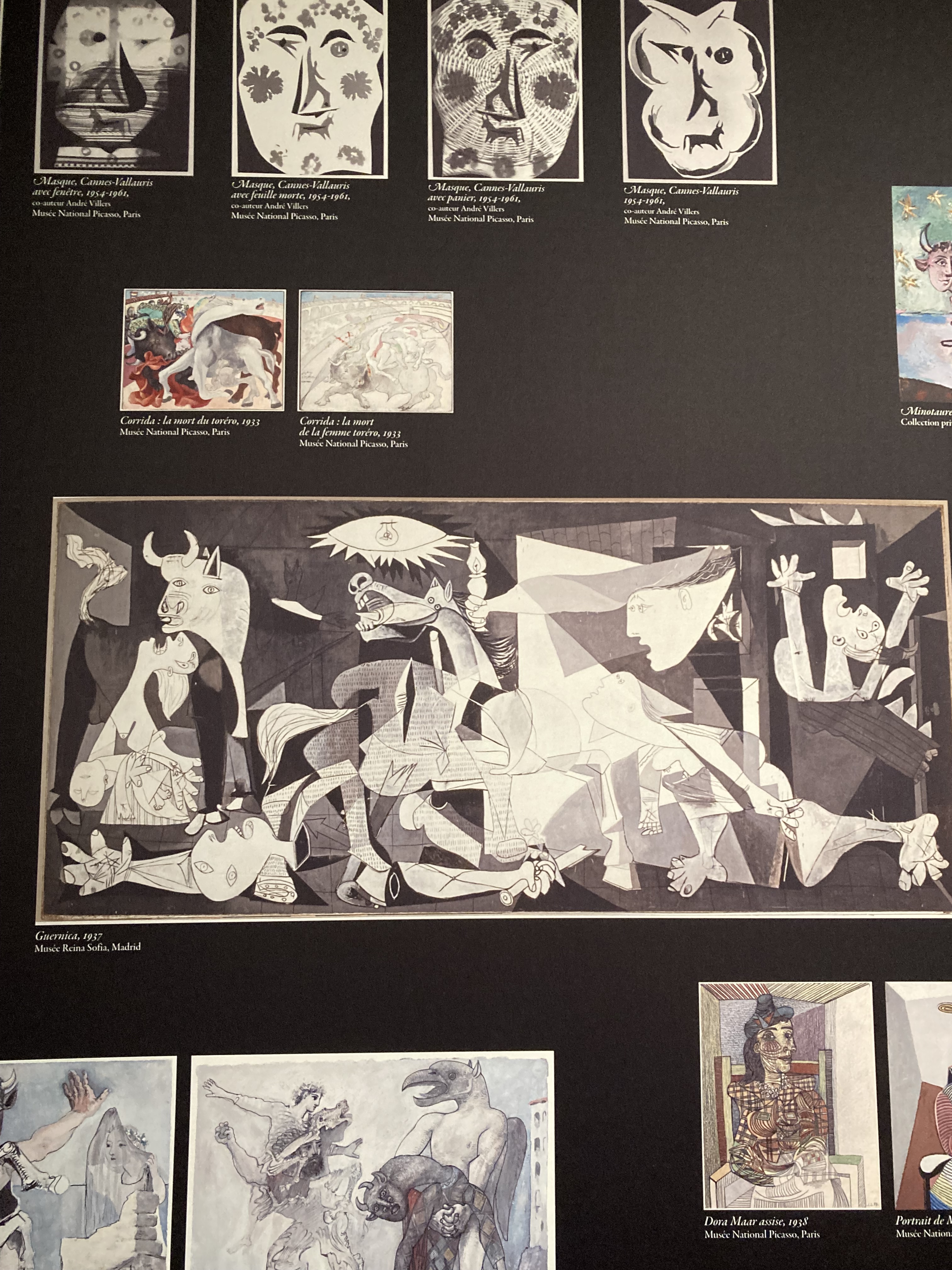
Picasso’s works, from 1890-1960,were largely his reaction to the horrific World Wars, Spanish Civil War and what he saw as the rise of materialism. Pablo Picasso had his own mind about the political reality of the day and would depict those he regarded as corrupt and decadent, in a monstrous manner-representing Francisco Franco, for example, as a pile of inedible food, in Guernica, itself named for a village in northern Spain that had been bombed by Franco’s forces during the Spanish Civil War.

Picasso was a varied artist, though, and was able to represent people beloved to him, in a more conventional manner. He wrote poetry as well, such as the autobiographical “A Lonely Road Is That I Walked”:

“I walk a lonely road, the one and only one I’ve ever known.
I don’t know where it goes, but I keep walking on and on.
I walked the lonely and un trodden road for I was walking on the bridge
of the broken dreams.
I don’t know what the world is fighting for or why I am being instigated.
It’s for this that I walk this lonely road for I wish to be
ALONE!
So I am breaking up, breaking up.
It is the lack of self control that I feared as there is something
Inside me that pulls the need to surface, consuming, confusing.
Being called Weird, I walk this lonely road for on the verge of broken dreams.
And so I walk this lonely road and so just keep walking still” – pablo picasso

Like e.e. cummings after him, Picasso created in a self-deprecating fashion. He was somewhat devoted to his children, who were the only people allowed in his studio, while he worked. From the 1920s until the end of World War II, he hobnobbed with the avant-garde, in the south of France, only occasionally returning to Spain, for short periods of time. He reacted to what he saw as crass materialism, by becoming a Communist after World War II and continuing to depict members of the economic and social elite, in unflattering ways.

Picasso has always been a source of fascination to me, although admittedly an acquired taste, and requiring of considerable pondering and rumination, as to the meaning of his surrealist work. This immersion event has whetted my appetite for exploration of other great artists of our time and of earlier eras.

There was no corned beef and cabbage for us, today. The crew gathered for St. Patrick’s Day dinner, at a Taco Max in Dunwoody, north of Atlanta, and enjoyed fairly copious amounts of guacamole-along with rather good Mexican dishes. The children have their own take on everything, much like Senor Picasso. I hope to see them reach for the stars and not suffer undue hardship. It was a rare, but most enjoyable visit with our Dunwoody family.

May art, and creativity, ever be honoured and encouraged.

The Summer of the Rising Tides, Day 4: Fascism, Part 2

2

June 4, 2020-

One common definition of the term, frequently cited by reliable sources as a standard definition, is that of historian Stanley G. Payne. He focuses on three concepts:

  1. the “fascist negations”: anti-liberalismanti-communism, and anti-conservatism;
  2. “fascist goals”: the creation of a nationalist dictatorship to regulate economic structure and to transform social relations within a modern, self-determined culture, and the expansion of the nation into an empire; and
  3. “fascist style”: a political aesthetic of romantic symbolism, mass mobilization, a positive view of violence, and promotion of masculinity, youth, and charismatic authoritarian leadership.[27][28][29][30]

The period 1929-45 is notable for the rise of several regimes that were based on continuity of government, on strong rule by a coterie of “dependable” officials, and a critical mass of public support, for those in power.

This was accomplished in the United States, by elections which were judged free and fair, resulting in the election of Franklin Delano Roosevelt, in 1932, and his re-election in 1936, 1940 and 1944. When Roosevelt died, barely into his fourth term, there was a peaceful transfer of power to his Vice President, Harry S. Truman.

In neighbouring Canada, a similar process resulted in the election of William Lyon Mackenzie King as Prime Minister, in 1921, and his re-election in every contest, save 1930-35, until his retirement from public life, in 1948. King’s tenure was more based on public support for his policies, than on any cult of personality, however.

Across the Atlantic, the harsh terms imposed upon Germany, under the Treaty of Versailles, resulted in severe economic conditions. Coupled with the worldwide economic collapse of 1929, the grief felt by many Germans proved fertile ground for Adolf Hitler, and his National Socialist Party (NAZI). Hitler’s willingness to apply a particularly efficient form of brute force ultimately brought more ruin to Germany, after his Armed Forces staged a sweep across Europe, only to expend their resources and fall to defeat, at the hands of a three-pronged Allied offensive, in World War II. His legacy of infamy is signified by the mass ethnic cleansing campaign, which is known today as The Holocaust.

Was Hitler a Fascist? Certainly, he employed portions of all three of the concepts identified by Stanley G. Payne, as definitive of the Fascist system. His economy, though, did not alienate itself from standard business-oriented conservatism. He conducted a robust, if clandestine, trade with large multinational corporations, based in both North America and neutral European nations. Otherwise, Hitler adhered to both Fascist goals and style of governance.

At this point, I wish to point out the more “orthodox” Fascism, followed by Benito Mussolini. Mussolini began his public life as a socialist, but grew bored with the efforts at seeking an egalitarian society. He turned instead to the concept of Fascism, embracing a total state control of economic structure, a renewal of the “Italian Empire”-his take on ancient Rome. and a social network that promoted the use of violence and an emphasis on masculinity-with himself as the prime example (Il Duce-“The Leader”). He ruled Italy from 1922-1945, managing to establish a fairly efficient transportation system and large homegrown industries. As with Hitler, however, Mussolini’s ambitions outgrew his nation’s resources, and his government fell, before an Allied invasion, from 1943-45.

Mussolini’s protege, Francisco Franco, of Spain, took power, as a Falangist (the Spanish equivalent of Fascist), in 1936, assuming total control of Spain, with both German and Italian military assistance, in 1939. Franco ruled Spain until his death, in 1975. Franco’s Fascism focused promarily on achieving Fascist goals, particularly state regulation of the economy. He did not renounce conservatism, as Mussolini had, as one of Franco’s goals was preservation of the Church and eventual restoration of the Spanish monarchy. He did not pursue as active a cult of personality, as Mussolini, either, though he took the title of El Caudillo (” The Strongman”). Franco’s caution, with regard to World War II, kept Spain out of that conflict, though he supported the Axis Powers in principle. Franco’s brutality relaxed, in the 1950’s, though Spain remained something of an economic backwater, lacking the natural resources and capitalist minds of Italy. With that relaxation, however, a group of younger businessmen and entreprenuers did emerge, leading to the “Spanish Miracle”, for which Franco took personal credit. His long rule was largely due to his more moderate take on Fascism.

Finally, for this section, let it be noted that fascism, like communism, is not limited to the European continent. Field Marshal Idi Amin Dada, a military careerist, with considerable informal education, became rather enchanted with the period of Nazi rule in Germany. Although Amin was not enamoured of Communism, he did abide its presence in his country of Uganda, mainly to procure aid from the Soviet Union and East Germany. Amin pursued what he thought of as Fascism, though his economic model was negligible, being mostly focused on enriching himself and a coterie of advisers. He did encourage a cult of personality, with himself at the center, allowing thugs to operate, with impunity, against real and perceived opponents. His one attempt at trying to carve out an empire, proved his undoing. In 1978, Amin sent troops into the neighbouring Tanzanian province of Kagera, with the idea being its annexation by Uganda. Tanzanian President Julius Nyerere, a no-nonsense man, sent his nation’s Army to take back Kagera, and to finish the job of ridding Africa of Amin.

So Fascism, like Communism, has been several things to several people. Could it happen in our time?

Two Grapes

6

February 3, 2020-

The young girl had less willpower than she had thought.  Faced with a sumptuous, fully-laden buffet, she took two grapes for herself.  This awakened the buffet’s master, who killed two of the young girl’s faerie guides and nearly captured her.  In turn, the faeries’ master, a faun, angrily banished the young girl from his enchanted cave.  I got the initial impression, whilst watching Pan’s Labyrinth, last night, that the faun was no more enamoured of the child-or of children in general, than was the girl’s step father, a severe and arrogant captain in Francisco Franco’s Army.

It was 1944, and while the Fascists had largely brought Spain under their control, there were pockets of active partisan resistance.   There was little tolerance for romantic notions or for childhood fancies.  The girl was tolerated by both of the principal male figures, as mentioned above, and her mother, the captain’s new wife, was merely a means to an end for her husband, who wanted a male heir above all else.

I thought of just how much progress has been made, with regard to gender relations, since that time.  Like any other area of life, the most progress towards equanimity has been made since the mid-1970’s, when women stopped gratuitously accepting acts of chivalry.  The truer, deeper courtesy that came out of the Women’s Rights movement of 1970-76 has only served to help men become more authentic gentlemen, rather than simply aping the courtesies of the past.  Honouring a woman’s dignity meant that she could open her own doors-and even open a door for a man.

The little girl, Ofelia, was as skillful as she was willful, managing to fool a monstrous frog, who had stolen a key belonging to the faun.  She also got a dagger from a cabinet in the buffet master’s chamber, and procured mandrake root, which she nourished in order for her pregnant, ailing mother to recover.  She never appeared to wallow in self-pity.

The captain and his men made a mess of things, leading to his wife’s death and, eventually, to their own slaughter.  This, by dint of their stubborn adherence to Franco’s doctrine of “cleansing Spain”.  The faun, also doctrinaire, inadvertently caused Ofelia to be caught by the captain, through his insistence that she let her infant brother be bled.

Everyone serves the Creator, directly or indirectly.  As it happened, Ofelia’s refusal to shed her innocent brother’s blood, preferring to sacrifice herself instead, met with approval from her Eternal Father, who welcomed her into Paradise, with a throne of her own, to his left.  The chastened faun recognized her goodness in the end, and bowed in service.

The calamities set in motion by the pure child, eating two grapes, leave lots of room for thought:  Who is more at fault, a child taking a small bit of food from another being, or the chastiser, full of his own importance?