The Road to Diamond, Day 311: Split, The Unified

2

October 4, 2025, Split, Croatia- Boris met me at the designated spot, which I found only by happenstance. This was another of those “We can’t help you because you have no Internet connection” catch-22s that Spectrum/Safari plays with abandon. (They are the ones denying Internet service, btw). I went to Pazar 1’s gate and waited just a bit-and there he was, telling me that I looked more like a Croatian local than he would have imagined. That felt good.
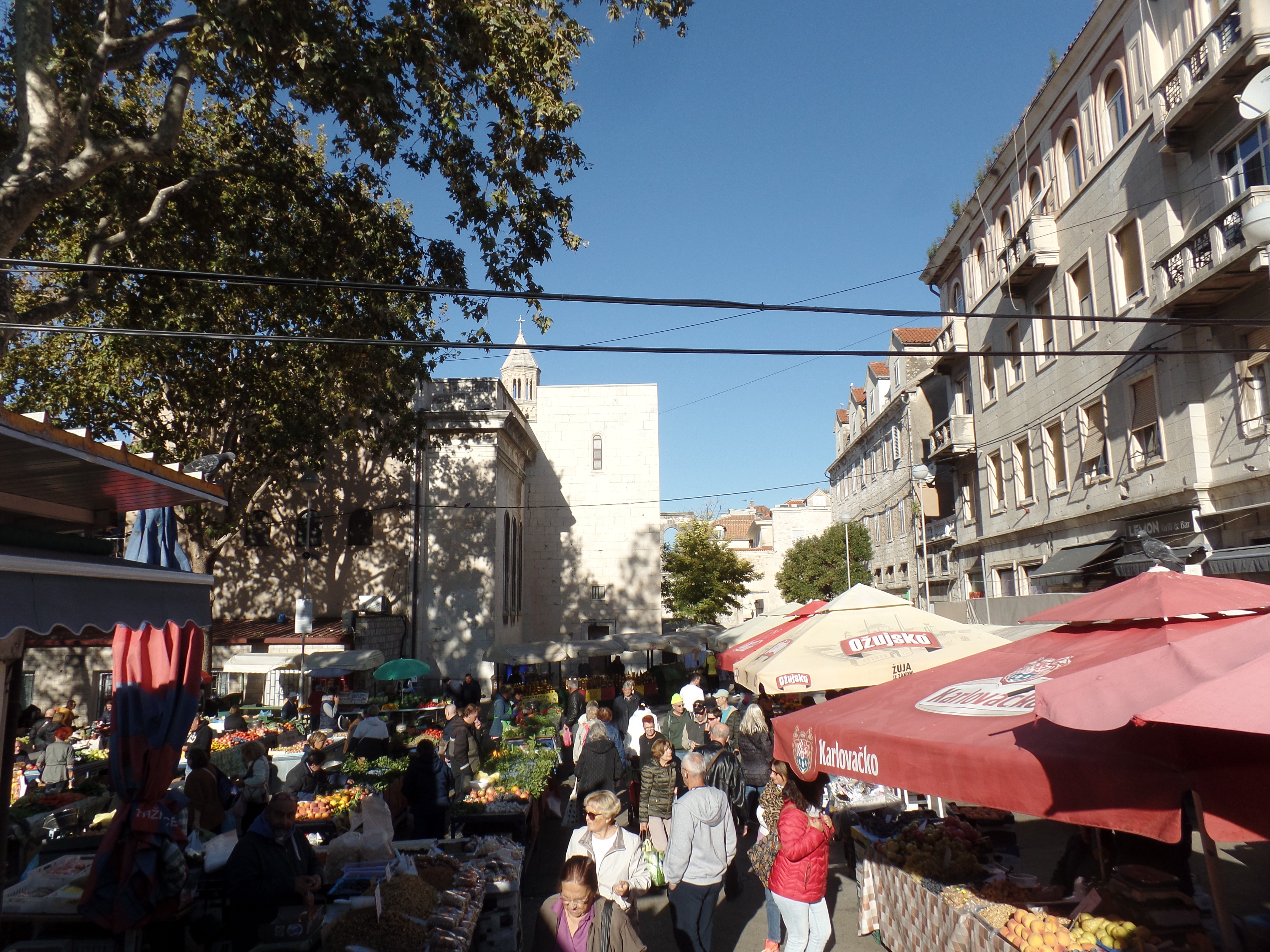
Pazar 1, Split

Our game plan was a full one: We walked through Pazar (the city market since Ottoman times, or longer.) The south and east areas of Diocletian’s Palace were next on the agenda. Diocletian was a native of this area, an Illyrian, born and raised in Salona, over the mountain, from what is now Split. He rose through the ranks of the Roman Army and became co-Emperor, at first along with Maximian in 286 AD/CE. This started the process of the Empire being divided into East and West. Diocletian built his palace at Spalatum, claiming the East for himself. Although he was an autocrat, Diocletian went along with Maximius’ plan to further divide the Empire, this time into four units, with Galerius and Constantius as junior co-Emperors. This arrangement actually helped the Romans defeat Persia, in 200, with the sacking of the Persian capital, Ctesiphon.

Diocletian carried out a bloody, but unsuccessful campaign to eradicate Christianity in the Empire. When the campaign failed, Diocletian retired from imperial duties, in 305. Co-Emperor Constantine, son of Constantius, recognized it as the official religion of the Roman Empire in 324. He lived out his days at this palace of Spalatum, now known as Split.

Pazar 1, east gate of Diocletian’s Palace and the Church of St,, Domnius

Domnius was sent, by the Apostle Paul to Dalmatia, the region that encompasses Croatia’s coast and the immediate interior, to preach the Gospel to the Illyrian people. Despite Diocletian’s imprisonment and execution of Domnius, in 304, Dalmatia became a steadfast Catholic region, under the encouragement of Constantine. Croatia is still a largely Roman Catholic country, as is neighbouring Slovenia.

Church of St. Domnius, Split
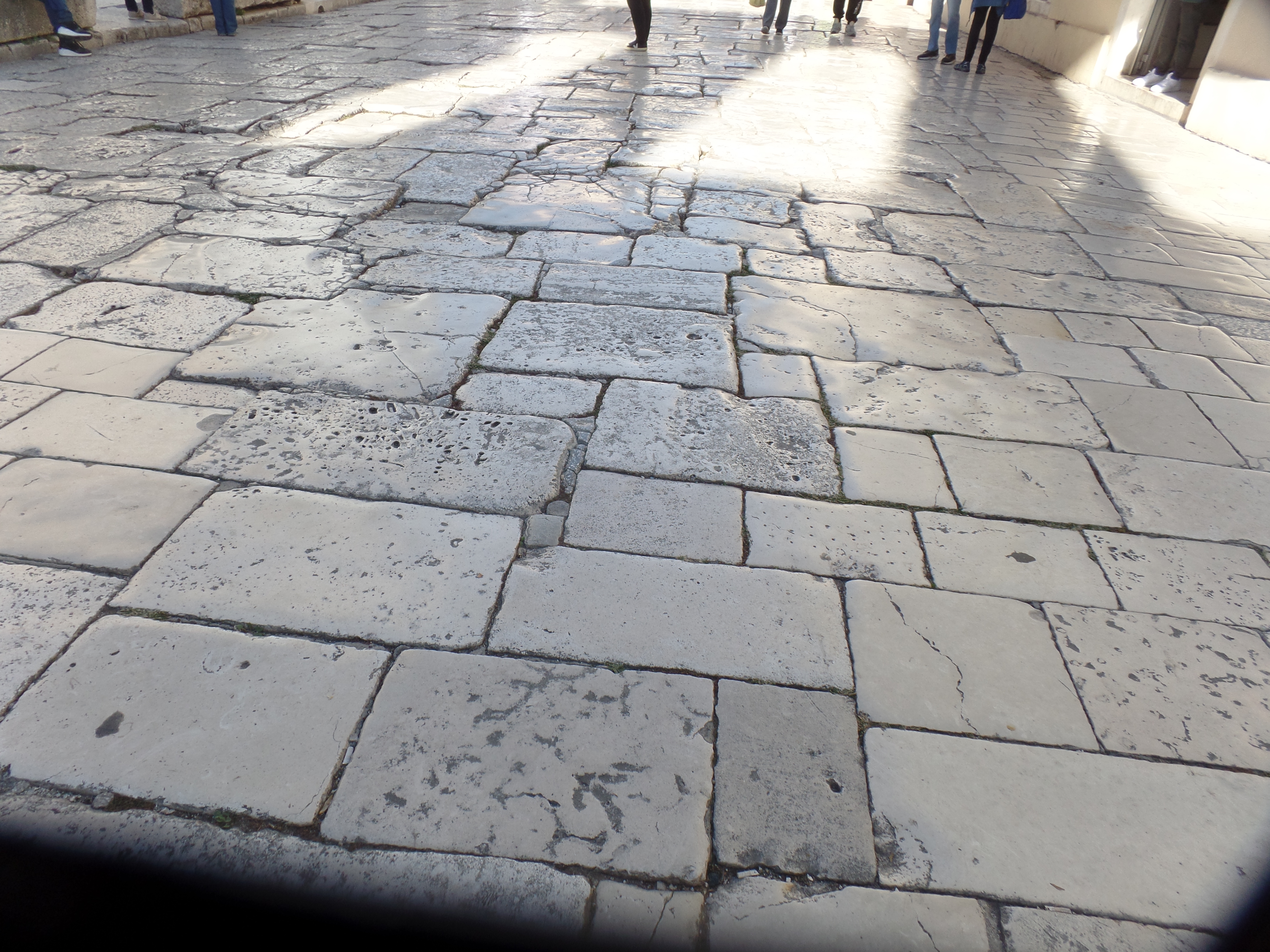
Original paving stones from the time of Diocletian

Here is a more complete view of the east and south areas of Diocletian’s Palace.

South courtyard of Diocletian’s Palace, Split

Diocletian’s Palace is the only place, outside ot Rome and Gizeh, that still has sphinxes (There are two here).
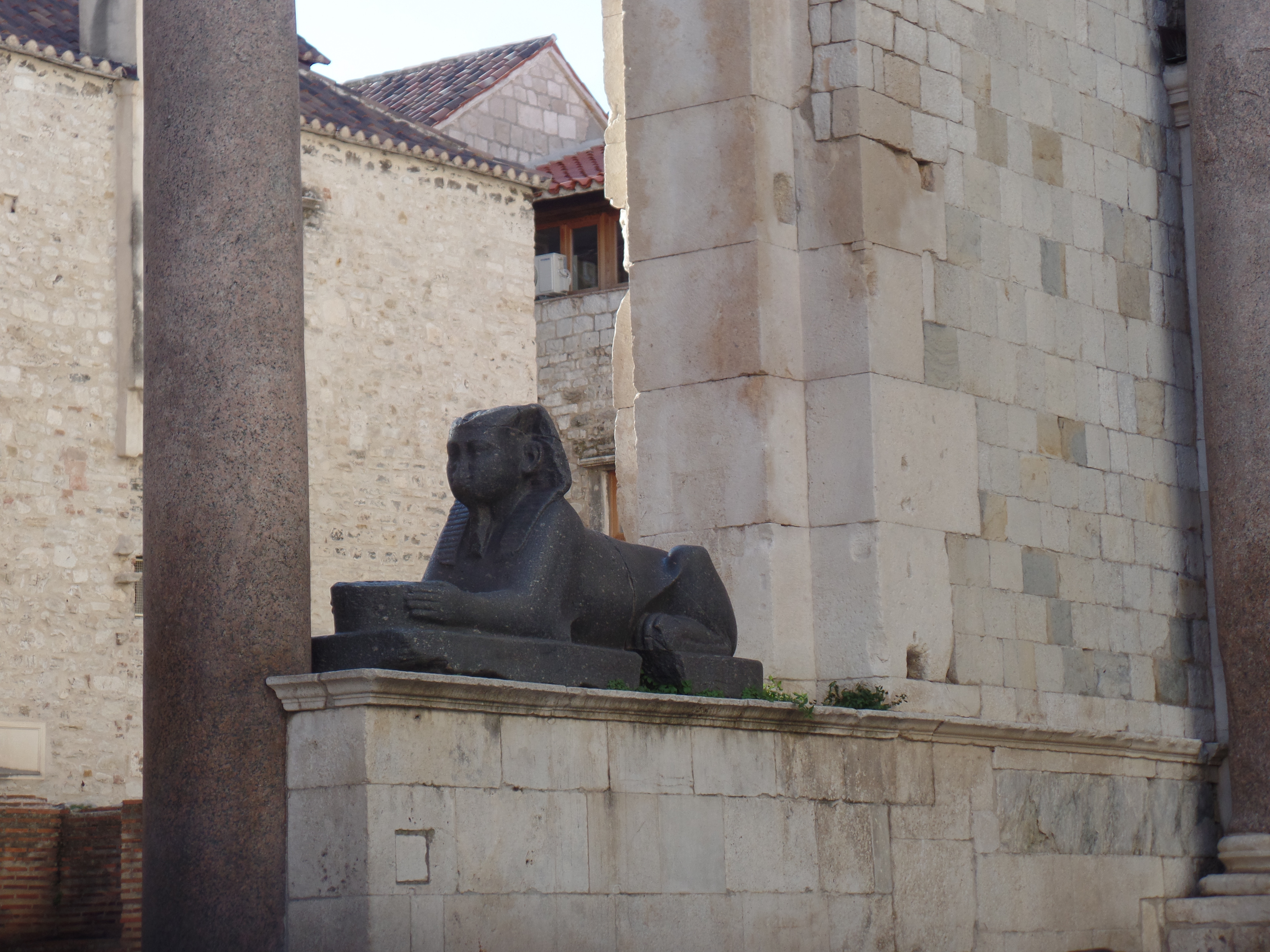
One of the two Sphinxes of Diocletian’s Palace, Split

We left this part of the palace, heading toward Marjan (marYAN) Hill. To get there, we had to pass through the “Street that can fit only one at a time”. Here I am, having gotten through it.
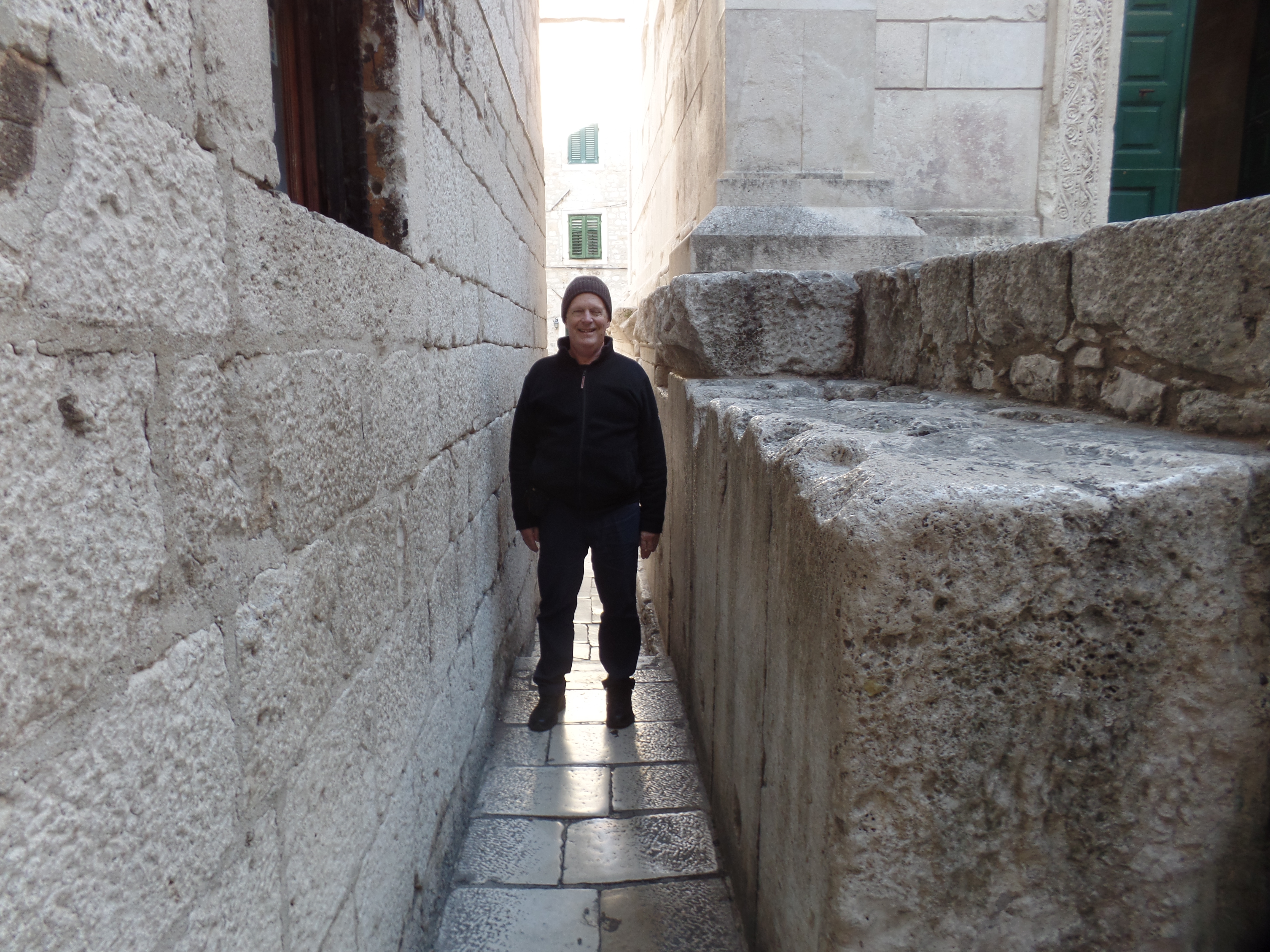
“The street that can fit only only at a time”.

The next photo shows the melange of architectural styles that can be found in Split’s oldest neighbourhood. These are Roman, Venetian,Ottoman, and Austrian.
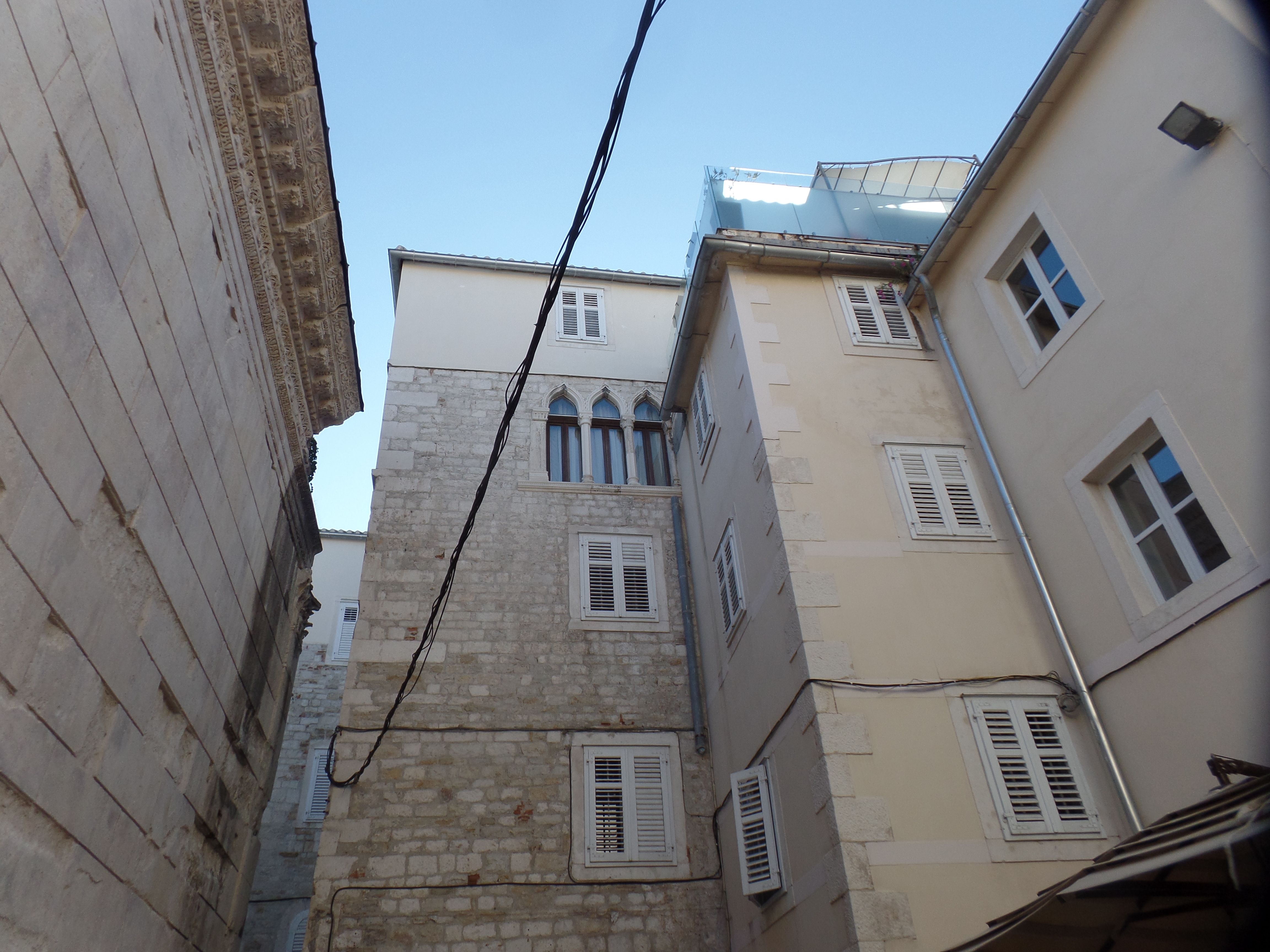
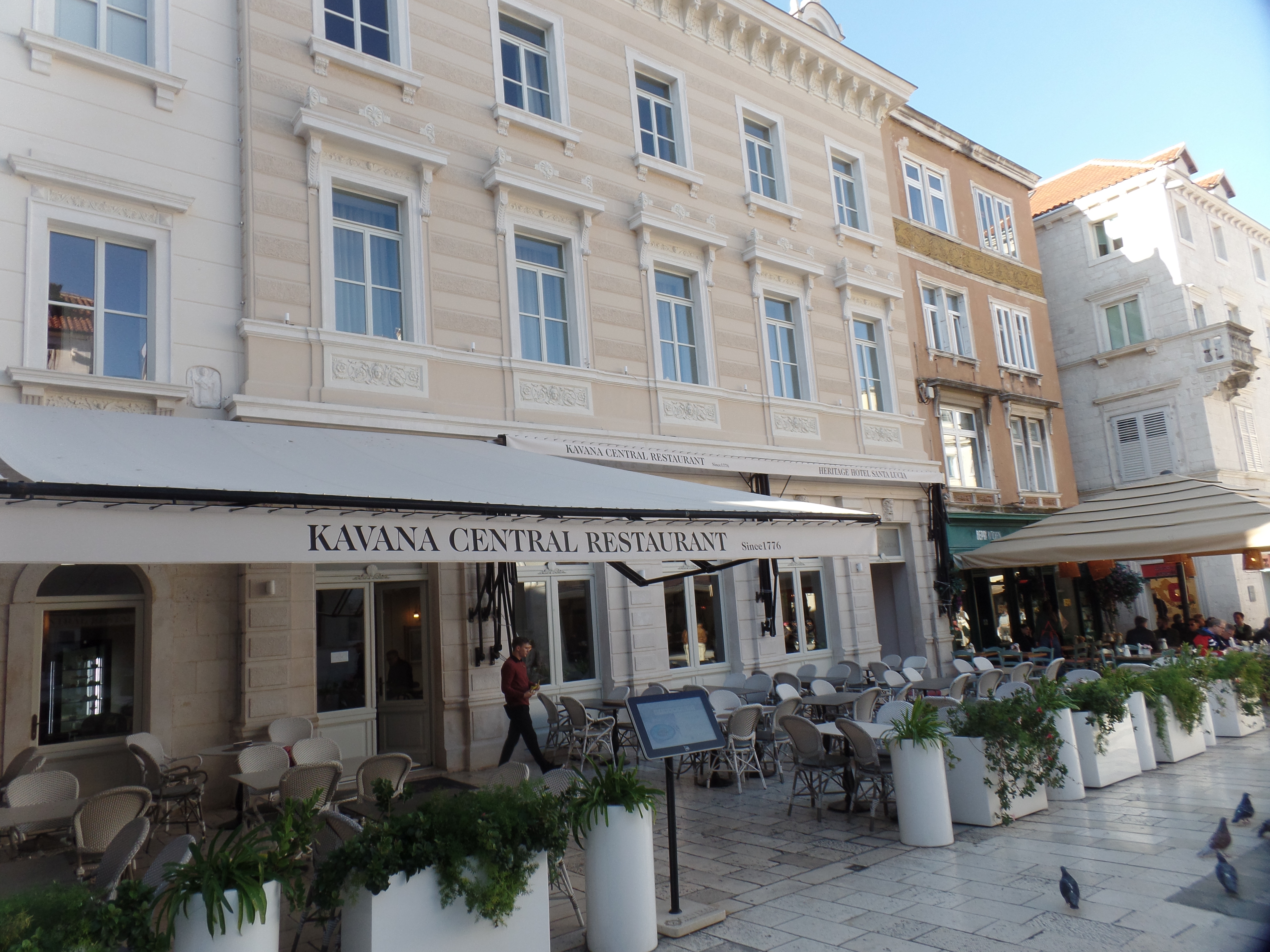
Four styles of architecture, in one neighbourhood
The place to be seen in the Split of the mid-Twentieth Century.
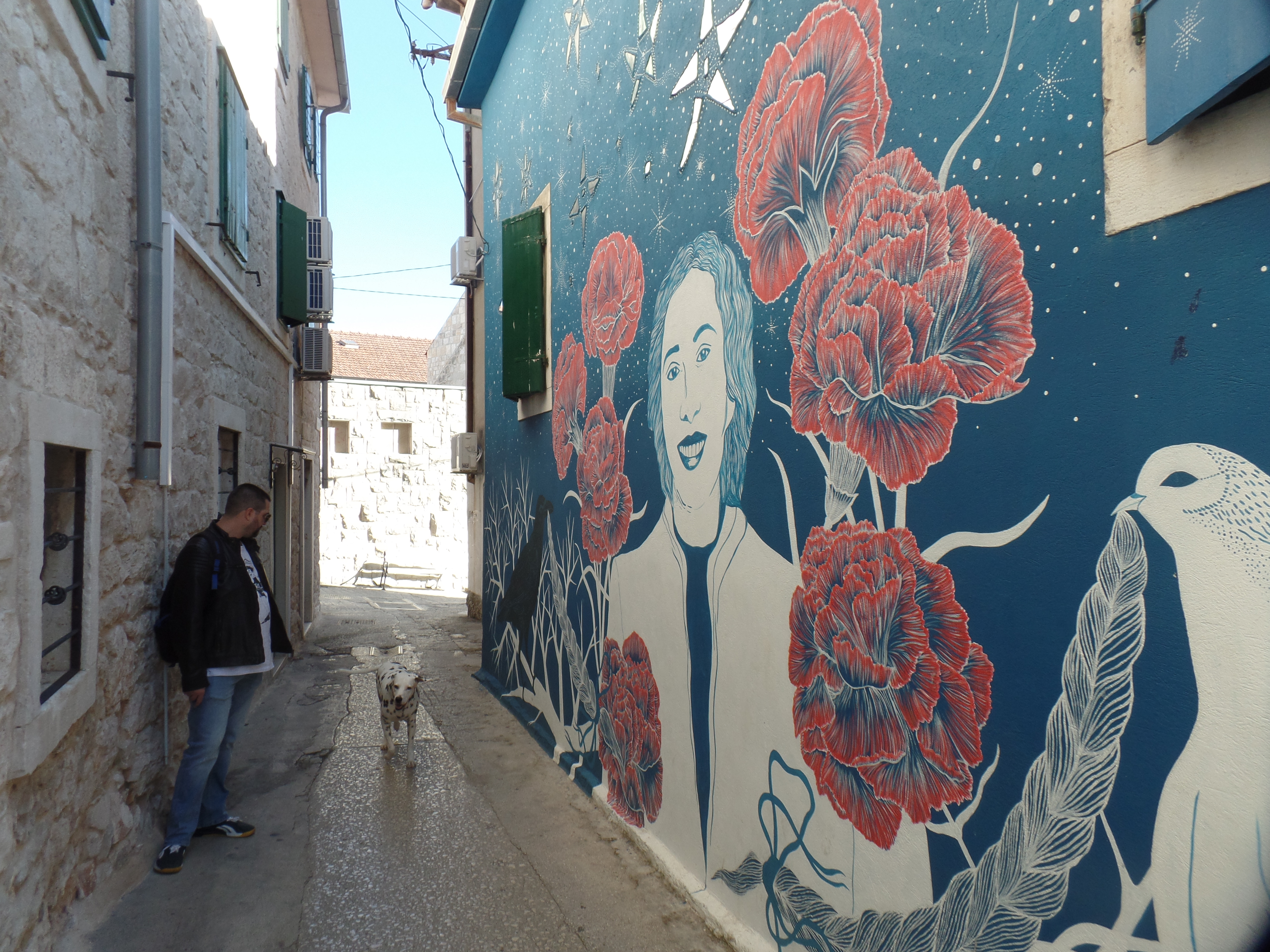
A martyr for freedom from Fascism-and a Dalmatian

Vahida Magajlic was a Croatian Muslim, who fought the puppet regime that was installed by the Nazis in Croatia. She gave her life for the freedom of Croatia-and of all Yugoslavia.

We took many steps up Marjan Hill. (Mar YAN).
View from first overlook, Marjan Hill

Boris enjoys coming up here, when he needs peace and quiet.
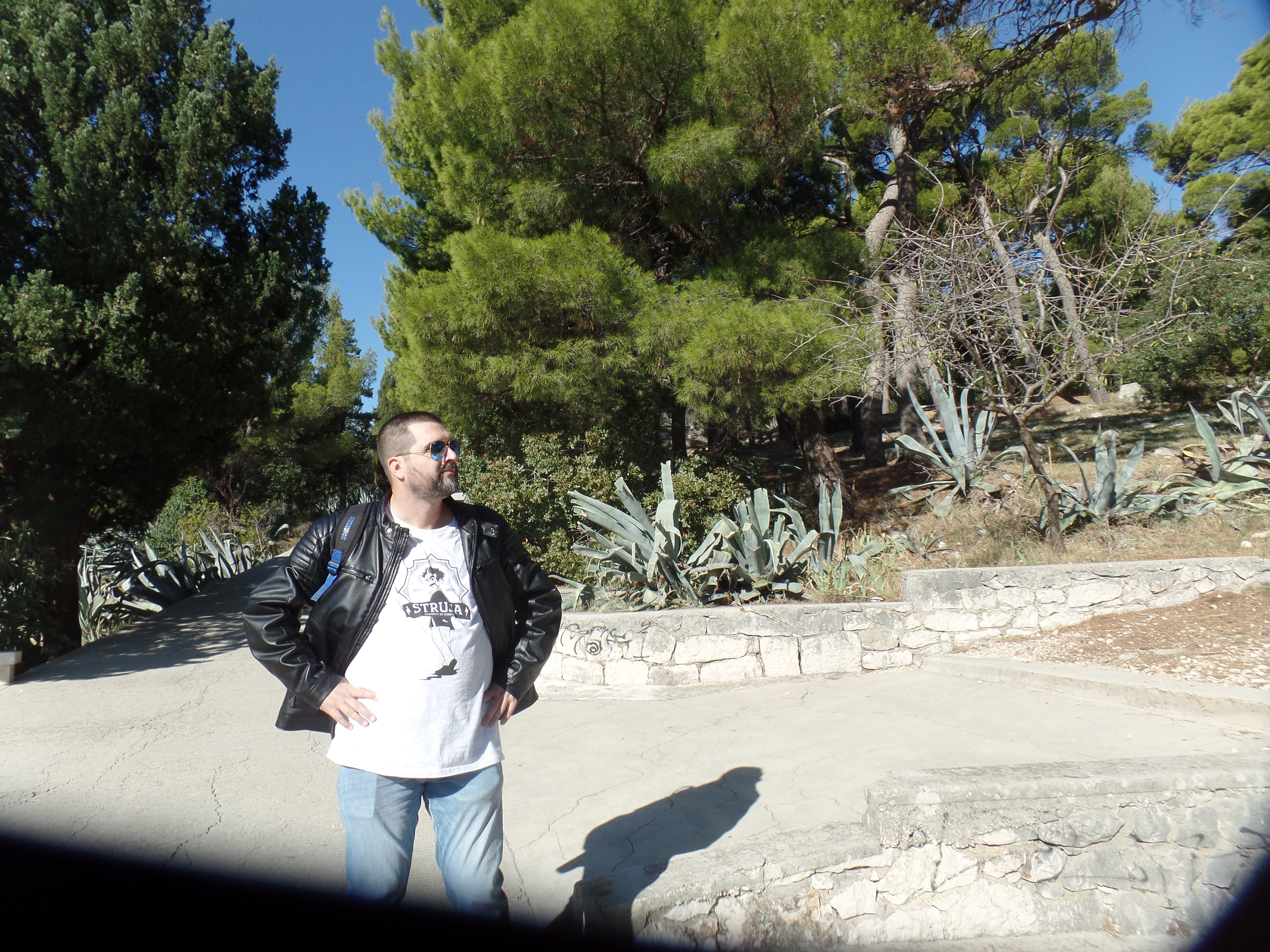
Boris at Marjan Hill’s Botanical Garden
The Adriatic, from atop Marjan Hill

Orofessor Humbert Girometta was the man who spearheaded both this park and the promotion of hiking and wilderness training in the Split area. He was a mentor of Boris’ mentor.
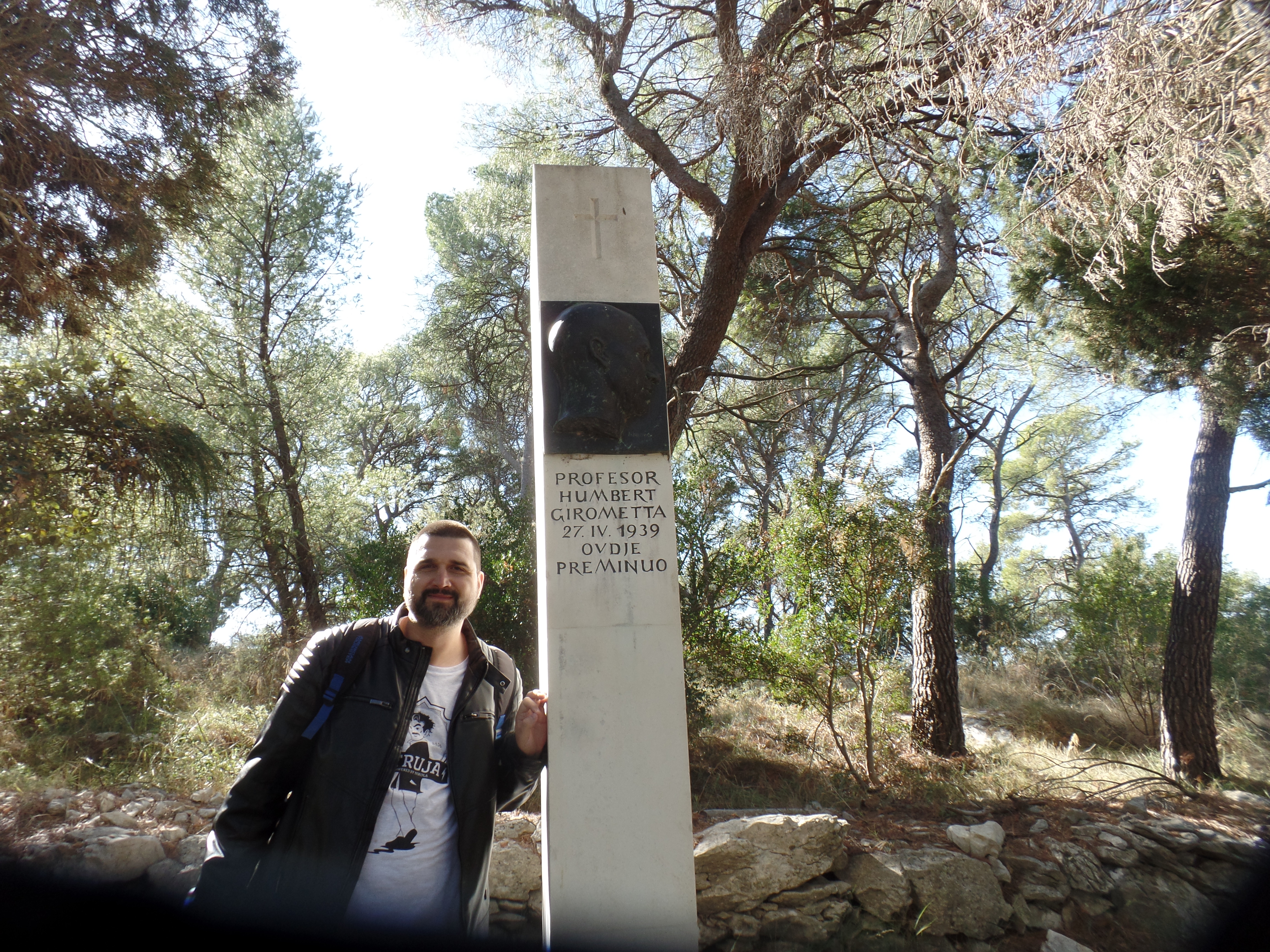
Memorial to Dr. Humbert Girometta, Marjan Hill, Split
The Adriatic, from the third vantage point on Marjan Hill, Spli
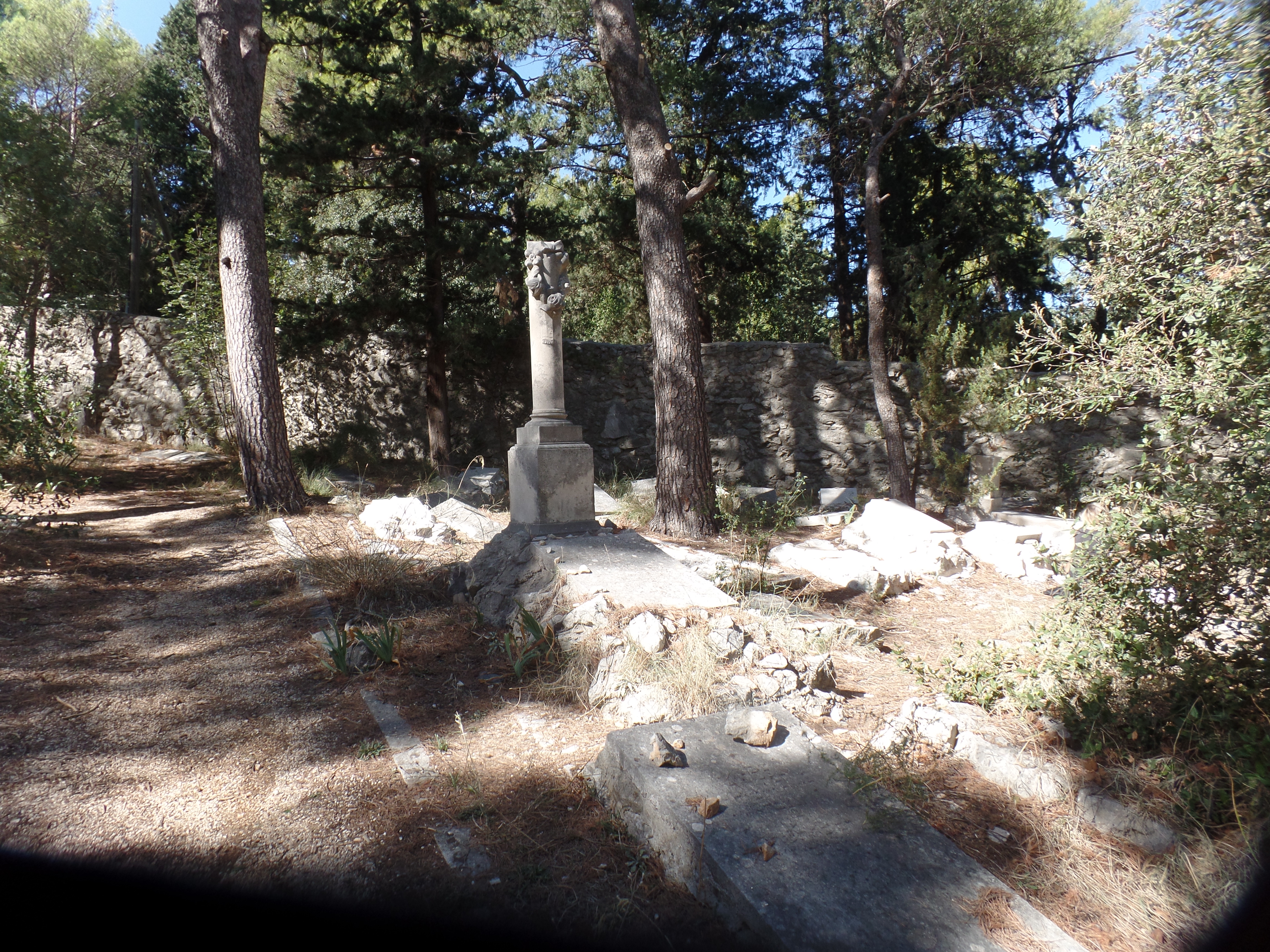
Jewish Cemetery of Marjan Hill. Jews have been in Dalmatia since shortly after the destruction of the temple in Jerusalem, by the Romans.

We next had a delectable Croatian lunch, of beef in marinade, with a side of gnocchi and beet salad. Ice cream, dipped in chocolate, at Split’s oldest ice cream parlour, followed.

Next were the northern and western sides of Diocletian’s Palace

The exterior of the north side of Diocletian’s Palace
Archway, north side of Diocletian’s Palace
Entrance to North Courtyard
Again, three styles of architecture in one building.
The grand north courtyard, Diocletian’s Palace

Here is the most astonishing view: The vestibule of Diocletian’s Palace, which once led to his living quarters.
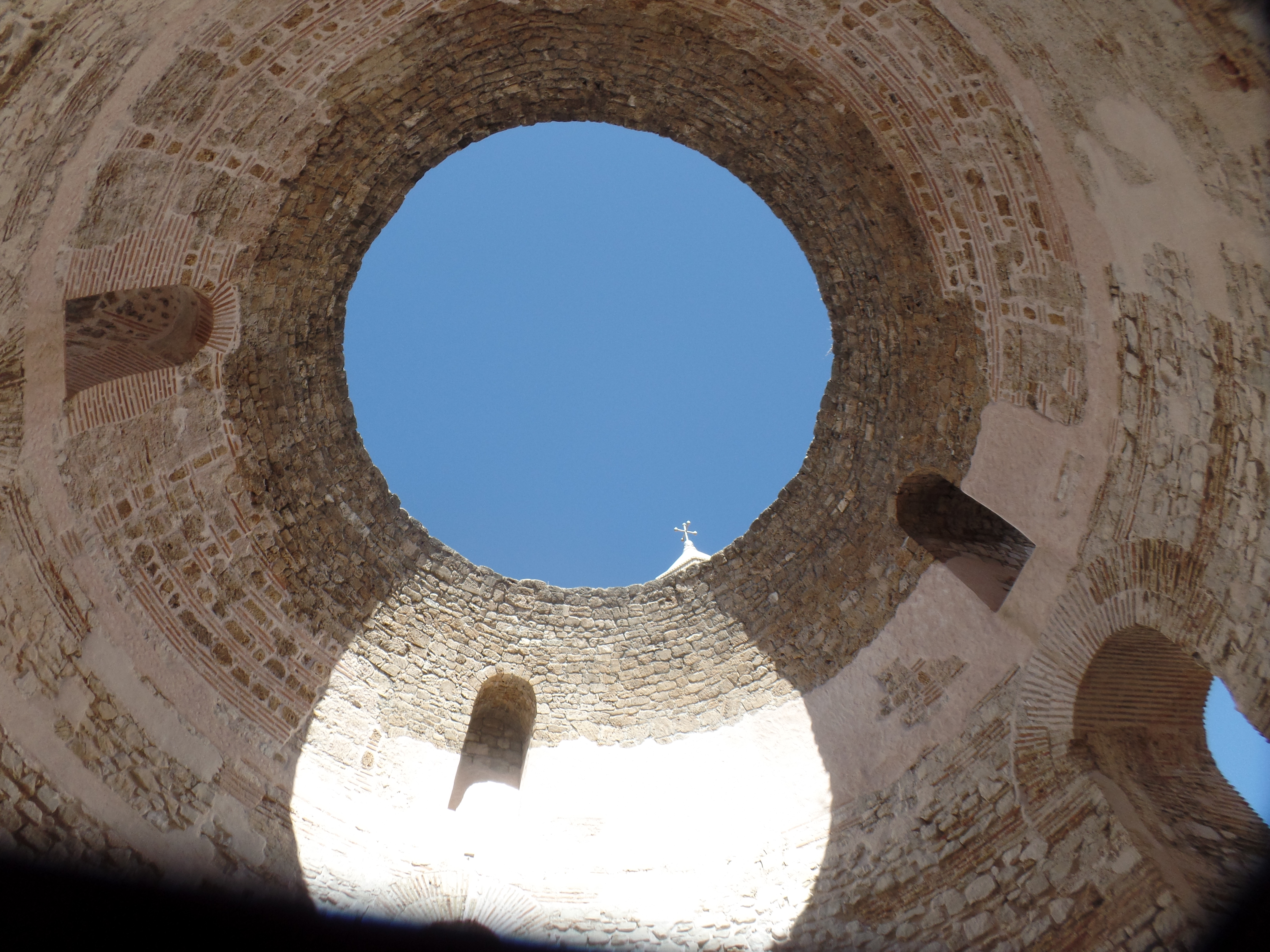
Vestibule, Diocletian’s Palace
Underneath the palace

We closed out this extraordinary day with a visit to Split’s Athletes’ Walk of Fame. Many of Croatia’s stellar athletes came from Split.
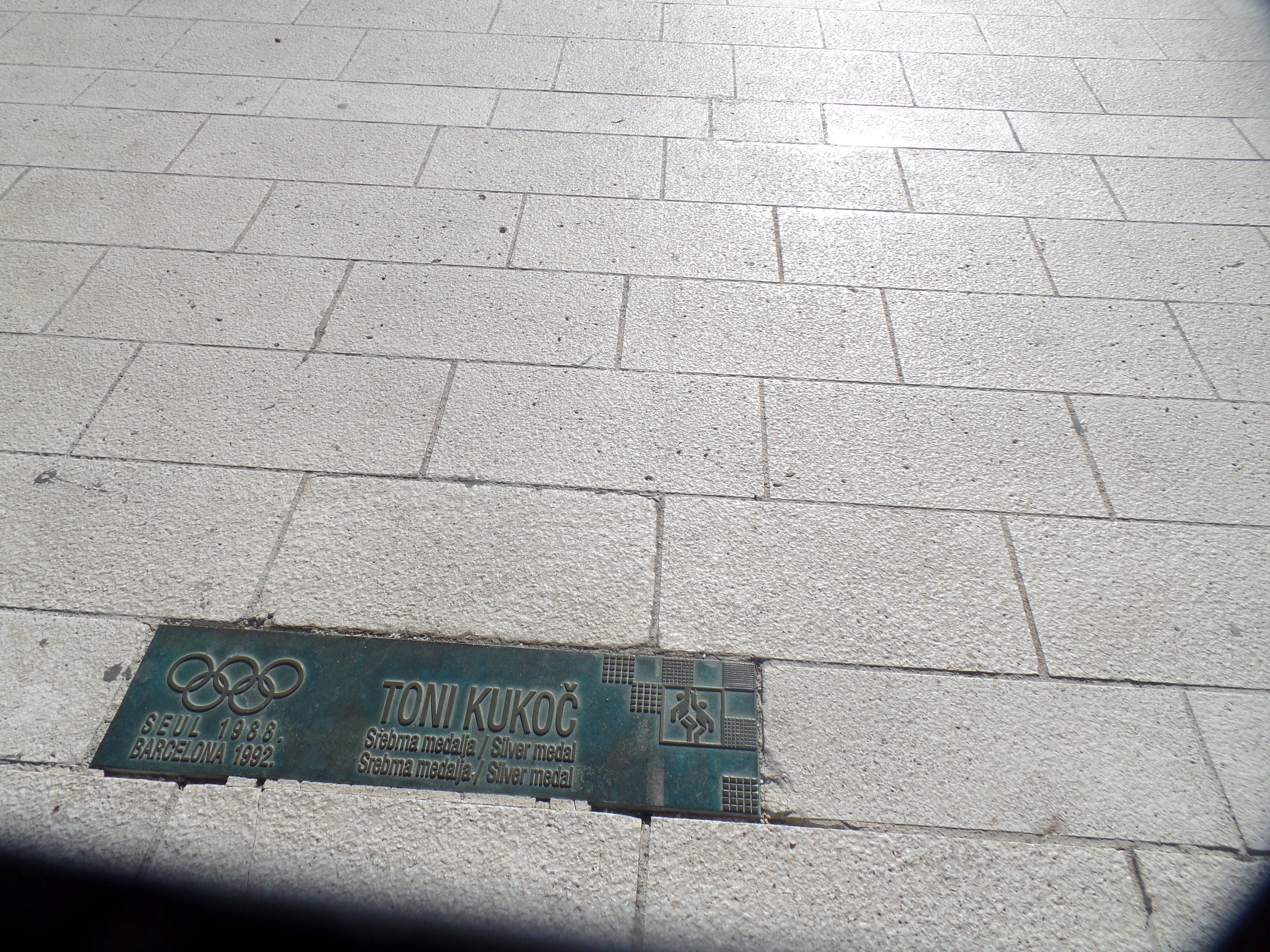
Toni Kukoc, “The Croatian Sensation” of NBA fame
Goran Ivanesevic, a great tennis player

With a few more views of the Walk of fame, I bid farewell to my friend, Boris and headed back towards Hotel Pax, and a restful night, before the next leg of the journey: Bosnia and Hercegovina. Split will long shine in my heart.
The Myth of Finality

2

April 28, 2024, Gallup- As I was walking to breakfast, at Post 6, this morning, one of the dogs who customarily run up to their owners’ fence and barks his head off, was true to form. A raven began flying in circles, above the dog, and cawed loudly, mimicking the dog’s bark. Animals can hassle each other like that.

So, too, do we humans seem to think it is our due, to hassle one another. I give you the current version of “Forward, into the past!”-Right-wing students, mixing with peaceful protesters and yelling for a renewal of “The Final Solution”. There is no real concern about the Palestinians who have suffered, no desire to see justice for Gaza, just a re-hash of Nazi propaganda-blaming Jews in this country and around the world for the destruction that has come from two groups of extremists fighting one another. Palestinians, in Gaza, have asked that the hatred against ordinary Jews be stopped. It is, they note, not helping their search for justice.

I have relatives who are at least a quarter, or half, and in a few cases full-blooded Jewish. I have many more, both Arab and Jew, who I count as friends. None of them hate the others. Growing up, my parents counted both Arabs and Jews as friends. It is thus second nature.

In Creation, there is no permission given by the Divine, for one group of people to slaughter another. The deluded young man who called for the deaths of all Jews can quote Mein Kampf all he wants, but if he follows through, he deserves full punishment, under the law. I say the same applies to anyone calling for the deaths of all Arabs. Enough is enough! If someone, or a group, attacks a Jew, or an Arab, in my presence, I will stand for the intended victim-nonviolently, mind you, but I will stand in defense of the one being attacked.

Today is the anniversary of Baha’u’llah’s Declaration of His Mission, to unite mankind, both spiritually and materially. We Baha’is celebrated, worldwide. There are fellows in Faith who are of Jewish descent, as Penny was and there are fellows in Faith who are of Arab descent-in fact, there are Baha’is in virtually every ethnicity, across the planet. We stand for the oneness of mankind. There is no room for anyone to act on genocidal thoughts, of any kind. There is no such “final solution”.

In a few days, I will be at the Baha’i House of Worship, in Wilmette, Illinois, north of Chicago. I try to visit there, each time I head east, for family visits. The magnificent Temple helps me ground self spiritually. This time, I hope to see both Jewish and Arabic visitors, among the multitude that is there, on any given day.

The only finality should be love.

An Eastward Homage, Day 32, Part II: The Two Faces of Berga

9

June 27, 2014, Gera- The wait for the train to Berga, while standing on the platform at Gera Hauptbanhof, was almost as long as the time I actually spent in the former prison camp town.  It was due at 1:15, and came at 2:15.  In the meantime, I was amused by a man chasing his 9-year-old son around the platform, as the child giggled and hid behind the concrete posts.  This became the child’s fault, when the train actually did pull in, and Pater-Meister was embarrassed that the boy was almost hit.  The boy took his tongue-lashing quietly, but I could tell he had no idea what he had done wrong.

The Jews who were taken prisoner, and given unwanted special attention by the Nazis, had no idea what they had done wrong, other than to be distantly related by blood to the Rothschilds and a handful of money lenders and grifters, who had contributed somewhat to the collapse of the European economy- a collapse which would have happened regardless of the level of mercantilism in any one country.

I digress, however. Berga, a small town southeast of Gera, was a satellite station of Buchenwald, the much larger Concentration Camp in northern Thuringia.(Photo courtesy of http://www.freerepublic.com)

bberga

Here were brought Jewish soldiers from the US, Canada and Britain, especially after the Battle of the Bulge, in late 1944, when Buchenwald itself was at saturation point. One of these was my future father-in-law, Norman Fellman, 6’3″ tall, weighing into the camp at 175 pounds.  He was part of a group assigned to work a gypsum mine.  He and his fellows walked up a trail like this, (Photo courtesy of http://www.thirdreichruins.com)

splittergraben2

through a door like this, (Photo courtesy of http://www.kilroywashere.com)

LaborTunnel

to a place like this (Photo courtesy of http://www.tripmondo.com), every day, for a hundred days. When General Patton’s men found him, in April, 1945, he weighed 87 pounds.

Old gypsum mine, near Berga

They spent time, after coming back from the mine, in this “work station”. (Photo courtesy of http://www.thirdreichruins.com)

Old dormitory  for prisoners, Berga

The camp where they were held, from their capture in the Vosges of southern Lorraine, to the date of Gentle George’s arrival, looked something like this. (Photo courtesy of http://www.channelnationalgeographic.com)

46705_berga-barrack_u4otpkuoohegc34cxym6cgqbe3ncurxrbvj6lwuht2ya6mzmafma_610x457

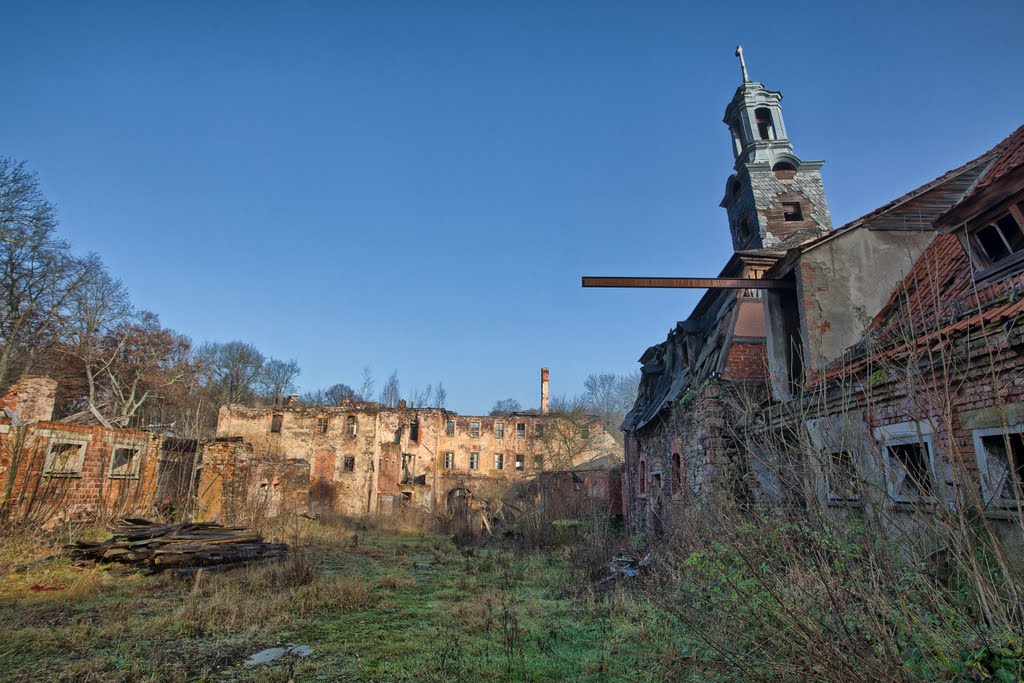
Now, the area looks like this. (Photo courtesy of en.immostreet.com)Prison camp for Jews, Berga

I walked around this decrepit, southern edge of Berga, even walking the periphery of the abandoned V-1 Rocket Factory, now closed off by a fence, with only a small security team allowed inside. (Photos courtesy of andrea-kublitz.de)

V1 Rocket factory, Berga

Old rocket factory, Berga

Understandably, Pop never went back to Germany, and the less said about that country in his presence, the better.  I told him, two months before he passed on in May, that I intended to go to Berga, to try and put the ghosts to rest.  Ghosts, demons, visionaries of Hell- they seem to hang over this part of the town, in a way that the giggling school children who were waiting at Berga Train Station can only dimly imagine.  The kids, of course, were waiting for their families, from the north end of town.  Few people live in the old camp zone- a farmer or two, perhaps even an aging former guard, released from prison to live out his ignominy.

Berga today remembers its victims and its enslaved “guests”, with this memorial. (www.en.wikipedia.org)

Denkmal_Berga

North of the train station, Berga could be Everytown, Deutschland.  There is a bright, red Rathaus. (Photo courtesy of http://www.commons.wikipedia.org)

Feuerwehr_Rathaus_Berga

A small town square sits in front of the Town Hall. (Photo courtesy of http://www.stock-clip.com)

Village Square, Berga

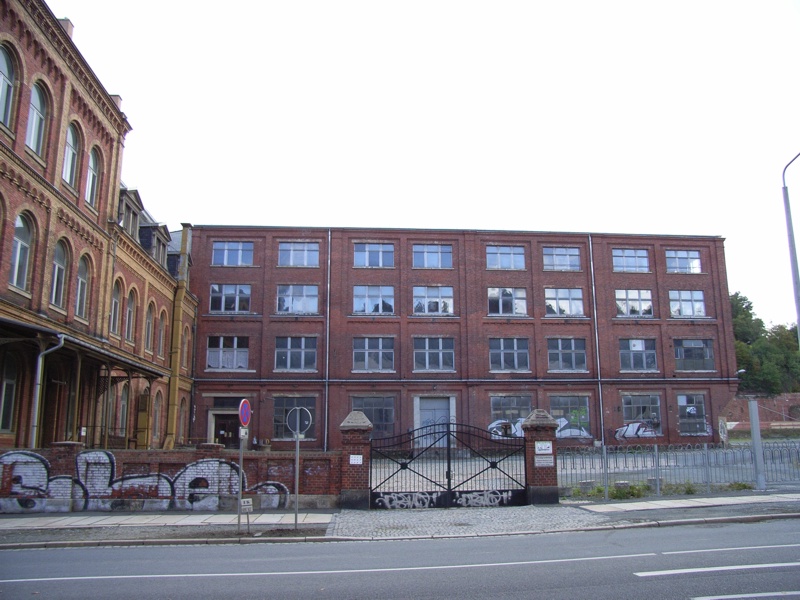
Not far from here, I guided a mother and small child to an ice cream parlour, where I had just stopped, perhaps to comfort myself and return to the more benign reality of this “new” Berga.  There are churches nearby as well.  I can only imagine what the churches, and the schools, impart to their patrons. Below, is the legacy of Marxism for Berga.  These apartments are still highly occupied. (Photo courtesy of http://www.amberrom.org)

OLYMPUS DIGITAL CAMERA