
March 11, 2019, Jeonju, South Korea-
After a brief walk around the farmstead of my hosts, Shin Dongwhon and Park Miwha (Many Korean women keep their maiden names, even in marriage), they, the new Mr. & Mrs. Boivin and I headed for Jeonju, the capital of Jeolla Buk-do (North Jeolla Province), famous for the hot pot, known as pibimbap (rice, mixed with vegetables, chopped meat and egg, then garnished with hot pepper sauce). It is also well-known for maintaining historical buildings, as it is the birthplace of the Joseon Dynasty (1392-1897). The dynasty was founded by General Yi Song-gye, who became King Taejo as a result. He and his heirs instilled a strong Confucian ethos into Korean culture. They also built Korea’s legacy of distinct language and literature. King Taejo’s heirs included his fourth-born son, who became Sejong the Great. King Sejong, one of the seminal figures of Korean history, was committed to universal education. In order for the masses to become literate more easily and quickly, Sejong commissioned the development of a phonetic alphabet, Hangul, which is still commonly used today. He also commissioned the development of movable type, about the same time as Johannes Gutenberg was developing a movable type printing press, in what is now Germany.
With all this rich history, I was surprised that the emphasis in Jeonju’s historic district was not so much on telling the tale as on showing the buildings as they were and on the selling of goods and services. Of course, any living community has to strike a balance between legacy and functionality, as Salem, MA, San Juan Capistrano, CA, St. Augustine, FL, Heidelberg, DEU-and Gyongju- a living history city, in eastern South Korea, have all done.
Here are some photos of the day’s festivities- first of the farmstead, then of Jeonju Hanok Village. First, here is the home to which I was welcomed.
The koi pond has some rather shy inhabitants.

Building stones and ollas (for storing kimchi) are essential to any Korean farmstead.

A newborn rabbit needed warmth and safety. He is hidden in the shorn fur of one of his elders.

The rooster and his ladies were in full voice, this morning.

This is a row of pine windbreak.

This is a view of Mr. Shin’s field.

There, to greet us and send us off, is “Buri” (Barley), the family porch dog. Korean farm dogs are rarely, if ever, allowed inside the house.

Now let’s have a look at the first set of photos of Jeonju Hanok Village. Below, is the Hanok Visitors’ Center.

Yunhee and her parents, in front of commemorative stone.

Our side of the coin.

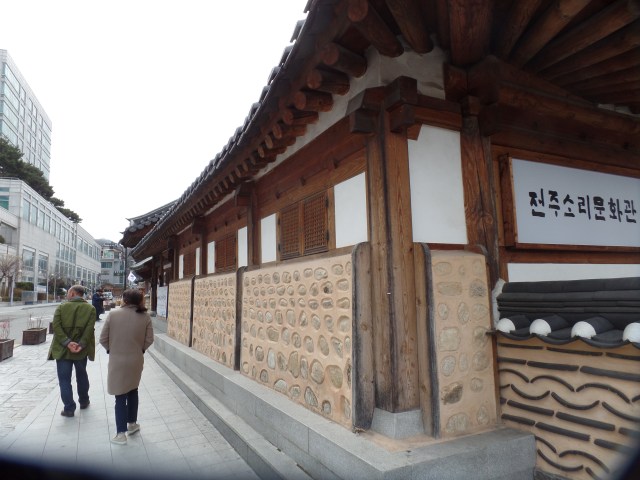
“It still could snow, this Spring.” Here is a traditional Jeollabuk-do tiled roof.

More traditional Jeollabuk-do tile-roofed houses. Many of these are Guest Houses.

This is the Year of the Boar, in the Lunar New Year configuration.

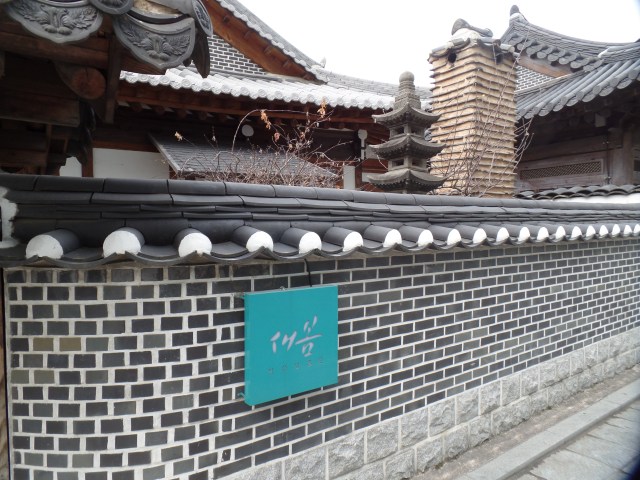
Traditional Chollabuk-do home, with walled courtyard and shrines.
Here are hanbok, traditional Korean formal dress.

Here is a more upscale version of the Chollabuk-do tiled roof. It was probably the home of a wealthy merchant or minor official.

A more modern variation of traditional water wheel.

These traditional shirts are actually made of paper. We visited a paper-making establishment and saw various products, made of durable paper.

Yunhee is watching a traditional demon mask, made of heavy paper.

Mrs. Park is demonstrating traditional grain milling.

It was a little chilly for an outdoor lunch, so we admired the courtyard and moved on.

Here are some household decorations that graced a merchant’s home, in the early 20th Century.

Here is a hilltop pavilion, probably used as Confucian shrine.

“Spring is on its way”, say the cherry blossoms.

A heavy-duty community level water wheel.

Commemorative stone, indicating road leading to Confucian shrine.

There are a number of other photos to share, of this large historic district. I will post these in the next installment.
 A Sagittarian Seeker