Freyja and Thirteen

3

February 13, 2026- Friday is named for Freyja, the Norse goddess of just about everything earthy. She is given the portfolios of love and war, among other matters, thus making her job pretty much impossible. It is said by some that she was a child born of siblings, which would seem to make just about any task impossible for her to perform, though what do I know about supernatural genetics? She had a husband who was always off doing his own thing, leaving her to raise two daughters alone. We thus honour her by naming many people’s favourite day of the week in her honour.

Friday is, for people in business, a day to wrap things up for the week and to set sights on the following Monday. For teachers and office workers, it’s an afternoon and evening of unwinding. For many in tight-knit neighbourhoods, it’s another day to gather at the corner bar. For me, it was a night to catch live music at the Raven or Rafter 11, when I lived in Prescott and for going to a coffee shop for the same, when Penny and I were in Flagstaff or Phoenix.

Nowadays, Friday is another day of being with my granddaughter and all the snuggling, playing a little game of “Stand-Up, Sit Down” (for which she loves being praised for standing up, straightening her legs, with my support and then sitting back down) and helping with her personal care and feeding. There are no special things that distinguish one day from another, save that her father is off work on Saturday and Sunday. This is new for me, and likely is only a temporary state of affairs. (The world will inject itself into our lives again, soon enough.)

Friday the 13th, depending on one’s point of view, is either a day to revel in the joys provided by feminine energy or a day to stay home and hide under the covers. I can’t stand to stay in bed after 6 or 7, and my time with Hana begins at 5, so the second option has about as much appeal as a root canal. I’ve always loved women and girls, so the first choice has been easy to go with. To date, I have not had any bad experiences on Friday the Thirteenth. If anything, it’s been a fairly good day, over the years.

Freyja, wherever she is, must be smiling on our little Hana.

The Road to Diamond, Day 296: Picture Stones and A Watchful Wolf

0

September 19, 2025, Visby, Gotland-

Today’s festivities will be shared in two parts, as some photos are on the iPhone gallery and the cable for my phone doesn’t quite connect to the Lenovo.

Sharing is caring, regardless, so let’s take a look at Gotland Museum. There are four floors, each with two or three galleries. Floor 0 is where we enter, pay admission, check out the bookstore and spend time with Gotland’s unique Picture Stones.

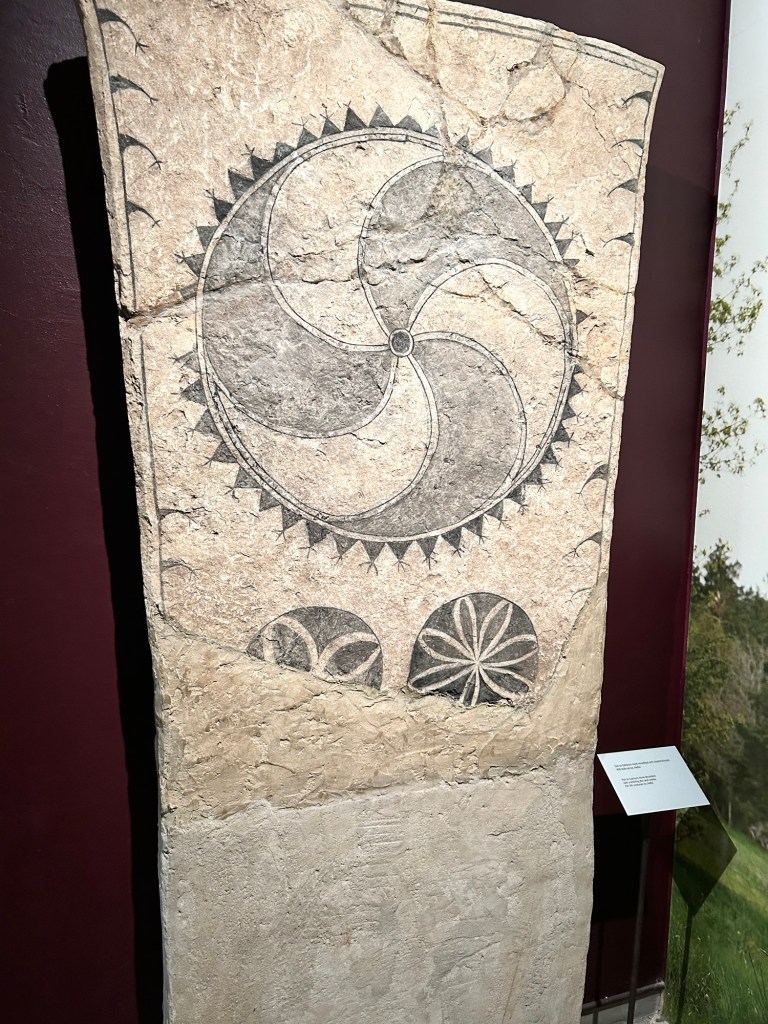
Many picture stones were originally painted with red, yellow or blue pigment. Most have lost the pigmentation, over the centuries.

The standing stones are all over Gotland and its northern offshore sibling, Faro (not to be confused with the resort city in Portugal’s Algarve). See gotlandpicturestones.se

Here are a few scenes of that gallery.

This came from the early Christian era, most likely commissioned by someone looking to protect his farm.
The pinwheel also is a
harbinger of good fortune.
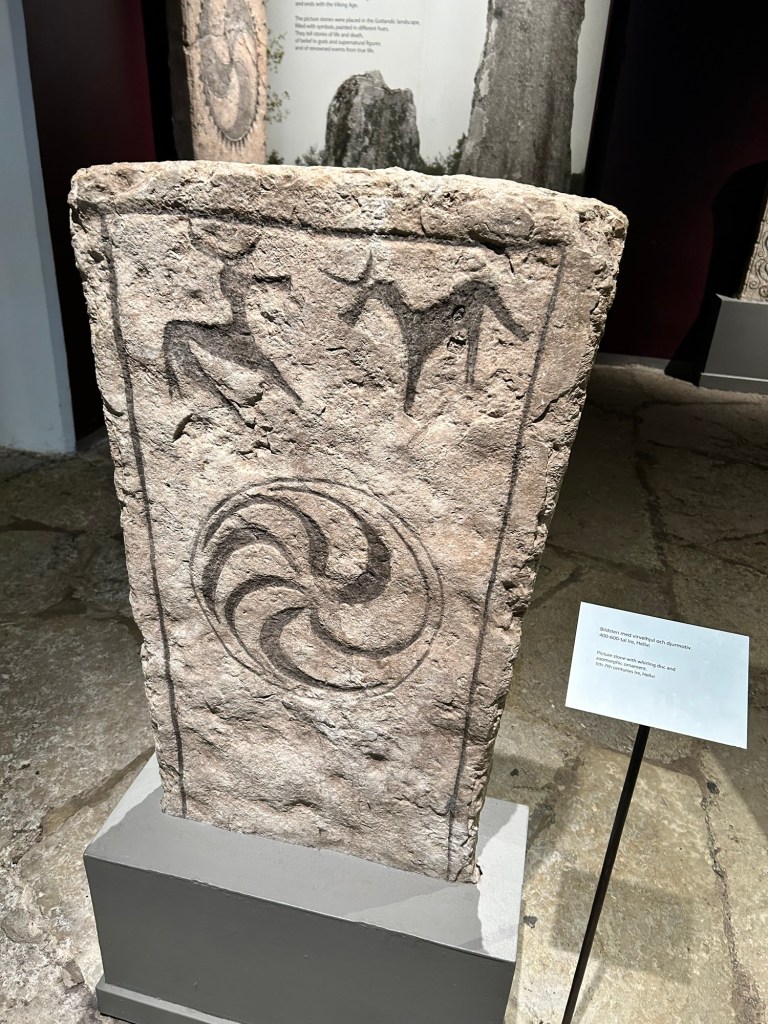
This tells the story of a horse and a deer.

This one has a sensor, which fills in the colours when someone approaches.

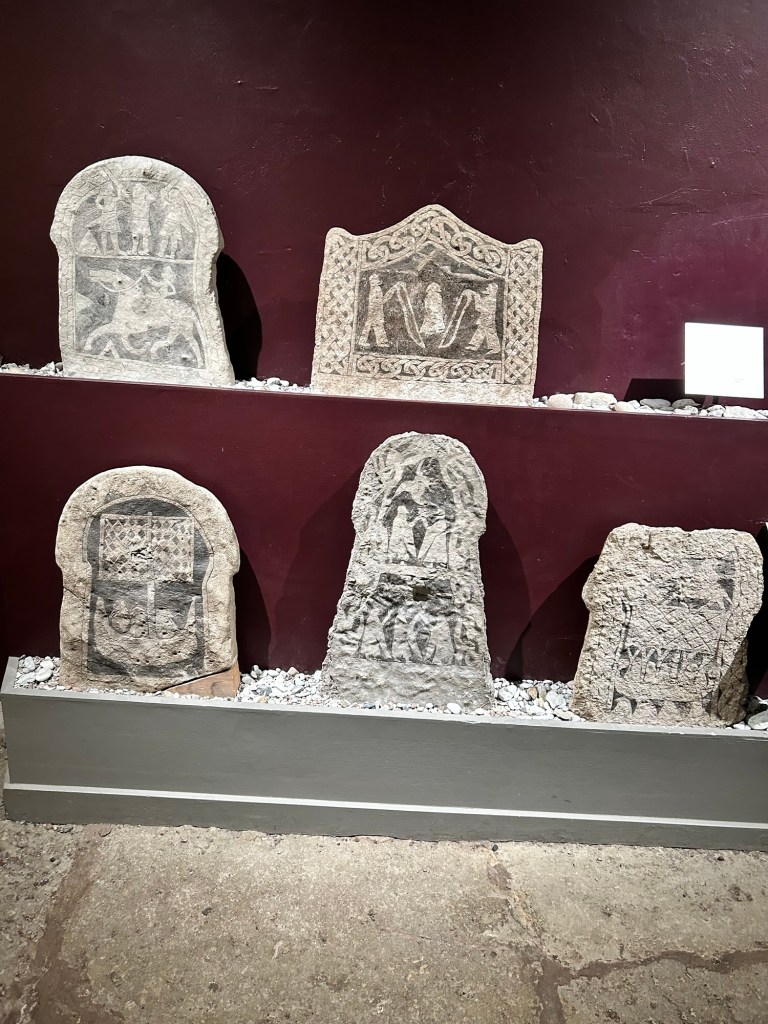
There are several others in the gallery, but here is a tableau of some smaller reproductions from around Gotland.

Up to Floor #1, we find The geology of Gotland. It, like the rest of Scandinavia, was once buried under ice. As the glaciers retreated, the Baltic Sea filled in, while islands like Oland, Aland, Bornholm and Gotland remained above water, being the tops of small hills.

Sandstone and limestone predominate the gently rising, but mostly flat landscape. There are some forests, but Gotland is still mostly farmland.

Floors 2 and 3 feature the history of Gotland and stories told by local children and youth, respectively. The historical part begins with a Norse creation story. Odin, representing the Sun, brings the world to life. He and other deities guide people in the ways of right living. All the while, the ravenous Wolf watches and waits. At the end time of Ragnarok, the Wolf will swallow Odin.

On that cheerful note, the story of Gotland proceeds, through its early days of increasingly successful farming, the Viking Era, Hanseatic League and incorporation into the Kingdom of Sweden.

It was during the Hanseatic period that the wall encircling Visby was built. At the East Gate, all peasants wanting to sell produce at Visby’s market had to pay a toll. Those trying to sell elsewhere were fined pr flogged. This was the stricture of the manorial system.

On the third floor, there are both paintings and recorded stories by Gotland residents.

The painting above shows the juxtaposition of hillside Visby with the sea.

The museum was founded in 1875, by Per Arvid Save( pronounced SAH- vay) and the Friends of Gotlanf, with the aim of preserving the island’s rich heritage and sharing it with the world. Dr. Save encouraged the farmers and fishers of Gotland to safeguard the picture stones they found about their homes and nearby lands.

Next, I will visit the ruined churches of Visby’s centrum, with the help of my laptop.

Metro Manila, Day 3: No Place for Bad Luck

4

September 13, 2024, Manila- There are two schools of thought about Friday the 13th. One holds that both Friday and the number 13 augur badly. The other counters with the cultural artifact that the day is named for Freya, Norse goddess of love, war and fertility. It also is deemed unlucky, in Norse mythology, as Loki the Trickster was the thirteenth Norse god.

The Vikings may have given themselves reason to be conflicted about Friday the 13th, but I personally have never had any hard luck associated with the day. This day was no different. I was able to extend my time at Ola! Hostel, my dear friend arranged a nice group outing for tomorrow, as well as help me get a bus ticket for a visit to central Luzon, late next week. and I was able to join a study group from Arizona online.

Most of the day was quotidian, otherwise, but that has never been a bad thing. I helped with shopping, at an open air market and house sat, while the Baha;i Cnter’s caretaker went to tend to another matter.

Every day, loud or quiet, has its advantages.