
July 10, 2017, South Bend-
The University of Notre Dame has long been the stuff of legends, particularly when it comes to college football. There is, of course, far more to this fine institution, so it was ironic that the stadium was off-limits to the public today, with intense construction work being done, in and around it. My tour of Notre Dame, courtesy of a long-time correspondent, focused on everything else that makes this campus such a great institution.


Our tour began near the Joyce Center, a performance center, named for one of the University’s prime movers, Reverend Edmund P. Joyce.
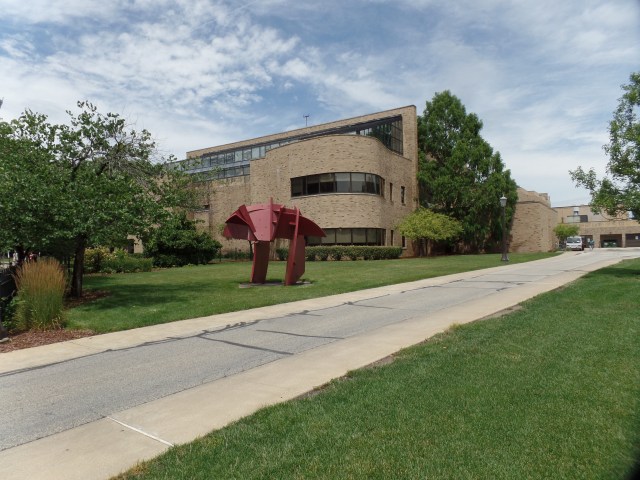
I am always drawn to student art. This metal dinosaur was produced by a team of Notre Dame students, and is one of a wide variety of projects, visible around campus. While I was there, several pieces were being transported to storage, saving them during the summer construction.
Horticulture is as vital here, for aesthetics and soil enrichment, as it is at any great public place.


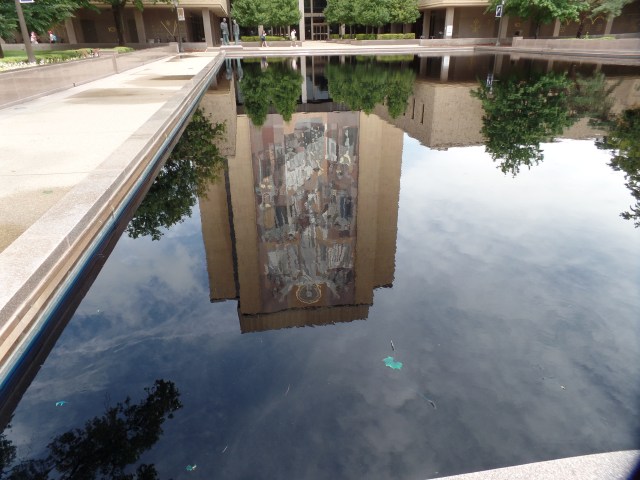
I give you two views of Touchdown Jesus, the lovely, famed, and rather presumptuous, mural which faces Ara Parseghian Stadium.
Rev. Drs. Joyce and Hesburgh are seen, discussing their vision for Notre Dame.

There are several panels, along the wall of the University Library, depicting symbols from the Old Testament.

There are four concrete pavilions, in the center of campus, honouring those who fought in World Wars I & II, Korea, Vietnam and the ongoing conflicts in western Asia.

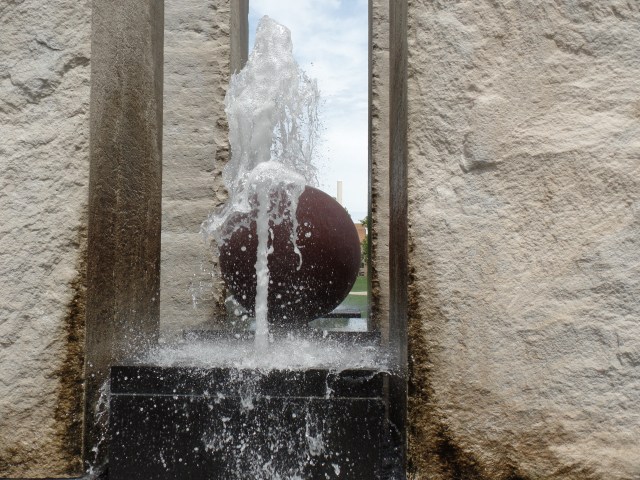
In the central fountain of these pavilions, is a steel ball, representing our shared planet.
The Washington Center, Notre Dame’s administrative center, is topped by this golden dome.


Along the central corridor of the Washington Center are several portraits, depicting the life of Christopher Columbus. An ornate crown may also be viewed, at the north end of the corridor.
My guide and I next proceeded to the Basilica of the Sacred Heart. The modernesque features of the interior stand somewhat in contrast to the interiors of several much older cathedrals of, say, western Europe. Nonetheless, the artistry does a fine job of telling the Eternal Story.

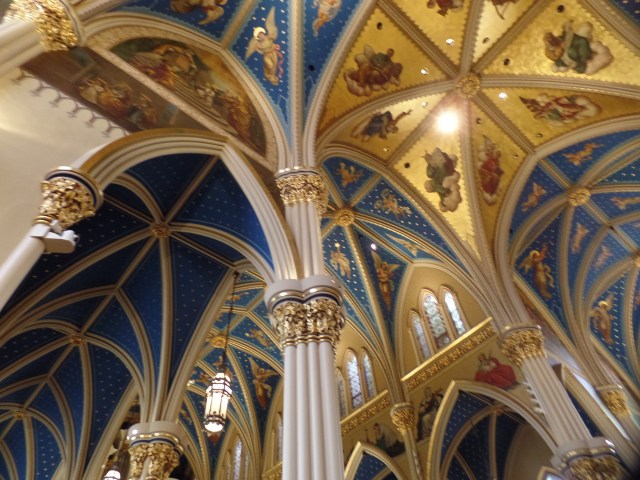
The High Altar, the Altar of St. Peter and the Altar of the Blessed Mother appear, lined up.

The Basilica’s ceiling calls attention to the Divine Sacrifice.

This tree shows its resilience, after a sacrifice of a different sort.

It was now time for my guide to head back to her other duties, so from here, I spent several minutes on my own.

That time was spent in the Jordan Center for Science.
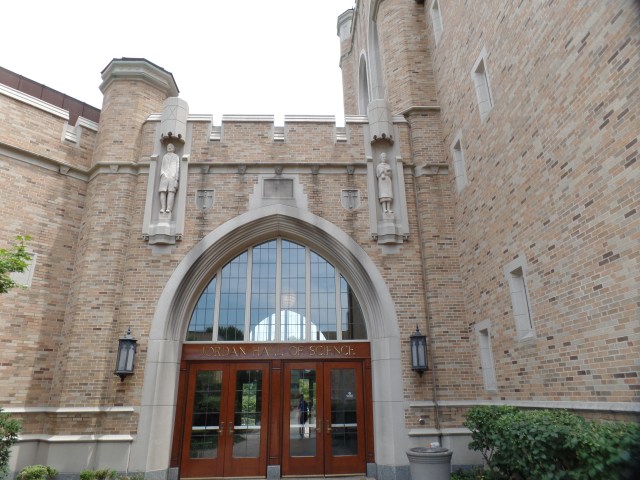
The Center’s biological and medical research is wide in field, most notably its research into blindness. The Museum, closed when I was there, has an extensive collection of skeletons and taxidermy.

The Sundial hearkens back to a time when naturalistic observation meant the difference between life and death.

This has been one of the more fascinating campus tours, along with that, four years ago, of Princeton University, courtesy of another longtime correspondent. So, farewell, Notre Dame and Ara Parseghian Stadium.

 A Sagittarian Seeker