
July 19, 2017, Philadelphia-
Whilst waiting for some family members to meet me at downtown Philadelphia’s Cafe Ole,
 I spotted an intriguing wall, across the street from the coffee house:
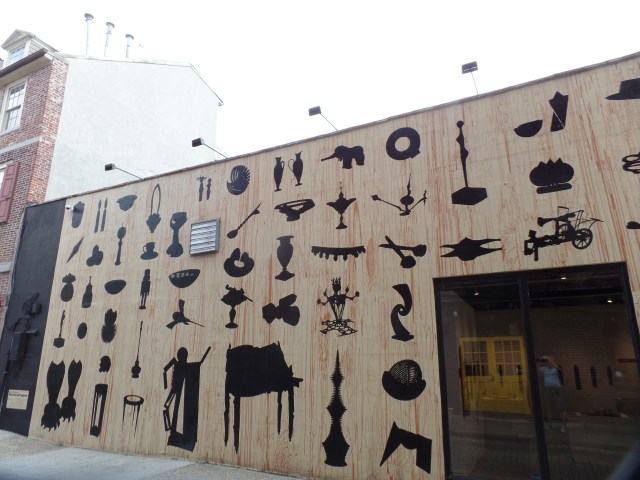
A brief walk showed that this belonged to a museum and art gallery, the Center for Art in Wood. I spent about an hour, in the astonishing museum, which showcases both the traditional plank art of northern Europe and several contemporary pieces, from around the globe. Several variations use the root word, Mangle, meaning cut, as their base. Below, is a Danish piece, called a manglebraette.

Bear with me, I am taking the liberty of interspersing the traditional ware with contemporary pieces. This one, by an American, Michael Scarborough, celebrates Buddhism.

Australian artist, Ashley Eriksmoen, presents this Judeo-Christian piece.

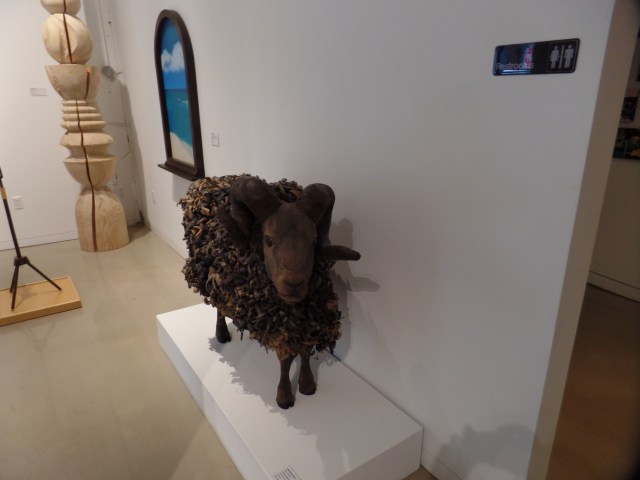
Who wants a wooden sheep?
These Icelandic pieces are examples of that nation’s trafakefli traditional craft.

Sweden’s variation is known as mangelbraden.
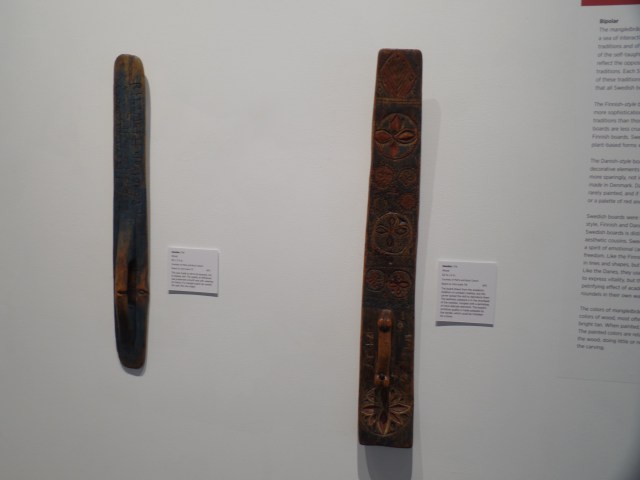
Norway’s woodcraft, mangletraer, is displayed at the front of the exhibit. Some pieces are in glass cases.

Finland adopted the art form, as well, and is the easternmost country in which the mangleplank tradition took root. Its form is called kaulauslandet.

Surprisingly, it is the Netherlands which is credited with originating the art form. Merchants of the Hanseatic League spread it to the Nordic lands. The Dutch form is called mangelplanken.

The variety, in both styles and uses, of woodcraft could capture one’s interest for hours, I think.
Here are a couple of other contemporary pieces.


I will definitely be back here, next summer, at the very least as a customer-for one of the gallery shop’s more utilitarian pieces, while learning more about plank art. I, who whittled as a child, could possibly fashion something of use, one of these fine days.
 A Sagittarian Seeker
Intriguing! I also love the mangle art pieces and contemporary pieces you pictured.
LikeLike
Aren’t they amazing?
LikeLike
Wow, wonderful; I had no idea of this form. I love the Buddhist piece by Scarborough, of course.
LikeLike
This museum seems unique, although I’m sure there are similar places, in the countries where the art form is widely practiced.
LikeLiked by 1 person
AMAZING!! ✨🙏
LikeLike
I found them so!
LikeLiked by 1 person
Beautiful. And the meaning of each one of them.
LikeLike
They are, and I would not be surprised if Canada has such woodcraft traditions.
LikeLike
My grandfather whittled when he was in the army in WWII. He made a set of hound dogs in various poses. My cousin has them now. They were always displayed by my grandmother as if they were fine art pieces – and in my eyes they were!
LikeLike
I would have treasured anything made by one of my grandparents. 🙂
LikeLike