The Hana Chronicles: Month 10, Day 21

0

November 11, 2026- Hana has decided that her father is “Dada” and I am “DadaDa”. She made that announcement after looking at each of us at the dinner table. I guess that is a reasonable distinction.

Today is Veterans Day. Both Aram and Yunhee worked. School was in session, as the Districts here take a full week off at Thanksgiving, thus trading some Federal holidays in return. So, Hana saw many kids going back and forth, as usual. In the evening, Yunhee prepared a lovely steak dinner; Aram and I felt much honoured.

HANA’S NOTE- Mommy asked Papa and Daddy if they wanted to go out to dinner. Both said “No”, because it would be too late for me to be up. That made me feel good.

EXPANDING CIRCLES: Prince Edward Island- I have made one visit to the Birthplace of Confederation, in 1973. I spent five days, and drove around the island, landing at Borden, then driving to North Cape, along the north coast and to St. Peters Bay and Montague, before returning to the mainland via Wood Islands. Standing outside Province House, I pondered the irony of PEI having hosted the talks on Confederation, in 1867, then balking at actually becoming a part of Canada, until joining the Dominion as its seventh province, in 1873. It was this centenary that lured me to Charlottetown, in the first place. I would like to return to PEI, on my next visit to Atlantic Canada, especially as a Causeway connects the island to New Brunswick. My paternal grandmother’s forebears were among the original settlers of the island, naming it Ile St. Jean. They departed for Quebec, after the French defeat at Louisbourg, in 1758.

The Turf: Prince Edward Island is essentially flat, with red sandy beaches along the north shore and more conventional sand along the beaches of the south. The rich soil of the interior lends greatly to farming, giving PEI the name, “Garden of the Gulf”. Prince Edward Island is drained by several short streams and creeks. Three, the Hillsborough, Brudenell and Montague Rivers are somewhat navigable by small craft.

First Nations- Prince Edward Island is the ancestral home of the Mi’kmaq people. They formed an alliance with the French during the various conflicts between France and England. They persevered, after the island became English territory. Today, there are two Mi’kmaq communities on Prince Edward Island: Abigweit and Lennox Island.

Where I feel most at home: Burton, Cavendish

Where I feel most at peace: Cavendish, North Cape

NEXT: Nova Scotia

Ferry to Province # 10

2

June 23, 2022, Doyles, Newfoundland- I got up and out the door, at Fair Isle Motel, as quickly as possible-making time for a decent breakfast at The Herring Choker, in the village of Nyanza, about eight kilometers east of Whycocoming. The place specialize in natural fare, so I did nto feel the need to eat again, until dinner.

Arriving at the ferry gate, in North Sydney, I had to wait for another party, whose documents were apparently not in order. When it came my turn, I was through the gate in short order and ended up in the last parking slot on Level 3. My reserved seat, up on Level 9 of the ship, was a window seat on the ocean. The service on this vessel was excellent, with a little treat of soft-serve ice cream, in mid-afternoon, and a fine dinner of cod au gratin, salad and steamed vegetables about two hours later.

So, I watched the departure from Cape Breton Island and the arrival in Newfoundland.

Thus, around 6:30 p.m., Newfoundland Daylight Time. This time zone is 1/2 hour ahead of Atlantic Daylight Time, which is observed in the other three Atlantic provinces, on the eastern North Shore of Quebec and in its own mainland section, Labrador. Atlantic Daylight Time, in turn, is an hour ahead of Eastern Daylight Time. So, when it’s 5 p.m. in Boston and Buffalo, it’s 6 p.m. in Shediac and Sydney, as 6:30 p.m., in Port aux Basques and L’Anse aux Meadows.

Newfoundland & Labrador was the last Canadian province I had not visited-and it’s also the last to have become a part of Canada. In 1949, still beset by economic difficulties, the people of the then-British colony voted, albeit narrowly, to become a part of Canada. The first Provincial Premier was Joseph Roberts Smallwood, who led the province until 1972. It was he who spearheaded the vote to approve confederation with Canada. He was a champion of hydroelectric power and promoted pulp and paper milling as a means to expand the prosperity of the average person in the province. His policies, like most, had mixed results.

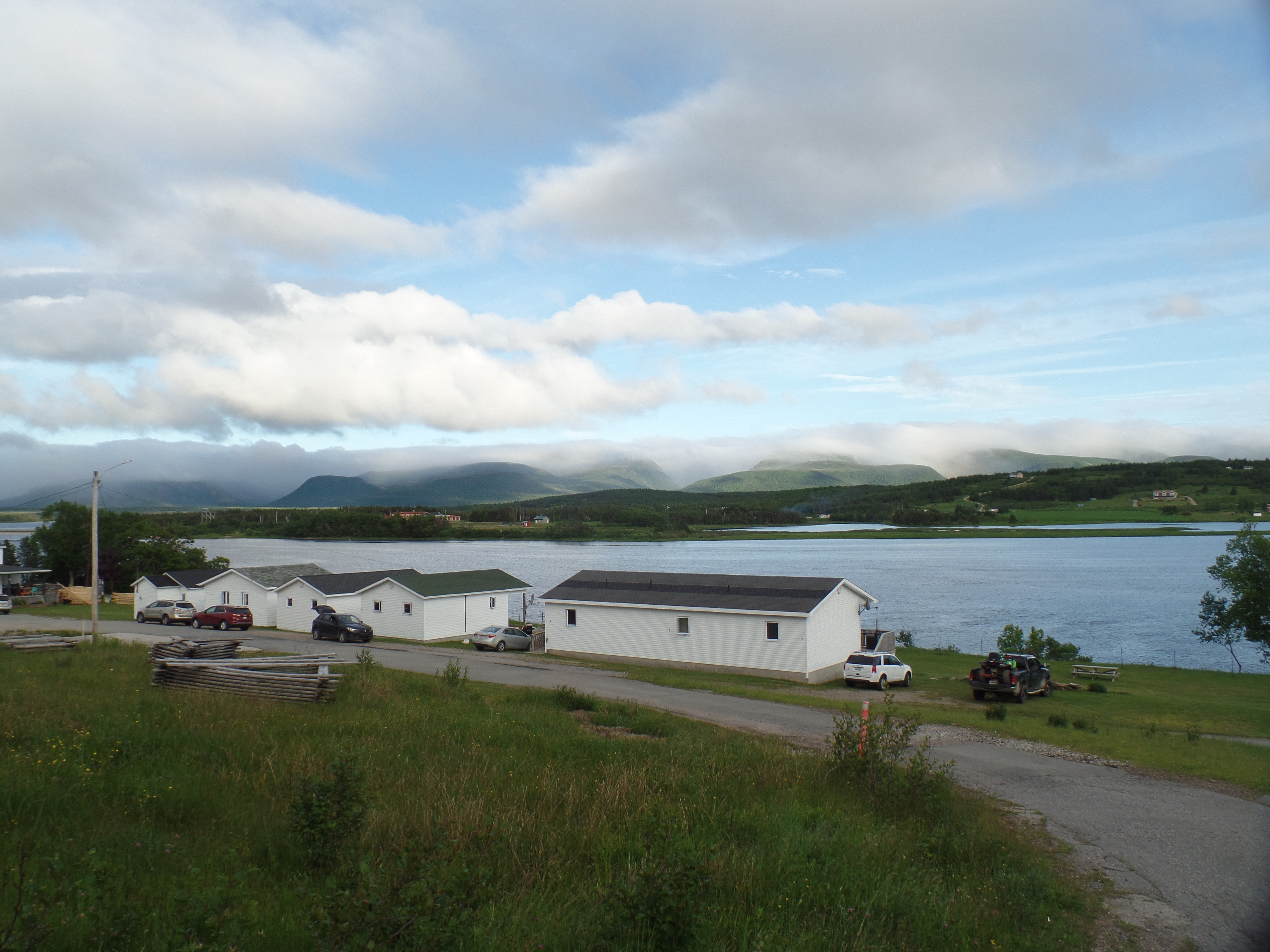
I am staying, this evening, in a lovely cottage, part of Codroy Cottage Country, overlooking the Grand Codroy River, which empties into the Atlantic, not far from here. The cottages are as modern, and tech-savvy, as any in either North America or Europe. I am pleased to see the level of comfort that the people of this valley seem to enjoy, though the owner of a store across the street from the cottages pleaded with me to buy something from his grocery. I needed a few things, and so obliged him in that way. The Devine family, who run Cottage Country, present a cordial, if reticent, demeanour. This is fine, as I’m only a guest here for one night. I must say, though, that this would be a fabulous venue for a week’s stay.

Thus has my five day initial visit to Newfoundland begun. So far, it’s lovely! (As for the photos, I found a venue where I could upload them, with no fuss, elsewhere. CC has good WiFi, but motels in Atlantic Canada tend to be limited, in their uploading capabilities.)