June 2, 2016, Ely- Sitting in the spare, but comfortable Silver State Restaurant, in this little anchor-town of the White Pine country of eastern Nevada, I had a bit of time to reflect on “America’s loneliest highway”.
I got on U.S. Highway 50, in the eastern edge of Carson City, around 10:30 this morning, saying goodbye to my Baha’i sister, and her new home across town. Gradually, the wonders of the Silver State itself unfolded: The exit to Virginia City, the Comstock Lode historic site of Dayton, and the small commercial hub of Fallon, which serves as the western anchor of the so-called Lonely Road.
Fallon was rather quiet, on this first of many hot days to come. It did have its share of business, though, and some of that filtered in to Susie’s BBQ, where I stopped for lunch.

Susie’s BBQ, Fallon, NV
I opted for brisket, as it was not really a sausage kind of day. A Big Heat has taken the West under its wing, probably for the next seven or eight weeks, so we move, eat and adjust accordingly.
On my last ride across Highway 50, in 1980, my driver pointed out an expanse of salt flat, a remnant of ancient Lake Lahontan. This was a massive body of water, stretching from the Sierra Navada to the Toiyabe Range. Its remnants include the much smaller Lake Lahontan, east of Fallon, plus Lake Tahoe, Mono Lake and Pyramid Lake. I did not, given the nature of my visit, go to any of the three western lakes, and there is intensive road work around the present Lake Lahontan. Thus, here are some surrealist, filtered scenes of the Carson Lake Salt Flats.


Notice there are some graffiti, inscribed by local lovebirds and various passers-by, who find romance in the desolation.
My next focus was on the Toiyabe Range, one of three mountain ranges that stretch north to south, in central Nevada. The Toiyabe and White Pine mountains, like the Sierra Nevada, are still somewhat snow- packed on their summits and high ridges.

Toiyabe Range, central Nevada
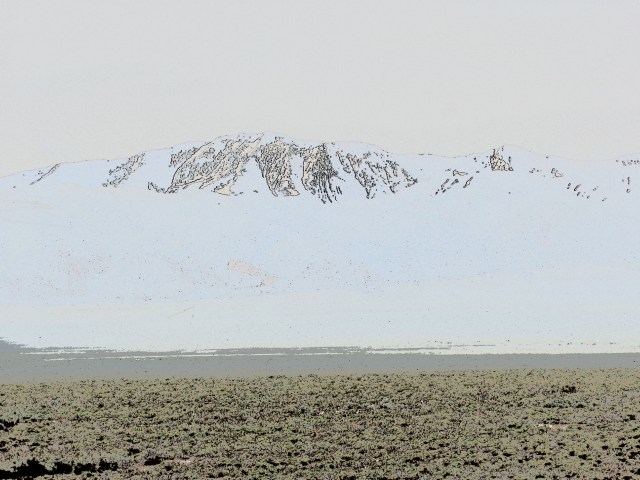
Toiyabe Range, Central Nevada
Austin is one of those little towns that used to be a link on the Pony Express, as well as where silver, lead and zinc were mined. Silver still can be found, here and there. Lead being largely out of favour these days, for health concerns, is cause for several closed and shuttered mines. The few folks who live here tend to be flinty-eyed towards anyone wearing shorts and a camera, but I find places like Austin intriguing, nonetheless.
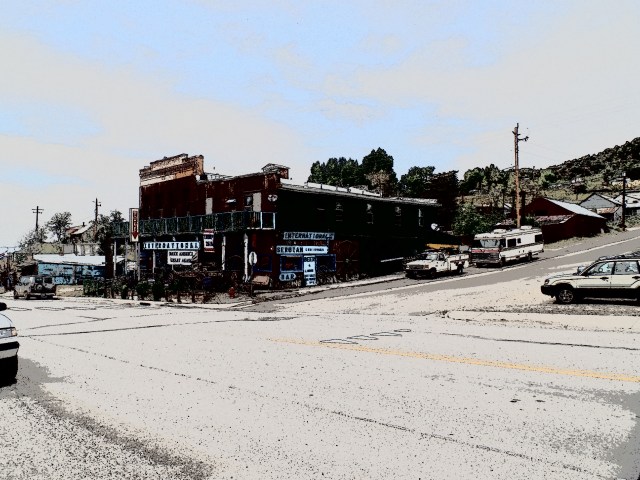
Main Street, Austin, NV

St. Augustine’s Church, Austin, NV
The back streets have their appeal, as well. Virginia Street alludes to the Mother Lode.

Lander County Courthouse, Austin, NV
Back on Main Street, the courthouse and visitor center(closed at the time) give Austin a bit of gravitas.
The walls in back of the main properties were built to last, with land slides always being in the back of people’s minds.

Retaining wall, behind Courthouse, Austin, NV
The old city hall was taken over by the American Legion, as John F. Hiskey Post 45, in 1947.
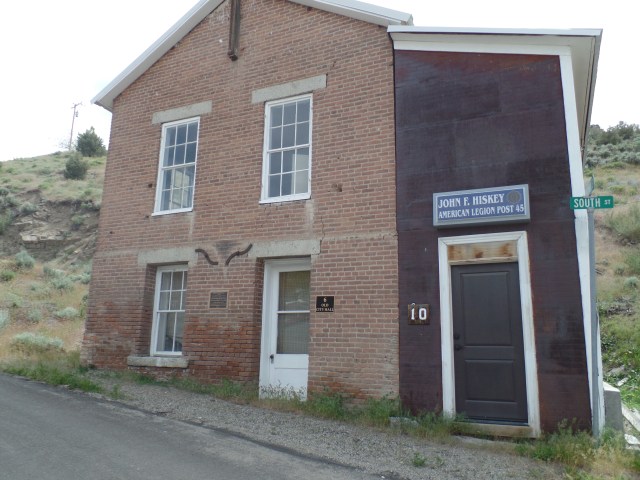
Old City Hall, Austin, NV
Crowning the heights above Austin is Stokes Castle. Anson Phelps Stokes, The Elder, was an industrialist and entrpreneur in the late-19th Century. He built the edifice as a summer “tower”, but only actually used it for two months, in 1897. After that, the Stokes family abandoned the place. Austin’s citizens have fenced the structure off, and it is indeed unsafe to enter. It remains, though, as a testament to the town’s glory days.

Stokes Castle, Austin, NV
An hour or so east of Austin lies Eureka, where people smiled, flashed peace signs and seemed quite relaxed, as their work day was coming to an end.
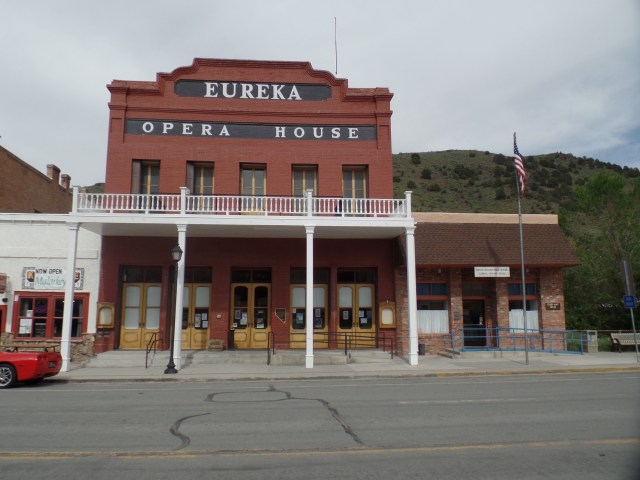
Eureka Opera House, Eureka, NV

Eureka County Courthouse, Eureka, NV
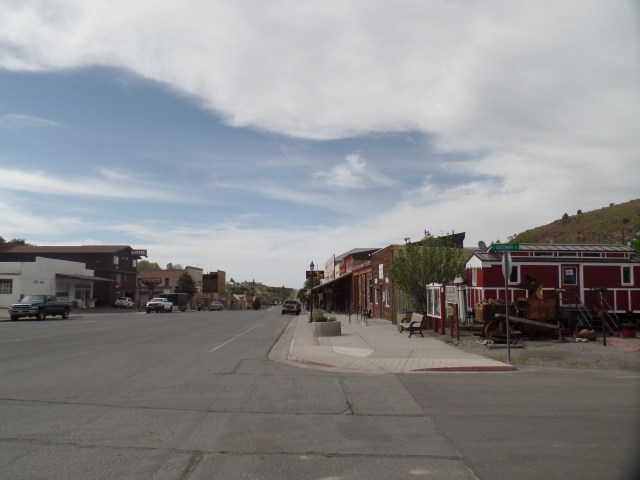
A westward look down Main Street, Eureka, NV
I had miles to go, before I slept, so on east it was, to Ely, NV, a more contemporarily- built, commercial hub, at the end of the “Loneliest Road”. I had dinner at the aforementioned Silver State Restaurant, then gave my camera a rest- until I came to the White Pine Range. These mountains are named for the light-coloured wood of the local evergreens.

White Pine forest, south of Ely, NV
Wheeler Peak, not to be confused with the mountain of the same name that is New Mexico’s highest peak, is the crown of the White Pines, and second only to Boundary Peak, (in western Nevada), in terms of high points in the state.
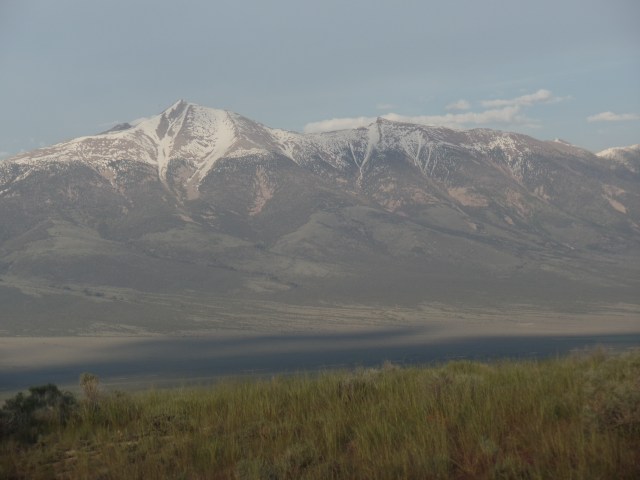
Wheeler Peak, White Pine Range, south of Ely, NV
Thus, as you can see, loneliness is a definite state of mind.
NEXT UP: Pioche, Panaca and the amazement of Cathedral Gorge

![20180531_093348[1]](https://peacefulwarrior9.com/wp-content/uploads/2018/05/20180531_0933481.jpg?w=640)
![20180531_084520[1]](https://peacefulwarrior9.com/wp-content/uploads/2018/05/20180531_0845201.jpg?w=640)
 A Sagittarian Seeker