The Dreamer’s Edge

6

March 9, 2024- The young lady looked, for all the world, like a 1920s Flapper. The moment she began singing, though, the melodious and heartfelt voice brought the chatty audience to rapt silence. Her connecting two very different semblances and times-the Roaring Twenties and the Hesitant Expectancy of the 2020s gave me much to consider. There really isn’t a whole lot different, between the two decades that lie a century apart.

Two business-oriented politicians, Calvin Coolidge and Donald Trump, set the tone for the conduct of affairs in the country. Both believed in the power of the marketplace and in cultivating a top-down economic structure, in which commercial interests are to be the stimulators of the nation’s prosperity. Coolidge’s programs did not factor in the suffering that was still extant in Europe, after World War I and the Influenza Epidemic of 1918-19. Trump’s programs were stymied by Covid-19, and by the turmoil in underdeveloped countries, much of it fueled by the international drug trade and its accompanying violence.

In the economic crash that followed the failure of Coolidge’s policies, and those of his successor, Herbert Hoover, only a combination of progressive governmental intervention, and the outbreak of another global conflict brought about recovery on a massive scale. It took twelve years to complete. The turmoil that accompanied Trump’s efforts was not as severe, but some governmental intervention from his successor’s team has helped lower inflation and improve at least the long-term prospects for a good many people. Time will tell whether the short-term efforts of the current administration will register with the American public.

In both decades, the difficulties faced by the average person led to impatience, and a certain amount of tolerance for authoritarian rule-even among those of historically marginalized populations. Only the recognition of Franklin D. Roosevelt’s comprehensive platform for recovery, and the patriotic fervor that followed the bombing of Pearl Harbor, and the D-Day landing at Normandy, three years later, stayed the hand of ultra-conservatism. It remains to be seen how the current, palpable climate of impatience will play out, in the Fall.

The capacity of the human spirit to look beyond temporary difficulties, the dreamer’s edge, if you will, may yet temper any rush to embracing a retreat from the constitutional republic, a form of democracy. In order for that to happen, the frequent victims of reverse marginalization need to be heard, and to feel that their concerns are being addressed-by the forces of a democratic mindset. That must happen, without the zero-sum game playing out; without historically-marginalized groups being shoved, once again, back into the corners of the American Mansion.

Will the current Twenties roar, or squeak?

The Summer of the Rising Tides, Day 4: Fascism, Part 2

2

June 4, 2020-

One common definition of the term, frequently cited by reliable sources as a standard definition, is that of historian Stanley G. Payne. He focuses on three concepts:

  1. the “fascist negations”: anti-liberalismanti-communism, and anti-conservatism;
  2. “fascist goals”: the creation of a nationalist dictatorship to regulate economic structure and to transform social relations within a modern, self-determined culture, and the expansion of the nation into an empire; and
  3. “fascist style”: a political aesthetic of romantic symbolism, mass mobilization, a positive view of violence, and promotion of masculinity, youth, and charismatic authoritarian leadership.[27][28][29][30]

The period 1929-45 is notable for the rise of several regimes that were based on continuity of government, on strong rule by a coterie of “dependable” officials, and a critical mass of public support, for those in power.

This was accomplished in the United States, by elections which were judged free and fair, resulting in the election of Franklin Delano Roosevelt, in 1932, and his re-election in 1936, 1940 and 1944. When Roosevelt died, barely into his fourth term, there was a peaceful transfer of power to his Vice President, Harry S. Truman.

In neighbouring Canada, a similar process resulted in the election of William Lyon Mackenzie King as Prime Minister, in 1921, and his re-election in every contest, save 1930-35, until his retirement from public life, in 1948. King’s tenure was more based on public support for his policies, than on any cult of personality, however.

Across the Atlantic, the harsh terms imposed upon Germany, under the Treaty of Versailles, resulted in severe economic conditions. Coupled with the worldwide economic collapse of 1929, the grief felt by many Germans proved fertile ground for Adolf Hitler, and his National Socialist Party (NAZI). Hitler’s willingness to apply a particularly efficient form of brute force ultimately brought more ruin to Germany, after his Armed Forces staged a sweep across Europe, only to expend their resources and fall to defeat, at the hands of a three-pronged Allied offensive, in World War II. His legacy of infamy is signified by the mass ethnic cleansing campaign, which is known today as The Holocaust.

Was Hitler a Fascist? Certainly, he employed portions of all three of the concepts identified by Stanley G. Payne, as definitive of the Fascist system. His economy, though, did not alienate itself from standard business-oriented conservatism. He conducted a robust, if clandestine, trade with large multinational corporations, based in both North America and neutral European nations. Otherwise, Hitler adhered to both Fascist goals and style of governance.

At this point, I wish to point out the more “orthodox” Fascism, followed by Benito Mussolini. Mussolini began his public life as a socialist, but grew bored with the efforts at seeking an egalitarian society. He turned instead to the concept of Fascism, embracing a total state control of economic structure, a renewal of the “Italian Empire”-his take on ancient Rome. and a social network that promoted the use of violence and an emphasis on masculinity-with himself as the prime example (Il Duce-“The Leader”). He ruled Italy from 1922-1945, managing to establish a fairly efficient transportation system and large homegrown industries. As with Hitler, however, Mussolini’s ambitions outgrew his nation’s resources, and his government fell, before an Allied invasion, from 1943-45.

Mussolini’s protege, Francisco Franco, of Spain, took power, as a Falangist (the Spanish equivalent of Fascist), in 1936, assuming total control of Spain, with both German and Italian military assistance, in 1939. Franco ruled Spain until his death, in 1975. Franco’s Fascism focused promarily on achieving Fascist goals, particularly state regulation of the economy. He did not renounce conservatism, as Mussolini had, as one of Franco’s goals was preservation of the Church and eventual restoration of the Spanish monarchy. He did not pursue as active a cult of personality, as Mussolini, either, though he took the title of El Caudillo (” The Strongman”). Franco’s caution, with regard to World War II, kept Spain out of that conflict, though he supported the Axis Powers in principle. Franco’s brutality relaxed, in the 1950’s, though Spain remained something of an economic backwater, lacking the natural resources and capitalist minds of Italy. With that relaxation, however, a group of younger businessmen and entreprenuers did emerge, leading to the “Spanish Miracle”, for which Franco took personal credit. His long rule was largely due to his more moderate take on Fascism.

Finally, for this section, let it be noted that fascism, like communism, is not limited to the European continent. Field Marshal Idi Amin Dada, a military careerist, with considerable informal education, became rather enchanted with the period of Nazi rule in Germany. Although Amin was not enamoured of Communism, he did abide its presence in his country of Uganda, mainly to procure aid from the Soviet Union and East Germany. Amin pursued what he thought of as Fascism, though his economic model was negligible, being mostly focused on enriching himself and a coterie of advisers. He did encourage a cult of personality, with himself at the center, allowing thugs to operate, with impunity, against real and perceived opponents. His one attempt at trying to carve out an empire, proved his undoing. In 1978, Amin sent troops into the neighbouring Tanzanian province of Kagera, with the idea being its annexation by Uganda. Tanzanian President Julius Nyerere, a no-nonsense man, sent his nation’s Army to take back Kagera, and to finish the job of ridding Africa of Amin.

So Fascism, like Communism, has been several things to several people. Could it happen in our time?

The Road to 65, Mile 213: Manzanar

8

June 29, 2015, Lone Pine-   Today is the last day of my second long road journey of this year.   Like all trips, it has been less of a “vacation”, (though to some, any time spent away from one’s home town is a vacation), and more of a time of self-discovery.  I learned that I could handle the worst of circumstances, with help from the spirit realm and logistical support from steadfast friends.  I learned that there are those who will love me, regardless of what condition I am in and that there are those who will despise and avoid me, no matter how humbly I approach them.  I learned, again, that there is no Final Destination, and that, no matter how far one goes, there is that one step beyond.061

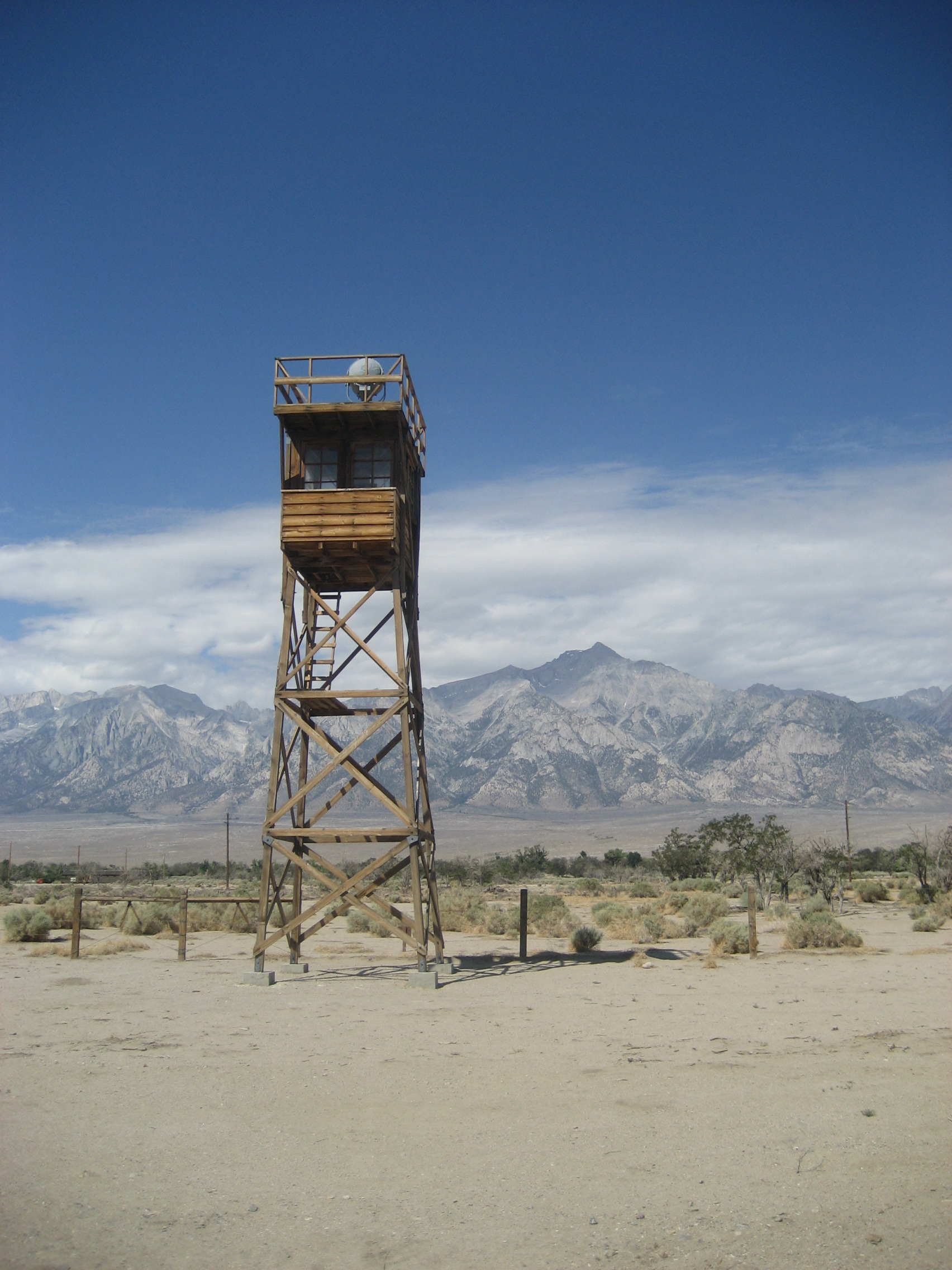
My last key destination on this road trip is a place of national shame, and of continuous soul-searching.  Fear itself drove Franklin D. Roosevelt to order the removal of Japanese-Americans from the immediate Pacific Coast and of smaller numbers of German-, Italian- and Romanian-Americans from the Atlantic and Gulf Coasts, from 1942-1945.  These American citizens were interned in what the President himself called “Concentration Camps”, though there were no pogroms planned or carried out against any of the interned.

Manzanar was the largest of the camps, with the Sierra Nevada serving as a wall between its Great Basin location and the western 2/3 of California.  People were rounded up, without explanation, by the FBI and the military, early in 1942, from places like San Diego, Long Beach, Los Angeles, San Francisco, Sacramento, Portland and Seattle, and transported in buses and trains to this desert camp, and several others, such as Poston, AZ and Tule Lake, CA.  There are two ironies here:  The camps were often close to, or on, Native American reservations, though Manzanar was not- as the reservations in this part of California are on the outskirts of small Great Basin towns.  Manzanar was a small collection of farms and ranches, such as Wilder Farm and Shepherd Ranch.  These had been abandoned, before the U.S. government took over the area.  The second irony is that, in 1944-45, internes were recruited into the U.S. military, for service in the European theatre.  Many Japanese-Americans distinguished themselves in military service, including the late Daniel Inouye, who later served several decades as a U. S. Senator from Hawaii.

The Visitor Center at Manzanar National Historical Site has elaborate displays of both the Internment Period and of the history of the region.  The other big conflict between ordinary citizens and the governments, both state and Federal, involved water rights in this region, the Owens Valley.  The City of Los Angeles has bought up the lion’s share of water rights and built a pipeline, to meet much of its water needs.  There is ongoing discussion with Owens Valley residents, from Bridgeport and Bishop, in the north, to Lone Pine and Lee Vining, in the south, about how to strike a balance with the City of Angels.

062

Here is a scale model of the Internment Camp, at its peak.063

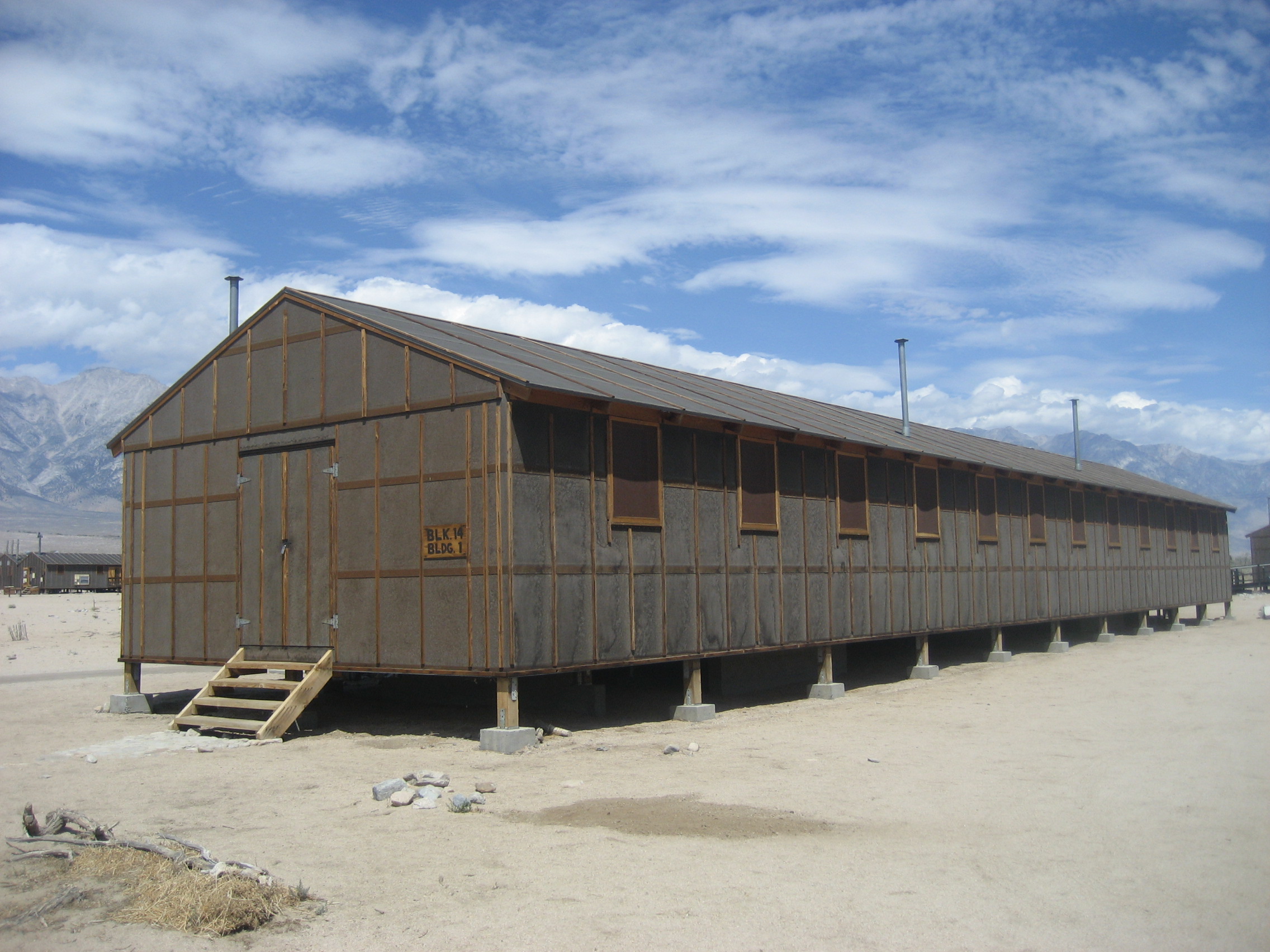
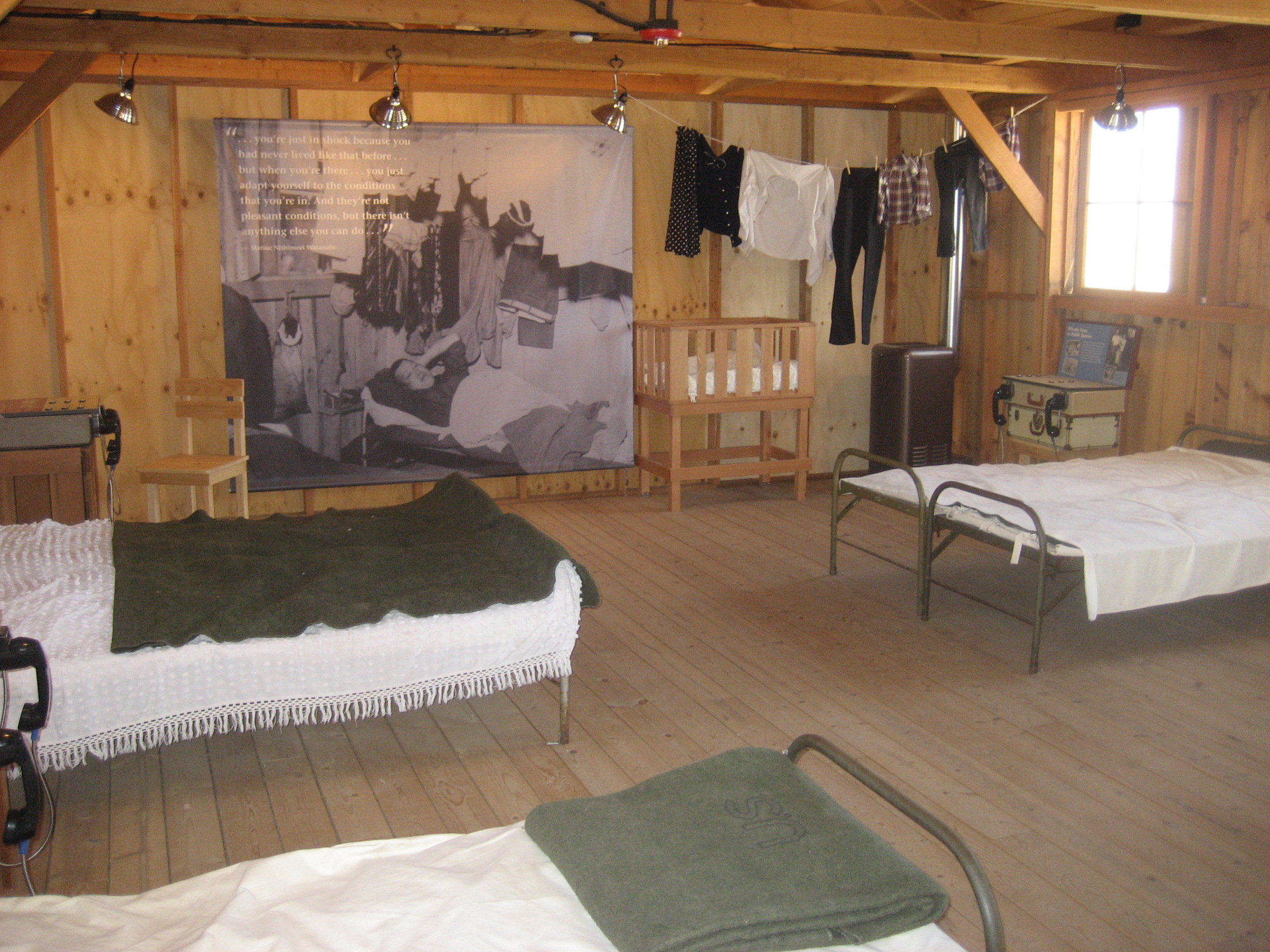
Some dormitories are maintained, by the National Park Service, to show just what living conditions were for the detainees.  Remember, in 1942, there was no air conditioning, such as we know today.

064

068

The dining halls were crowded, and there were few safeguards against infestations by vermin and scavenging insects.

078

Ruins of several areas are accessible.  Here is what’s left of the house at Shepherd Ranch.

093

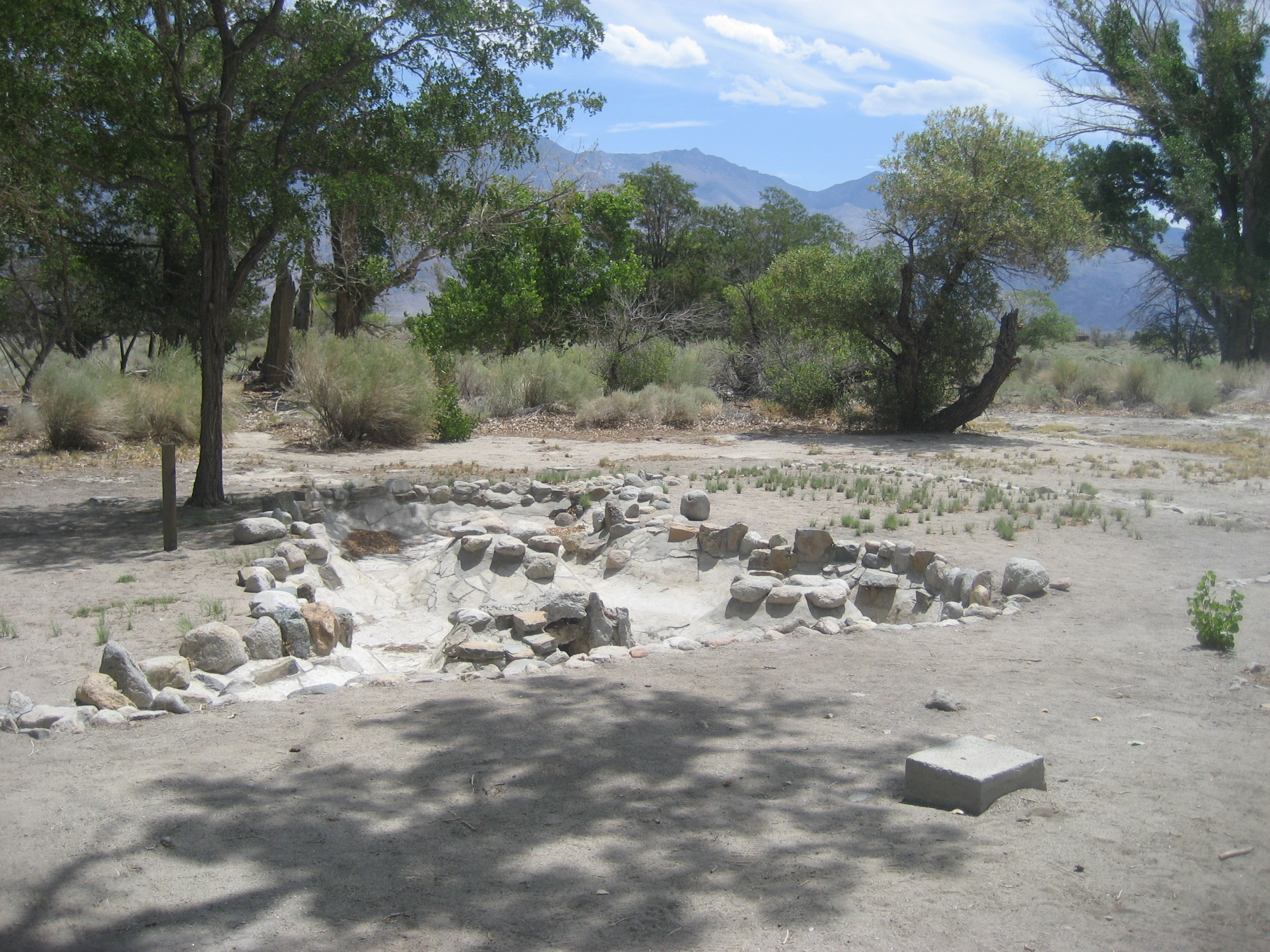
This was once a koi pond, maintained by the internes.

100

They kept up a splendid “city park”, on the north side of the camp.

103

Yes, it was called Pleasure Park.

107

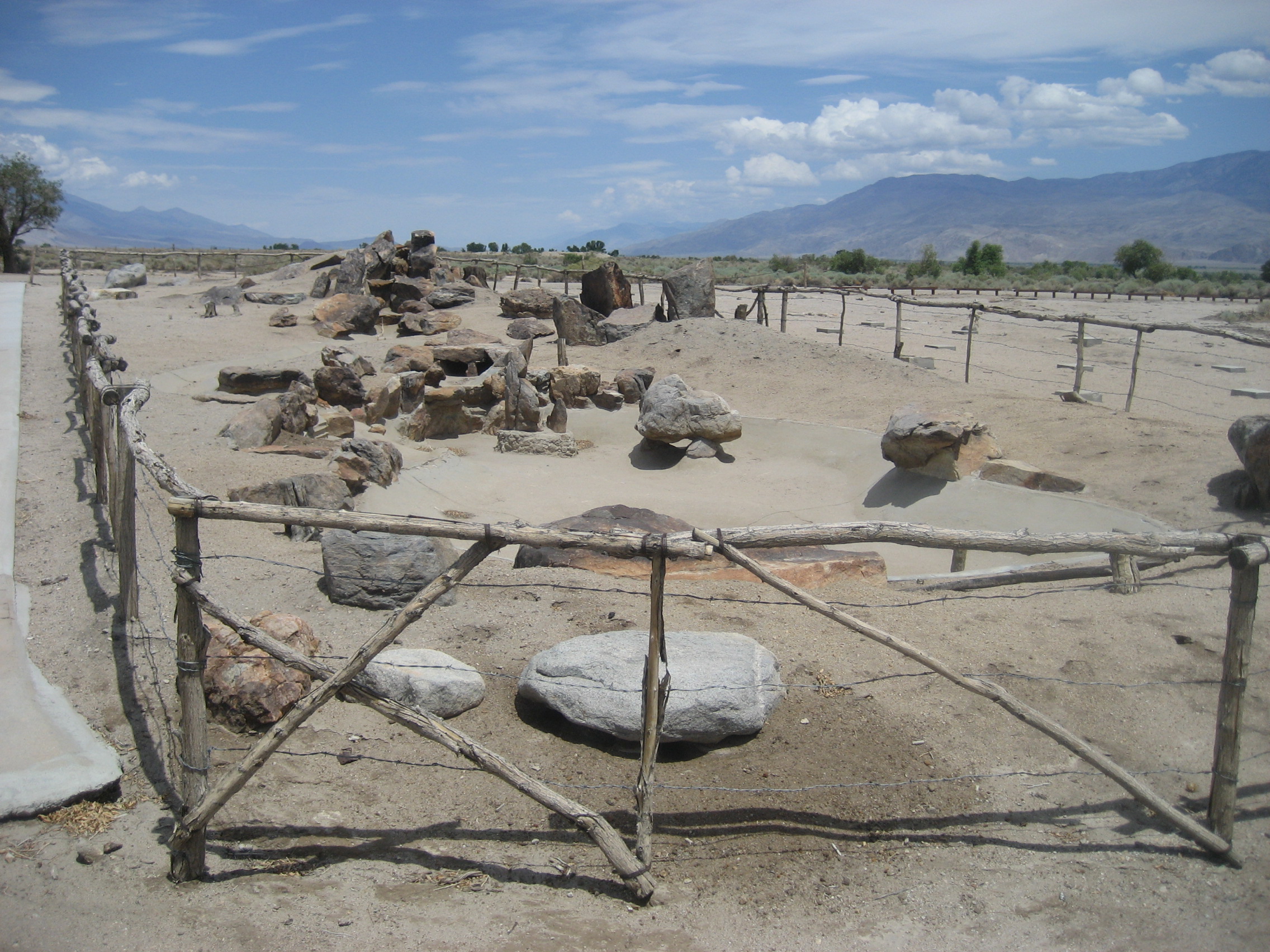
This part of the park is sealed off, to prevent injuries to the public, and defacing of sacred inscriptions.

114

These are scenes of the hospital zone.  There was a full medical facility, separate doctors’ and nurses’ facilities, and as was the wont of the internes, a garden.

119

There was also a cemetery, and this cenotaph stands today, in honour of those who died during internment.

129

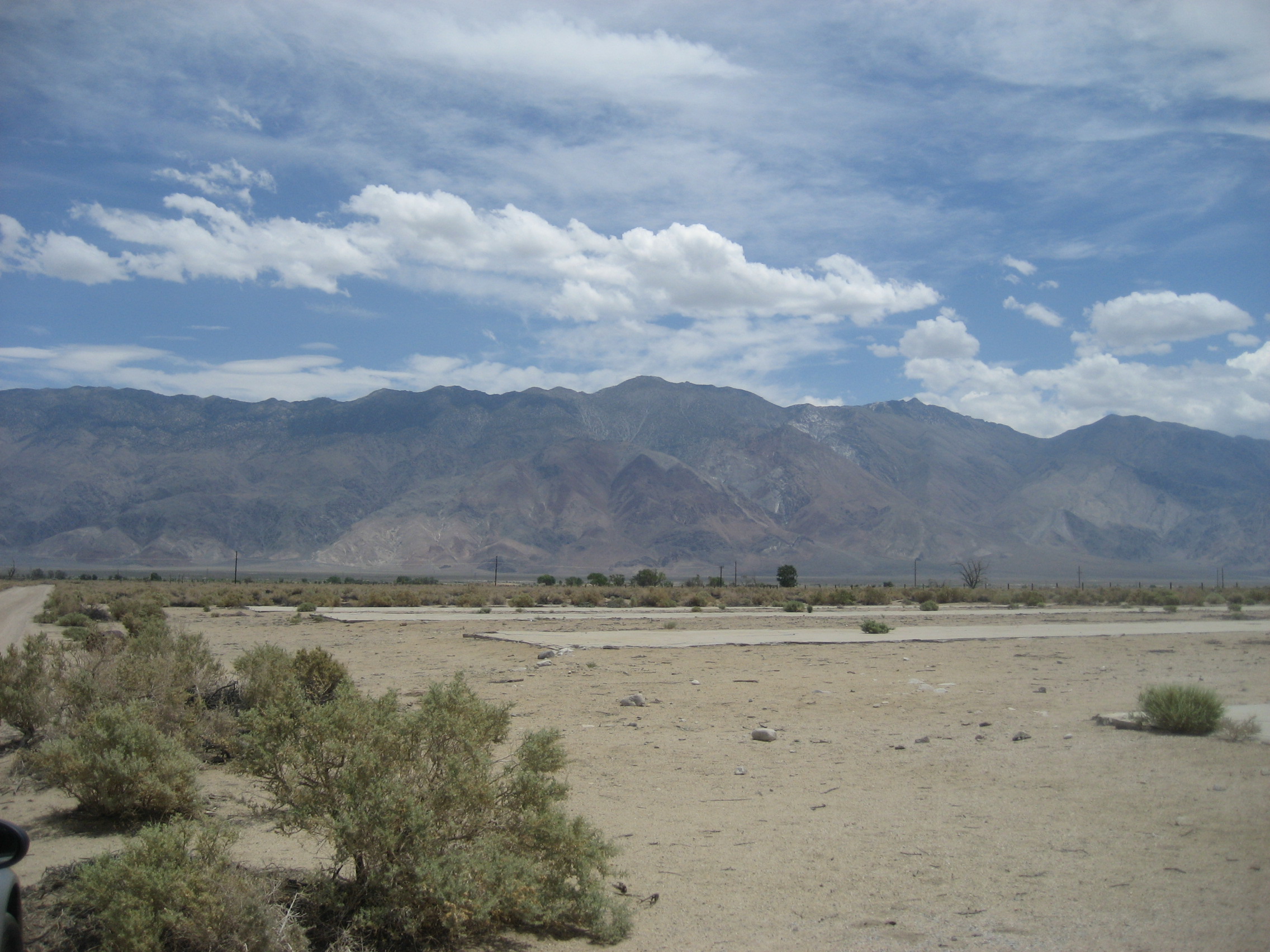
At the southeast corner of Manzanar, there is this slab, the remnant of a camouflage tent factory, where many internes worked, “for the war effort.”

136

This time in an American government internment camp was nearly as jarring, and as thought-provoking, for me, as my visit, about this time last year, to Berga, Germany, where Jewish-American and Hispanic-American POW’s were kept, in slave labour conditions, during the last months of World War II.  The difference was that the U.S. was, and is, a representative democracy, and Germany knelt to the whims of a few. The similarity:  Bigotry called the shots.

In 1988, President Ronald Reagan formally apologized to those interned, and to their families, and signed legislation which authorized $20,000 to be paid to each surviving victim.  This was the Civil Liberties Act of 1988.

I drove, purposely, with the windows rolled down and no AC, from Manzanar to Prescott.  Stopping for lunch and a copious amount of iced tea, at Totem Cafe, Lone Pine, set the stage for this.  I came in to the pleasant establishment alone, but was followed by 28 other people, within ten minutes.  The couple running the place managed to keep everyone pleased, but I had some concern fro the wife, who had to brace herself on the back cabinet and apply a wet towel to her forehead, for several minutes.

140

My heart goes out to all those who work in the hospitality industry, during these days of triple digit temperatures, in so many places, around the globe.  I also stopped at Juicy’s Famous Riverfront Cafe, Needles, for an early supper, before heading on across the Colorado and back to base.  Juicy was a stray dog, who attached herself to the fire company in Needles, and to the hearts of the entire town.  That, alone, made it worth the stop.  The service is excellent and the food fine and dandy.

I got back to Prescott at 9:40 P.M., exulting in the drizzle and cooling temperatures, no worse off, for the heat, having plied myself with lots of iced tea and cool water, along the way. Oh, yes, and plenty of sunscreen was applied.