Journey 3, Day 6: Nebraska, With and Without Trees

2

September 5, 2023, Luverne, MN- The lady from somewhere in Florida stepped out into the open air observation deck, at Golden Spike Tower, North Platte, felt the bracing Great Plains wind and rushed back inside. When I came back in, myself, she remarked that it was “a nice two seconds of fresh air- Brrr!” My mind went back to the February, 1987, ride on the Chicago El, and a stoned goofball opening the door, which got stuck until a world-weary conductor came along, giving the rest of us a true dose of “bracing”. 67 F , 40 mph winds and all, just felt refreshing, this morning.

Golden Spike Tower

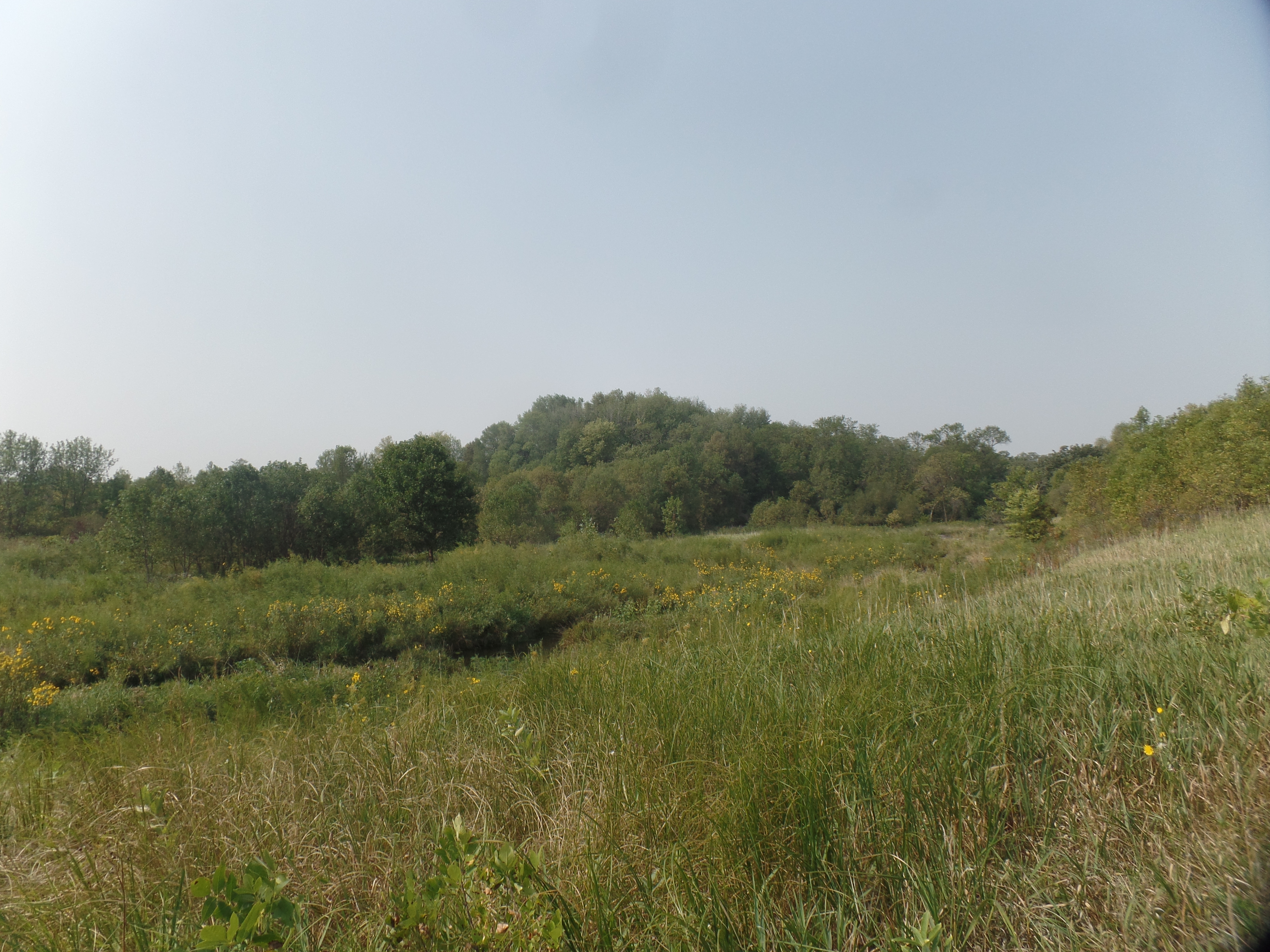
I like the Great Plains, finding more here to appreciate than many do. Then again, that may be said of anywhere I’ve been-and the Southwest does remain my Home Base of choice. Nebraska has its share of flat cornfields, which are themselves hugely important to the nation’s, and the world’s sustenance. It also has its share of forested land, including a National Forest, up near Chadron, in the northwest of the state. I did not get anywhere near there, today, but did pass a number of small forests, particularly along the Platte River, its forks and the many irrigation-focused reservoirs that dot its plain. The Platte, like its fellows to the west, is suffering. It is mostly sand bars, these days-hoping for rain.

The first part of the morning was spent in homage to all that the railroad industry has done for the good of humanity-even as we, with some degree of justification, fret about the after-effects of fossil fuel use. My take is that all this concern should propel us into a Green Economy, which it is doing-just not fast enough to suit some people. The change-over needs to be done carefully, though, lest those whose interests lie in the old energy format convince the masses of people to resist what is, in the long run, best for the planet and for all living things within its gravitational pull.

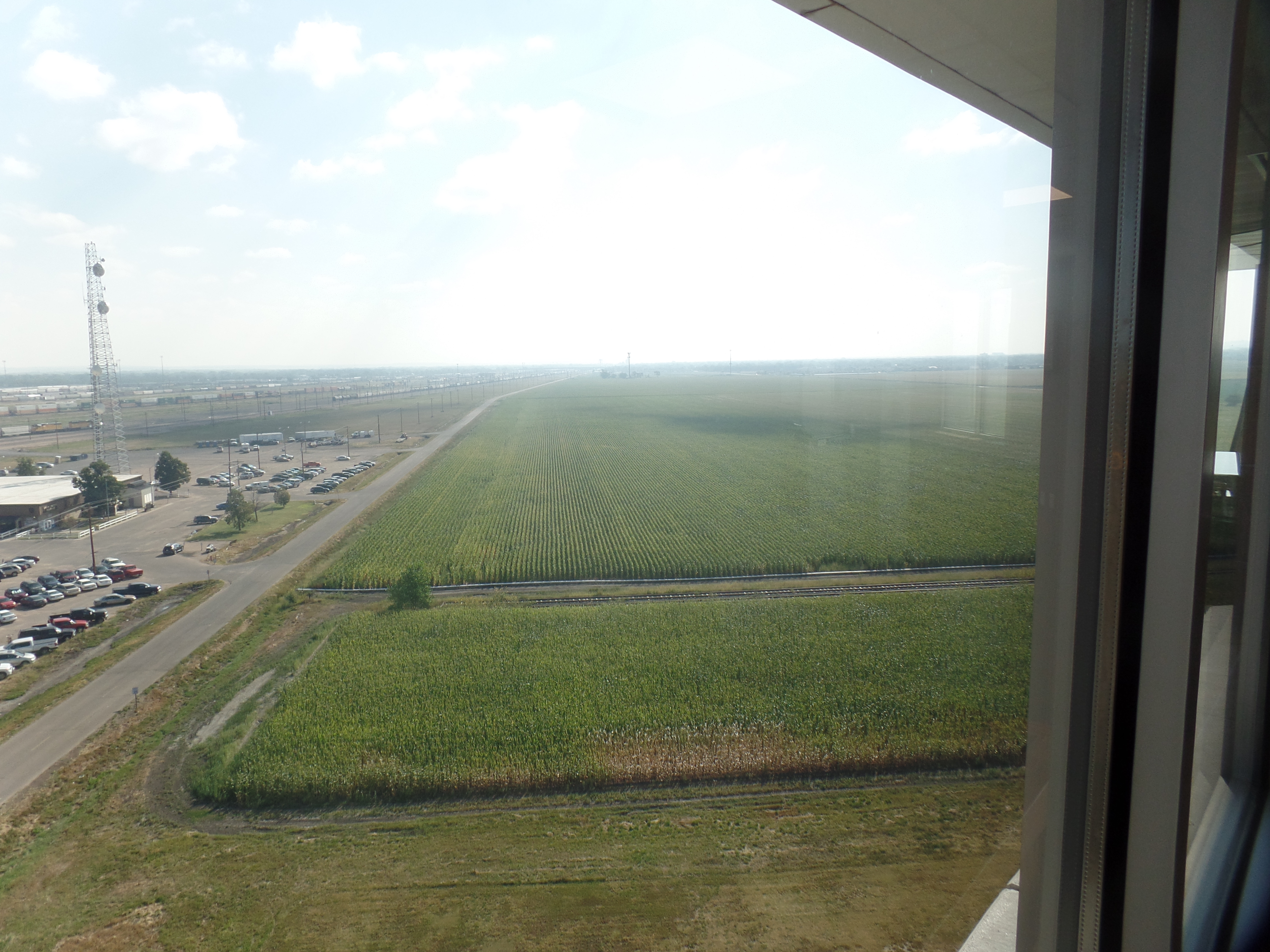
Corn fields abut the Bailey Yard, home to Golden Spike Tower. The Bailey is the largest Classification Rail Yard in the world, being 8 miles long and occupying 2,850 acres. Union Pacific trains, centered here, transport goods, and more than a few crafty travelers, to 23 states. As the name, Golden Spike, implies, it was on a Union Pacific track, in Promontory, Utah, where the spike that brought the country’s rail system to completion was driven into the ground. This tower, at this yard, underscores that feat.

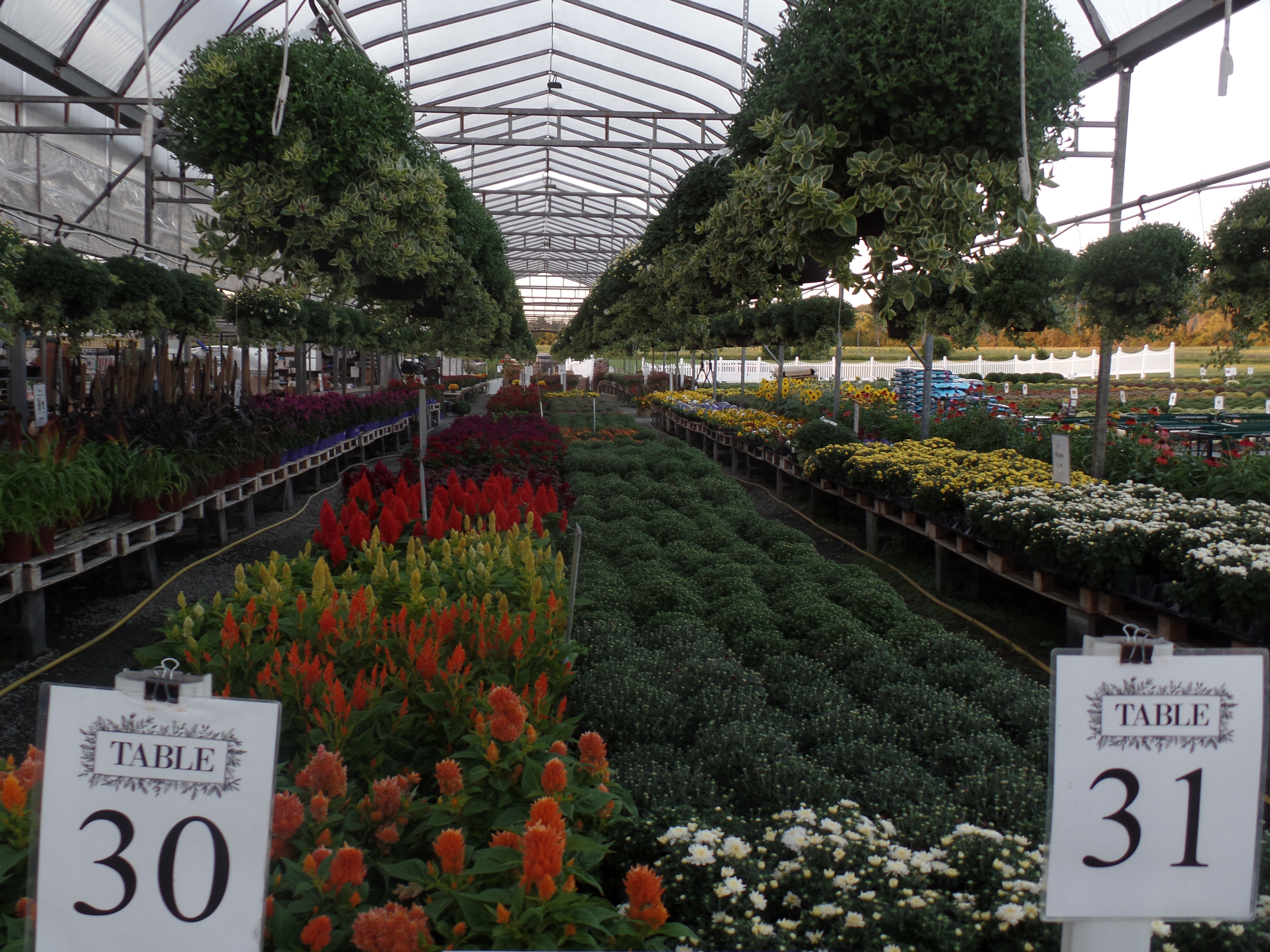
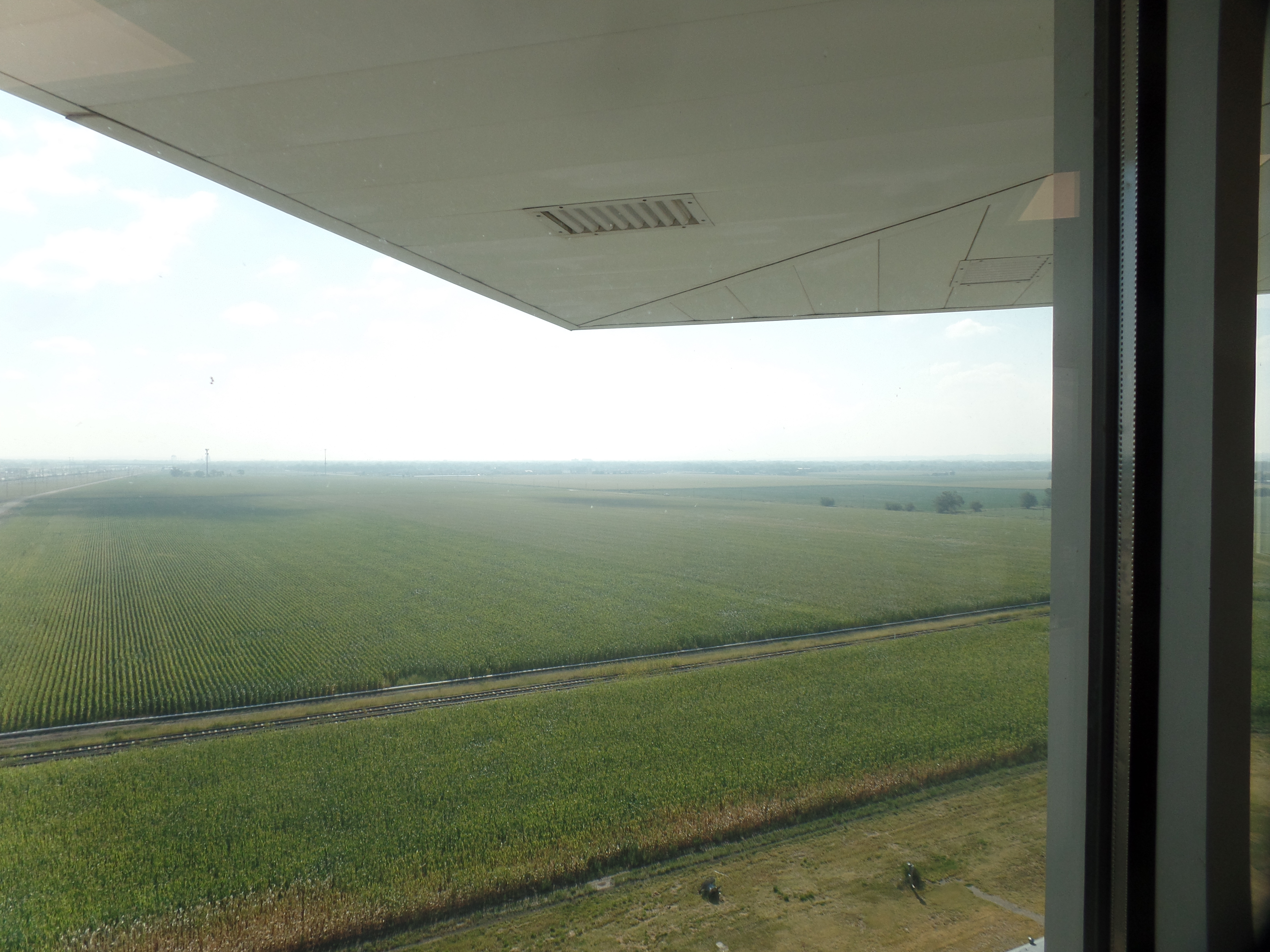
Union Pacific’s leased cornfield, at Bailey Yard, North Platte (above and below)

There has been more care taken to let tired land lie fallow or be protected by cover crops, in the past five or six years. People are learning, from the excesses of the Monoculture Boom of the last two decades.

A field at rest, on the northwest side of Bailey Yard.

One more fact about Bailey Yard: In 1941,in the aftermath of Pearl Harbor, a young North Platte woman named Rae Wilson recalled that the grandmothers of her town had operated a canteen for servicemen, during World War I. She wanted to do the same in her time, and approached Bill Jeffers, the President of Union Pacific, and a North Platte native, for permission to use a vacant room in his company’s North Platte terminal. He gladly offered the space, free of charge, with the caveat that the community provide all that was needed-food, drink and furniture. He knew that North Platte, and the surrounding area, would rise to the occasion. That, the community did, in spades. Beginning with a company of Kansas National Guardsmen, on Christmas Eve, 1941, thousands of troops passing through North Platte were fed and shown a warm welcome by the community-with plenty of support from communities across Nebraska, northern Kansas and northeastern Colorado. Remember, this was before there many processed foods, before microwave ovens; everything was made from scratch. The effort continued until 1946. The passenger terminal was torn down in 1973, so Bailey Yard maintains a replica of the canteen and offers a video account of the efforts.

I continued on, after viewing the video, stopping for lunch in the town of Gothenburg, an hour east of North Platte. Here, at Deb’s Diner/Nana’s Country Kitchen, I struck up a conversation with two local gentlemen, over lunch. One of the men had been in Colorado Springs, as I had, this past weekend. He told of taking a cabin at a large facility on the northwest side of town, and of his hapless wife getting into bed-and being stung by a bee, that had been trapped between the sheets! Good thing she wasn’t allergic-and there was plenty of mud outside, as it rained almost incessantly, on that side of town. (Mud, for those too young to remember, was the farmer’s medicine for insect stings. I’ve used it quite a few times, though I am no farmer.)

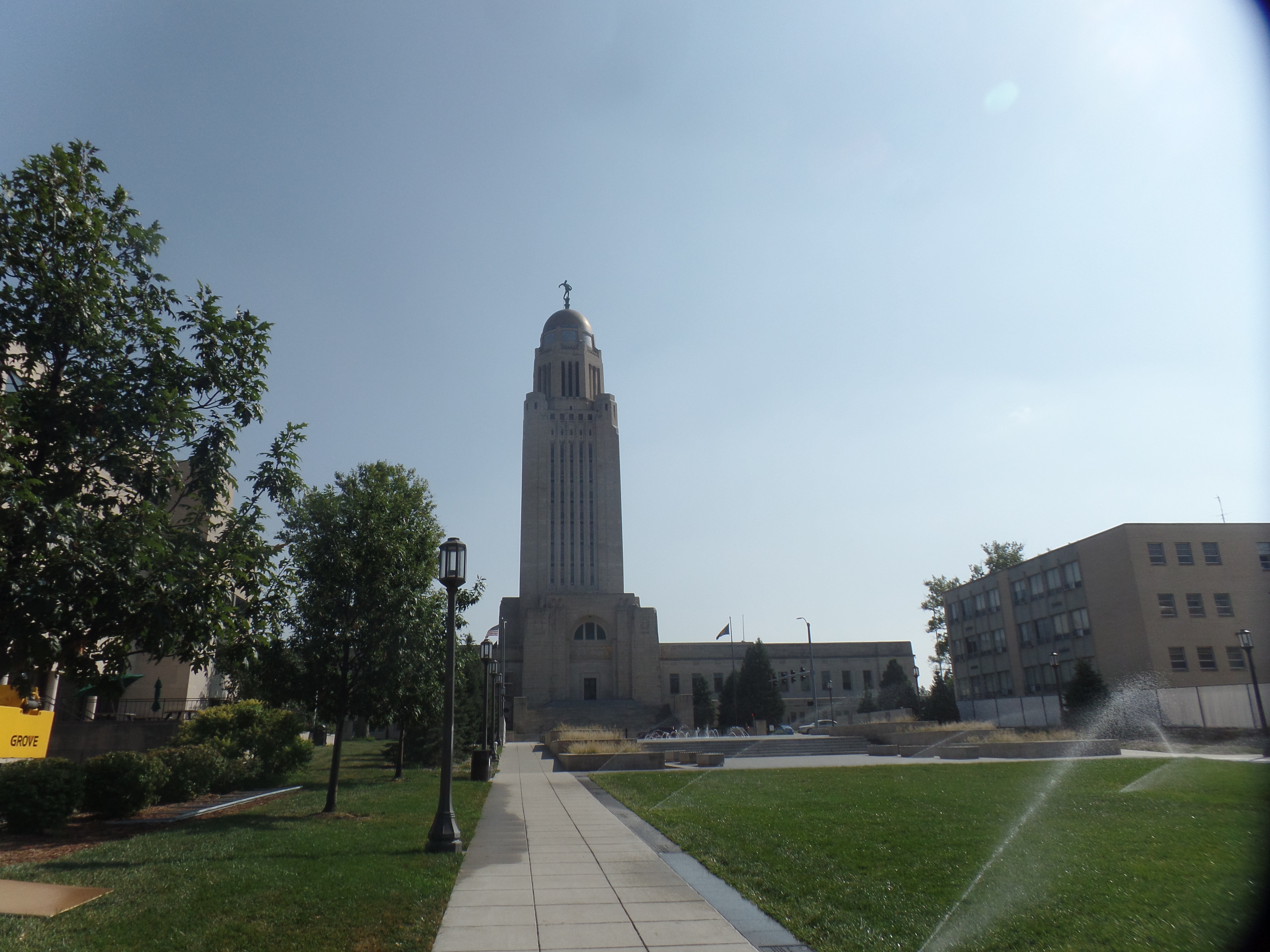
The capital of the Cornhusker State, Lincoln, is a medium-sized city, about an hour west of Omaha, which is somewhat larger. I stopped by the state capitol, for a short circumambulation. The edifice is in the shape of a skyscraper, though its base has expanded, as state government has grown over the decades.

Nebraska State Capitol, Lincoln
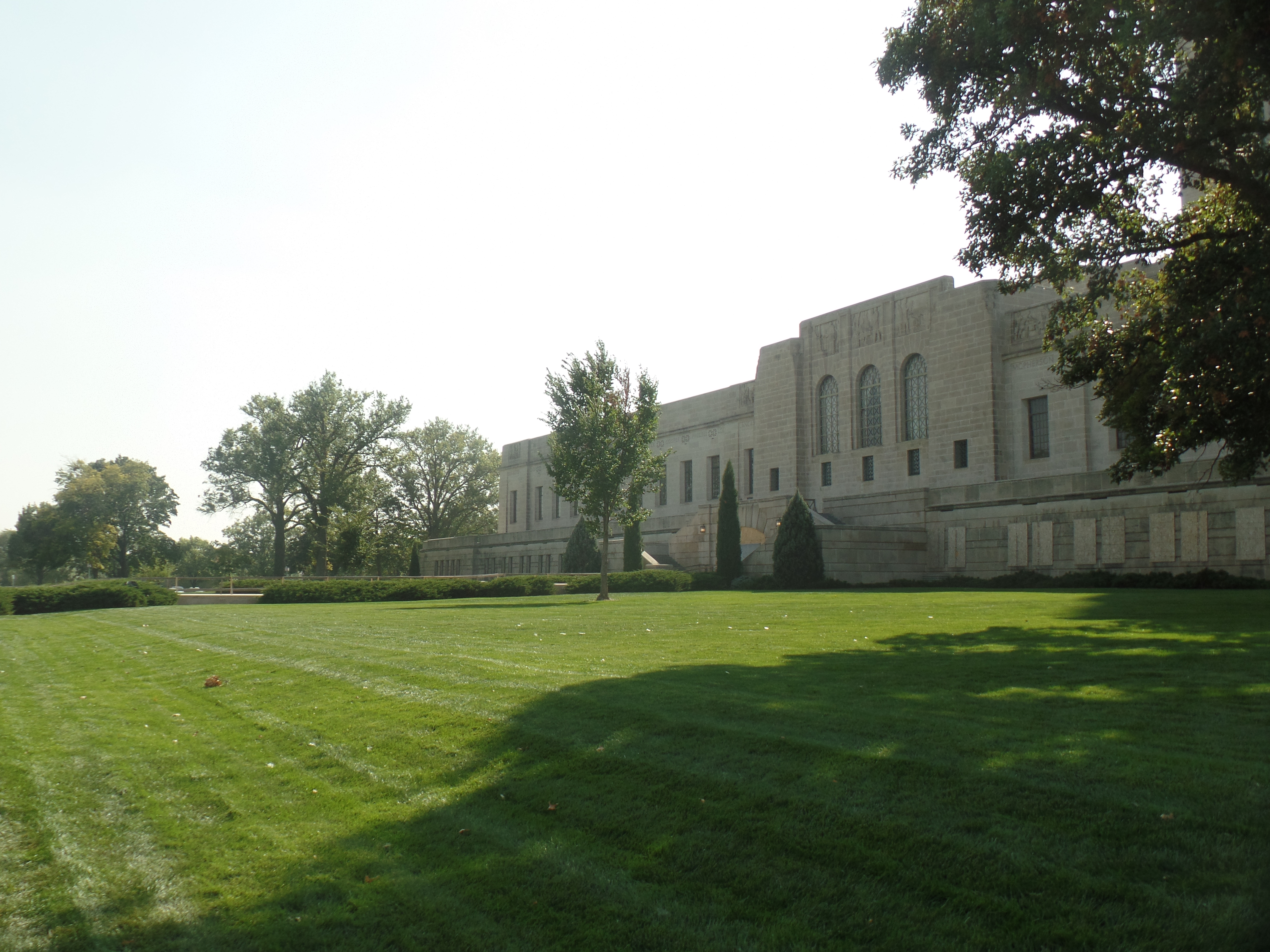
Base of Nebraska State Capitol, spreading southward.
View of Nebraska State Capitol, from the east.
The capital city’s namesake.

The day was fading, though I had plenty of energy left, so I wended the way north, past Fremont, Winnebago, Sioux City and the southeastern sliver of South Dakota, to the small quarry town of Luverne. Tomorrow, I might hike a bit at Blue Earth State Park, and pay respects to the victims of the Mankato massacre, before heading to Mendota Heights, and laying a wreath at the grave of a police officer, who was the work partner of an extended family member, and who was killed in the line of duty, nine years ago. I became aware of his murder,whilst paying similar respects to George Floyd, in 2021. It is past time, but murder is murder-and Officer Scott Patrick deserves to be remembered for his service and his life, every bit as much as any other victim of our national intemperance.

What’s The Point?

2

August 22, 2023- The robust cat sat in my carport, right by the hatchback, and looked at me, as if tho say: “Have you thought this through? Are you sure you want to go up to the South Rim?” It was raining lightly, which was one reason why the cat was sitting in that dry spot. I had, however, looked at the weather forecast for Grand Canyon, and saw PC (partly cloudy).

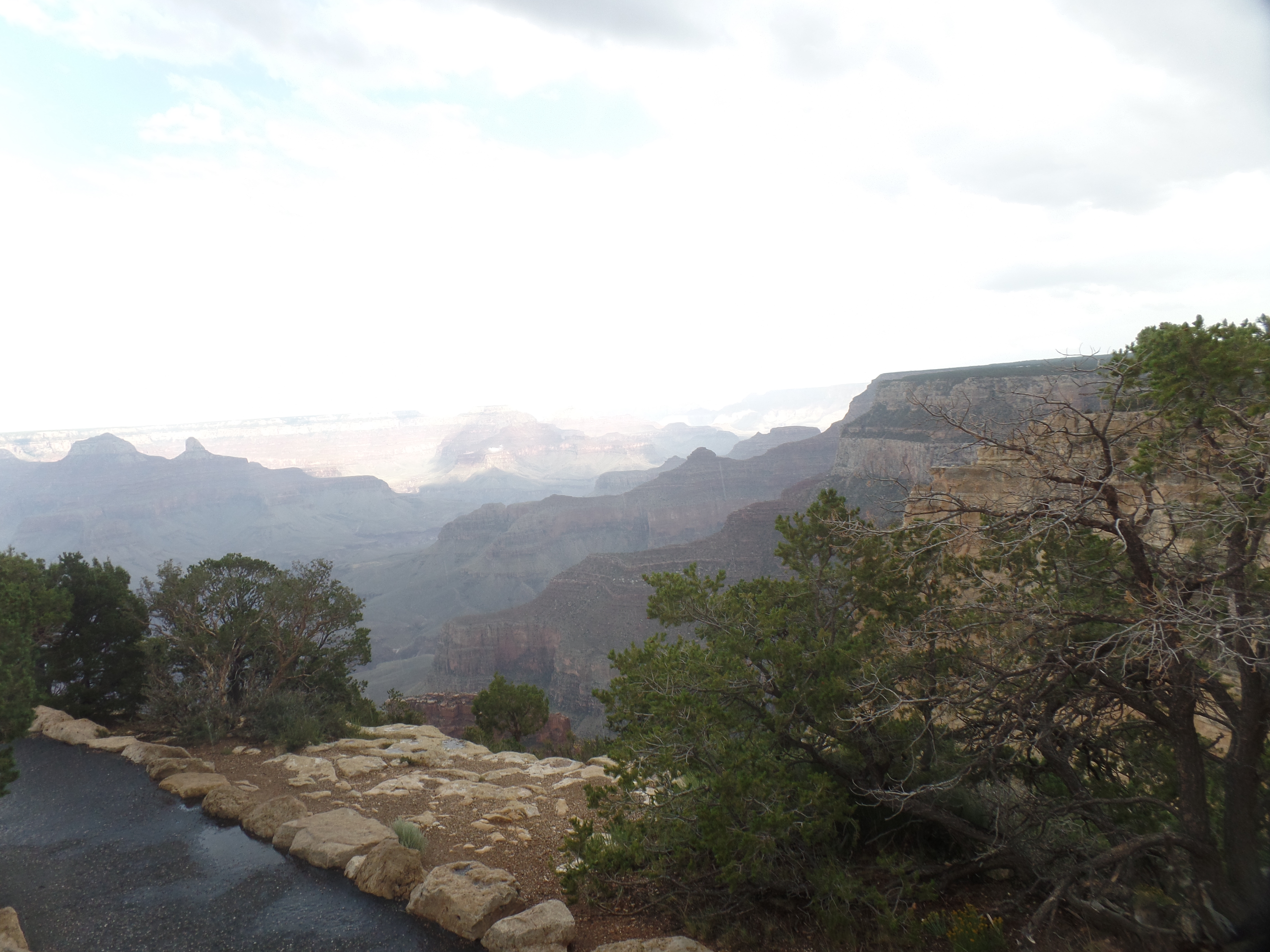
So, northward I went. Stopping at my Williams favourite, Brewed Awakenings, I fueled up with a Light Wrap and coffee, then headed up to the Park, an hour away from downtown Williams. The first hour or so of my shuttle bus ride/walk was quite pleasant. I took these shots of the Bright Angel Trail, from Trailview Point, just to the west of the Bright Angel.

Bright Angel Trail, seen from the west.
More of the Bright Angel Trail, from the west.
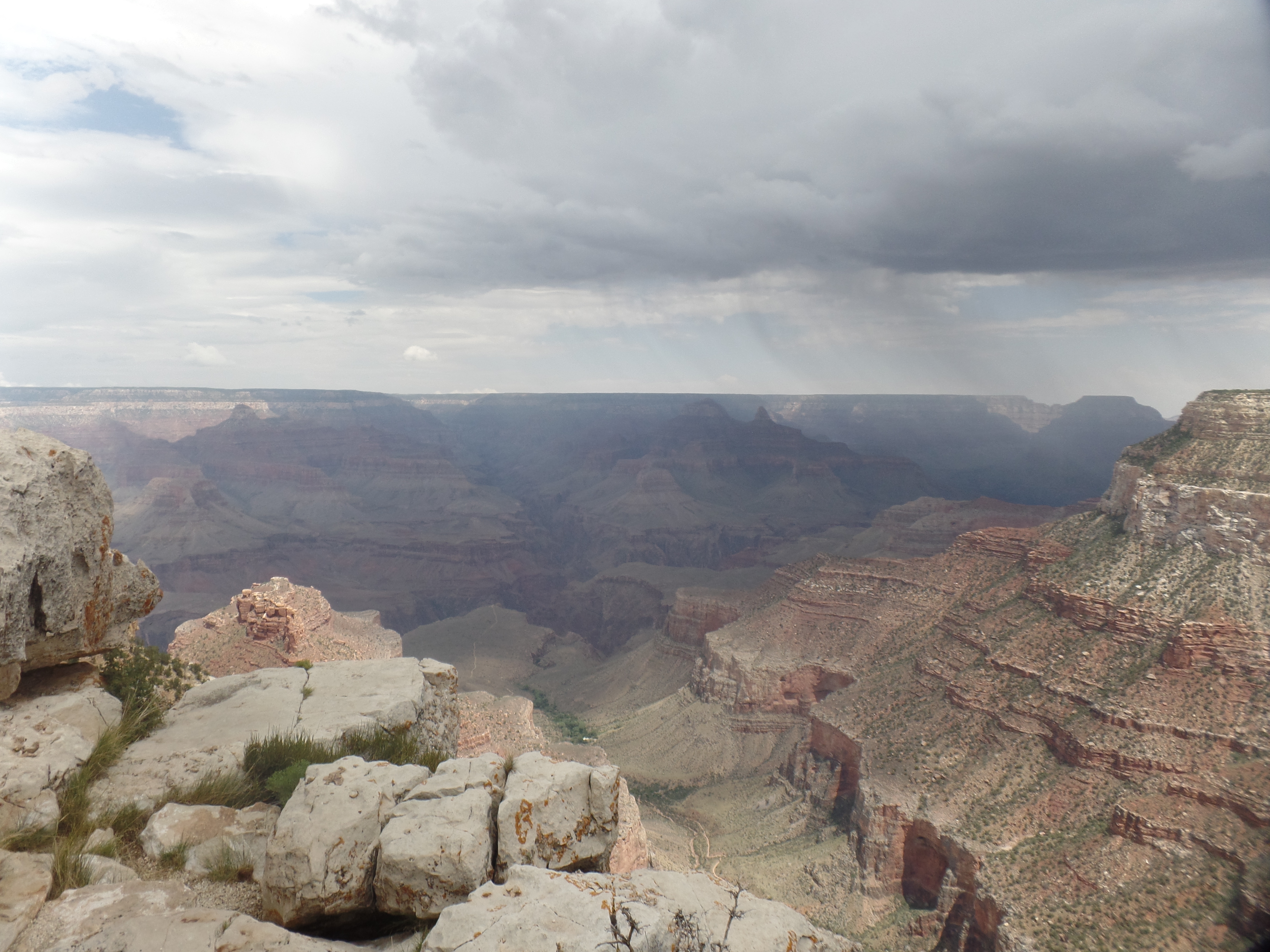
Approaching rain, from Trailview Point

I got back on the shuttle bus and headed to Hopi Point, from where I planned to walk back towards the JW Powell Memorial and Maricopa Point. I got in these shots at Hopi.

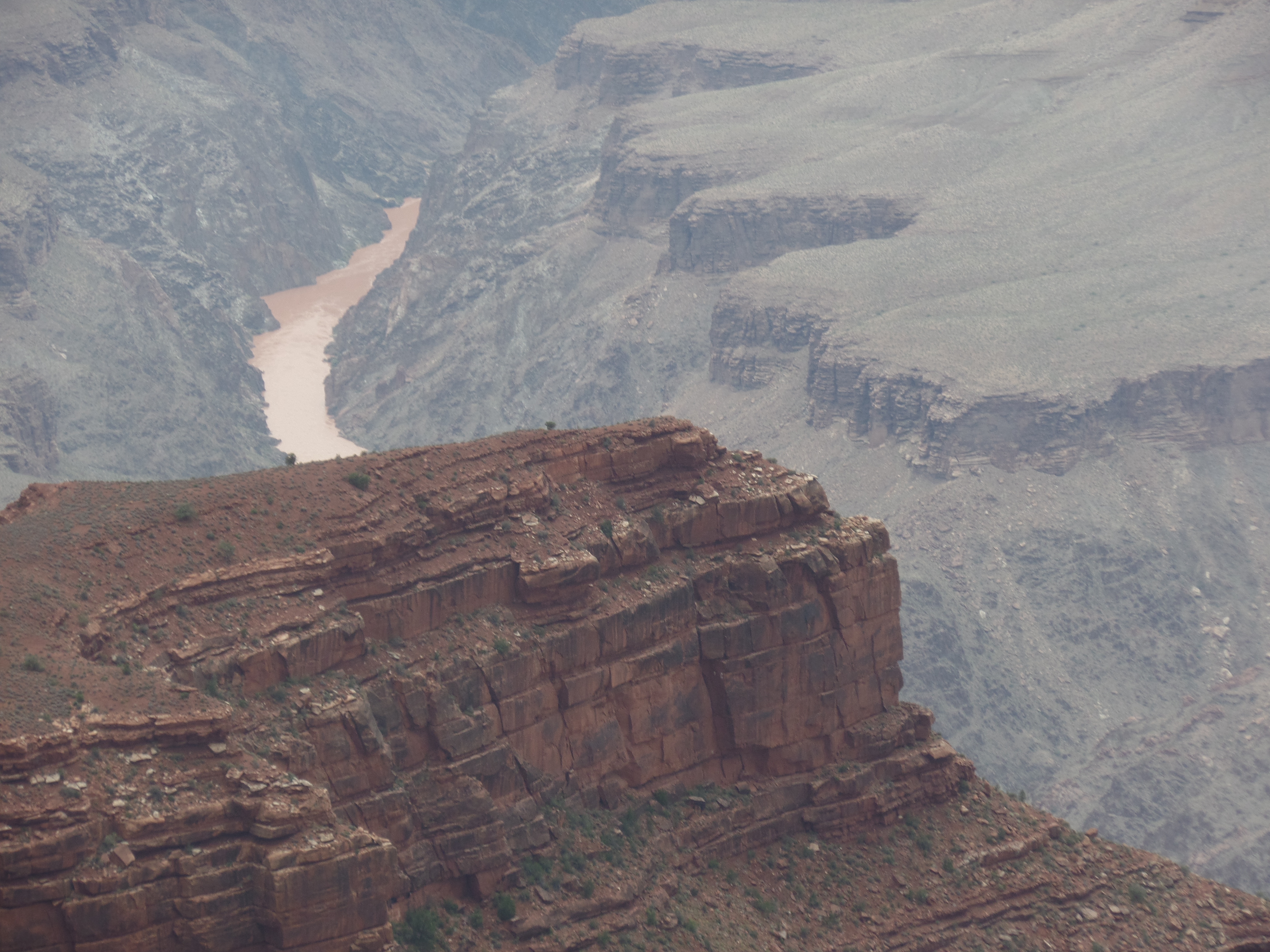
Hopi Point and the Colorado River below.
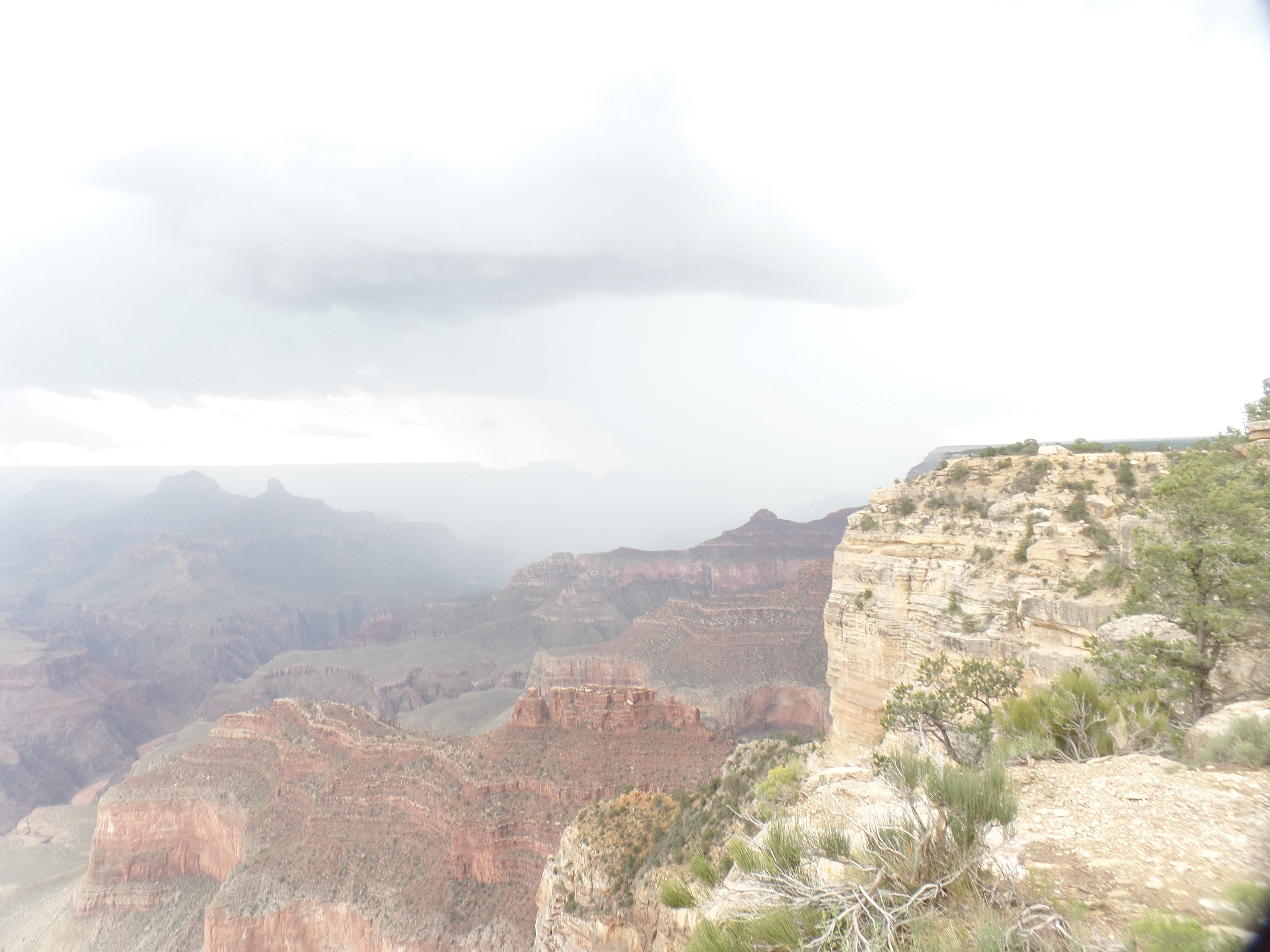
Approaching storm, from Hopi Point

I walked the short distance from Hopi Point to the Powell Memorial. It was then that lightning flashed in the east, a bus driver told me that we would all be evacuated from the Hermit Sector (the near west segment of the Rim Trail, which I had planned to explore in its entirety) and I found a spot to wait for an empty bus, as his was full. In about ten minutes, one arrived and took a bunch of us back to the transfer station. I went into Bright Angel Lodge and had a leisurely lunch, then returned to the transfer point and waited with about sixty other people, for the lightning danger to abate.

After about forty minutes, the storm was judged to have let up, and we went back towards Hermits Rest. I got off at Maricopa Point, walking about 200 yards, to these scenes.

Trailview Point, from Maricopa Point
Colorado River, from Maricopa Point
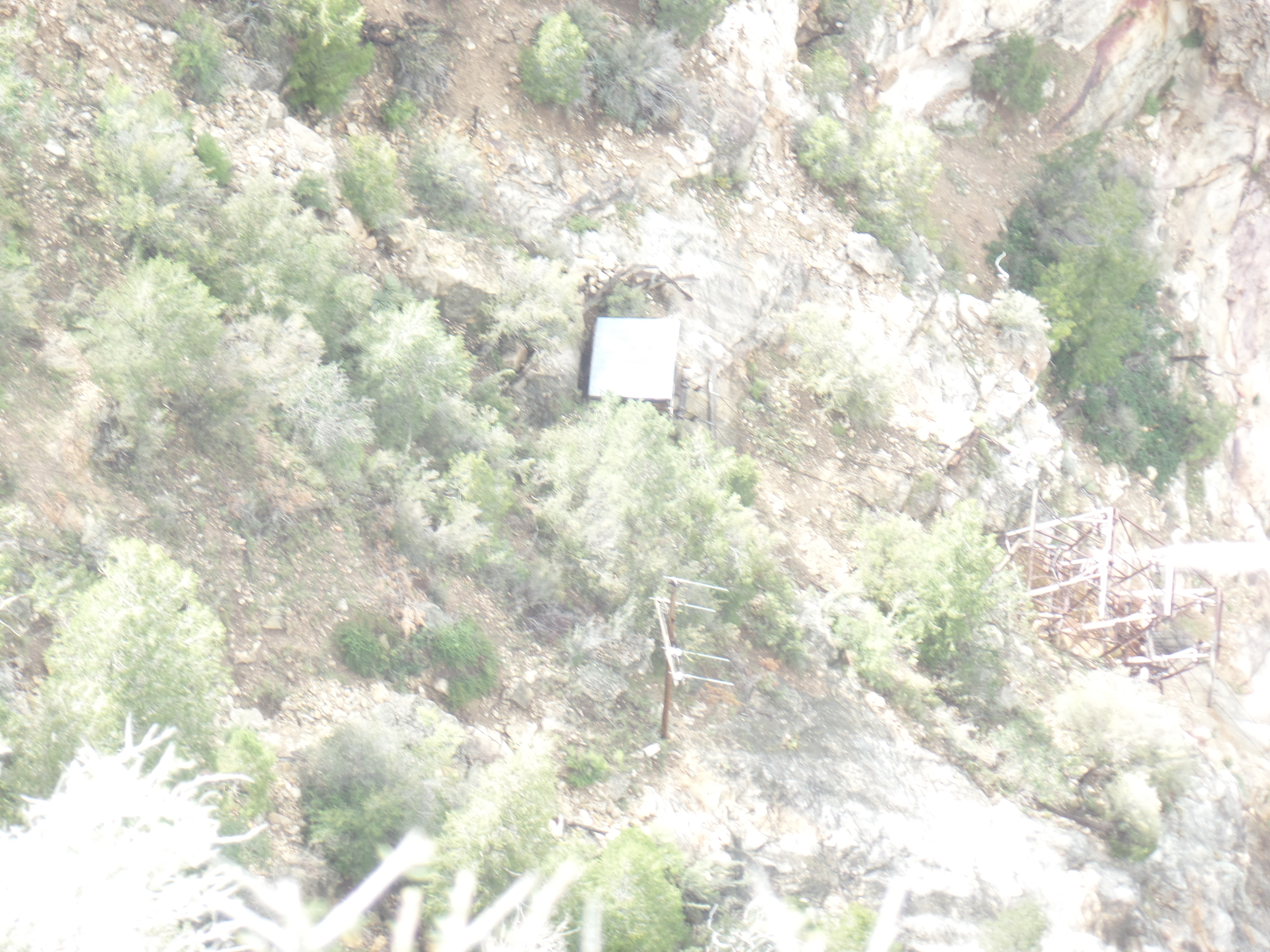
The defunct Orphan Mine (copper and uranium) was just below Maricopa Point. It is marked by this memorial.

As it was still not raining again, yet, I walked the .9 miles from Maricopa to Powell Memorial.

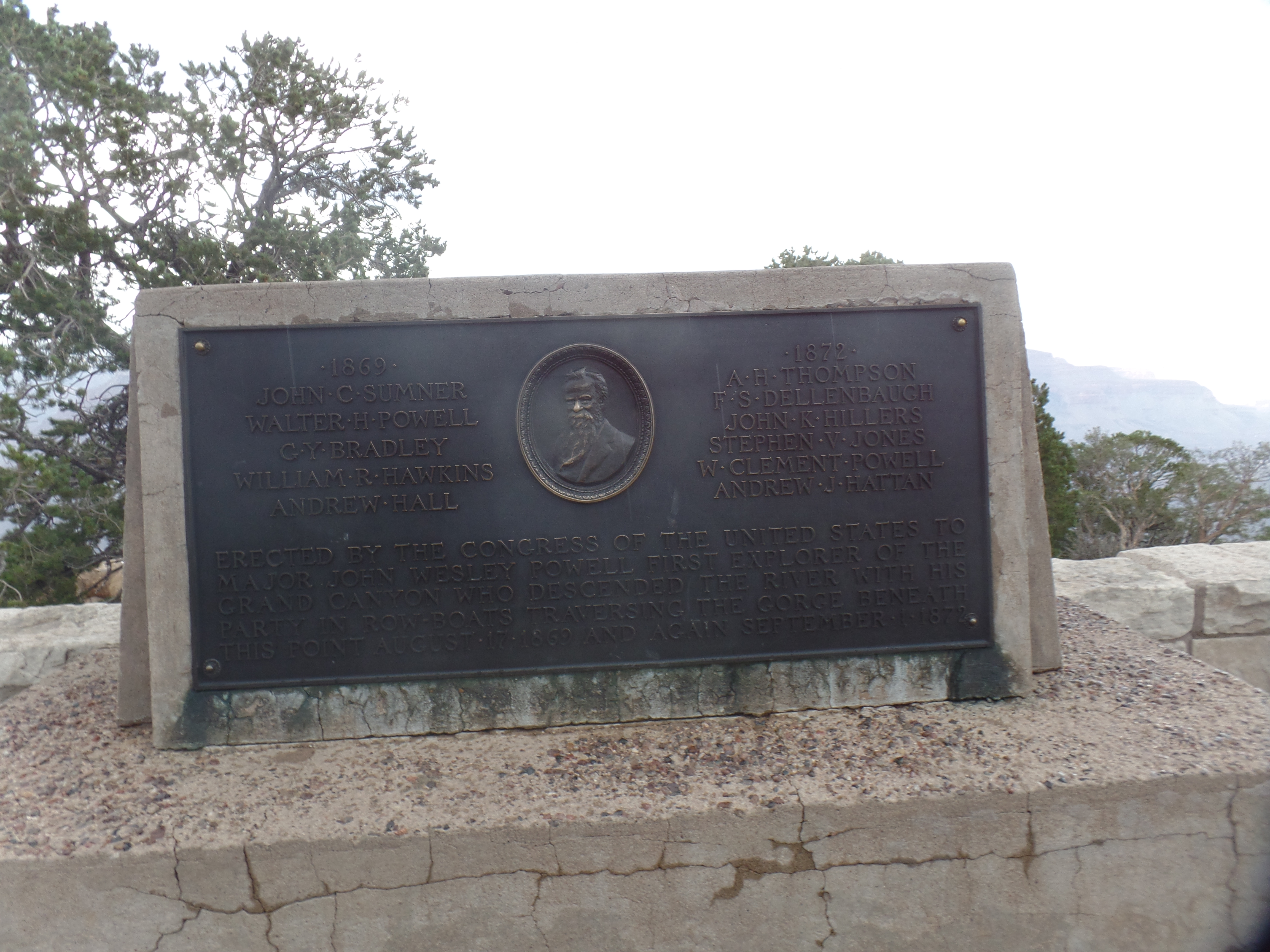
Plaque memorializing John Wesley Powell, first American navigator of the Colorado River, in the Grand Canyon.
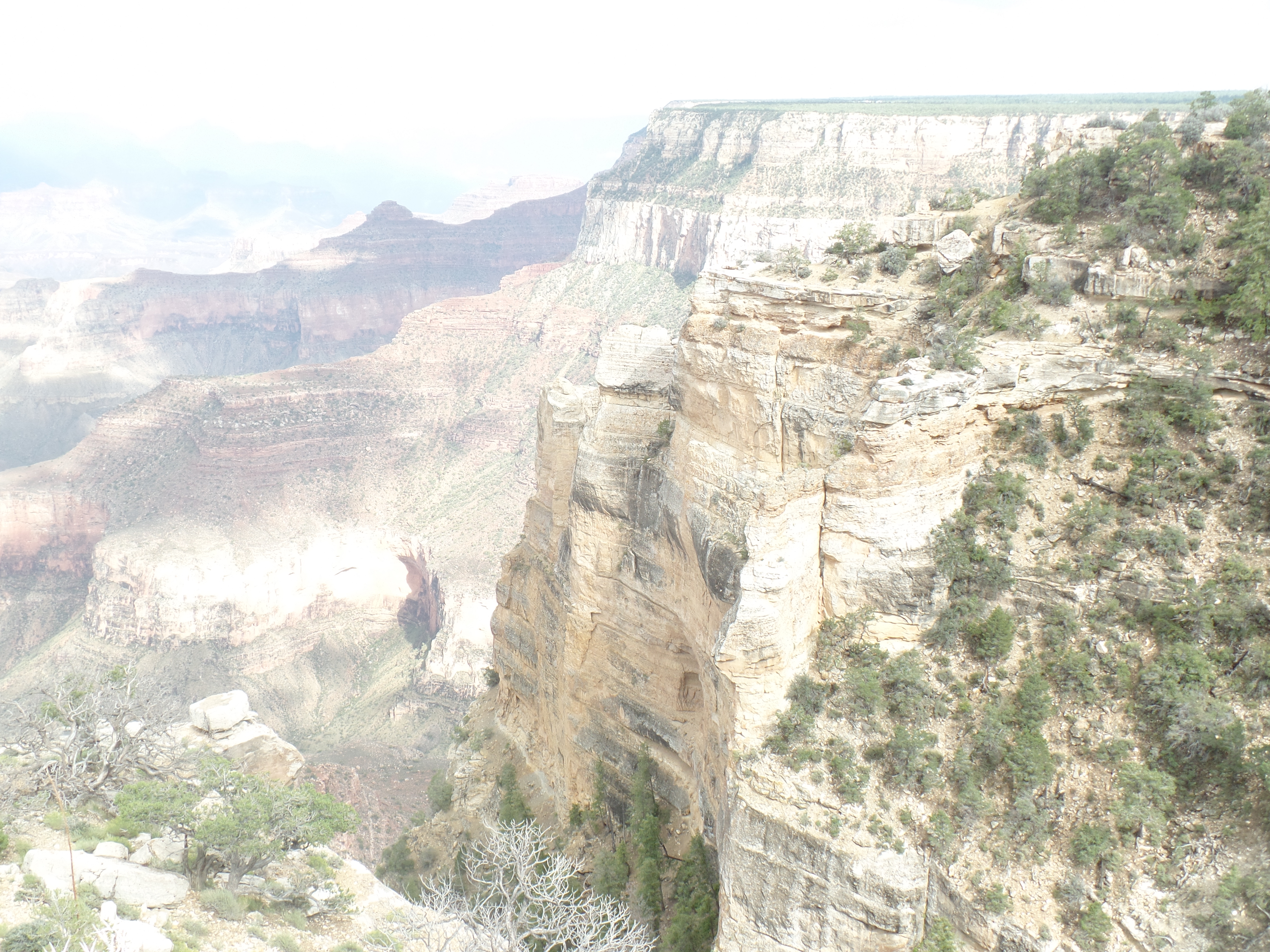
View of canyon, from Powell Point

Once I got this shot off, the rain began to return, and we were evacuated a second time. I commiserated with the shuttle driver, as it must be quite frustrating to have to repeat an evacuation, only an hour after the first one was lifted. Needless to say, it was time to head for the car and towards home base.

There was a slight hitch in that, as well. The road back to Williams goes through Tusayan, and that little tourist village was flooded. The county sheriff had a road block up, which put those staying in Tusayan, Valle or Williams-or who were scheduled to fly out of Grand Canyon Airport, in a bit of a pickle. For me, it meant driving back by way of Cameron and Flagstaff, which I did. On the way to Cameron, I saw one thing we on the Hermit Sector missed: A huge pile of hail had remnants at roadside, from Mather Point, east to Desert View.

Let it not be said that this year’s monsoon was a total bust.

Four Farms, Four Approaches

4

August 20, 2023- “This year has been a doozie.”, the young farmer deadpanned, as she and her husband welcomed our tour group, from Slow Food Prescott.

It certainly seems so, given the cold month of June, followed by a blistering July and first half of August. Each of the farms we visited today experienced the June frost and hail storm in a slightly different way, and each is operated differently, while all use environmentally safe practices.

Vang Farm- This one acre property, at the southern edge of Chino Valley, is in a gated community-one of the few agriculturally-oriented Home Owners’ Associations in our area. Chris and Elaine Vang have, as you might imagine, put every square foot of this property to good use-even the “fallow” section is used for storage. They produce grapes, figs, squash, cilantro, corn, tomatoes, carrots, apples and peaches. Chickens, Muscovy ducks and Mini-Nubian goats keep them company-and well-fed. A large dog, who looked like a Mastiff/ Rottweiler mix, was on hand, when we first arrived, to let us know that we were to wait for Chris and Elaine to come outside. Once we got started, the animals were uniformly happy to have company-as were their humans. The Vangs are full-on into composting, and showed us a small urn that had decaying substance inside. Fortunately, lunch was at least an hour away, after our second stop! Elaine has a Facebook group, called Let’s Grow Together! Any sincere gardener, farmer or aspirant can check out this group. The Vangs also have space for small outdoor weddings and have made the property very welcoming, with benches in various spots and an arbor, near the goat pen.

Beverly Farm- Our tour director, Molly Beverly and her husband, Gary, have a much larger property, on the northeast side of Chino. They’ve been here for nearly five decades and have been forces for sustainability, spearheading Slow Food Prescott (Molly) and Friends of the Verde River (Gary). I first met them at Gary’s computer repair shop, Argosy West, in the early 1990s. When I came up to Prescott, to live, in 2011, Molly’s initial efforts at a Slow Food chapter in Prescott were one of the first community service organizations to draw me in.

I’ve visited this farm several times, usually under the auspices of a Slow Food activity. Today, we saw three varieties of corn: A tall field corn from “the Midwest”, and two varieties from Peru-which were brought in as food corn, and produce nutty, very edible kernels. All are sure to be tasty. There are also figs, apples, peaches, grapes, blackberries, strawberries, tomatoes, foot-long beans (green beans) and potatoes.

After the tour, we enjoyed lunch, with fresh tomatoes, corn and a brick of fresh cheddar/Triscuits to add to our own brown bag items. Not on the menu- grasshoppers, though these were everywhere-at each farm, and have been the most avid “fans” of the farmers efforts. Gary and Molly are making use of some mechanization, in addition to heavy composting, a tack which suits a medium-sized, or larger, operation. They also have a concrete and black plastic lined pond, which has doubled as a swimming site. Their home, which has benefited from Gary’s considerable building skills, is a modified Spanish adobe edifice, with the courtyard around the periphery of the house, rather than the other way around.

Whipstone Farm- Shanti and Cory Rade both entered farming as adults, being drawn by their love of soil and of providing nutrition on an ever-larger scale. Whipstone started small, and has gradually grown to two properties, some four miles apart, in somewhat different areas of Paulden, a vast community eight miles north of Chino Valley. Where Chino sits in an area that was once a lake, Paulden is a series of mountain dales, with forest interspersed by short-grass prairie.

The Rades have become a major presence in the farm community-growing several varieties of flowers, which Shanti offers to selected shops around the Prescott area, as well as event venues There are a full range of fruits and vegetables on offer-green leafy vegetables (Kale, Lettuce, Spinach, Arugula) are plentiful,as are-to the extent the insect foragers allow- apples, plums, peaches, pears, grapes and strawberries. There is field corn produced here and a variety of herbs, especially basil, as well as lots of tomatoes and carrots Garlic is one of Whipstone’s signature crops, as is butternut squash.

Given Whipstone’s scale of operation, a fair amount of mechanization is needed, though the farm’s crew is of a size that allows economical hand-picking and minimal tilling. “Organic” spraying is used on a very limited scale. One of the Rades’ biggest concerns is the effect of any chemicals, even “safe” varieties, on the health of the crew members.

After a brief visit to the “honour system” Farmstand, we thanked Cory and Shanti, then headed to Schaffer Farm. Joseph and Shaunte’ have the honour of farming in one of the coldest and windiest spots in Paulden- and are doing a masterful job. Despite bearing the brunt of this “doozie” of a year, this handsome and diligent couple, and their five children, are producing tomatoes, salad greens (lettuce, arugula, spinach, kale, mizuma and basil), strawberries and blackberries, corn, several varieties of beans, wheat and zucchini. This is all done on 1/4 acre of land, with the rest as living space-for the seven Schaffers, for their peacocks and chickens, and for three kinds of ground-nesting bees, which make use of the short-grass prairie buffer that Joseph set aside between the farm fields and the BNSF rail tracks to the south of the property. The family has some fruit trees, with the most prominent being an apple tree hedge, serving as a windbreak. This is crucial, given that this area , just south of Feather Mountain, is one of the windiest sections of Paulden.

Joseph, Shaunte’ and (sometimes) their three oldest children are the crew, not using machinery, producing organically and by no-till, an at times limited, but always high quality variety of produce. Like each of their fellows, they have plant houses. Their two are of the cold frame variety, whereas those used at the other three farms are greenhouses. For an explanation of the similarities and differences between the two, see: https://www.garden-products.co.uk/news/growhouses-and-mini-greenhouses/cold-frame-vs-greenhouses/

This will not be my last visit to these four establishments-and on the next scheduled visit, (visits to working farms should always be scheduled well in advance), I will bring a notebook and channel my inner Least Heat Moon.

An Untiring Servant

2

July 30, 2023- A small group of organic farmers and food security activists gathered, among the young families, street musicians and urban campers, for the purpose of honouring a man who has spent much of his time here ensuring that food security is real in this community and that the unhoused, as well as those sheltering because of abuse and neglect, get access to their daily nutritional needs.

John A. and his wife are moving to a homestead, in eastern Tennessee. There, they will have a good opportunity to continue what they have done here. A Slow Food chapter thrives in that area, as ours does here. There is substantial interest in school gardens, as there is here. The growing season is comparable to ours, as is the elevation. There is a somewhat wetter climate, so more might conceivably be accomplished.

John’s energy puts me to shame, but he is twenty years my junior, so no need to feel remorse. He will, though, be very hard to replace. It may well be that a team will form to tend to the matter of delivering food to the shelters, once or twice a week. That was John’s initial suggestion, in any case.

I have been fortunate to have worked with him, on several small projects, and to learn some building and mechanical skills that had eluded me, for many years. The saving grace, though, is that Athens, TN is not that far from Knoxville or Crossville, where I also have friends. When en route back to Home Base, from the Northeast in September, I will be sure to try and connect, at their new place.

Heat Rises, Even in the Mountains

2

July 19, 2023, Medford, OR- As I drove through the southern Cascades and the Siskiyou Mountains, this afternoon, I was amazed at the consistency of the heat index, regardless of altitude. It remained a constant 95-102, from Sacramento to Ashland.

Yes, choices, choices…I made this bed and am actually quite happy in it-as long as I keep hydrating, sun-screening and safari-hat wearing, all will be well. So, here is how the day went, otherwise.

Sacramento- My third visit to HI Sacramento was another round of toddlers playing in a sand box-everyone getting along, but essentially doing their own thing. It was packed, yet not once did I feel like anyone was in anyone else’s way. A Korean gentleman and I were the first ones up, so we got first dibs on the men’s showers. We were also first to breakfast. I checked out around 9:40, then went over to Old Sacramento. The place is pretty much Stock Old West, but it doesn’t feel shopworn. I walked a loop, across Tower Bridge, along West Sacramento’s River Walk, then back across the Old Bridge, north of Old Town and back along dusty Main Street.

Along the way, I met a world-weary man, sitting in the park above River Walk and gave him some encouragement, along with a dollar bill-which I don’t usually do, but he looked like he had earned at least that much. I also shooed away a too-friendly squirrel and passed a flock of Canadian geese, who were diligently cleansing the park of bugs and grubs. My reward, back in Old Sacramento, was an Arnold Palmer (lemonade and iced tea) with a fresh blueberry scone, at Steamers Coffee House, so named for the steamships which connected Sacramento with San Francisco, in the latter 19th Century.

Tower Bridge, one of two spans connecting Sacramento with West Sacramento.

Sacramento Riverfront, from Tower Bridge
West Sacramento River Walk, with City Hall in background
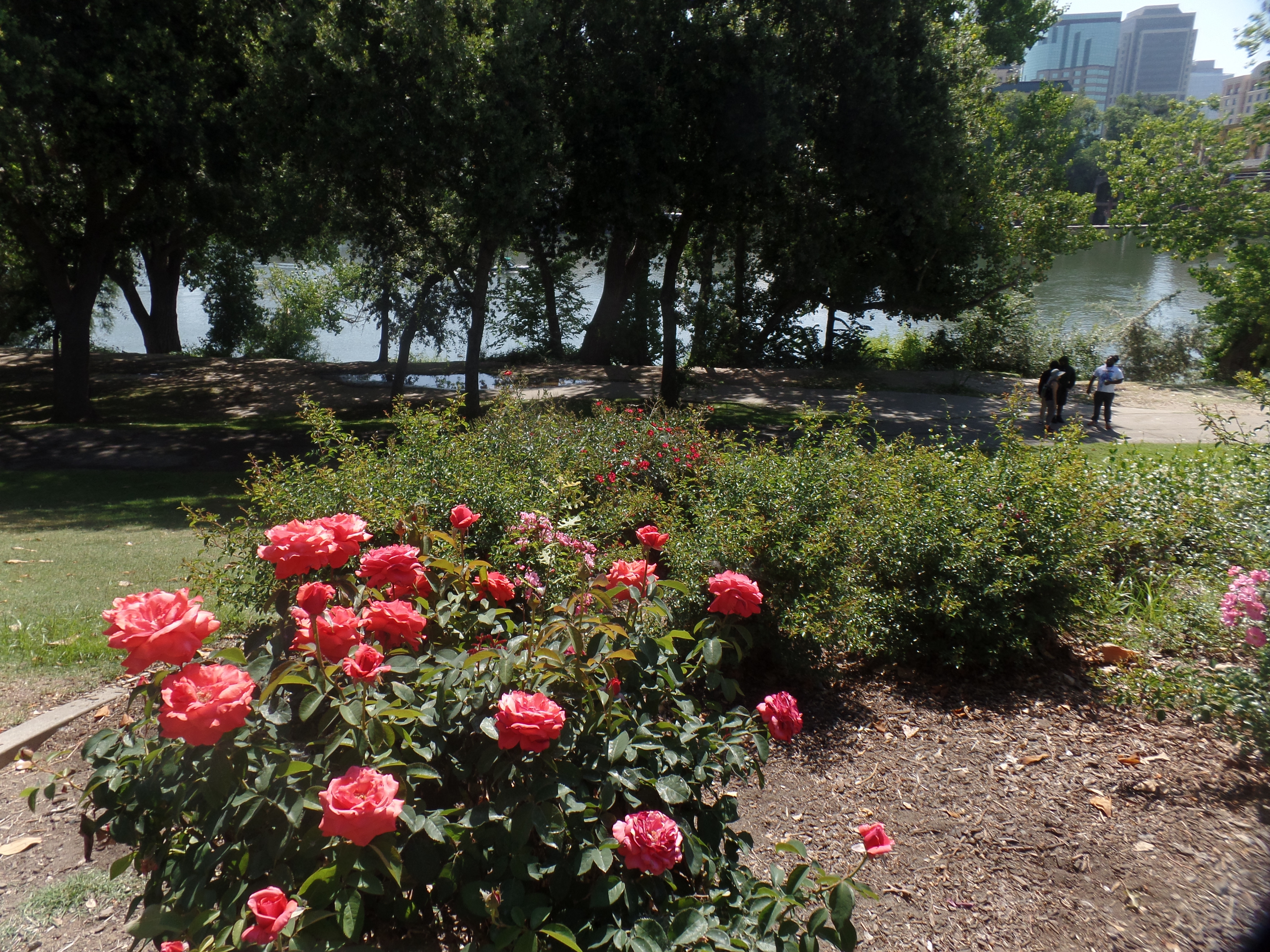
The roses of Washington Park-in West Sacramento, not in Portland
View of Tower Bridge, from Riverwalk, West Sacramento
“Old” Bridge over Sacramento River
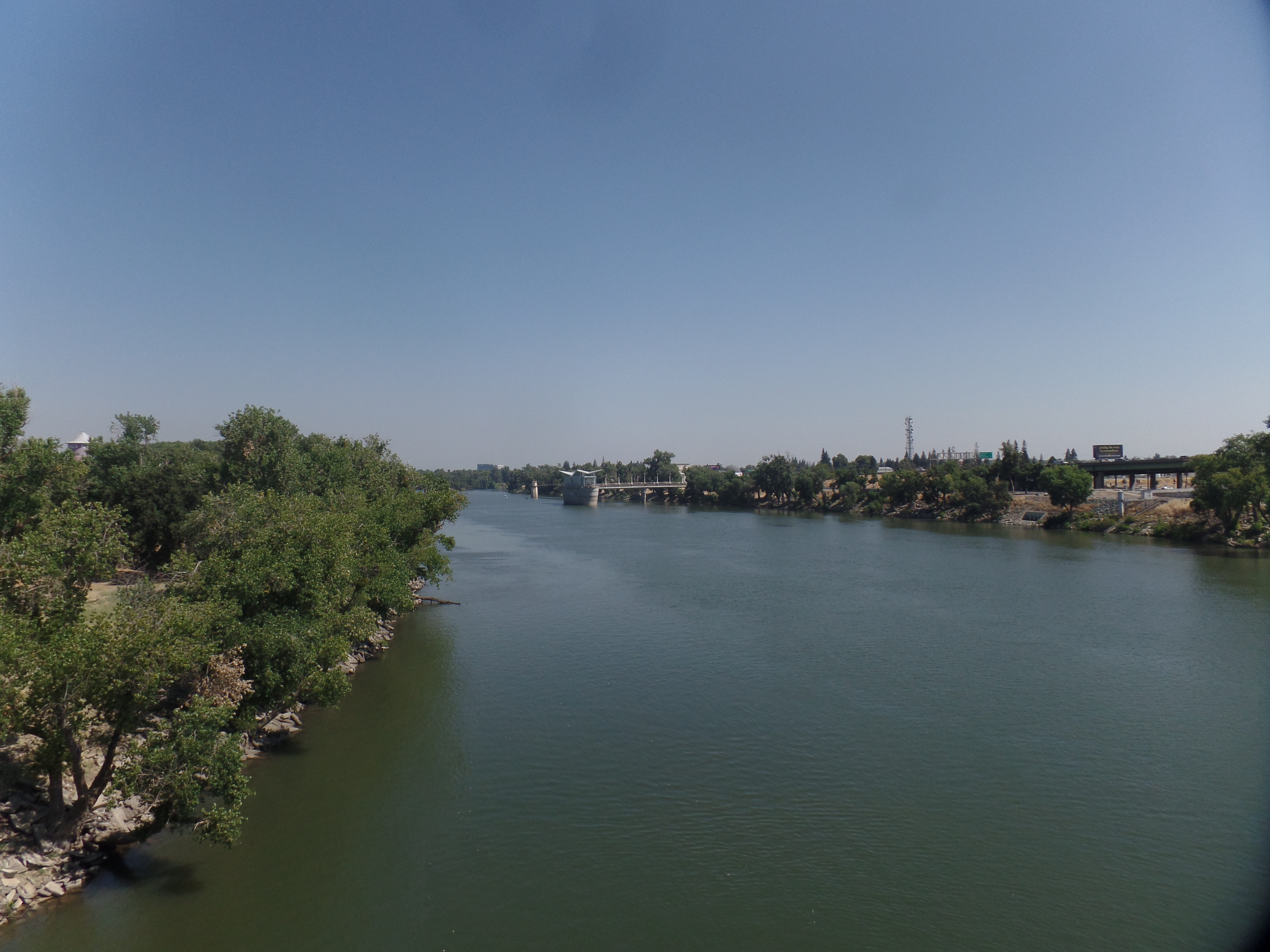
Sacramento River, from Old Bridge
Old Sacramento

Sacramento to Medford- Leaving Old Town at 11:30, gassed up at Costco, in Woodland, fifteen minutes north, and drove on to Dunnigan North Rest Area, where a crew was busily raking up leaves, in anticipation of the August “fire season”-which is now a year-round event. I noticed that there were huge piles of cut dead wood, on a lot not far north of there. There seems to be a will to reduce fire risk, at long last.

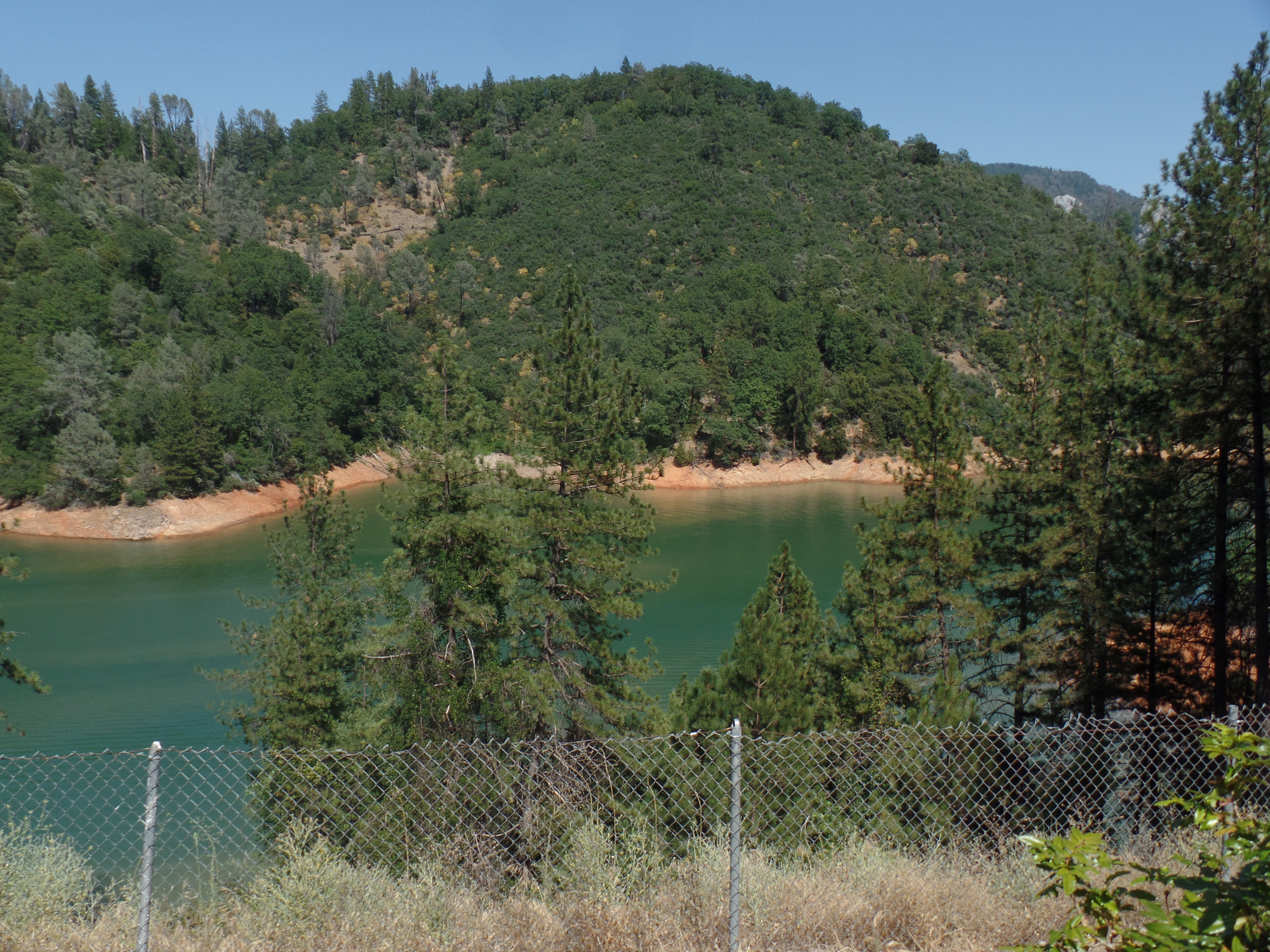
The highway started to get winding, after I stopped at the California Welcome Center, in Anderson, just south of Redding. I spent several minutes talking with the attendant, and a winsome fellow visitor, about the Pacific Crest Trail, of all things. The trail is nowhere near Anderson, but we each picked up a map of the route. There were a couple of spots thereafter, where the traffic backed up, as construction is in intermittent swing, between Redding and Dunsmuir. At Lake Shasta, I stopped for a look at the water level, which seems to have dropped about five inches from last Spring’s copious rain.

Lake Shasta

Gradually cresting Siskiyou Mountain and heading downhill, I spotted a sign for Penny’s Diner, in Dunsmuir, and decided to check it out. I walked into a room devoid of humans, save a gentleman who said he was a regular customer, and who was bellowing at the kitchen workers in Spanish. I started to order a meal from the QR Code, and a server came over to hand me a paper menu. The meal was rather good, the server rather blase’ about her work. I mentioned that Penny was my late wife’s name, eliciting a blank expression. Maybe every other person who comes in has a comment about knowing someone with that name.

So here I am, in smoky Medford, thankful for a comfortable room, nonetheless.

Pushing Back On The Mud, Day Four

3

April 6, 2023, Aptos, CA- The night shift is not for everyone. That much is clear, from the actions of one individual who has reportedly let his co-workers down, each night for the past three. I get an earful every morning, when I come into the shelter. Other than raising the issue on their behalf, as a responsible supervisor, I can do little more than listen-and keep prodding my superiors to take action.

Corporate life has long been weighed down by regulations that were initially intended to curb the tendency to dominate others and to ensure that every human being is treated fairly, valued, honoured and affirmed. Without the requisite appeal to heart and spirit, though, it has become a set of hollow point bullets, shattering initiative and guaranteeing, in all too many cases, the protection and enabling of miscreants. While no one really expects perfection in this life, lowering the bar of social behaviour cheats us all, including the miscreants who are little more than useful idiots, to the wirepullers.

I have been blessed to be among the flood victims, who have gathered in the cavernous exhibition halls of one of California’s premier agricultural fairgrounds. The people of Watsonville are among the millions who work and thrive in the “non-tourist” communities of the Central Valley and San Joaquin Delta. In the smaller area of Pajaro, the farmers go through floods, let the mud dry and go back to tending the soil-producing artichokes, strawberries and Brussels sprouts that meet growing demands for healthful diets.

This sort of resilience may very well survive even the present rising danger, posed by climate change. “And still we rise”.

The Atmosphere Delivers

2

March 22, 2023- Dad would have been 96 today. He grew up with a love of flowing water, especially salt water, which soothed his psoriasis somewhat. We inherited that love, though something in my physical make-up has hampered my swimming skills. Nevertheless, being around water is soothing. Aram picked up that love of water and is a top notch swimmer and diver. He has translated that into success so far in the U.S. Navy-nowadays in the Naval Reserves.

I thought, when moving to Arizona, from Maine, in 1978, that I might miss the ocean. California, as it happens, is not far away-and on occasion, I have visited seaside resorts in Mexico’s northwest corner. The desert, however, is an ocean in itself-just storing its water safely, in pockets-oases, tanks and the storage components of trees, cacti and succulents. There are also plenty of mountains, which in northern Arizona are quite similar in vegetation to the mountains of New England, albeit with cacti thrown in for good measure.

The atmosphere has delivered copious amounts of precipitation this Winter-and into the first days of Spring. Most people are aware of the mixed blessings this has brought to California and Nevada. Arizona has had the same experience as its western neighbours. So, as mentioned in the earlier post, the rivers and creeks of our area, as well as near Flagstaff and parts of the Navajo and Hopi Nations , have assumed monsoon-level flows. This has opened shelters, as those living near the overflowing banks have had to be evacuated. Some have headed down to the Phoenix area or further afield. A few have stayed with us, in the Red Cross facilities.

Thus, my tentative schedule has set me to working nights, possibly through Friday, and doing minimal activities during the daylight hours, the rest of this week. I have, however, kept my basic exercise routine-and in the event of an empty, “stand-by” shelter, I can walk many laps around the gym, without bothering anyone. Life goes on nicely.

Nature and Nurture

0

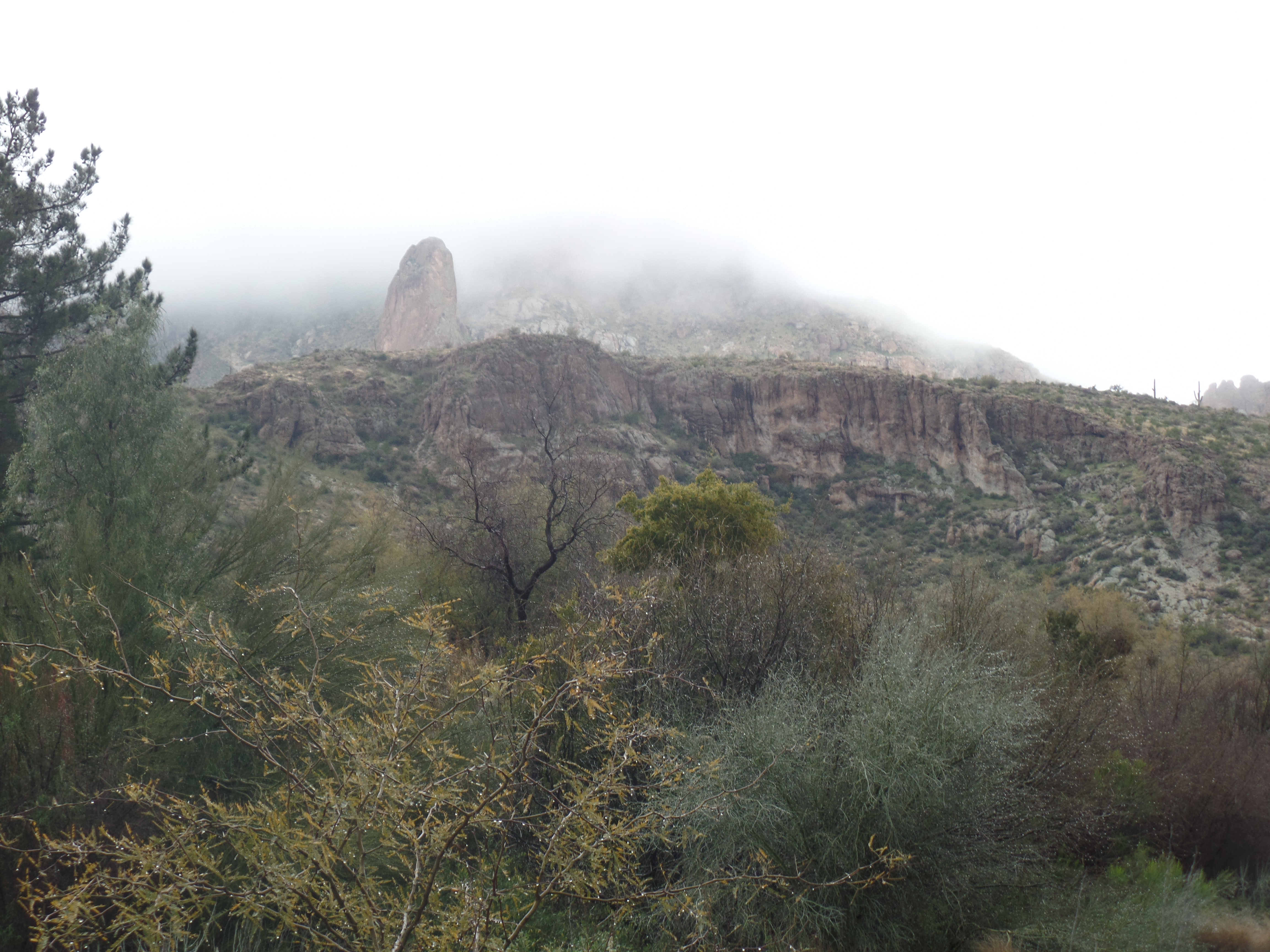
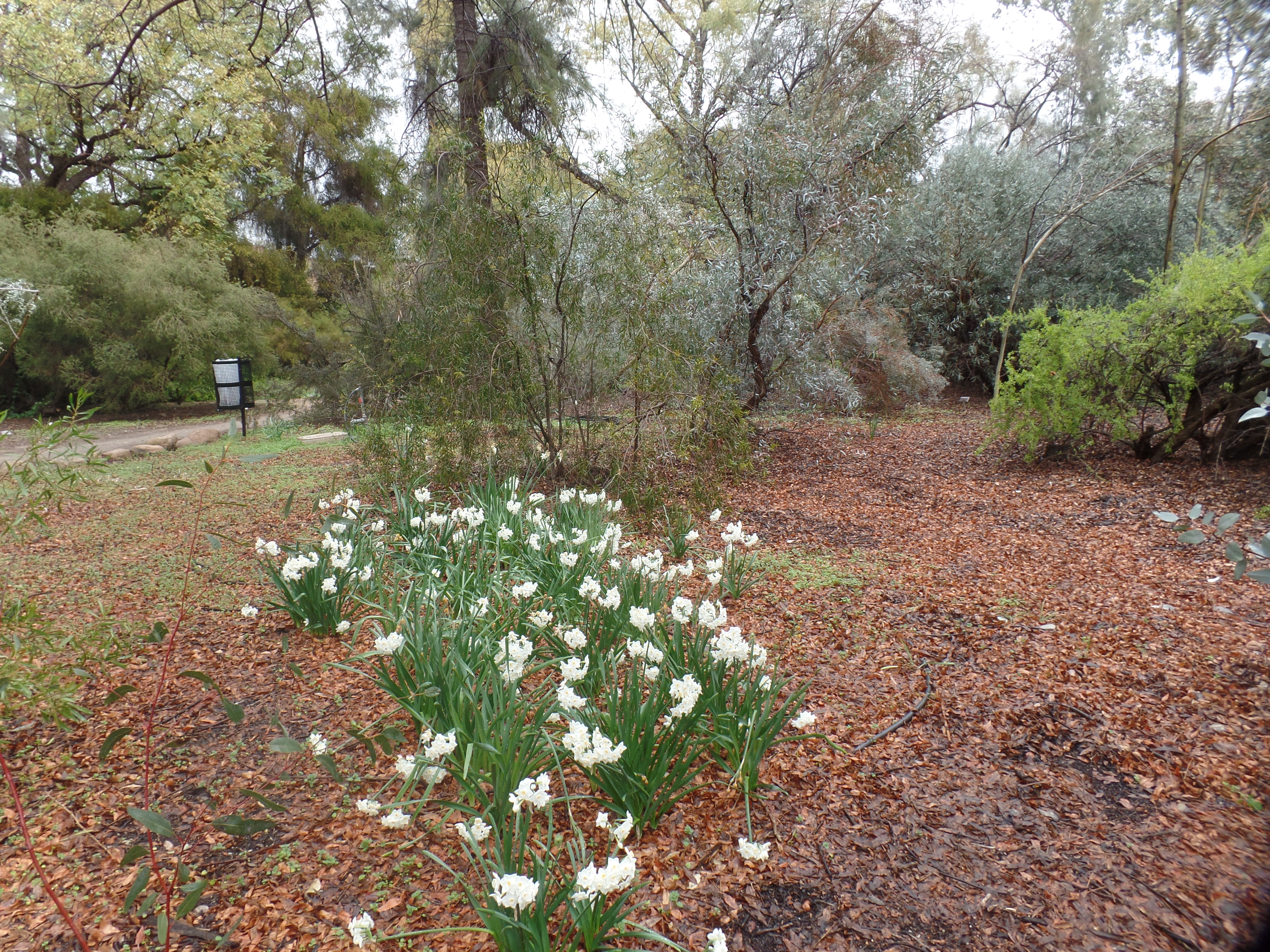
February 21, 2023, Sierra Vista- The day began, nicely enough, though it was raining in Superior. The rain continued, off and on, while I was taking in Boyce Thompson Arboretum, the town’s crown jewel. I have been here, three times before, but never under cloudy skies or when rain alternated between drenching shower and light drizzle. I was no worse for the wear; nor were any of the seventy or so others, including 57 fourth-and fifth-grade students, who did not let the weather get between them and the bountiful flora-with collections from various arid and semiarid areas around the globe. Starting with our own Sonoran Desert, the park takes in the neighbouring Chihuahuan, the Kalahari, western Sahara, the Mediterranean Rim, the deserts of Asia, of Australia and of South America.

Here are six scenes of nature, taking in its nutrients, on this mid-winter day.

East face of Picketpost Mountain, Boyce Thompson Arboretum
East face of Picketpost Mountain, as the fog is lifting.
Teddy Bear Cholla, rejoicing in the moisture.
Early blossoming camellias
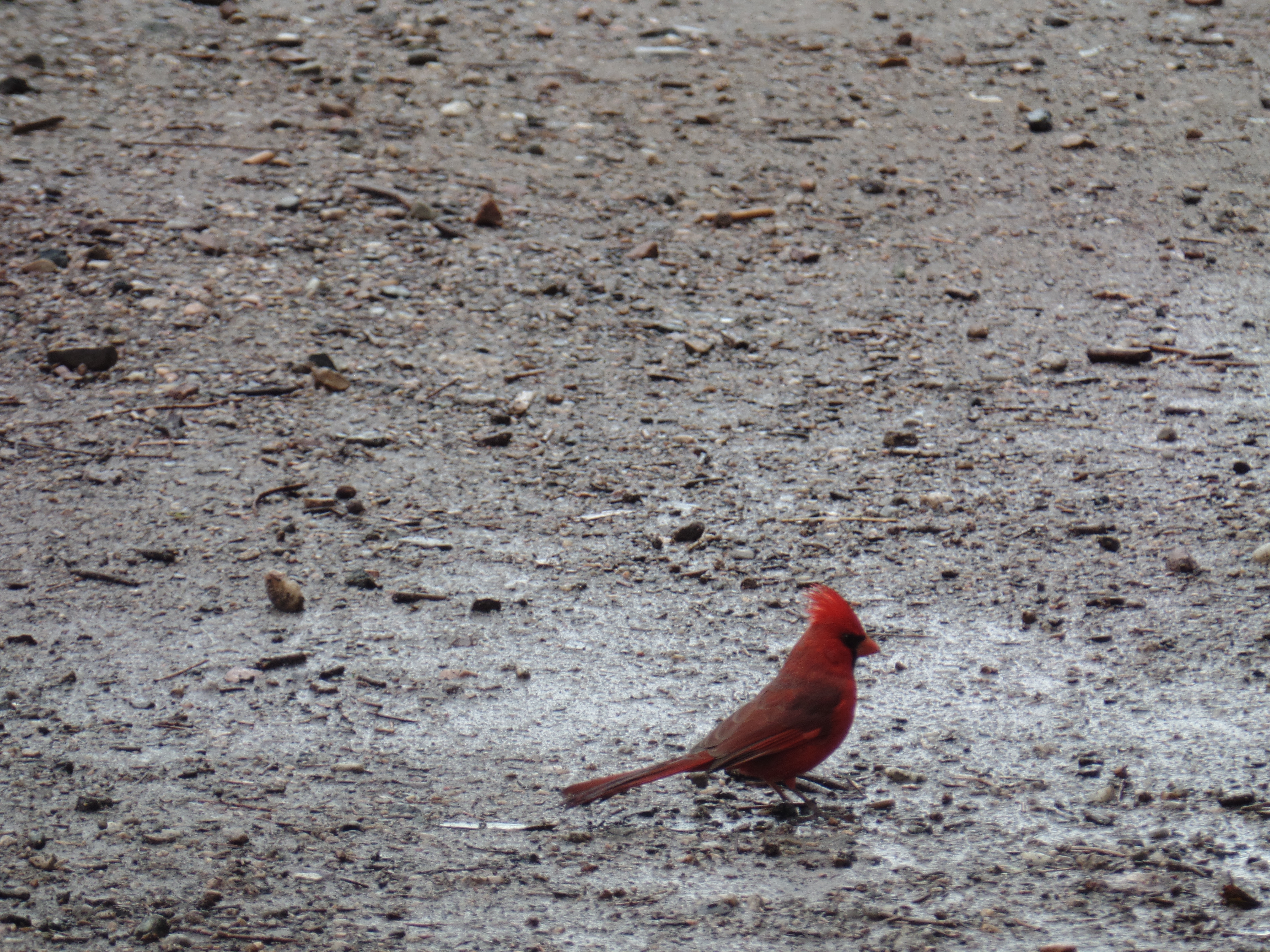
A cardinal looks for food.
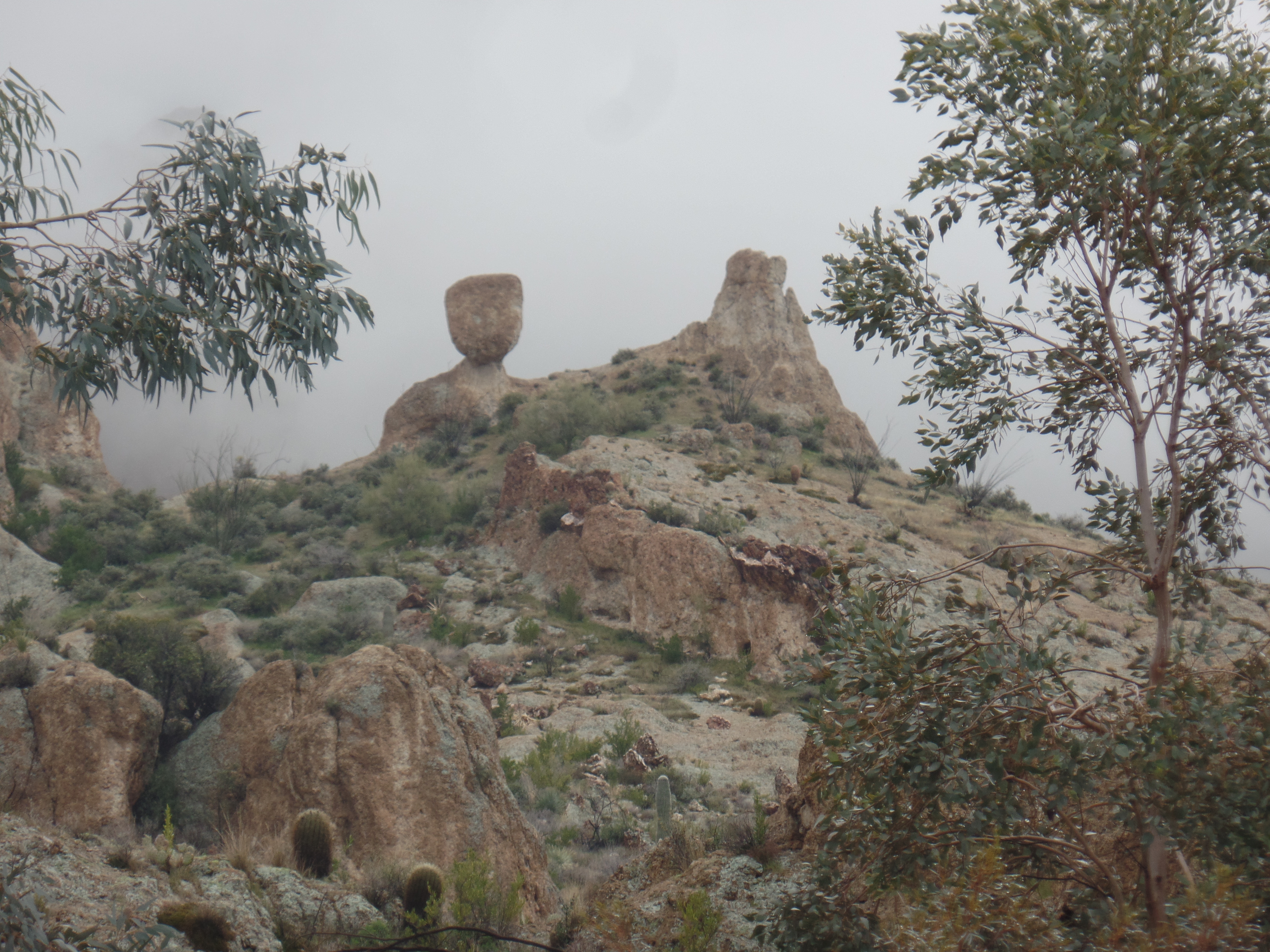
A pair of stone watchmen, east face of Picketpost Mountain.

There is much for me to visit, still, the next time I come this way: The Asian and South American desert gardens and Picketpost House, most specifically.

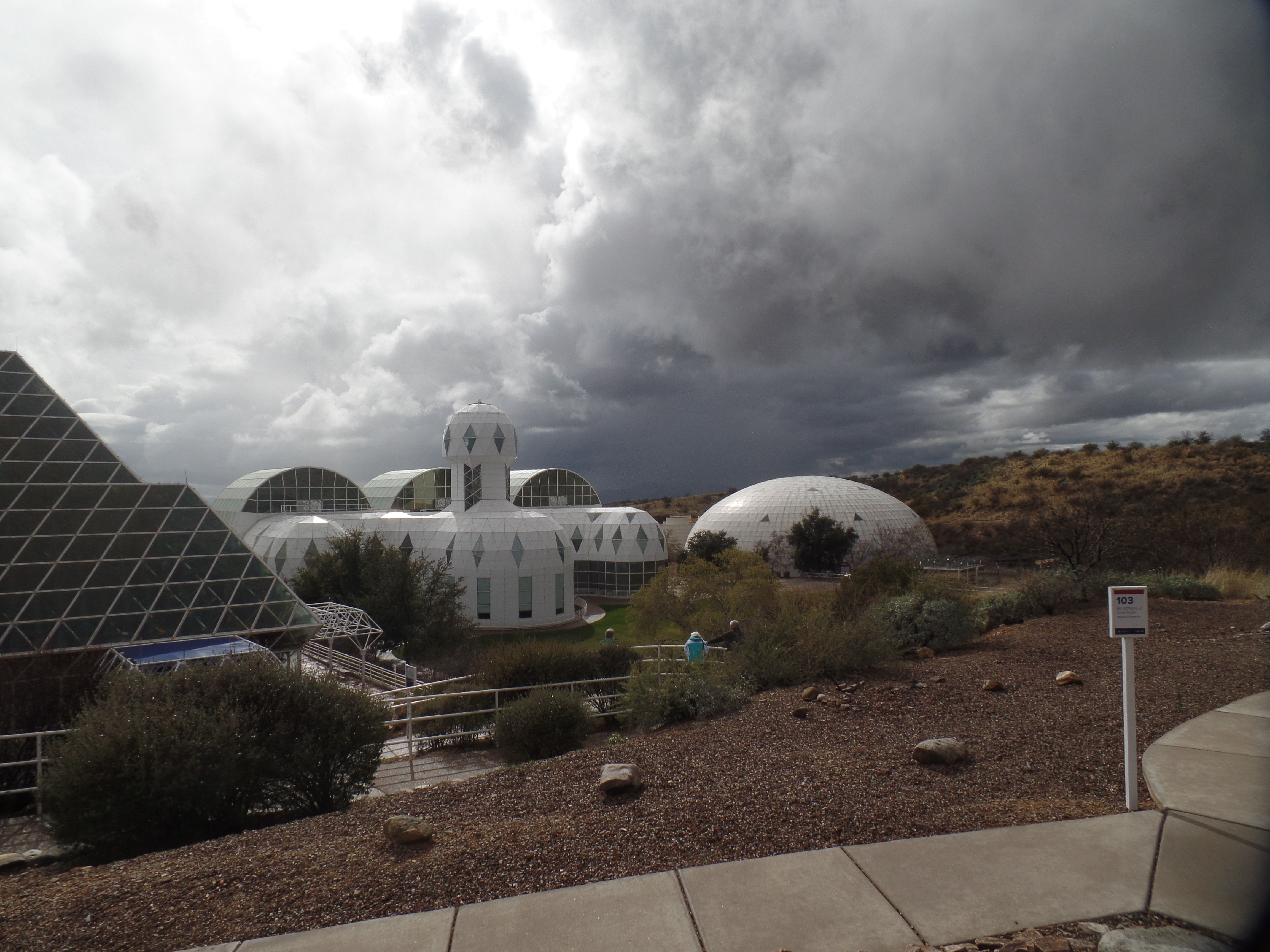
Next up was Biosphere II, the site of an experiment in enclosed living and recreation of natural environments, within that enclosed space. Two teams, each managing a separate mission, worked the space between 1991-1994. https://en.wikipedia.org/wiki/Biosphere_2. The space is presently owned and operated by the University of Arizona, which maintains the site in a good faith synergy with the original vision of Ed Bass and John P. Allen, who themselves were inspired by Buckminster Fuller’s “Spaceship Earth” project. https://en.wikipedia.org/wiki/Operating_Manual_for_Spaceship_Earth.

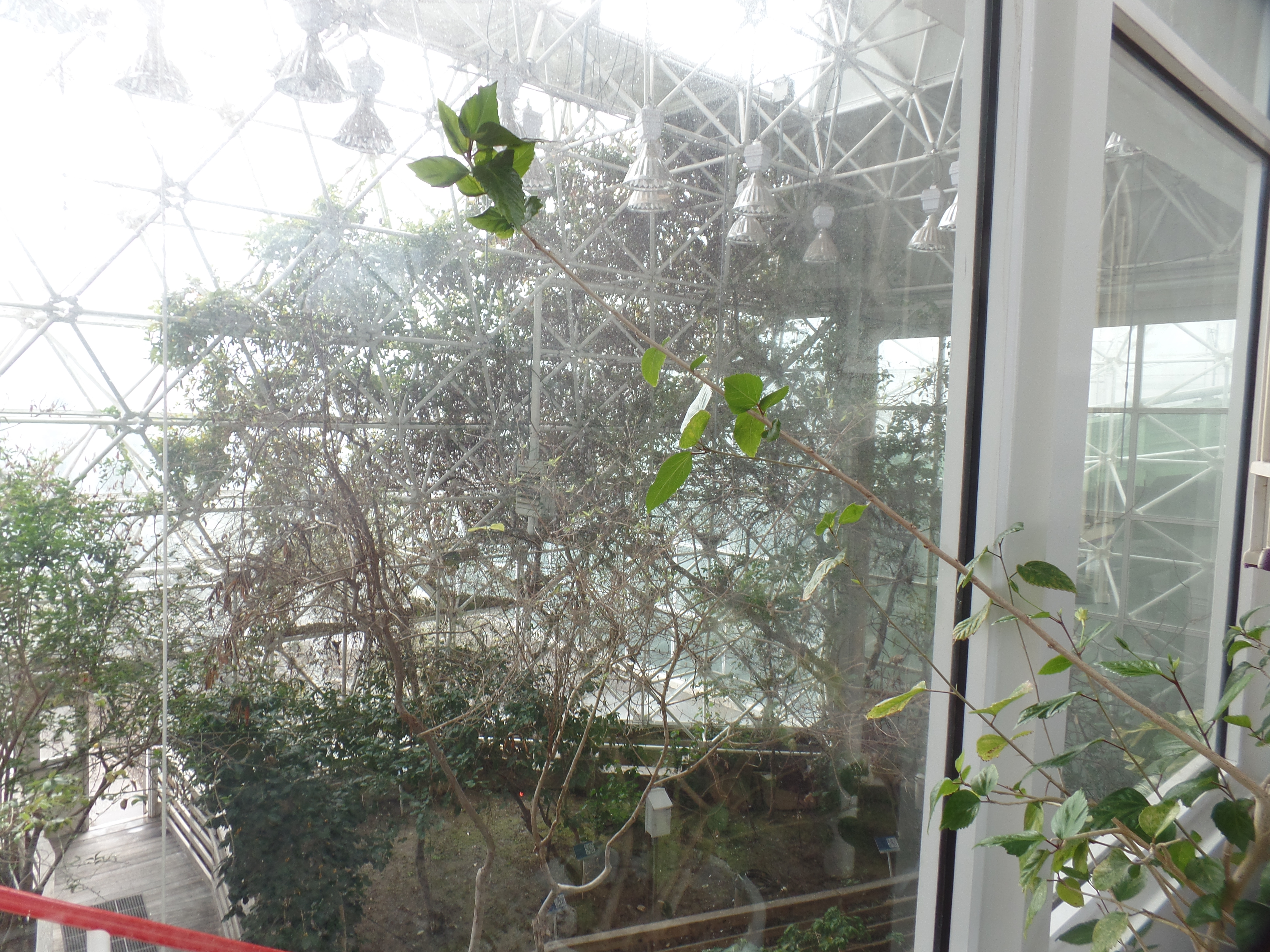
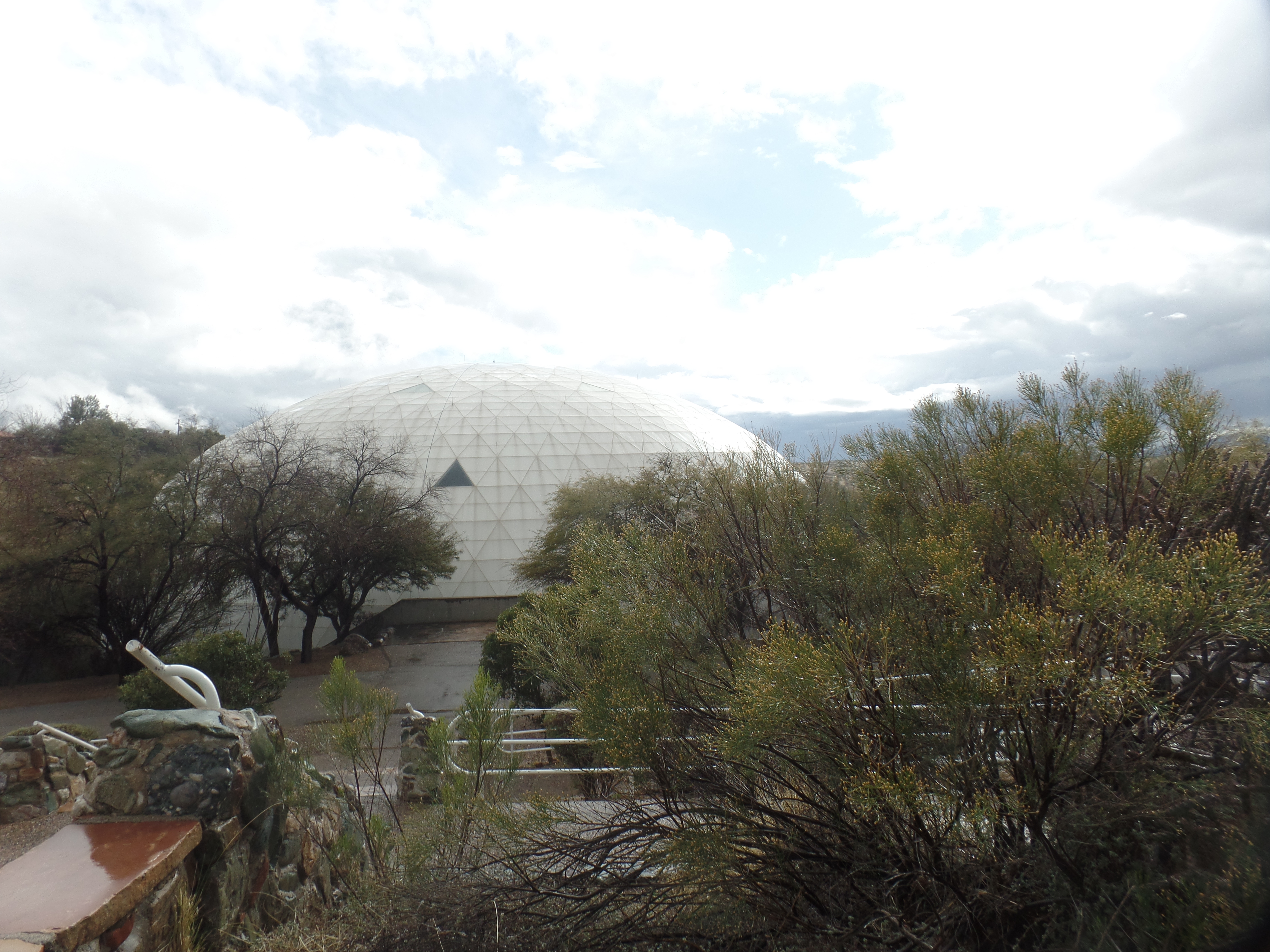
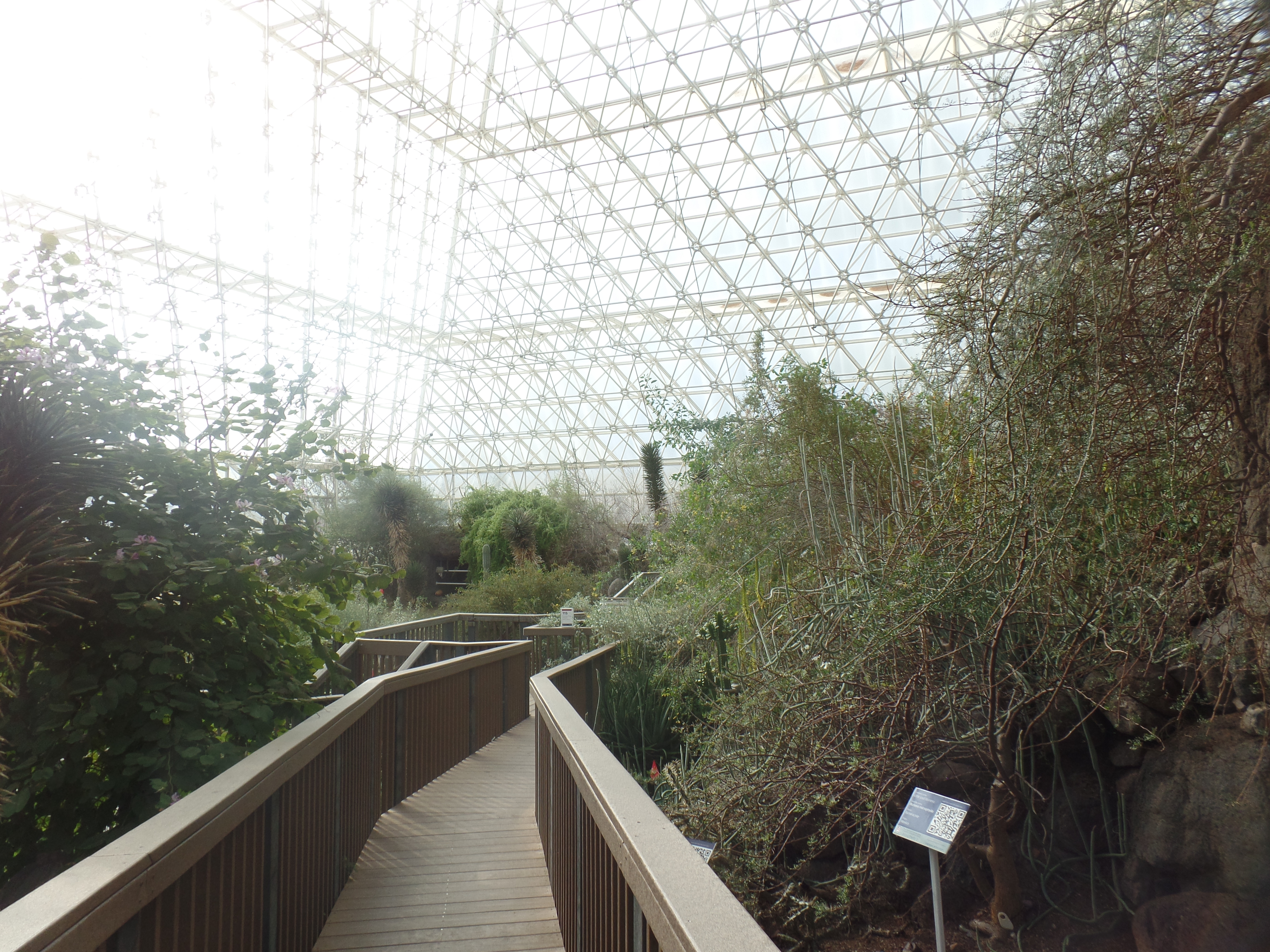
The site remains the largest closed ecological system ever created. Here are several photographs of the site, taken by my trusty camera, until it ran out of battery.

Staff residences and common building (right foreground), Biosphere II.
Overview of Main Campus, Biosphere II.
View of garden, Central Commons building
Freight Farm-the buildings in which hydroponic farming produces what is needed for the residents to live.
The Lung-which regulates air pressure, within the glass enclosure.
Fog-laden desert scape. This is one of many environments, created and maintained, within the glass-enclosed laboratory. Others include both High and Low Savanna, Rain Forest and Ocean.

Biosphere II was a noble effort, laid low by power-seeking and by human conflict. Nonetheless, the University of Arizona is giving the basic mission of the site its best shot. I am at a loss to succinctly describe the physics of LEO. This article may explain the concept, by which three landscapes are created on site. https://biosphere2.org/research/research-initiatives/landscape-evolution-observatory-leo

Superior Rising

0

February 20, 2023 , Superior, AZ- The day started with heartwarming, and heart-rending, stories of Black artists of the 19th and 20th Centuries and the conflicted reaction of even the most prominent “abolitionists” of the Civil War era to women of colour who showed a gift for artistry. I confess that my blood boiled, hearing some of the stories. Every person deserves encouragement and a platform for prosocial gifts.

In the early afternoon, I slowly and deliberately made my way out of Prescott, stopping at Costco for gas and a quick lunch, in the overflow parking lot, and in Prescott Valley, to purchase nuts for snacking. Then, it was straight to this old mining town, which I had not visited since before COVID hit. The overall purpose, rain or shine tomorrow morning, is to re-visit Boyce Thompson Arboretum. This afternoon, though, I hit upon a rudimentary, but interesting, little walking loop, from Superior History Park, across the highway from Copper Mountain Motel, and northwestward across a footbridge, past Porter’s renovated Bar and Grill, then eastward into the small, but somewhat revitalized downtown.

Walking across the footbridge, I encountered a man walking with his infant daughter, who was just learning to walk and was gleefully taking steps along the metal bridge. I told them what a joy it was to see someone taking her first steps in such a delightful place. Dad lifted his baby girl up and showed her the dry, rocky bed of Queen Creek.

I kept going, past Porter’s, where a about a dozen people were enjoying the patio and several others were visible from the window. There is a fairly new park on the north side of Main Street, Besich Park, with a new pavilion. Where Sun Flour Boutique was, there is now Bella’s Marketplace and Cafe. Where the original Sun Flour Bakery and Coffee House was, there is now Random Boutique, where the curio shop was, and the more upscale Miners on Main in the old cafe section. Around the corner, heading back towards the highway underpass, is Superior Barmacy, also a dinner-only restaurant, with a small mural of the “Indian Wars” on its east wall. Such is Legends of Superior’s Downtown Loop Trail.

Here are some scenes of the trail.

Mining Elevator, Superior History Park
Picketpost Mountain, from Lower Queen Creek Canyon
Queen Creek, from the Legends Footbridge.
Hematite and copper boulder, Main Street, Superior
Besich Park, Superior
Apache Yavapai warriors, (Mural at Superior Barmacy Restaurant)
Queen Creek, from Stone Street Bridge, Superior

The night’s focus was a Baha’i study circle, which I facilitated on Zoom, focusing on social action. It is clear as day that there will be no end to the need for such a focus. For now, and for the foreseeable future, I will offer such acts of service, small and large, as the opportunities present themselves.

High Desert Chill

4

December 15, 2022- Skull Rock really does look forbidding. The formations that dot Joshua Tree National Park are all pretty aptly named, though I must admit that the Hall of Horrors did not seem all that harrowing. My hikes were rather limited by the lingering chill that has decided to stick around the Southwest, for several more days-in lieu of a week of snow and rain that was forecast, as recently as a week ago.

This first visit to the crown jewel of the Mohave. After three days along the coast, the inspiration came to head northeast, along CA 62. Here are seven photos of the park’s main route, from the West Entrance, in the town of Joshua Tree, to Cottonwood Springs, just west of Chiriaco Summit. While the trees which some Mormon settlers thought reminded them of the Prophet Joshua, with his arms upraised in triumph, give their name to the Park, the rock formations are what bring visitors back to the area, time and again.

Keys West
Near Quail Springs
Butte, near Hemingway Campground
Quail Springs climbing area
Hall of Horrors
Skull Rock
Jumbo Rocks

The day started off with a breakfast from Zebra House, in downtown San Clemente, my first experience with ordering a meal from a computer screen, when there was a full crew standing at the counter. It does help the team streamline orders, but I felt a bit awkward doing things this way. The breakfast burrito was excellent, though, and I got to exercise more options. As with any novel experience, I would be more relaxed next time.

The drive across CA 76, 15, 79 and 74 brought me to a more familiar place, Gramma’s Country Kitchen, in Banning-as usual, taking a place at the counter. Half a tuna melt and a few steak fries later, I was headed towards Joshua Tree. It was, as said earlier, a chilly visit-weather-wise, but I encountered several friendly folks, both park rangers and visitors, especially rock climbers, who were planning each step very carefully. Most memorable were a newlywed couple, in their nuptial attire, being photographed at various landmarks. My paternal self fretted, just a bit, for the bride, in such lightweight attire. It was not surprising, about fifteen minutes later, to see the young lady wrapped in a blanket, with a forlorn look on her face. I hope the rest of their life together is more well considered.

Chiriaco Cafe’s chili added a fine finishing touch to a lightly-planned, but fascinating afternoon. It will not be my last visit to Joshua Tree, not by a long shot.