“Be Nice or Leave”

8

April 14, 2019-

Such was the message on the t-shirt worn by another patron of today’s Powwow, at Ken Lindley Park, across the main street from my apartment.  I saw no one being anything less than nice and I was certainly my usual self.  The words kept coming back to me, throughout the day.

The full range of  dancers performed this afternoon, from 5-year-olds to senior citizens, with male and female dancers, in each age category, from Juniors(10-12), teens (13-17)  adult (18-550 and Golden Agers (55>), performing in one of three categories:  Traditional, Grass and Fancy, which refer to the type of regalia worn.

I sat comfortably in my “director’s chair”, for most of the afternoon. Though while still in shy and awkward mode, I got up and joined in the Round Dance, a social dance in which everyone sidesteps in a circle.  Being among Indigenous people is a balm.

I didn’t take photographs, as those gathered here asked that no one take pictures of anyone they didn’t know personally.  As everyone  else who was there was not known to me, the camera stayed off.

After the Powwow ended, and my laundry was done,  I stopped by the grounds of Chalk-It-Up, to get photos of this year’s entries to the annual chalk art festival.  The actual work took place earlier, but a small group was still there-likewise taking photos.

Here are my candidates for the most memorable.20190414_181022

20190414_181320

20190414_18130820190414_181446

20190414_181526

20190414_181614

20190414_181715

20190414_181557

20190414_181505

To anyone who has felt overcome by the careless judgments of others, there is this:

20190414_181350

It was ironic that, shortly after I took the above photo, I was approached by a couple of school district employees, who found it uproariously funny that I would appear at a public event.  Leaving them to their giggling and derision, a much warmer atmosphere was a block away- at Two Mamas Pizzeria, another place where I can say I feel welcome and safe.

I can say this:  Neither those foolish women, their co-workers, nor anyone else will run me out of town.  Shy and awkward as I feel right now, I take solace in knowing I need run no more.  I will define my place.

Reignition

5

April 13, 2019-

I cam close to making what would have been a pre-mature, and perhaps reckless, decision.  It basically would have meant leaving my Home Base, earlier than expected.  It became unnecessary.

Although, I have felt a good deal less welcome here, since the events of April 3- and yes, people in this growing town still do talk and pass judgement- there are still a few pockets in Prescott where I can go and feel safe.  I spent an hour or so at such a place, Ms. Natural’s, where the owner is relatively friendly and glad for my business-even if her helpers are a bit on the hostile side.   I also went to Farmers’ Market, where a few of the vendors remain friendly.

The Arizona Department of Education has decided to renew my substitute teaching certificate.  This at least will give me the opportunity to maintain a flexible work schedule, bounce back from the most recent assaults on my reputation and show, yet again, that I am basically a loving and competent educator.  So, the notion to retire early, leave this area and re-establish myself, somewhere else, is not something I need to pursue for the time being.  I will be safe enough, among the Baha’is and a few other friends.  Hopefully, things will even out and I can follow my game plan until December, 2020.


“Part of The Experience”

16

April 4, 2019-

This morning, I read a news report that a recently dismissed Arizona state legislator had remarked to a fellow diner, at  a recent luncheon, that, hypothetically speaking, sexual behaviour towards children, by adults, would be “part of the experience”  The comments are supposedly on tape, having been streamed.  Sexually activity should not be part of any child’s experience.

In all my years of working with children and teens, I have seen this mindset rear its ugly mug, time and again.  It has never been part of my own mindset.  Many of us, in the course of our daily work, have hugged or held our charges, boys and girls alike.  It is not for our own physical or emotional gratification.  The child comes up to us, is reassured that all is going to be okay and goes off again, free of any trauma.

This same ex-legislator, in a couple of instances, has minimized the extent of sex trafficking of minors. That mindset is, woefully, far more rampant in our society-and globally, than one might imagine.  The judiciary is rife with men and women who pronounce themselves “disgusted” with the young people brought before them, on charges of  prostitution.   The implication seems to be that the poor, deprived old man who is found in the child’s/teen’s company is actually entitled, under the law, to gratification.

I am an older man, and I will pass on that entitlement, thank you.   I agree with the judge who stated:  “Children should be at home, with their parents.”  That is why human trafficking, especially of minors, is an abomination.  Children, under normal circumstances, ARE at home, particularly at night,  especially after hours.  This is true, even if they run away, for a bit, in fits of pique.  Many runaways find their way home.

Normalcy, though, is not always on everyone’s plate.  The streets abound with teens, and children, living in insecure environments.  Predators smell money and power, and the hook-ups happen.  The causes of the kids being away from home are almost as many as the number of young people.  Generally speaking, though, it boils down to a person-parent, parent’s live-in friend, other family member not regarding a child or teen as fully human,  totally worthy of respect.

Having grown up in a home, where even my deeply-flawed person was loved and cherished, with parents who blocked my running away-more than once, my deepest inclination is to love those who aren’t.  I have seen adults who were battered, pummeled, sexually-assaulted as children.  The resulting human being is an horrific sight.  That visage underscores the vileness of the comments made by the above-mentioned ex-legislator, the judge who sentenced two teen girls to the maximum penalty, for “being aggressors” towards the man who purchased them from their pimp, and the Catholic priest who told me, during an interview in 1975, that there was “no such thing as child abuse”.  Shame on all such blinkered mentalities.

I stand ready to help any victimized, trafficked human being mend and heal.


A Step at a Time

2

March 31, 2019-

I made it to Planet Fitness, despite a sense of fatigue after a trip to Phoenix and back, having attended a worthwhile, but somewhat tiring, meeting.  I was glad to have not had to drive, with a competent friend at the wheel instead.

Tonight’s workout came after a twenty-minute catnap.  I feel better, having done the 30-minute express, followed by ten minutes on the hydrobed.  Bittersweet March has thus, in the end, affirmed that there is still quite a bit left in this sexagenarian frame.  I get appreciative glances from ladies, the younger among them knowing, as well as I do, that that is as far as it goes.  It feels nice, regardless.

It is now full-on Spring.  Tomorrow, we will see what practical jokes remain to be played.  Later in the month come Chalk-It-Up, Earth Day, Easter and the Twelve Days of Ridvan, commemorating Baha’u’llah’s Declaration of His Mission.  I will get my annual physical at the VA, sometime during the month, and will visit the Grand Canyon, on Good Friday.

April, as a wise colleague once remarked, cannot be the cruelest month.  Sorry, T.S. Eliot.

Another One Out Like a Lamb

2

March 28, 2019-

There is one more work day and one more trading day left in March.  A quarter of my sixty-ninth year will end on Sunday.  March has been roiling, as we have seen, in the areas of weather-based crises and human conflict.  It has also been a time of great joy for me, personally.

As I get ready for the last two months of a fairly successful work year, and begin to ponder what life might be like, after I leave full time employment and devote my time to family and to several months of the year as a traveling writer, there may be a catch.

Having said, a few times, that I am likely to leave Prescott, and Arizona, after nearly thirty years straight and thirty-eight years, all told, in the Grand Canyon State, there is the matter of who might prevail on me to remain here.  Most of my friends here will wish me well, regardless of what path I choose to follow.  There are some, not  counted as friends, who will be glad to see me leave.  One or two special people, who will remain nameless, could yet get me to stick around.  In any case, I know my meanderings would bring me back here, time and again.

This is all conjecture, at present.  I have two very full and rewarding years left, before “retirement”.  The March Lion will bow out, and April will bring pesky standardized testing, the beauty of Ridvan and of Easter, and the Proms.  May will likely see the first 90-degree day for Prescott, and 100-degree day in Metro Phoenix.  The weekends seem to be fully-booked, but I could very well get in a day trip to Grand Canyon, on the Centenary of its National Park.  This one would be to the east side of the Park, and Desert View Tower.  That was my Dad’s favourite spot, when he and Mom visited, in 1985.

Enough meandering, word-wise; I had a busy day and rest is of the essence.  See many of you, tomorrow.

All Those Meanwhiles

9

March 26, 2019- 

For a good part of my time with my little family, in Korea, I was drawn away from anything to do with the wider world.  It felt only natural to narrow my focus, with only a relatively brief microburst of heavy rain, upon our return to Busan from Jeju, on March 15, to let the potential of havoc remind me that there was indeed “life’s mud and stone”, in the words of the great Kenny Rogers, of which to be ever mindful.

Nothing was more jarring than the shootings in Christchurch, something for which I ached, for days afterward, upon reading a digest of news in a copy of The Korea Herald.  Spiritual truth is one, continuous flow, throughout history and will remain so.  The wanton slaughter of 120 people in northern Nigeria, yet another episode in the back-and-forth atrocities between Christians and Muslims in that country and the ongoing bloodbath in Mali, orchestrated by the Islamic State and pitting the Peuhl people against IS’s Dogon opponents, have stayed on the back burner of the world’s awareness.  This is the wrong approach. At the very least, what happens in Africa, especially in the west and north of the continent, will spread to Europe, eventually, just as conflicts in the west of Asia are feared to do.  More essentially, the deaths of hundreds-anywhere- is a humanitarian crisis, worthy of the full attention of the wider world.

We seem to at least be paying closer attention to the horrific cyclone-caused damage and casualties in Mozambique, Malawi and Zimbabwe.  Americans can identify with such events, especially when simultaneous horrors are ravaging the North American Great Plains and riparian areas of the Midwest.  Nature is in a highly-charged state right now.  Whether it is cyclical or the result of intense man-made climatic disruptions, unified responses are necessary.

Then, there were the more personal individual tragedies:  A young lady who had survived last year’s Parkland, FL shootings was overcome by her emotional pain, and took her life.  A week later, the esteemed economist, Paul Krueger, overcome by suffering of his own, followed suit.  Closer to home, two teen girls in our area and a Phoenix police officer were killed by inattentive drivers.

I learned my lesson, that even during the most basic and intensely personal of life events, there is no separation from all that surrounds us.  Meanwhile, family thrives, near neighbours may struggle-and those who live in areas, where life’s larger problems seem intractable, continue to warrant our love and efforts to help, where possible.

The “meanwhiles” never take a vacation.

Busan’s Magnetic Side

2

March 16, 2019, Busan-

SAMSUNG CAMERA PICTURES

This ancient port has become, like many large cities across the globe, a place of high rise, high density apartment buildings and intense, often grid-locked, traffic.  Nowhere is this more clear than in the area called Marine City, close to the popular Haeundae Beach and Strip.

We used our God-given feet today, the final day of my entry into a Korean family.  Our foci were two:  Dongbaek,  site of the 2005 Convocation of the Asia-Pacific Economic Council and Haeundae itself.

The night before, shortly after our arrival back in Busan, we headed directly over to an older section of the city, to patronize a restaurant owned and operated by family friends, the Paks.

SAMSUNG CAMERA PICTURES

As the sign implies  it is a place for people to get a dose of quality American-style food.  The father and son also serve what I regard as the best coffee in Busan, if not in all Korea.  I was fortunate to have been given some, to bring back with me to the U.S.

SAMSUNG CAMERA PICTURES

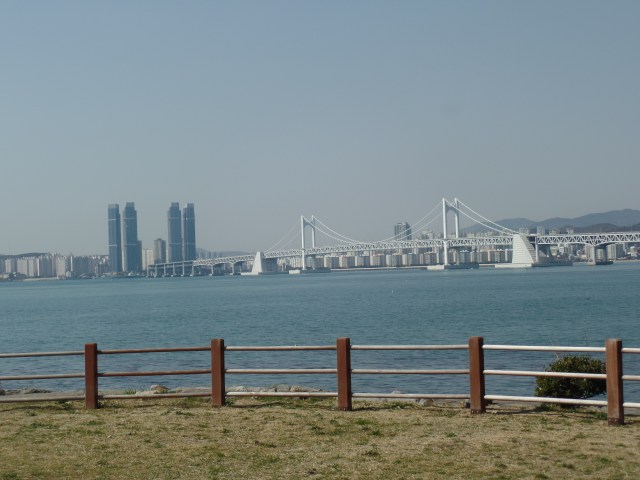
Here is a view of Dongbaek, from Gwangan Pier, near Marine City.  Conversely, once at Dongbaek, we had a fine view of Gwanggalli Bridge. It is said to rival the Golden Gate and George Washington Bridges, when lit up at night.

SAMSUNG CAMERA PICTURES

We spent several minutes looking at the APEC House, site of the aforementioned conference.  We joined a group of visitors from west Africa, on this fine morning.

SAMSUNG CAMERA PICTURES

Miniature pines abound, on this small headland.

SAMSUNG CAMERA PICTURES

Below is a fine view of the traditional pavilion and of Dongbaek Lighthouse.

SAMSUNG CAMERA PICTURES

This mural of a Korean country scene greets visitors to APEC House.  I refrained from photographing the auditorium, to protect the privacy of a young Korean family, who were making a detailed visit to the conference center.

SAMSUNG CAMERA PICTURES

SAMSUNG CAMERA PICTURES

Above, is a statue of Choi Chi-won, regarded as the first great Korean advocate of Confucian teachings and etiquette.  He lived during the Silla Dynasty, in the Tenth Century A.D.  Below, is a shrine to the great teacher.  At the summit of Dongbaek, it is a serene place, most of the time. We were there only briefly, as an older man started to pester us.

SAMSUNG CAMERA PICTURES

Here is a view of Dongbaek’s southern tip.

SAMSUNG CAMERA PICTURES

This Mermaid Statue commemorates the legend of a princess from a foreign land, who pined away for her homeland, day and night.

SAMSUNG CAMERA PICTURES

Haeundae Beach Park includes this shady, forested area. We walked there, easily, from Dongbaek.

SAMSUNG CAMERA PICTURES

Modern Korean etiquette eschews photography of people, without their consent.  I was able to catch a glimpse of Haeunedae Beach, sans bathers.

SAMSUNG CAMERA PICTURES

Rabbits are seen as good fortune, as well as being symbols of fecundity.

SAMSUNG CAMERA PICTURES

Here is the southeastern edge of Haeundae Strip, a bustling commercial tourist area, where we had lunch.  Looking for a chicken restaurant, we found they open at 2 p.m., which is averse to my schedule. So, we settled for more burgers-at one of  the ubiquitous Hello, Patty cafes.  The people in this photo shrugged their shoulders at being photographed, so no harm, no foul.

SAMSUNG CAMERA PICTURES

With that my time in Korea is drawing to a close.  My time as a member of a gregarious extended family is, however, just beginning.

NEXT:  Further reflections on Korea-and the trip back to Arizona


Jeju, Part 4: When Jeju Was Tamna

14

March 14, 2019, Song-eup, Jeju-

Korea abounds in traditional folk villages, as do many nations who seek to preserve their traditional culture-in the face on onrushing development and prosperity.  Jeju’s premier folk village, which I have visited on three other occasions, is Song-eup, not far from Songsan, in the eastern part of the island.

By chance, when Aram, Yoonhee and I arrived here, we were introduced to the same woman who had,as a newly-wed, told Penny and me about the way of life here, some thirty-two years ago.  I recognized her, though she didn’t remember me.  A good-natured, saucy young woman had matured into a dedicated advocated for preservation, with an encyclopedic knowledge of her subject.

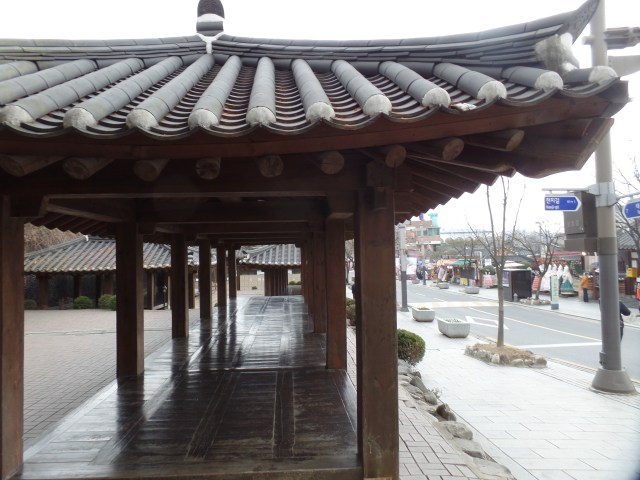
These poles served as a gate.  If they were on the ground, this meant the residents were home and ready to receive guests.  If one pole was mounted, call out before entering.  If two poles were mounted, the residents were at home and did not wish to be disturbed.  If three poles were up, no one was at home.

SAMSUNG CAMERA PICTURES

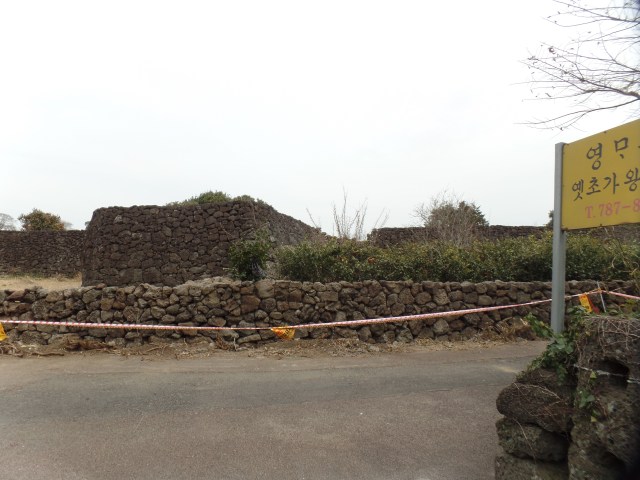
Song-eup proper was, and is, a walled community.  Pirates from Japan were known to occasionally stage raids on towns, in the eastern and southern coastal areas of Korea.  This was enough of a problem that Korean Admiral Yi Sun-shin, one of history’s greatest military commanders, led his sailors to victory over both the pirates and their imperial enablers, in the Imjin War of 1592-98.  The walls helped stem the pirate attacks, in the short term.
SAMSUNG CAMERA PICTURES

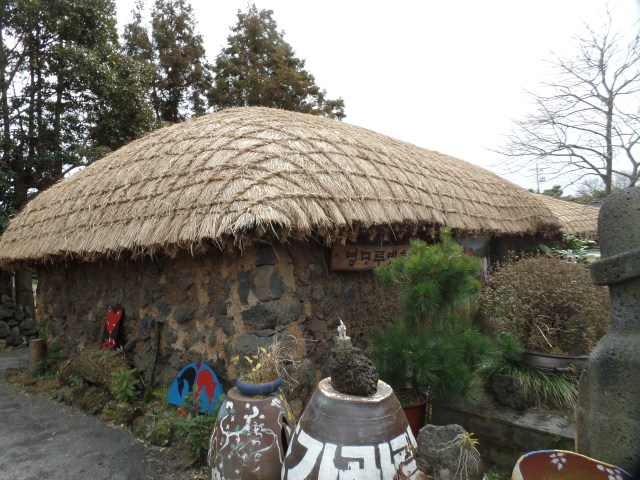
This system of roof thatching was used by high and low alike, across Jeju.  The villagers on the west of the island used different material, but the system was the same.
SAMSUNG CAMERA PICTURES

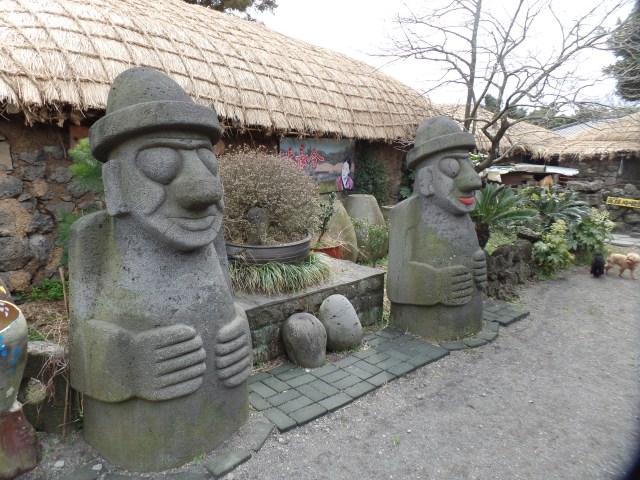
Stone guardians, nowadays called dolharubang, or “stone grandfathers”, graced the entrance to every village in Jeju.  They are now symbols of the island’s culture.  The one on the right is an example of  Koreans’ playful spirit.
SAMSUNG CAMERA PICTURES

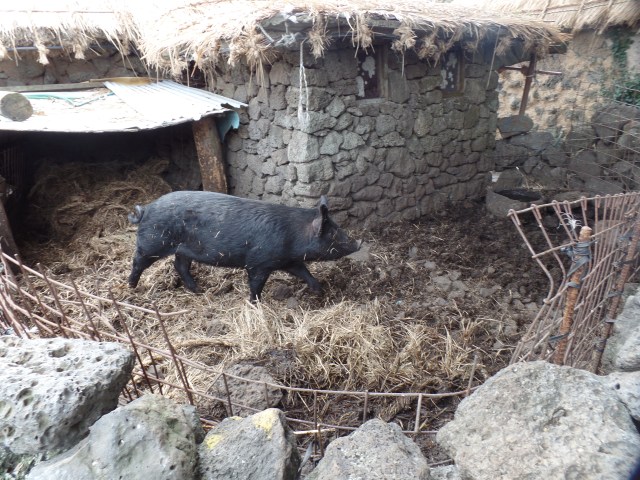
The black pig is one of Jeju’s primary domesticated animals-sometimes used as a watch animal, but more commonly raised as livestock.
SAMSUNG CAMERA PICTURES

This house, with its foreroof, is an example of a wealthier person’s residence,as it has an up-step.

SAMSUNG CAMERA PICTURES

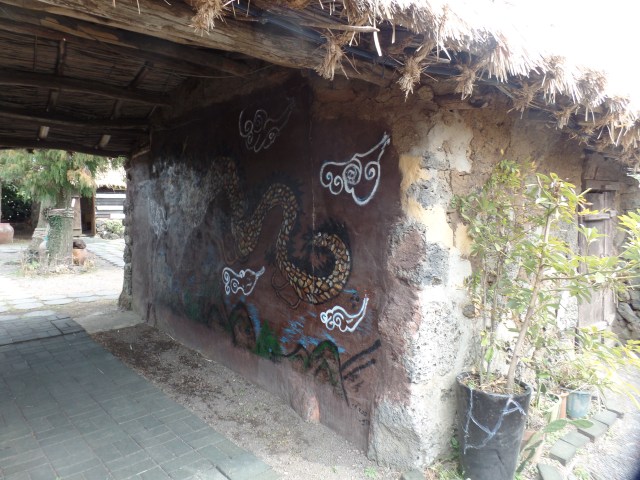
Street art here is used mainly to depict animal figures prominent in Jeju lore- especially the dragon- here accompanied by snails.
SAMSUNG CAMERA PICTURES

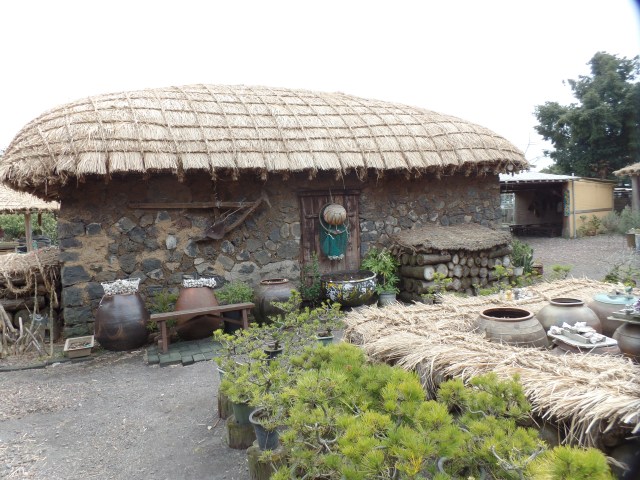
Here is an example of a more humble person’s residence,with no up-step.
SAMSUNG CAMERA PICTURES

Roof thatch is replaced every five years.  These grubs are found, in the hundreds, thriving in the thatch.

SAMSUNG CAMERA PICTURES

Usually, grinding stones in Korea were pulled by oxen.  On Jeju, horses pulled stones like this one.

SAMSUNG CAMERA PICTURES

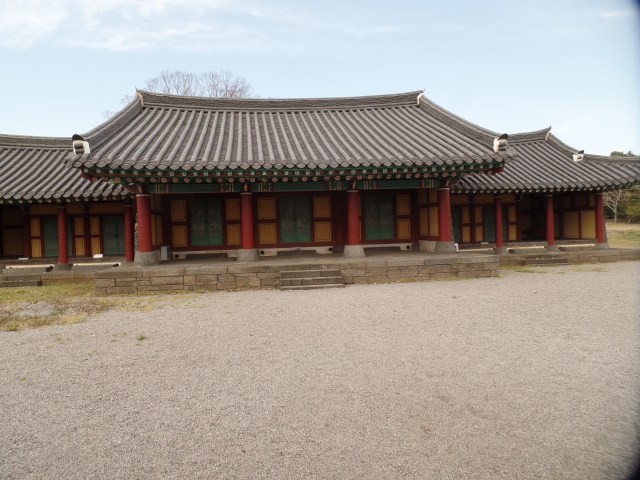
Masks were mounted as a defense against harm, in the days of shamanist Korea. Back then, Jeju was called Tamna.  Legend has Tamna established by three men, Go, Yang and Bu, who emerged from three holes-in an area, called Samseonghyol, that is still preserved in Jeju-shi.  Tamna simply means “island nation”, in Jeju’s indigenous language.  There are still a small number of indigenous Jejuans, living in the foothills of Halla-san.SAMSUNG CAMERA PICTURES

After thanking the docent for her time and sharing, we spent a few minutes in an educational institute, on the outskirts of Song-eup.  Here, another docent showed us more mock-ups of early village life.  Here is a display of an outdoor kitchen.

SAMSUNG CAMERA PICTURES

As we walked towards the walled, main section of the village, we spotted a fuller example of a long cottage, with an up-step.

SAMSUNG CAMERA PICTURES

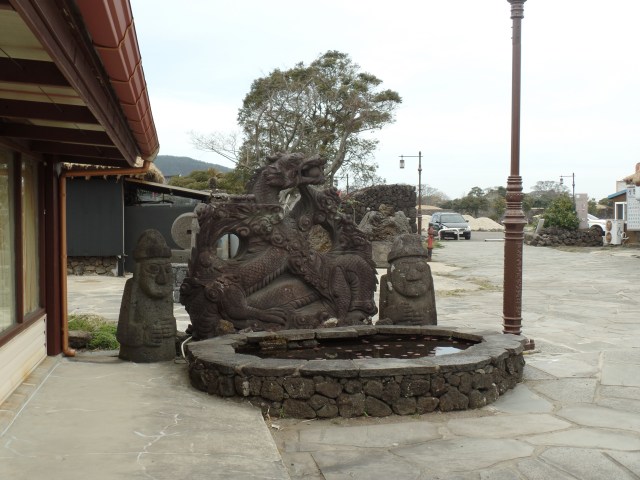
This house was called the “House of Two Dragons”, by its early owner.  Thus, here is a sculpture of  the double threat.
SAMSUNG CAMERA PICTURES

Stone guardians can reflect a wide variety of expressions.  Most are serious; some can be mirthful.  These are definitely not in a good mood.

SAMSUNG CAMERA PICTURES

Here is the West Gate, through which we entered Song-eup proper.

SAMSUNG CAMERA PICTURES

Here is  a full view of a Song-eup street.

SAMSUNG CAMERA PICTURES

Large Korean cabbage, a primary ingredient in much kimchi, is a key crop of Jeju. It is related to the Chinese bok choi.SAMSUNG CAMERA PICTURES

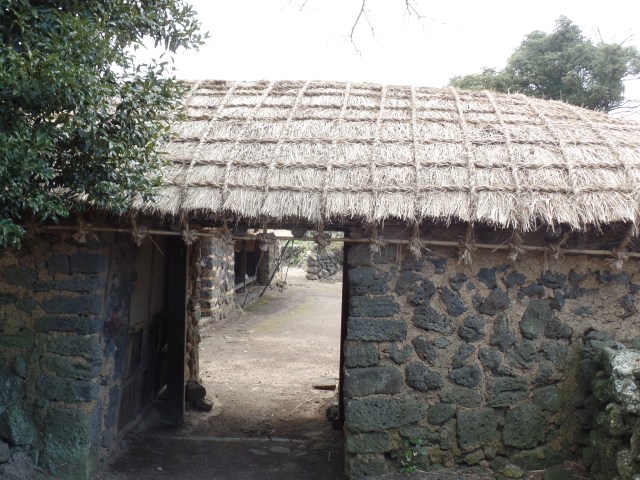
Han Bong-il, a wealthy farmer of old Jeju, left this farmstead to the government, which now preserves it as an historic home.
SAMSUNG CAMERA PICTURES

This is the Peddler’s Inn, located in front of the main Guest House. The former housed people wishing to sell items to or supplicate the magistrate and other officials, who themselves stayed in the Guest House.

SAMSUNG CAMERA PICTURES

Here is the main Guest House.

SAMSUNG CAMERA PICTURES

This is the entrance to the  old seat of government in Song-eup.

SAMSUNG CAMERA PICTURES

This is Mokgwana, the actual office of the magistrate.

SAMSUNG CAMERA PICTURES

Large. old hackberry trees are often top heavy,with age.  This tree needed to be shored up by a system of cables and metal stands.

SAMSUNG CAMERA PICTURES

At this Confucian school, another docent guided us around the areas that are open to the public, whilst explaining that the main courtyard was off-limits, due to an earlier high volume of traffic, detracting from the serenity of the place.

SAMSUNG CAMERA PICTURES

Here is a fuller view of the school and courtyard.

SAMSUNG CAMERA PICTURES

We left Song-eup, in a tranquil mood. Headed westward, we stopped at a rest area, to get this view of Halla-san, rising proudly in the background.

SAMSUNG CAMERA PICTURES

The day was only half over!

NEXT:  Jusangjeoli and Jeongmyon- Two Wonders of Wind and Water

Jeju, Part 3: Where the Sun Greets Jeju-do

4

March 14, 2019, Songsan, South Korea-

After a robust meal of kalbi (grilled ribs), at Kyodong Dok Kalbi, we retired to the Golden Tulip Hotel, in this eastern fishing and shellfish diving center.

SAMSUNG CAMERA PICTURES

Our first stop, on a robust and happy day that will take us across the island, was Songsan Ilchulbong, a small promontory that is a favourite of locals and tourists alike, for greeting the sunrise.  We did not do so, as the sumptuous breakfast buffet of Golden Tulip beckoned first.

Once we did get to the site, though, we found a small course for riding a Cheju pony, similar to the ponies of Shetland.  Yunhee gladly rode the pony, even though it was a very brief experience.

SAMSUNG CAMERA PICTURES

SAMSUNG CAMERA PICTURESSAMSUNG CAMERA PICTURES

Although the coastal areas of Jeju are treeless, in most spots, an effort is being made to plant windbreak in some places around Songsan.

SAMSUNG CAMERA PICTURES

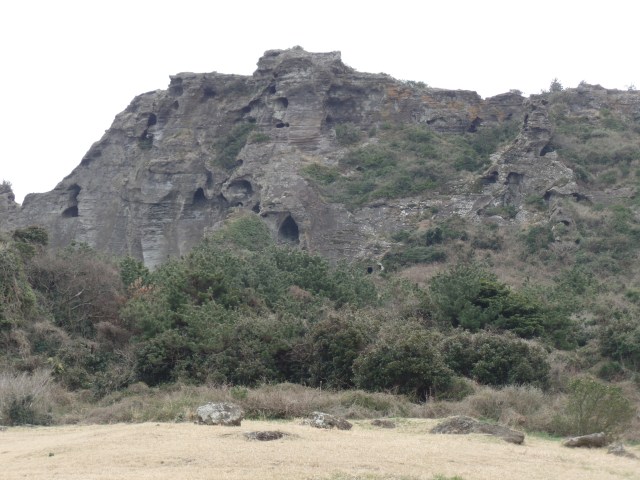
Here is the volcanic promontory that beckoned us.  I was last up this hill, in February, 1992, with a small group of freshman students.

SAMSUNG CAMERA PICTURES

Here is a view, from halfway up, of Songsan, in the morning light.  Halla-san, the highest peak on Jeju, and in South Korea, is seen in the distance, on the near left  side.

SAMSUNG CAMERA PICTURES

There are many igneous boulders along the route.  Here is a particularly popular photo point for many Korean visitors:  Lamp Rock.SAMSUNG CAMERA PICTURES

SAMSUNG CAMERA PICTURES

The image on the right side evokes a Grandmother’s kind visage.

SAMSUNG CAMERA PICTURES

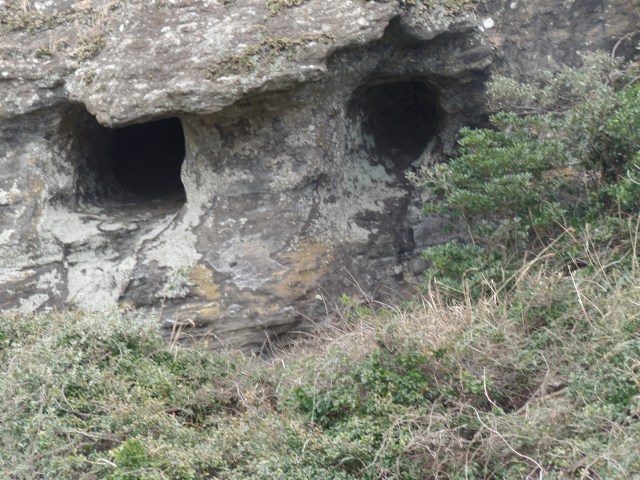
Two eyes appear to be watching, at this site of twin caves.

SAMSUNG CAMERA PICTURES

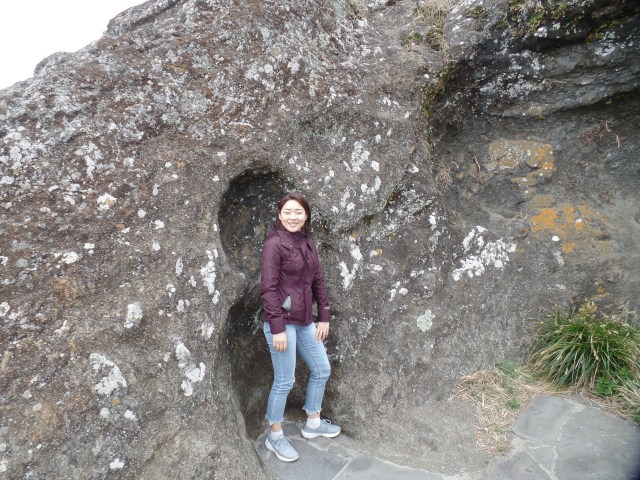
The indentation below seems to fit my daughter-in-law perfectly!

SAMSUNG CAMERA PICTURES

We made it to the top, so I chose this as my next profile picture on social media.

SAMSUNG CAMERA PICTURES

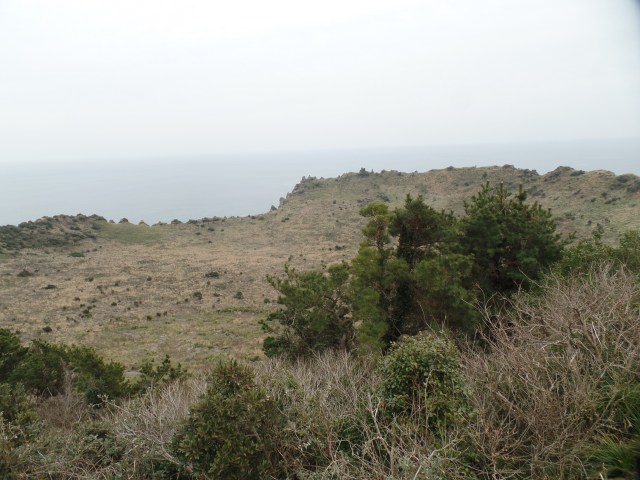
Below, is a view of the crater, for which the summit of Ilchulbong is famous.  Yes, the hill is a dead cinder cone.
SAMSUNG CAMERA PICTURES

Here is the southern, less inhabited part of Udo, an islet just across a small channel from Songsan.

SAMSUNG CAMERA PICTURES

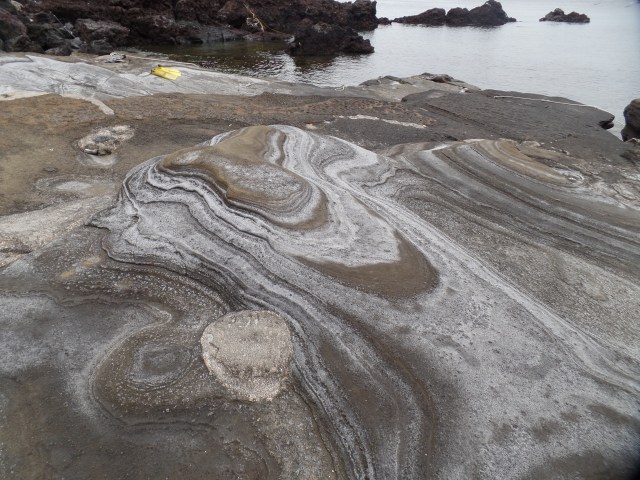
Here are the effects of constant saline deposits on this sedimentary boulder, in an area that hosts haenyo, or women who dive for abalone and sea cucumber.  The traditional divers are mainly found in Jeju, though some are in a handful of towns on the southern mainland coast.
SAMSUNG CAMERA PICTURES

One haenyo is seen in the water, wearing a yellow diving vest.

SAMSUNG CAMERA PICTURES

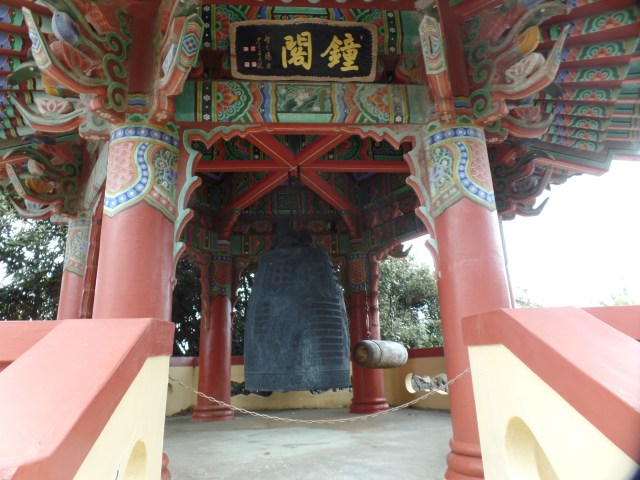
Here is the bell of Dongam-sa, a Buddhist temple at the foot of Ilchulbong.  A funeral was in progress when we visited, so we kept our visit quiet and short.

SAM_1203.JPG

Contrasting images of the Buddha are seen here.

SAMSUNG CAMERA PICTURES

SAMSUNG CAMERA PICTURES

SAMSUNG CAMERA PICTURES

We ended our visit to Songsan, with a brief visit with an old friend.

SAMSUNG CAMERA PICTURES

With that, we are off to Songeup Folk Village, for some reconnection with the farm folk of old Jeju.


Hanok Village: History as Enterprise, Part II

2

March 11, 2019, Jeonju, South Korea-

As promised, I continue here with the second half of our little family’s tour of this blend of history and modern entrepreneurship.  It most closely reminds me of the Belgian city of Bruges, in that regard.

We felt the need for lunch, so we stopped at Kyodong Dok Kalbi, which offers a limited number of pibimbap dishes, along with a chopped, pressed and pre-cooked version of Kalbi (beef or pork ribs).   Their herbarium provides many of the key ingredients.

SAMSUNG CAMERA PICTURES

Here, my Korean relatives observe the round of side dishes, which are essential in any true Korean meal. There are usually a few varieties of kimchi, steamed spinach, some small sardines, buckwheat noodles, and some cold pressed vegetable gelatin.  Miso (fermented soup) and a bowl of white rice accompany the meat.  We ate using chopsticks and a large spoon.

SAMSUNG CAMERA PICTURES

Having eaten our fill of satisfying dok kalbi and “fixings”, we felt content as cherubim.

SAMSUNG CAMERA PICTURES

So, we walked along the road that leads to a straw-roofed complex.  We came upon this irrigation stream, with various animals of the Oriental zodiac as conduits for the water.

SAMSUNG CAMERA PICTURES

The fortunate woman has a husband who is willing to be her servant, at least on occasion.

SAMSUNG CAMERA PICTURES

Jeonju is largely devoid of street murals, so this vertical rainbow was a sublime surprise.

SAMSUNG CAMERA PICTURES

Many Korean families have at least a small garden plot.  This one is at a traditional Tea House, where we stopped for cups of medicinal herbal tea.

SAMSUNG CAMERA PICTURES

It is the Tea House which sports the traditional “Jeobuk” straw roof.  The proprietress was surprised at the approach of a mixed group of Koreans and Americans, but was very gracious.

SAMSUNG CAMERA PICTURES

To the east of Hanok, there lies a shanty area, climbing the hillside.  I took this photo from the Tea House grounds.  Later, we would get closer to the settlement, which lies across a divided highway.

SAMSUNG CAMERA PICTURES

Here are the flowers of the cauliflower plant.

SAMSUNG CAMERA PICTURESHere is a view of the Tea House’s main garden.

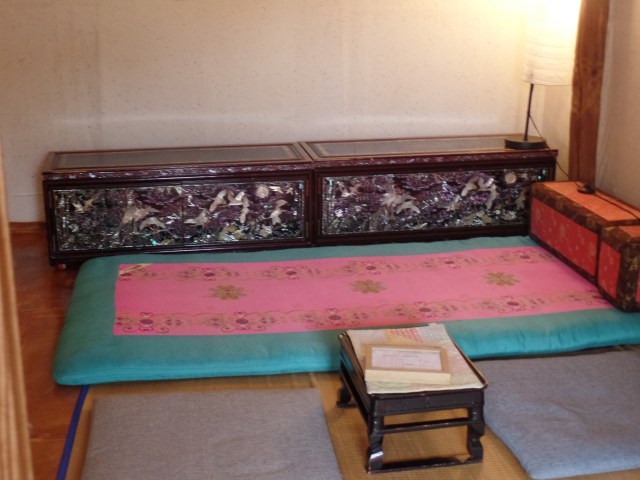
SAMSUNG CAMERA PICTURESFor those wishing to sip their tea in an indoor setting, there is a silk-covered mat, on which one sits cross-legged.  The pearl-inlay chest is a common decor in many Korean homes.
SAMSUNG CAMERA PICTURES

These yellow buttercups match their vase.

SAMSUNG CAMERA PICTURES

This small shrine blesses the garden plants.

SAMSUNG CAMERA PICTURES

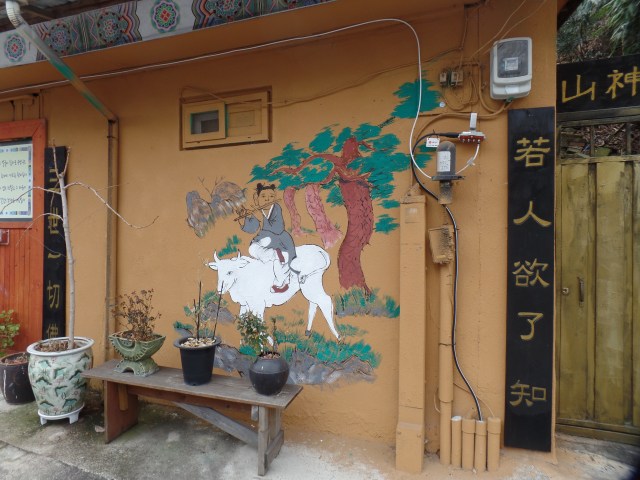
Outside this small shrine is a depiction of one of the scenes from the Ten Ox-Herding Series, an allegory of one man’s quest for spiritual enlightenment.

SAMSUNG CAMERA PICTURES

Here is a small Buddhist shrine.

SAMSUNG CAMERA PICTURES

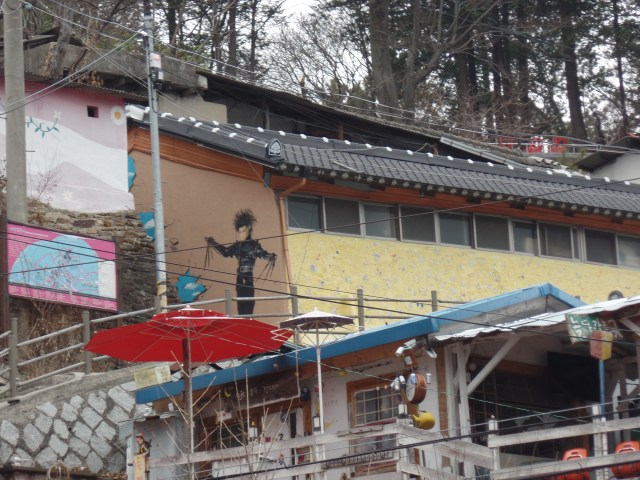
As we arrived at the edge of the highway, I looked across to the shanty, and spotted Edward Scissorhands.

SAMSUNG CAMERA PICTURES

We left the heights and went back down to the main street of Hanok, passing this traditional pavilion, a gathering place in Jeoson days.

SAMSUNG CAMERA PICTURES

Next, along the way, was the place where King Taejo was crowned first monarch of the Jeoson Dynasty.

SAMSUNG CAMERA PICTURES

The coronation courtyard is graced by this stone wheel, dating from 1392.

SAMSUNG CAMERA PICTURES

These stone lions guard the entrance to a nearby guest house.

SAMSUNG CAMERA PICTURES

Thus ended our four-hour visit to Jeonju Hanok Village.  There is much more to this bustling district.  Perhaps a future visit will mean an overnight stay.

Feeling the need for some rejuvenation, we went to Damyang Spa Resort, about forty minutes north of the farmstead.  There, we experienced sauna, hot and cold waters, and I underwent a thorough treatment from an exfoliation specialist, a sort of masseur, who scrubbed me, head to toe, with a rough cloth, then rubbed cleansing oil.

SAMSUNG CAMERA PICTURES