September 13, 2024, Manila- There are two schools of thought about Friday the 13th. One holds that both Friday and the number 13 augur badly. The other counters with the cultural artifact that the day is named for Freya, Norse goddess of love, war and fertility. It also is deemed unlucky, in Norse mythology, as Loki the Trickster was the thirteenth Norse god.
The Vikings may have given themselves reason to be conflicted about Friday the 13th, but I personally have never had any hard luck associated with the day. This day was no different. I was able to extend my time at Ola! Hostel, my dear friend arranged a nice group outing for tomorrow, as well as help me get a bus ticket for a visit to central Luzon, late next week. and I was able to join a study group from Arizona online.
Most of the day was quotidian, otherwise, but that has never been a bad thing. I helped with shopping, at an open air market and house sat, while the Baha;i Cnter’s caretaker went to tend to another matter.
July 25, 2024, Yachats, OR- As I awoke this morning, up in Kent, WA, and pondered my route for the day, I got a message: Astoria is calling, and you should spend the night in Yachats. The route to the tip of Oregon was easily set, and by 12:30 p.m., I was parked near Flavel House Museum. The place looked interesting, but I had limited time and there was a set of hoops to jump, just to purchase a ticket. I was more drawn towards walking downtown. Besides, my camera was acting up and I couldn’t get a clear shot of the house.
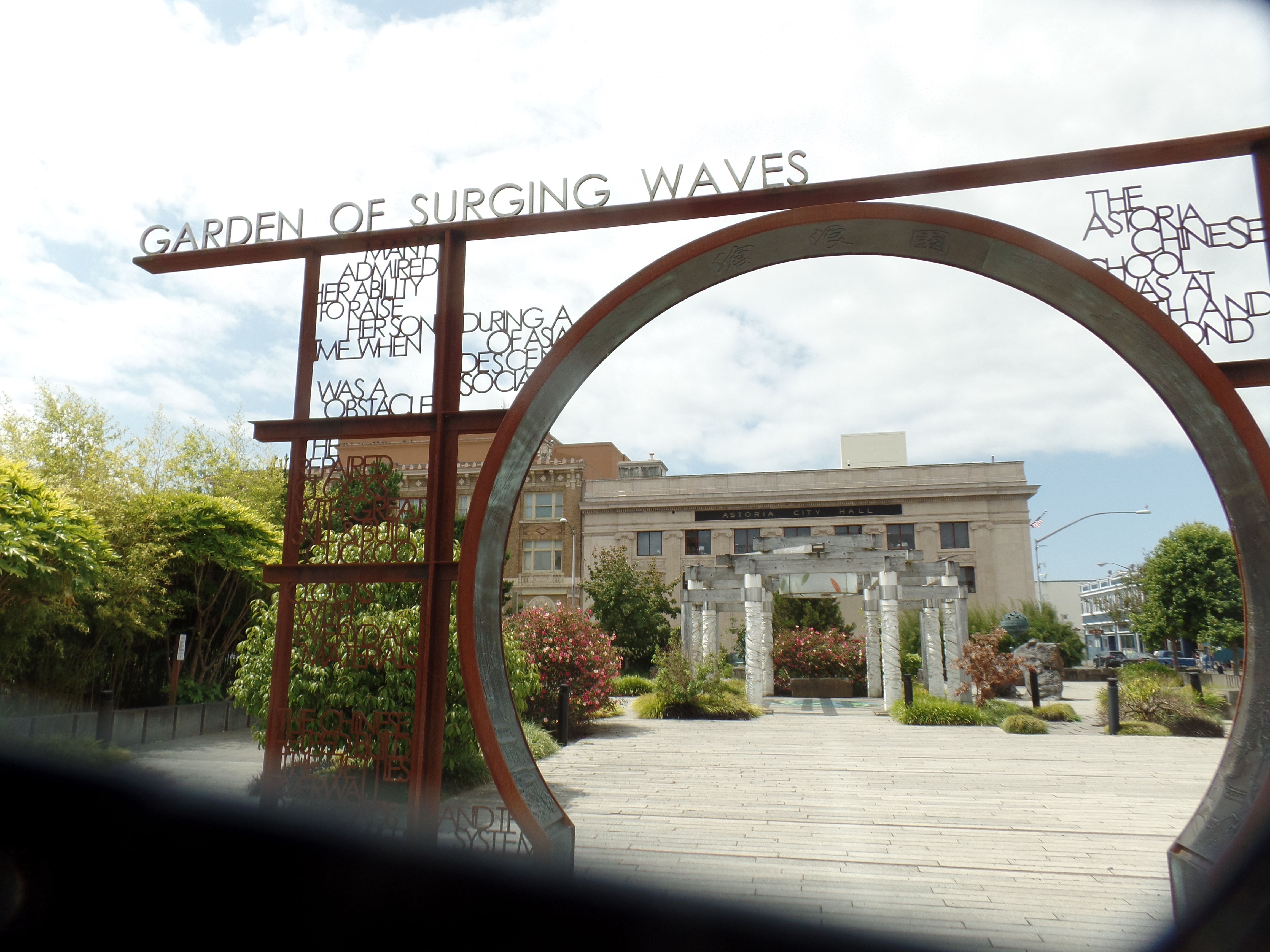
This lovely little park would not be denied, by a brief issue with a camera lens. It was established in 2011, on the occasion of Astoria’s bicentenary, to honour the contributions of the Chinese community in Astoria and the Columbia Valley. Text and art tell the story in a delicate and fitting manner.Astoria thus bookends with Lewiston, Idaho, in giving the Chinese immigrant community its due as builders of railroads, jetties, canneries and, in Astoria’s case, the sewer system. Lewiston has the Beuk Aie Temple. Astoria has placed its tribute outside.
Astoria also has its funky side, as seen at this Mexican restaurant, near the Cambium Gallery.
At Cambium, I sat and observed a potter at work, for several minutes, purchasing a lovely bowl as a gift for a couple who I plan to revisit tomorrow. As this is a working studio, I refrained from photographing her work.
The last stop in Astoria was at its Column. High atop a promontory, on the city’s east side, is the tower erected in honour of John Jacob Astor, the community’s founder. Along with two dozen other people, ranging in age from 4-86, I made it up 164 steps and saw these views:
NorthwardWestward
After descending the stairs, it was time to leave Astoria. Cannon Beach was the next brief stop, and afforded the day’s most heart-warming surprise.
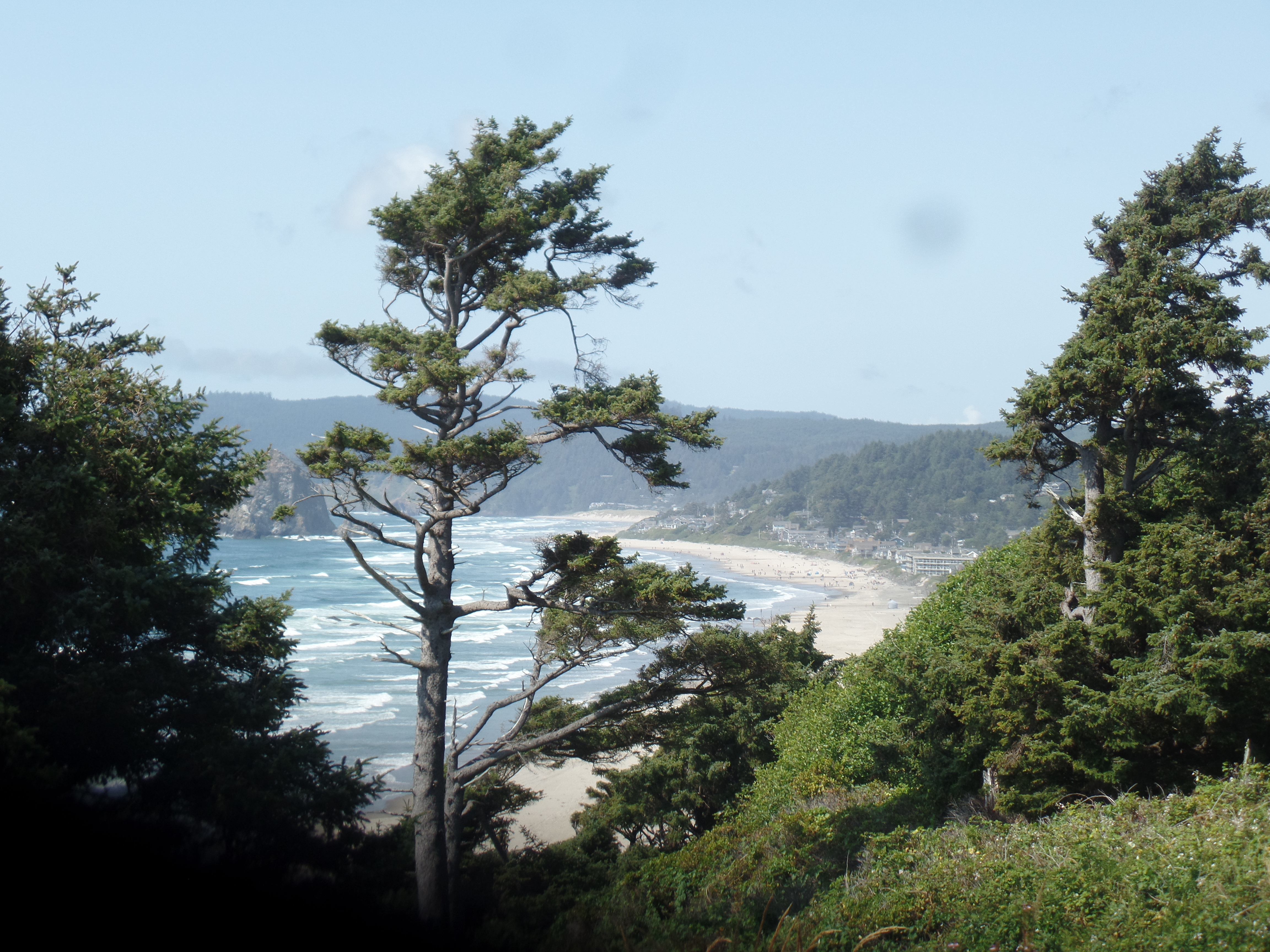
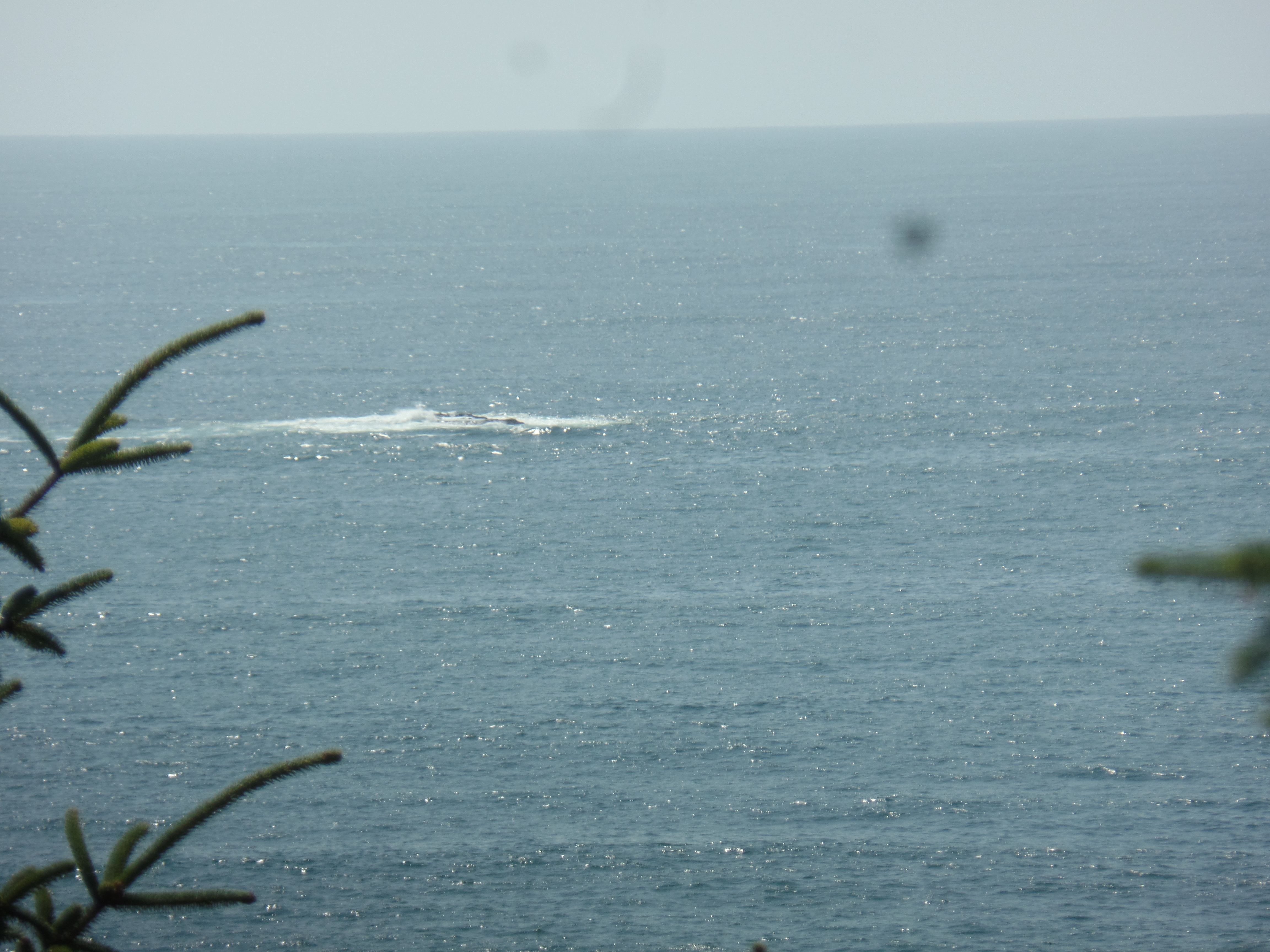
View of Cannon Beach, from overlook to the south.There, in a deeper cove to the south of Cannon Beach, was a pod of gray whales at play. I was able to gather a group of about twelve people to watch the festivities, so there were a number of photos taken, in the ensuing ten minutes. The cetaceans kept jumping about, during that time of astonishment on the beach.
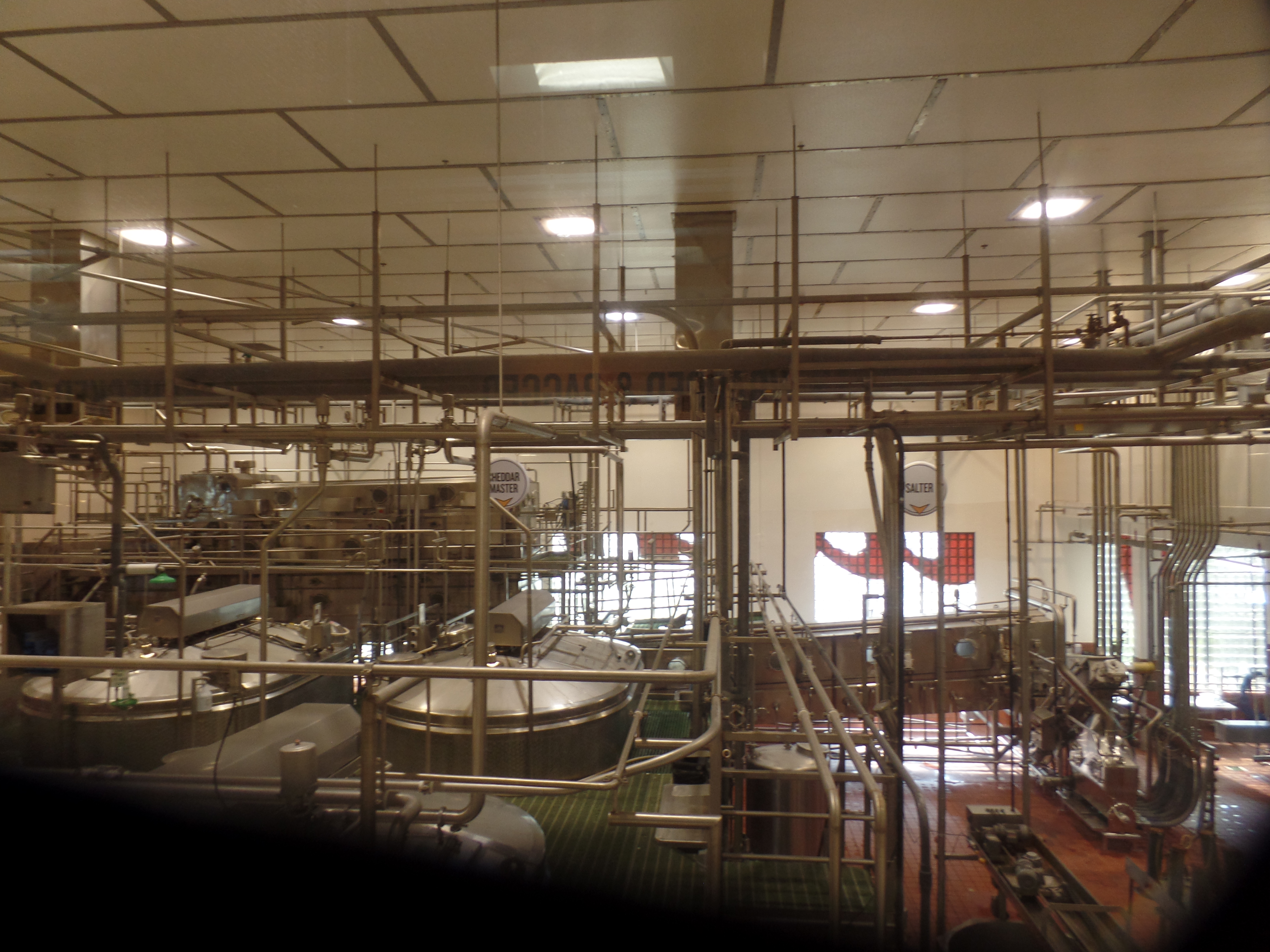
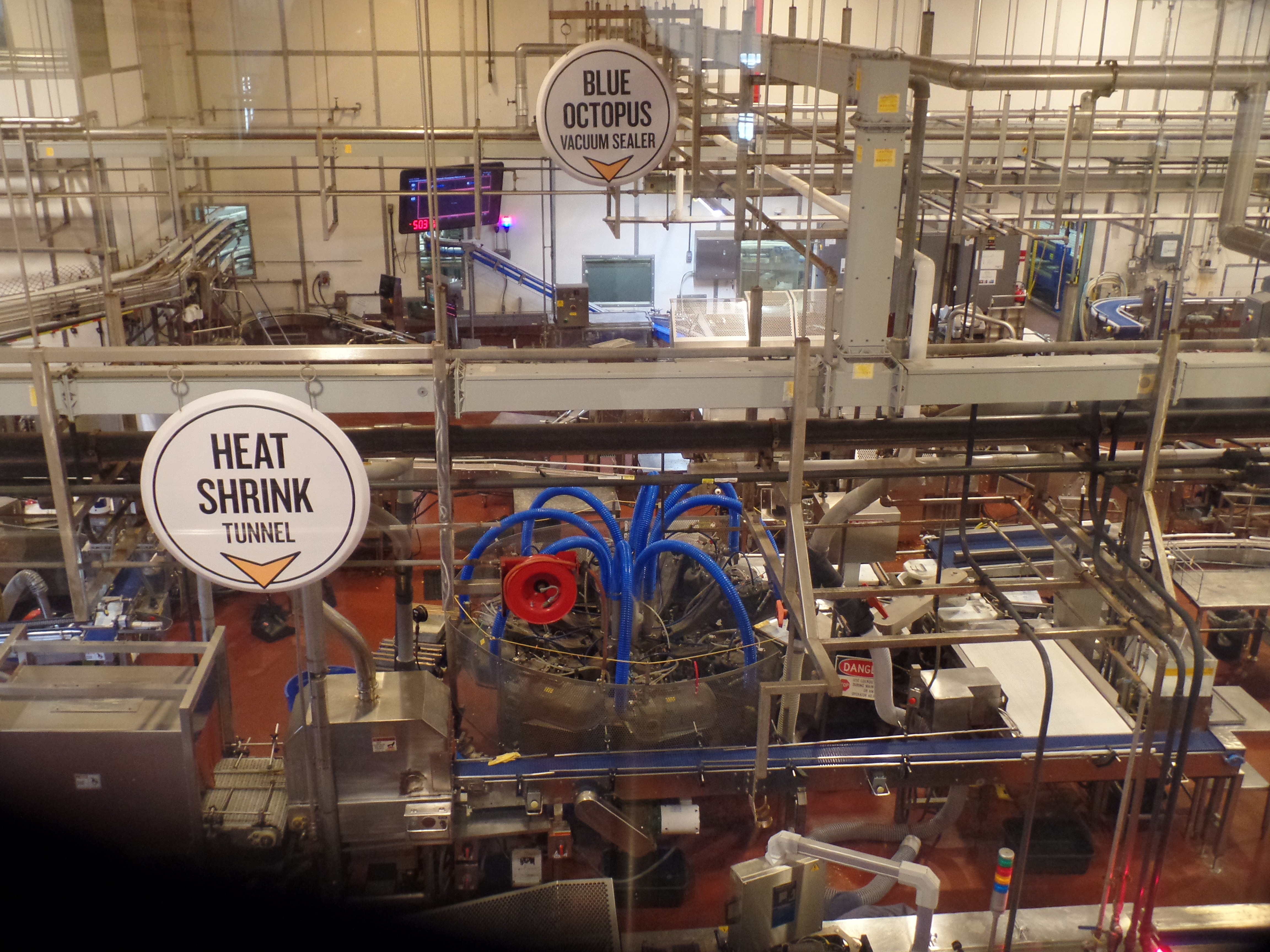
My last wonder of the day was of a mechanical type: Tillamook Creamery’s cheese factory. The second floor of the creamery offers a viewing of the machines that are used in cheese-making and an explanation of what the human workers, and a few robots, do at each step of the process.
Vats, where fresh milk is heated. Curds are then separated from whey.Salt is then added to the coagulating mix.Finally, once the cheese has been cooled and is formed into blocks, it can be cut into smaller blocks or sliced into sheets and packaged. The Blue Octopus is a machine that packages and seals the finished cheese products.After the self-guided tour, it was time to get to my lodging, so back to Yatel it was. Dinner was down the street, at Sea Note- a relaxed repast of clam chowder, followed by baked oysters and spinach, at bar side. I couldn’t ask for a more comforting end to a great day on the coast.
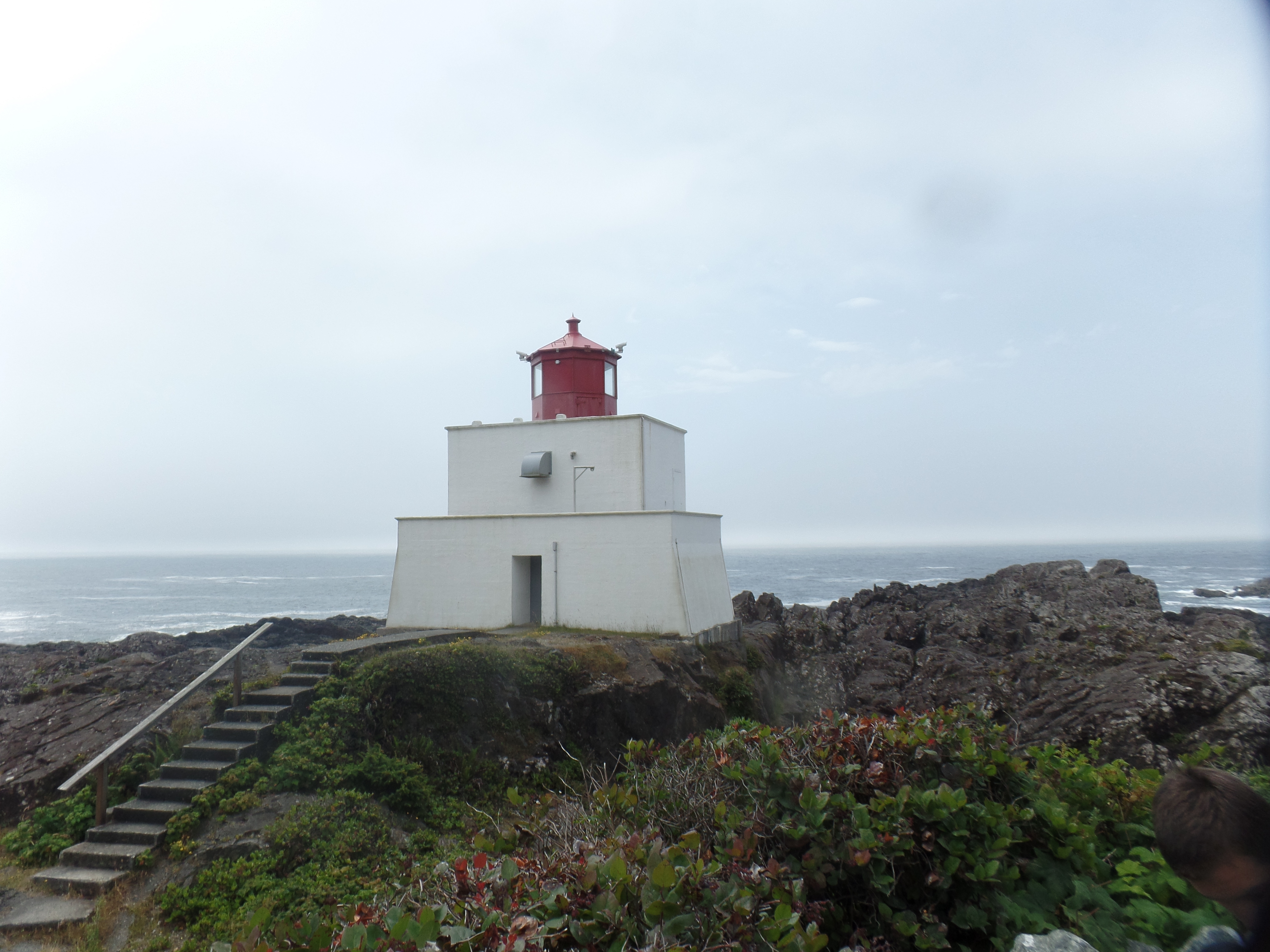
July 23, 2024, Halfmoon Bay, BC- The excited children swore they had just seen harbor seals diving down to get fish, near the closed-off Amphitrite Point Lighthouse. It well could have been, as humans can’t get close enough to the actual lighthouse to disturb any marine animals, but the field of vision is certainly clear enough.
Amitrite Point, UclueletAmitrite Lighthouse, Ucluelet. It is rather compact, but from its vantage point on the headland, the job got done.
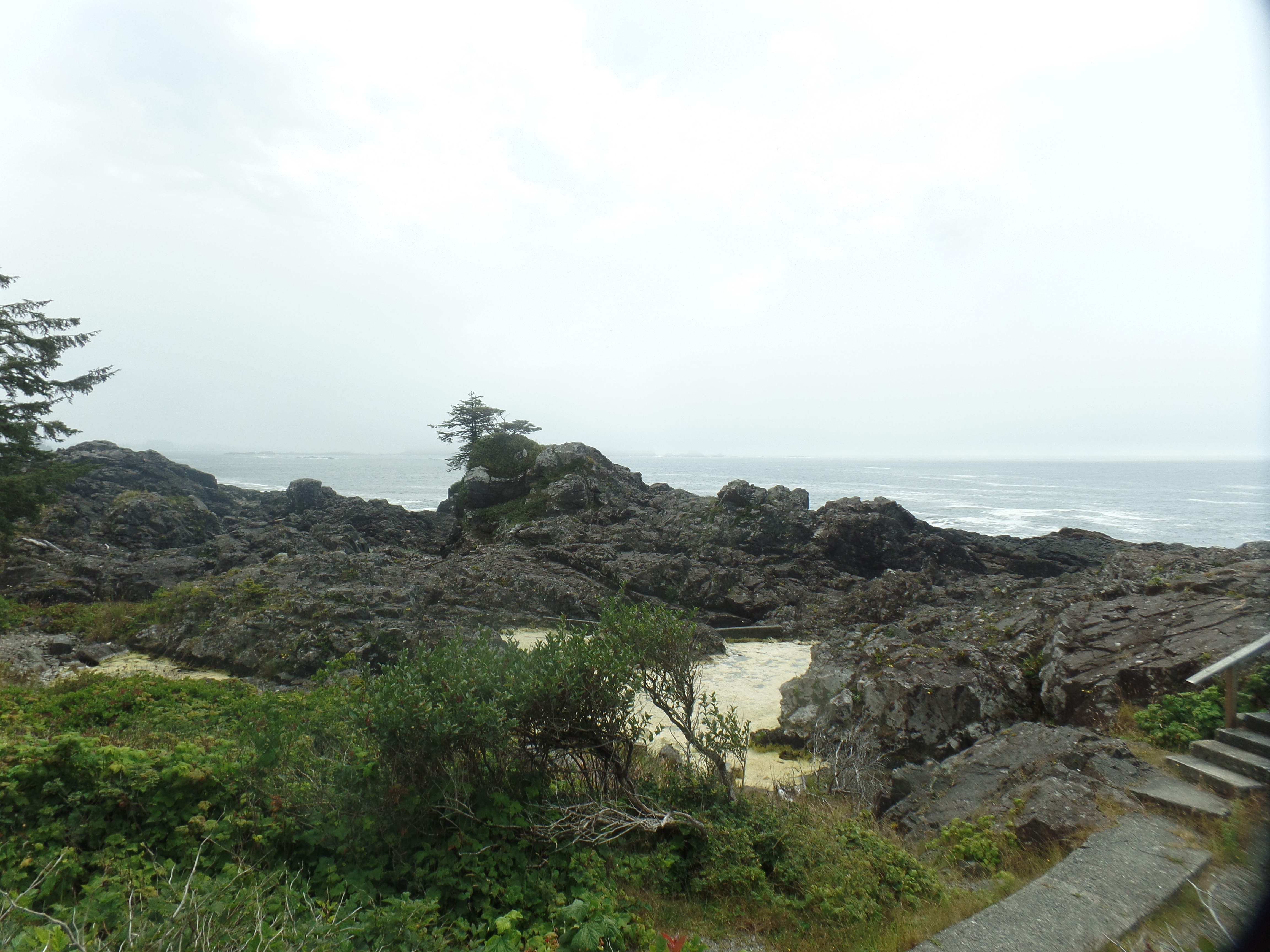
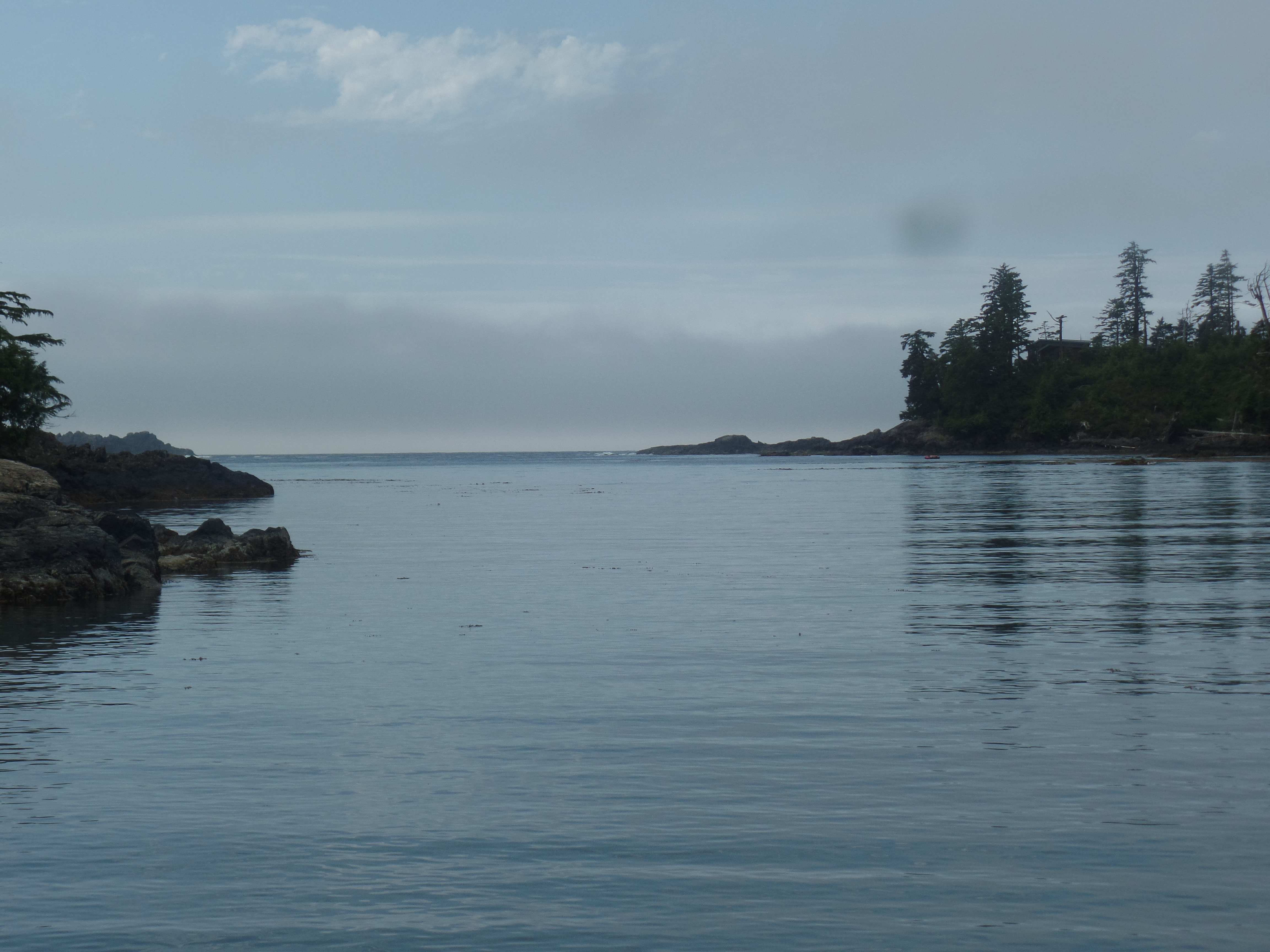
Just north of Amitrite is Little Beach. From this small cove, one may gaze out southwestward. This is not the southern edge of Vancouver Island-that would be Victoria, from which one could see the Olympic Peninsula, on a crystal clear day. From Little Beach, there is nothing but ocean, all the way to Japan-from which the currents brought debris from the Fukushima earthquake and tsunami.
The westward view, from Little Beach, UclueletLittle Beach, UclueletA lusher view of Amitrite Point-the trailhead of Wild Pacific Trail. Lighthouse Loop, which begins at Amitrite Point, is one of two segments of the “WP”, and is 2.6 km. The other segment goes from Big Beach to Rocky Bluffs (5 km, each way) and has a 1 km spur to the Ancient Cedars. I had a ferry to catch, so Yes, I “missed the Ancient Cedars”-though not entirely. Cathedral Grove presented a second chance, en route to Comox.
First, though, was a fine, lightly-milky bowl of seafood chowder, at Cedar Grill. Soup lunches have hit the spot lately, and this was no exception. It had the feel of Puget Sound-style chowder, with halibut, clams, scallops and lobster in the bowl.
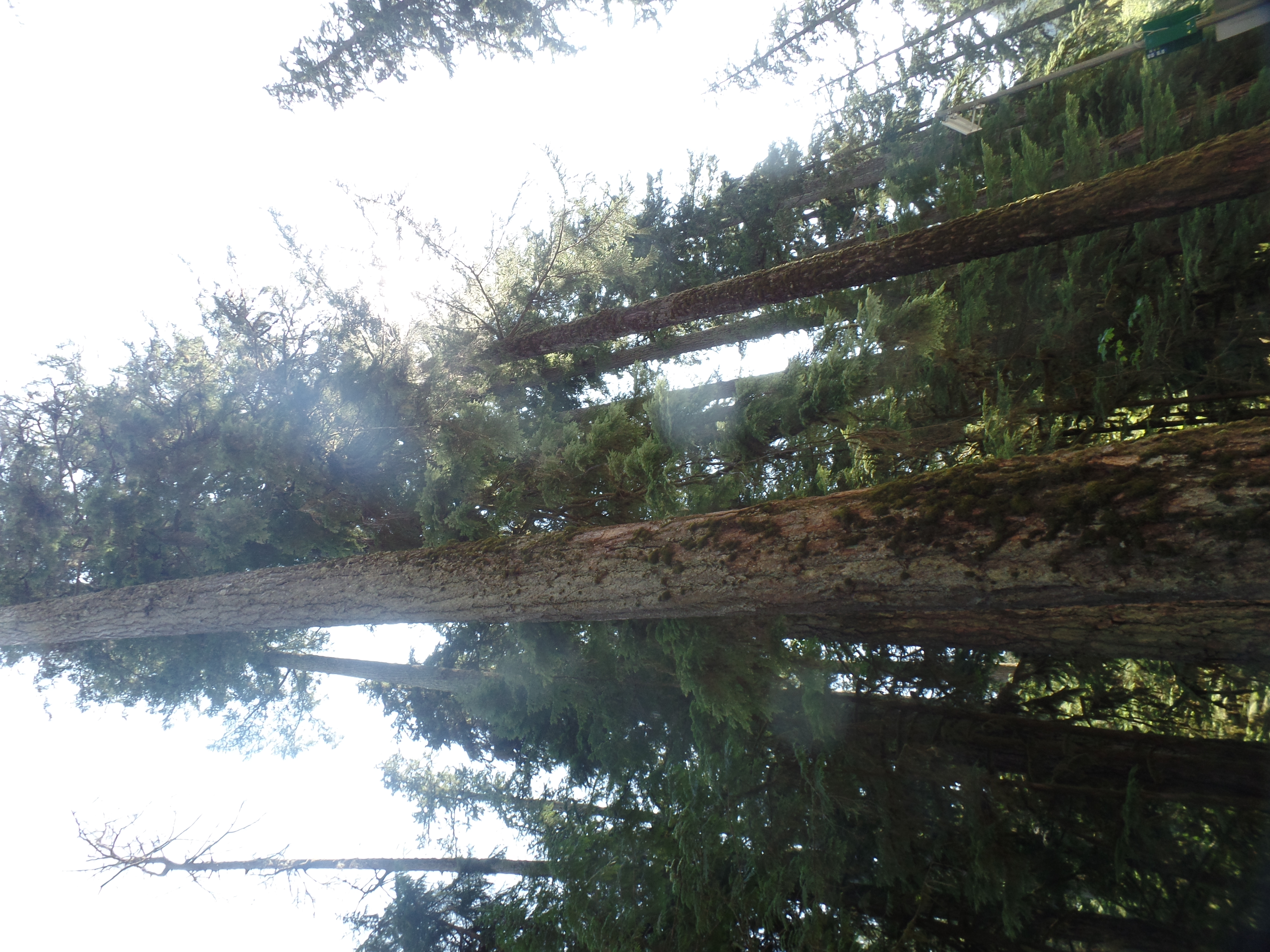
Cathedral Grove, near Kennedy Lake,BC. Pardon the sideways view-WP has no provision for rotating.
Once past Port Alberni, I was back on the eastern shore of Vancouver Island. Around Deep Bay, there are several spots to enjoy the calmness of the Inside Passage.
Rest area, near Deep Point, Vancouver IslandBuckley Bay, looking towards Denman IslandOnce at Comox, I was able to relax a bit at the ferry terminal. Here is the jetty, pointing eastward. It was a smooth ride, and a trio of us spotted a bowhead whale spouting, off the starboard bow. The whale was almost guiding us.
As it happened, once in Powell River, Sportage was the first vehicle off the boat, and so I bid farewell to Vancouver Island and hail to the Sunshine Coast. I was soon at Marland Motel, and in a clean, comfortable room, despite Google trying to tell me that the place was closed! Not so, according to the owner, who was grateful for those of us who checked in and stayed the night!
July 22, 2024, Halfmoon Bay, BC- The earnest young guide touted West Coast Trail, a strenuous 75-mile trail that incorporates just about every skill a wildland fire fighter, or candidate for the Survivor reality series, would need in order to meet with success. He is in university, and so has not set aside his own time to do the trek-but I could see in his eyes that the will is there. The trail’s northern terminus is near Bamfield, southeast of the Ucluelet-Tofino main segment of this Reserve. Its southern trailhead is just northeast of Port Renfrew, which itself is 110 km west northwest of Victoria. The route is on par with Newfoundland’s East Coast Trail, Ireland’s Wild Atlantic, the Florida Trail, Rim-to-Rim in the Grand Canyon and Michigan’s Keweenaw Peninsula Trail. It would be a good prep for an Appalachian, Pacific Crest, Continental Divide, Colorado, or Arizona Scenic trek.
My own short hikes today gave me a good sense of what a dedicated exploration of the area would entail. Stops were at Radar Hill, Grice Bay, Combers Beach, Rainforest Trail and Kwisitis Visitor Center (where the young man was touting the trail.)
Here are scenes from those spots.
Approach to Radar Hill. This site has the remnants of a World War II era Canadian Forces radar station, which kept watch for any Japanese incursions into Canadian airspace.
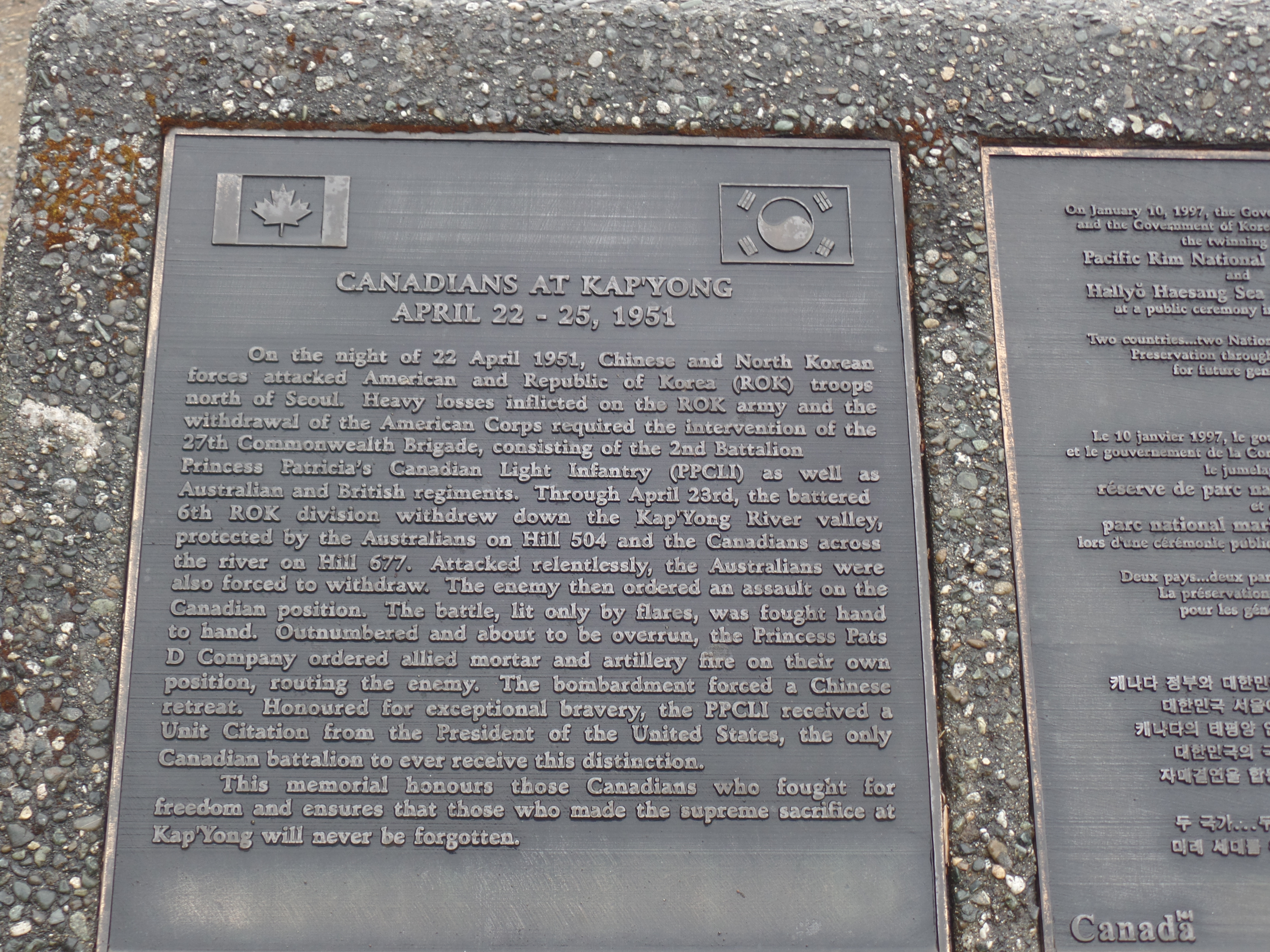
Canada was a key member of the Allied forces in the Korean War, as well. This plaque commemorates the Canadian Forces’ landing at Kapyong.
Commemorative ciinul for Radar Station. Like indigenous people in the United States, First Nations people in Canada were all-in, for defending the homeland during wartime.
Grice Bay lies about three kilometers east of the main Pacific Rim (Tofino-Ucluelet) Highway. It’s a major recreational fishing area, as one might expect, and there were quite a few boats being launched, while I was checking the place out.
View of Grice Bay from the west.Southwest view of Grice BayDolphins were moving about the bay-also looking for fish.Incinerator Rock is a spot popular with surfers, just north of Rainforest Trail and Combers Beach.
The trail to Combers Beach has several elements of the rain forest, in and of itself.
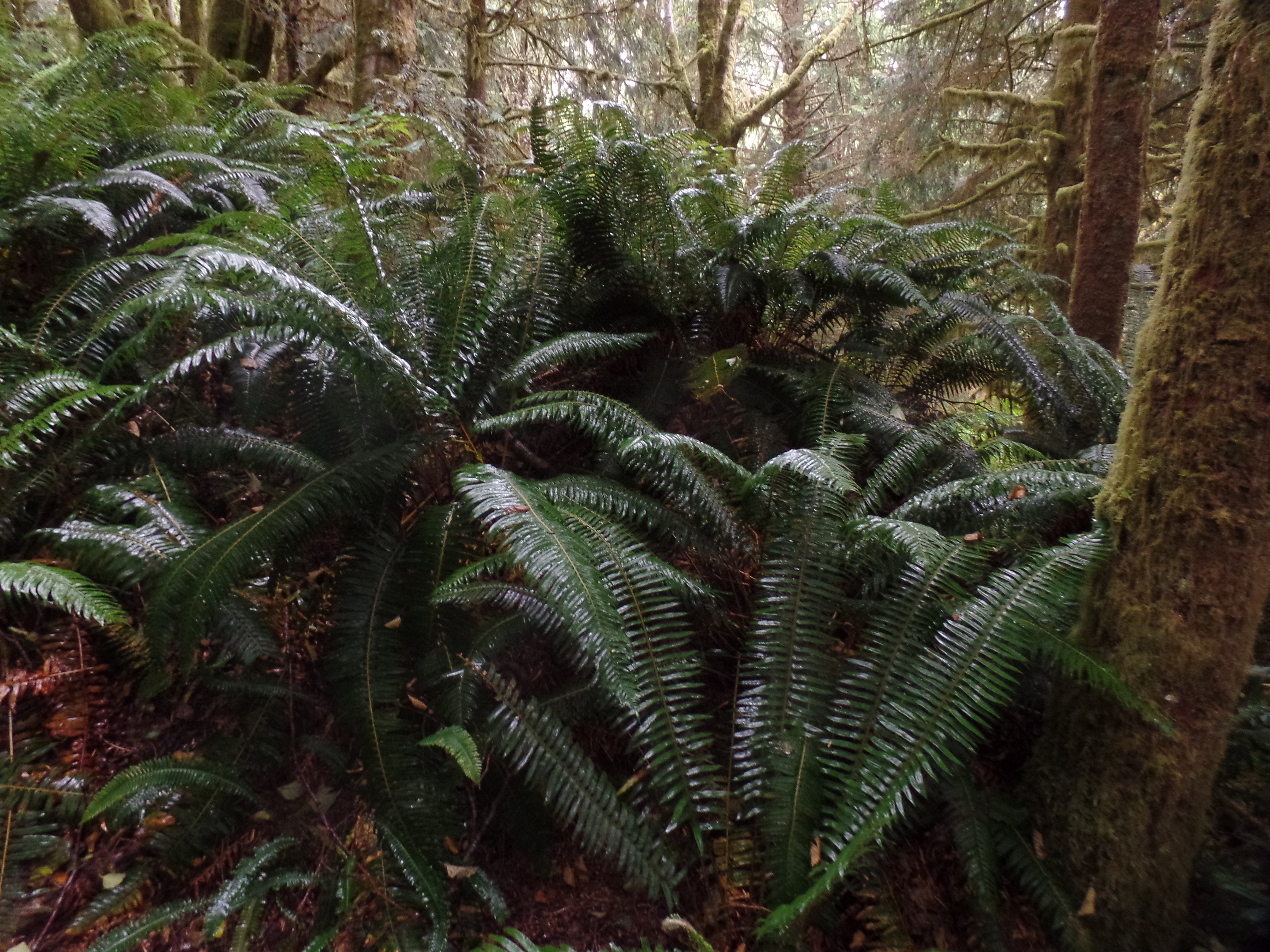
Looking at these giant ferns transported me to the Silurian Era.Huckleberries abound at Combers Beach.
Driftwood forts are everywhere at Pacific Rim. Combers Beach reminded me of Kalaloch, Washington, in that respect. (Next two photos)
This looks like a fair shelter from a storm.
The surf at Combers looks as enticing as any I’ve seen, north of Doheny. The beach is famous for its riptides, and guidance on how to handle a riptide is prominently displayed here.
Incoming tide, Combers Beach
Next up was Rainforest Trail. It was not really redundant, after the Combers experience, reinforcing the importance of recognizing the fragility of both the water table and the soil. Water storage is not strong here, because the soil is so thin. For communities like Tofino and Uculuet, this means taking strong conservation measures, despite the high average yearly rainfall. Rainforests endure more droughts than one might think.
Canopies help to preserve water, by limiting sunlight.
Red cedars, Rainforest Trail, Pacific Rim.Sitka spruce coexist nicely with red cedars.Saplings, springing up, guard the soil’s moisture even more.
Finally, at Kwisitis, there was a feast of driftwood and black basalt.
Wickawinnish Beach, KwisitisBasalt outcroppings, Kwisitis
In this Visitor Center, we learned much about the sacredness with which the Tla-o-qui-aht and neighbouring nations approach the whale hunt, to this day. The bowhead is taken with the same reverence that other Indigenous hunters approach the hunting of bison, deer or elk. The entire animal is put to use, once the kill is made, and there was/is a strict limit on the hunt.
The balance of nature weighs on the minds of all who wish to see our Planet thrive. The Nuu-cha-hulth-aht, of Ucluelet, are no exception.
July 21, 2024, Powell River,BC- I must have looked like a duck out of water, clad in t-shirt and shorts, in 55 F (12.7 C) and cloudy weather. A Tofino pull-over hoodie presented itself, and so the duck was back in the water, in short order. The few small children present appeared to breathe a sigh of relief. The adults, being the flinty sort, were more “Well now, that shows there’s a light on upstairs, after all, eh?” Thus it goes, when one finds slivers of foggy dew, after days of high heat, even ten kilometers inland.
Tofino, and its sister town, Ucluelet, are the north and south anchors of Pacific Rim National Park Reserve, western Vancouver Island’s well-visited gem. I first heard of the place, when sent a recording of a young girl prodigy from there, and was drawn to its artsy vibe. Friends who had been to the area corroborated this rather laid back aura, but said it was getting somewhat more commercialized. So, as with any other place that sets forth competing reputations, I had to go see for myself.
This brief break from Baha’i-centered visits took me to Whalers on the Point Guest House, at Tofino’s north end. The name refers to the whale hunting traditions of the Tla-o-qui-aht (“Clayoquat”, in English parlance) First Nation and their neighbours along V.I.’s west coast, as well as of the Makah people, across the Strait of Juan de Fuca. The large and comfortable, family-friendly hostel was a beehive of activity, especially in and around the kitchen. The ambiance, though, was most welcoming.
Between an evening sunset stroll (at 9:45 p.m.) and a longer walkabout in the downtown area, this morning, I got a sense of Tofino life. Here are some scenes.
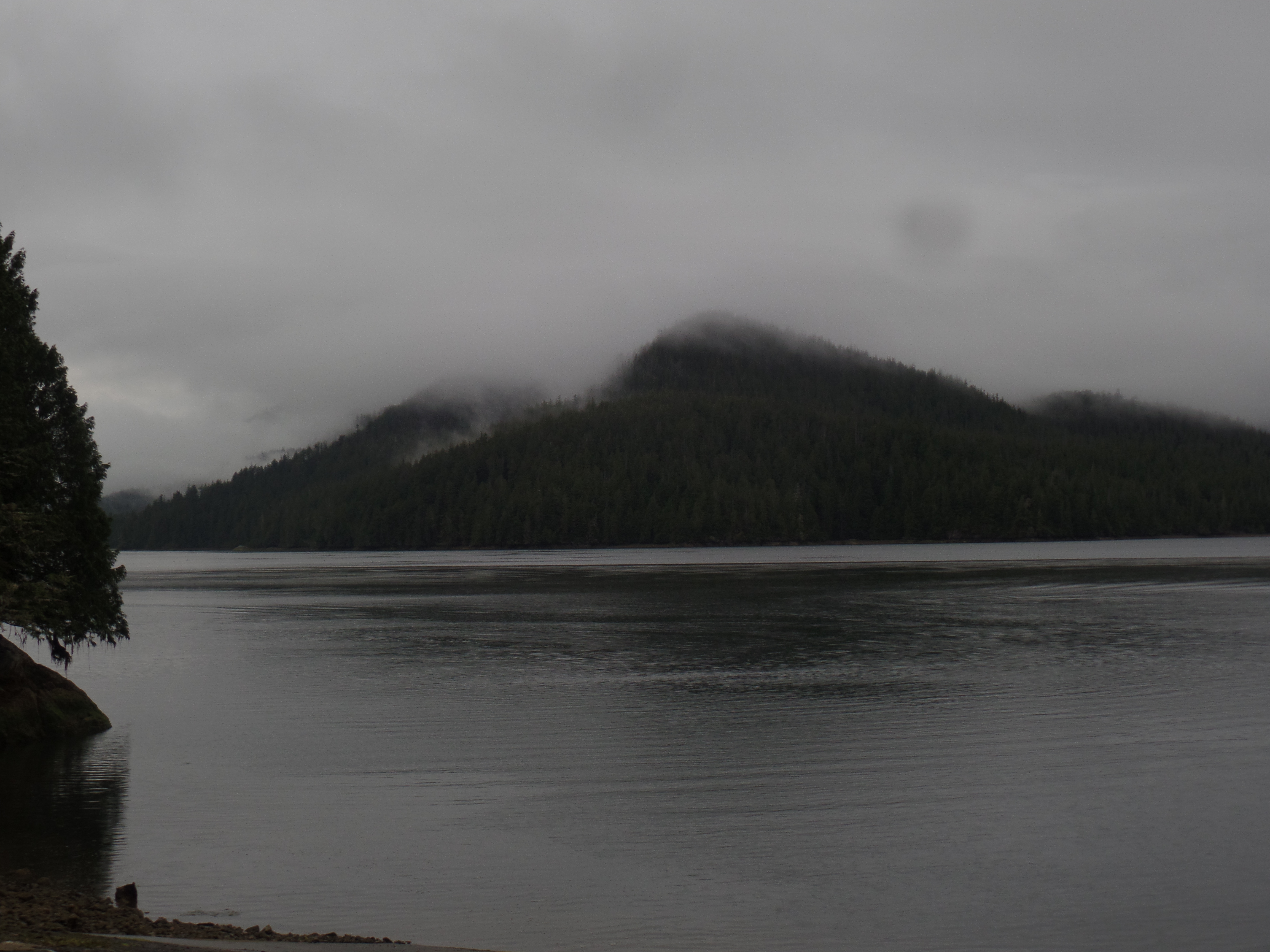
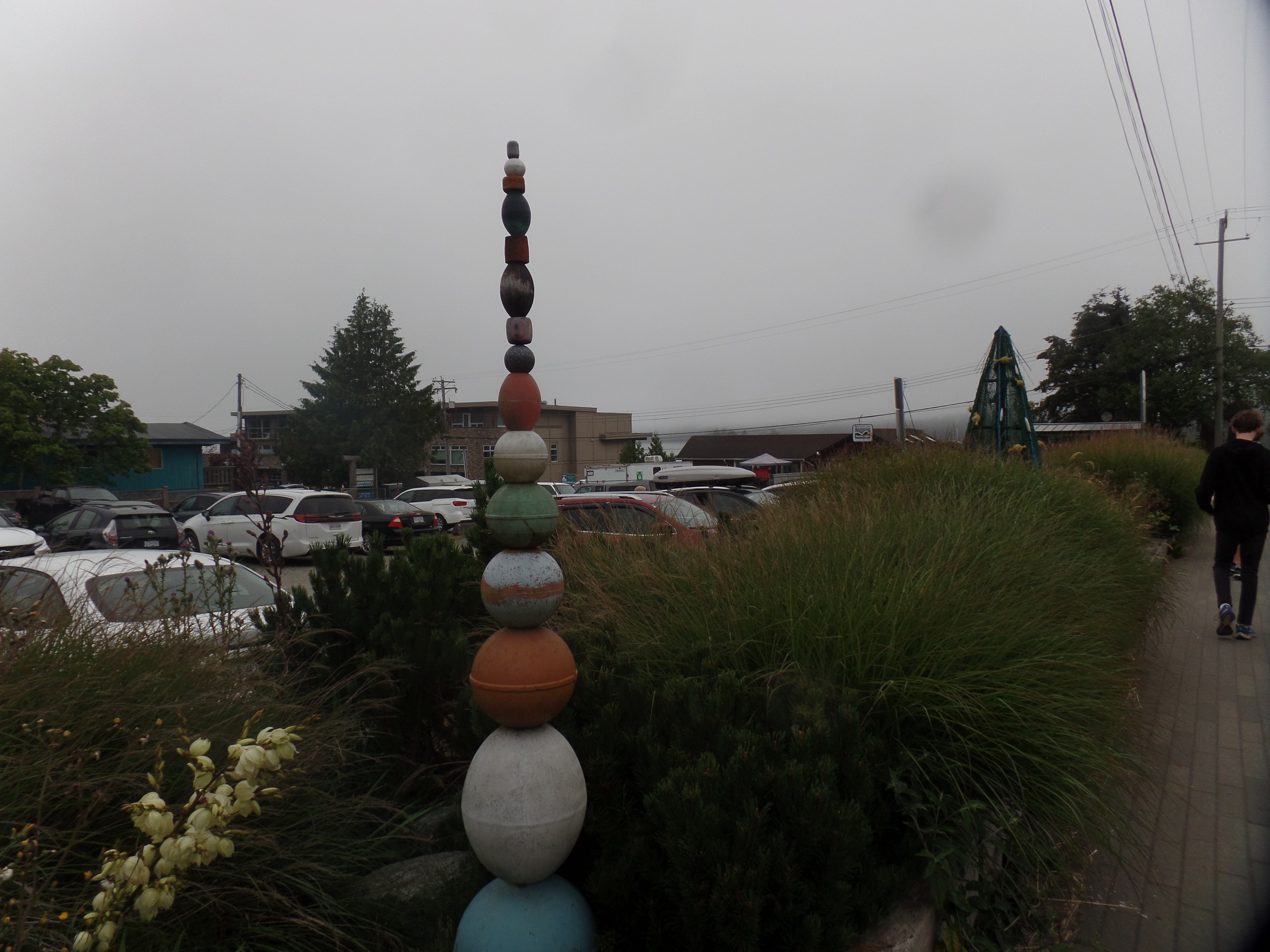
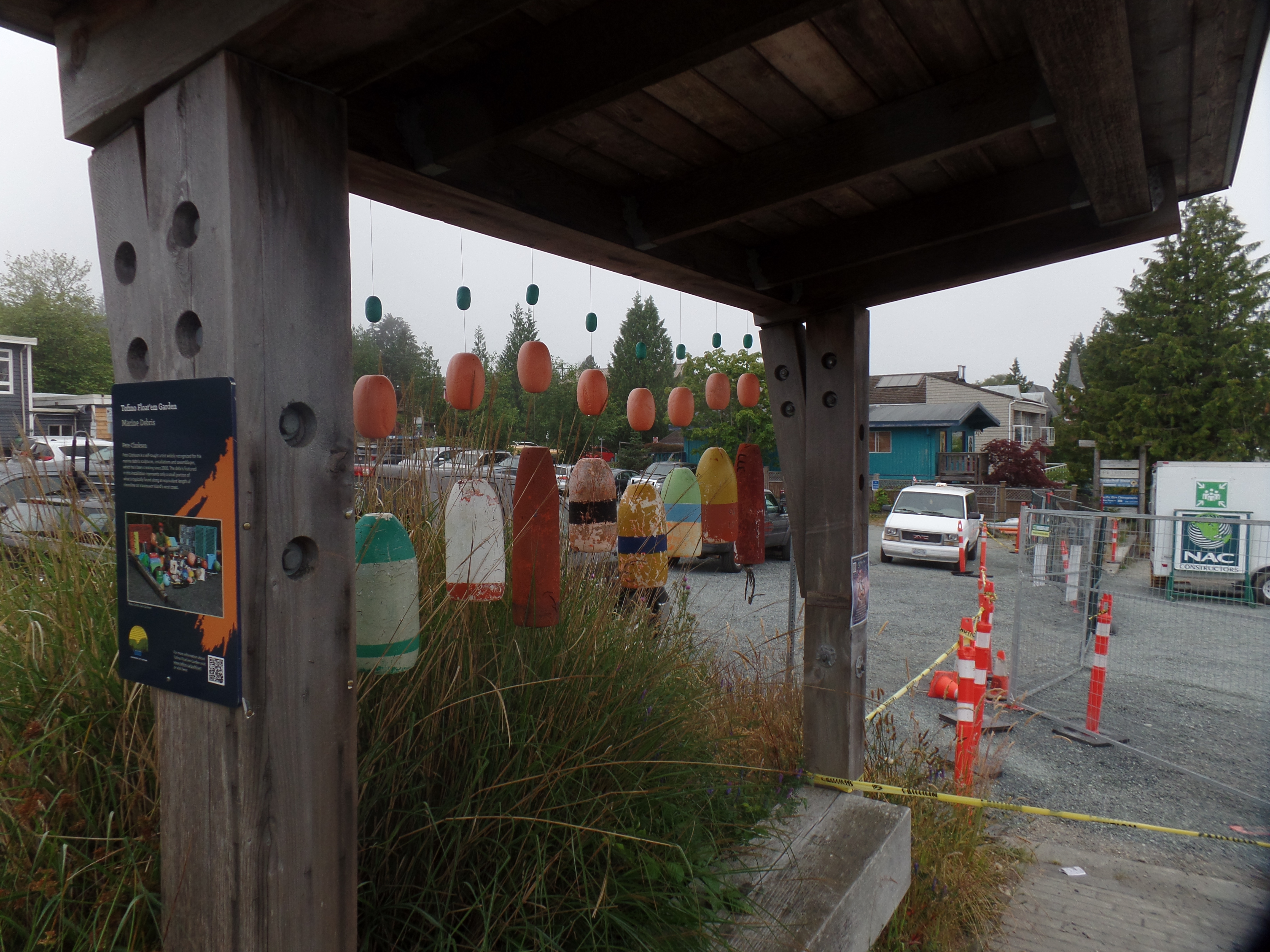
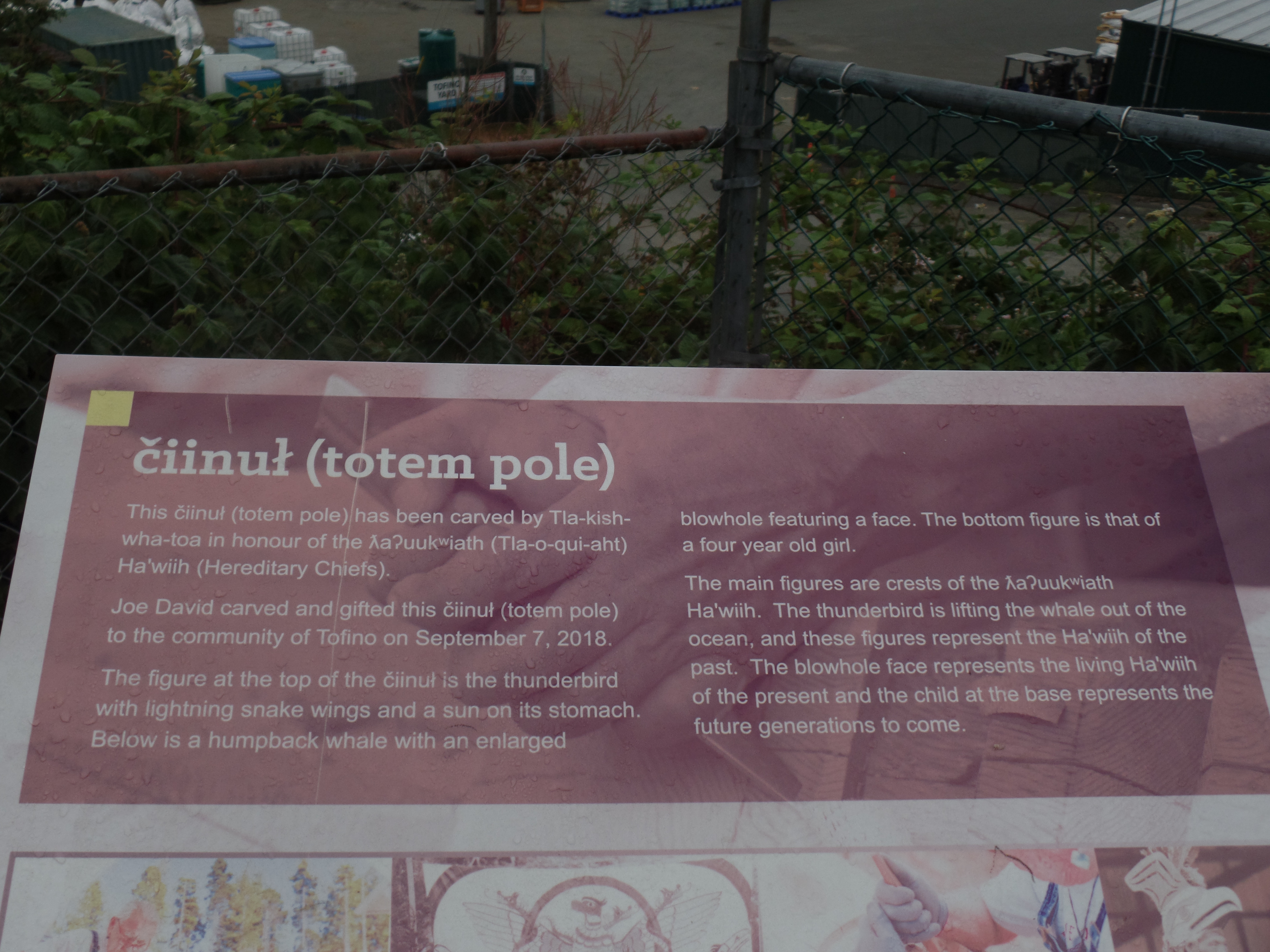
The salubrious hostelClayoquot Sound, on a foggy Sunday morningThe entrance to Tofino’s children’s parkSalvage art, part of a display by Pete Clarkson, a marine debris collector. His Washed-Up Workshop has several pieces in this unique downtown garden.Another of Pete’s piecesCiinul (totem pole), with explanation below:
So I found this earnest community, of First Nations people and eclectic artisans. Now, it was time to check out the National Reserve itself.
July 18, 2024, Bellingham, WA- I went in the out door, so to speak, this morning. Parking with Sportage’s nose to the curb, in a “back-in” zone, I took two photographs of nearby buildings, got back in the car and carefully backed out, watching for any vehicles that might have come along-and which would have had the right of way. There were none, so on I went to Tacoma’s Old Town. I rarely, if ever, do such things, but have learned to not hide from judgment or ridicule, when they do happen.
Ownership of missteps is often absent, or only grudgingly done, in modern life. We fear judgment and ridicule, but you know they are going to come along, anyway. So, why fear, run or hide? I apologized to someone I love dearly, this evening, because it was the only thing to do, under the circumstances. Erich Segal was off-base, when he wrote “Love means never having to say you’re sorry.” It is the first thing that someone who has heart must say, when a loved one is hurt. Apologizing to my late wife, to our son, to a beloved student or client, to a dear friend, has been de rigeur, when I go on a wrongful tangent.
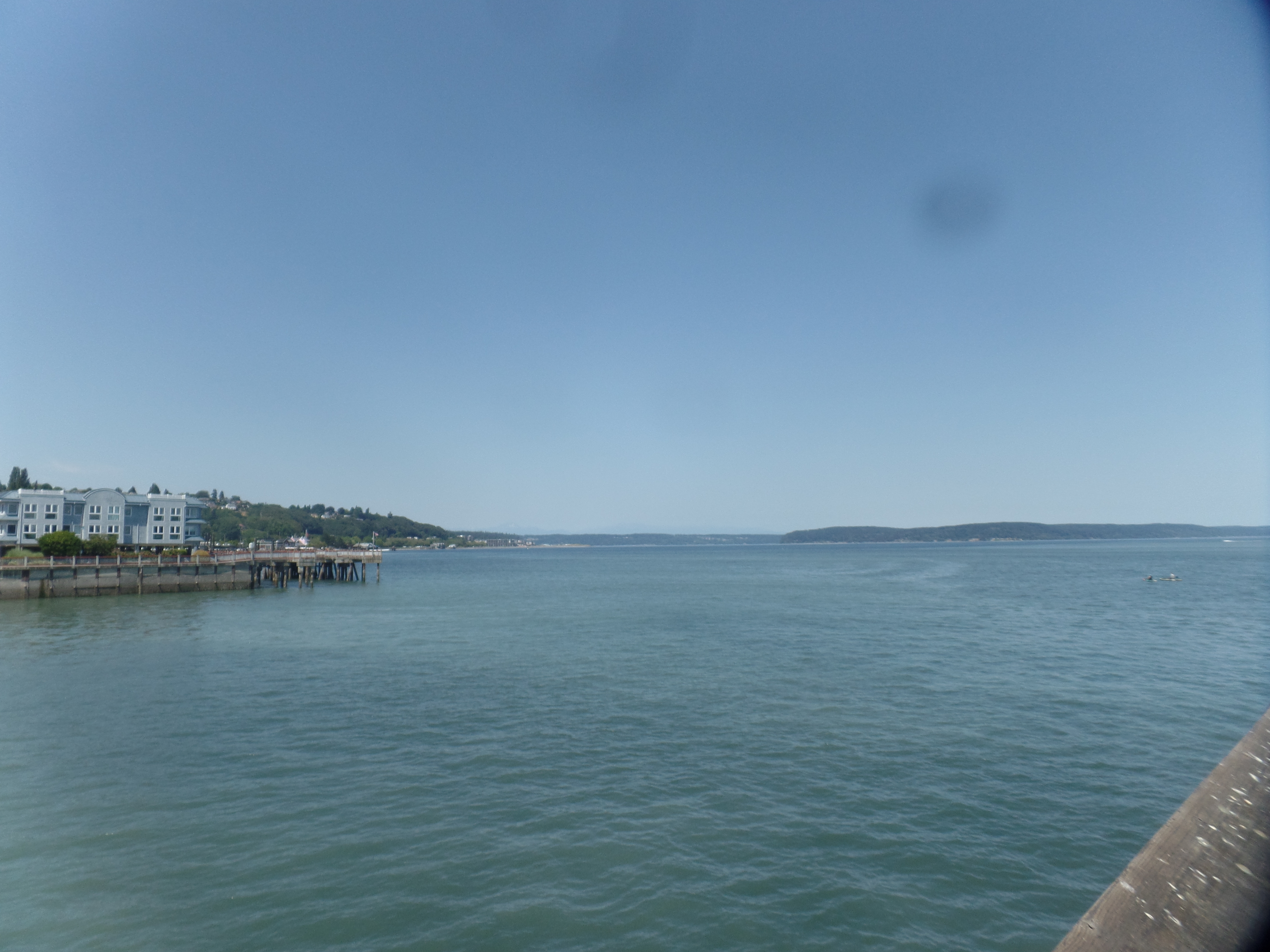
Today, otherwise, was a fine day, partly spent in and around Tacoma’s Old Town and waterfront area, meeting with an old friend from Xanga, and her husband and patiently navigating the heavy traffic, from Federal Way to Mount Vernon. Seattle rivals any other major city, in the thickness and slowness of its major thoroughfares’ traffic. It is best to make do. Owning up also means pushing forward, without moaning about short-term circumstances.
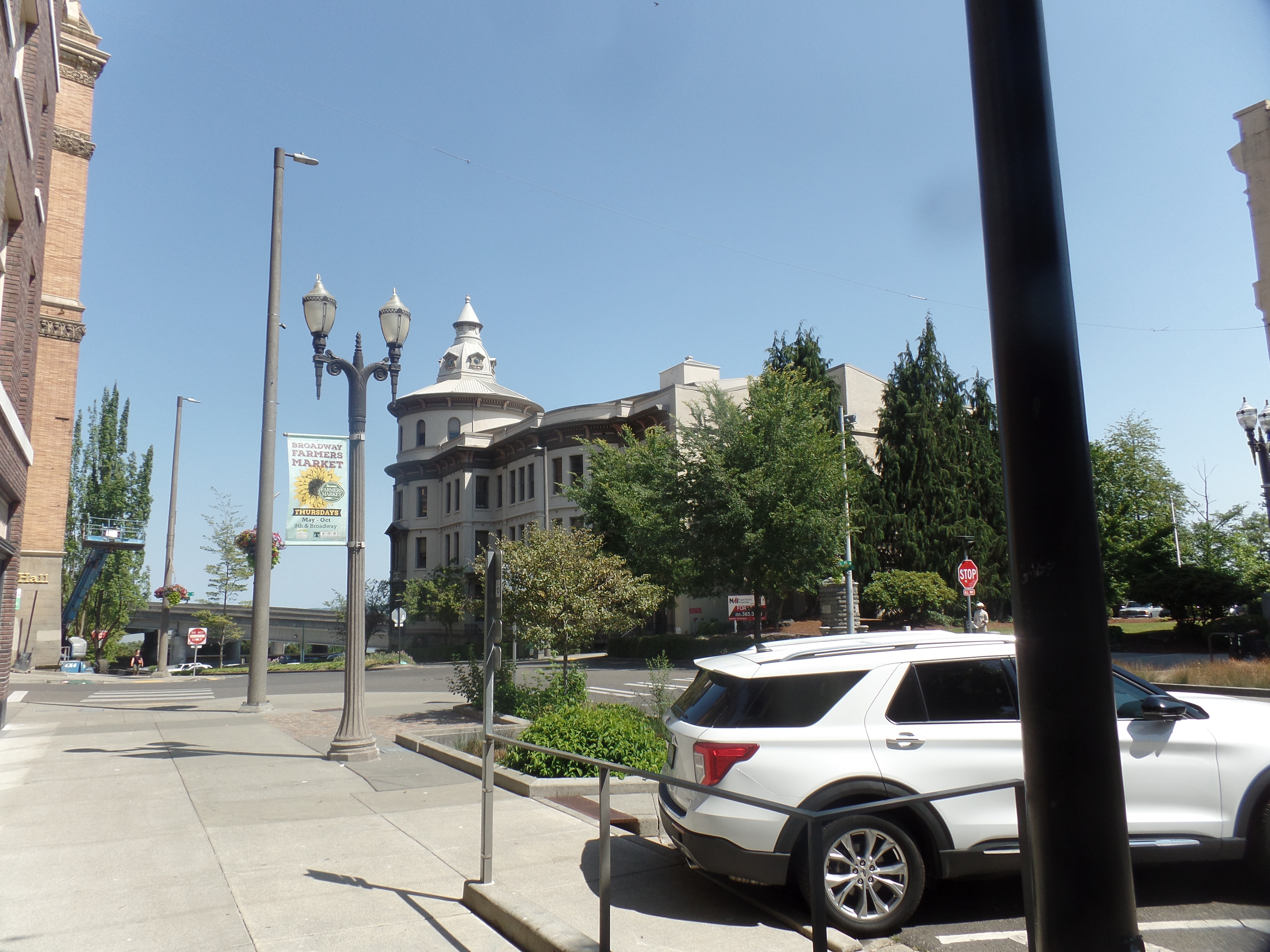
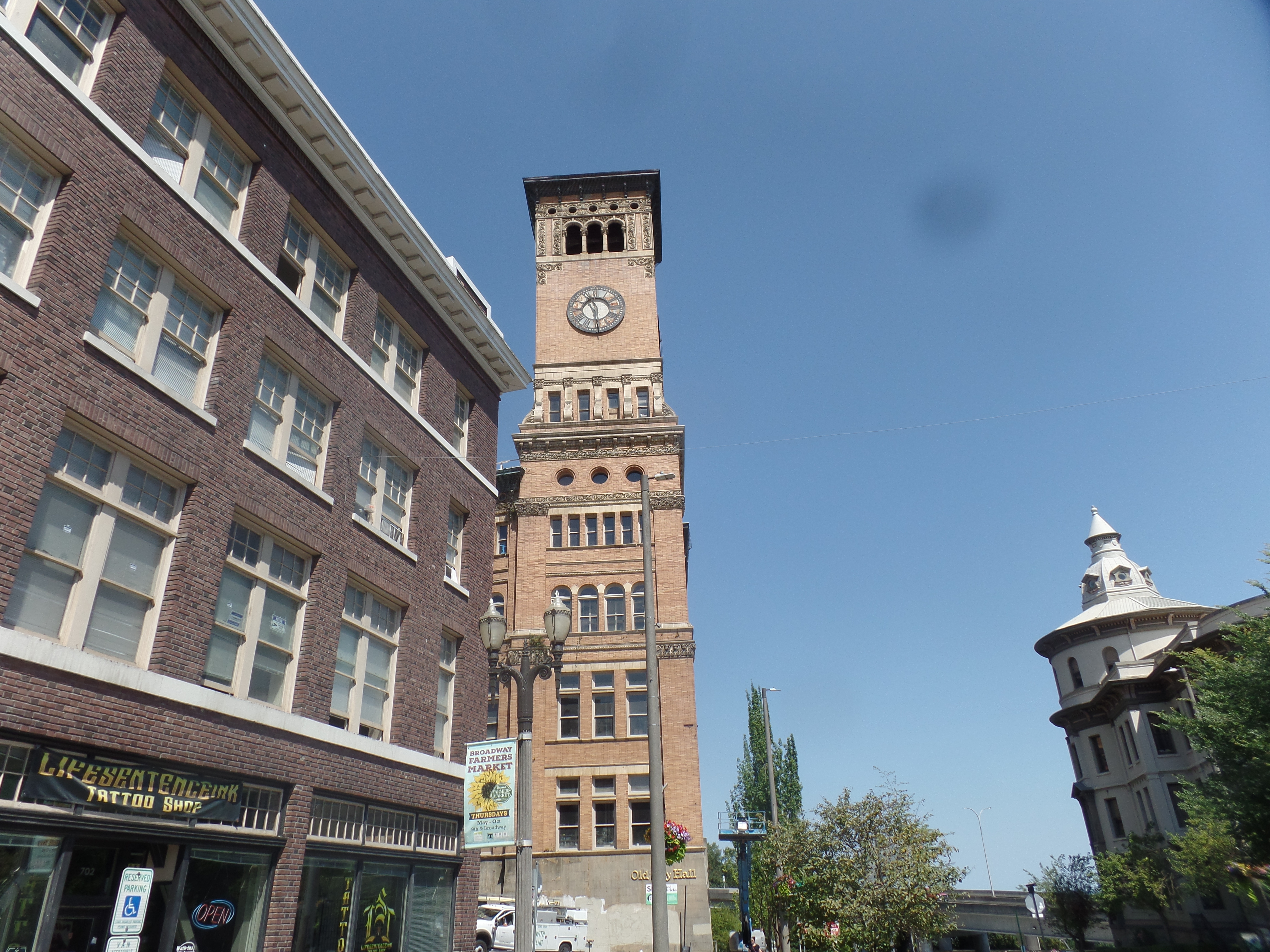
Here are some scenes from Tacoma, an underrated gem of the Pacific Northwest.
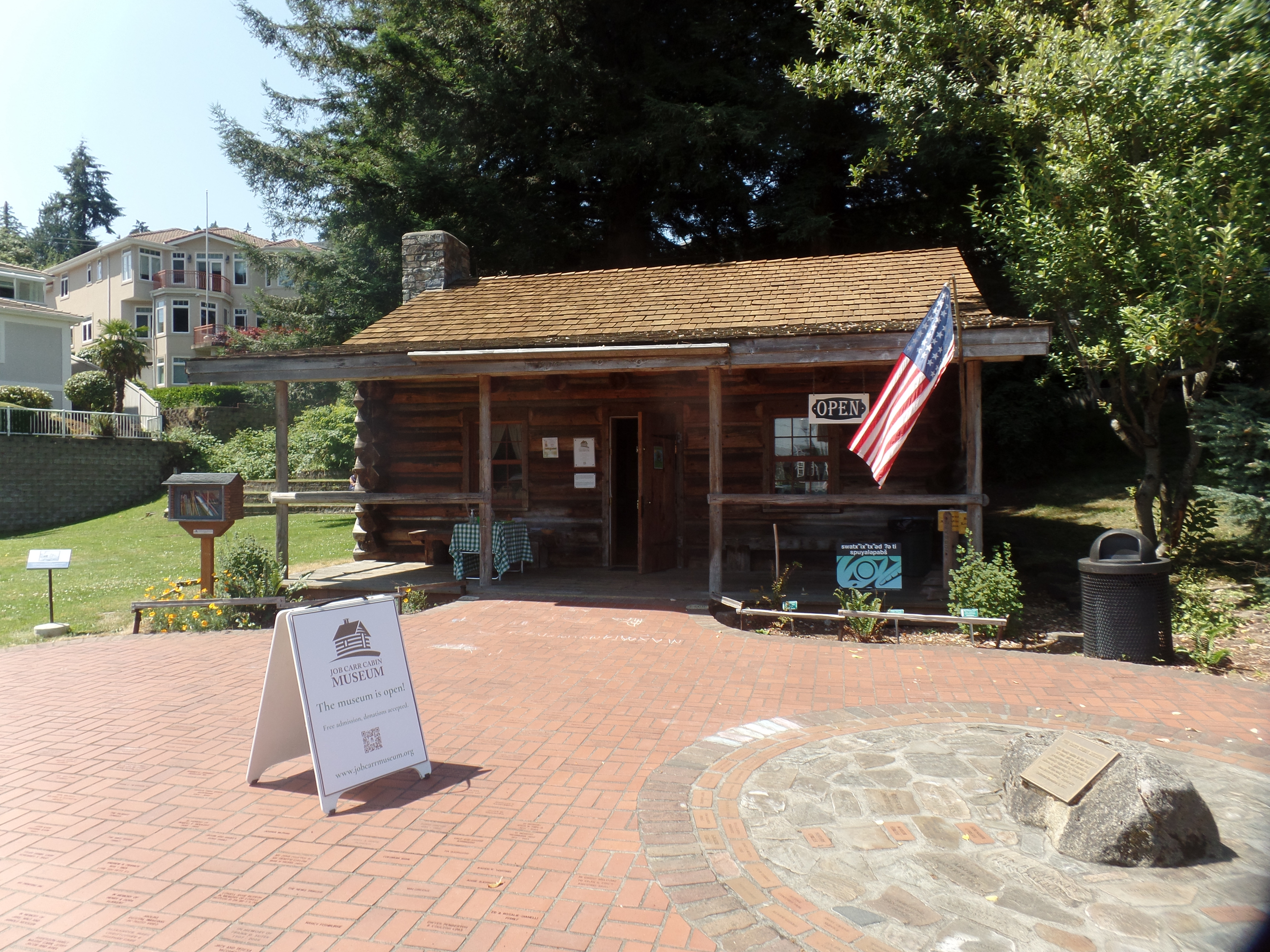
Northern Pacific Office Building, City Center, TacomaClock Tower, Old Tacoma City HallJob Carr’s Cabin, Old Town Tacoma
Job Carr was the first settler to make Tacoma his home, building this cabin in 1865. He got along quite well with the indigenous Puyallup community, and was well-known for navigating Commencement Bay, where he encountered whales and dolphins, whilst going back and forth to Puyallup, in his canoe.
Job came to the area because he thought the Burlington Northern Railroad would have its western terminus at the spot where he settled. When the BNR stopped two miles east of his cabin, he was rattled, but made do.
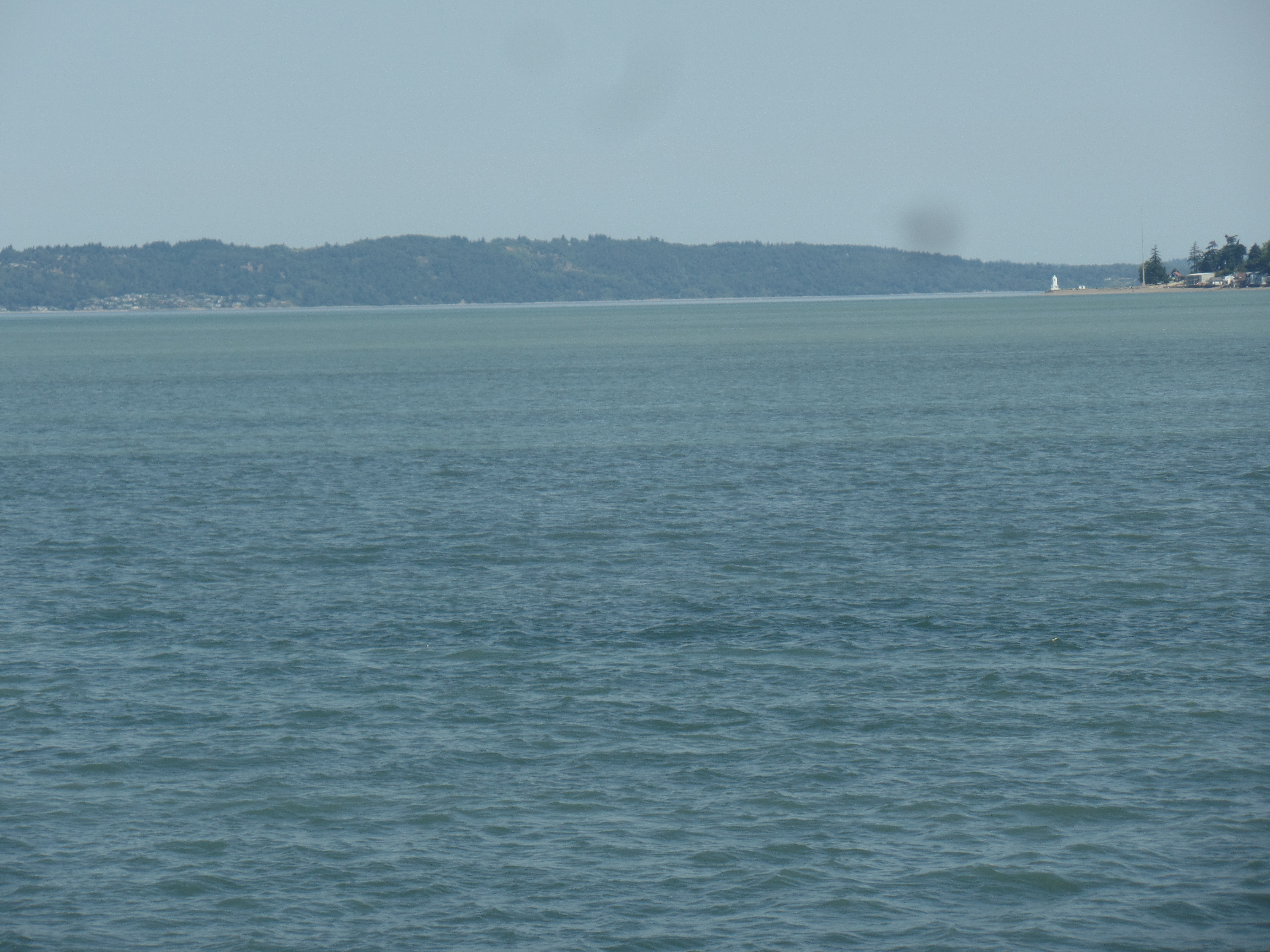
Burlington Northern railbed, near Commencement BayCommencement Bay, at Tacoma (above and below)
The afternoon found me back at another gem: The Muse, at the edge of Everett’s waterfront. I visited this lovely Victorian coffee house/bar, a year or so ago. This time, I was honoured to be joined by these fine folks:
Debra (“Ampbrea”) and Jeb Watts
I will not forget those friends from the 2000s and 2010s who stuck with me, even during the times when I “flaked out”.
July 5, 2024, Boston- The cobblestone walk, in the photo on my wall, in this spacious, yet relatively simple room, near Fanueil Hall, pretty much spells it out. There are light curves and a mild turn to the left, before the photo print heads into eternity. The photograph encapsulates my trip from Woburn, this afternoon.
It could have been so much worse, had the random driveway and lane closures of last week still been in effect, around the Car Rental Center at Logan Airport. As it was, we go to the airport area in less than 20 minutes, I topped off the tank and returned the vehicle, leaving plenty of time to catch the shuttle to the terminal, where Aram caught his flight, and my getting cash for incidentals and various tips. It was a quarter mile alley oop to the taxi stand, then the sharp, efficient driver got me to the Bostonian Hotel, in ten minutes.
The Bostonian Hotel, near Fanueil Hall.The Parlor, lobby of Bostonian Hotel.
These were very short limbos, and it was gratifying that I did far less overthinking and ruminating about them than in times past. Both self-confidence and trust in the Divine are far greater than they have been. Mother got a fabulous send-off, family and friends who I hadn’t seen in years came to pay their respects to her and re-connect with one another, and with me. Aram came to have my back, and in the process completed much of his remaining academic work. Yunhee, waiting at home, got a lobster stuffed figure. I have a sense that one more powerful spirit guide is going to help me over various challenges, in this still roiling year, and through the rest of the decade. As a bonus, she guided me to a nice place for a lobster salad roll and cup of clam chowder, to close out my time in Massachusetts.
Fanueil Hall, Boston
Shortly, I will get my rest, then rise early tomorrow and make the flight back to Arizona, via Denver. It has been a semi-expected, and reassuring, ten days.
July 4, 2024, Woburn, MA- With ringing tones, a volunteer in 18th Century garb, replete with a tricorner hat, read the Declaration of Independence, in its entirety. There was then a procession of five uniformed Colonial Volunteers to North Bridge, where they re-enacted a volley of three rounds of musket shots, representing the “Shot heard around the world”.
Aram and I chose to focus on the North Bridge sector and Monument Square, Concord, integral parts of Minuteman National Historical Park, which commemorates the beginning of our nation’s long, and unfinished, struggle for the freedom of all. The commander of Massachusetts Militia forces, Colonel James Barrett, had warned his men not to fire upon the British regulars, a directive that changed, when the regulars marched to North Bridge, leading the Militia forces to fire upon them and causing the British to retreat.
We walked around the North Bridge area, then back to Monument Square and along Main Street, and at long last, I visited an area that had been drive-through country, with family and friends always drawing me to a small section of the North Shore. This will not be my sole visit to the Minuteman region. Massachusetts will always be one of my homes.
Here are some scenes of downtown Concord, and around North Bridge
Concord Town House
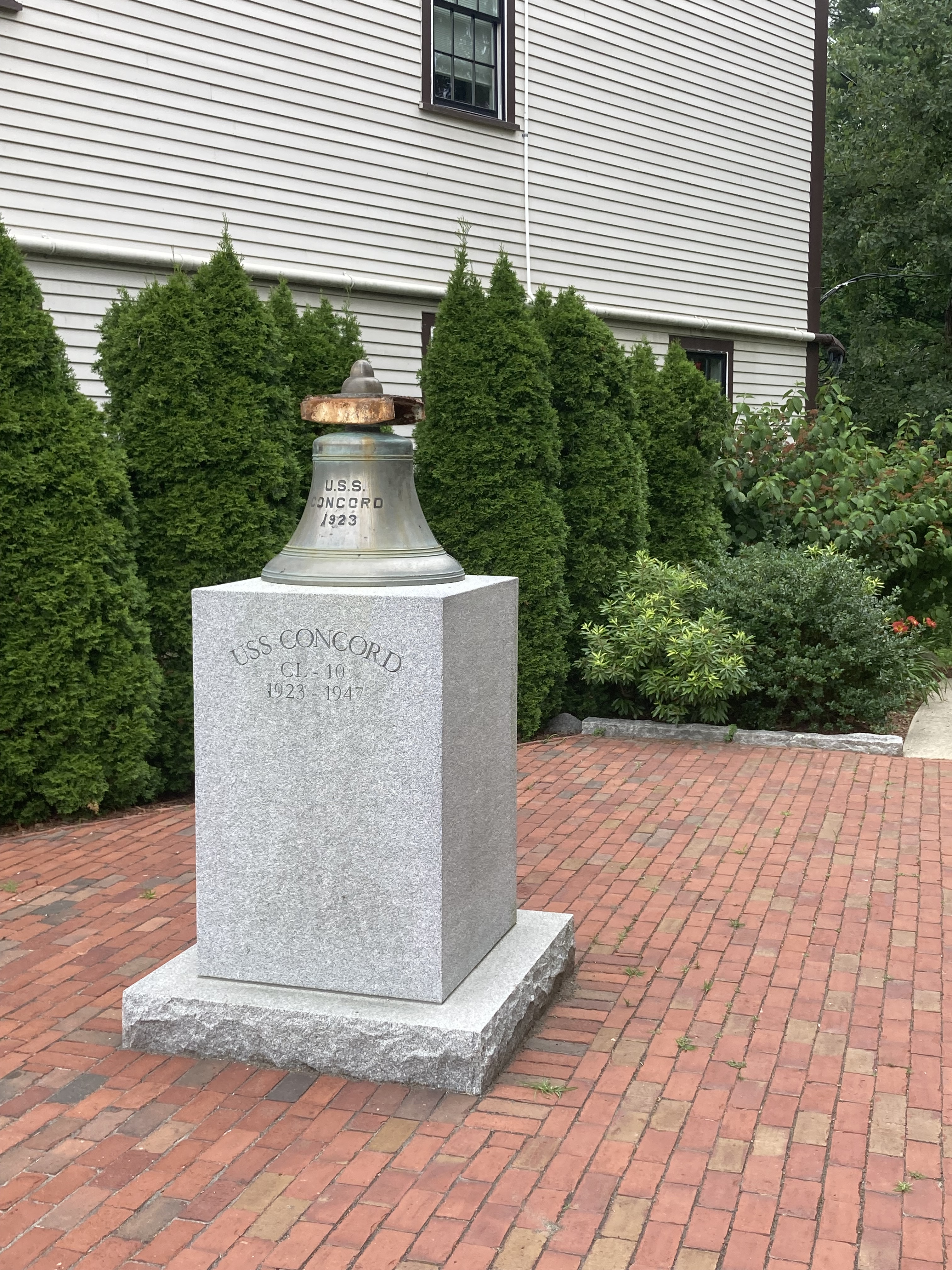
Ship’s bell from USS Concord
Concord River, at North Bridge
Minuteman Statue, North Bridge
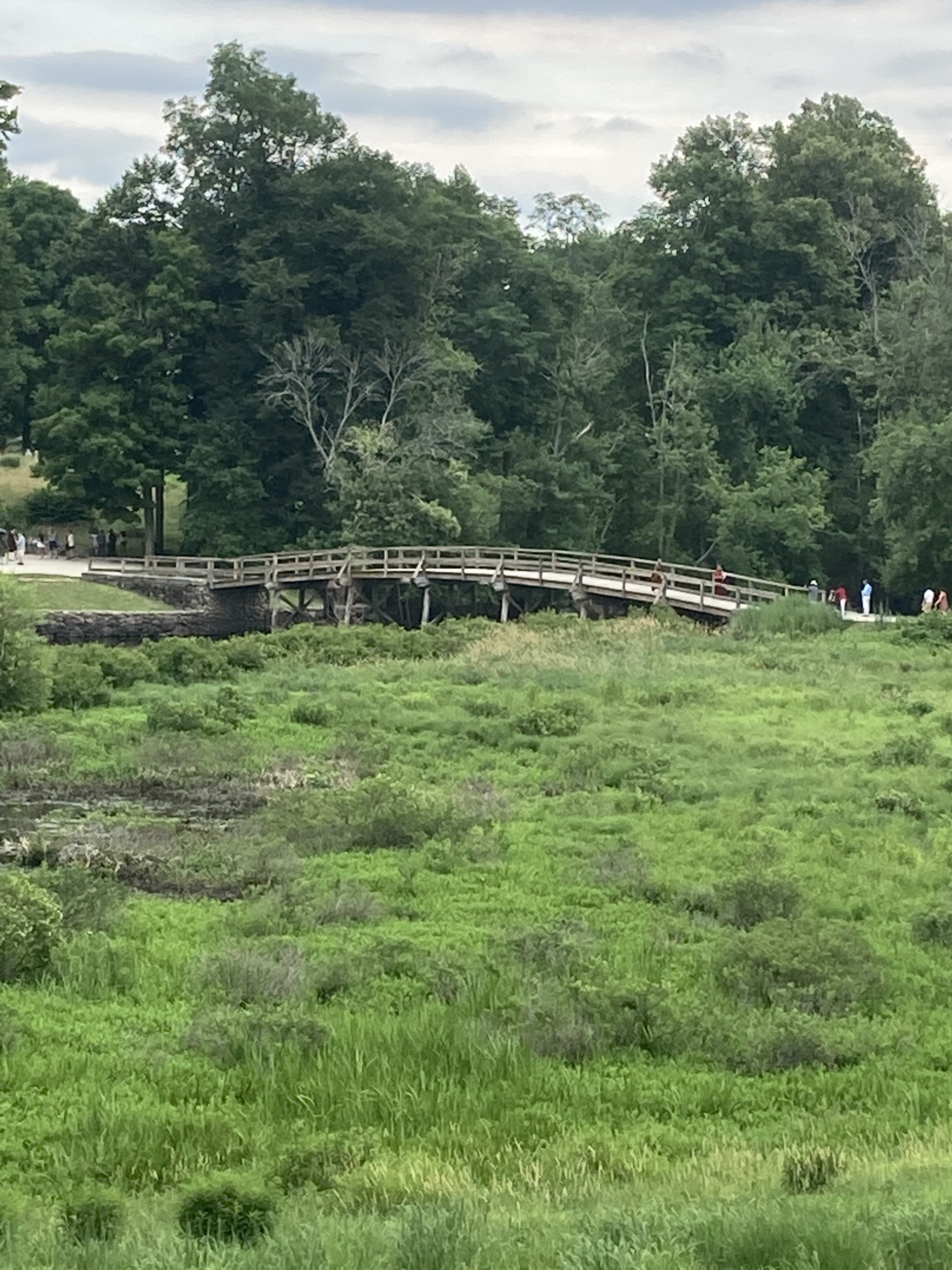
North Bridge, from the Visitor Center
The Old Manse (Emerson family home). Here, William Emerson, grandfather of Ralph Waldo Emerson, witnessed the skirmish at North Bridge.
Main Street, Concord. We ended our visit with cool beverages at Nero Coffee House. It’s been a fine unwind, from a very long week.
June 19, 2024- Today, we commemorated the date, in 1865, when enslaved people on Galveston Island, TX learned that they had, in fact, been freed from slavery by President Abraham Lincoln, 2 1/2 years earlier. Juneteenth has been a Federal holiday since 2021, so a good many people had the day off.
I have visited Palmito Ranch, the site of the last battle of the Civil War, fought in June, 1865, after the surrender of Robert E. Lee’s forces, which had taken place in April. There is much made of the fact that it was a nominal Confederate victory, yet it also was followed by the surrender of the “victorious” forces, a few days later. Colonel John S. Ford, CSA, escaped to Mexico, then returned to help process the paroles of the captured Confederates and to guarantee the humane treatment and release of remaining enslaved people in south Texas. He also, interestingly, campaigned for the suffrage of newly freed African-Americans.
It was not the cotton farmers who put up the last fights, on behalf of the Confederacy. That effort was made by the Mexican cotton merchants, and by a force sent by French Emperor Napoleon III to protect French mercantile interests in Tamaulipas and Nuevo Leon. These merchants spurred Col. Ford and his troops on, and took in many of the Confederates who had eluded capture. Pro-Confederate, but not necessarily pro-slavery, sentiment remained in the Rio Grande Valley for decades afterward.
One hundred fifty-nine years later, there has been much progress in race amity, but the long struggle continues-as humanity works out just what is meant by that term. A blessed Juneteenth to all who have worked so hard to bring its legacy to bear.
June 6, 2024- Eighty years ago, American forces began the process of landing at a series of beachheads, along the northern coast of Normandy, France. Contrary to some characterizations by people too young, apparently, to have much awareness of World War II, this was a real, and somewhat deadly, event. So, too, was the Holocaust that took place between 1942-45. Real people died, and others suffered mightily, despite what those who make apologies for Fascism would have the rising generations believe.
One of those who suffered mightily was a Jewish-American soldier, captured along the southern limit of the Battle of the Bulge, near Bellecroix, in Metz, France, in January, 1945. He survived, and returned to the U.S., in the aftermath of V-E Day. He married, and sired a daughter, who grew up to be strong, intelligent and of sound moral character. Forty-two years ago today, that daughter of a soldier became my wife. Our marriage lasted 28 years, 9 months, until her death, in 2011, from pneumonia that was brought on by a progressive neurological disease.
Penny led me to embrace a Faith that has made more sense to me than any other system I have ever studied or investigated. She held the bar high for me, as a husband, and more times than not, I reached it- just as she met my expectations of her as a wife. Those times when we each fell short were more growth opportunities than failures, and they served to give our son the roadmap to a successful marriage of his own, which began civilly in November, 2018 and became faith-based in March, 2019.
I have done a lot of reflecting on our time together, and on the flow of energy that has sustained me, in the thirteen years since her passing. Thirteen years of largely alone time, punctuated by a growing friendship with another strong, intelligent woman, of sound moral character, would not have been possible, without feeling Penny’s spiritual energy, a light brush against me or a strong message from the other side of the curtain that separates the corporeal from the ethereal. Forty-two years have passed, and I will never be the same soul I was before she entered my life.























 A Sagittarian Seeker