The Summer of the Rising Tides, Day 23: Calming the Conniptions

4

June 23, 2020-

Taking part in a lively debate, in the Age of Hypersensitivity, is no small thing. Most of those who operate from a place of political correctness have at least recognized that I operate from a humble posture of learning, and if I can be proven wrong, by facts rather than well-presented emotion-based opinions, I will actually be grateful.

Any man who voices opposition to abortion is going to get pushback, unless that opposition acknowledges that the mother of the fetus and has the final say. Making that acknowledgement, and prefacing my own qualms about the matter with the sacredness of being, from the moment of conception, has been, for all but the most fervent abortion advocate, enough room to set common ground.

The same may be said about the dispostion of controversial historical monuments. I have reservations about the wisdom of wholesale destruction of statuary. Certainly, those figures whose presence causes extreme anxiety for African-Americans , First Nations people or anyone else who has faced systemic persecution, need to be removed from public view-not because there is a need to comfort the overly sensitive, but because there is a deeper genetic memory than is commonly accepted.

I will discuss this last, in another post, insofar as it pertains to my own being. For now, note that the practices adopted by enslaved people, over the period of chattelhood and right up to the end of the Jim Crow Era, in order to ensure the safety of both their children and of themselves, have found continuity, in the seemingly draconian disciplinary practices of a good many African-American families. Keeping the child safe, by limiting his/her freedom to explore, is one feature of this. It goes back to keeping the child safe from exploitation.

Thus, the strength of an emotional trigger is far different for a person whose forebears faced oppression, than it is for one whose hardships have been more in line with the struggles inherent in earthly life, in its generality. Life is complicated like that, and we do best to grow a thick hide of patience, along with a strong spine of fortitude.

The Summer of the Rising Tides, Day 21: Ever Strong

2

June 21, 2020-

This was a Father’s Day of my own making. My Uncle Walter told us boys, for years on end, to learn to make our own fun. So it has been, for nearly seven decades.

After hosting a heartfelt and meaningful devotional on Zoom, I hopped over to Ms. Natural’s and had a quick and healthful lunch, on the downstairs patio. Then, it was off to Sedona, for a relatively short hike, along a trail called Big Park Loop. It was hot, so I walked fairly slowly and drank a good amount of water. The scenes were of Courthouse Butte and Bell Rock from a southern angle.

Bell Rock and Courthouse Butte, Sedona-seen from the south.
Cathedral Rock and Castle Butte, from the east.

The past two months have been very dry, as usual. The great rushing creeks and rivers of the “Monsoon” season are flowing only underground, right now, if they are flowing at all.

Large dry wash near Courthouse Butte, Sedona

I stopped in, after the hike, at a normally favourite and welcoming coffee house, but found the mood a bit tense- largely over who got to use a device which soothes muscle pain and can heal skin disorders. A friend who works at the cafe managed to get some use from it. The device, it turns out, belongs to the cafe owner, is quite expensive, and was not to be used by anyone but the employees. The owner was not amused, when friend offered it to me for a session. Fortuitously, it operates off cell phones, and mine was not co-operating. I quietly left, after enjoying a refreshing and healthful cool drink.

Father’s Day dinner was at a barbecue place, called Colt Cafe, in Old Town Cottonwood. The tried and true brisket sandwich and Triple Crown potato salad restored my physical balance. It was a fairly easy drive back, after dinner.

My father taught us He showed us that strength is not brutish, not overbearing and is never selfish. Strength shows respect where it is due, but is not fawning or sycophantic, as no human being is worthy of such adulation.

At the same time, strength avoids excessive fault-finding. If a person is praiseworthy, on balance, clebrate that which is good about the individual, neither dwelling on, nor ignoring, the person’s frailties. I wonder what Dad would think of the current campaign to denigrate most, if not all, of our nation’s, nay our planet’s, people of renown? In an age when everyone from George Washington to Mother Theresa has detractors who have managed to find a ready audience, can we truly approach anyone’s legacy objectively?

The Summer of the Rising Tides, Day 12: Overcoming Selves

4

June 12, 2020

There are those who loathe Columbus.

They would gladly tear down his statue,

were the opportunity to present itself.

I don’t at all like what he did to the First Nations

of the Caribbean and the north coast of South America.

There are those who would erase all mention

of anyone who ever owned a slave.

They would obliterate statues and monuments,

of Washington, Jefferson, Madison and Monroe.

Locales, across the country,

would be obliged to change their names.

If it ever came to that,

I would recommend the original names

given to each place,

by the First Nations people.

I don’t at all like that people were enslaved,

or even indentured in servitude.

I think, though, that

we cannot erase our history.

I have made mistakes in my life,

some of which merely irritated

those affected, and some

which greatly discomfited

the people who were in

my life, at the time.

I will not erase myself,

I will improve, and continue.

We, as a human race.

cannot erase our past.

We can only learn from it,

and move on.

The Summer of the Rising Tides, Day 11: More Than One Wall Must Fall

2

June 11, 2020-

Every so often, someone will raise the issue of one aspect or another, pertaining to the wall being built, in segments, along the U.S.-Mexico border. There are certainly very legitimate concerns about wildlife corridors and ecosystems, the desecration of Native American ancestral gravesites and sacred places. There is also no guarantee that this wall will succeed in achieving its goal of establishing law and order along the frontier, in perpetuity.

Of equal, or greater, concern to me, however, are the mental walls that have risen up, long before the physical barrier began taking hold. People, within our borders, have taken the stance of refusing to associate with anyone who expresses a viewpoint that is counter to one’s own. It does not take a genius to figure out that the underlying issue is one of personal insecurity. Too many have drawn the conclusion that, if the “other side” gets in power, that all their cherished values will be smashed to smithereens. The group in power draws the same notions about the potential replacement.

At the risk of being misinterpreted, which I will own, if that comes to pass, I can say that there are indeed good people, all along the political spectrum. Those who loudly fulminate against such an observation are, along with the violent and unsettled, on both sides, part of the problem. I have met fine white people in the rural South, who are curious as to why I show kindness to Black folks, and vice versa. That they are willing to hear someone who doesn’t share their fears, is a step in the right direction. The same has happened with people here in the West, who are wary of Native Americans and/or Hispanics.

Living without a need for walls has been a labour of love for me, and there was a time when I had little mental walls constructed in my psyche. Taking them down, one by one, has only made life better. I don’t know of anyone who expanded their heart, because someone came at them, swinging a hammer.

The Summer of the Rising Tides, Day 6: The Cabin, The Pyramid and The Homage Walk

7

June 6, 2020, North Rim of Grand Canyon-

Of all things that get done in life, none exceed in value the homage paid to those who have gone before. As giving, to those in need, results in getting more of what oneself could use, so does paying respects, to those who have transitioned, bring more honour to the one paying the respects.

I was able to stay in a fine little cabin, a duplex, which I shared with a family of three, who kept to themselves. Jacob Lake Lodge has been built into a resort, of modest size, staying free from any ostentatiousness. It has a small, but quality, restaurant, where pandemic-based spacing is in effect, and of course, masks helped give a sense of health security, for both patrons and staff-when we weren’t eating or drinking, of course.

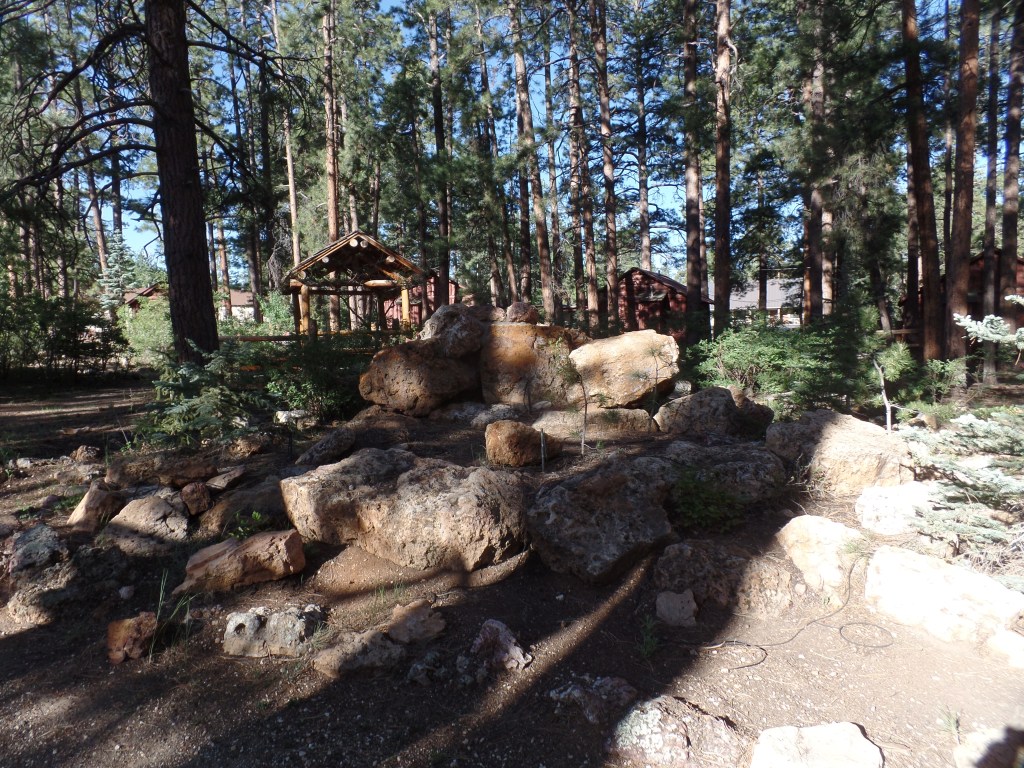
Cabin 10, where I stayed at Jacob Lake Inn.

After hiking a “warm-up” trail, in search of the actual Jacob Lake, I found only an RV Park, and so returned to the resort, in time for check-out. Then, it was off to the Canyon!

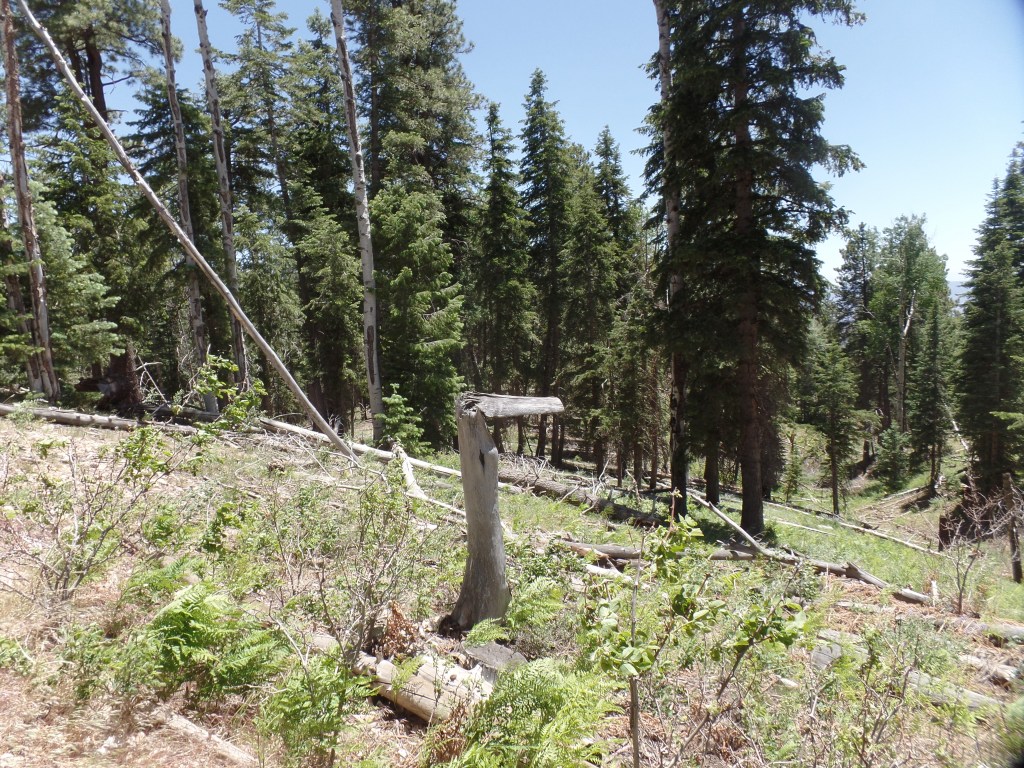
There is a plan being considered, that will result in a sizable amount of trees being cut, in Kaibab National Forest, along the road to North Rim. There is a huge amount of slash and burned-out trunks, left from previous fires and intense storms. To me, it would make the most sense to clear that mess, and probably would put a fair number of people to meaningful work, this month and next. As the trees under consideration are “old growth” forest, it is especially heart-rending to consider the unnecessary damage to the ecosystems.

After arriving at North Kaibab Trailhead, where the Elantra would rest, while I hiked, it took a short bit of checking the route, to make sure I din’t end up going down the North Kaibab Trail, itself. Ken Patrick Trail, a bit to the north of the steep big kahuna, would take me to Uncle Jim Trail. With the help of a thru-hiker doing the Arizona Trail, I was on my way, in short order. You can see from the sign, below, that Ken Patrick was dedicated to service with the National Parks.

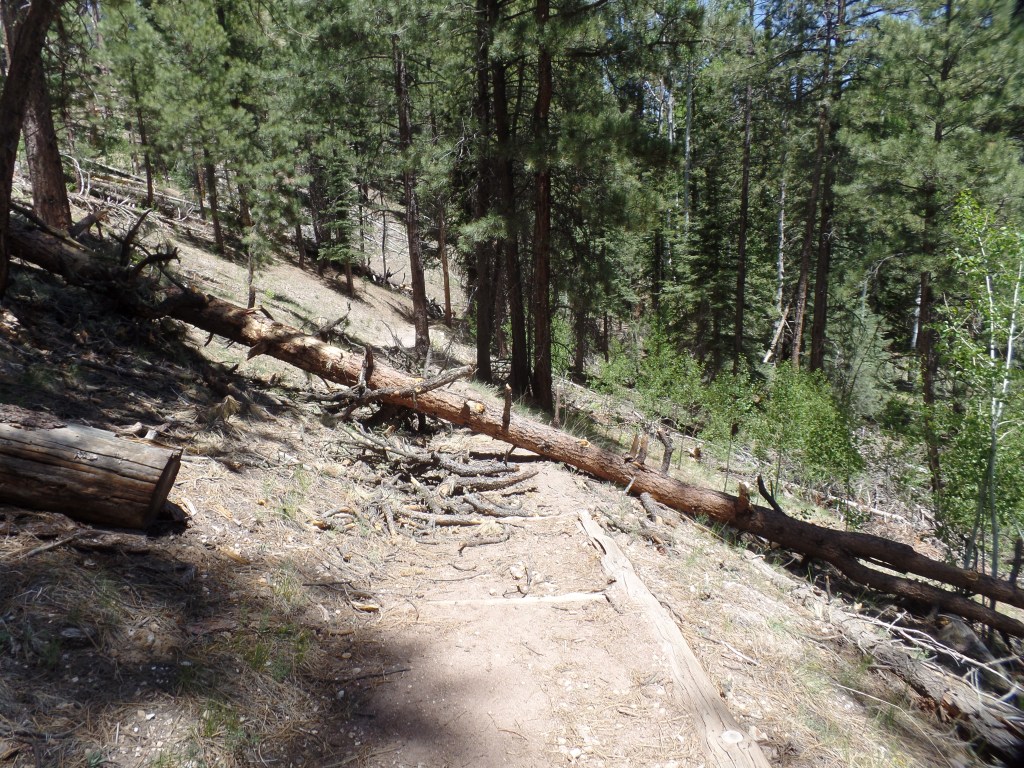
About 500 feet along the trail, a large ponderosa pine had fallen across the path, so I went up and around the mess. Three other trees would lie across the trail, at different points.

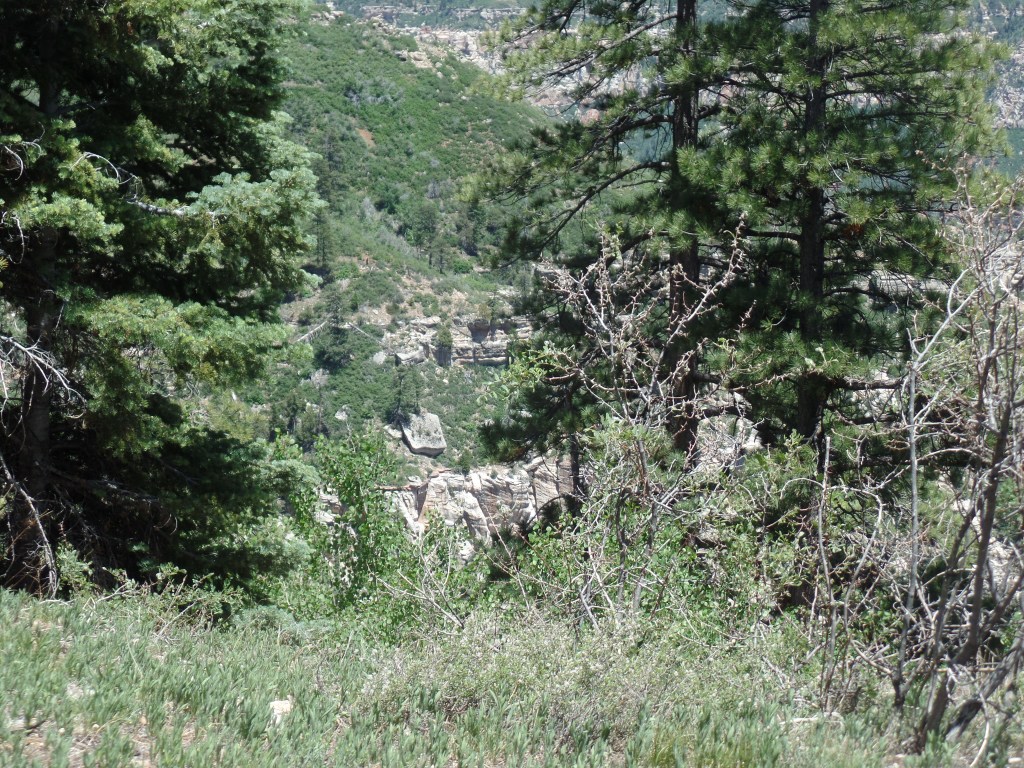
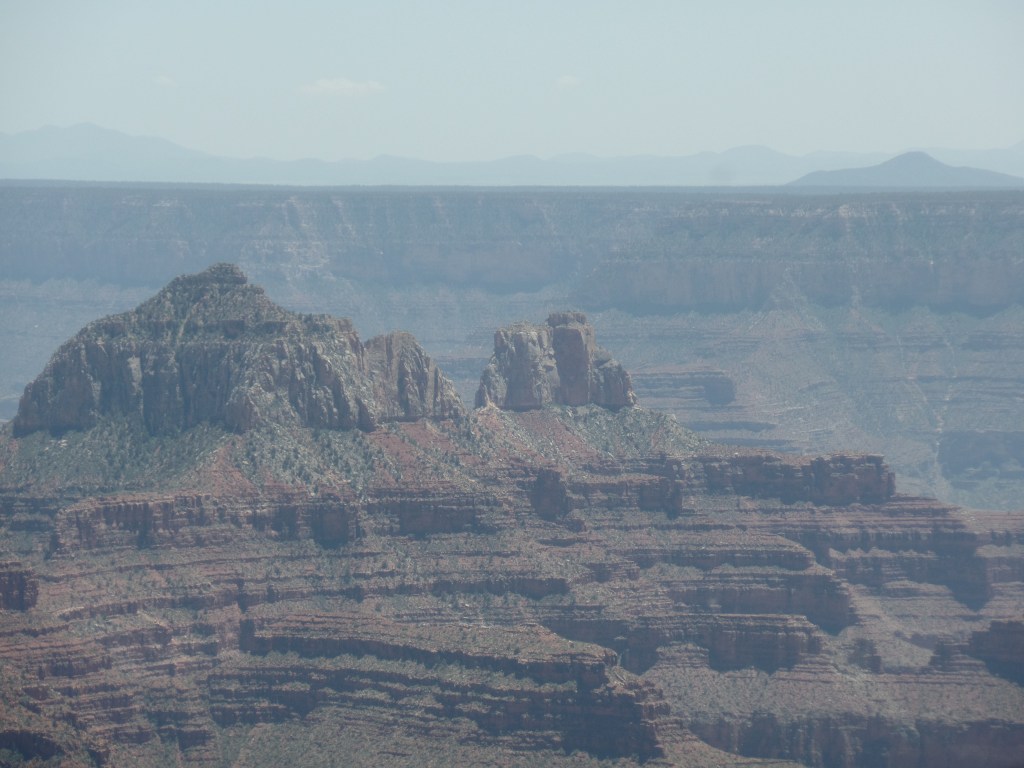
The first set of overlooks lies about 1/4 mile along the Ken Patrick Trail. This view mirrored what I saw last October, from the Bright Angel Point trail.

The limestone columns remind me of horse heads.
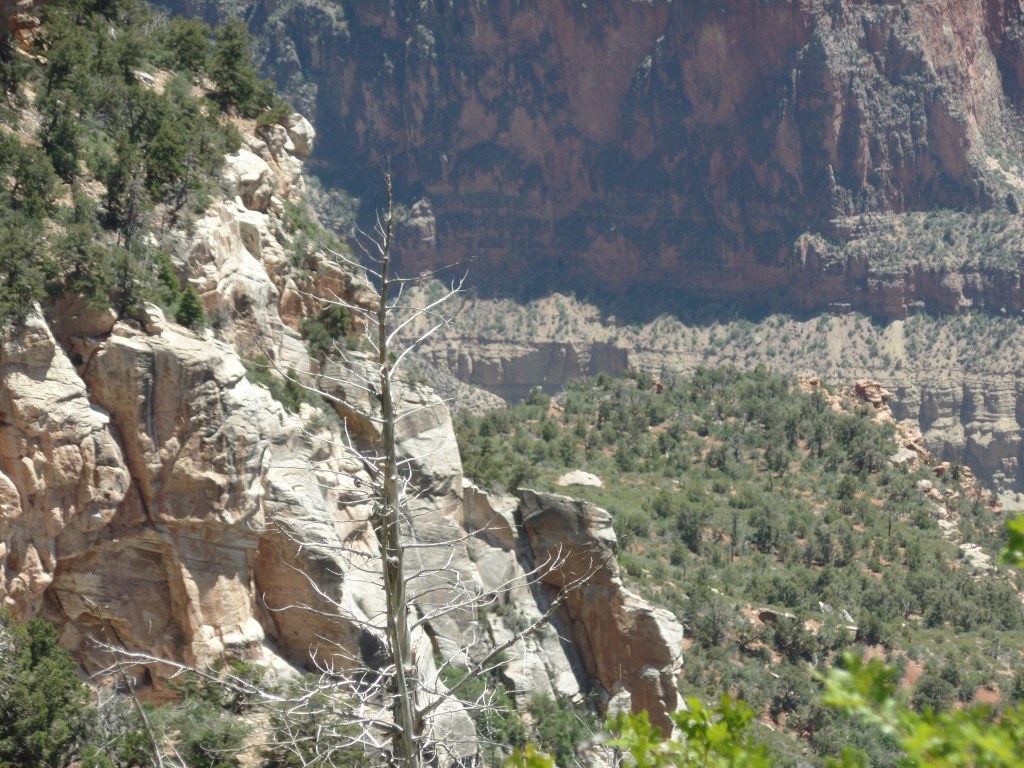
Here is a cross section of the Inner Basin.

Nature leaves her little jokes, even at the expense of damaged trees.

A guidepost, perhaps?

Sooner than I expected, it was time to take a hard right.

The trail junction.

The first segment of Uncle Jim Trail is four tenths of a mile. It is also the area with the most up and down inclines, and the only place where there are switchbacks, albeit mild ones. Two downed trees greeted us hikers, along this stretch, as well.

At 7/10 of a mile, along the western leg of Uncle Jim Trail’s 2.1-mile loop, I came to a series of fabulous canyon views.

This drop-off looks milder than it is.
Who’s watching whom?

Finding a heart-shaped rock, I placed it carefully against a small set of wood shavings.

A little altar

This natural eroded bowl could serve as an amphitheater.

Looking at this “amphitheater”, I also saw a back country hiker looking over its edge.

I came upon an unofficial overlook, east of the main viewpoint, and appreciated the two “guardians”, looking back towards the rim.

Sandstone heads have this mesa to themselves.

Looking out from this vantage, at Uncle Jim Point, I have a tripod to help me focus.

Here’s a view towards the Inner Basin.

Heading out from this vantage point, I spotted a burnt ponderosa, which could serve as a memory pole, of sorts.

A woodpecker’s home and a place to mark memories.

I spent a few minutes sitting on the landing of a restroom building, writing in my journal. As I did, a fierce gust of wind came up and blew my sunglasses off the landing. I looke for the shades, for about ten minutes, but to no avail. If that is my offering to the forces of nature, so be it. I have a feeling that the wind took them all the way to the rim, and over.

Hearing happy voices, I followed the tral to the main viewpoint. There were four women, a couple and me, taking one another’s photographs. Thus, a pyramid could be envisioned: Four at the base, two in the middle and one on top.

Here I am, courtesy of the “better half” of the couple.

With Uncle Jim Point in the background, I fulfilled a promise to myself and to his family.

Uncle Jim Point juts out into the Inner Canyon.

With that, the two parties and I leapfrogged one another, on the way back, as each took rest breaks. We all missed the junction sign, going back on the Ken Patrick Trail by osmosis. I last saw the four women taking an extended photo shoot at the first overlook. The couple, it turns out, are from Santa Monica, and were enjoying their first venture out of town, since January.

So, my heart’s desire was fulfilled and I headed out of the Canyon, with a brief stop at North Country Market, for a well-earned salted caramel latte and a long, but smooth, drive to Flagstaff.

The Summer of the Rising Tides, Day 5: Fascism, Part 3

2

June 5, 2020, Jacob Lake, AZ-

Here, we look at the possibility of a fascist regime, or several, in our own time.

One common definition of the term, frequently cited by reliable sources as a standard definition, is that of historian Stanley G. Payne. He focuses on three concepts:

  1. the “fascist negations”: anti-liberalismanti-communism, and anti-conservatism;
  2. “fascist goals”: the creation of a nationalist dictatorship to regulate economic structure and to transform social relations within a modern, self-determined culture, and the expansion of the nation into an empire; and
  3. “fascist style”: a political aesthetic of romantic symbolism, mass mobilization, a positive view of violence, and promotion of masculinity, youth, and charismatic authoritarian leadership.[27][28][29][30]

Since 2000, several central andeastern European states have seen the rise of charismatic and authoritarian leaders. To varying degrees, the leaders of Russia, Hungary, Poland and Belarus have adopted a Fascist style of governance, though they have not been as full-on, in adopting a culture of violence as their predecessors in the last century. Russia has certainly built a nationalist economic structure, with a view towards restoring at least some of its past territorial range.

Fascists in other European countries, who have less of a chance to gain power, have nonetheless pursued attempts to remain in the public eye. Rallies, and intermittent acts of harassment against non-native residents, have increased in frequency, in Germany, Italy, Norway, Sweden, Greece and the Netherlands. The United Kingdom and France have seen less of such incidents, mainly because the extremists have been subsumed into the more “mainstream” far right parties, led by Nigel Farage and Marine Le Pen, respectively. Neither of those leaders is given to promoting a Fascist agenda, eaudi Arabia, Hungary, myanmar,ven if their stress is nationalistic.

Elsewhere in the world, we see Fascist sentiments, expressed by leaders as disparate as the Crown Prince of Saudi Arabia, the Presidents of Brazil, Myanmar and the Philippines, as well as the Supreme Leader of Iran. In each case, all three fascist negations are in evidence; a nationalist, nativist economic system is being encouraged; ethnic and religious minorities are being disparaged as enemies of the state’; the glories of the nation’s past are being used to whip up a nationalistic fervour and violence, combined with a near worship of the charismatic, authoritarian leader is being enkindled.

Is this being repeated in the United States? The very question has set the nerves of some conservatives on edge, and in fairness, the current president does not show an anti-conservattive bias, has a utilitarian view of relations with communist countries (albeit a love-hate relationship) and focuses most of his disdain on liberals and progressives. A dictated economic structure, which he is certainly capable of arranging, would appeal to many citizens, who are as tired of the weekly grind, as members of ethnic minorities are of daily harassment.

Although he shows appreciation, and a need for, the attention being showered on him by his admirers and tends to lash out at even his slightest detractors, there is not a strong cult of machismo being established, as such (The image of the president as a “Rambo” figure, here in Arizona, is more a red herring, than anything else.). He does not place as much emphasis on physical training as, say, the leaders of Russia and the Philippines. Authoritarianism, however, is a growing concern. His ability to accept defeat, gracefully, needs to be displayed, and followed up with evidence of personal growth, if the fears that many people have, of an emergent fascist regime, are to be assauged.

We are not immune to seeing fascism take the reins of governance, in the United States. This is one of the prime reasons for a system of checks and balances- and for the Bill of Rights being the first ten amendments to our Constitution.

The Summer of the Rising Tides, Day 4: Fascism, Part 2

2

June 4, 2020-

One common definition of the term, frequently cited by reliable sources as a standard definition, is that of historian Stanley G. Payne. He focuses on three concepts:

  1. the “fascist negations”: anti-liberalismanti-communism, and anti-conservatism;
  2. “fascist goals”: the creation of a nationalist dictatorship to regulate economic structure and to transform social relations within a modern, self-determined culture, and the expansion of the nation into an empire; and
  3. “fascist style”: a political aesthetic of romantic symbolism, mass mobilization, a positive view of violence, and promotion of masculinity, youth, and charismatic authoritarian leadership.[27][28][29][30]

The period 1929-45 is notable for the rise of several regimes that were based on continuity of government, on strong rule by a coterie of “dependable” officials, and a critical mass of public support, for those in power.

This was accomplished in the United States, by elections which were judged free and fair, resulting in the election of Franklin Delano Roosevelt, in 1932, and his re-election in 1936, 1940 and 1944. When Roosevelt died, barely into his fourth term, there was a peaceful transfer of power to his Vice President, Harry S. Truman.

In neighbouring Canada, a similar process resulted in the election of William Lyon Mackenzie King as Prime Minister, in 1921, and his re-election in every contest, save 1930-35, until his retirement from public life, in 1948. King’s tenure was more based on public support for his policies, than on any cult of personality, however.

Across the Atlantic, the harsh terms imposed upon Germany, under the Treaty of Versailles, resulted in severe economic conditions. Coupled with the worldwide economic collapse of 1929, the grief felt by many Germans proved fertile ground for Adolf Hitler, and his National Socialist Party (NAZI). Hitler’s willingness to apply a particularly efficient form of brute force ultimately brought more ruin to Germany, after his Armed Forces staged a sweep across Europe, only to expend their resources and fall to defeat, at the hands of a three-pronged Allied offensive, in World War II. His legacy of infamy is signified by the mass ethnic cleansing campaign, which is known today as The Holocaust.

Was Hitler a Fascist? Certainly, he employed portions of all three of the concepts identified by Stanley G. Payne, as definitive of the Fascist system. His economy, though, did not alienate itself from standard business-oriented conservatism. He conducted a robust, if clandestine, trade with large multinational corporations, based in both North America and neutral European nations. Otherwise, Hitler adhered to both Fascist goals and style of governance.

At this point, I wish to point out the more “orthodox” Fascism, followed by Benito Mussolini. Mussolini began his public life as a socialist, but grew bored with the efforts at seeking an egalitarian society. He turned instead to the concept of Fascism, embracing a total state control of economic structure, a renewal of the “Italian Empire”-his take on ancient Rome. and a social network that promoted the use of violence and an emphasis on masculinity-with himself as the prime example (Il Duce-“The Leader”). He ruled Italy from 1922-1945, managing to establish a fairly efficient transportation system and large homegrown industries. As with Hitler, however, Mussolini’s ambitions outgrew his nation’s resources, and his government fell, before an Allied invasion, from 1943-45.

Mussolini’s protege, Francisco Franco, of Spain, took power, as a Falangist (the Spanish equivalent of Fascist), in 1936, assuming total control of Spain, with both German and Italian military assistance, in 1939. Franco ruled Spain until his death, in 1975. Franco’s Fascism focused promarily on achieving Fascist goals, particularly state regulation of the economy. He did not renounce conservatism, as Mussolini had, as one of Franco’s goals was preservation of the Church and eventual restoration of the Spanish monarchy. He did not pursue as active a cult of personality, as Mussolini, either, though he took the title of El Caudillo (” The Strongman”). Franco’s caution, with regard to World War II, kept Spain out of that conflict, though he supported the Axis Powers in principle. Franco’s brutality relaxed, in the 1950’s, though Spain remained something of an economic backwater, lacking the natural resources and capitalist minds of Italy. With that relaxation, however, a group of younger businessmen and entreprenuers did emerge, leading to the “Spanish Miracle”, for which Franco took personal credit. His long rule was largely due to his more moderate take on Fascism.

Finally, for this section, let it be noted that fascism, like communism, is not limited to the European continent. Field Marshal Idi Amin Dada, a military careerist, with considerable informal education, became rather enchanted with the period of Nazi rule in Germany. Although Amin was not enamoured of Communism, he did abide its presence in his country of Uganda, mainly to procure aid from the Soviet Union and East Germany. Amin pursued what he thought of as Fascism, though his economic model was negligible, being mostly focused on enriching himself and a coterie of advisers. He did encourage a cult of personality, with himself at the center, allowing thugs to operate, with impunity, against real and perceived opponents. His one attempt at trying to carve out an empire, proved his undoing. In 1978, Amin sent troops into the neighbouring Tanzanian province of Kagera, with the idea being its annexation by Uganda. Tanzanian President Julius Nyerere, a no-nonsense man, sent his nation’s Army to take back Kagera, and to finish the job of ridding Africa of Amin.

So Fascism, like Communism, has been several things to several people. Could it happen in our time?

The Summer of Rising Tides, Day 3: Fascism, Part 1

2

June 3, 2020-

The word “fascism” has been bandied about so freely, these days, it seems useful to take a look at what the term means (Part 1); how it has been applied in the past (Part 2); how, if at all, it is being applied now (Part 3).

Here is a commonly-accepted definition of the term:

“One common definition of the term, frequently cited by reliable sources as a standard definition, is that of historian Stanley G. Payne. He focuses on three concepts:

  1. the ‘fascist negations’: anti-liberalismanti-communism, and anti-conservatism;
  2. ‘fascist goals’: the creation of a nationalist dictatorship to regulate economic structure and to transform social relations within a modern, self-determined culture, and the expansion of the nation into an empire; and
  3. ‘fascist style’: a political aesthetic of romantic symbolism, mass mobilization, a positive view of violence, and promotion of masculinity, youth, and charismatic authoritarian leadership.[27][28]“[29][30]

Fasci were bundles of sticks, fastened together around an axe handle, in Roman times. The tool was used by lectors, who served Imperial Magistrates, as a means of corporal or capital punishment. Although Fascism, as a system, is not commonly associated with the Roman Empire, the ‘fascist style’ certainly could describe the cults of personality that sprung up, during the rules of Julius Caesar, Octavian (Augustus), Claudius and, even more to the extreme, in the days of Caligula and Nero.

Thus has Fascism come to suggest a regime that purports to signify a government of high efficiency, yet often is marked by high levels of caprice and corruption-with the chief civil authority figure and the chief operating officer, underneath him (so far, no women have been identified as Fascist figures), running the affairs of state, virtually by decree.

NEXT: A look at three Fascist states of the Twentieth Century

Altogether Fitting and Proper

0

May 20, 2020-

I woke today, feeling the power that comes with a day which may be written as 05-20-20, and which is the midpoint of the twentieth week of 2020.  Being Wednesday, I found myself in two consecutive Zoom calls, for two different reasons, this afternoon.

After those were finished, it was time for a regenerative cat nap-THEN came the urge to finally take the first of four directional walks.  So, on went the sneakers, sunglasses and ballcap-and east I went.

Today was the last of a series of mild, rather breezy days, so walking was a veritable pleasure.  My eastward route took me as far as the still-shuttered Planet Fitness franchise, in a shopping center called Frontier Village.  This was a 1 1/2 mile-one-way jaunt, and relatively easy.

The way back led me along the edge of Prescott VA Cemetery, resting place of many military veterans, and a place where I usually join a large group of volunteers, placing American flags at gravesites, on Memorial Day weekend.  I’ve heard nothing about that, this year, so am thinking it’s another casualty of COVID19.  I stopped and read Abraham Lincoln’s “Address at Gettysburg Memorial Cemetery”, thinking about what, today, is “altogether fitting and proper”.

There are three things that come immediately to mind:

  1.  Treat all citizens, especially those with whom one disagrees, as worthy of respect.

2.  Honour those who may need us to make small adjustments in our daily conduct- i.e. people who might be immunocompromised, and need those around them, in public places, to wear face masks.

3.  Continue thinking for self-and that means THINKING, not following the loudest voices in the room, on the Internet or in the streets.

These are altogether fitting and proper, nearly 157 years after our nation’s 16th President dedicated a military cemetery, receiving the remains of those who fought in one of our nation’s bloodiest, and most divisive, conflicts.

Light, Out of Calamity

8

March 27, 2020-

In some of mankind’s darkest moments,  advances have come from the suffering, like small mammals coming forth after the Age of Dinosaurs.  These advances, in short order, became a part of the fabric of human culture.

After the Great Plague, of the Fourteenth Century, Europeans began to return to embracing science, rather than superstition, in treating illnesses.  The primacy of Cardinals and Bishops began to face widespread scrutiny, and the stirrings of Protestantism were felt.  The Catholic Church itself had to make changes, under Ignatius Loyola.  Advances in scientific discovery came, as a result of these trends.

After the American Civil War, the Red Cross was started, by Clara Barton, as a means of assisting soldiers, in time of calamity.  It quickly expanded to help society at large, in times of disaster.

After World War I, movements to assist disabled and unassisted veterans, in returning to civilian life began, with the American Legion and Disabled American Veterans. These organizations still make large scale efforts to assist those who suffer from dislocation, or from Post-Traumatic Stress Disorder.

After World War II, mass production of houses, the science of rocketry, television and large computers became part of the civilian world, having been first advanced within the military sphere.  From large, room-sized computers have come hundreds of technological products, many of them falling into the realm of nanotechnology.

Now, we will await the advances coming out of the struggle against Coronavirus Disease 2019.  Teleconferencing, already available for business, government and limited conversations between family members and other small groups, has exploded in use, as nearly every group, which conducted its business in person, has found ways to meet virtually. Even when the crisis has ended, I can see the sheer range of teleconferencing leading to its continued wide use among the public at large.  It will also greatly modify the educational process, even more than it has to date.

The retrofitting of factories that produce a wide variety of products, from airplanes to distilled spirits, are now also producing items that will help face the virus.  Ventilators, medical-grade masks and hand sanitizer will still need to be stockpiled, even after this virus has spent its rampage.  Preparedness will not soon, if ever, be relegated to the realm of memory.

There will be many tasks, which the technology and skill sets coming out of the current crisis will need to be called to perform. Not the least of these is completing the still gargantuan effort to provide all homes with clean, running water and reliable heat or cooling.  This work will occupy post-pandemic humanity for years, if not decades.

Out of  the darkness comes a greater light.  Baha’u’llah teaches:

“O SON OF MAN! My calamity is My providence, outwardly it is fire and vengeance, but inwardly it is light and mercy. Hasten thereunto that thou mayest become an eternal light and an immortal spirit. This is My command unto thee, do thou observe it.”