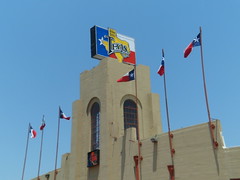
Northwest by North, Day 8: Slowing Down In Oregon

4

The Oregon Coast is not to be taken lightly, or quickly.  Maybe that’s one reason for fog.  The meeting of cold and warm air forces one to pay attention, like no other force of nature. This is because fog doesn’t  slam into our lives, wreak havoc, and leave.  It rolls in, lingers and only leaves when the heat of the sun burns it off.

I began the day with a full breakfast at Mattie’s Pancake House, my first pancakes in six months being blueberry cakes- with large, freshly-picked Oregon berries.  These, and a large sausage patty, gave me yet another day of sustenance.

First up, once I got on the road, was Brookings’ own Azalea Park.

Here, the renowned director and producer Elmo Williams, who has given us “High Noon” and “20,000 Leagues Under the Sea”, built a capella for his beloved wife, Lorraine, with whom he raised three children, and who died in 2004.  This incomparable memorial is now shared with Elmo’s neighbours in the city of Brookings.  Here, the visitor may sit and reflect on the important themes of life, and on a clear day, look out at the Chetco River flowing into the blue Pacific.

The redwood tree does not stop at the California/Oregon line.  Southwest Oregon is graced by its share of the arboreal giants.  Here are some redwoods of Azalea Park, which also has a population of deer.

From there, it was three or four miles at a time up to Bandon.  Chetco Point, Harris Beach, the seven turn-offs of Boardman State Park, and beyond, serve up the legendary sights of this unique coast- the other O.C.

Sometime ago, I lost a walking stick, which had helped me on several trails.  This morning, while entering Chetco Point Park, I spotted a redwood walking stick leaning against a trash can.  The stick was left there for disposal, so I gratefully rescued it and now can take its place on my meanderings.

Another thing about Chetco Point: It reminds me of Cheju, the Korean island where Penny and I taught university-level  English for a few years, and where Aram was born.

Harris Beach, about a mile north of Brookings, was my third stop.  A common feature of this, and subsequent stops in Boardman State Park, is the presence of jagged rocks and islets, which are in turn a part of Oregon Islands National Wildlife Refuge, and are off-limits to the lay visitor.

These scenes repeat themselves continuously along this fascinating coast.  One may either admire the scenery from the frequent overlooks, or take a trail down to the beach.  I did some of each, and one particularly scintillating and challenging place was the view of two natural bridges, on the northern end of Boardman State Park, just south of Gold Beach.

Many other great scenes presented themselves today, and will be organized in my Flickr account, when I get back to Prescott.  I was unable to visit the lighthouse at Cape Blanco, just north of Port Orford.  I was able to check out the headlands of that fine little town, themselves and had a delectable scallop dinner at Bonnie’s Grill, a fairly new establishment in Port Orford.  I know of a cousin-in-law of mine, named Bonnie, who lived in Orford, NH, the last time I heard, so it obliquely rang a bell to see the sign for this place; hence, the dinner stop.

Above is a view from the top of Port Orford Head.  Below, is Bonnie’s Grill, Port Orford.

Next up, more O.C.- Bandon to Tillamook, then on to Portland.

Northwest by North, Day 5: Three Sides of the Bay

2

Today could be very neatly divided into three parts, so this post will be an overview of the day’s venues, and I will post more cogently on them, when I get to a slow point in my journey.

For now,  these are places I covered, with a photo or two of each.

Jack London Square, Old Oakland, Oakland Chinatown and Downtown.  There are lots of “theres”, there, unlike in the days of Gertrude Stein.

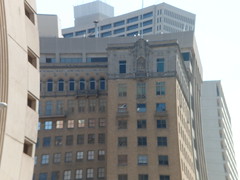
Above is Hotel Oakland, in the city’s downtown.

Next up, San Francisco’s Embarcadero, and Telegraph Hill, with its famous Coit Tower.

I felt I was getting sensory overload in the bay cities, so around 2 PM, it was farewell to this beautiful city and its underrated sister, Oakland.  I headed across the Golden Gate Bridge to Sausalito and to the Golden Gate natural preserves.  Here are photos from Vista Point, Sausalito and Muir Woods National Monument.
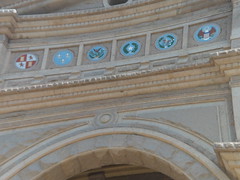
Well, that’s it for tonight.  I will write more specific stuff about this fine day, tomorrow- if the Internet kicks in here at Abalone Inn Bed & Breakfast, near Point Reyes.

Northwest by North, Day 4: A Hundred Years of Spirit

0

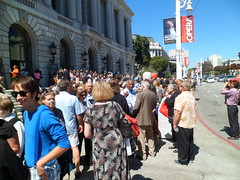
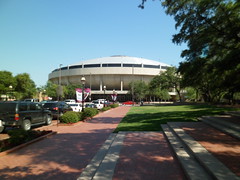
I drove into San Francisco this morning, so as to prepare for the first of this trip’s centerpiece activities.  A hundred years ago, this October 3, Abdu’l-Baha began a visit to the Bay Area.  Yesterday, many of us walked around Oakland’s Lake Merritt, to commemorate His visit there.  Today, two thousand people gathered at the San Francisco Opera House, now properly called War Memorial Performing Arts Center, in honour of the fallen in World War I.  My friends and I went in early, to ensure ourselves parking slots in the garage on Grove Street.  Below, is the Opera House:

After ascertaining the correct spot for our 1 PM entrance, we went photo- seeking around City Hall and the surrounding area, where we also were to find great San Francisco coffee and superb street food, in the Heart of the City Farmers’ Market.

This is a statue of Simon Bolivar, facing San Francisco City Hall.

We happened upon Celtic Coffee Company, about three blocks east of City Hall.  Great   coffee is one of three musts for me, in the Bay Area.  The others are good Asian cuisine, which I had last night and a fine Italian meal, still to come.  Celtic puts out some fine coffee.

Great cities always have open air markets, and SF is no exception.  Heart of the City is a place where I could happily hang out for days- Fresh fruits, vegetables, organic meat and fish are all there for people with coolers or insulated storage bags.  Trail mix and nuts are plentiful.

It’s the street food, though, that makes it happen.  I enjoyed a curried lentil wrap, with mango sauce and cilantro chutney, at this vendor’s booth:

Other possibilities were pupusas, which my friends enjoyed and sushi.  I also picked up some fresh trail mix and pizza bread, to replenish my road trip stock.

This foodie trek having worked out well, we headed over to our event venue, and were seated fairly quickly.  It’s a good thing, because the crowds of our fellows in Faith were quite awesome.

All aspects of Abdu’l-Baha’s time in the Bay Area were covered this afternoon, from His visits with Mrs. Phoebe Hearst, a Baha’i who was the mother of William Randolph Hearst, to his comforting of the poor in San Francisco and Oakland.  He was a strong advocate of establishing storehouses in each community, to fend off hunger and illness, in times of dire public need.  Three main speakers addressed aspects of Abdu’l-Baha’s work for world peace.  Actors portrayed Mrs. Hearst, her butler Robert Turner, who was the first African-American to become a Baha’i, Mrs. Helen Goodall (a friend of Mrs. Hearst and Abdu’l -Baha’s hostess in Oakland, Mrs. Ella Cooper ( Mrs. Goodall’s daughter), Thornton Chase ( the first American to become a Baha’i) and John Bosch, a vintner who was a business associate of Mr. Chase.  Lively music punctuated the presentation and we were all on our feet for the gospel-tinged final song.

The theme going out of this afternoon’s event was “Increase the Peace”- brought to us by young Baha’is between the ages of 9-14.

Later, at the elegant San Francisco Baha’i Center, about 300 people viewed segments of a documentary, entitled  “Luminous Journey:  Abdu’l-Baha in America, 1912”, which is being completed by Tim and Anne Perry, of the Dallas area.  This film will be ready sometime later this Fall,  and looks like a polished and fast-paced account of those momentous months.

Here is Anne Perry, moderating the presentation of segments from “Luminous Journey”.

This day will long live in my heart, as one of the more stellar events carried out by my fellow Baha’is.  The company of my friends brought back all the warmth I felt when Penny was with me at such gatherings.  Then again, I felt her there today, too.

“Increase the Peace!”

One Giant Leap

0

Last night, as I was driving back from Phoenix, a BBC News report came on National Public Radio.  At that time, I looked up at the Moon, and saw the crater shadow that looks like a giant in full stride.  The account on BBC was of the life of Neil Armstrong- how apropos!  I can remember, when we were in the midst of Basic Training, a drill instructor brought us all up into a room which had a TV.  The instructor told us that today was a moment that would live in the memories of everyone alive at that time.  The Apollo 11 Crew had made it to the Moon’s surface.  As 45 green soldiers-in-training, and millions of other people, watched, Neil Armstrong stepped onto the surface of our planet’s natural satellite and uttered his famous words-minimizing his own act and placing emphasis on the collective:  It was Mankind that had taken a bounding leap into the greater universe.

Neil Armstrong was too self-effacing a man to ever insert himself into continuous national prominence, afterward.  In spite of that, or maybe BECAUSE of it, he will live for all posterity as one of the greatest American heroes- a fact acknowledged by President Obama, by his colleague Edwin “Buzz” Aldrin, and more privately by thousands of us around the globe.  It was his wish to see us move on towards further lunar exploration and towards the exploration of Mars.  Let’s do that, as a human race, and do so responsibly, as good stewards and as good neighbours in the Universe.

A Tale of Three Houses

0

Long ago, a builder decided to erect a structure that he intended to last for several centuries.  He planned it to house those of his family who had nowhere else to go.  He drew long plans for the house, then set to work.  Shortly afterward, there were twelve men and a woman who came to help.  The builder looked around his neighbourhood, and saw that several of the older structures which had been originally built simply and well, had fallen into disrepair, and were overcrowded with objects.  The people who lived in those buildings valued the objects more than the houses, or even their own lives.  Animals, large and small, were allowed to live in the houses as well, and there were several competing landlords, even within one house.

The builder told his helpers:  “If anything should happen to me, before the house is finished, Mr. Rock will lead the crew.  Make sure that only one of you is the landlord.”  The helpers were a bit puzzled by that comment, but kept on with their work, day by day- with the woman often encouraging the men.  One day, the builder was set upon by some competing contractors, who had been cued in, as to his plans, by one of the crew members, who was not satisfied with his wage.  The builder died of his injuries, three days later.  Mr. Rock tried to carry on, after the builder was laid to rest, but several of the crew left to build houses of their own, saying they could do better than Mr. Rock.

Mr. Rock managed to finish his great house, but over time, his successors added rooms and overstocked the house with furniture and glittering objects.  The poor were cast out, and found their way to several other houses, which various former crew members had built.  The original house still stood, over several centuries, somewhat strong and sturdy, but a shadow of its former self.

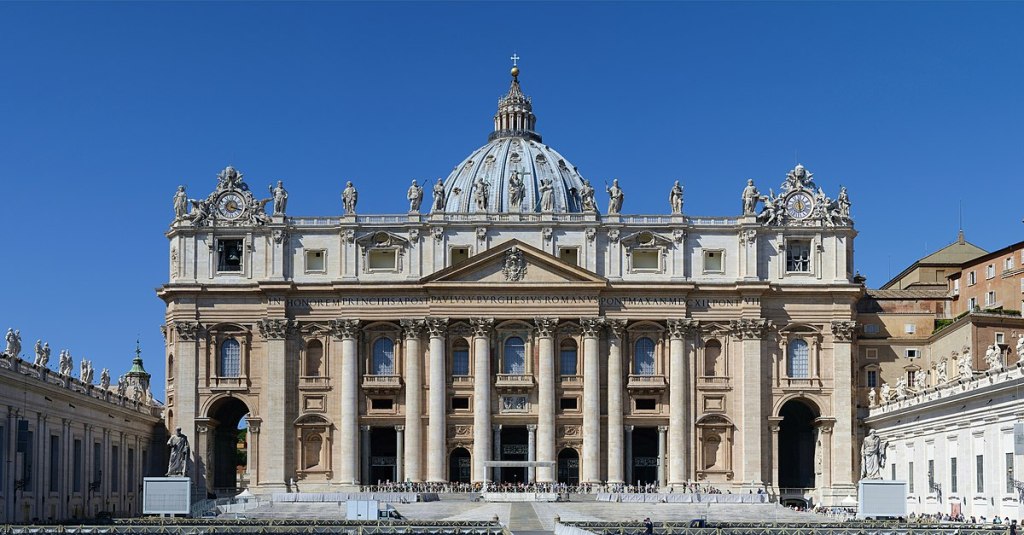
St. Peter’s Basilica

In time, another builder, in a nearby neighbourhood, noticed the various homes that had been built centuries earlier.  He determined to build a grand house, similar to the originals of the others.  This would house the good-hearted  of his family, and would be a place where learning and science were valued.  He also gathered several helpers, all men.  The builder had two crew leaders- one to help with the building itself and the other to organize the men.  He said that, if anything happened to him, before the house was completed, that the crew leader responsible for the building itself would take his place.  This did not set well with the supervisor of the men, who thought that he, alone, would build a house grand enough to dominate the whole city.  He would do this by being hard and tough, and punishing those who disagreed with him.

As it happened, as the house was nearing completion, the builder took ill with a fever.  As he was languishing in bed, his building supervisor came to him and asked, “Master, what would you have me do?”  The builder responded, in a weak voice, “Carry on, as I have asked.”  Just then, the supervisor of the men entered the room.  “The master is weak and confused.  He knows not what he is saying.  I shall take charge now!”  The men listened and by, force of numbers, banished the building supervisor and his small group of helpers to an outlying area of the city.  No sooner had the builder died of his fever, than the two supervisors began to build houses of their own.  The supervisor of the crew finished the original house, and grand it was!  The original building supervisor built his own house, several blocks away, but encouraged his tenants to visit the original great house and always look to it as a model.  As time went on, others built similar houses of their own, separately from the two former crew mates.

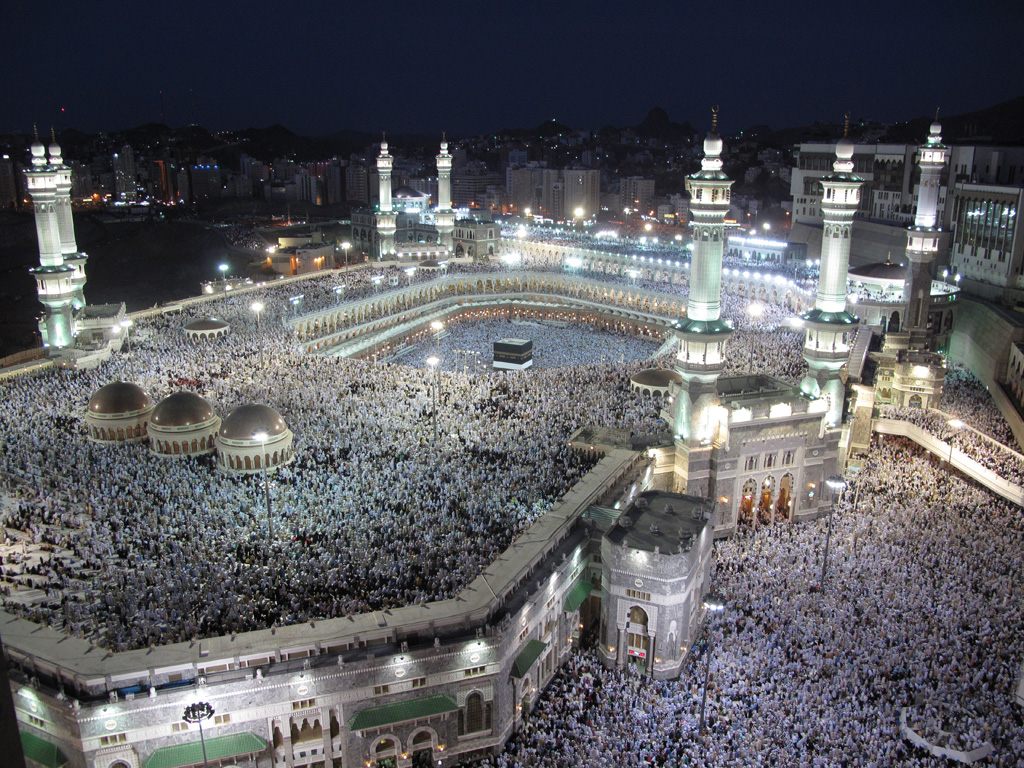
The Grand Mosque of Mecca

Many, many years thereafter, two builders appeared on the scene.  The first builder constructed a small, but elegant cottage- which was finished at considerable peril to himself and many of his helpers.  The residents of the last great house’s building supervisor’s domicile made many attempts to stop the completion of the little cottage.  They even killed the new builder and many of his crew.

The second of the two new builders, however, was the one with a greater set of plans.  The old home’s residents prevailed on the building inspector to chase this new architect from one neighbourhood to another.   After several years, he and his crew landed in an old and decaying city, far from the place where he had grown and had worked with his colleague.  His idea, however, was to build a great palace, where there was room for all who wished to live there.  So, he set to work ,beginning the great palace- surviving attacks from several followers of the earlier builders, from his own former chief lieutenant and from the various building inspectors.

All this exhausted the Master Builder, and he left completion of the Palace to his eldest son and further descendants.  He left a message, before leaving this world, that those who wished, should live there in peace and harmony, for at least a 1,000 years.  Those who wished to leave the Palace could do so, but they would be on their own.  The building of the Great Palace goes on, to this day, and will continue for some time to come.  Occasionally, some crew members go off, to build their own “palaces”, but with no plans, is it any surprise that these turn out to be hovels?  For without attention to the plans that work, how can a home be made to last?

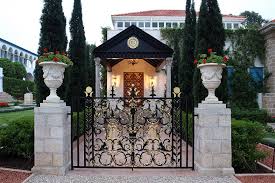
Shrine of al-Bab, Haifa, Israel

Shrine of Baha’u’llah, Bahji, Israel

Thoughts on “A Song of Ice and Fire”

0

If Tyrion Lannister were a time traveler, I can envision him on stage with Peggy Lee, doing a duet of “Is That All There Is?”.

I have just finished reading the five completed volumes of “A Song of Ice and Fire”.  This is arguably the most complex and riveting series since Tolkien’s Ring Trilogy- yes, a cut above Harry Potter.  Maybe it’s the unabridged realism of how the human animals treat one another, and the “no promises” twists and turns of George R.R. Martin’s imagined blend of pre-history, ancient Rome and China, medieval Europe and 20th Century American snarkiness that kept me going- and leave me waiting, eagerly, but patiently, for Volume 6.

There are characters I have come to love, and love to hate.

The aforementioned Tyrion swings like a pendulum between the former group and the latter- his finest moment, thus far, is his sensitivity in the wedding bedroom with the hapless Sansa Stark.  His basest, the slaughter of his father, is balanced by the fact that Lord Tywin is such a hideous man of his times.

The girls, Daenerys Targaryen, Sansa (aka Alayne Stone), her sister, Arya (aka “Cat of the Canals”), Ygritte,  Margaery, the two Jeynes and Myrcella are stunningly sympathetic beings- though never saccharine and always complete personalities, they are always supremely lovable.  I found myself infuriated at the harshness that continually comes their way in the course of the story, but always cheering for their successes and ingenuity, while knowing that they will need to suffer the same ignominies as everyone else.

Besides Tyrion, the tale abounds with great characters:  the insipid, but dangerous, Vargo Hoat;  the ever-present shadow, Lord Varys;  the good-hearted brute, Strong Belwas and the kindly giant, Wun Wun.  I would have liked to have seen Ned Stark and his bastard son, Jon Snow, escape their cruel fates, at least for a time, but the story would have probably suffered.

The great villains, Tywin, his daughter Cersei, Roose Bolton, his bastard son Ramsay and the psychotic Walder Frey bring a near-blinding blackness to their   corners of Martin’s undulating Eurasian prototype.

The great adventurers- Robb Stark, Drogo, Jaime Lannister, Stannis Baratheon, Jorah Mormont, Victarion Greyjoy, Jon Connington- and Tyrion, in his own way, show the destiny that so often awaits those who ride larger than life- and end up getting snagged by a combination of their own folly and the treachery of their petulant enemies.

The promise, and the threat, will continue for at least two more volumes, as Daenerys and her young nephew Aegon follow their destinies.  My hope is that the vagaries of modern American television don’t thwart George R.R. Martin in HIS imaginative quest.  Let’s wait for “The Winds of Winter”, “A Dream of Spring” and whatever else the denizens of Westeros and the eastern cities may care to bring us.

Texas, Day 8, Part 3: Port Isabel

4

There is something about an anchoring outpost, at the far end of any of the four directions, that continually fascinates.  People of all walks of life, ethniciities, orientations and creeds can appreciate the ambiance and raw challenge suggested by a human settlement  at the very edge of  a landmass, or even of a political unit.  Someone once posited, rather indelicately, that “Key West and Provincetown aren’t just for Gays anymore”.  True enough- a die-hard “straight” person like me would enjoy such places perfectly well.   I think my “gay” friends would agree.

The appeal is in the edge; but I digress.

Port Isabel lies at the southeast corner of the Texas mainland.  Though the small settlement of Boca Chica is just a tad further to the south and east, Port Isabel has the role of  welcoming anchor, with its lighthouse that once guided thousands of ships to safe harbour.   Today, “Isabel” is the gateway to the beaches and boat slips of South Padre Island.  Its school system serves island children, as well as its own.  The town has three museums, which complement one another and operate in unison.

Here are some views of this surprisingly complex town.

8188908721_9409eb5551_m

First, a look back towards South Padre Island.

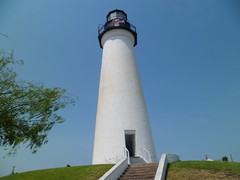
Next, I visited the Port Isabel Lighthouse.  It’s no longer serving its original purpose, of course, but kids of all ages can challenge their acrophobia and claustrophobia by climbing up the narrow stairs, and cramming into the veritable crawlspace that is the tower.  It holds two adults at a time, comfortably.

8188871333_3c47017b0b_m (1)

Next, I walked over to the Port Isabel Historical Museum.  It  does a fine job of chronicling the cultural contributions, and relationships to the land, sea and river, of the Coahuiltecan indigenous people, of the Spanish, Tejano, and American settlers. This area was vital to the cotton trade, and as I’ve said before, the mercantile Tejanos of the lower Rio Grande Valley were more ferocious in defense of the Confederacy than even the cotton barons themselves.

8188867061_64653b2799_m

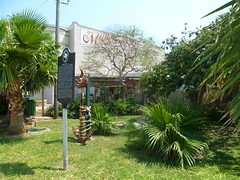
Here are a few shots of the Historical Museum, starting with the front garden.

8188924627_3eb3db6c67_m

Children of Victorian Port Isabel were taught the finer things of life.  Girls learned manners through play with intricately-made dolls.

8188911573_d190ccb3c9_m

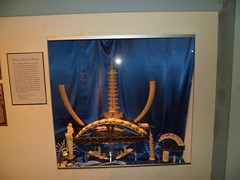
Like any maritime community in North America, Port Isabel had ties to, and a fascination with, the culture of eastern Asia.

8189992640_efc10677c3_m

The last museum on this circuit is Treasures of the Gulf.  I took no photos inside, but the museum does have marvelous murals and artifacts of Spanish and Civil War Era shipwrecks, as well as hurricane memorabilia.  A Children’s Discovery Room will make this a great place for visiting families to beat the heat.

8188874161_bf38f18a20_m

It was getting to be time to leave the Gulf region, so I headed up the Rio Grande Valley, past the farms and thriving communities of Cameron and Hidalgo Counties, to:

Day 9, Part 1: Laredo

Texas, Day 4, Part 1: The Lone Star Capitol

2

I arrived in Austin around 10 A.M. on Monday.  Most every place was packed with students on end-of-year field trips, but that was true in Palo Duro as well.  Kids have been part of my landscape for so long, that I miss them when they aren’t there.  So this week would prove to be very refreshing.  I spent about ninety minutes, in and around the Texas State Capitol, once having parked in the visitors’ garage.

This capitol building is suitably huge and majestic, befitting a state that, under the terms of its admission to the Union, may legally subdivide into as many as five states. That this diverse land has chosen to remain united as the Lone Star State is a message to the nation as a whole, as well as a reminder to its citizens to not repeat the choice it made in 1861.  Until recently, there was a separatist movement in Texas, to bring back the Republic of 1836-45.

There was much that was praiseworthy about the original Tejas Rebellion.  It would likely not have happened, had not Mexican President Antonio Lopez de Santa Anna usurped nearly imperial powers, after his election by the Congress of Mexico, in 1833.  The majority of Tejas residents by then were American southerners, who had a sense of their own freedom, while espousing the institution of slavery.  The irony was not lost on them, but they were determined to safeguard their freedom, anyway.  More on Santa Anna, and the rebels, in Day 4, Part 3.

Here are some photos of this magnificent building and its surroundings.

8177168406_1ba96ba5ef_m

Approaching the capitol from the east.

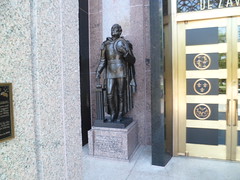
Here is Sam Houston.

8177134867_11b48944f3_m

This statue honors those who fought for freedom in 1836.

8177161360_e306536ea3_m

A Fountain of Youth, on the South Side of the Capitol.

8177118579_00bb6b1743_m

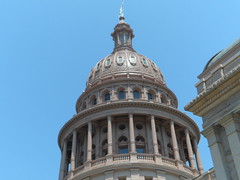
This is a close-up of the dome, from the south side.

8177127869_d7c93af252_m

Six Flags Over Texas- The Real Deal.

8177125607_ea7fe0e692_m

The Texas State Capitol, from the south.

8177145220_f76c9dea54_m

The Tenacity of the Tejano, part of a sculpture honoring the Mexicans who stayed in Texas, after 1836.

8177134306_d01641b6f6_m

The Texas Capitol Visitors’ Center,  is southeast of the Capitol.

8177132256_0979812de6_m

In 2008, an arsonist set fire to the Texas Governor’s Mansion, which was unoccupied at the time.  This piece from the portico of the mansion is on display in the Capitol Visitors’ Center.

8177090839_4bc48a1ff4_m

Here is an interior view of the Rotunda, taken after I got back from lunch (See Part 2).

8177292237_f978fdc78b_m

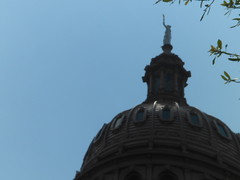
Silhouette of Lady Liberty; was taken from north side of the Texas Capitol.

8177287383_81824ed73b_m

So you can see, the Texas State Capitol could easily take up a good five hours of a person’s time.  This vignette, like my other posts, could easily be topped by the connoisseur of Texas history.

I will have three more posts on Austin:  Part 2 is on Downtown; part 3 will cover the Bob Bullock Texas State History Museum and part 4, the University of Texas at Austin.   Some may be up tonight, depending on where I stay the night.  Otherwise, being Memorial Day weekend, I will post my 20 or so remaining blogs over the course of next week.  Stay tuned.

Texas, Day 3, Part 4: Czech Stop

2

Texas drew people from the world over, during its brief stint as an independent nation,1836-1845.  Among the Europeans who came in droves were the Bohemians and Moravians, now known as Czechs.  They tended to settle in areas where there were many Germans, for some reason- areas like what are now San Antonio, the Hill Country and Corpus Christi.  This, even though Germans and Czechs weren’t exactly kissing cousins.

I found a gem of  a town, with a large Czech presence:  West, TX.  It is orally referenced as “West comma Texas, to distinguish it from the REGION of West Texas, from which it is rather far.  The town of West, TX lies just north of Waco, another center of German heritage, which is unfortunately better known for the Branch Davidian debacle of the 1990’s.  I didn’t have time to seriously discover Waco and my friend who lives near there was busy, anyway.

West, TX, however, may be well-covered in an hour or so.  It is named, not for the idea of Texas being in the West, but after Thomas West, a rancher who was also the area’s first Postmaster.  He promoted its growth, as a counterpoint to Waco and Fort Worth.  Somehow, though he built a solid little town, its greatness is still a potential rather than a reality.

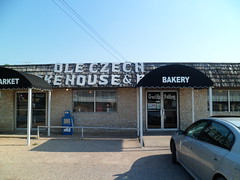
West, TX is a fine place to stop and enjoy awesome Central European staples, such as feisty sausages, beer bread and kolaches (fruit or nut filled buns).  I chose Czech Stop, a bakery attached to the Sunoco station.  Actually, it was chosen for me, as everyone else was closed, with it being Sunday.   No matter, the place was packed, with people flying up over the hill and whipping into the parking lot, as if there were a fire sale going on.

I bought enough poppy seed kolaches, cheddar-jalapeno rolls, summer sausage and rye bread to keep me happy over the ensuing three days- making breakfast and supper  at restaurants unnecessary.  I had to save for purchasing beach wear, you see.

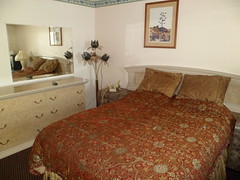
Here are some scenes from West, TX and from the delightful Oasis Inn, in Temple, TX, where I spent Sunday night.  Below is West City Hall.

8174180392_79750dfae9_m

Czech-Mexican fusion is big here, as it is in Corpus Christi.

8174186798_5de200099f_m

Other bakeries in town do stick to traditional central European fare.

8174178842_38a52aaf62_m

Below, the gazebo honours Thomas West.

8174149213_62f96d0cb6_m

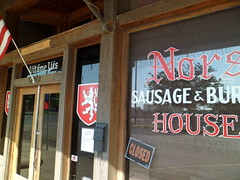
Another Czech butcher shop/bakery was closed, but looks interesting.

8174185078_df893634b3_m

On the far West Side of West, I found this:

8174144837_3e7fe5a185_m

Now, since this was such a long, full and wonderful day, I found a marvelous little motel, right off I-35, in Temple.

8174140549_78f2e4b1df_m

It’s Oasis Inn.

8174174398_1488b5b3d4_m

Texas, Day 3- Part 2: Fort Worth Downtown and Way Uptown

2

Understanding a city like Fort Worth takes a good dose of meat- lovin’.  I imagine it’d be hard to be a vegan and live here, though I’m sure there are plenty who do.  I am one who likes a balanced diet, so some meat in a day is a good thing, in my view.

I spent about forty minutes on Saturday and an hour or so today, walking around Fort Worth’s downtown, before heading up to the city’s heart:  The North Side.

As I mentioned earlier, when cattlemen build something, it’s meant to last.  Here are Tarrant County’s Administration Building, and a few other shots of downtown Fort Worth.

8173813964_e853d0c5e6_m

This is where the Fort Worth Colts (baseball team) play, or so I’m told.

8173800707_64b126308b_m

Downtown has a mix of Victorian, Art Deco and Modern architectural styles.

8173799027_e12b92f56c_m

Now, the fun part- the Stockyards District!

8173772051_494b422d2b_m

Here is one of several Barbecue choices on the North Side:  Cooper’s.   It’s a large open bay with long tables.  Pick out your meat and choice of sauces, jalapeno or “regular’, then go on to the carbs area- baked potato, potato salad, corn on the cob, etc, then get a drink cup and settle up at the register.  After that, “set down” and dig in!  Oh, there’s cobbler, but you have to practically beg the girl at the carbs area for a piece.  She might not think you need it.  Some customers pitch a fit if you leave your tray after eating, but there is a busperson, so ignore them, and let him do his job.  It’s all good.

There are still a few head of cattle left in the pens.

8173798194_80c07605a9_m

I walked up into and along the pens and came out here, where the animals obligingly dare you to try and pet them.  Warning signs dissuade most everyone, including me.

8173756733_160a3d35ea_m

There was a good crowd on the streets south of the pens, reminding me of all the tales told about Old Fort Worth.

8173981597_b535e3b6e5_m

8174028662_d58e7d720b_m

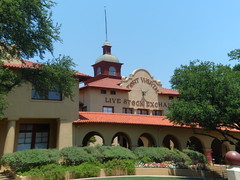
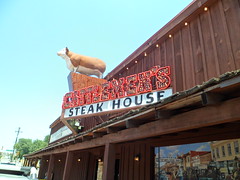
This is, of course, the Livestock Exchange.  As I walked around, I noticed a few more BBQ choices, for those who like table service.  One is Riscky’s Steakhouse (Yep, that’s the spelling).  Another is Cattlemen’s.

8173986459_0770c445b2_m

8173975187_18c85850ae_m

After one has eaten, it’s time for a show.  Billy Bob’s Texas has it covered!

8174000824_1cb5f08dbf_m

There’s more than enough in the North Side to keep a passel of kids entertained, for days.  I will be back here, some day.  It was time, though, to head a bit west, to the Cultural District, and Log Cabin Village.