December 19, 2025, Grants, NM- The forlorn-looking man, head down on the high top table, seemed the way I had felt, just before enjoying a hearty meal at the Iron Skillet branch, in nearby Milan. I was somewhat refreshed by the burger, salad and coffee and Linda was a bustling, attentive young server, seemingly new to the job, but very pleasant. Poor Julio was just tired and slept on, unmolested by the truckers who were coming and going.
The day, for me, was comprised of finishing the clean-out of the bathroom cabinets, file cabinet, dresser and tall kitchen cabinet. A bit remains to be done, after Christmas, but by then, I will have a moving truck, one way or the other, the furniture will be carted away to DAV and a cleaning crew will make the old apartment presentable. That is the plan for December 29-30. For today, I packed about 40 % of what I own into the Sportage and headed out, after dealing with a large shred pile and giving more items to DAV. There was also a farewell meal at Zeke’s, bringing to a close a fourteen-year set of weekly breakfasts and lunches.
The drive east had a brief moment of interruption, when an off-duty policeman pointed out that something was dragging in front of Sportage. I checked it out and found the molding under the hood had come loose. After re-clipping it, I had no further problems. The drive from Prescott to this former mining town, east of Gallup, was then uneventful. Now I am at SouthWest Motel, the Delta Motel of New Mexico, replete with music-themed rooms. I am in the Fleetwood Mac Room. There is an LP of their greatest hits and a turntable. Out of respect to the older gentleman next door, (In his late 80s), I will pass on cranking the tunes.
Tomorrow will bring me back to Texas and by Sunday afternoon, I should be at Home Base Plano.
December 18,2025- It took all of ten minutes to get a thrift store dispatcher to schedule the pick-up of most of my furniture for the last week of the year. It took five minutes to schedule a cleaning crew for the same day. Drawers and cabinets were cleared and wiped clean. A lot more stuff went to the Disabled American Veterans thrift store. There is about three hours’ worth of work left, for tomorrow morning.
I changed my address with the Post Office, effective December 30 and said farewell to The Arizona Republic, after subscribing since March, 1992. (I had subscribed from June, 1980-August, 1986, but then Penny and I moved to South Korea for 5.5 years.) The Red Cross was informed of my new address, as was National Geographic Magazine. Other notifications will go out, in the next few weeks.
Visits with friends punctuated the day. I made one last visit to the Farmers Market office and left some items in the care of one of my first co-workers. Dinner with a colleague from the Soup Kitchen capped a very fine day, with talk of the state of the teaching profession-and his concerns about the shallowness of online dating. Yet the ninety minutes spent with someone who helped turn my life around, after I was wallowing in the doldrums in the early 2010s, was easily the high point of the day. M is a model of proactivity and sustained self-reliance. She has achieved, singly and alone, the transformation of a neglected property into an organized and comfortable residence-something that I saw eluding her for most of our 12-year friendship. I can say she is one of those I will miss the most in this community of bright friend stars.
Now, I will rest and prepare for finishing my downsizing and getting underway on the first stage of the move to Plano. It is all falling into place.
December 17, 2025- The lone pedestrian took his turn in the crosswalk, as I approached the intersection, with one car ahead of me, and prepared to turn left-once the man had reached the curb. The driver ahead was also turning left, and edging up to the very crosswalk, while the pedestrian was still in it, made a show of going around the poor soul. Pedestrian and I both shook our heads simultaneously. I get quite exercised about that sort of close call! What if the pedestrian had stumbled and fallen backwards?
I bit later, I took some items to a friend who said she might be able to use them. After sifting through the stock and taking about half of it, she mused about people routinely bringing items, almost expecting that she would take the lot. I don’t dump things on people. I leave them with what they can actually use and find other places for the rest.
Public libraries have graciously accepted seven boxes of the books that have accumulated over the past fifteen years-between Phoenix and here. I have kept those volumes that I know will get read, especially the children’s books that I look forward to reading to my grandchild. The books that are left should fit in the car, along with the clothes, on my first trip out to Plano. I also donated another two boxes of assorted household items to other services.
The furniture will involve more calling around and seeing which agency is interested and can pick up. The first, which shall remain nameless for now, is rather fussy about what it will take. No matter, I no longer deal with them, anyway, for other lapses of ethics, as regards the homeless. I have a hard time with those who foster a mentality that divides people into classes.
December 16, 2025- The tall, soft-spoken man had become used to being overlooked. This morning, though, he was tired of it. When asked to wait for our Blood Donation center to finish being set up, he obligingly sat down. Then, things happened in rapid succession: The Center opened, ten people came through the door and lined up to be admitted, while he stayed seated. Once the line had been processed, the man was called over. He was livid.
He got an apology and was processed, then, still grousing about unfair treatment, he went to the donor interview seating area. One of those who had preceded him in line struck up a conversation, heard him out and offered to let him go ahead. That took the wind out of his angry sails and he calmed down. After a satisfying donation, he told the registration volunteers that they were not at fault, and wished everyone a Merry Christmas.
Many people in our society, and in large communities across the globe, feel overlooked, anonymous. Many indeed are. The human brain can only process just so much, and can only pay attention to just so many, before encountering someone who just doesn’t register, whose needs don’t compute. The brain is part of a physical system. It is finite, although it is also far more capable of achievement than most of us allow.
A lot of anonymity in society is due to spiritual dissonance. We are all primarily spiritual beings, living for a time in a physical frame. Those who don’t recognize their spirituality are far more likely to both feel overlooked and to compartmentalize their relationships with others. Isolation is a dangerous thing, both for the person experiencing it, and for those at whom the isolate, eventually, lashes out. Those who feel overlooked will eventually, invariably, find each other, and form groups with skewed visions of reality. Terrorism then ensues, either by someone acting alone or by the group.
The ISIS attack on American Army Reservists in Syria, over the weekend; the mass murder in Sydney; the murders of a conservative activist and an Uzbeki student, in Providence; and even the killings of Rob and Michele Reiner, all follow the pattern: One or more isolated people, to some extent or another exacerbated by mental illness, and in many cases separated from their true spirit (even if they claim to be acting on behalf of a Faith), and feeling misunderstood, lash out in a horrifying manner. They misunderstand their own nature, and taking the seeming indifference of others-who are themselves a bit cut off from their spirituality-as proof that they are owed retribution, lash out in a horrifying manner.
Each individual needs to know that s(he) is responsible for own spiritual education. Parents and adults close to a child can help him or her in that regard. Adults can help one another, but in the end, we each need to take agency for our spiritual existence.
Several of us heard the gentleman’s cry for recognition, this morning, and turned around what could have been an ugly situation. This can be done anywhere, if we recognize the Source of our lives and strive accordingly.
December 15, 2025- There is only one constant, when transitioning from a long-time residence to taking over someone else’s long-time residence. It helps to have money set aside. I have found it will be in my best interests to invest in a U-Pod, which will mean two stages of the move, owing to Hana’s birth and the U-Pod’s schedule being on two separate wavelengths. I am only grateful that I can manage to do justice to both.
I divested myself of about half my wardrobe, saying goodbye to things that I have kept, but not worn and things that no longer fit. I have done the same to my book collection. Those volumes that I am unlikely to ever read, or that I have read and think will be enjoyed by others, have been passed on. Finally, the furniture: I have scant need for anything that is in this apartment, save a folding card table, once I am in Plano. Most will go to one thrift store or another. One piece is likely to be bought by someone in town.
Today was my last visit to the Coffee Klatsch, and last time volunteering at the Soup Kitchen. Both groups are filled with fond memories and people who will miss me as much as I do them. Life will go on, though, and a friend has already stepped up to take my place on the serving line. He will be an excellent fit for that operation, and made a good impression this evening.
So, the wall art and the small knick-knack keepsakes will be covered in bubble wrap. The family archives will be prepared for transport, some at the end of the week and the rest in the middle of next week. Our darling will appear in between it all. I am all in for the whole process.
December 14, 2025- I did not go to Bellemont, and climb up a long flight of stairs, six times, in order to store six boxes of books in an already crowded room which few people will enter until next summer. I had considered that option, until early this morning.
My late wife appeared to me in a dream, as if she were right beside me. That was a nice sensation, and though I realized it was a different level of reality, some insights came to me. I got the message to check with our public library, to see if they would take 2 boxes of the books. They did so, gladly, thus bringing a more meaningful Baha’i presence to either their general stock, their saleable book collection, or both.
Regarding the actual move, consultation with my son led me to contact a possible moving assistance service, comparing their price with what it would cost me to do the move on my own. There are timing issues, as well, so I will see what their answer is. This is the U-POD system that is growing in popularity. It makes sense for people who have a high volume to move. I do not, but rather am just in that gray area, with a few too many keepsakes for one trip.
Reason made this day a nice one. I did not have to leave town, saving my energy for what lies ahead this week. I can get a lot more done tomorrow, and won’t have to worry about letting my family down, come next week.
December 13, 2025- Two farewell gatherings took place today. One was small and short, taking place after my last work effort with Prescott Farmers Market. I got a thank you card and a special little round of hugs and handshakes.
The second was a full-on dinner party, a gathering of Baha’is, at the home of a couple who have been here for about three years. We shared several of our experiences, as well as focusing on the challenges present in our lives. Every person alive today has challenges and unmet needs. Camaraderie both eases those and offers a way by which they can be overcome.
I was recently advised, by someone whose counsel I value, that once I leave the area, no one will give me a second thought. Yes, and no. Everyone has lives to live and must go forward, regardless of who else leaves or stays. There was today, however, an overwhelming consensus that my presence will be missed. Yes and no, for me as well. I will focus on what is in front of me, in Plano-as I have in Prescott, these past fourteen years, and as I did in Phoenix before that. That focus, and commitment to being honourable, are what earned the respect of so many in this community. They are also what lead me to see the same qualities in others. I will never forget my time here, and all that ended up moving forward, because of our teamwork.
I will pack those things that I feel the need to bring with me, and I will carry the love of people in my heart.
December 12, 2025- The sunbow appeared in the northern sky, as I walked downtown from HB I. It was an affirmation that all had ended well, after a tumultuous day. It was Acker Night, time to walk about and enjoy the lights, music and camaraderie that foreshadow Christmas here. I ran across several friends and walked around with Hiking Buddy Akuura and another one of her friends. The musical fare ran the gamut from hip hop to novelty Country. The latter included a revision of “Take Me Home, Country Roads”, with Arizona taking the place of West Virginia and US 89 replacing the generic country roads. There were fewer Grinches, and no Krampases in sight. There were plenty of children and dogs wearing deer antlers, though. It was also warmer and more serene than the pushing and shoving that has sometimes characterized the crowds downtown.
I had entertained thoughts of heading up to Bellemont, with six boxes of books, earlier this morning. It occurred to me, though, that time was getting short to advertise and sell the sofa hide-a-bed. So, I took the measurements and a couple of photographs, and posted on Craig’s List. It didn’t take long for the grifters to come out of the woodwork. Offers of purchase on Venmo and Zelle came via text. Needless to say, after ridding myself of three or four such pests, (one of whom sounded quite convincing, until his “coach” came on in the background and was heard telling him what to say), I found it necessary to call my bank. If the thieves had my contact info, they might have been able to hack my account. So, proper measures were taken to safeguard my assets. Nothing was compromised, in the end. I will sell the item for cash and nothing else. It was a good day of learning about private sales of items.
I will use Sunday as a Books to Bellemont day. It is a lot less stressful now, knowing that there are alternatives to driving back and forth from Prescott to Plano, twice. I will talk with U-Haul reps on Monday, for transport of what might not fit in Sportage.
These things, too, shall pass and Christmas in Prescott will remain a bright and shiny memory, for years to come. Plano, and the Metroplex, have their own holiday festivities. My family will enjoy them all, as a unit.
December 11, 2025- A few of us gathered for a regular gathering, this afternoon, with illnesses and work trimming our numbers. There was a fair amount of interest in my schedule for departure and what might await me on the other end. Friends here are universally happy for me and family, while wistful about what it all means for the community. I know that I am hardly the be all and end all of anything, yet it feels nice to be so appreciated.
One friend gifted me with a small device that, inserted in the left ear, will alert with a buzz, if it senses a driver starting to doze off. This has not been a problem for me since the lowest point of my caretaking days, but it is best to be forearmed. I will use it faithfully, in the journey that lies ahead.
My morning had been occupied with cleaning out the spice cabinet. All those items that I had dutifully kept, from time immemorial, ended up discarded. Most glass bottles and metal boxes were carefully cleaned and placed in recycling. The worn out contents were properly placed in trash. Similar processes lie ahead for the office desk drawers, the clothes closet and the dresser. Then, there is the carport storage, either next Wednesday or Thursday. The book shelves are separated between “keep” and “donate”. Friends will come to look at the furniture, probably over the weekend, knowing that the sofa and the bed frame are headed elsewhere.
All this occupies me and generates solutions. There was a suggestion that I rent a large truck and tow Sportage. That would obviate any need for a second trip back and forth, but which is the absurdity and which, the solution, is still a matter of dollars, and sense. Aram and I will work that part out next week.
At least one medical provider has a counterpart in the Plano-Frisco area, and I can drive to that office, using a surface road. I’m hardly afraid of freeways, mind you, but have always made it my business to know the layout of secondary streets.
I go through this process, in the only way I know how, seeking solutions by talking things over with family and friends, and taking concrete steps forward, each day. I would like to see the same thing happen, in affairs of state, but there are so many who, it seems, are given over to absurdities. Eventually, solutions will present themselves, and not take “No’ for an answer. I prefer to have found them in a timely manner.
December 10,2025- In the Fall of 1979, a co-worker at Villa School, in Eloy, had a vehicle and wanted someone to go with her to Oak Creek Canyon and Sedona. My hand went up, as I was actively visiting as much of Arizona as I could on weekends, without the benefit of owning my own vehicle. So, northward we went, first to Flagstaff’s Fort Tuthill (fairgrounds), then down along U.S. 89, stopping next at an overlook and purchasing a few items of Dineh jewelry. (She, for herself and I, for another co-worker, whose birthday was approaching).
Then, the magic started to unfold-a riotous blend of colours: Blue sky, green trees and grass and red rocks presented their unique co-existence all along the windy canyon road, carved long ago, by Oak Creek. The creek itself served up a hearty torrent, at Slide Rock, which hosted a popular Arizona State Park. We looked for a bit at the happy families, kids squealing in delight and teen boys on the ledge above, daring one another to jump off into the creek. (None did, given that their fathers were close by, wielding veto power). We soon went on, down towards Sedona, creeping along behind a bicyclist, who was half arrogantly occupying the center of the lane and half scared to death that his brakes might fail. The slow pace only amplified the majesty of the place. We took in Cathedral Rock, Courthouse Butte and Bell Rock, all from their bases. I was an avid hiker, but my co-worker was not. I made a mental note to return to each of these, and explore further.
Over the years, Sedona has been a regular destination-either alone, or when accompanied by Penny, by our son, Aram, by his wife, Yunhee, by members of the NAU Hiking Club or, most recently, by my present Hiking Buddy, Akuura, the area has not once failed to present the most majestic of views. Those views change with the position of the Sun. Light and shadow are everything in the Southwest, and nowhere more so than in this most wondrous of places, where canyon meets mountain.
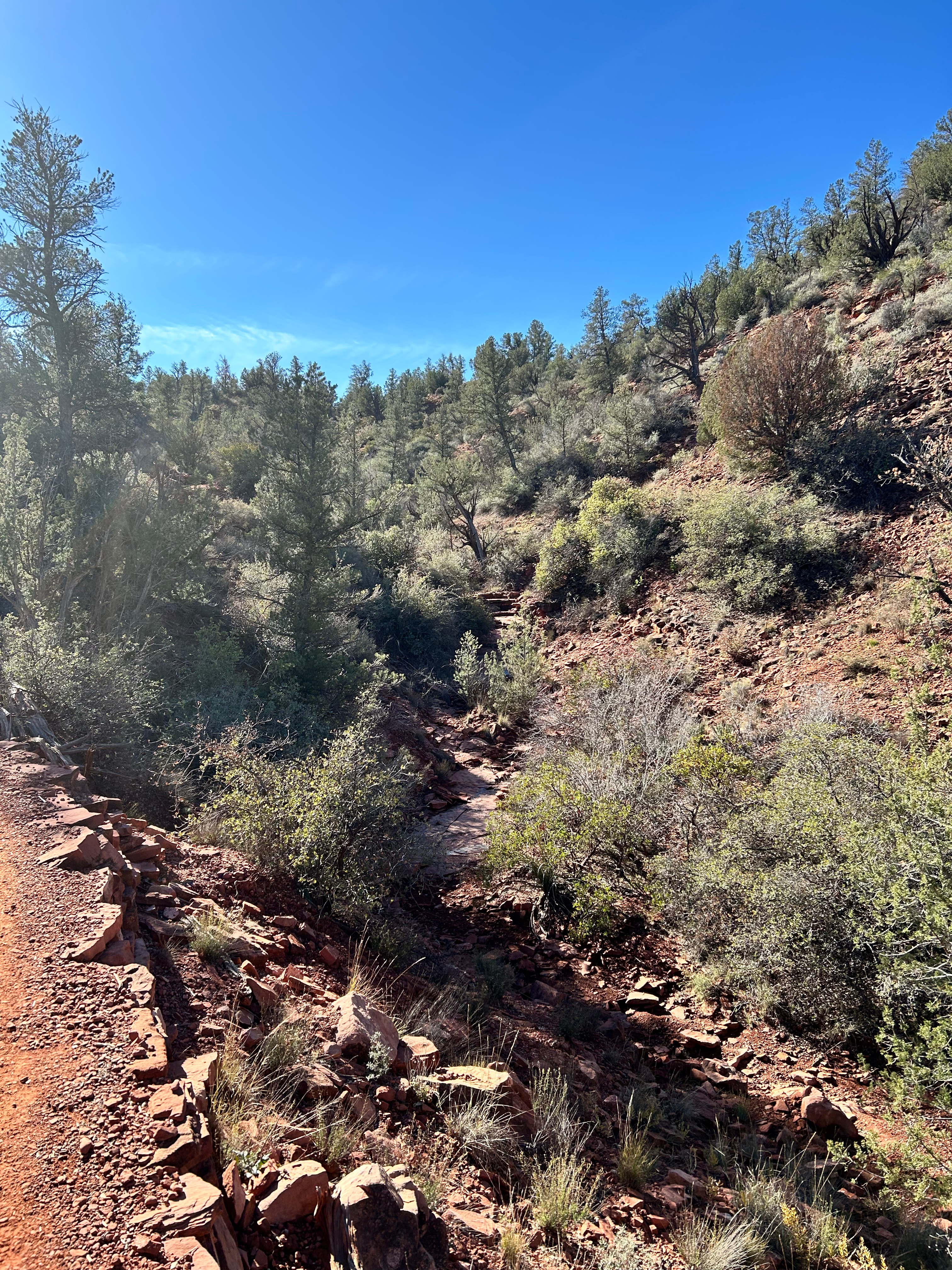
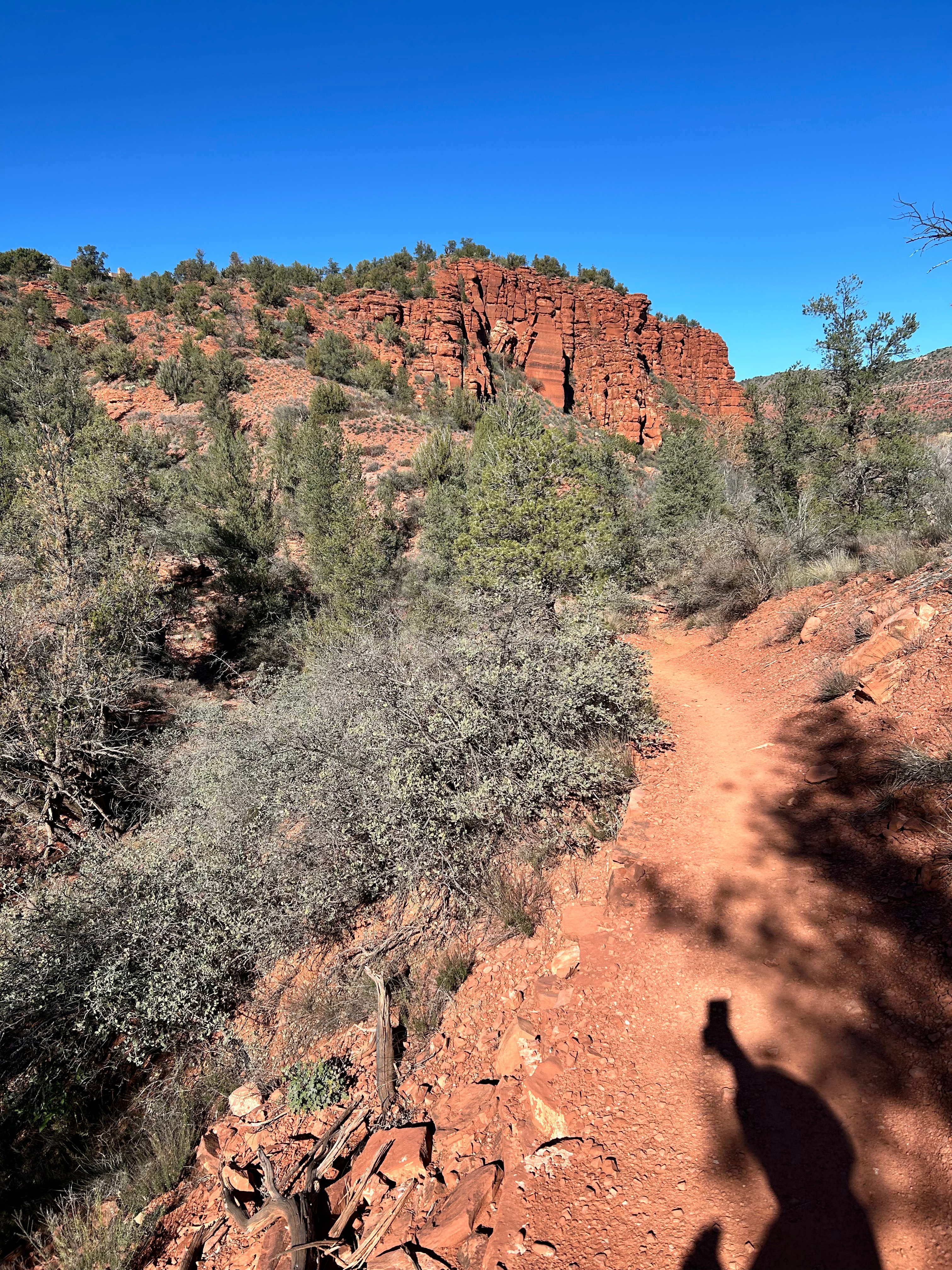
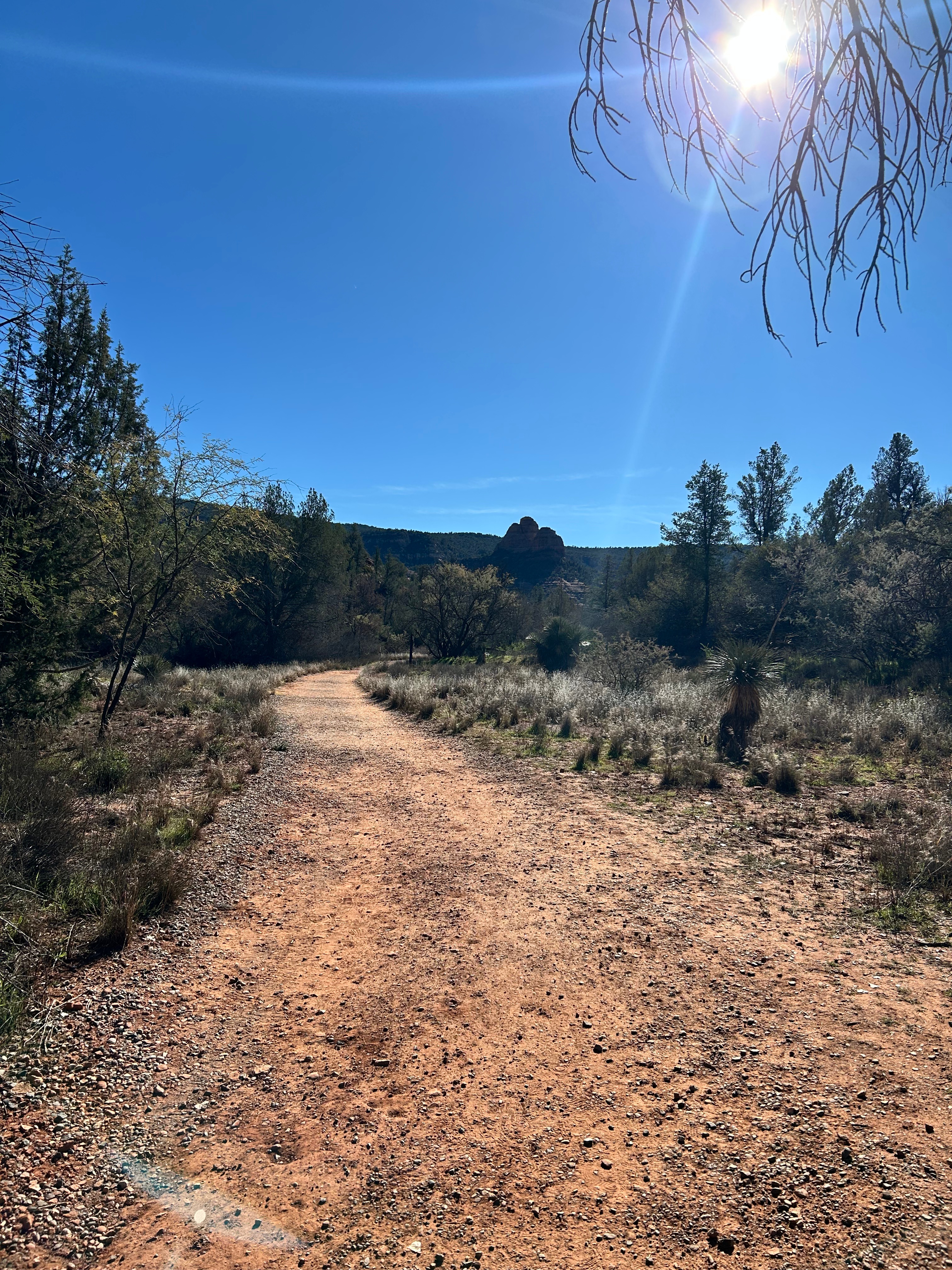
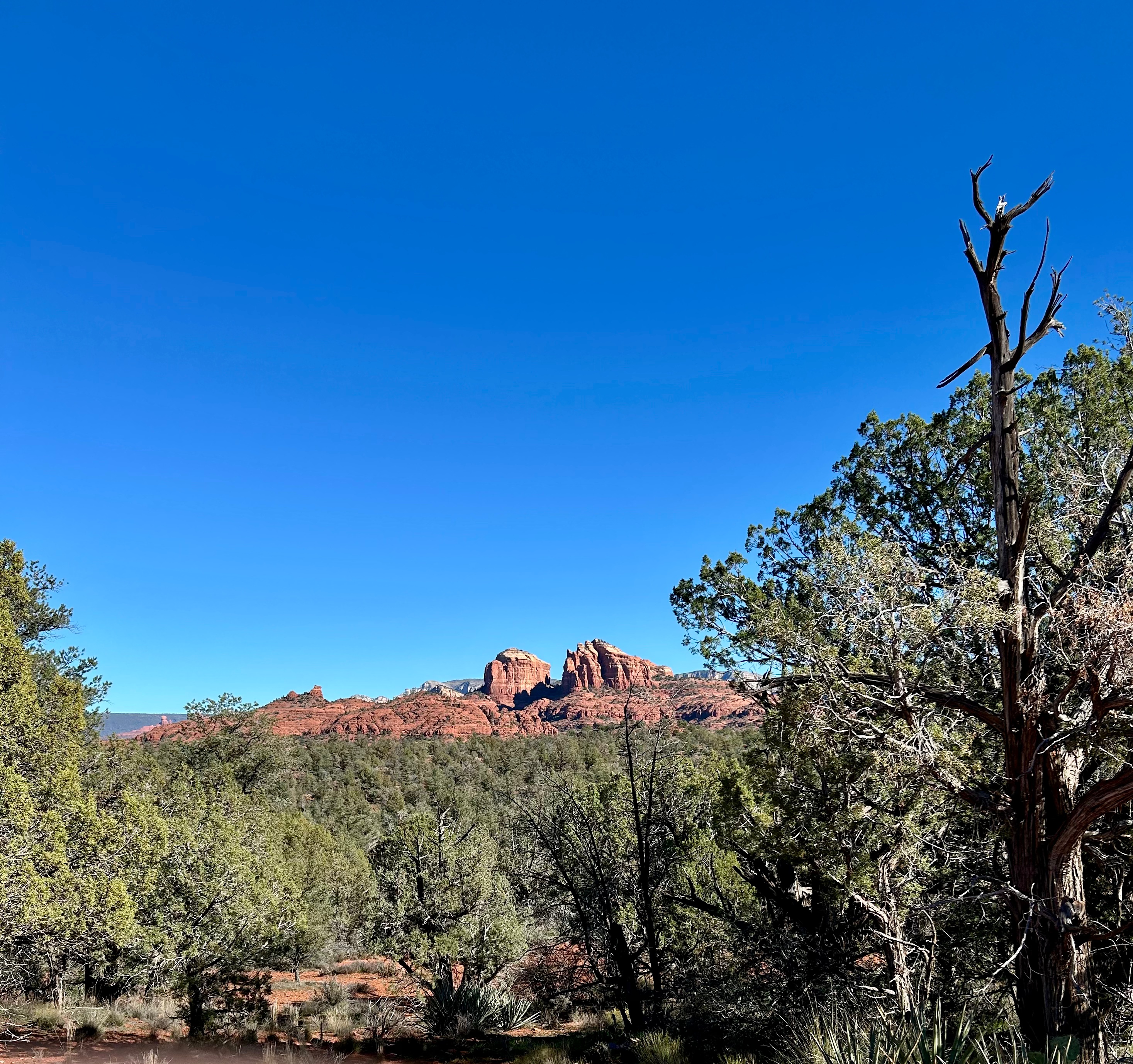
Akuura and I took in Red Rock State Park, for one final excursion, before I devote myself full tilt to dispersing many possessions and packing up the rest. It was an exquisite day, weather-wise, and so we took in Eagle’s Nest and Javelina Overlook-and several points along the way.
The blue and green were gearing up; the red a bit subdued, yet, at the base of Eagle’s Nest Trail.
The hues deepened, though, as my shadow and I walked towards the switchbacks that led to the overlook.
It may not look treacherous, but the sign is quite accurate.
The first phase of Javelina Trail passes by an area where several mule deer were grazing and another area, where a lone javelina was moving away from a small assembled group of bird watchers/deer oglers. We would encounter the deer again, towards the end of our hike, but that was the last we saw of the boar. This magnificent little spire could be called Love Rock, for all I know, but it is a standalone outcropping, along the flat trail, just before Apache Fire Loop rises off to the right.
Once atop the Javelina Trail, the iconic view of Cathedral Rock offered itself.
We briefly pondered the trail east to another part of this majestic expanse, but then opted to head back down to the Visitors Center-and on to lunch. Just before getting to the Visitors Center, we encountered the family of resident mule deer, enjoying their lunch.
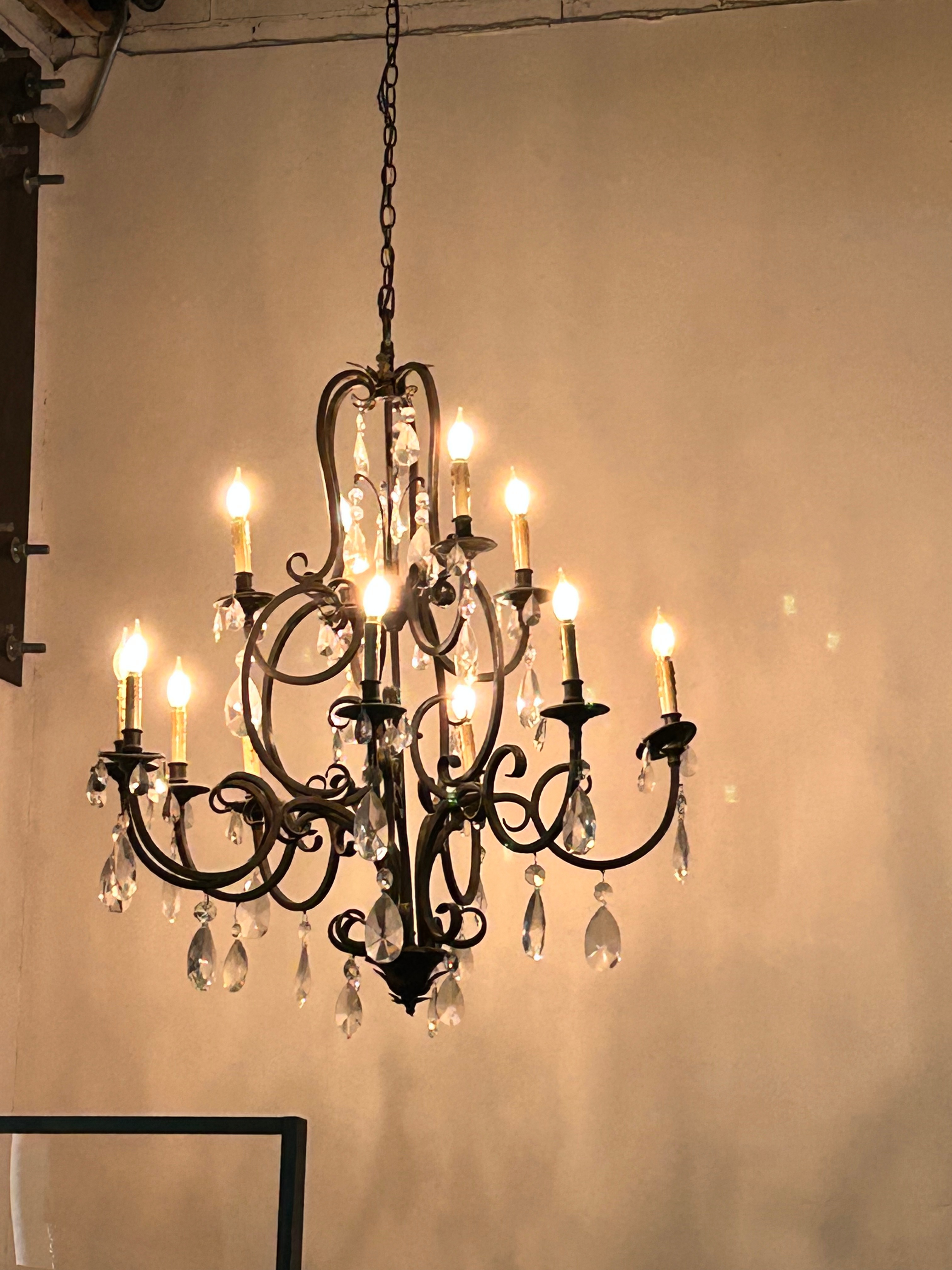
The final visit to Sedona, of this year at least, came to an end, with a celebratory lunch at The Belfry, at the entry to Old Town Cottonwood. I long ago swore to spare my readers any food photos, but this chandelier is worthy of praise.
I will someday be back in Sedona, and God willing, I might even have a wide-eyed granddaughter along.



 A Sagittarian Seeker