The Hana Chronicles: Month 9, Day 9

0

September 30, 2026- Hana is a true composite of several people, on both sides of the family. She has Yunhee’s eyelids and nose, my mother’s facial shape and eyes, Penny’s ears and mouth and Aram’s curly hair. Personality-wise, though, she is unique. Given sliced blueberry pieces, she has to roll them back and forth on her place mat, before eating them. This is the only food with which she does that.She also will stand still, smiling, when I say my prayer for her, each day. When she is tired, during the day, she will come to me and put her head on my chest. That is the cue that she wants to be put in the crib for a nap.

My granddaughter likes it best, when she has all three of us in the same room. Thus, dinner seems to be her favourite meal. We also all take a role in her bathing. I hold the bath towel that “catches’ her, after the bath is finished,and make sure she is wrapped, before handing her of to her father. I imagine, once she is able to walk completely unassisted, that I will just hand her the towel and help her wrap around. As we use a walk-in shower for her, this should be easy to effect.

HANA’S NOTE– Papa went off for a long time, this afternoon, and came back with a wrap on his arm, like I have when I get a blood draw. Did he get a blood draw? Why?

EXPANDING CIRCLES: Hawai’i- The Aloha State was the forty-ninth that I visited. The occasion was Aram’s ship having a Tiger Cruise, in October, 2014, on which I was invited to sail with them from Honolulu to San Diego. This gave me a look at some parts of the Hawaiian capital.

The Turf- Hawai’is major islands are all the result of volcanic activity. The largest, Hawai’i, has two active volcanoes, on its eastern side. The east also gets more rain than the leeward side, which is called the Kona Coast.. Kauai, Maui, Molokai and O’ahu all have volcanoes, which are dormant at present. O’ahu’s symbol, Diamond Head, was formed by an interaction between lava, ocean water and coral reef. On Kauai, Waimea Canyon, the island chain’s largest and deepest, is 10 miles long and 3000 feet deep.

First Nations- Kanaka Maoli (Hawaiians) appear to have settled the islands in two waves-the first, coming from Marquesas, in the Third Century, AD/CE and the second, from Tahiti around 1300. Legends of pre-Polynesian residents: Small humans, called Menehune, have not been independently verified. These people, if they did exist in Hawai’i, would probably have resembled the Denisovans of Indonesia and the southern Philippines. Kanaka Maoli today have exclusive rights to the islands of Kaho’olawe and Ni’ihau. They have led a revival of the Hawai’ian language and culture, since the 1970s.

Where I most feel at home: Iolani Palace, Helumoa,

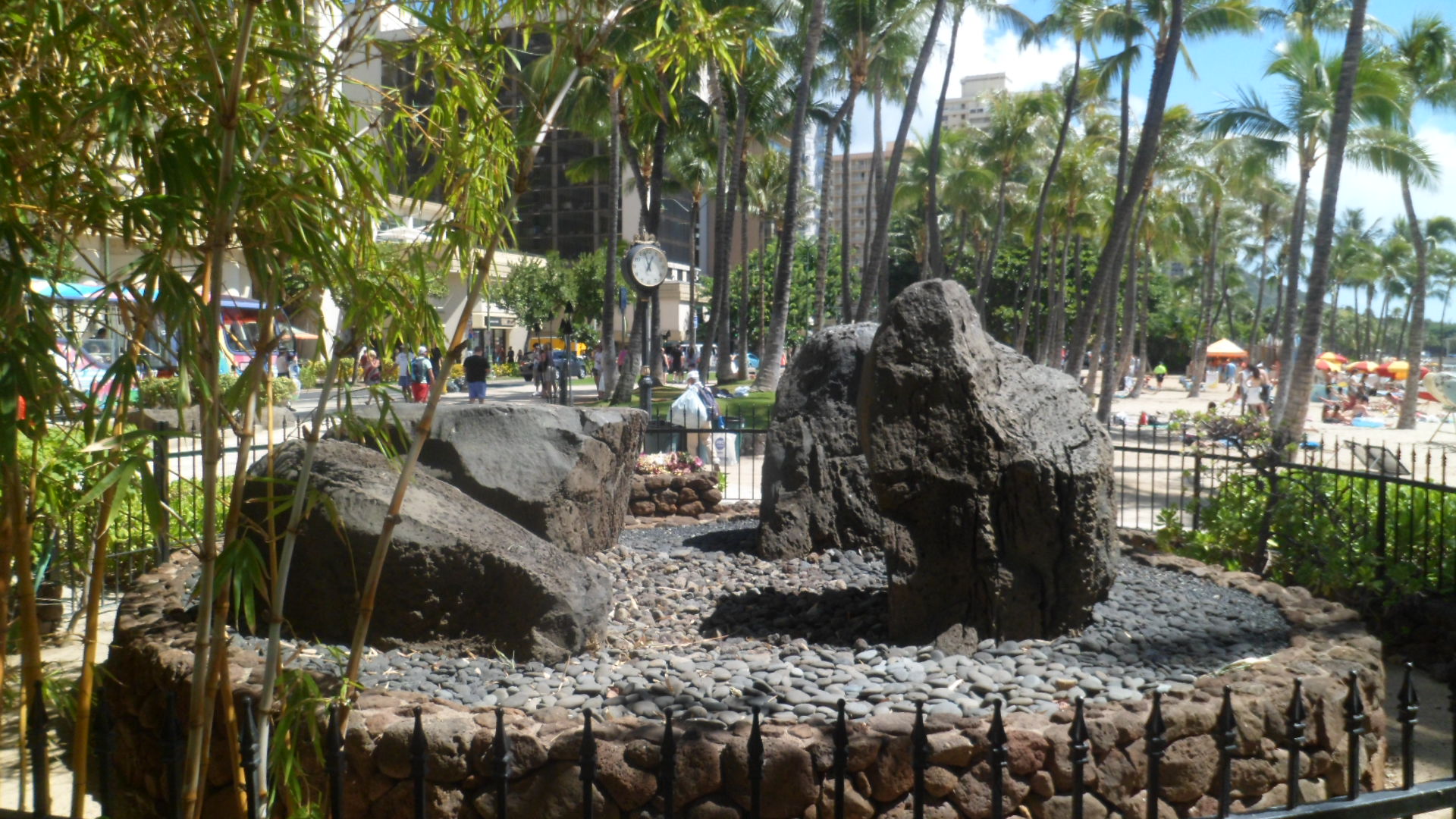
Where I most feel at peace- Helumoa, the Wizard Stones

Where I’d like to visit- Diamond Head, Pearl Harbor Memorial, North Shore of O’ahu, Island of Hawai’i, Maui, Molokai, Kauai.

NEXT: Alaska

The Road to 65, Mile 290: The Soup of Good Fortune

9

September 13, 2015, Prescott-   I spent three hours today, in one of the most worthwhile of endeavours.  The Empty Bowls Project is an annual event in Prescott, on Courthouse Square, where so many of our great community events take place.  I was given the job of Gazpacho Ladeler.  Each of us ladelers gave a contributing patron 6 oz. of soup in either a ceramic bowl, which they had purchased, or in a free Styrofoam bowl.  Patrons could come back for second helpings, so one or two of the more popular soups (i.e. lobster bisque) ran out.

Various restaurants in Prescott and nearby Prescott Valley sent a plenitude of soups, most of them hot.  The gazpacho seemed to be the only one that wasn’t.  Even so, there was just about a bowl left over, when we stopped at 2:10, and the chef came to get her materials. My tangible reward for this effort was two 16 oz. cups of soup, one minestrone and one coconut cauliflower curry.  Far greater, of course, is knowing that a substantial amount of money was raised for the benefit of local food banks.

I went back to the house afterward, and finished reading “Sacred Journey of the Peaceful Warrior”, which recounts Dan Millman’s experiences, whilst on Oahu and Molokai.  I sat, totally concentrating on the last fifty pages of the book, and journeyed with him through various dimensions and states of mind.  He did not use hallucinogens, and I can identify with that, since my own mind can make its way to worlds that hardly make sense, in a tangible context.  This afternoon, I only followed his lead.

After my reading was finished, I was given the message to prepare a certain soup of my own.  I first peeled the rind off a butternut squash, after cleaning out its seeds and slicing off the ends.  Then, I did the same with an eggplant and a red pepper, adding lean ground beef and a few figs, with various seasonings.  Turmeric was put in there, for some reason.  I don’t usually add it to a vegetable soup, but there it was.

The scraps and seeds were then buried in the backyard, in an impromptu garden plot.  I’ve never heard of planting so close to Fall, but that was the message I got- and well, trust the journey.  We’ll see what transpires.

I will regard the resulting concoction as a soup of good fortune- celebrating what appear to be doors opening for me, even as a door of friendship, of two years’ duration, seems to be closing.  Everything happens in its time.

A Small Time Mariner’s Voyage, Days 2 &3, Part One: Amid Spouting Waters

5

October 12 & 13, Honolulu- In five hours’ time, I found myself having left behind the measured bustle and polyglot ambiance of San Diego for- the measured relaxation and polyglot ambiance of Honolulu. Seated beside me on the flight was a quiet, demure and mildly cordial Native Hawaiian woman, headed home. This brought to mind the warnings I had gotten from some in Arizona, that “Locals in Oahu don’t like haoles (Caucasians).” I didn’t get the vibes from her, or any other person in Honolulu, that I was particularly disliked; then again, I rarely have gotten those vibes from any person of colour- save the occasional drunk. I take each person as I would have him or her take me. It works, by and large. Hawai’i ought to be seen, first and foremost, as the sacred land of a deeply cultured and spiritual people- just like anywhere in the Americas.

I met my son, Aram, at Honolulu International Airport. We took a Honolulu city bus to my hotel in Waikiki, sharing stories with a Brazilian man who was in the midst of a round-the-world journey. He had much to say about Korea, India, Turkey and the Iberian Peninsula, in particular, the last being an exercise in “whose Portuguese is the true language?” I checked into Hokele Suites, two blocks north of the beach and an equal distance south of Ala Wai Channel. The medium high rise has all the amenities needed by a modest sojourner like myself, and is near enough to the beach that I could don a swimsuit and a pair of reef runners- and get my fill of sand and surf. Watching out for me was this composed wahine.

SAM_2913

Aram and I headed out to Kimukatsu, a restaurant specializing in Japanese-style cutlet, usually pork. The Japanese tend to regard veal as a waste of a good animal that is better used to provide mature beef. So, the hog is a useful substitute. Katsu (cutlets) establishments abound in Japan, and in Korea, Guam, Hawai’i and anywhere else with large Japanese communities. Kimu offered gourmet toppings, such as those shown in the second photo below.

SAM_2914
SAM_2915

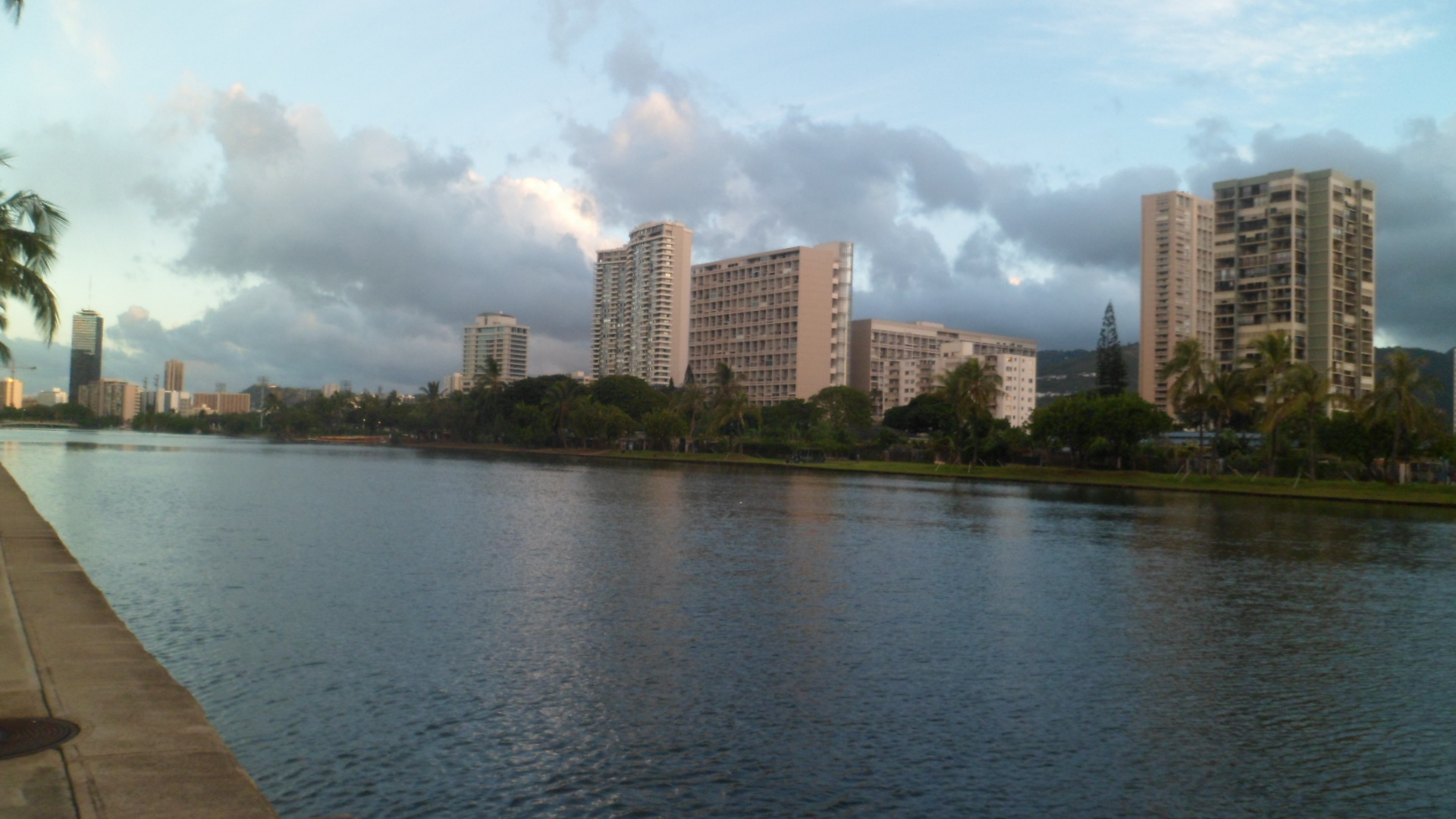
We then walked about the Ala Wai area, along the south bank of the channel, taking in Honolulu’s encroaching dusk.

SAM_2916
SAM_2918

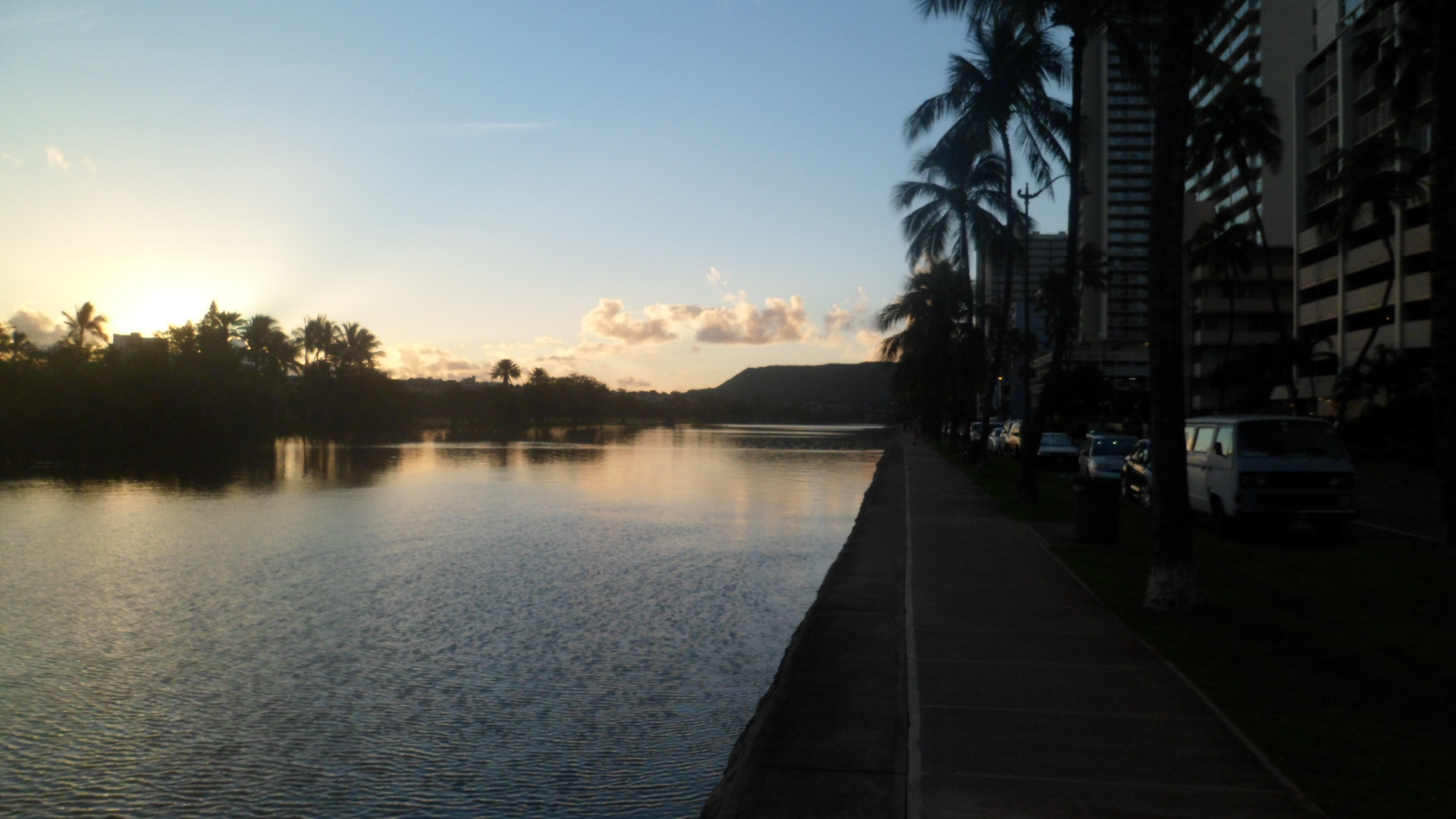
Waikiki is inundated with high rises, both condominium and hotel, but the spirit of the place still reflects the spouting waters for which it is named. Ala Wai is not the stinking mess I was told it had been in the ’80’s and 90’s. It reminds me more of Riverwalk in San Antonio, or the paths along the Seine. True, those places face the challenges of being treasured by the masses, and I probably wouldn’t swim in Ala Wai, even if it were legal to do so. There is, however, a growing civic sense that this is an area that is as much for year-round residents as it is for those who come and go.

The next morning, I saw the channel at sunrise.

SAM_2922
SAM_2923

After joining a fair number of locals in an IHOP, for a breakfast of Belgian waffles and coffee, I headed for Pauahi Garden, near the Sheraton Waikiki. (Sushi, the alternative, somehow escapes me as a breakfast item, though it is common enough fare for the Asian communities here.)

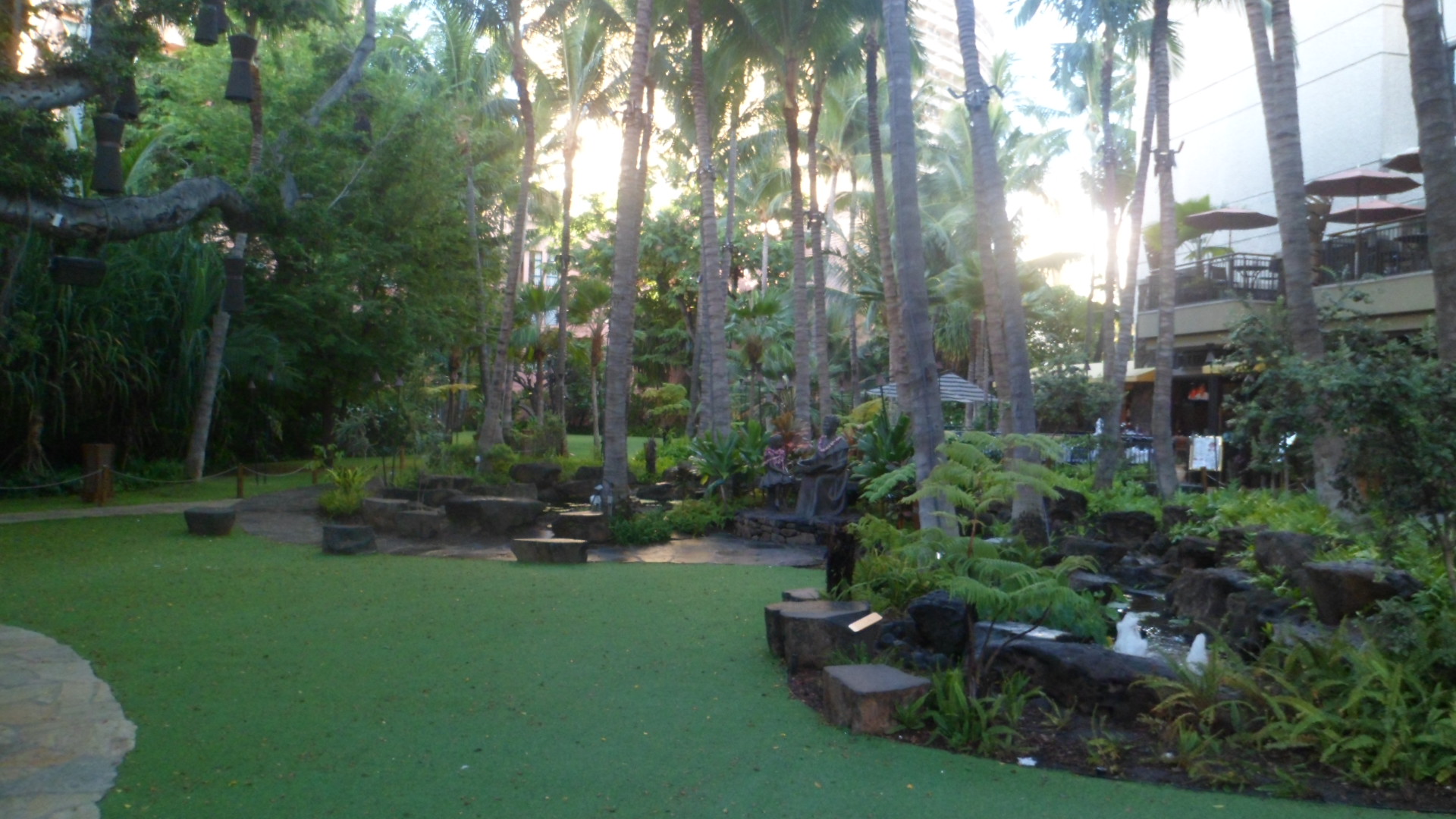
Bernice Pauhi Bishop was of the royalty of Maui and Moloka’i. She was highly educated and was an astute businesswoman, eventually owning 9 % of the island of O’ahu. She died at age 52, of breast cancer, and left no heirs. The small gardens in the hotel district of Waikiki Beach,though, were established in her honour.

SAM_2924

The hearts I invariably encounter on my journeys were in abundance here, in the form of leaves.

SAM_2925

No visit to Honolulu is complete without time in the sand, and at least a nod to Diamond Head.

SAM_2932

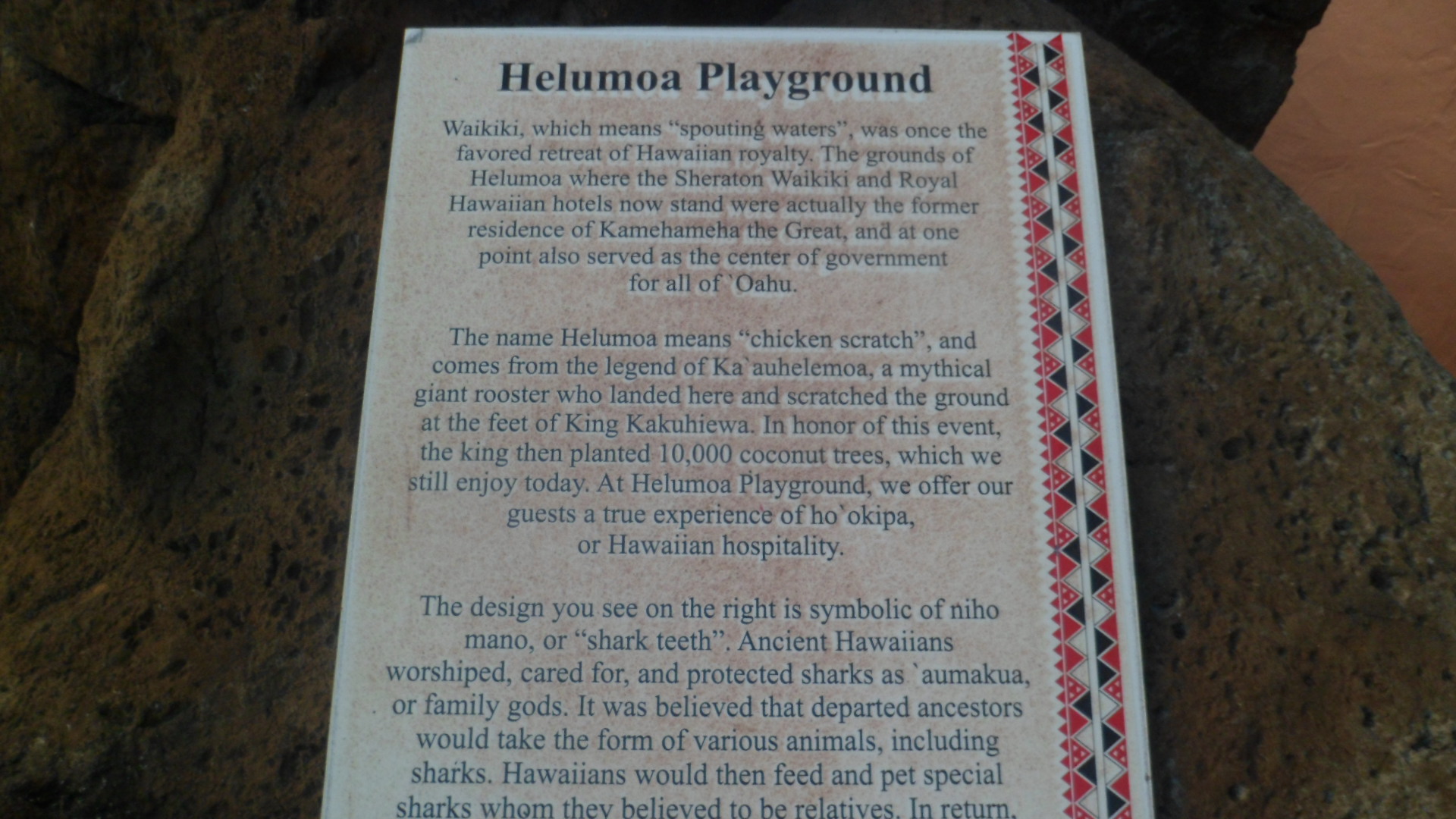
Helumoa, the midst of Waikiki (“Spouting Waters”, in Hawaiian), was the favoured relaxation site of Kamehameha I and his successors. When American businessmen took control of Hawai’i in 1898, they, too, saw the salubrious nature of the spot.  Being entrepreneurs, they set in motion the process which gave us the Waikiki shorefront of today. Hawaiians revered the shark, yet somehow I don’t think they were quite prepared for the human sharks who descended on them in the lattter third of the 19th Century. Waikiki today is in the process of balancing itself, to be more in tune with the natural beauty it once had in abundance.

SAM_2933

We have reached the stage in Honolulu’s legacy where the first hotel in Waikiki, the Surfrider, is a genuine historic site.

SAM_2994

Later in the afternoon, before I headed to Pearl Harbor, and my son’s ship, another walk along the strand was in order. The Wizard Stones, near Waikiki Police Substation, are held to have healing powers. At the very least, they are reminders of nature’s power, having been sent here in a volcanic outburst, ages ago. Lava also is used in the various breakwaters that line children’s pools and the boundaries of hotel properties along the strand.

SAM_2995
SAM_2997
SAM_2998
SAM_3003

Sand, though, is the prime real estate. Below, King David Kalakaua, who succeeded the Kamehameha line in an election, of all things, continued the royal promotion of education for all Hawaiian children.

SAM_2935

Those who promote Hawaiian culture to the world are also honoured. Don Ho is remembered for pop and lounge renditions of Hawaiian songs, and is revered by many here on O’ahu.,

SAM_2993

With limited time in Honolulu, I chose to focus much of the rest of my day on the true legacy of the Native Hawaiian people, and one of its treasure troves: Iolani Palace.