Jeju, Part 3: Where the Sun Greets Jeju-do

4

March 14, 2019, Songsan, South Korea-

After a robust meal of kalbi (grilled ribs), at Kyodong Dok Kalbi, we retired to the Golden Tulip Hotel, in this eastern fishing and shellfish diving center.

SAMSUNG CAMERA PICTURES

Our first stop, on a robust and happy day that will take us across the island, was Songsan Ilchulbong, a small promontory that is a favourite of locals and tourists alike, for greeting the sunrise.  We did not do so, as the sumptuous breakfast buffet of Golden Tulip beckoned first.

Once we did get to the site, though, we found a small course for riding a Cheju pony, similar to the ponies of Shetland.  Yunhee gladly rode the pony, even though it was a very brief experience.

SAMSUNG CAMERA PICTURES

SAMSUNG CAMERA PICTURESSAMSUNG CAMERA PICTURES

Although the coastal areas of Jeju are treeless, in most spots, an effort is being made to plant windbreak in some places around Songsan.

SAMSUNG CAMERA PICTURES

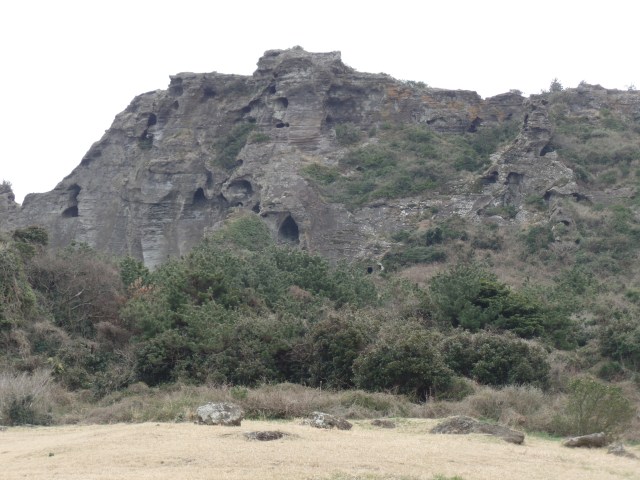
Here is the volcanic promontory that beckoned us.  I was last up this hill, in February, 1992, with a small group of freshman students.
SAMSUNG CAMERA PICTURES

Here is a view, from halfway up, of Songsan, in the morning light.  Halla-san, the highest peak on Jeju, and in South Korea, is seen in the distance, on the near left  side.

SAMSUNG CAMERA PICTURES

There are many igneous boulders along the route.  Here is a particularly popular photo point for many Korean visitors:  Lamp Rock.SAMSUNG CAMERA PICTURES

SAMSUNG CAMERA PICTURES

The image on the right side evokes a Grandmother’s kind visage.

SAMSUNG CAMERA PICTURES

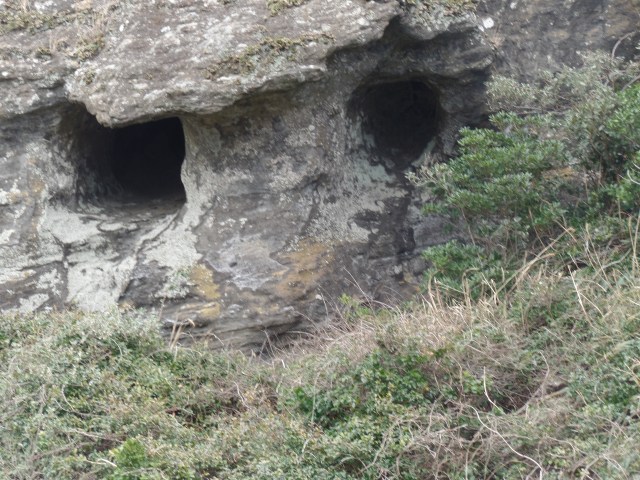
Two eyes appear to be watching, at this site of twin caves.
SAMSUNG CAMERA PICTURES

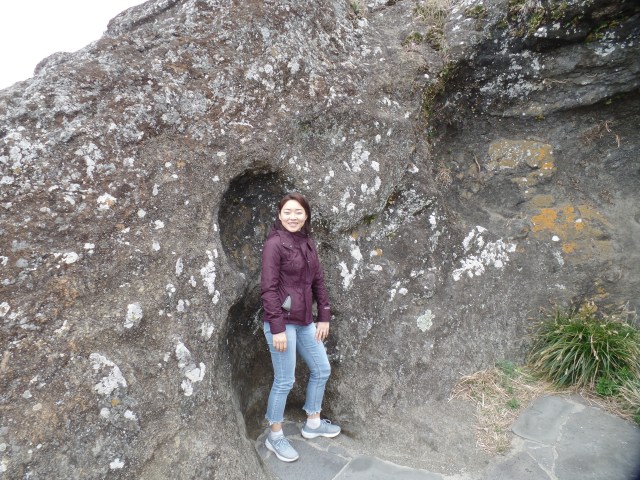
The indentation below seems to fit my daughter-in-law perfectly!
SAMSUNG CAMERA PICTURES

We made it to the top, so I chose this as my next profile picture on social media.

SAMSUNG CAMERA PICTURES

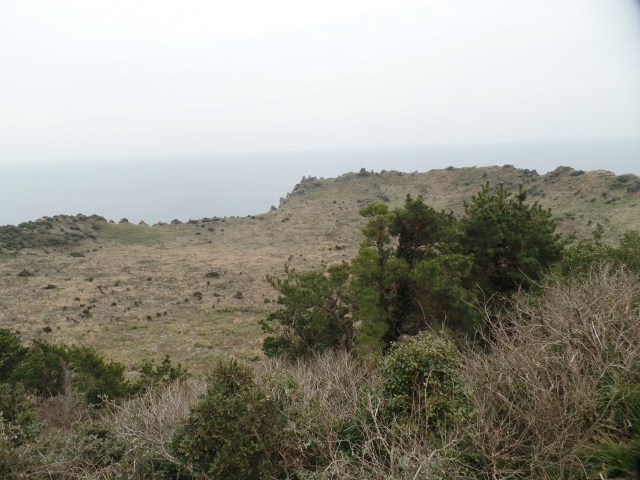
Below, is a view of the crater, for which the summit of Ilchulbong is famous.  Yes, the hill is a dead cinder cone.
SAMSUNG CAMERA PICTURES

Here is the southern, less inhabited part of Udo, an islet just across a small channel from Songsan.

SAMSUNG CAMERA PICTURES

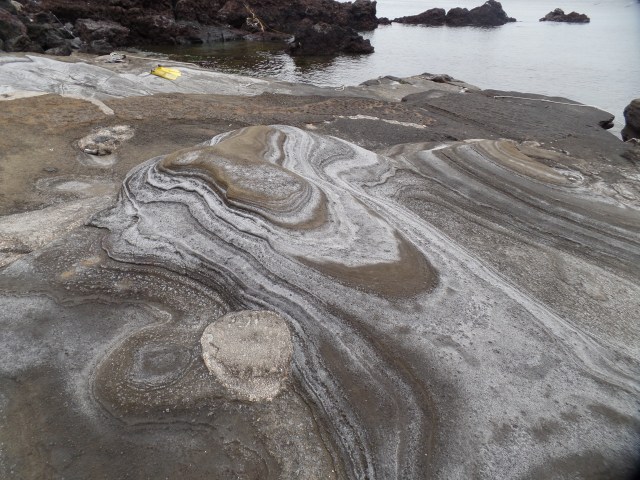
Here are the effects of constant saline deposits on this sedimentary boulder, in an area that hosts haenyo, or women who dive for abalone and sea cucumber.  The traditional divers are mainly found in Jeju, though some are in a handful of towns on the southern mainland coast.
SAMSUNG CAMERA PICTURES

One haenyo is seen in the water, wearing a yellow diving vest.

SAMSUNG CAMERA PICTURES

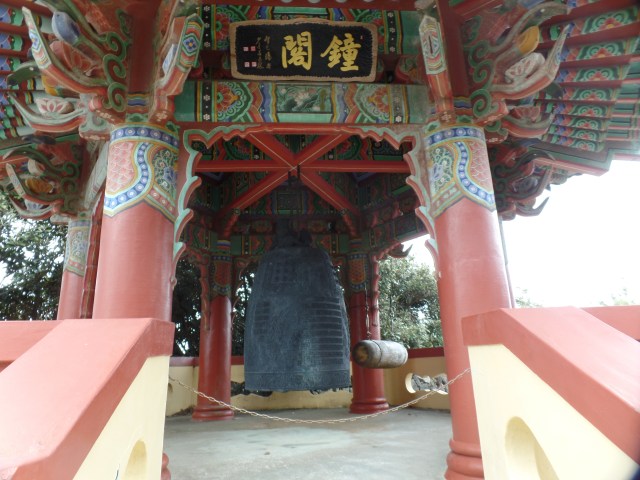
Here is the bell of Dongam-sa, a Buddhist temple at the foot of Ilchulbong.  A funeral was in progress when we visited, so we kept our visit quiet and short.
SAM_1203.JPG

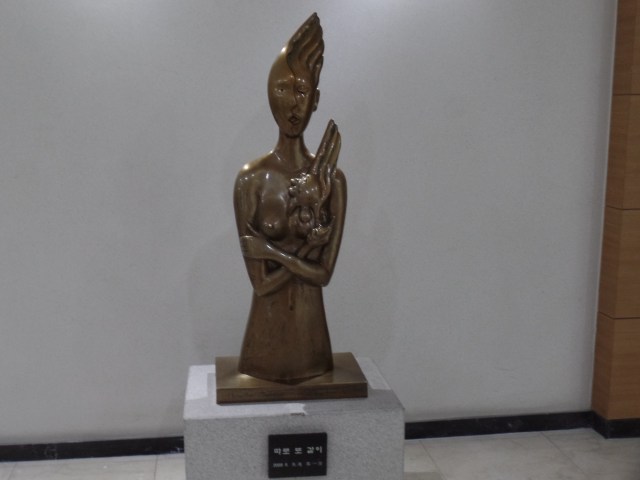
Contrasting images of the Buddha are seen here.

SAMSUNG CAMERA PICTURES

SAMSUNG CAMERA PICTURES

SAMSUNG CAMERA PICTURES

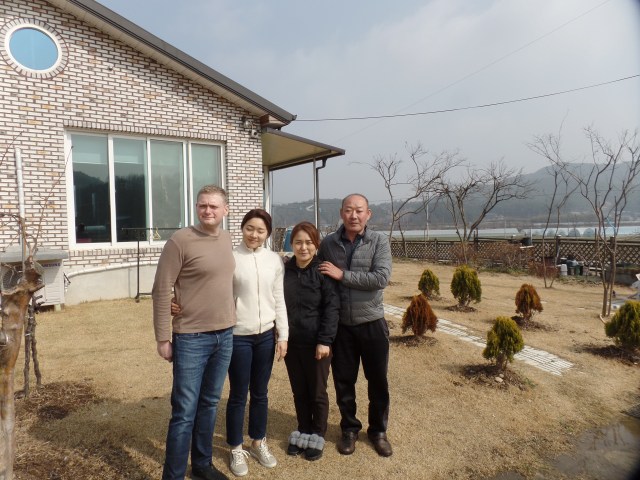
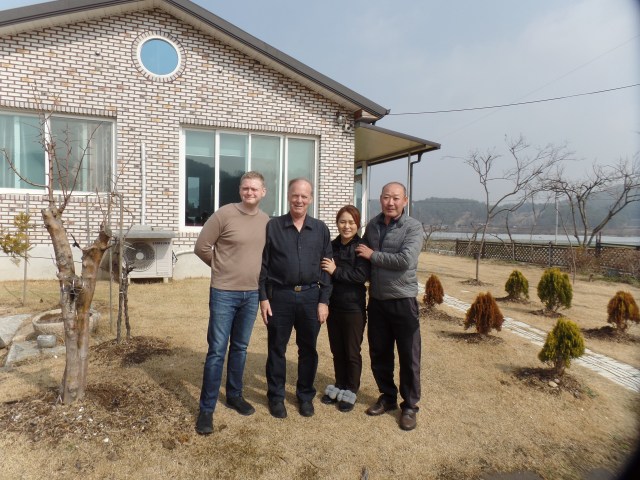
We ended our visit to Songsan, with a brief visit with an old friend.

SAMSUNG CAMERA PICTURES

With that, we are off to Songeup Folk Village, for some reconnection with the farm folk of old Jeju.


Jeju, Part 2: Jeju Stone Park in Fresh Eyes

4

March 13, 2019, Jeju-

My camera’s battery quit, midway through our Jeju Stone Park experience.  Fortunately, my son, Aram, who is also my co-host, had a fresh, new camera on hand. So, without further ado, here are twelve more photos of the park, chosen at random from those he shared with me.

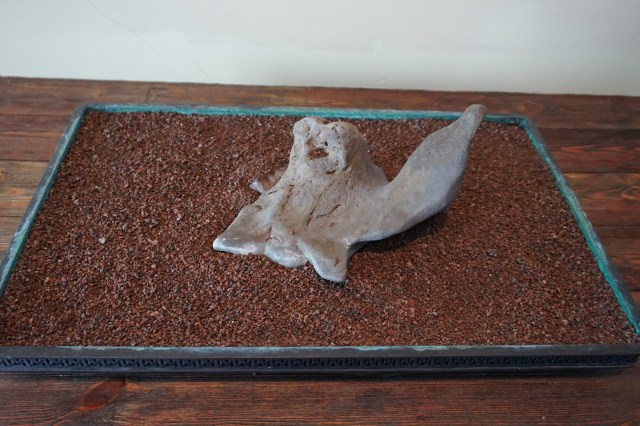
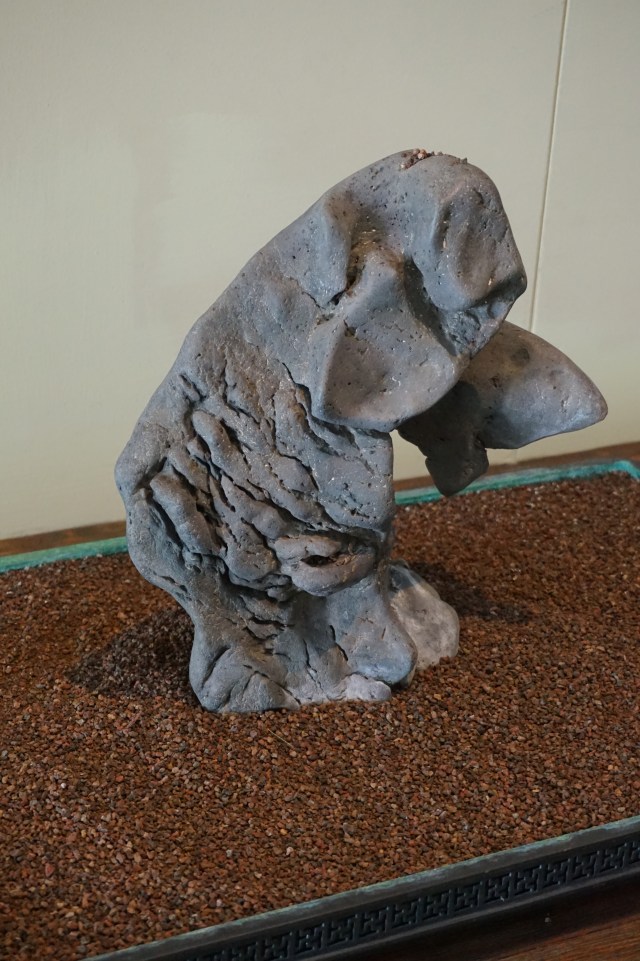
I’d guess this is a frog-spirit, in prayer.

DSC00163

Perhaps, this is a disconsolate basset hound.

DSC00165

This could be a model of the lake, at the top of Mt. Halla.

DSC00164

Here is a geode, turned into a globe.

DSC00173

Paek Un-cheol had these mounted, back in Tamna Mokseokwon.

DSC00197

This eerie scene features the Guardian Children, also brought from Mokseokwon.

DSC00202

“Your turn to curtsy, my turn to bow.”

DSC00208

Another dystopian scene-perhaps an anti-Stonehenge.

DSC00254

The Museum, seen from the west.

DSC00273

This great pile of boulders resembles a tumulus, particularly with the stone entrance way.

DSC00310

This new institute for the furtherance of Jeju culture has several admirers, eagerly waiting for its 2020 opening.

DSC00316

My daughter-in-law, a curator at the museum, and I are on our way off the grounds.

DSC00323

Needless to say, I will be back in a few years, as Korea is certainly part of my extensive travel itinerary, post-retirement.

NEXT: Songsan Ilchulbong, Where the Sun Greets Jeju.


Jeju, Part 1: The Stone Dream of Mr. Paek

5

March 13, 2019, Jeju, South Korea-

SAMSUNG CAMERA PICTURES

There are new discoveries, in this life, constantly-and there are re-discoveries.  Today, the three of us headed down to Jeju, a burgeoning resort island, off Korea’s southwest coast.  From 1986-92, Penny and I were part of Jeju, serving as Visiting Professors of English, in two departments of Cheju National University.  Aram became part of the community, in 1988, being one of two American children born on the island, up to that point.

During that time, Mr. Paek Un-cheol, a spiritual gem of a man, was waging a small but concerted effort to preserve Jeju’s unique traditional culture.  He found an amazing variety of figures, made naturally by water and wind, among the volcanic rocks and driftwood that dotted various points along the island’s shores and on the mountain slopes of its interior.

His first effort, Tamna Mokseokwon, was a constant haven for us to visit and regain a natural semblance of order and serenity.  With his mother’s passing, and with development in the name of tourism becoming a growing threat to Jeju’s traditional culture, Mr. Paek found an ally in the same officials who were a driving force in that very tourism development, the Board of Supervisors of North Jeju County, the area comprising the northern half of the island outside Jeju City proper.  Jeju-shi, as it is known in Korean, has since subsumed the county, with Seogwip’o-shi (So-gi-PO) having subsumed the southern half of the island.

In 1999, the two sides found common ground in establishing Jeju Stone Park, and in 2005, the new park opened to the public.  We took in the eastern part of the park, and its museum, in the two hours we had.  Another visit, or two, looms in the future.  In this post, I will share those scenes captured, before my hard-working camera’s battery ran low.  In a second post, scenes captured by my son’s camera will be featured.

So, here are seventeen scenes to be found at Jeju Stone Park, a place that could easily enchant me for a full day, at minimum.

We found ourselves among the few remaining visitors, as this was a cold, brisk afternoon.

SAMSUNG CAMERA PICTURES

These arrangements leave much to the imagination.  What do you suppose this rock resembles?

SAMSUNG CAMERA PICTURES

Here are some traditional Jeju thatched roof houses.  One may stay in such a home, for W40,000 per night.

SAMSUNG CAMERA PICTURES

Here, I envisioned a standing bear and a pair of witches.

SAMSUNG CAMERA PICTURES

These nineteen steps commemorate Mr. Paek’s agreement with the County Board of Supervisors, in 1999.

SAMSUNG CAMERA PICTURES

These are some of the figures I recognize from Tamna Mokseokwon.

SAMSUNG CAMERA PICTURES

The legend of Grandmother Seolmundae is the impetus for the preservation of Jeju’s stone heritage.

SAMSUNG CAMERA PICTURES

Here are more figures, transported from Mokseokwon.

SAMSUNG CAMERA PICTURES

My precious ones are captivated.

SAMSUNG CAMERA PICTURES

These stone “wishing towers” are meant to honour the spirits that are said to inhabit the countryside of Jeju.

SAMSUNG CAMERA PICTURES

Perhaps this is a likeness of such a spirit.

SAMSUNG CAMERA PICTURES

Mr. Paek and a team of engineers created Sky Pond, to set the mood for a visit to the Park’s museum, and to honour the element of water.

SAMSUNG CAMERA PICTURES

The museum itself contains many examples of both stone and tree root art.  This is stone depiction of the island of Jeju and its tributary isles.

SAMSUNG CAMERA PICTURES

Reach out to the stones, but do not touch!

SAMSUNG CAMERA PICTURES

Perhaps this bird is wanting freedom from its tether.

SAMSUNG CAMERA PICTURES

I see duck, or perhaps a platypus.

SAMSUNG CAMERA PICTURES

Here might stand a  Hadrosaur, or horn-billed dinosaur.

SAMSUNG CAMERA PICTURES

In the next post, my son’s new camera will provide more magic, both in the museum and beyond.  What he found has convinced me to return to Jeju Stone Park, most likely during my envisioned lengthy travels, a few years hence. Then, I will wish to stay in one of those traditional Jeju houses.


Getting Squared Away

2

March 12, 2019, Busan-

We bid farewell to the Shin branch of my extended family, with a fine dinner last night and a heartfelt  series of bows, this morning.  After a few family photos, we were off to the Korea Boivins’ home, here in this crossroads port.SAMSUNG CAMERA PICTURES

SAMSUNG CAMERA PICTURES

There is always a greeter, no matter where one goes in life.  This figure is in the lobby of Aram’s and Yunhee’s apartment building.

SAMSUNG CAMERA PICTURES

After a fashion, we headed for Shinsegae Department Store, where we first had an American-style dinner, at Johnny Rocket’s, then went suit shopping-for me.  The family wanted to gift me with a new suit, so they did.  It’s a Spring through Fall suit, blue as opposed to my black winter suits, which have had to suffice up to now.  A dress shirt was chosen, to accompany said suit.  With that, and a coffee, downstairs, the shopping jaunt was done.  I guess in some circles,  I’m a wet blanket.

NEXT:  Journey back to Jeju


Hanok Village: History as Enterprise, Part II

2

March 11, 2019, Jeonju, South Korea-

As promised, I continue here with the second half of our little family’s tour of this blend of history and modern entrepreneurship.  It most closely reminds me of the Belgian city of Bruges, in that regard.

We felt the need for lunch, so we stopped at Kyodong Dok Kalbi, which offers a limited number of pibimbap dishes, along with a chopped, pressed and pre-cooked version of Kalbi (beef or pork ribs).   Their herbarium provides many of the key ingredients.

SAMSUNG CAMERA PICTURES

Here, my Korean relatives observe the round of side dishes, which are essential in any true Korean meal. There are usually a few varieties of kimchi, steamed spinach, some small sardines, buckwheat noodles, and some cold pressed vegetable gelatin.  Miso (fermented soup) and a bowl of white rice accompany the meat.  We ate using chopsticks and a large spoon.

SAMSUNG CAMERA PICTURES

Having eaten our fill of satisfying dok kalbi and “fixings”, we felt content as cherubim.

SAMSUNG CAMERA PICTURES

So, we walked along the road that leads to a straw-roofed complex.  We came upon this irrigation stream, with various animals of the Oriental zodiac as conduits for the water.

SAMSUNG CAMERA PICTURES

The fortunate woman has a husband who is willing to be her servant, at least on occasion.

SAMSUNG CAMERA PICTURES

Jeonju is largely devoid of street murals, so this vertical rainbow was a sublime surprise.

SAMSUNG CAMERA PICTURES

Many Korean families have at least a small garden plot.  This one is at a traditional Tea House, where we stopped for cups of medicinal herbal tea.

SAMSUNG CAMERA PICTURES

It is the Tea House which sports the traditional “Jeobuk” straw roof.  The proprietress was surprised at the approach of a mixed group of Koreans and Americans, but was very gracious.

SAMSUNG CAMERA PICTURES

To the east of Hanok, there lies a shanty area, climbing the hillside.  I took this photo from the Tea House grounds.  Later, we would get closer to the settlement, which lies across a divided highway.

SAMSUNG CAMERA PICTURES

Here are the flowers of the cauliflower plant.

SAMSUNG CAMERA PICTURESHere is a view of the Tea House’s main garden.

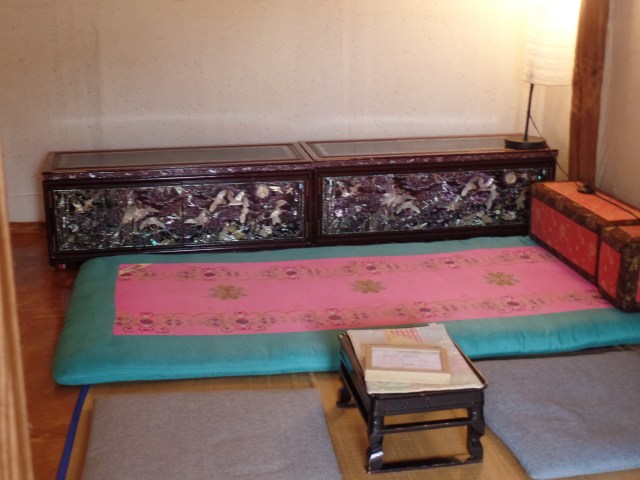
SAMSUNG CAMERA PICTURESFor those wishing to sip their tea in an indoor setting, there is a silk-covered mat, on which one sits cross-legged.  The pearl-inlay chest is a common decor in many Korean homes.
SAMSUNG CAMERA PICTURES

These yellow buttercups match their vase.

SAMSUNG CAMERA PICTURES

This small shrine blesses the garden plants.

SAMSUNG CAMERA PICTURES

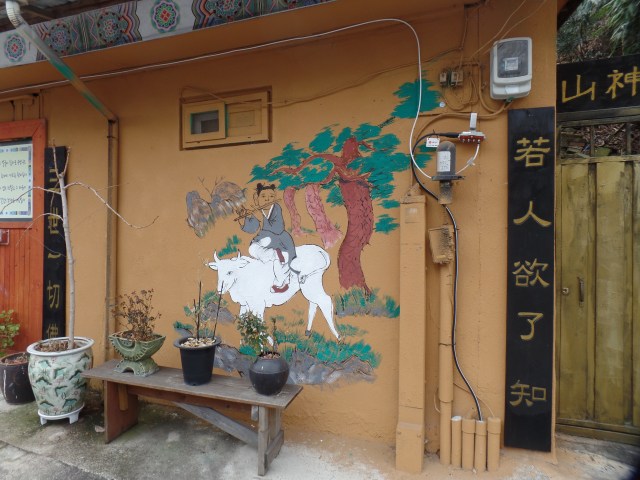
Outside this small shrine is a depiction of one of the scenes from the Ten Ox-Herding Series, an allegory of one man’s quest for spiritual enlightenment.

SAMSUNG CAMERA PICTURES

Here is a small Buddhist shrine.

SAMSUNG CAMERA PICTURES

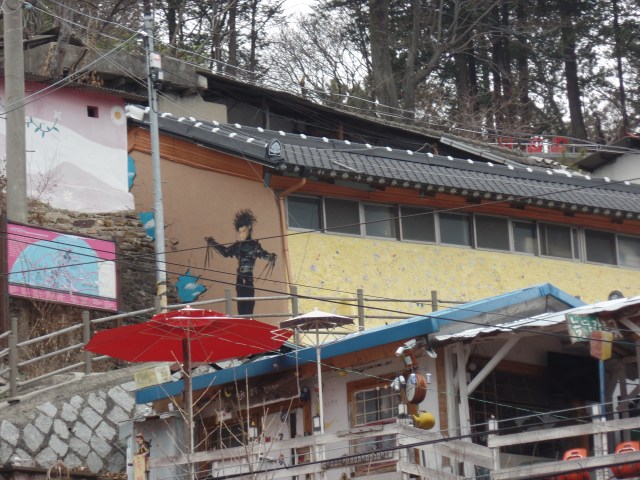
As we arrived at the edge of the highway, I looked across to the shanty, and spotted Edward Scissorhands.

SAMSUNG CAMERA PICTURES

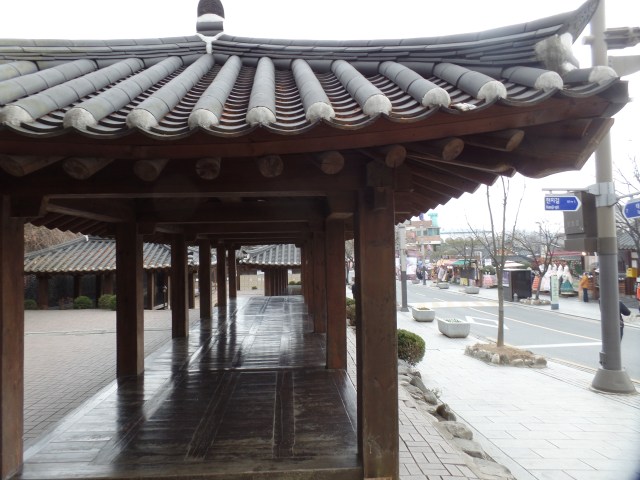
We left the heights and went back down to the main street of Hanok, passing this traditional pavilion, a gathering place in Jeoson days.

SAMSUNG CAMERA PICTURES

Next, along the way, was the place where King Taejo was crowned first monarch of the Jeoson Dynasty.

SAMSUNG CAMERA PICTURES

The coronation courtyard is graced by this stone wheel, dating from 1392.

SAMSUNG CAMERA PICTURES

These stone lions guard the entrance to a nearby guest house.

SAMSUNG CAMERA PICTURES

Thus ended our four-hour visit to Jeonju Hanok Village.  There is much more to this bustling district.  Perhaps a future visit will mean an overnight stay.

Feeling the need for some rejuvenation, we went to Damyang Spa Resort, about forty minutes north of the farmstead.  There, we experienced sauna, hot and cold waters, and I underwent a thorough treatment from an exfoliation specialist, a sort of masseur, who scrubbed me, head to toe, with a rough cloth, then rubbed cleansing oil.

SAMSUNG CAMERA PICTURES


Hanok Village: History as Enterprise, Part 1

13

March 11, 2019, Jeonju, South Korea-

After a  brief walk around the farmstead of  my hosts, Shin Dongwhon and Park Miwha (Many Korean women keep their maiden names, even in marriage), they, the new Mr. & Mrs. Boivin and I headed for Jeonju, the capital of Jeolla Buk-do (North Jeolla Province), famous for the hot pot, known as pibimbap (rice, mixed with vegetables, chopped meat and egg, then garnished with hot pepper sauce).  It is also well-known for maintaining historical buildings, as it is the birthplace of the Joseon Dynasty (1392-1897).  The dynasty was founded by General Yi Song-gye, who became King Taejo as a result. He and his heirs instilled a strong Confucian ethos into Korean culture.  They also built Korea’s legacy of distinct language and literature. King Taejo’s heirs included his fourth-born son, who became Sejong the Great.  King Sejong, one of the seminal figures of Korean history, was committed to universal education.  In order for the masses to become literate more easily and quickly, Sejong commissioned the development of a phonetic alphabet, Hangul, which is still commonly used today.  He also commissioned the development of movable type, about the same time as Johannes Gutenberg was developing a movable type printing press, in what is now Germany.

With all this rich history, I was surprised that the emphasis in Jeonju’s historic district was not so much on telling the tale as on showing the buildings as they were and on the selling of goods and services.  Of course, any living community has to strike a balance between legacy and functionality, as Salem, MA, San Juan Capistrano, CA, St. Augustine, FL, Heidelberg, DEU-and Gyongju- a living history city,  in eastern South Korea, have all done.

Here are some photos of the day’s festivities- first of the farmstead, then of Jeonju Hanok Village.  First,  here is the home to which I was welcomed.SAMSUNG CAMERA PICTURES

The koi pond has some rather shy inhabitants.

SAMSUNG CAMERA PICTURES

Building stones and ollas (for storing kimchi) are essential to any Korean farmstead.

SAMSUNG CAMERA PICTURES

A newborn rabbit needed warmth and safety.  He is hidden in the shorn fur of one of his elders.

SAMSUNG CAMERA PICTURES

The rooster and his ladies were in full voice, this morning.

SAMSUNG CAMERA PICTURES

This is a row of pine windbreak.

SAMSUNG CAMERA PICTURES

This is  a view of Mr. Shin’s field.

SAMSUNG CAMERA PICTURES

There, to greet us and send us off, is “Buri” (Barley), the family porch dog.   Korean farm dogs are rarely, if ever, allowed inside the house.

SAMSUNG CAMERA PICTURES

Now let’s have a look at the first set of photos  of Jeonju Hanok Village.  Below, is the Hanok Visitors’ Center.

SAMSUNG CAMERA PICTURES

Yunhee and her parents, in front of commemorative stone.

SAMSUNG CAMERA PICTURES

Our side of the coin.

SAMSUNG CAMERA PICTURES

SAMSUNG CAMERA PICTURES

“It still could snow, this Spring.”  Here is a traditional Jeollabuk-do tiled roof.

SAMSUNG CAMERA PICTURES

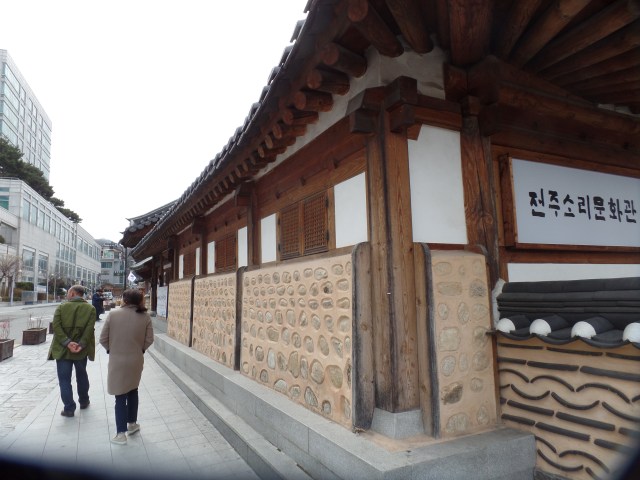
More traditional Jeollabuk-do tile-roofed houses. Many of these are Guest Houses.

SAMSUNG CAMERA PICTURES

This is the Year of the Boar, in the Lunar New Year configuration.

SAMSUNG CAMERA PICTURES

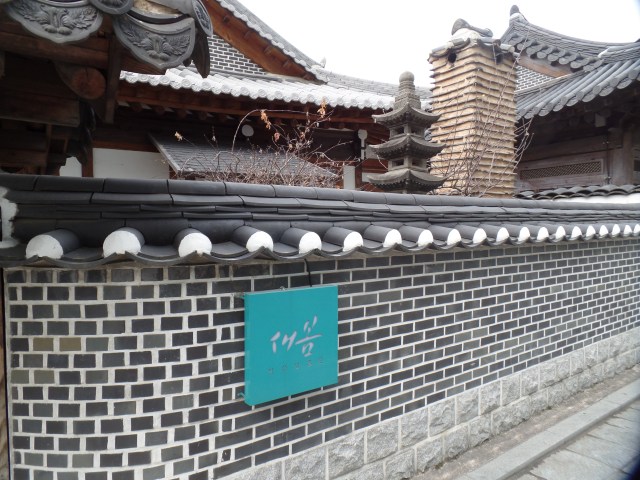
Traditional Chollabuk-do home, with walled courtyard and shrines.

SAMSUNG CAMERA PICTURES

Here are hanbok, traditional Korean formal dress.

SAMSUNG CAMERA PICTURES

Here is a more upscale version of the Chollabuk-do tiled roof.  It was probably the home of a wealthy merchant or minor official.

SAMSUNG CAMERA PICTURES

A more modern variation of traditional water wheel.

SAMSUNG CAMERA PICTURES

These traditional shirts are actually made of paper.  We visited a paper-making establishment and saw various products, made of durable paper.

SAMSUNG CAMERA PICTURES

Yunhee is watching a traditional demon mask, made of heavy paper.

SAMSUNG CAMERA PICTURES

Mrs. Park is demonstrating traditional grain milling.

SAMSUNG CAMERA PICTURES

It was a little chilly for an outdoor lunch, so we admired the courtyard and moved on.

SAMSUNG CAMERA PICTURES

Here are some household decorations that graced a merchant’s home, in the early 20th Century.

SAMSUNG CAMERA PICTURES

Here is a hilltop pavilion, probably used as Confucian shrine.

SAMSUNG CAMERA PICTURES

“Spring is on its way”, say the cherry blossoms.

SAMSUNG CAMERA PICTURES

A heavy-duty community level water wheel.

SAMSUNG CAMERA PICTURES

Commemorative stone, indicating road leading to Confucian shrine.

SAMSUNG CAMERA PICTURES

There are a number of other photos to share, of this large historic district.  I will post these in the next installment.


These Lengthening Ties

4

March 11, 2019, Gyong-Meon, South Korea-

One of the questions I have been asked about the marriage of Aram and Yunhee is how I feel about my son marrying someone from another nation or culture.  (“Race” is left out of this, thankfully. )  My answer is very simple:  Aram has married a beautiful and highly intelligent young woman, who will bring great pride and joy to my family  We, in turn, will bring a great deal of the same to her equally distinguished family.

There was a time, even during our previous living in Korea, when language and cultural differences cast all manner of misunderstandings and suspicion upon even the strongest of work relationships and faith community affairs.  Slowly and carefully, we managed, by working together, to mitigate the worst of these.  Aram, being an infant and toddler at the time, was largely spared the relatively few insults and personal attacks that came our way-not just from more hidebound people in this society, but from equally narrow-minded people on the eastern shore of the Pacific as well.

My friendship with the Shin and Park families has been instantaneous.  There is none of the rancour or suspicion of the 1980’s and ’90’s to soil the life of the extended family.  The growing pains have eased, and we have found that there is an authentic human bond.

This is as Baha’u’llah intended, in calling for the spiritual unification of the entire planet- before other forms of unity are truly realized  This does not mean uniformity, which is the antithesis of true unity.  We families will long cherish each other, much as those who were previously set, within the bounds of American culture, have proven enduring.  It’s time for the next step forward, and the rising generations are leading the way.  I am gladly following that lead.

NEXT:  Chonju and its historical preservation

Their New Beginning

9

March 10, 2019, Guangju-

This city was once best known as place of uprising- against a second-level military regime, in the Spring of 1980.  Although the uprising was initially quashed, its target, President Chun Doo-hwan, never gained the level of power and stability he wanted, and eventually stepped down, on the last day of 1988.

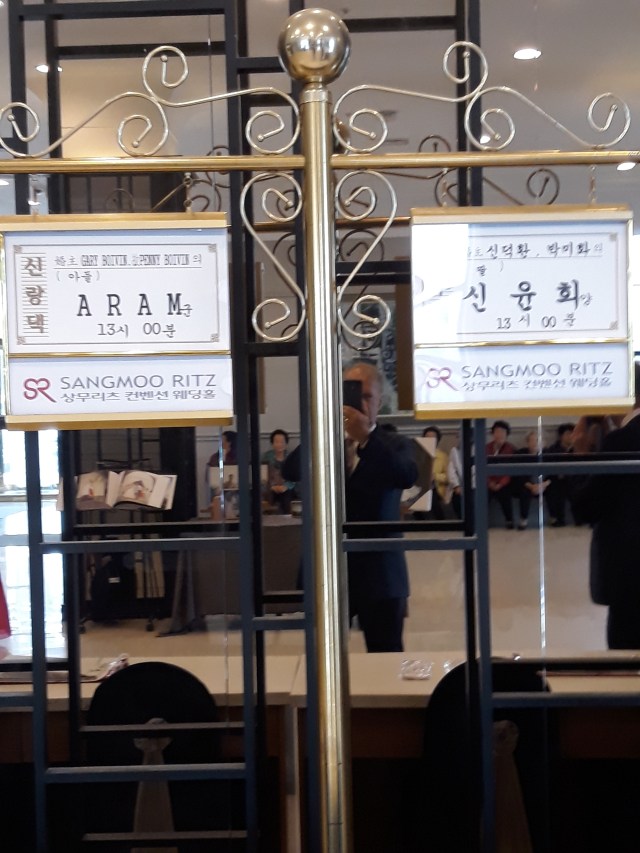
Today, Guang-joo is a more peaceful place and was the scene of the consecration of the marriage of Aram Boivin and Yunhee Shin, my son and daughter-in-law.  Now they have established themselves as  a full-fledged unit.  At the nicely-appointed Sangmoo Ritz Wedding Hall, a reverent blend of Baha’i scripture and tasteful musical selections made for a lovely hour-long ceremony, cementing what was set in motion with their civil wedding, last November in Guam, which, being an American Territory, provided the U.S. marriage license that will just make things easier, when it comes time for them to return to the U.S.

20190310_110716

I gave a short speech, as father of the groom, but otherwise submitted to the instructions of the wedding planner, photographer and master of ceremonies,  I did get in a few photographs, prior to the ceremony.

20190310_110922

The above has Yunhee’s name written in Hangul (Korean script), with her family name first, then her given name.  The names of us parents are written above.

20190310_111039

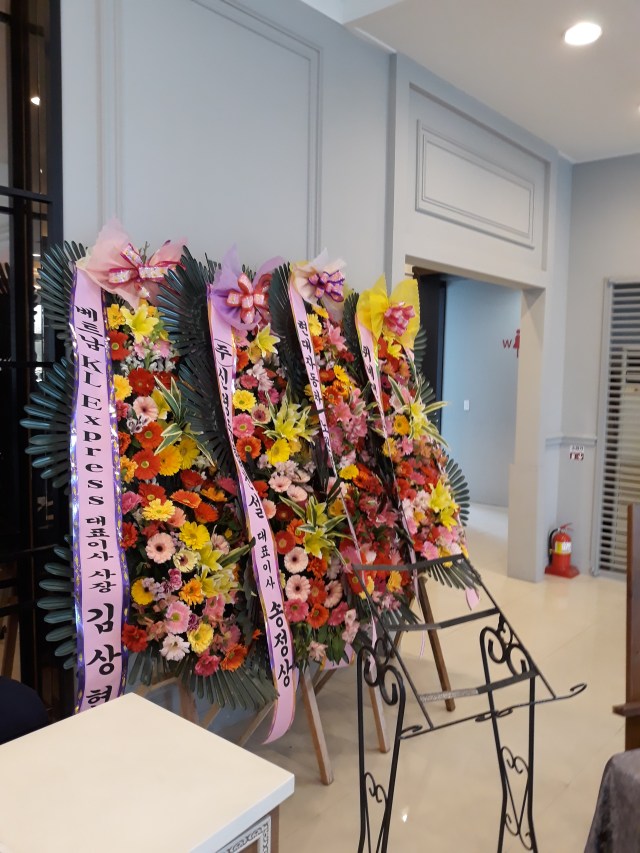
The flower arrangements are from well-wishers. Below are random photos of Yunhee and Aram, in the lobby of the wedding hall.

20190310_120257

20190310_120543

Another milestone has passed, yet with it, the duties of a father-in-law, and God willing, those of a grandparent, will fall to me. My family has now been extended across the Pacific and I have a feeling the blessings far outweigh the burdens.  We will enjoy the rest of this fine week together- tomorrow with Yunhee’s parents and the remainder of the week, divided between Busan and Jeju, the place of Aram’s birth and a well-established resort community.

Quantum Leaps and Recovery

3

March 9, 2019, Gyeom-myon, South Korea-

Friday, March 8, 2019 was the day that barely happened, in my world.  I crossed the International Date Line, right at Midnight, thus throwing me into- today.  We landed at  Seoul Incheon International Airport, about eight hours later.  Amazingly, I got a blessed seven hours of sleep , whilst on board the flying city that is a trans-oceanic flight.

The short hop to Busan, from Incheon, ended on a disconcerting note:  My checked luggage had been detained there, for some sort of “further inspection”.  I was assured that nothing was found amiss, and that the bags would be delivered to Aram’s in-laws’ address, which is where we will be staying, during and immediately after tomorrow’s wedding.

With that, I finished clearing Customs, at Gimhae International Airport, then joined Aram and Yunhee to head to their apartment in the Marine City section of the large port, South Korea’s second largest city.  I took a brief rest, and after catching up on the past several months, we sat down and planned the itinerary for the next several days.  I also caught up on life in the U.S., and learned, to my dismay, that my last surviving maternal uncle had passed away, not long before my flight from Phoenix to Los Angeles had departed.  I will miss his stories and the twinkle that was always in his eyes.


We set out for the lovely country home of Yunhee’s parents, arriving around 4 p.m.  The brief rest stop at Saman yielded these first photos of the Korean countryside.  This highway rest stop has many of the amenities associated with similar concourses in North America and  in Europe.  It also has a small exercise area, with rudimentary simple machines, for limbering.  The bridge connects nearby housing areas with the Rest Area, so that locals can walk and enjoy the shops and restaurants.  The covered shrine-like buildings are for people to enjoy picnic lunches or to just sit and meditate.

DSCN0949

DSCN0950

DSCN0951

DSCN0953DSCN0954

DSCN0955

Korea has changed much, since we last lived here as a family, in 1992.  I look forward to re-visiting some of the areas we treasured, and to see a few new places, as well.  Tomorrow, my beloved son and daughter-in-law will sanctify their civil marriage.  Stay tuned!

Quotidia Beget Adventure

4

March 7, 2019, Los Angeles-

Among the phenomena which might be overlooked, when one is en route to a special destination, is the landscape below an airplane circling for a safe landing.  Such was the case this evening, as our Sky West flight from Phoenix got cleared for landing at LAX.

This was the first time in memory that I had a window seat, and thus could look at the vast expanse of  territory that is the Los Angeles Basin.  With all that has been written, bantered and felt about LA and its smog, congestion and excess, the place as a whole is a marvel, when seen from 8,000 feet-especially at night.  Some SoCal-phobes will reply that a mess can’t be a marvel, but we know better.  One does not have to approve of  what is the current situation, to be amazed at how much humanity is packed into even such a vast area.

Prior to this, I put in a full day at work and was glad to leave my charges with a sense of accomplishment, leading up to the ten-week homestretch that follows Spring Break,  The shuttle van down to Phoenix was an equally smooth and quotidian process, with us arriving at Sky Harbor with time to spare.  Barrio Avion provided tender and spicy beef for my farewell burrito.

Two three-year-old boys, meeting by chance and becoming fast friends, provided the after-dinner entertainment.  G., a new older brother, very much appreciated the presence of J., his new friend.  Watching them play with miniature cars and trucks, hide and seek and get lectured by their respective fathers, for shaking the line stantions, that are used to separate groups of boarding passengers.  There was no lack of spirit with these two.  Indeed, my first encounter with G was his running up the aisle, momentarily unbeknownst to his parents.  I kept my distance, but also kept an eye on him, in case he made it clear to the TSA  area.  Mom was on scene, 30 seconds later, and brought him safely back to the gate lobby.  Then J and father showed up and more localized activity took over.

We landed at LAX, about fifteen minutes late.  I then embarked on a 1 1/4-mile walk, from the United terminal to the Asiana booths, at Tom Bradley International (AKA Terminal B).  I am in the shape to undertake such a luggage lug, but I wonder how disabled people are accommodated, with the City of Cars expecting everyone to walk, with no electric sidewalks and only the occasional elevator, along the labyrinth.

I made it, with the loudspeaker calling my name, four times, as the Koreans wanted to verify my new passport.  I heard them and felt their pain, eventually getting to show the document to the chief of security at Asiana and receiving his swift assistance, in getting through the line, to the check-in booth and onto the shuttle bus that brought us to the plane.  It was an East Asian style shuttle, meaning that a packer was on hand, to shout at and cajole us into cramming as tightly as possible.  I actually kind of miss those days, in Seoul and Jeju, though I must say young men are less prone to grab all the seats and make women and older men stand for the ride.  That is the one thing about the old days that never failed to get me rankled, especially when Penny was pregnant with Aram.

I’m on the plane now, seated with an elegant woman from Colombia and a Korean student, on Spring Break from her school in Arizona.  It’ll be a long, and I sense, restful, journey to Seoul.