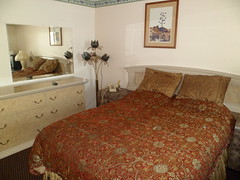
This is Texas’ oldest awesome big city. When I arrived on the evening of May 22, I found a very warm welcome at Rodeway Inn Downtown and that Quiznos sub I mentioned earlier was very welcome to my famished abs.
After a grand night’s sleep, on the highest bed I encountered this trip, I checked out of Rodeway, parked my car in a covered garage, and headed out for a day in this magnificent city.
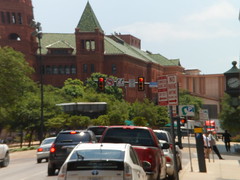
Here is an overview of the heart of downtown.
Below is the front of Catedral de San Fernando.
The remains of the heroes of the Alamo lie here.
The cathedral is a working, vibrant parish church. Worshipers were present here when we tourists were circulating. I removed my ball cap upon entry, of course, and only photographed when two men were done praying.
This altar, though, is exquisite.
The courtyard is also serene, and an enterprising parishioner has a comfortable and friendly restaurant, Poblano’s, on its east side. I enjoyed mole enchiladas, with a zingy unsweetened chocolate sauce. Poblano’s is a Main Avenue institution, coming back from a fire a year or so ago. It would be to the right of this fountain. I know where I will head next time I’m in “San Antone”.
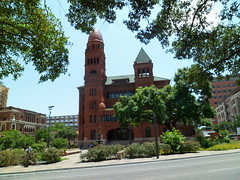
Just southeast of the cathedral is Bexar County Courthouse.
I headed east, along Commerce Street, passing a few Riverwalk venues (See Day 6, Part 3). One, on the north side of Commerce, near Crockett Street, is the Five and Dime, a huge market and cafe, reminiscent of the store where many people my age bought school clothes and had an ice cream soda or a milkshake, back in the 1950’s. This is the beginning of San Antonio’s Midtown.
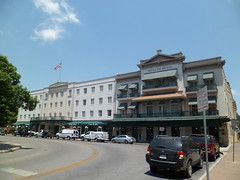
Near Alamo Square, well-heeled travelers can enjoy fine hotels, like the Menger. The St. Anthony, northwest of Alamo Plaza, is also a fine hotel, and is being remodeled
Midtown’s bustle, based on the heart of the Riverwalk, comes to a halt as one reaches Alamo Plaza. For many, a sense of reverence starts to enter the psyche and heart.
People even approach the Gazebo (above) with respect.
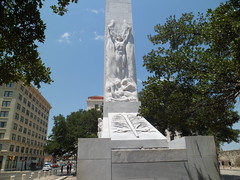
Just before entering the Alamo, it’s good to stop and reflect at the Cenotaph: “Spirit of Sacrifice”.
This being a post about our nation’s 36th President, there are lots of photos. For the same reason, there are no photos of the interior of the Ranch House. Lyndon Baines Johnson had his public side, and his private side. He made it very clear, very fast, which was which. I never heard of anyone back-talking the man who once said: “In this White House, there’s elephants and there’s ants. Right now, I’m the only elephant.”; no one that is, except Lady Bird- the only human being who ever terrified him, once his Grandma passed on.
LBJ enjoyed inviting people to come to the Texas White House, telling them to “take the first left across the bridge, when you see the Ranch House.” It was the original Bridge to Nowhere, and many a chagrined visitor ended up in the Pedernales, with Lyndon standing on the north bank, laughing his head off. Word is, he invited the Reverend Billy Graham to the ranch once, and Reverend Graham said, “I’d like the REAL directions to the house.” You can’t fool a man of the cloth.
Today, thousands of people make their way here. There were 65 of us, in three tour groups, when I showed up.
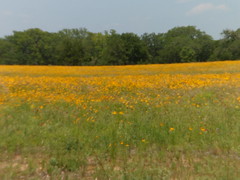
This was Lady Bird’s home, first and foremost, so there were lots of coreopsis, and a myriad of other kinds of wildflowers.
This is the spot where LBJ had his prank foils try and cross the Pedernales.
Before touring the Ranch, I spent about thirty minutes at the Visitors’ Center, near the Living History Farm.
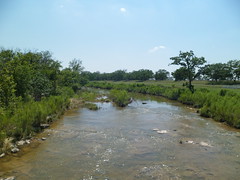
This is the Pedernales River, near where Billy Graham, and those of us visiting presently, crossed to get to the Ranch.
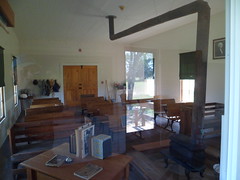
In this schoolhouse, a four-year-old Lyndon insisted on attending, so that he might make friends, being an only child at the time. (Sam Houston Johnson came a bit later.) He also developed a thirst for knowledge, and eventually became a teacher, prior to entering politics.
This was the dog trot house where LBJ lived as a small boy. Remember the dog trot houses from Log Cabin Village, in Fort Worth? They were all over the Hill Country, also.
This view is of Stonewall Lutheran Church, which the Johnsons sometimes attended.
These are the final resting places of President and Mrs. Johnson. Luci and Lynda ask that people not enter the cemetery. Photos may be taken from outside the fence.
I’ve seldom met a horse I didn’t like. LBJ felt the same way. His horses stayed here, in the Show Barn.
Every plane a president of the United States uses is dubbed “Air Force One”. This was one of LBJ’s favourites, and now sits next to the Hangar Visitor Center, from whence tours of the Texas White House begin.
LBJ loved to amuse his grandson, Patrick Lyndon Nugent, by singing along with his dog. Mr. Nugent is today the principal manager of LBJ Ranch.
Here is a car which LBJ himself liked to drive into the Pedernales. Often, Robert McNamara, his Secretary of Defense, would come along for the soaking.
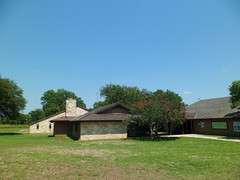
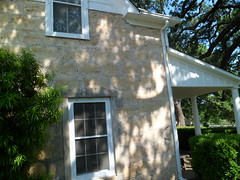
Here is the fine native stone that was used to build the Ranch House, by LBJ’s uncle, Judge Martin.
.
The interior of the Ranch House carries its share of stories. As a Southern man of the Fifties and Sixties, LBJ made sure there was an ashtray in every room, beer in all seven refrigerators, and that all fifteen televisions were on, continuously. He had another motive for the last one, though. In his bedroom, there were three TV’s. As back then, we only had three major networks and PBS, he had one TV set to each commercial network. He kept an eye on what was being broadcast , and would call the head honcho of any network that was critical of his policies, and browbeat the hapless exec, on the subject of patriotism. Some of these calls were made in the middle of the night, and LBJ made no note of time zones. He didn’t worry about PBS, since he was technically its boss.
When a person was invited to the Ranch, and was escorted, upon arrival, into the Living Room, he knew a tongue-lashing was coming. George McGovern was brought to the Living Room. Richard Nixon wasn’t.
Lyndon and Miss Claudia Alta maintained separate, but adjoining, bedrooms. This was done so that she could get some sleep. The President was a night hawk, and lay his head down around 3 A.M., many nights. Of course, he’d be up by 7.
He died here in January, 1973, at age 64. A lifetime of smoking, drinking, and all-around rough living took Lyndon Johnson out, probably far sooner than he might have left. What really did him in, though, was feeling tossed aside. His decisions with regard to Viet Nam made him a pariah to many Democrats. So, he fell to depression, and the broken heart gave out.
Nonetheless, Mr. Johnson’s considerable legacy transcended the Viet Nam War, and the man whom the children of Stonewall, Texas called “Mister Jellybean”, for his gifts to them of candy, lived a life worthy of study.
The area just southwest of Pedernales Falls is now largely wine country. Once sleepy Johnson City and Stonewall can now command a cool $100 per night for a bed and breakfast, between Memorial Day and Labor Day, as urban Texans escape their heat islands. I met a docent at a museum in San Antonio who can’t wait to retire, to Stonewall, in two years’ time.
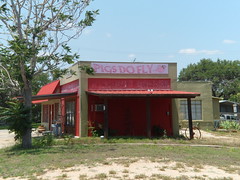
Johnson City is predictably irreverent, signifying the Hill Country’s demeanour. This is the Pigs Do Fly Store.
In midweek, during the school year, it’s still a wide spot in the road.
I had started the morning a bit bleary-eyed, hopping on over to Speedy Stop for coffee on Tuesday morning (5/22), and grabbing a copy of the San Antonio Express-News. I had the paper folded under my arm, setting the coffee down on the counter, and the clerk rang up only the coffee. When I got back to the motel, I realized my error and went back next door, and gave her a dollar for the overlooked newspaper. No security guards, no sheriff, just “Thanks, hon, for bein’ honest.”
After playing a while at Pedernales Falls, with a clear conscience, I headed down 281 towards Luckenbach. The place is only open during the weekends, so I had to content myself with a photo shoot of the area, and never did get lunch that day. Tuesday is a day off for the cafe in Stonewall. The Quiznos sandwich in San Antonio tasted all the sweeter that night, but as my father-in-law says, “That’s a horse of another garage.”
Luckenbach doesn’t have Willie around very often, and Waylon’s watching us from a different vantage point, but I don’t think too many in Luckenbach are feeling pain, at least on weekends.
Here are some photos of a Texas outdoor arts mecca.
Hondo’s is ready to quench thirsts, even during the week.
One may also mail letters and parcels in Luckenbach.
Weekends, horses and chow hounds alike can enjoy good eating.
Of course, Luckenbach is a great place for a picnic.
Texans the world over can be assured of a great old time in the heart of the hills.
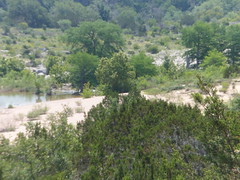
Now I got to experience a bit of Texas’ other wild side. I had no idea what to expect when I got to Pedernales Falls, except that there would be more bus loads of kids, which, as I said earlier, suits me just fine.
The bucolic nature of Johnson City gave me a sense of peace and dignity that one looses in even the finest of cities. It’s no wonder such a hyperactive man as Lyndon Baines Johnson could actually clear his head here.
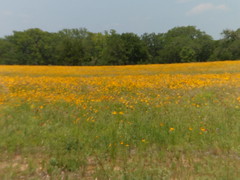
I was greeted by the wildflowers which so inspired Lady Bird.
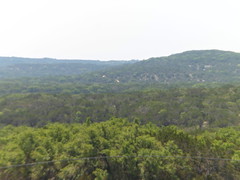
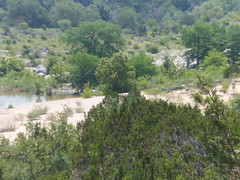
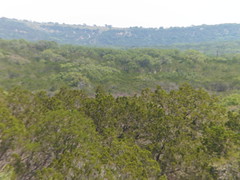
The broad reach of the Texas Hills dispels the myth of “Big Flat’.
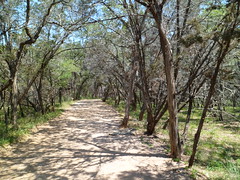
I set off down this path, towards the wonderland created by wind and water.
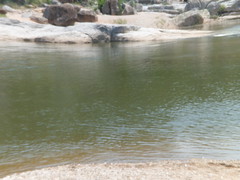
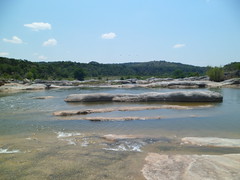
This is what brought peace to one of the most tortured minds of the Twentieth Century.
I will let the following photo montage speak for itself.
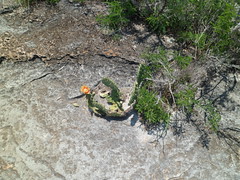
The limestone does get quite slippery for us humans, but flowering plants know how to get a grip.
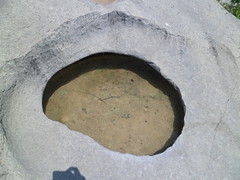
Never doubt, though, the power of water to dig its own hole.
By the time I got to the Falls area, the high school kids were on their way back to the buses. So, I had Mother Nature’s energy pretty much to myself. It’s days like this that kept me on track with my overall purpose of showing the real beauty of Texas to that portion of the world that shares my life.
Next, Johnson City and Luckenbach.
This sweet morning set me to thinking about replenishing my own beach wear. That would be done later, in South Padre Island.
At a few points along my journey, I have found myself standing in awe at the spiritual energy I felt, in what some call a vortex. At others, I have stood still in reverence and respect for what has happened there, to innocent people and freedom fighters alike.
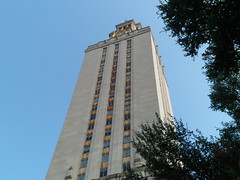
The University of Texas at Austin is one of the latter such places. On August 1, 1966, an ex-Marine named Charles Whitman, in the throes of an advancing brain tumor called a glioblastoma, killed his wife and mother at his home, went to the University of Texas Main Building, climbed up the clock tower and opened fire with an assault rifle. He killed 15 people, in and around the tower, before Austin Police Officer Houston McCoy shot and killed him.
This has always stuck in my mind as an act of domestic terror. The Texas Tower has a place in my heart, as hallowed ground. So, on Monday, May 21, this is where I concluded my visit to Austin.
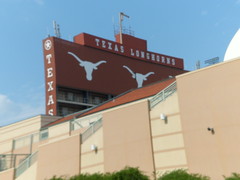
Forty-six years later, UT @A has long since reverted to the ways of a community that is secure in its freedom. University students do college-type things, like study hard, party, and play sports. The Longhorns are one of college football’s most celebrated teams. This is their stadium.
Someone recommended I take in Austin’s natural beauty on a future visit. That is certainly something I will keep in mind. Near the campus, there is a small creek that symbolizes the people’s interest in nature. Here is a glimpse of Shoal Creek, a tributary of the Colorado River of Texas.
The true natural beauty of Texas is plentiful in the Hill Country. That is where I headed next, after dealing with one of Texas’ few road-raging hotheads at a 7-11 gas station. (18-years old and wanting everything done two weeks ago. At least she wasn’t packing heat).
Day 5 found me at Pedernales Falls, Luckenbach and the LBJ Ranch. Stay tuned.
After lunch, I walked back to the Capitol and spent about forty minutes looking at the interior, which I have included in my first post on Austin. Then, it was time to check out the Bob Bullock Museum of Texas History, which is about two blocks north of the Capitol, on Congress Street.
Bob Bullock was Texas’ State Comptroller, then Lieutenant Governor,in the 1980’s and ’90’s. He was a Democrat, but worked masterfully on both sides of the aisle. His overriding focus was on what was best for Texas. He passed on in 1999, and was the inspiration for the comprehensive museum which tells the full story of Texas history.
Photography is not allowed in the exhibit halls here, much like an art museum. I will share photos of the outside and the lobby, as we go along in this post
This is the Texas Historical Commission Building, just south of the museum.
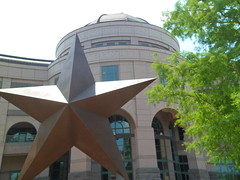
Above is the exterior of the museum, viewed from the east. The Lone Star is a symbol of unity.
The first exhibit one sees upon entrance is also an audio treasure. The importance of Texas to our musical heritage cannot be minimized. All the legends are represented, by region. From North Texas came Stevie Ray and Jimmy Vaughan, Jack Teagarden and Roy Orbison. East Texas sent Janis Joplin, George Jones, Kenny Rogers and Lyle Lovett. South Texas’ Freddy Fender, Kris Kristofferson, Chelo Silva and Selena have grabbed our hearts with songs of life on the hard side. The Hill Country’s Willie Nelson, Waylon Jennings and Jerry Jeff Walker have immortalized their native region. West Texas’ Buddy Holly, Roy Orbison and Bob Wills brought “Rockabilly” and Western Swing into the American musical panorama.
All of them, and hundreds of others, may be heard and enjoyed in this extraordinary hall. Once moving onward, I entered the hall of early Texas. The lives of the Comanches, Caddos, Kiowa, Lipan Apache and coastal Karankawa and Coahuiltecans are illustrated in great detail. The Karankawa were not cannibals, as the Spanish seemed to have portrayed them, but were tough warriors. The Caddos were the most technologically and agriculturally advanced of the Texas tribes, and dominated the eastern woodlands. They were also master traders, and had contacts in the Southwest, Ohio Valley and Mexico.
Next came the story of the early Spanish explorers and missionaries. Texas was not seen as altogether hospitable by the Spanish. They established their main presence in San Antonio and along the Rio Grande, as far as Del Rio and El Paso. These were the main centers of religious activity and of a military bulwark against French encroachment. The French explorer La Salle attempted a settlement at Matagorda Bay, which failed. After that, Spain paid more attention to Texas, despite its coastal swamps and searing deserts to the west. The result is the architectural treasure trove that remains in San Antonio and several smaller towns, to this day.
The War for Texas Independence is well represented here, as one goes upstairs to the second floor. The economics of the era, the ambition of Antonio de Santa Anna and the strong bond between white American settlers and Spanish-speaking Tejanos are all laid out in full detail. Audio presentations and brief films are here to explain events and dispel misconceptions about both sides. Slavery was a key component of white settlement in Texas, especially in the east. It was the economics of the cotton trade along the Rio Grande, however, which drove Tejanos to become both the main instigators of the independence movement and of Texas’ secession from the Union. Tejanos abhorred central government, because of their experience with Santa Anna. They did not take kindly to what they saw as Lincoln’s threat to their livelihoods as traders. Thus, the Tejanos of the Rio Grande Valley. led by Santos Benavides, a major cotton trader from Laredo, were the last Confederates to surrender in 1865. Indeed, Benavides’ troops actually defeated a Union force at Palomitas, east of Brownsville, nearly a month after Lee’s surrender at Appomattox.
The rise of the cattle and oil industries is well covered, in displays on both the second and third floors. Less prominent, but still important, activities, such as the turpentine industry of east Texas, and the fisheries of the Gulf region, are also given good display here.
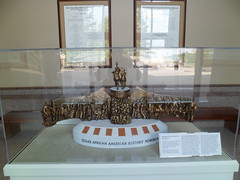
In the lobby, it is mentioned that a memorial to African-Americans in Texas is being developed here in Austin, and will be open later in 2012. Black people have suffered here, as elsewhere in the South, but also were brought into the economic life of west and south Texas more readily than in many places, even in the north. It was said that the Benavides brothers could have cared less whether cotton was harvested by slaves or by paid workers, so long as the trade thrived. Black men were also among the first Texas cowboys, after the Civil war ended.
Finally, the museum has a full audio and video hall on the topic of the Texas film industry. John Wayne, James Dean, Gene Autry and several others are given full due. It seems what really spurred the Western film industry was the Texas Centennial Exposition of 1936.
So, there’s a lot here in Bob Bullock Museum of Texas History. It’s yet another great place to spend an afternoon, or a day. (It took me four hours).
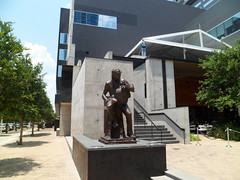
The capital city of Texas also pretty much draws lots of free-thinkers. Downtown fills up fast, after sundown. There are dozens of places to unwind, but the streets themselves are not the least among them. Even one of the swankiest venues in town, the ‘W’ Hotel, can claim to have a statue of one of Texas’ freest thinkers:
What restored my own capacity for free, or any other kind of, thinking, was a stop at a place recommended by Kate a few weeks ago:
I was not disappointed. La Condesa has the best Mexican-German Fusion cuisine imaginable. I had a Torta Ahogada de Carnitas. I repeat myself; this was the best ever. The chain has a presence in every major Texas city, plus Napa Valley and Phoenix, and is coming soon to Hollywood.
There is a spiritual side to Austin as well. One place for this is the Austin Baha’i Center. There is also a Buddhist temple, somewhere over on the West Side, and the Cathedral of St. Mary.
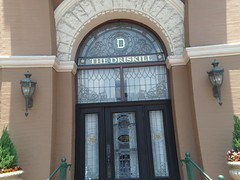
The movers and shakers have their shrine also. Driskill Hotel is associated with both LBJ and the Bushes.
As for me, I prefer to do my hobnobbing and deal-making in a good coffee house. In Austin, one can’t beat Halcyon.
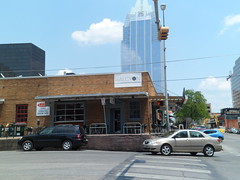
For those who gather when it’s “too late” to drink coffee or chai, there is the original Austin honky-tonk:
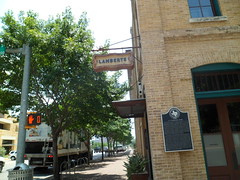
Lambert’s is right across the street from La Condesa, so dinner and a show is easy in downtown Austin! If one still needs dessert, after all this, there’s Lundberg Bakery.
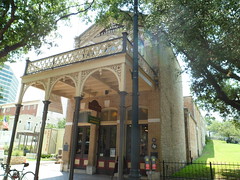
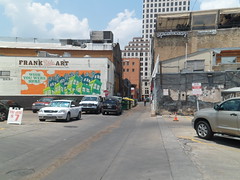
Austin’s architecture does feature a blend of styles and periods, which somehow don’t seem to clash.
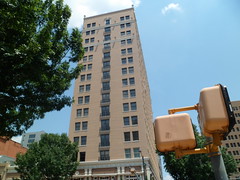
There is, as in any great city, a sense of upward striving.
I found that Austin, like Fort Worth, merits not one, but two or three days of exploration and enjoyment. I had much to ponder, while walking up to the Bob Bullock Museum of Texas History.
I arrived in Austin around 10 A.M. on Monday. Most every place was packed with students on end-of-year field trips, but that was true in Palo Duro as well. Kids have been part of my landscape for so long, that I miss them when they aren’t there. So this week would prove to be very refreshing. I spent about ninety minutes, in and around the Texas State Capitol, once having parked in the visitors’ garage.
This capitol building is suitably huge and majestic, befitting a state that, under the terms of its admission to the Union, may legally subdivide into as many as five states. That this diverse land has chosen to remain united as the Lone Star State is a message to the nation as a whole, as well as a reminder to its citizens to not repeat the choice it made in 1861. Until recently, there was a separatist movement in Texas, to bring back the Republic of 1836-45.
There was much that was praiseworthy about the original Tejas Rebellion. It would likely not have happened, had not Mexican President Antonio Lopez de Santa Anna usurped nearly imperial powers, after his election by the Congress of Mexico, in 1833. The majority of Tejas residents by then were American southerners, who had a sense of their own freedom, while espousing the institution of slavery. The irony was not lost on them, but they were determined to safeguard their freedom, anyway. More on Santa Anna, and the rebels, in Day 4, Part 3.
Here are some photos of this magnificent building and its surroundings.
Approaching the capitol from the east.
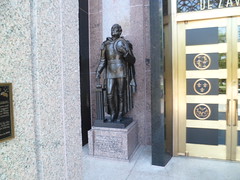
Here is Sam Houston.
This statue honors those who fought for freedom in 1836.
A Fountain of Youth, on the South Side of the Capitol.
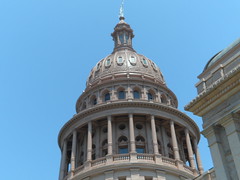
This is a close-up of the dome, from the south side.
Six Flags Over Texas- The Real Deal.
The Texas State Capitol, from the south.
The Tenacity of the Tejano, part of a sculpture honoring the Mexicans who stayed in Texas, after 1836.
The Texas Capitol Visitors’ Center, is southeast of the Capitol.
In 2008, an arsonist set fire to the Texas Governor’s Mansion, which was unoccupied at the time. This piece from the portico of the mansion is on display in the Capitol Visitors’ Center.
Here is an interior view of the Rotunda, taken after I got back from lunch (See Part 2).
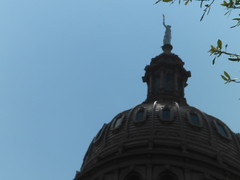
Silhouette of Lady Liberty; was taken from north side of the Texas Capitol.
So you can see, the Texas State Capitol could easily take up a good five hours of a person’s time. This vignette, like my other posts, could easily be topped by the connoisseur of Texas history.
I will have three more posts on Austin: Part 2 is on Downtown; part 3 will cover the Bob Bullock Texas State History Museum and part 4, the University of Texas at Austin. Some may be up tonight, depending on where I stay the night. Otherwise, being Memorial Day weekend, I will post my 20 or so remaining blogs over the course of next week. Stay tuned.
Texas drew people from the world over, during its brief stint as an independent nation,1836-1845. Among the Europeans who came in droves were the Bohemians and Moravians, now known as Czechs. They tended to settle in areas where there were many Germans, for some reason- areas like what are now San Antonio, the Hill Country and Corpus Christi. This, even though Germans and Czechs weren’t exactly kissing cousins.
I found a gem of a town, with a large Czech presence: West, TX. It is orally referenced as “West comma Texas, to distinguish it from the REGION of West Texas, from which it is rather far. The town of West, TX lies just north of Waco, another center of German heritage, which is unfortunately better known for the Branch Davidian debacle of the 1990’s. I didn’t have time to seriously discover Waco and my friend who lives near there was busy, anyway.
West, TX, however, may be well-covered in an hour or so. It is named, not for the idea of Texas being in the West, but after Thomas West, a rancher who was also the area’s first Postmaster. He promoted its growth, as a counterpoint to Waco and Fort Worth. Somehow, though he built a solid little town, its greatness is still a potential rather than a reality.
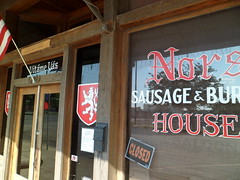
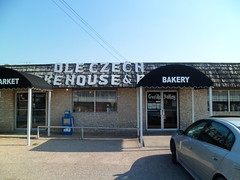
West, TX is a fine place to stop and enjoy awesome Central European staples, such as feisty sausages, beer bread and kolaches (fruit or nut filled buns). I chose Czech Stop, a bakery attached to the Sunoco station. Actually, it was chosen for me, as everyone else was closed, with it being Sunday. No matter, the place was packed, with people flying up over the hill and whipping into the parking lot, as if there were a fire sale going on.
I bought enough poppy seed kolaches, cheddar-jalapeno rolls, summer sausage and rye bread to keep me happy over the ensuing three days- making breakfast and supper at restaurants unnecessary. I had to save for purchasing beach wear, you see.
Here are some scenes from West, TX and from the delightful Oasis Inn, in Temple, TX, where I spent Sunday night. Below is West City Hall.
Czech-Mexican fusion is big here, as it is in Corpus Christi.
Other bakeries in town do stick to traditional central European fare.
Below, the gazebo honours Thomas West.
Another Czech butcher shop/bakery was closed, but looks interesting.
On the far West Side of West, I found this:
Now, since this was such a long, full and wonderful day, I found a marvelous little motel, right off I-35, in Temple.
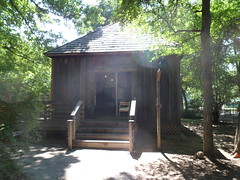
I chose Log Cabin Village as my foray into Fort Worth’s vast Cultural District. Sundance Square, the Zoo and other fine features of the Civilized Cowtown will wait for another time. Many Fort Worthers, including the marvelous family I met here, had not ever heard of LCV until recently. It turns out that the Winters’ younger daughter heard about it first, and brought her parents there, this beautiful Sunday afternoon. Now, to spill on Fort Worth’s Best-kept Secret. Dog Trots are a Texas tradition, or were, in the 19th and early 20th Centuries. Sam Houston built one. Lyndon B. Johnson grew up in one.
Now, let’s see what the photo record shows.
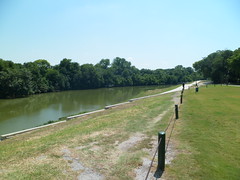
Here’s the Trinity River, which made Fort Worth, Dallas and all their intervening suburbs, possible.
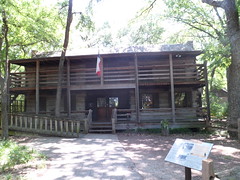
The Log Cabin Village’s main building is the only two-story structure in the park.
Next is the Seela Cabin.
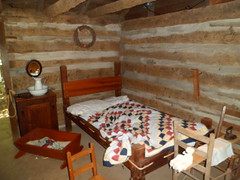
Here a couple of shots of the inside of Seela Cabin. Note how well “dolly” is treated.
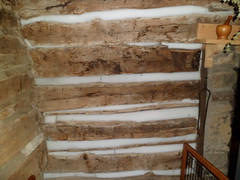
Also, note how the building is insulated. King Cotton had many uses.
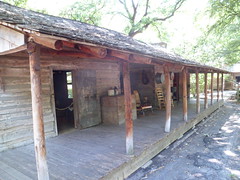
This is a Dog Trot House. It has two rooms, separated by a covered area, where dogs (and cats) could come in for the night, or out of the rain.
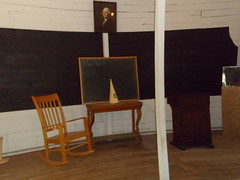
Next, we moved on to the School House, where someone ( not me), who will not be identified here, tried on the dunce cap.
If a kid messed up, the dunce cap was waiting.
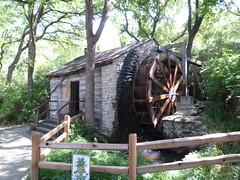
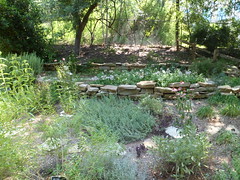
No village is complete without a garden, and a mill house.
There you have it- at least a portion. I will be putting together complete albums, once I get home. As a bonus to this visit, I gladly recommend http://michellewinters.com, for those women looking to treat themselves to fine fashion. Mrs. Winters was dressed to the Nines, even while walking the paths of Old Texas.