On Juniper Mesa

10


SAMSUNG CAMERA PICTURES

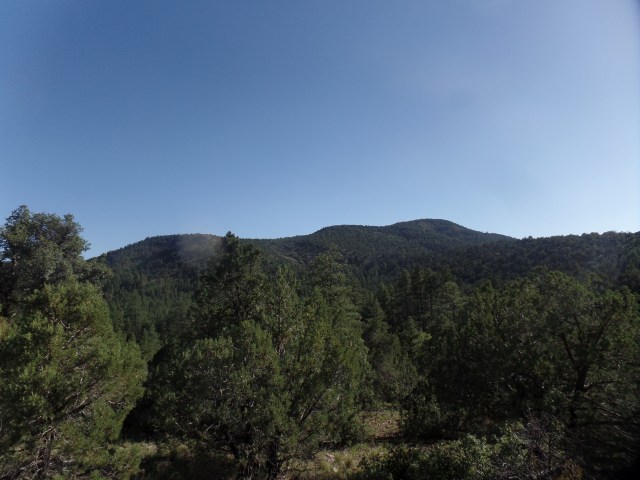
Juniper Mesa, from George Wood Canyon

September 4, 2016, Walnut Creek, AZ-  This settlement is only intermittently populated, when researchers from Arizona’s public universities, and Prescott College, show up to conduct their monitoring of the high desert’s overall health, in an area far from any permanent, sizable human community.  A few ranches break the landscape and, indeed, one of those ranches, just west of Juniper Mesa’s main trailhead, is sealed off from anyone not associated with its operation.

I came out here, in mid-afternoon, to explore the sky island known as Juniper Mesa.  The place was, in the 1870’s and 80’s, a military encampment, an extension of Prescott’s Fort Whipple.  It was, to the cavalrymen of the time, the perfect spot for a railway station, with the route commencing in Prescott, going through Del Rio (now Chino Valley) and pushing clear to the Colorado River, at Hardyville (now Bullhead City) and, from there, to San Pedro, one of the ports serving Los Angeles.  The railroad was built, but it went north, to Ash Fork, then to Seligman and Kingman, connecting with a much larger, transcontinental track, the Santa Fe.


So, Juniper Mesa has reverted to a lonesomeness.  I was the only person on the trail today.  Fortunately, I have come to expect that, even in areas closer to Prescott.  The large pack, with an ample water supply, a first aid kit, two knives, a detailed topographic map and a sturdy flashlight, along with one of my trusty walking sticks, has been an integral part of my communes with nature.  What has occasionally caused chuckles, from the smug hipsters doing lakeside botanical and entomological research in Prescott’s city parks, is, to me, a must on any hike lasting more than an hour.  Besides, it wasn’t too long ago, that one of those individuals had to be rescued from Watson Lake Park, a ten-minute walk from a North Prescott business district, because she was dehydrated and delirious.

I saw fairly fresh horse-hoof prints, along the way and smelled fresh bobcat urine, trail side, closer to evening, but it was the insects and I who had the place to ourselves, from all outward seeming.  Juniper Mesa could be for lovers, but so far, it is for the soloists.

I used three trails, in the course of my loop hike:  Oaks and Willows; Juniper Mesa (rim)  and the steep Bull Spring Trail.  Oaks and Willows meets Walnut Creek Road (County Road 125), proceeds through the lush George Wood Canyon to the top of Juniper Mesa, then branches off to the northeast.

Here are some scenes of Oaks and Willows.

SAMSUNG CAMERA PICTURES

Broad trail, along the Oaks and Willows, Juniper Mesa

SAMSUNG CAMERA PICTURES

Thick scrub, George Wood Canyon, Juniper Mesa Wilderness
SAMSUNG CAMERA PICTURES

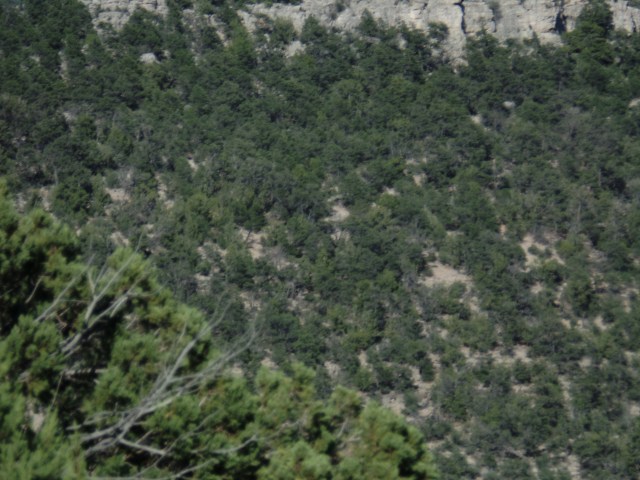
View across George Wood Canyon

SAMSUNG CAMERA PICTURES

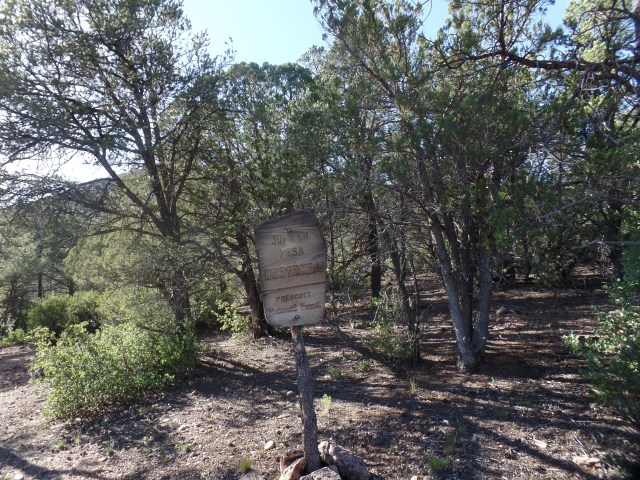
Sign, gnawed by black bears, over several years
SAMSUNG CAMERA PICTURES

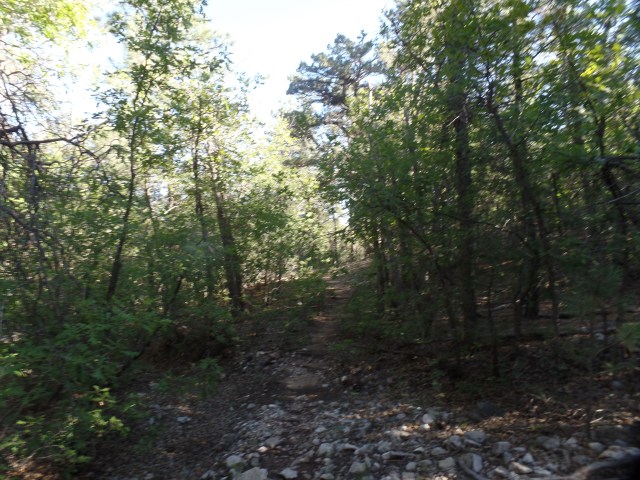
Heart of George Wood Canyon, Juniper Mesa Wilderness

Once atop the mesa, I basically followed Juniper Mesa Rim Trail, though finding it rather sparse, in several places.  Horse trails, though, are easy to identify by their indentation into the ground.

SAMSUNG CAMERA PICTURES

Alligator Juniper, top of Juniper Mesa.  I almost see a parrot’s face, in the branch stump.
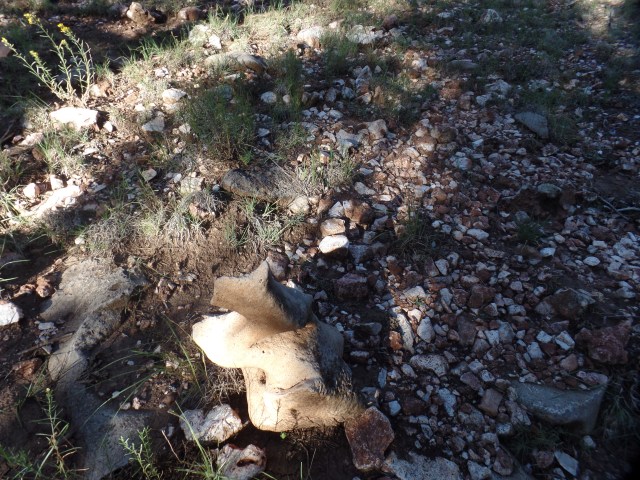
SAMSUNG CAMERA PICTURES

Bear image, small sandstone, Juniper Mesa Rim Trail

Bears are reported to be common here, but I saw no sign of them- not even old scat.  They are probably further north, or in areas more sheltered from the lightning that hits Juniper Mesa frequently, during the monsoon season, that is in hiatus for several days.

SAMSUNG CAMERA PICTURES

Lightning-struck tree, Juniper Mesa Rim Trail

SAMSUNG CAMERA PICTURES

Lightning-struck piece of limestone, and heart rock, Juniper Mesa Rim Trail

The rock above was given a fierce countenance, by a recent lightning strike.
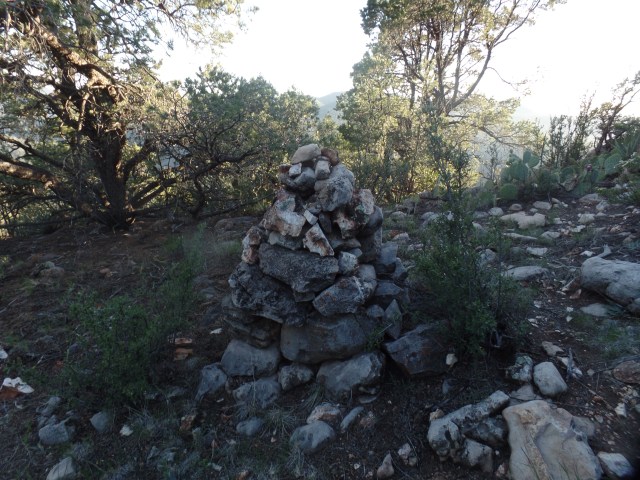
SAMSUNG CAMERA PICTURES

Cairn, Juniper Mesa Rim Trail

Large cairns mark Juniper Mesa Rim Trail, at several points, especially after Oaks and Willows Trail branches off to the north.  A half-mile further east, I bid farewell to the benign rout along the rim, and began the descent, on steep Bull Springs Trail.

SAMSUNG CAMERA PICTURES

View of Walnut Creek settlement and the Santa Maria Range, from Bull Spring Trail
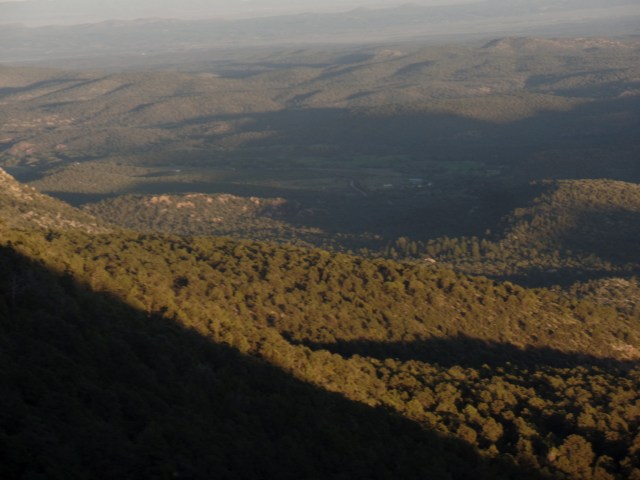
SAMSUNG CAMERA PICTURES

Hazy view of Walnut Creek settlement, from Bull Spring Trail

SAMSUNG CAMERA PICTURES

Limestone cliff, east end of Juniper Mesa

The cliffs seen above, and in the next photo, were redoubts for Yavapai and Hualapai warriors, who resisted the U.S. Cavalry in the 1870’s.

SAMSUNG CAMERA PICTURES

Limestone cliffs, east end of Juniper Mesa

After climbing down from the mesa top, I followed Bull Spring Trail, into the darkness.  Although it was along this trail, that I smelled the bobcat’s markings, the animal itself stayed out of sight, and only small insects, attracted by the flashlight’s beam, showed me any interest.  It took careful attention for me to find the last trail sign, returning to the nub of Oaks and Willows Trail that led me to the car, but I enjoyed a very deep sleep tonight- far from Juniper Mesa.

This is one of several places, in the middle of Arizona’s “nowhere”, that have been on my hiker’s list, in the wake of having completed Prescott Circle.  Stay tuned for others.


The Thick Accent

4

September 2, 2016, Prescott-

(A brief thought, on a sultry night, in which I am lying low.)

You cannot understand, why I take up for men in blue.

Do  you not see, that the worst among them represent what will happen,

should the best among them feel abandoned.

You say, “But you don’t understand, that WE don’t understand

their tendency to rush to judgment, and juryhood.

The police speak a language that is indecipherable, in these parts.

This is a language of both words and gestures, often simultaneous with one another.

Their speech and body language, are hard to understand.”

Hmm.  I see the problem of dealing with snap decisions.

The police officer weighs in on the young men gathered up ahead.

“I think I’ll need backup- and have a bus ready.

You never know what tricks some of THEM may have up their sleeves,” he opines,

as the air feels thick with words and gestures, from one and foreign to the other.

I, the translator and peacemaker, get weary- as well as wary.

Tales from the 2016 Road: West Virginia’s “Pot Handle”

13

July 13-14, 2016, Martinsburg-  My processing and purchase of a 2013 Hyundai Elantra became final at 12:30 PM.  I gathered my stuff at Days Inn, went over to Sugar Hill Auto and transferred everything from the Altima, paid up, said goodbye to the Old Trouper and went for lunch at Blue Colony Diner.  It was time to head south.

SAMSUNG CAMERA PICTURES

Blue Colony Diner, Newtown, CT

The very Russian waitress was rather brusque, and hurried, something to which I’m not accustomed.  The Reuben was nicely prepared, though, so I made do.

Southward became a bit of a slog, at first.  An enormous pile-up, involving three tractor-trailers and eight cars, had taken place on I-84, between Newburgh and Middletown.  I stayed in queue, until the State Police ushered us all off, at Exit 5-A.  I went south when most everyone else headed north.  The road from Goshen to Middletown was relatively empty,and I was back on I-84, in less than an hour. I was in Pennsylvania, a short time later, stopping at a Rest Area in Mountaintop, where my eldest brother and his family once lived, and enjoying the other half of my Reuben.

There was a second pile-up, near Hershey, but it was on the eastbound I-78.  I took the westbound, to I-81, near Chambersburg.  Then, it was a short hop, through a narrow stretch of Maryland, to Martinsburg,WV.

After a very restful sleep, followed by continental breakfast, it was time to spend a bit of time taking in Martinsburg’s downtown.  There are several Federal Period structures here, as there are across both West Virginia and Virginia.

SAMSUNG CAMERA PICTURES

First Presbyterian Church, Martinsburg,  WV

SAMSUNG CAMERA PICTURES

Berkeley County Courthouse, Martinsburg, WV

SAMSUNG CAMERA PICTURES

Martinsburg Arts Centre

The center of town is marked by a landscaped little square.

SAMSUNG CAMERA PICTURES

Central Square, Martinsburg, WV

The house built by General Adam Stephen, founder of Martinsburg, is preserved on the city’s southeast side.  General Stephen’s residence was built of native limestone.

SAMSUNG CAMERA PICTURES

Adam Stephen House, Martinsburg

SAMSUNG CAMERA PICTURES

Root Cellar and Spring House, Adam Stephen House, Martinsburg

SAMSUNG CAMERA PICTURES

Native Limestone, Adam Stephen House, Martinsburg

The brick house next door was built by Philip Showers, in 1874, and housed railroad workers and their families.  It is called the Triple Brick House, and was divided into three dwellings.  Today, Triple Brick House serves as Martinsburg’s Historical Museum.

SAMSUNG CAMERA PICTURES

Triple Brick House, Martinsburg

This city was a Western outpost of Revolutionary forces during the War for Independence, and has had a key role in subsequent conflicts, from the War of 1812 to the “War on Drugs”, of the Reagan Era.  It is now home to major offices of the Department of Homeland Security.  Yet, on this quiet morning, it was a place of restfulness and reflection.  There is much in the “Pothandle” of eastern West Virginia to explore and enjoy, so I will come through here again.  It was time, however, to get as far south as possible by this evening.

NEXT:  Harrisonburg of the Shenandoah

Tales of the 2016 Road: Death of An Altima

10

July 10-12, Bethel, CT-   I got up fairly early, Sunday morning, as usual.  Somehow, I was a bit like a caged cat, pacing about, doing small chores, none to the satisfaction of Mom, with her plaint of “typical man”, ever in the background. My restlessness, though, had nothing to do with that.  I had had a vision of this being my Altima’s last ride and its being replaced by a small white or gray sedan. Besides,  I am no longer put off by anyone’s criticism, preferring to keep at a task until it is done to my own satisfaction.

The plan was for me to make it to York, PA and there, try to connect with a young artist, who has made Cherokee crafts, for several years.  I bid Mother a loving farewell, after eating the brunch she prepared, and the rain had subsided to her satisfaction.

The drive out, along the Massachusetts Turnpike, to I-84, was uneventful.  I stopped, briefly, at Framingham Service Center, and had no problem continuing down the road.  After a slow, but steady, passage through Hartford and Waterbury, I decided to pull off at Newtown, and fill the Nissan up with gasoline.  I would then go over to Sandy Hook, and pray for the victims of the horrific shooting of 2012.

When I tried to start the Altima, though, smoke began to rise from under the hood.  A generous young man gave me a gallon of coolant, which he said had “been left” in his truck.  I gave him some money for that, and added a fair amount to the overflow tank.

The engine continued to smoke, and I noticed that the coolant tank, itself, was cracked and useless.  A trio of motorcyclists came over and helped me push Altima into a vacant parking space.  One of them cautioned me against trying to take the car any further.  The Altima, and I, found his advice was sound.  Car wasn’t going anywhere, without a tow.

The AAA tow took me to the Days Inn at Bethel, then took Altima to its resting place, Sugar Hill Auto Service Center, on the west side of Newtown.  By then, I had contacted my sister-in-law, in Florida and my brother in Georgia, letting them know of the situation.  Facebook also learned of my challenge.  An hour or so later, arrangements were made for my purchase of another car, by Wednesday, and I made myself at home, in the comfortable second floor room at Days Inn.  Three days of continental breakfast, a walk to/from Target, for a few odds and ends, and catching up on my reading and writing, hardly constituted suffering.

The 2005 Altima, though, had endured enough.  The litany of engine woes, first taught me by my father, when I was 13:  Head gasket leak, valves bent, rings broken, engine kaput swam out of the auto technician’s mouth, at various points along our phone conversation.  He had spent two hours in diagnosis, on Monday.  Tuesday morning, I told him not to do anything further.  I would pay him for his diagnostics and for disposal of the Nissan.

The rest was due diligence on several cars offered by Danbury Auto Group.  After looking at several vehicles, online, and discussing with my best friend, I settled on a 2013 Hyundai Elantra.  It would be ready on Wednesday, so my relaxation continued.

Nissan Altima required quite a bit of me, financially, but it also took me to Vancouver, BC, once, to Reno and Denver, both twice. and to Southern California, about five times.  For an old car, going to the East Coast proved to be the last straw, despite my having had it serviced, just before we left Prescott. Mechanics tended to blame the catalytic converter and a “bad sensor” for the occasional check engine light.  I know, now, that it has to be more than that.  I am glad for one thing:  Its last journey took me to the place of my birth, and at least got me far enough away, that I had to stand on my own two feet, and not place an undue burden on anyone.  BF helped, immeasurably, and I will repay him.  RIP, my gray vehicle.

NEXT:  No York, but Plenty of Martinsburg

Pandering

4

December 9, 2015, Prescott- One of the things that harkened the collapse of the Roman Empire was the degree to which the elite maintained power by appealing to the baser instincts and cravings of the  masses.  I see a fair number of parallels between Rome, and both the United States and the Islamic State.  Both current entities maintain their status quo by pandering to the xenophobia and self-absorption of those who have struggled to merely make ends meet. How odd, that the worst of politicians maintain control by villifying those who are just like them.  I see little difference between the xenophobes here, and those in Iraq and Syria.

I am seeing this unfold, too, in local communities.  Those who grasp at power will obfuscate, dissemble and spread rumours, to keep those they fear from getting involved too intimately with their public.  This happens both in government and in business- especially in “non-profit” enterprises.  I have been invited to join an effort, and have seen others be so invited, only to have the leadership who issued the invitations devolve into games of “gotcha”.  They, too, pander  to the fears of some whom they serve.

True public service puts the needs of those who are being served above all other considerations.  When last I checked, such needs did not include having one’s baser instincts honed and exacerbated.

Chennai

10

December 4, 2015, Prescott- The kids and I did a lot of work, yesterday, so I went to bed early.  Today was also full, mostly with errands that a “day of rest” finds waiting.  My life has gone well this week, culminating with the news that I had passed the third and final examination, prior to my application for elementary certification, and likely continuance in my current position.

Not so in the Indian manufacturing hub of Chennai, the Madras of colonial times.  It’s said that ten feet of water have submerged some parts of the fourth largest city in India.  Aerial photos show a series of islands, and the rain still comes.

Chennai is becoming a real time poster child for climate change, even as the ministers of 150 nations continue their deliberations in far-off Paris.  It is a fair question to ask, whether there will be a recovery this time.  This is not a matter of histrionics or handwringing.  In too many cases, politicians, conservatives mostly, play the game of the perfect being enemy to the good.   We are now considering the immediate futures of 11 million people in Chennai, to say nothing of the 60 million between the twin megalopolises of Kolkata and Dhaka, nearly 1,000 miles to the northeast, Bangkok, further east, and the myriads of islands in the Indian Ocean and in the far-flung Pacific.  The good must suffice, and the perfect be built on it, eventually.  Paris has to produce concrete results.

A popular American television program is presenting the scenario of 2 % of the world’s population disappearing, POOF!  Sounds like the alarm bells are far more real than the legislators gathered in Washington prefer to believe.

The Road to 65, Mile 347: Staying Calm in Chaos

8

November 10, 2015, Chino Valley- It rained hard, and hailed, in early afternoon.  The last time that happened, my students freaked out and I had to be very firm with them.  Today, also a day before a mid-week holiday, all I had to do was calmly remind them that there was no need to flip out, because of weather. We were all safe and warm, and they decided there was no need for excitement.  I’m very proud of the kids, and see steady progress in a number of areas, both emotional and academic.  They made birthday cards for their last teacher, who retired a month ago, and as it happened, she came by today, so she got the cards.  Nothing could have pleased her more.

I am also making headway with the close-knit adults, and was invited to their Christmas party, in mid-December.  The only impediments to my staying on, it seems, are Pearson Testing Services and the State.  The former is notoriously slow to verify  passing of its exams, and Arizona won’t act until Pearson does.  Eventually, I will get my certification, though, and being calm in the midst of chaos will again pay off.

The Road to 65, Mile 322: Course Corrections

6

October 15, 2015, Chino Valley-  We sat together, at the end of the day, and of the week.  The kids and I agreed that there was too much varied content thrown onto one page of the textbook publisher’s worksheet on perimeters.  We humans don’t, generally, speaking, absorb more than one mental skill at a time.  I will make the necessary adjustment in the lessons, next week.

I knew it would not be long, before I felt like taking the pre-fabricated material, and, like the late Richard Mulligan, in “Teachers”, open the classroom window and toss the useless book out.  I won’t go that far.  The taxpayers’ sensibilities matter greatly, after all.  One of the tenets of good teaching, however, is “monitor and adjust.” I am big on mastery, and will do whatever it takes to bring this about, for as many of the people with whom I work, as possible.

We, as a profession, are under a lot of pressure to provide ready answers to the question of “Why are our students falling behind, in the Great Global Rat Race?”  I have a few, tentative answers to that, which will not make the Testing Industry, or its political sponsors, very happy.  One, which I still remember, from having worked with Korean teachers of English, several years ago, is that many nations’ educational programs are focused on teaching one skill at a time.  That used to be the case here, when I was in school.

Now, however, I see a tendency to throw many concepts and skills together, so as to “hurry up and catch up”, with a perceived Global Mass of superlearners.  Grandma said “Haste makes waste”, and that is painfully obvious, looking in the faces of my still-trusting little ones.  We have to go back and look hard at the most basic level of the skill expected of them- and, yes, they will get it, and extrapolate the rest, one piece at a time- in time for the Great April Acid Test, which the state, in its wisdom, has cast upon us.

The journey of a thousand miles still needs that single step.

The Road to 65, Mile 320: Colliding Forces

5

October 13, 2015, Chino Valley-

Thoughts on my new job, thus far:

Needs overlooked,

lead to outrage.

They who overlooked,

hold fast to the stage.

Pleading eyes of the young,

hope my time will bring meaning.

Flinty eyes of the old,

hope my time will be fleeting.

A child speaks truth to power.

Does my contemporary feign power,

yet inside, cower?

The waning forces subside,

Yet with a rising tide,

they collide.

The Road to 65, Mile 319: Conquistador

8

October 12, 2015, Chino Valley-

A few thoughts about the day, as we might look at it.

The deer trails, drawing the interest of the hunters,

became the Kinship Trails, drawing the interest of the merchants,

the soldiers and the monks.

The Conquistador Trails, drawing the interest of the pioneers,

the entrepreneurs and the downtrodden,

became the railroads and macadam highways, drawing the

interest of the Lords of Commerce and the satisfied multitudes.

The Interstate Highways, drawing the interest of the masses,

fleeing oppression, become

closed, behind walls and fences.