November 10, 2021- Another signature morning meal, at Harbor Breakfast, this one involving fried oysters, of all things, got the day off to a marvelous start. Armando’s gracious hosting and Maria’s delightful antics and banter were supplemented by conversations with a visitor named Chris, who hails from the Boston area and who works in Saugus, as well as other communities in the area, and with Billy, a Little Italy local who has known the staff for quite some time. Chris and I knew some of the same people, most of whom have passed on. Billy is quite enamoured with Prescott, and has driven his vintage truck there several times. Needless to say, Harbor has joined my pantheon of breakfast establishments-alongside Zeke’s, Bedford Diner, Maple Leaf Cafe and Hammersmith Inn (all of which have stellar lunches, as well). Thus will it be a staple of future San Diego visits.
I headed out of San Diego, a bit after 10 a.m., fortuitously being nudged by traffic onto Rte. 67, which led, in turn, to Rte. 79 and Julian, Penny’s last place of residence before our wedding. I always enjoy a stop in this former mining town, which has since learned to prosper from apple farming and a healthy tourist economy. My main purpose there, this time, was to connect with a group of friends on a Zoom call. Ala, there were no electrical outlets, so using my laptop was not an option-and Zoom is awkward, when used on a mobile phone. The slice of apple pie and coffee were at least a consolation.
The route from Julian to Indio is fairly straightforward, and cuts out about 2/3 of southern California’s I-10. It also offers the cheapest gas in the region at Pit Stop, in the “don’t blink” settlement of Mountain Center. I was therefore not surprised at having to navigate a scrum of drivers, worthy of any strip mall parking lot, in order to get out of the place.
The rest of the way was uneventful, though I pulled into the gas station in Congress, AZ, at the tail end of an incident involving a little girl who had been missing for about ten minutes-and was found to have been just exploring the lot, before getting scared and running back to her grandfather. Congress is one of those small communities where everyone looks out for one another- and they will keep an eye out for visitors’ well-being, too.
These three days were a fine return to southern California. Even with my being far more relaxed these days at Home Base, it is a tonic to be near the ocean, every so often.
November 9,2021, San Diego- Three teams of fourth grade students manned a rope each, and carefully maneuvered the empty steel safe into position, in the hold of the Star of India, a barque that is the world’s oldest active sailing vessel and is the centerpiece of the Maritime Museum of San Diego. Below is a photo of the ship’s miniature, taken during my last visit to the Museum, in 2012.
It is always a joy to see children engaged in an activity that involves a fair amount of thought, and all the better when that activity requires teamwork. There were four sets of students each involved in ship-related activities, during the time I was aboard. It was the only place in the museum where face masks were required. With the children’s safety in mind, all but two people were in compliance. Fortunately, the teachers and parent chaperones made sure those two got nowhere near the kids.
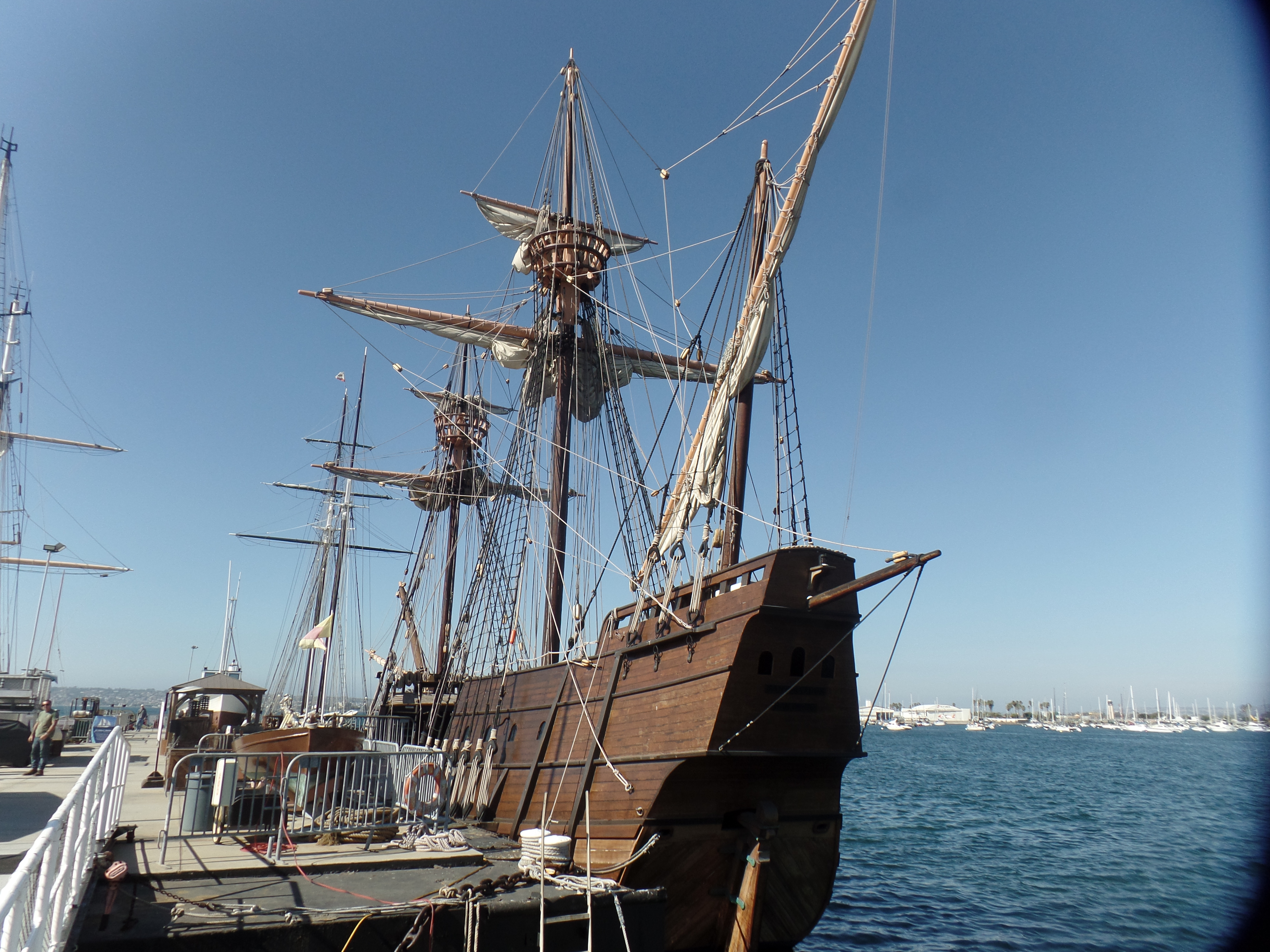
There are two ships that have been added to the Museum’s collection, since 2012: The galleon, San Salvador, a replica of the vessel which Juan Rodriguez Cabrillo used to sail into San Diego Harbor, in 1542 and a Patrol Craft Fast (Swift Boat). I took a fifteen-minute walk around San Salvador, joining a party of visitors from Mexico. Here is a view of the galleon.
The galleon, San Salvador, replicated for the Maritime Museum of San Diego
It is notable that Cabrillo, one of the wealthiest men in Spanish America at that time, contracted food poisoning either whilst in this area, or shortly after leaving. He never got to see the successful settlement, which was fostered sixty years later, by Sebastian Vizcaino (Viz-ka-YEE-no), who gave the settlement the name, San Diego.
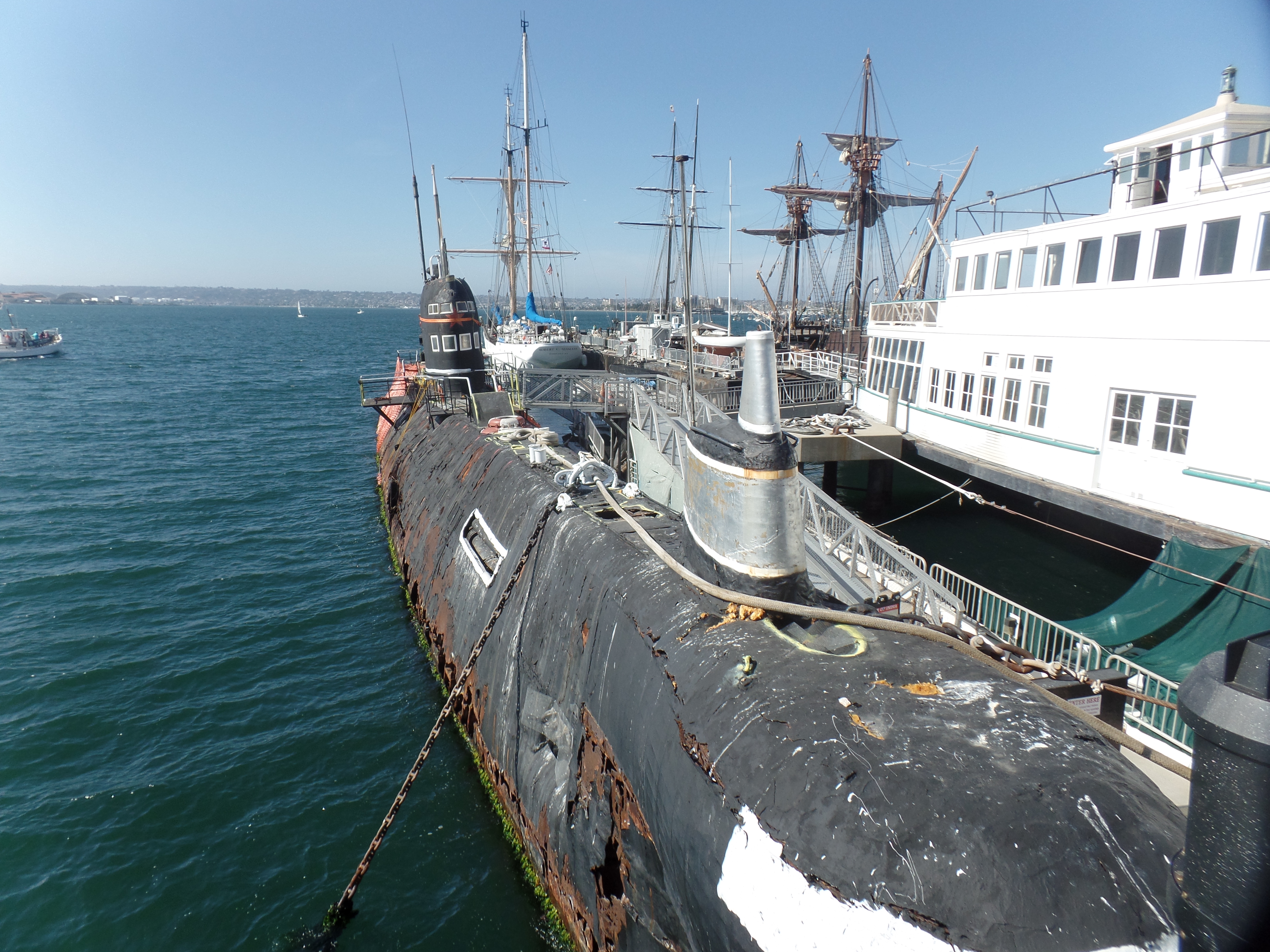
One ship will soon leave the Museum: The B-39 Soviet submarine. I made one visit aboard this vessel, in 2012. Here are the way it looked nine years ago, and how it looks now.
Soviet B-39 submarine, Maritime Museum of San Diego, 2012
Soviet B-39 submarine, with corroded outer hull, Maritime Museum of San Diego, 2021
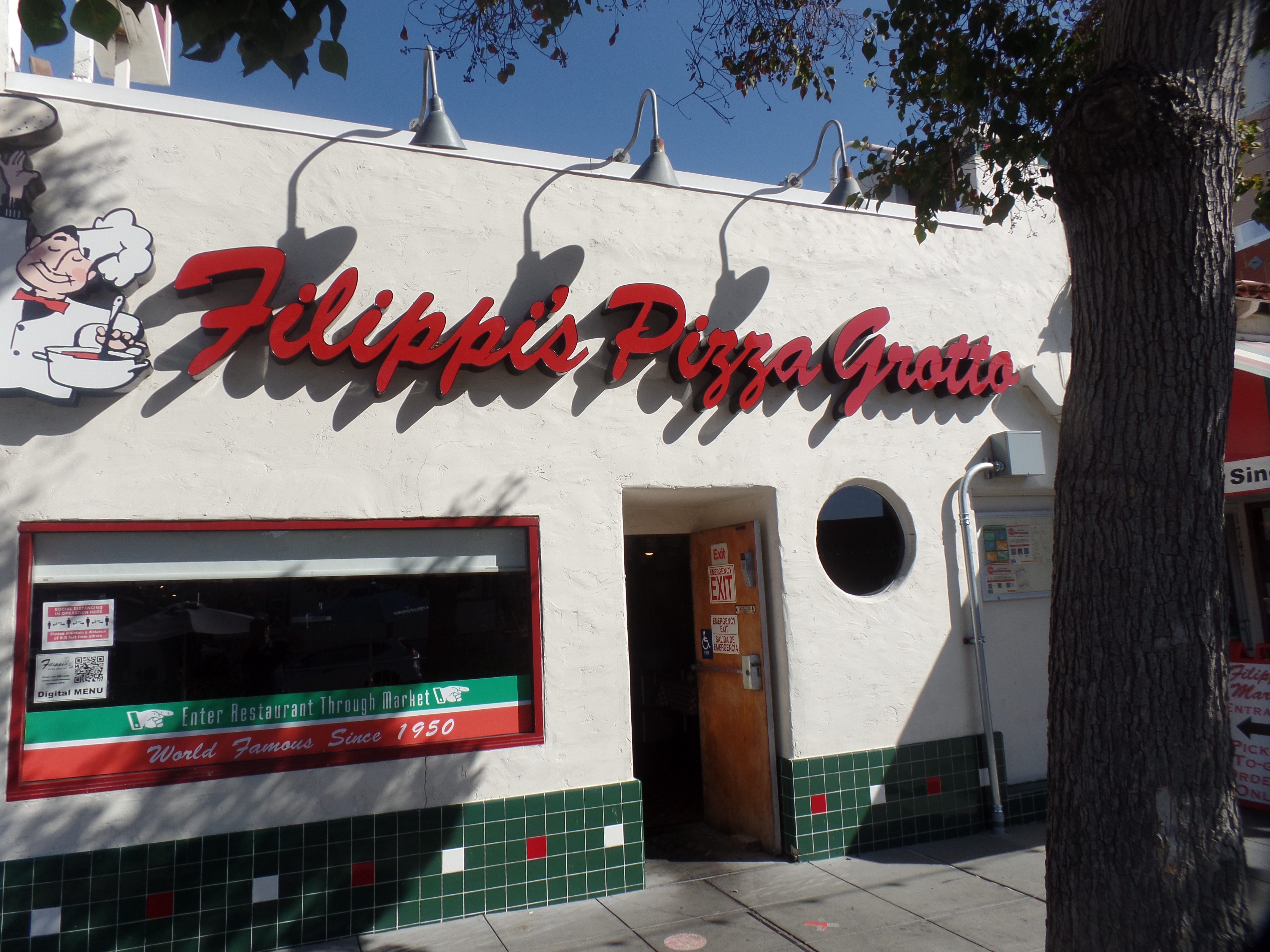
After visiting or re-visiting several of the vessels, I headed over to Little Italy, which lies between the waterfront and San Diego’s downtown core. There, a stop was made for lunch, at an old favourite: Filippi’s Pizza Grotto. It was the first restaurant I visited in San Diego, back in 1979-then, as now, accessible by entering through the market and kitchen.
Filippi’s flagship restaurant, in Little Italy, San Diego
This was a most gratifying day, made all the more so by the presence of so many young people, who are enthused by embracing their city’s maritime heritage-and learning teamwork in the process.
November 8, 2021, San Diego– A lot of the conversation with friend, J, at Harpoon Henry’s Restaurant, in Dana Point, had to do with self-assessment and self-accounting. This was my first visit with her in two years, due to both the pandemic and the current circumstances of her life. J and I normally walk a bit along a beach of her choosing- Crystal Cove, Laguna Beach and Dana Point being her favourites. For the time being, such walks are on hold, but it was a good time for catching up. We agreed that it has been quite a year, all around. There have been ongoing debates and recriminations passed around, unwitting public figures being drawn into the limelight and a penchant for name-calling taking the place of people owning their decisions and the resulting behaviours. Through all the negativity, the pandemic continues, albeit in a slowly diminishing manner and responsibility takes a vacation-not in the beach towns, but at large public events.
Astroworld’s hip hop concert, over this past weekend, ended in horrific fashion, with eight people being crushed to death, and dozens more injured, in a stampede. There are further intimations of people being jabbed by hypodermic needles, laced with illicit drugs, at certain points during the Travis Scott concert. The performer himself couldn’t hear people calling for assistance for those injured or dying, until it was too late.
It is time for musicians, performance artists- and politicians to take stock, not only of how their words and actions immediately affect their audiences, but also how these infest the muscle memory of significant segments of society. Travis Scott cannot bring back his dead and injured fans-nor is he, alone, likely to curb the increasing tendency towards lurching towards abandon, when crowds of people are whipped into a frenzy. Astroworld should be a wake-up call for people to exercise restraint and look out for those around them. In the same way, Columbine, Sandy Hook, Parkland, Las Vegas, North Charleston each should have been a wake-up call for curbing the access by mentally ill people to firearms.
The solution is spiritual. J and I each have chosen different paths to the sacred. Yet, both of us have found that sacred, in a way that makes sense to us, as individuals. It would have been all too easy, at least for me, to embark on acts of throwing caution to the wind-and giving vent to the wildest of urges-had I not been raised to act in a conscientious manner. Even so, trial and error have taken their toll, though thankfully not in a manner that was injurious or lethal to another human being. I can credit belief for the fact that such tendencies have gradually faded.
My heart always aches for those who suffer, needlessly, in events that go awry or where destruction is intended. The stampede at Astroworld and the apartment collapse in Lagos, also this weekend, are only the latest examples of the consequence that accrues, when we do not-even for the briefest of times, look upon the well-being of our neighbours with the same vigilance that we look upon our own.
November 7, 2021, San Diego- There are times when even with the best intentions, one gets behind the eight ball, and misses out on something of fair importance. This morning, preparing for a short trip out to this third hometown of mine led to my arriving late for a spiritual gathering, honouring the Birth of Baha’u’llah. Nonetheless, there was a warm welcome, great conversation and a fine meal. The Blessed Beauty (one of Baha’u’llah’s titles) has long seen to my well-being, and was no doubt watching over this one, from His place in the Unseen Realm.
Leaving Prescott around 2 p.m., I made a beeline, of sorts, for Yuma. The mission was to spend some time with old friends, and to receive their generous gift of Baha’i literature. The choice of books was mine, and I was thus able to retrieve some treasured volumes by the late humourist and radio personality, William Sears. He spent several years in the Philadelphia area, as well as in the South, in Hawai’i, and several more in southern Africa, in service to our Faith. His take on spiritual matters is always refreshing and often light-hearted, but reverent.
My friends treated me to a light, but satisfying meal, at a place called El Buen Taquito, on Yuma’s south side. It is still possible to get a delectable dinner, in a “Mom and Pop” establishment, for under ten dollars. After coffee and further conversation, I left my friends and headed due west. A brief stop in the town of Ocotillo, for another cup of java, put me on track and arrival here, at the Pacific Hotel, on the northern edge of Little Italy, was achieved by 10:30. After a slight mix-up, with regard to which room was actually unoccupied, I am now in my home for the next three days.
It’s time to revisit some old haunts, starting tomorrow.
October 15, 2021- In the fall of 2020, there were protests against keeping the statue of Juan de Onate, one of the Conquistadores who re-established Spanish hegemony in what is now the American Southwest, after the Indigenous Peoples’ Revolt of 1680. The statue still stands at the southwest entrance to Old Town Albuquerque. As painful as much of Spanish rule was, for both the Puebloan and nomadic tribes that were subjugated, that collective pain and the response to it-including the retributive pain meted out by the rebels upon the Spanish settlers are cautionary tales-two among many from which mankind is learning, ever so slowly. The horrors endured cannot be wiped from memory.
All across Europe, there are reminders of the grim events that forged that continent’s present state, from the Museum of Torture, in Bruges, Belgium to the preserved concentration camps of World War II. In Africa, the dreadful remnants of Slave Castles and places like Ile Goree, remind residents and visitors alike of the widespread culpability for this most heinous sustained and codified injustice. Hiroshima and Nagasaki bear witness to the ultimate fate that awaits the worst of ultranationalists, along with the millions of innocent victims that their excesses cause to be brought down with them.
Here in North America, it is surely tempting to “correct” history, by eradicating statuary that reflect the erroneous notion of one racial subgroup, or ethnicity, being superior to others. Indeed, statues of Confederate leaders and slave holders scarcely have any place, standing in communities that abolished slavery, to the extent it ever was practiced in them, well before the onset of the American Civil War. Ditto for the Stars and Bars.
I have visited places associated with controversial, even unsavory, historical figures and events, from the Confederate Cemetery of southern Maryland to the site of the Silver Creek Massacre, in eastern Colorado-and will continue to do so, for the purposes of my own understanding. I do so, knowing that I will never subscribe to either heinous mistreatment of other human beings, or to the systems that spring from it.
Careful, measured and accurate presentation of unpleasant to horrific episodes of our history, and of the blinkered systems they produced, is however part of learning. De Onate’s role in the suppression of both indigenous peoples of New Mexico, and of the lower class settlers (including Afro-Spaniards, many of whom were enslaved) needs to be kept in mind. Seeing his likeness on horseback, upon first entering Old Town, is a suitable prompt in that regard. It also brings forth further contemplation, as to the role of the clergy, including the founders of the nearby Church of San Felipe de Neri, in the oppression of those viewed as of a lesser humanity. Again, gratuitous statuary in places not associated with a given figure of history- as in a statue of Christopher Columbus in, say, Portland, Oregon or of Robert E. Lee, in downtown St. Louis, serves no purpose other than to gratify that figure’s local admirers. In such a case, those admirers should be free to keep their memorabilia on their own private turf. For the rest of us, history presented in its true context will suffice.
Those are my thoughts, after visiting Old Town Albuquerque, before heading back to Home Base.
October 14, 2021, Albuquerque- The themes expressed in the New Mexico History Museum are common, in their presentation of the call for rectification of all that has been done wrong, between one group of people towards another, over the centuries. Simply put, there is no person, group of people, ethnicity or nation that has a corner on purity, kindness, love for the Earth, etc. Any time people feel backed into a corner, they lash out.
This is true, no matter how privileged and well-off people are, in actuality. “The reality of man is his thought”, said ‘Abdu’l-Baha, on His visit to Paris, in 1911. If a person feels that he is a victim, then no amount of explaining from someone else, even grounded in real time, will change the afflicted one’s perspective. it has to come from within. Before Europeans came to the Americas, there were times when the various Indigenous nations would quarrel and wage war. Usually, this was sparked by natural disaster, combined with population growth, resulting in scarcity. The influx of large numbers of people who came from other parts of the world, and who had different values and practices, did not exactly ease the situation.
The solution, though, is never to deny another person’s reality, as some intellectuals are trying to do with regard to social justice movements. The conservative who refers to the claims of a progressive as “that hoax”, and vice versa, brings no peace. Everyone has a piece of the truth, and deserves to at least be heard, so that the feeling of being backed into a corner does not arise. I came to this realization, again, after visiting the section of the New Mexico History Museum that deals with the Pueblo Revolt of 1680. The rebellion succeeded, initially, because there was unity of purpose across the various Indigenous nations. It failed, in the end, both because that unity did not hold and because the victors did not see fit to treat Spanish civilians, especially women and children, in a humane manner. It was the generating of extreme negativity that sucked the energy out of the otherwise worthy campaign for relief and equanimity for maltreated Indigenous people.
The songwriter Pete Townshend warned, after experiencing callous behaviour from some attendees at the Woodstock Music Festival, in 1969, that “parting on the Left” could change to “parting on the Right”, in his song “We Won’t Get Fooled Again”. It happens when, as the initially victorious have so often found, their views on holding power turn out to be unimaginative, merely copying the practices of their former oppressors-and thus either paving the way for the return of those oppressors, as happened in the late Seventeenth Century, or worse, hard-wiring the succeeding generations in patterns of socially maladaptive behaviour.
I have paid close attention, especially lately, to the interactions of people, across ages and ethnicities, in the latest stages of COVID19. I have heard of incidents of line jumping and people flailing at each other, over masks vs. no masks. I saw nothing of the sort, anywhere in mask-mandated New Mexico, these past four days. People appear to be making an effort to get along, on a very basic level. even when, as one conservative friend said, they regard the mask mandate as inane.
Everyone’s struggle is real, and though that struggle does not become everyone else’s God-given burden, we can at least wish the bedraggled soul the best, and not actively make the onus heavier, by denying that it exists.
I left Santa Fe, around noon, after the museum visit, making brief stops in the artistic havens of Galisteo and Madrid, before settling in at the avant-garde, minimalist Monterey Motel, near Old Town, in this sprawling, but still rather charming metropolis on the Rio Grande.
Here are a few scenes of the day.
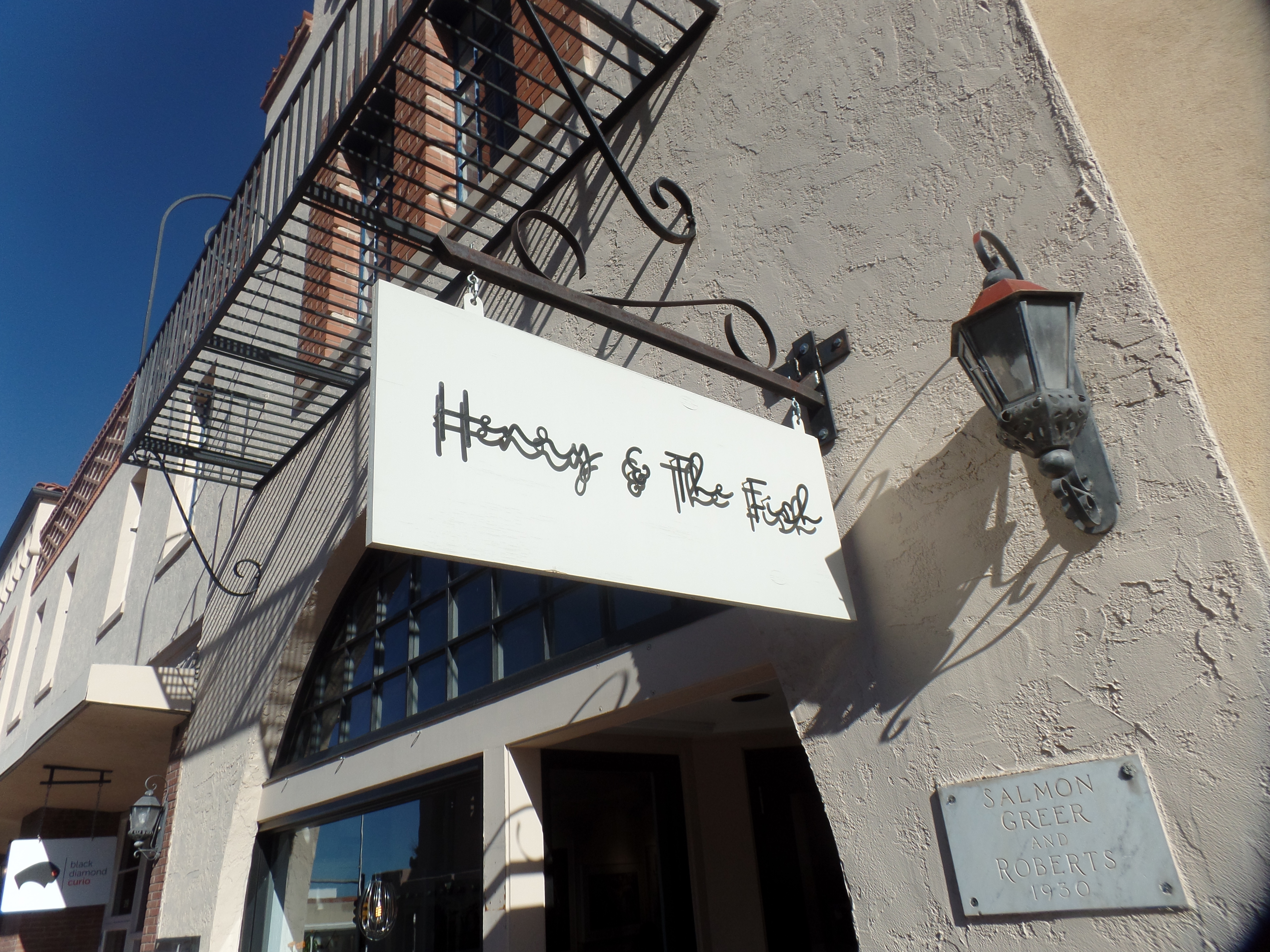
Henry and the Fish, near Santa Fe’s Lensic Theater, has upped the game on oatmeal-making the winter comfort food into a staple that lasts all day.
Learning, with some satisfaction, that the Georgia O’Keeffe Museum has sufficient rock star status as to require a fair amount of advance planning, before a visit, I made a note to wait until next time.
Affirmation Sculpture, near Georgia O’Keeffe Museum, Santa Fe
After leaving Santa Fe, a drive to quiet, artistic Galisteo introduced this adobe church: Our Lady of the Cures.
Nuestra Senora de Los Remedios, Galisteo, NM
This stone wall is similar to one that a former colleague mentioned, after his 1979 visit to a ranch owned by the late Burl Ives, who called Galisteo home.
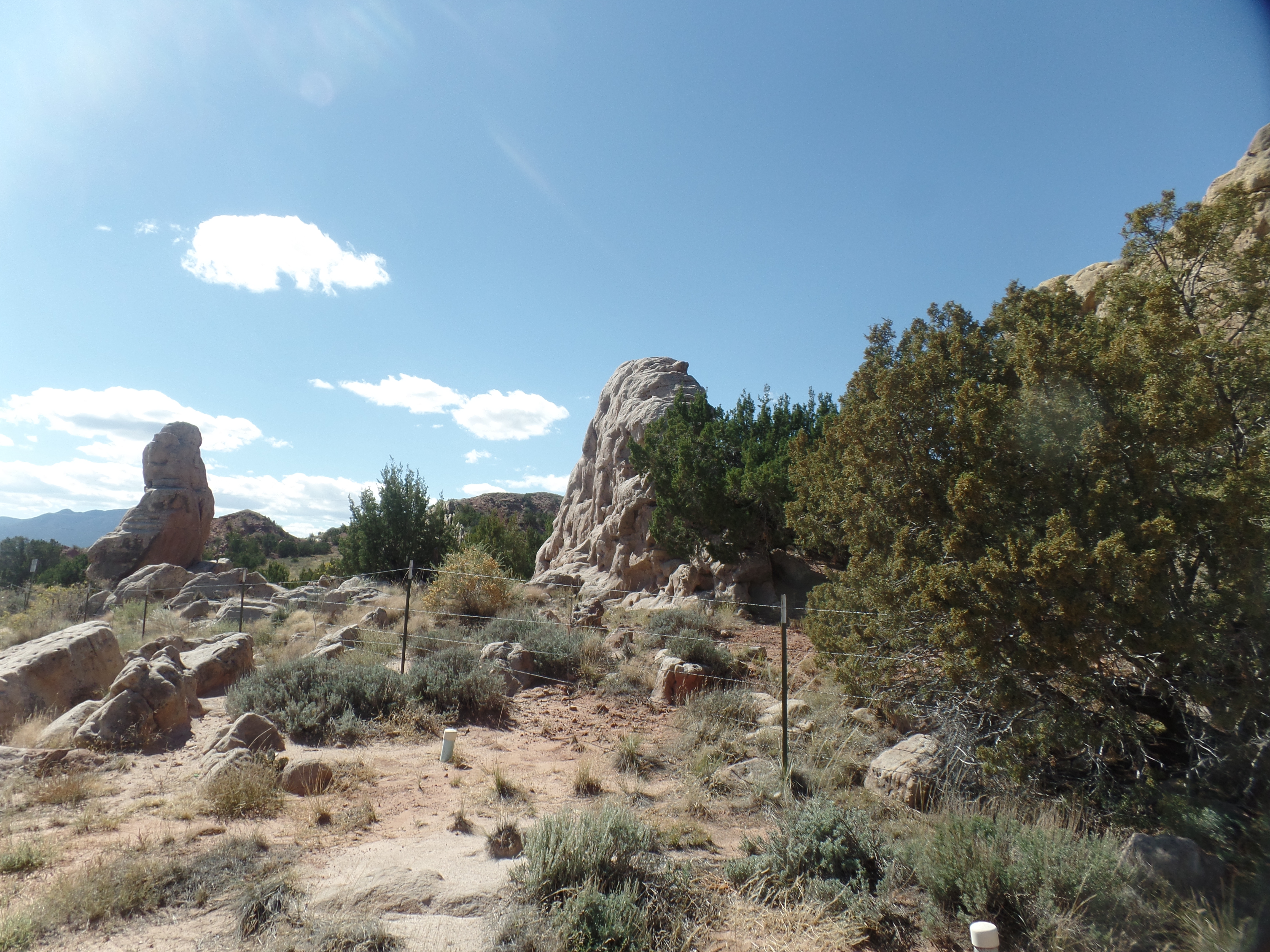
En route from Galisteo to the artist community of Madrid, I drove past some badlands.
Sandstone outcroppings, north of Cerrillos, NM
Outcroppings, north of Cerrillos, NM
Once in Madrid, I found this little gem, in the Gypsy Plaza. Mr. Shugarman carefully packaged two of his signature chocolate bark squares, for my gradual enjoyment. He also ships his wares, so some beloved friends may expect an occasional surprise, direct from Madrid.
Shugarman’s Little Chocolate Shop, Madrid, NM
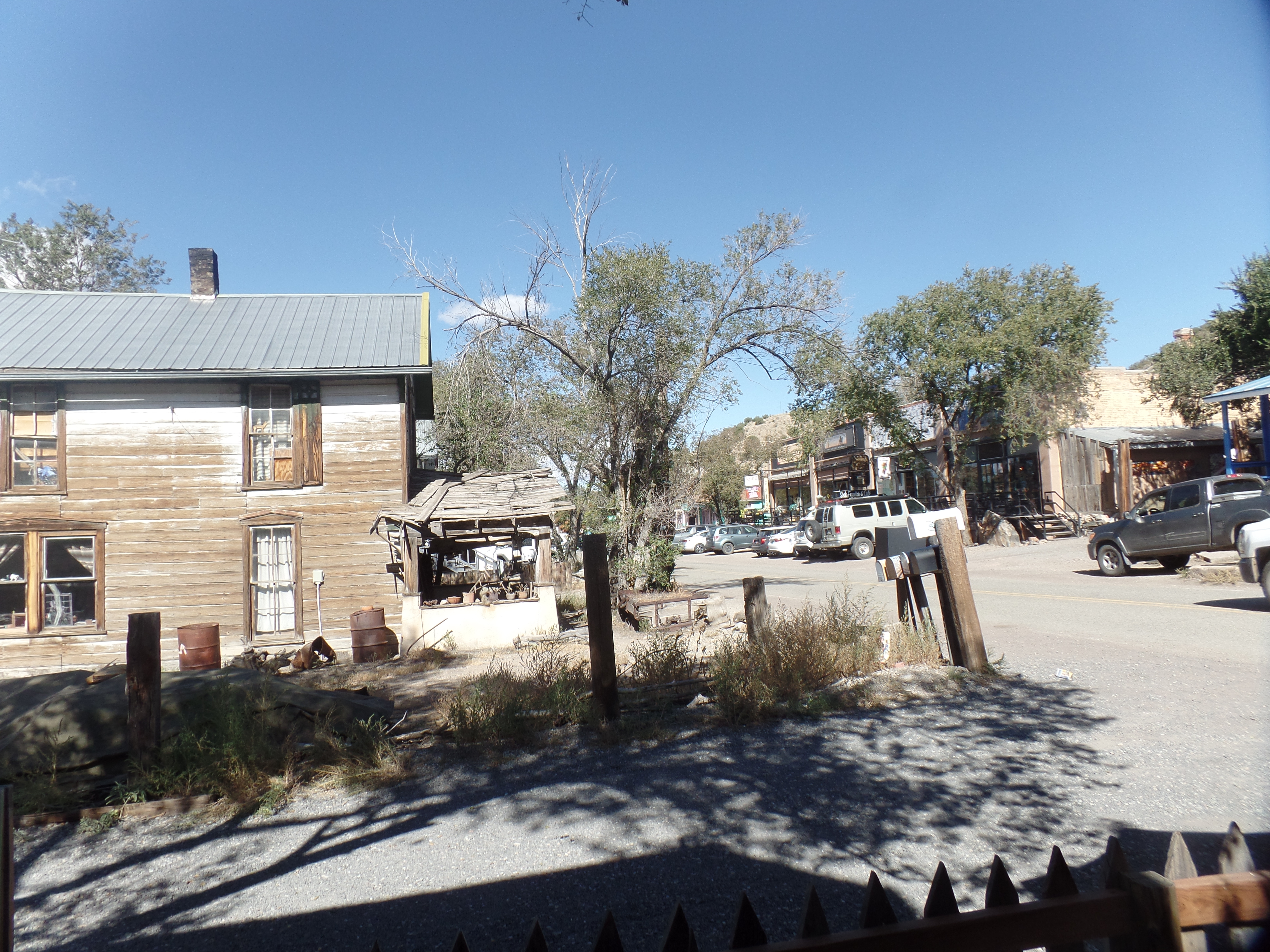
Madrid may look like it’s falling down, but thriving it is. The old coal mining town reminds me of Jerome, only not perched on a hillside.
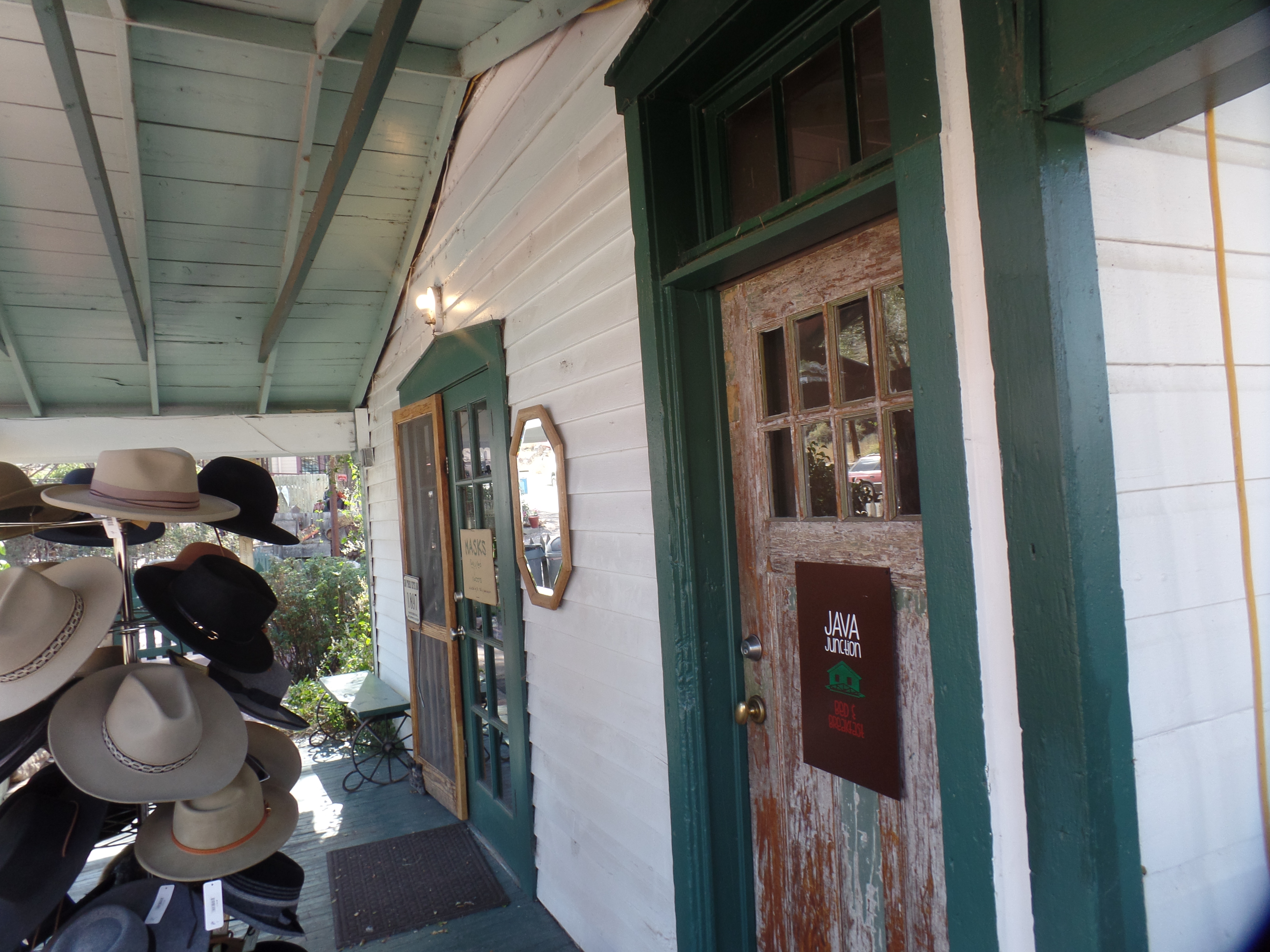
Java Junction’s apple cream muffin also is coming home with me, for a possible Saturday (or Monday) breakfast.
JJ was somewhat busy, this afternoon, but it hasn’t always been thus.
Madrid, on the east side of Sandia Crest, is another reason for me to return to northern New Mexico, soon. After tending to a critical business matter in uptown Albuquerque, I settled into Monterey Motel, about two blocks west of Old Town. The avant-garde ambiance was welcome this evening.
October 12, 2021, Santa Fe- The rough-hewn log cabin greeted several of us who pulled into Ghost Ranch around noon. It’s given name is City Slicker Cabin, though BYOB (Bring your own bedding) is the obvious message for those who take a look at its plank-floored emptiness. Needless to say, the present owners of the property take care to lock it, each night at 5 p,m,
Interior of City Slicker Cabin.
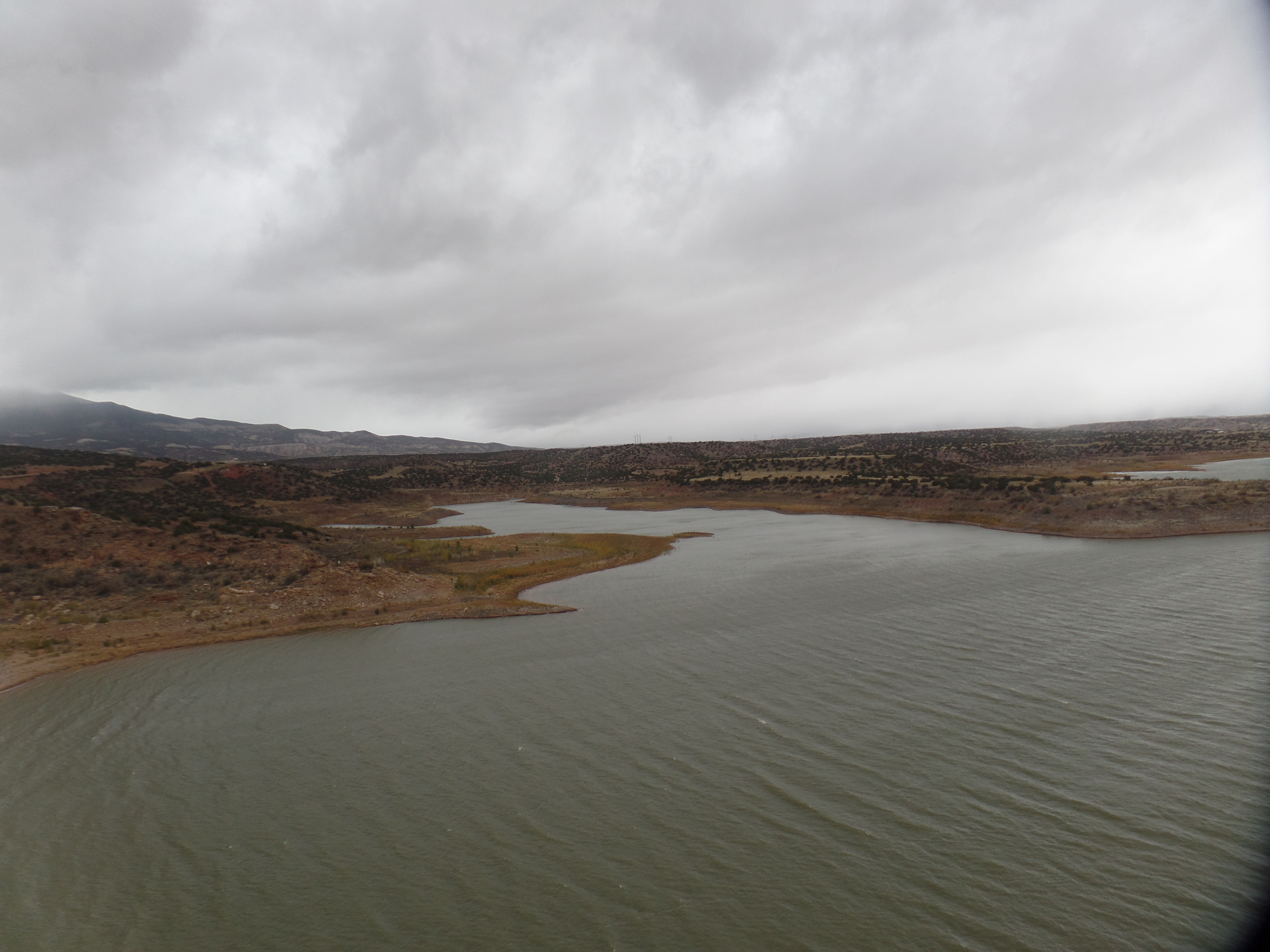
The day had started wet and cold, as I enjoyed a homestyle breakfast at Cuban Cafe, across the road from Cuban Lodge, both owned by the same family, in Cuba, NM. Rain changed to snow as the road took me over Sierra Nacimiento, and to a brief stop at Abiquiu Lake, a reservoir built by the Army Corps of Engineers in 1963. The earthen dam which secures the lake was raised in 1986.
Abiquiu Lake, in the Sierra Nacimiento, NM
Having made a reservation at Ghost Ranch, for a day pass, I was told rather apologetically by the attendant in the Welcome Center that I would not be able to eat in the Dining Hall. Since that was not one of my expectations, I thanked her and went into the theater, to watch a brief video about the property and its history. Imagine my surprise to see a treasured friend among those who was on a group hike, a few years back.
Ghost Ranch has attracted many of us, well-known and obscure, alike. Ansel Adams, Nelson Rockefeller, Del Webb and Robert Wood Johnson (the founder of Johnson & Johnson, and the second part-owner of the property) have all treasured its serenity and beauty. Perhaps most famous of all, however, were Max Roybal, the Santera (carver of wooden saint likenesses) of Ghost Ranch, and Georgia O’Keeffe. It was Ms. O’Keeffe’s association with Ghost Ranch that first prompted me to want to pay a visit. There is much about her simple artistic style and love for basic black and white backgrounds that has appealed to me, since my teen years. She had a passionate love of desert and mountain alike, regarding nearby Cerro Pedernal as “her” mountain. In many ways, Georgia was a daughter of Perdernal. She is also regarded as the “Mother of American Modernism”, relative to painting and sculpture. She lived on Ghost Ranch from 1934-1984, when frail health prompted a move to Santa Fe, where she passed on in 1986, at the age of 98.
With Ms. O’Keeffe’s long and cherished career in mind, I set about exploring the grounds of this fascinating property. Carol Stanley moved to the former Archuleta property, in 1930, recording the deed to it in her name, after divorcing her husband, Roy Pfaffle, who had won the property in a poker game. A frequent visitor, businessman Arthur Pack, bought the property from Ms. Stanley, in 1935. It was he who developed the land to its present rustic, but economically viable, state. Mr. Pack and his wife, Phoebe, being childless, sought a non-profit entity to purchase the land, after he became infirm. The Presbyterian Church was given Ghost Ranch by them, in 1955, and uses it as an educational and spiritual retreat. The property was damaged somewhat, by a flood in 2015, but has largely been restored.
Here are five scenes of Ghost Ranch.
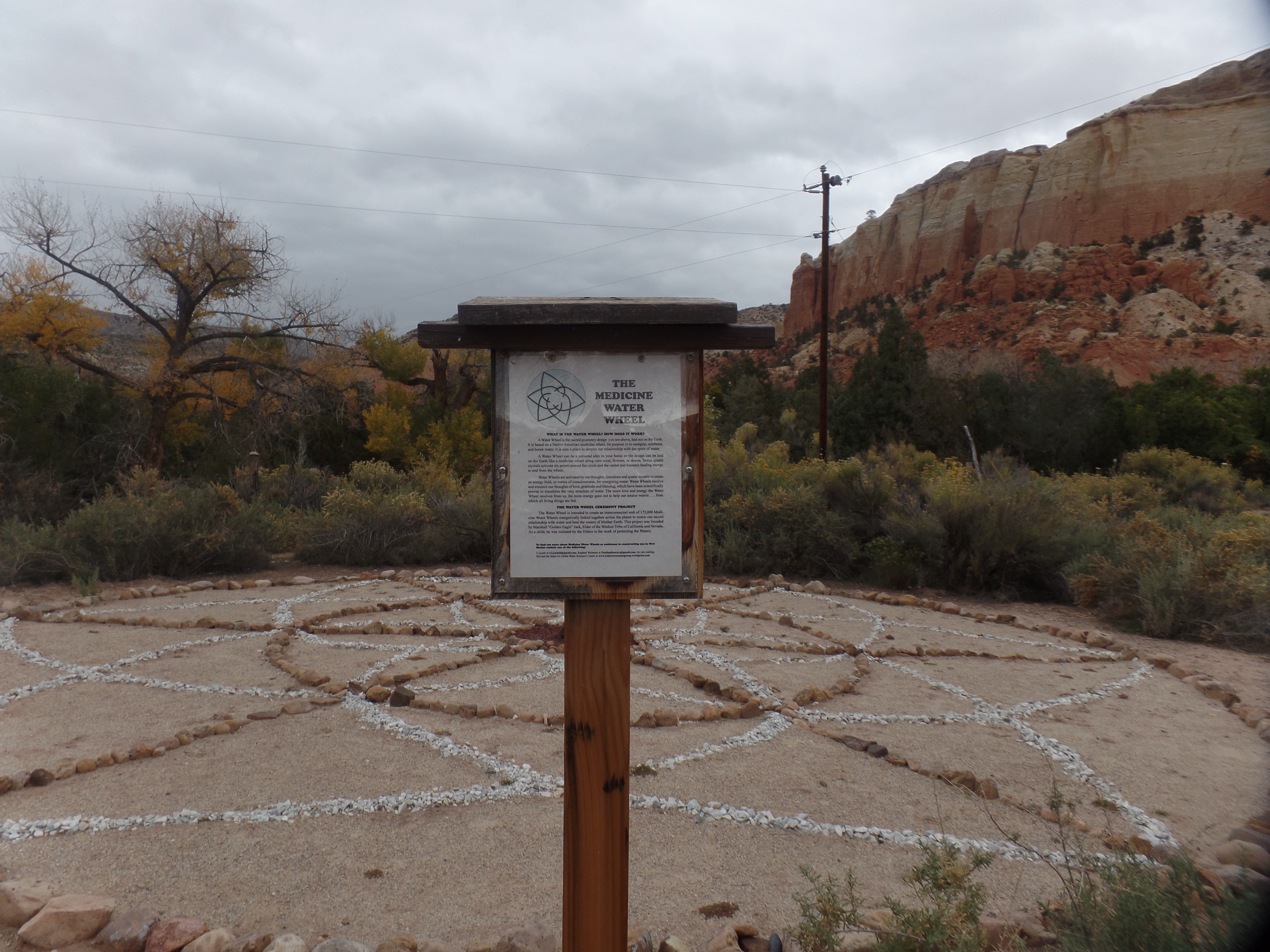
Agape Center, the indoor meditation and worship center of Ghost Ranch.Fall foliage, along the banks of Rio Chama.This was Georgia O’Keeffe’s residence and studio. It is now owned by the Georgia O’Keeffe Foundation and Museum. Santo, carved by Max Roybal. It greets the visitor to the Water Wheel, Labyrinth and Japanese Meditation Garden, east of the main complex.This traditional Medicine Water Wheel is reminiscent of the large Medicine Wheel in northeastern Wyoming. It is intended to offer protection and purification of water, the essence of life.
I spent about thirty minutes walking the nearby Labyrinth. Being in a deep state of meditation after leaving the Labyrinth, I decided to not photograph it, this time, but looking at the Medicine Water Wheel, one can get a fair idea of the appearance of the maze.
There are two museums, south of the Welcome Center: The Anthropology and Paleontology Museums. During the height of the Covid Pandemic, these were the only museums in New Mexico to remain open! Even so, only four people at a time could visit each one. I spent another forty-five minutes between the two.
When it was time to say farewell, for now, to Ghost Ranch, I was bid adieu by these two sentries:
October 11, 2021, Cuba, NM- The message was unequivocal, as I drove past the highway that led to Chaco Culture National Historical Park, and towards Farmington: “We are giving you THIS day, to honour the ancestors!” I turned around, and drove towards Chaco, promising myself that I would not continue along the unpaved road that led to the place, if there were any spots with high centers or jagged rocks that would reach up and take a bite out of the rental car’s oil pan or gas tank.
I needn’t have worried. There were spots with mild washboard, but nothing that harmed the Chevy Malibu. My new friends, Michael and Pat, were less fortunate, losing a water jug to the one spot on the road that had a hairline rupture and shook their vehicle. I think I went over that spot at 10 mph. Probably, the harbinger for what turned out to be an excellent observance of Indigenous People’s Day was this sight, along NM Highway.
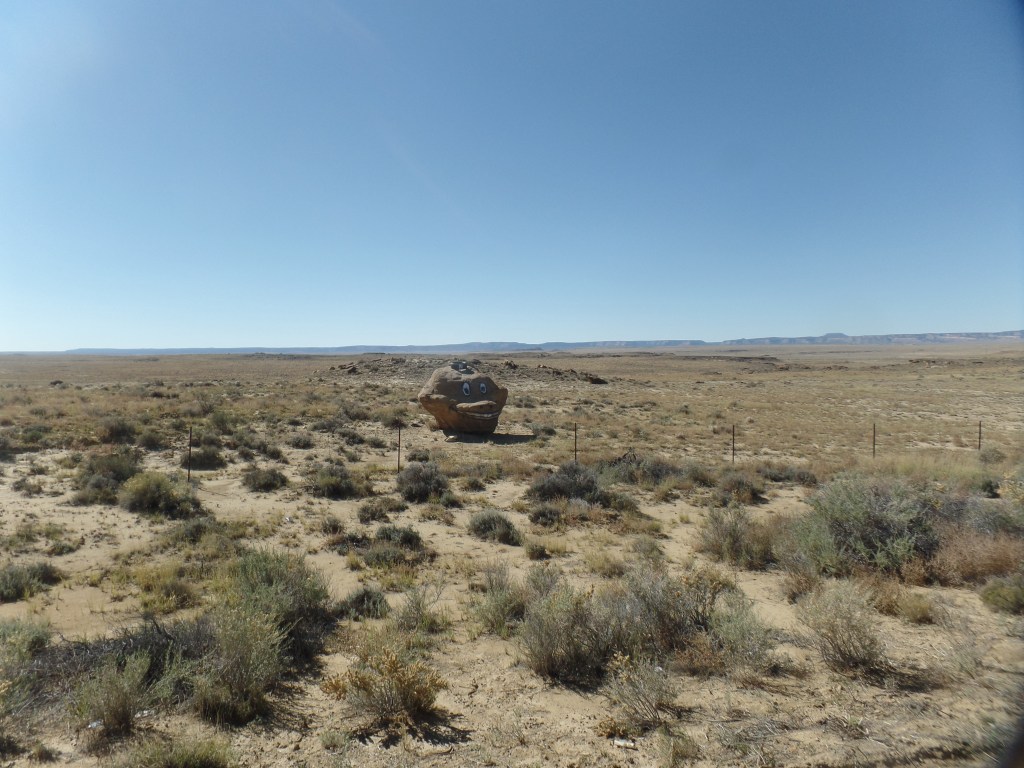
Mushroom Rock greeted me, upon my turning left onto Chaco Canyon Road.
Another half-mile along, a friendly rancher had arranged this greeting.
Longhorn Lee says “Howdy!”
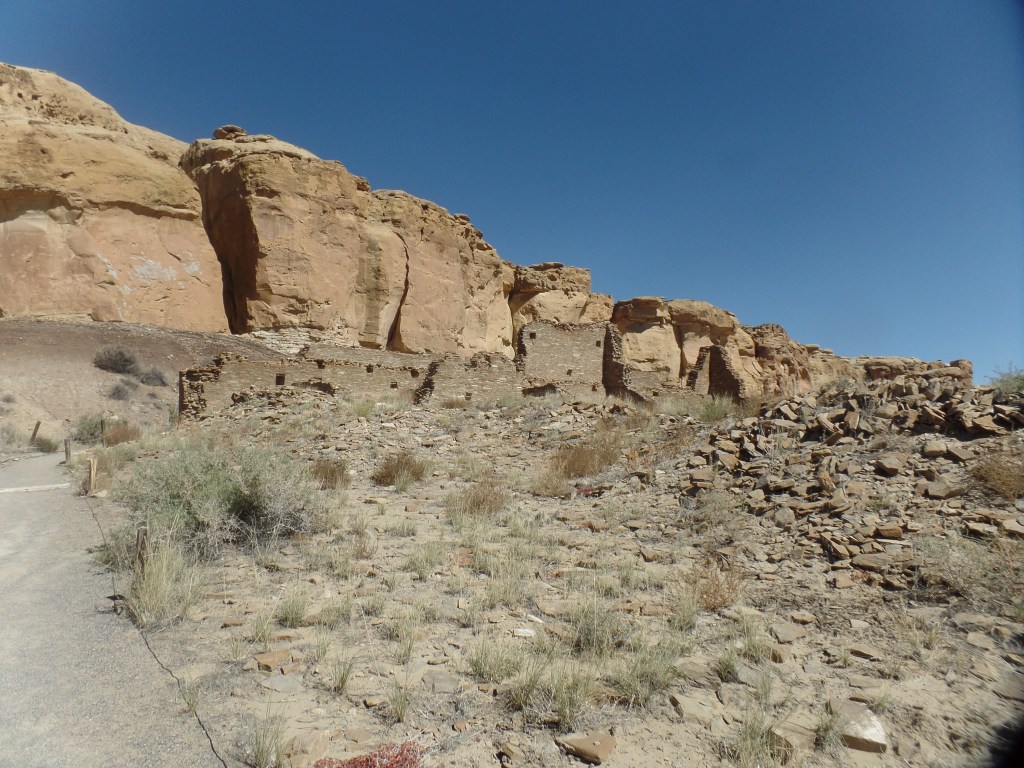
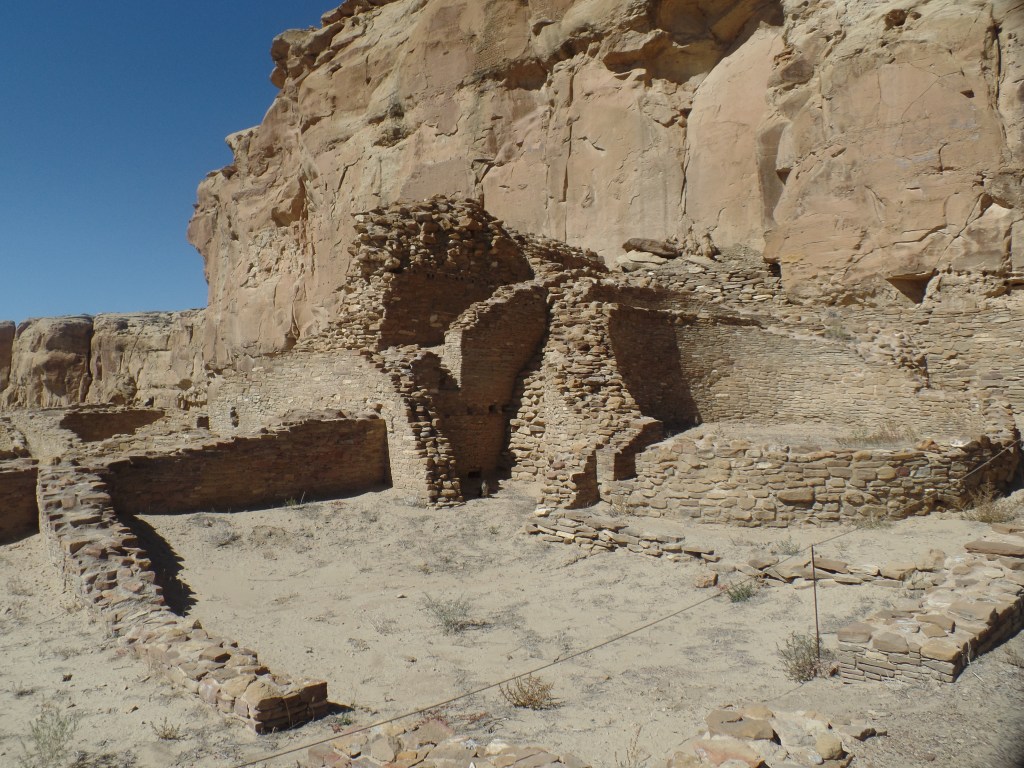
Hungo Pavi, the southernmost set of ruins in Chaco Canyon.
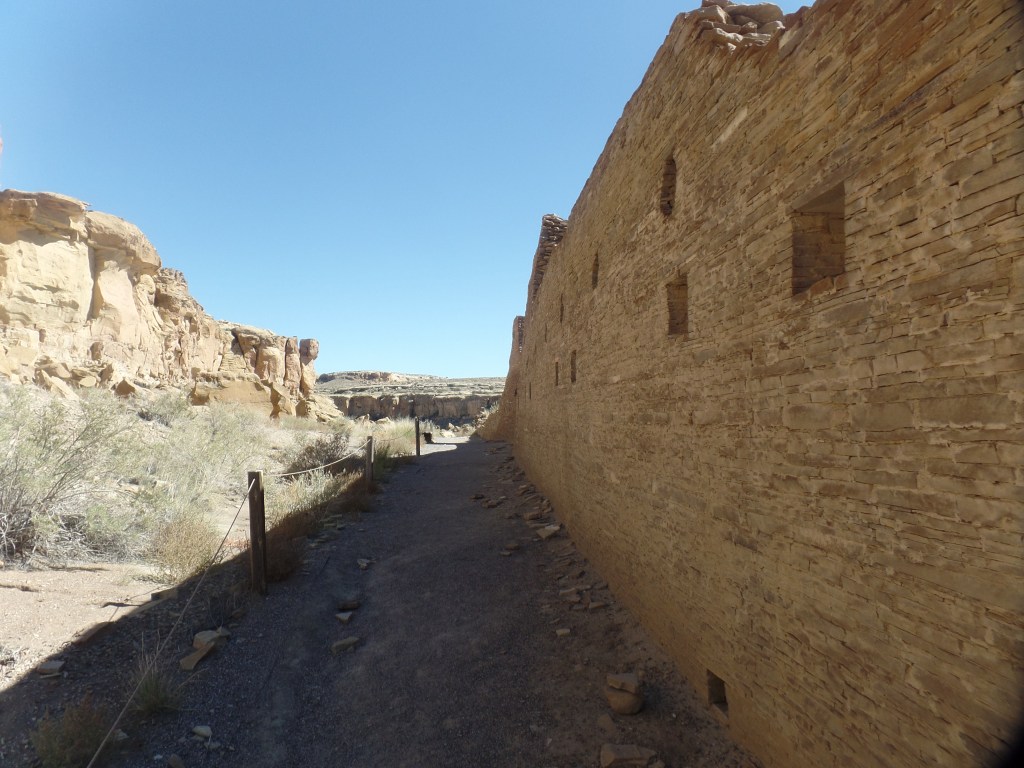
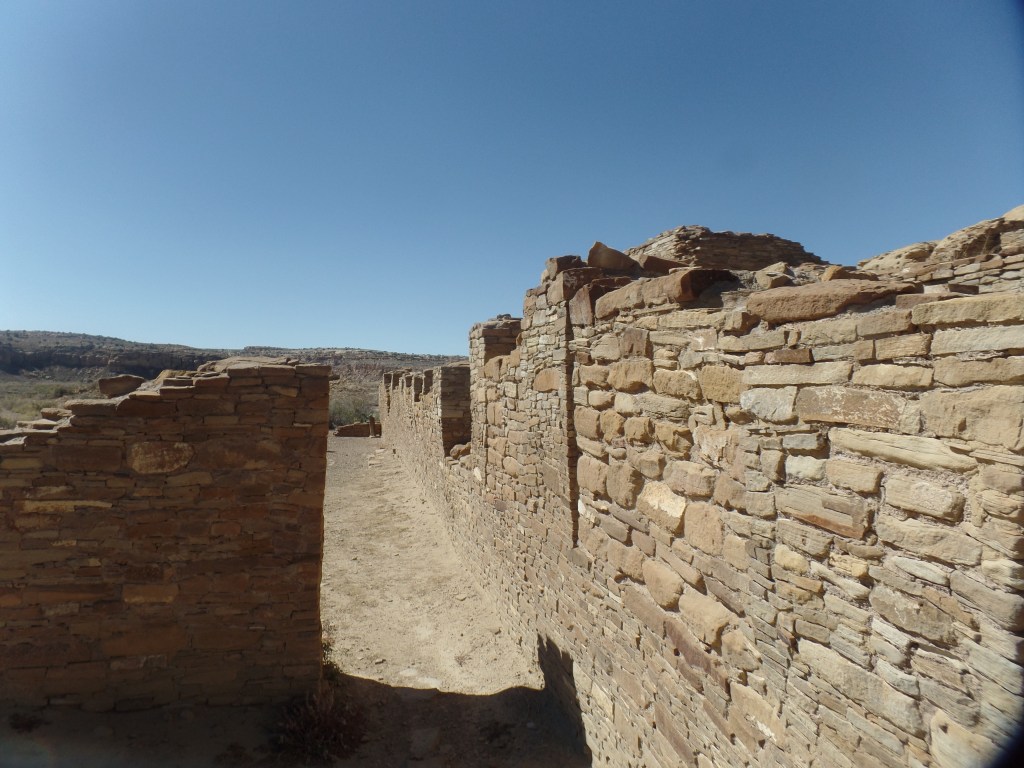
Today’s visit brought me to Hungo Pavi, Chetro Ketl and Pueblo Bonito. The above, and the next two photos, feature Hungo Pavi.
The Chacoans, like the builders of Hovenweep, had a penchant for building long,
and the squaring of corners.
I moved along to Chetro Ketl, one of the four clusters of buildings in Chaco that use a mix of round and square.. Chetro is located directly west of a fine collection of petroglyphs. Here is one of these.
A magnifying glass may be necessary, but the spiral petroglyphs are there.
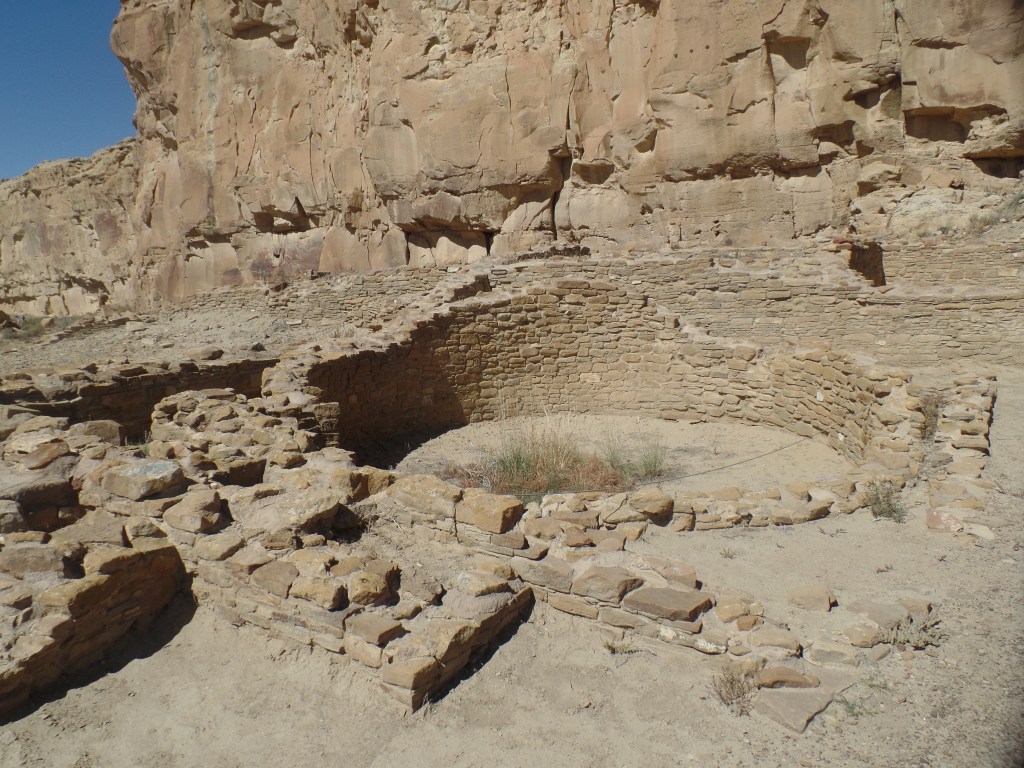
The first of several kiva sturctues in Chetro Ketl
A kiva, next to some residences. These remind me of Sinaguan and Mesa Verdean complexes.
Here, too, the accent was on length of a settlement.
As large as Hungo Pavi and Chetro Ketl were, they were mere suburbs of Pueblo Bonito. The central community was also the major trading hub for the Four Corners region, and likely as important to the commerce of at least the western half of North America, as Cahokia and Serpent Mound were to the east. Here are three views of that enormous place.
Here is the southern end of Pueblo Grande.
This is the end of one building subdivision, on th esouth side of Pueblo Bonito.
I will be back in this phenomenal place, perhaps as early as December. The spiritual and historical significance of Chaco Canyon, to both those who settled here and those who came after, is still being realized.
October 10. 2021, Gallup- Today is Double Tenth, the popular name for the National Day of Taiwan. The country is on watch, as it has been since 1949. Taiwan is staying vigilant, on game.
On a smaller scale, I, too, have to remain vigilant, on game-for a different reason. Life is getting more frenetic, I’ve noticed. More people are casting discernment to the wind, with me being one of them, for a split second too long, on September 23. The lesson was to not take eyes off my surroundings-in any situation.
After a morning that became whirlwind-a breakfast at Post 6, delayed a bit by human error (not mine), I hosted an online meeting-starting on time, but with seconds to spare. It all worked out, very nicely. A phone call to my mother, before all that, soothed any concerns I had about her well-being. She was more concerned that I was recovering from 9/23. I am, and just about completely.
Packing was fairly light, though I am ready for the vagaries of October-winter gear is mixed with near summer wear. I set out a bit after noon, noticing that there was a huge volume of traffic headed from Payson to the Phoenix area, for some reason going west to the Verde Valley, then south on I-17. I was headed in the opposite direction, but found it took seven minutes to be cleared for turning left so as to head north to Winslow.
There was no further delay in moving towards Gallup. I did stop for coffee, in the small Navajo Nation border town of Chambers, AZ. The restaurant attached to Days Inn was closed, but the convenience store had coffee. A well-meaning lady brought a stray dog into the store, pleading with the attendant to find a place for the scared puppy. Apparently, the finder was from Phoenix and had no way to care for the dog, which she said had been wandering around near the large semi-trailer trucks parked nearby. It being Sunday, and Chambers being a good hour from the animal shelter in Ganado, there wasn’t much the attendant could do, save put the dog outside and tend to her at shift’s end. Me? I am driving a rental car, have no pet carrier and would not be able to keep the animal at Home Base. I left a small group of people there to sort it out as best they could.
Once here, in western New Mexico’s regional commercial hub, I found no fewer than four motels closed for renovation. All can definitely use a world-class makeover, including the Lariat, where I stayed the last time I was here. El Capitan Motel is open for business and is definitely of recent renovation. The place is at least as good as a Motel 6, if not better. Who says Mom & Pop have nothing on the chains?
I am modifying my itinerary a bit, foregoing a drive into Chaco Culture National Historical Park, as the skinny on the roads into the park says there are very rough sections of the dirt roads, just before the park entrances, on either side. I am driving someone else’s vehicle and discernment precludes taking it on a rough route. I can drive a paved road, along the periphery of Chaco, which will suffice for now. Monday will thus be a day of familiarizing myself with the edges of the Bisti Badlands and the areas around the towns of Farmington, Bloomfield and Cuba.
My vigilance, in several instances of craziness, mostly pertaining to traffic, was much sharper today. I find that most reassuring.
September 20, 2021- This has been a strange eight days. I chalk most of it up to the change of seasons, which often finds me out of sorts and seeing darkness where none is intended. That, in turn, leads to trusted friends drawing back a bit and my being in a somewhat isolated state, for a few days. Taking the hint, this year, it’s a time to take care of a few things that have gone neglected for a while, today, and be in nature tomorrow-the day of Equinox.
It didn’t help matters any, that a planned deployment with the Red Cross fell through-only because I didn’t make a second consecutive phone call to the dispatcher-when I was expecting a confirmation call from that individual. Funny, how the protocol from last year has changed. At any rate, given my emotional state, I would not have been on game and mistakes may have happened, that would not have served well. Things, no matter how confusing, happen for the general good.
Today begins a second series of September birthdays (Mom’s and my middle brother’s being the first set, earlier this month). This one starts with the birthday of someone with whom I have had scant contact, in this life, but an inexplicable bond from some other realm of existence. It includes the birthday of my sister and ends with the commemoration of Penny’s birthday, both next week.
Summer’s end caps a season that took in a second cross-country journey, saw some friendships start to fade, others generate and renewed my bonds with good-hearted people. It included a longer work project than I had planned, but the results were fairly successful. It is now time to look towards Autumn-the season of harvest, and of my own birth. It will bring me to southern California, for a few days next week; complete Red Cross training that I feel is needed, in early October; and make a journey to places in New Mexico that have longed called out. Fall will also bring a couple more sessions with the dermatology team and hopefully see my little family come out here for Thanksgiving. I may yet also go on deployment for a couple of weeks.
“Every new beginning comes from some other beginning’s end.” – Dan Wilson, “Closing Time”