An Eastward Homage, Epilogue: Arlington and DC

2

August 3-4, 2014, Washington, DC- No sooner had I landed in Phoenix on July 7, than I received an e-mail that my Father-in-Law’s interment at Arlington National Cemetery would be August 4. It didn’t take long for my airline and hotel reservations to be made, and a budget drawn up for the four days I’d be gone.

I used to live at Fort Myer, VA, in the days when I was an Army postal cerk. I was always challenged by the Third Infantry sentry at North Gate, to tidy up this wrinkle or straighten that fatigue cap.  They never liked my hair, which was understandable, since none of them ever got to have any.

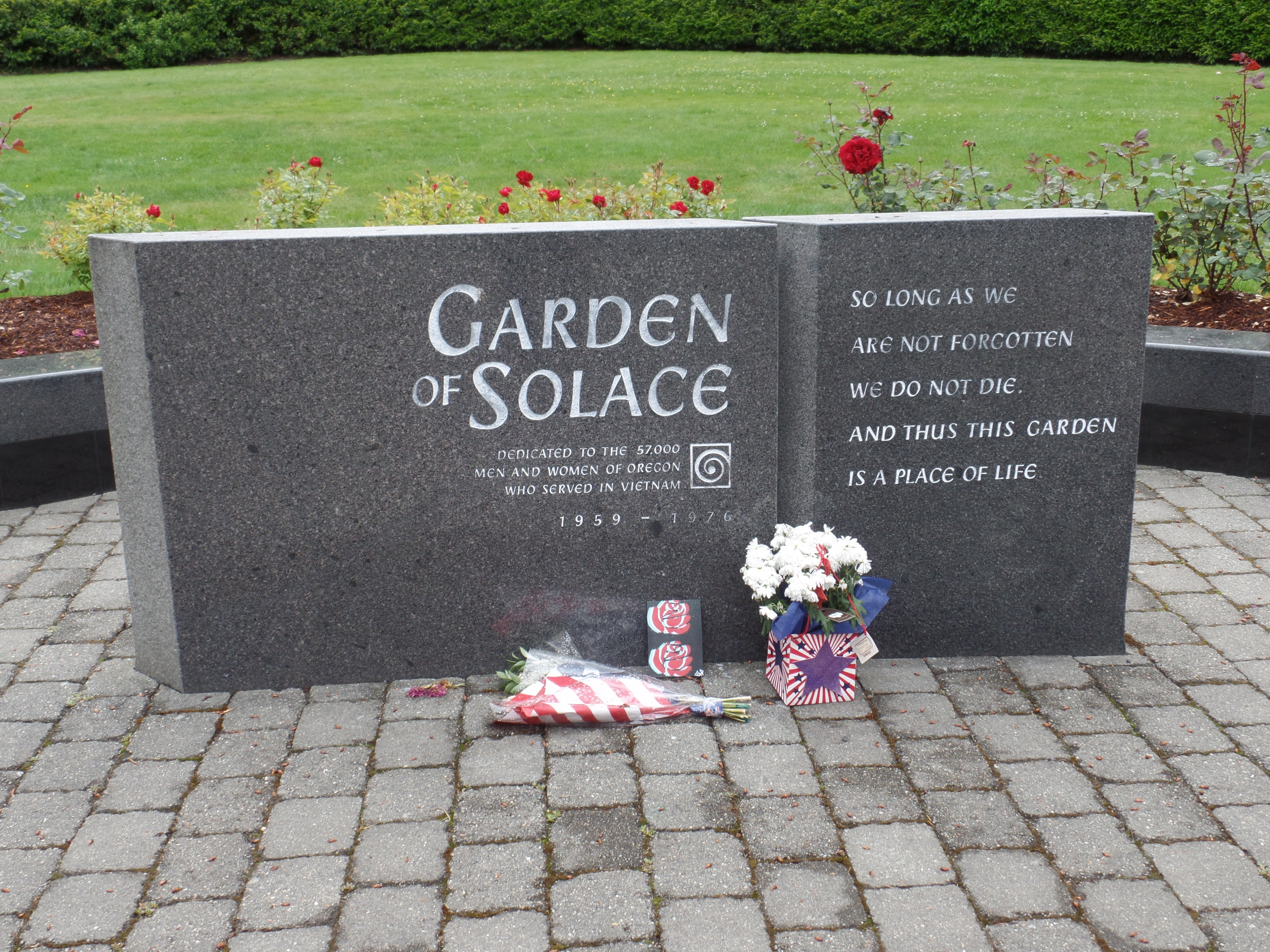
Pop was laid to rest in Arlington, on schedule-actually, three months posthumously, but it was a scheduling issue, and the ceremony was dignified and befitting of his service.  I don’t take photographs at funerals.  I did, however, have the waiter at Sky Lounge, Doubletree Crystal City, take a couple of family photos at our Sunday night dinner.  BIL (in ball cap) pronounced the photo useless, but hey, can see his smiling face, just fine.

SAM_2573

Earlier in the day, I meandered around Washington, DC, visiting a few old haunts from the Capitol grounds to mid-Pennsylvania Avenue to the southern edge of the National Mall.  Here are a few of the scenes, which I found preserved on a different SIM card than the one I thought I’d used.

The Capitol is closed on Sunday, but the grounds are worth a visit, in and of themselves. The Empty Edifice does look grand from the outside, and across a Reflecting Pool.

SAM_2478

Here a few other views from the south lawn.

SAM_2485

SAM_2487

Then, I went around to the north side.

SAM_2488

In light of recent events at the White House, this barrier from 2001 seems more prudent than ever.  Of course, the Capitol is not exactly frenetic with activity right now.
SAM_2492

I spent some time at the United States Botanic Garden, the National Museum of the American Indian, Smithson Castle, and along the National Mall.  The Garden will be the topic of an ‘appendix”, next post.  At the American Indian facility, I focused on the Indians of Central America. I had read about Minor Keith and United Fruit Company, and the sacrifices forced on the indigenous people of Guatemala.  Ironically, Keith’s smiling face is featured in an exhibit on “Benefactors of the Smithsonian”.  So, at least some of his money went into preserving the very culture he saw fit to plow under.  Below, is the entrance to the building.
SAM_2534

Here is an homage to those instances when Europeans and Native Americans got along. Since I have ancestors on both sides of that fence, I only wish the Europeans had been a bit less hasty in seeking “assimilation” of the indigenous folks.

SAM_2536

A second spot I visited briefly was Smithson Castle, the original facility of the Smithsonian Institution, now a Visitor Center for the entire complex.

SAM_2540

SAM_2548

SAM_2551

Washington is second to none, with its gardens.  The verdure outside the Castle is a prime example.

SAM_2546

SAM_2553

I paid my respects at the World War II Memorial, especially important, given the circumstances of my visit.

SAM_2557

SAM_2558

Constitution Garden, a misnomer at present, seemed to be calling to Congress to address its condition.

SAM_2562

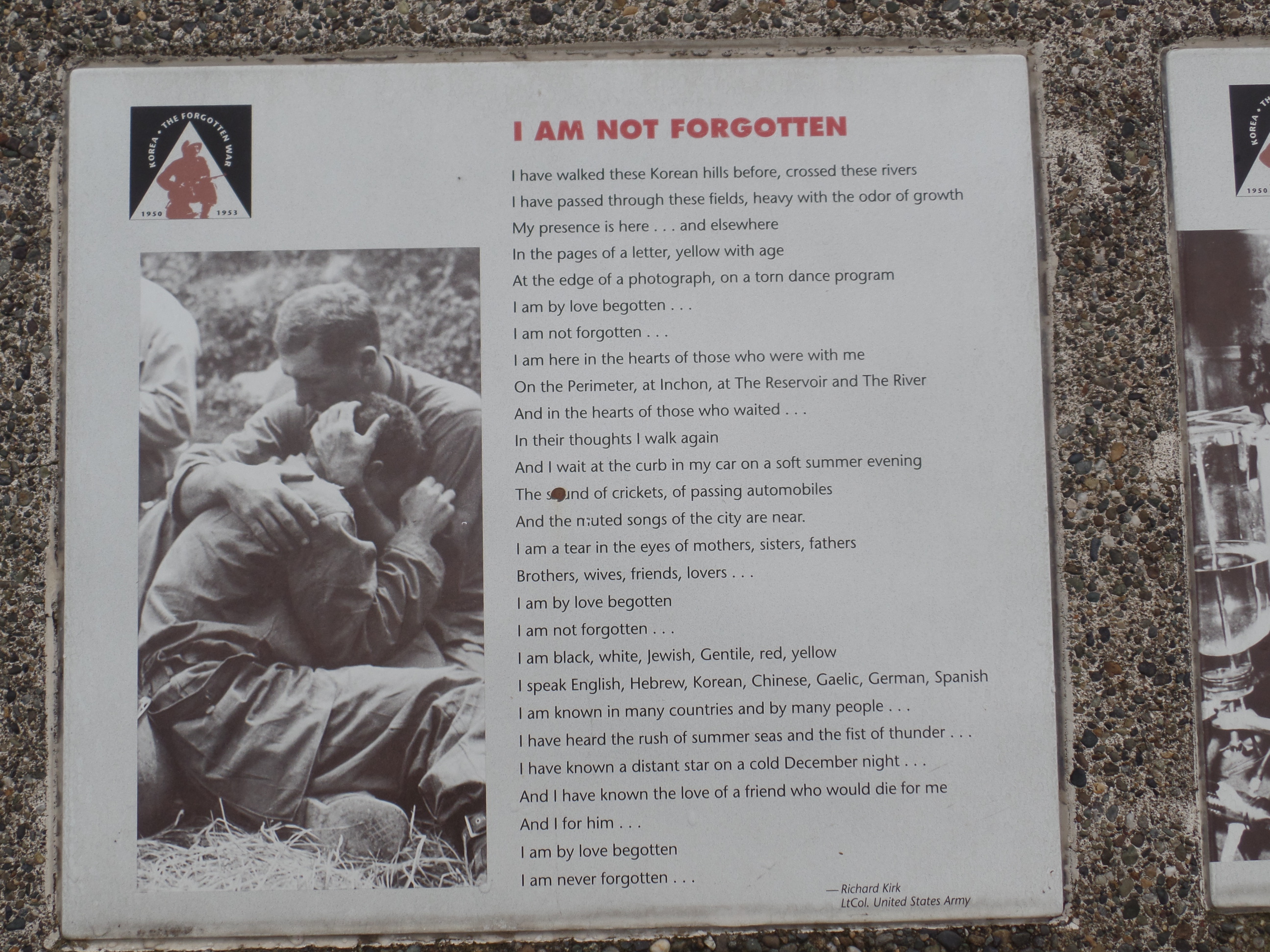
I paid my respects, privately, at the Vietnam Memorial Wall, then went by the Korean War Memorial (below).

SAM_2564

A good long-term remedy to constant warfare is a proper education.  Washington has had some good schools, and some mediocre.  This was the first public school in the nation’s capital.

SAM_2563

On July 4, 2007, Penny and I had the bright idea of taking our son to the National Mall, and hopefully viewing the fireworks.  The weather was horrible, the Mall was evacuated, and in trying to get my wheelchair-bound wife out of the rain, I met a fair amount of resistance from “security” along Massachusetts Avenue.  We finally found refuge, at the White House Visitor Center.
SAM_2568

The last place I stopped in Washington, on August 3, was the DC Africa Festival.  This year marked the third year of this lively event.
SAM_2571

As is my wont, I will post two more pieces to this series:  United States Botanic Garden and the Pentagon Memorial.

An Eastward Homage, Day 34: Europe in the Rear View Mirror

8

June 29, 2014, Boston-  The writer, Froma Harrop, in discussing the need for balance between travel and homing, mentions the Shakespearean character, Jaque, from As You Like It, as having bemoaned his own constant travel.  She muses about seniors, who give up everything binding, and make perpetual travel their endgame.

I have been tempted, now and then, to engage in just such an endeavour.  There are, in fact, a few years in the offing when my travel will be of a long-term nature.  The first such will be 2017, in fact.  Nevertheless, my meanderings are always going to be rooted in purpose.  This past June’s journey had three themes:  Seeing the ancestral home town of my father’s paternal lineage (Rouen); paying respects to my late father-in-law and other veterans of the two World Wars (Normandy, Brest, Amiens, Bastogne, Metz and Berga); and connecting with my fellow Baha’is (Paris, Rouen, Brussels, Luxembourg, Strasbourg and Frankfurt).  Of course, there were cultural stops, fun restaurants and parks, great architecture and wonderful, captivating people in the mix.  These, I find everywhere, though, and they may be found in abundance, in Home Base- Prescott.  My Baha’i friends are my tap root, and will remain so, regardless of how often I am in and out of town.  A dozen or so others are my branch roots, also keeping me focused.

Let me get back to the journey.  The flight back from Frankfurt was smooth as silk.  I was in the delightful company of a young baker, from Frankfurt to Montreal.  She had many stories of her own travel, across France and Germany, from Paris to Berlin, with Frankfurt as base camp, and as a vegan.  Taking a night bus from Berlin to Frankfurt sounded a bit rough; but there she was, happy and fully in the moment.  I have kept in contact with her, in the months since, and wish her a long and happy series of life experiences, as I do with all I met, east of the Atlantic.

There are those I will see again, and those whose lives will probably not intersect again with mine. There are the people with whom I experienced mutual joy and there are folks who saw me stumbling about, now and then, and threw up their hands in exasperation.  There were times of great exhilaration, quiet reverence, stern admonition- both given and received, physical and emotional near-exhaustion, and momentary confusion.  It was all worthwhile.

So, here’s to you:  The gate keepers and window clerks at each train and bus station; the desk clerks and maids at each of my hotels; the seat mates on trains and buses; the taxi drivers in the areas of Mont Saint-Michel and Carnac; my friends in the standage on the train from Rennes to Paris, all the restaurateurs who served me so graciously, from the brasseries and kebab shops to the high-end New Colours, of Luxembourg and Leo’s, of Bastogne; the people manning the natural and historical sites; the performance artists and street musicians; the scammers and the schemers, who got precious little, if anything, from me; the people who earnestly tried to help me, even when I was in a momentary state of suspicion; the lovers whose space I may have momentarily crowded; the police who kept us safe, without resorting to brute force; the grand musicians at Luxembourg’s National Day; the young folks whose energy and antics were invariably heart-warming; and, most of all, my brothers and sisters in faith, who were anchors throughout.  All of you made this, my fledgling solo voyage abroad, a memorable and reaffirming occasion.

So, I’ve been back in the home ground that is North America, since the date above.  There was a revelation, though:  Europe is also my home. The rest of the world will be, as time goes on. I can go from home, to home, to home, as the circumstances of this wonderful life lead me. Prescott is like my room, Arizona, my domicile and North America, my neighbourhood.  Home, though, is where the heart lives, and my heart is with all of you.

An Eastward Homage, Day 33: The Frankfurt Boomerang

5

June 28, 2014, Frankfurt-am-Main-  I awoke at 6 AM, on this bright Saturday morning.  PentaHotel has amazingly comfortable beds, and an exquisite breakfast buffet.  (There were all food groups, not just the breads and pastries you see here.) See, it’s not just Americans who like grand portions. 🙂  We could all learn to distribute food more equitably- and if there were these types of meals in small villages, around the globe, we’d feel better- though we’d also have to work harder to burn unwanted fat and excess calories. That work could be service-related, and we’d have a better world in that way, as well. (Photo courtesy of http://www.hotels.com)

563905_42_z

I left Gera, promptly at 9 AM.  The train to Frankfurt involved only one stop this time, at Erfurt.  It was, I’m told, a special Saturday train- not to be missed, without a penalty.  Ja,voll, Herr Kommandant!  So I made it back to Q Green Hotel, the first place I stayed in Europe, and was given a 6th Floor Suite, as a token of Melia Group’s appreciation.  For those who have forgotten, Q Green looks like this. (All remaining photos courtesy of ME!)

14572518883_be3f713584_n

The rest of the day involved: No laundry (Launderettes in Germany close at 8 PM, Friday and reopen at 8 AM, Monday.);  a light meal at a kebab place, and a walk around the periphery of Frankfurt Messe.  This undertaking took me past a parade of Working Girls, up over a short Autobahn, through several deserted, but perfectly safe parking lots and along der Messe’s west side, where a couple of billboards in German, and in Portuguese, pierced the horizon.  I ended up in a familiar neighbourhood, with such streets as Funckstrasse to remind me of my locus.  Note: What looks like a B with a tail is really pronounced ss.

14529339556_ce023ea578_n

14552419345_4824fcd220_n

Once back at Q Green, I took in the rest of a World Cup match, and was actually happy when Germany took it all, a few days later.  The next day, Sunday, I would head for the airport and back to North America.

An Eastward Homage, Day 32, Part II: The Two Faces of Berga

9

June 27, 2014, Gera- The wait for the train to Berga, while standing on the platform at Gera Hauptbanhof, was almost as long as the time I actually spent in the former prison camp town.  It was due at 1:15, and came at 2:15.  In the meantime, I was amused by a man chasing his 9-year-old son around the platform, as the child giggled and hid behind the concrete posts.  This became the child’s fault, when the train actually did pull in, and Pater-Meister was embarrassed that the boy was almost hit.  The boy took his tongue-lashing quietly, but I could tell he had no idea what he had done wrong.

The Jews who were taken prisoner, and given unwanted special attention by the Nazis, had no idea what they had done wrong, other than to be distantly related by blood to the Rothschilds and a handful of money lenders and grifters, who had contributed somewhat to the collapse of the European economy- a collapse which would have happened regardless of the level of mercantilism in any one country.

I digress, however. Berga, a small town southeast of Gera, was a satellite station of Buchenwald, the much larger Concentration Camp in northern Thuringia.(Photo courtesy of http://www.freerepublic.com)
bberga

Here were brought Jewish soldiers from the US, Canada and Britain, especially after the Battle of the Bulge, in late 1944, when Buchenwald itself was at saturation point. One of these was my future father-in-law, Norman Fellman, 6’3″ tall, weighing into the camp at 175 pounds.  He was part of a group assigned to work a gypsum mine.  He and his fellows walked up a trail like this, (Photo courtesy of http://www.thirdreichruins.com)

splittergraben2

through a door like this, (Photo courtesy of http://www.kilroywashere.com)

LaborTunnel

to a place like this (Photo courtesy of http://www.tripmondo.com), every day, for a hundred days. When General Patton’s men found him, in April, 1945, he weighed 87 pounds.

Old gypsum mine, near Berga

They spent time, after coming back from the mine, in this “work station”. (Photo courtesy of http://www.thirdreichruins.com)

Old dormitory  for prisoners, Berga

The camp where they were held, from their capture in the Vosges of southern Lorraine, to the date of Gentle George’s arrival, looked something like this. (Photo courtesy of http://www.channelnationalgeographic.com)

46705_berga-barrack_u4otpkuoohegc34cxym6cgqbe3ncurxrbvj6lwuht2ya6mzmafma_610x457

Now, the area looks like this. (Photo courtesy of en.immostreet.com)Prison camp for Jews, Berga

I walked around this decrepit, southern edge of Berga, even walking the periphery of the abandoned V-1 Rocket Factory, now closed off by a fence, with only a small security team allowed inside. (Photos courtesy of andrea-kublitz.de)

V1 Rocket factory, Berga

Old rocket factory, Berga

Understandably, Pop never went back to Germany, and the less said about that country in his presence, the better.  I told him, two months before he passed on in May, that I intended to go to Berga, to try and put the ghosts to rest.  Ghosts, demons, visionaries of Hell- they seem to hang over this part of the town, in a way that the giggling school children who were waiting at Berga Train Station can only dimly imagine.  The kids, of course, were waiting for their families, from the north end of town.  Few people live in the old camp zone- a farmer or two, perhaps even an aging former guard, released from prison to live out his ignominy.
Berga today remembers its victims and its enslaved “guests”, with this memorial. (www.en.wikipedia.org)

Denkmal_Berga

North of the train station, Berga could be Everytown, Deutschland.  There is a bright, red Rathaus. (Photo courtesy of http://www.commons.wikipedia.org)

Feuerwehr_Rathaus_Berga

A small town square sits in front of the Town Hall. (Photo courtesy of http://www.stock-clip.com)

Village Square, Berga

Not far from here, I guided a mother and small child to an ice cream parlour, where I had just stopped, perhaps to comfort myself and return to the more benign reality of this “new” Berga.  There are churches nearby as well.  I can only imagine what the churches, and the schools, impart to their patrons. Below, is the legacy of Marxism for Berga.  These apartments are still highly occupied. (Photo courtesy of http://www.amberrom.org)

OLYMPUS DIGITAL CAMERA

An Eastward Homage, Day 32, Part I: The East Also Rises

2

June 27, 2014, Gera- Thuringia has always been a crossroads, and was a vacation spot for the Prussians, in the days of Imperial Germany.  Lying as it does, just north of what is now the Czech Republic, Thuringia was also a transmission point for the ideas of Jan Hus, in the 14th Century, as he challenged papal authority from his home parish in Bohemia.  “Bohemian” became a synonym for rebel, while the Thuringians remained known for their hill country hospitality.

It is still thus, as far as the Thuringians go.  I found Gera, a resort town where I spent my next-to-last night in Europe, this go-round, a relaxing and accommodating city.  The Pentahotel Gera offered full buffets for breakfast and dinner, and the suite I booked was as well-appointed as any room I found elsewhere on the itinerary.

The day began in a low-key manner, with a simple breakfast at Pension Alpha, checkout and quick hop across the street to Frankfurt Hauptbanhof.  There were two trains, and four stops, between Frankfurt and Gera.

Fulda was the transfer point for my train eastward, as the first train was headed for Hamburg- a destination for a later journey. (Photo courtesy of http://www.media-cdn.tripadvisor.com)

blick-uber-fulda - Copy

Eisenach is a largely-restored medieval town, with an inviting arch at the entry to its Zentrum. (Photo courtesy of http://www.orangesmile.com)

eisenach_sightseeing - Copy

Erfurt is the capital of the State of Thuringen, and a vibrant city, reaching out to the international community.  On this very night, the incomparable Wynton Marsalis was to offer “Classical Meets Jazz”.  Lots of artists have done such delicious musical blends, over the past seventy years or so, but I would venture none have done it better.  He’s a master of both genres. (Photo courtesy of http://www.expats.cz)
erfurt4 - Copy

Jena was the most war-devastated town along my route (I stopped well west of Dresden), and yet it has bounced back dramatically and well, with a fine university as its bulwark. (Photo courtesy of http://www.skyscrapercity.com)

Jena, DE

Each of these cities would be worth several hours of a “stash-the-bag and hoof it” day or so.

I arrived at Gera Hauptbanhof, around 2 PM.  The train station has expanded a bit since unification, which brought a well-deserved spate of attention to Thuringia. (Photo courtesy of http://www.bbahn.en)

BF_Gera_13.10.10_1b - Copy

It was a short, but appealing, walk from there to Pentahotel.  The route took me through the Kuchengarten, a lovely gift from the days of Prussian rule.  The pre-Kaiser nobles who ruled Potsdam and Berlin liked to vacation in Gera, and built the Theater, Kunstsummlung (Orangerie) and the salubrious garden that links them.

As I passed the theater, it was drawing a group of youth, who were to perform a play, and their families. (Photo courtesy of http://www.schlarafia-geraha.de)

Gera_007

The Kitchen Garden intervenes magnificently. (Photo courtesy of http://www.virtualtourist.com)

Kitchen Garden, Gera

As I approached the Orangerie, there were a few small children and a couple of teens being photographed at the fountain.  I waited until they had their fill of selfies and splashing, then took my photo of the fountain, which was similar to the one you see here.  As an example of the apprehension many eastern Germans still seem to feel towards visitors, the father of one of the small girls cast a stern eye on me, until I was well away from the group.  Assimilation will take time, yet. (Photo courtesy of http://www.staedte-photos.de)

OLYMPUS DIGITAL CAMERA

From Orangerie, it was two minutes further to Pentahotel Gera.  I found the hotel about evenly divided between a busload of German seniors and a couple of van-loads of university women, who occupied opposite ends of the dining room, at both of the meals I took there.  A young German man and I had tables to ourselves, in between the two groups.  These were sumptuous, satisfying buffets, albeit in such a surreal atmosphere.  The servers, though, were patient and polite with everyone, and the hotel staff was uniformly gracious. (Photo courtesy of http://www.venere.com)

Pentahotel-Gera

Naturally,my inclination was to see as much of Gera as possible, on that delightful Friday evening.  So, I started out, stopping first at Otto Dix Haus.  The great Twentieth Century German painter was born in this house, in 1891.  It’s now Gera’s Art Museum. (Photo courtesy of http://www.gera.de)

Otto Dix Haus.59273

A short bus ride later, I found myself at Hofwiesen Park, more towards the center of town.  I will be known for a time as “the American lunkhead who pushed the wrong exit button”.  This delayed the bus for about a minute,  and seemed to throw the driver out of sorts.  Life went on, though, and I was delighted by the park. (Photo courtesy of http://www.gera.de)

Hofwiesen Park, Gera

Gera’s Arcaden is more akin to the malls found in our great land, than it is to the Soviet GUM stores of the Cold War era, despite the Stalinesque exterior. (Photo courtesy of http://www.jotz.de)

Gera Arkaden

German teens abounded inside the mall, just as their contemporaries do across our continent, and across Europe.  (Photo courtesy of http://www.wp.myshakeria.de)

Gera-Arcaden Interior 2

Gera has its share of churches, two of the most prominent being Catholic.  First, we see Johanniskerke. (Photo courtesy of http://www.gettyimages.com)

stock-photo-15871926-johannis-church-in-gera-germany

Across town,and up the hill a bit, is St. Mary’s Church (Marienkerke).  (Photo courtesy of http://www.shutterstock.com)

stock-photo-view-on-mary-s-church-in-gera-untermhaus-thuringia-germany-65426413

My last view of the night was of City Hall (Rathaus). (Photo courtesy of panoramio.com)

Gera  Rathaus

With this confirmation that all is well in this border state, and that the eastern Germans are getting a relatively fair shake, I retired to my cozy suite at Pentahotel.

Left unsaid, up to now, is reference to my main reason for going to Thuringia:  Berga, site of my late father-in-law’s incarceration as an American, and Jewish, prisoner-of-war, for a hundred days, in 1944-45.  The borrowed photos I will show in my next post will convey some, but not all, of the emotions I felt, in the afternoon of that warm, but chilling, Friday.

An Eastward Homage, Day 31: Excursion to a Silent Teacher

5

June 26, 2014, Frankfurt-am-Main-  Thursday morning was especially joyful, bringing with it a train and bus ride to the Baha’i House of Worship, in Langenhain, about an hour west of central Frankfurt.  The train to Hofheim, from whence the bus went to Langenhain village, took about forty minutes.  Hofheim lies at the foot of a forested hill region, and is quite picturesque, in and of itself. (Photo courtesy of de.wikipedia.org)

Hofheim_Taunus_Stadt_5857

The bus to Langenhain was driven by a man who seemed ready for a long vacation- not happy with my broken German, or with the fair number of high school kids who got on at the central bus terminal, about 200 meters from the Hofheim Hauptbanhof (Try saying that, ten times fast!).  We got to Langenhain quickly enough, though, and I encountered a couple of farmers, who were discussing goats.  One of the men kindly guided me to the road that led to the House of Worship.  I walked about 100 meters northward, and sure enough- there was the great edifice, the first of its kind on the European continent, a Silent Teacher of spirituality.  This view, taken from the air, shows the true beauty of the surroundings. (Photo courtesy of http://www.abahaipoint.com)

Panoramic view of Baha'i House of Worship-Langenhain

As the staff were still at lunch when I arrived, I went clockwise around the exterior, then spent an hour or so in prayer within the quiet and comforting sanctuary.

Here are a couple of views of the outside. (Photo courtesy of en.wikipedia.org)

House_of_Worship_Germany_2007

(Photo courtesy of http://www.bahai.us)

bahai-temple-germany

I was alone, but for two groundskeepers, who remained outside.  My prayers for the world, for the US, and for so many family and friends, and the resulting meditation, were taking me into another dimension, in this hot, but blessed afternoon.  Of course, the inside of the temple was airy and comfortable. The photo below was taken with many people present.  On that day, however, I had the auditorium to myself. (Photo courtesy of http://www.bahai.com)

Baha'i House of Worship, Langenhain-Interior

What really inspired me was gazing upward, at the dome light, which has the Arabic inscription, “God is the Most Glorious”. (Photo courtesy of http://www.emporis.com)

Baha'iHouse of Worship, Frankfurt-Interior dome

The House of Worship was completed and opened in July, 1954, a scant nine years after the end of World War II, and became a symbol of Germany’s continued recovery and of its re-entry into the family of nations.  People all over the country and all over the continent, are proud of this unifying symbol.  None are prouder, though, than the villagers of Langenhain, who told me on their own, of the Golden Anniversary of the House’s opening.  It was held July 6, six days after I actually left Europe.  Hundreds of people came from all over Europe, for the celebratory picnic.

There to greet everyone was the House of Worship’s caretaker, Erick, who gladly shared coffee and pastry with me, after my prayers were finished.  His wife then took this photo, the only one that survived the file corruption of two weeks ago, and which now is the Home Photo on my Twitter page.

Baha'i House of Worship Visitors' Center, Langenhain, DE

Recharged, and renewed spiritually, I went back to Frankfurt, to Pension Alpha and another round of World Cup matches.  Dinner at a Fujien-style Chinese restaurant seemed only fitting, after spending the day contemplating the Oneness of Mankind.

An Eastward Homage, Day 30, Part II: The Main is for Revelry

13

June 25, 2014, Frankfurt-am-Main- Returning to Frankfurt, after nearly a month, I decided to walk north along the left bank of the Main (“Mine”) River and back south, along the right bank, noting some sights along the way.  So, after settling in at Pension Alpha, chosen for its proximity to the Train Station, and enjoying a fabulous meal of braised lamb at a Bosnian restaurant named Imbiss Sarajevo, I headed out to the river bank.

Frankfurters love their river.  I could see people celebrating their Wednesday evening, up and down both banks of the watercourse. Of course, this night featured Germany vs. USA, in a World Cup match, so the fact that all Frankfurt was out and about had even more cachet.

The first place I passed was Judisches Museum. (Photo courtesy of http://www.freizestars.de)  Although it was evening, and the Museum was closed, I was glad to see such a prominent place for Judaism and its heritage in German life.

3113b0ff7062c92d-juedisches_museum

The Left Bank in this area is called Untermainkai, or “lower quay of the Main”. (Photo courtesy of http://www.tripadvisor.com)

untermainkai-frankfurt

By the way, a frequent commentator on this site is constantly wondering why I don’t use canned article formats from Google.  The reason is simple, my posts need to reflect MY thoughts and MY style.  Instant doesn’t cut it; so, thanks but no thanks.

Back to lovely Frankfurt.  Karmeliter Kloster is basically what the name implies, a cloister for Carmelite monks, or it was,from 1246-1803.  Now, it is an institute for Urban History and an Archaeological Museum. (Both photos courtesy of http://www.frankfurt.de)

15_karmeliterkloster_491x365

Interior, Karmeiterkloster, Frankfurt

St. Leonhardskirche, a Catholic facility, offered services in English, for foreign residents and visitors.  It is closed for renovation, until 2016. (Photo courtesy of http://www.commons.wikipedia.org)

Frankfurt_Am_Main-Leonhardskirche-Ansicht_vom_Mainkai-Gegenwart

Alte Nikolaikirche is a Lutheran church, just east of Frankfurt City Hall, in Romerberg (City Hall Square). (Photo courtesy of de.wikipedia.org)

Frankfurt_Am_Main-Alte_Nikolaikirche-Ansicht_vom_Fahrtor-20081230

Romerberg itself is one area I would like to explore further, on another visit. (Photo courtesy of http://www.commons.wikipedia.org)

Frankfurt_Römerberg_Ostzeile

The Square was every bit as busy as the river banks, very similar to the scene in this file photo.

The Dom St. Bartholomaus, or Frankfurt Cathedral, lies “behind”, or north of, Romerberg.  The cathedral was closed also, but here is what I saw of the exterior. (Photo courtesy of http://www.commons.wikipedia.org)

OLYMPUS DIGITAL CAMERA

About a block from the Dom, I crossed to the Right Bank, using Floesserbruecke. (Photo courtesy of http://www.holidaychecker.de).  The foot traffic was heavy, in both directions.

frankfurt-floesserbruecke-1-9a8621b5-87f2-4a5a-a1e2-fbe0f0111088

The Right Bank is largely a Museum District.  There is one Catholic church near the river:  Deutschordenskirche, or German Medal Church.

Deutschordenskirche-ffm001

It is not far from there that there were sizable crowds gathered along the river bank, until twilight- which was still ten o’clock.  This is the area called Schaumainkai. (Photo courtesy of http://www.skyscrapercity.com)

799px-Museumsuferfest_2005_-_Schaumainkai_Tiefufer

The Flohmarkt (Flea Market)  is also here during the day on Friday and Saturday. (Photo courtesy of http://www.panoramio.com)

Flohmarkt, Frankfurt

There are about five large museums in this district.  Here are views of two of those:  Museum der Weltkulturen (World Cultures). (Photo courtesy of en.wikipedia.org)

Museum der Weltkulturen, Frankfurt

and Museum Giersch, which houses art and other cultural treasures of the Main River Valley. (Photo courtesy of http://www.lonelyplanetimages.com)

find_a_museum_find_a_gallery_museum_giersch_1895443232

It was time for me to go back across to the Hauptbanhof area, and take in the rest of the World Cup match, being televised at a Brasserie patio.  So, Friedensbruecke provided the means. (Photo courtesy of http://www.panoramio-frankfurt.de)

Friedensbruecke_Nov06_Web

Although it appears to lie in a wealthy financial district, Friedensbruecke has a lively and prolific underground arts scene. (Photo courtesy of jwmn.naxosban.de)

jwmn_naxosbande

The patio was full for a while, when  I arrived, so I stood at the railing for about a half hour.  A seat opened up and it was my turn for coffee and ice cream, while watching Team Germany prevail, 1-0.  I did not call attention to my secret longing for an American victory, needless to say.  The gentleman sitting at my table left, as soon as the match ended, but his credit card fold did not.  So, after getting that bit of hardware to the Brasserie manager, I savoured the rest of a very delectable mocha ice cream “Decadence”, before calling it a night.

NEXT:  The Baha’i House of Worship at Langenhain

An Eastward Homage, Day 30: Of Barons and Bunsen

5

June 25, 2014, Heidelberg- It says quite a bit about a city, when one of its most celebrated citizens is a scientist and educator.  I decided to stop in Heidelberg, on the way from Strasbourg to Frankfurt, and spend time in the Universitat district.  Robert Bunsen, chemist and inventor, is the first prominent person identified with Heidelberg to be honoured with a statue. Although Ruprecht-Karls-Universitat was the first university in Germany, established in 1386, Dr. Bunsen,in his work at the University of Heidelberg, upgraded the institution to one of the top centers of scientific research in Europe.  Besides the Bunsen Burner, he achieved a wealth of success in electrolyte research, and in advancing the metallurgy of magnesium.  With Gustav Kirchhoff, he discovered cesium and rubidium. (Photo courtesy of de.academic.ru)

bunsen-denkmal_heidelberg_2

Today, the above statue faces the remaining hall of Ruprecht-Karls Universitat, also called Haus-zum-Riesen, still a center for Physical Sciences. (Photo courtesy of data: image/jpeg; base 64)

Haus_zum_Riesen_Anatomiegarten_Heidelberg

I debarked the train at Heidelberg Hauptbanhof, had lunch and gave myself three hours to meander around the university and walk a bit along the right bank of the Neckar River.  The train station is a fair distance from Altstadt, the Old City, with its narrow streets and energetic demeanor- which always comes with being near a university setting. So, I took the reliable and crowded, but pleasant, tram.

Here is the Hauptbanhof.  Although spare outside, I found it a relaxing enough place to enjoy a Wurttemburg-style bratwurst. (Photo courtesy of jaxstumpes.blogspot.com)

20130302001 Heidelberg Hauptbahnhof

The tram deposits its passengers for Altstadt at Bismarckplatz. (Photo courtesy of stadtblatt-online, ww2.heidelberg.de)

Haltestelle Bismarckplatz wird barrierefrei

The old campus of the University of Heidelberg is just off the Universitatplatz, where a group of British school girls were fawning over a bearded twentysomething German student, by the fountain seen below.  Some things are just universal. (Photo courtesy of  www.globopix.de)

Universitiesplatz

Here is another view of the main building of Alte Universitat. (Photo courtesy of data/image; base 64)

Alte Universitstat, Heidelberg

After World War II, American philanthropists helped establish Neue Universitat, with its emphasis on the Humanities and the School of Medicine. (Photo courtesy of sccs 10.uni-hd.de)

neue_uni

Other sites of interest in the immediate university campus are its Library, or Bibliothek, a beehive of activity on the day I was there.  That’s not surprising,as it was a Wednesday, and summer session finals week. (Photo courtesy of http://www.reisdit.no)

Heidelberger-Universitätsbibliothek

Studentenkarzer was the place where unruly students were sent, if convicted of an offense, by the Student Court.  Eventually, it became a farcical place, given to partying.  The practice of incarceration was transferred elsewhere, but the building is preserved, as a reminder of how things were done in the 14th-18th Centuries. (Photo courtesy of media-cdn.tripadvisor.com)

Studentenkarzer, Heidelberg

You can see just how punitive things turned out to be, in the long run. (Photo courtesy of http://www.travelswith divya.com)

studentenkarzer-1

Hexenturm, or the Witch’s Tower, is so-named to commemorate the cruelty of the Heidelberg Witch Trials of the Fifteenth Century.  It was originally used, however, to incarcerate thieves.  Part of the old wall of Heidelberg, it now stands on the grounds of Neue Universitat. (Photo courtesy of http://www.pausanio.de)

Hexensturm, Heidelberg

Heidelberg honours its lesser lights, as well.  One of these was Friedrich Ebert, the first President of Germany, under the Weimar Republic, from 1919-1925.  He ruled largely in an autocratic manner, with a fair amount of help from the military.  This may well have made it easier for Hitler to rise to power, but to Heidelberg, Ebert is still a native son.  His life’s work is still examined at the Ebert Memorial Institute, just west of the University. (Photo courtesy of ww2.heidelberg.de)

Friedrich Ebert Memorial

Now, let’s have a look at three churches of Heidelberg.  The first is a Catholic church, St. Anna, also west of campus.  It was originally a hospital. (Photo courtesy of http://www.commons.wikipedia.org)

450px-St_Anna_Heidelberg_2

Somewhat larger, and to the south a bit, is Peterskirche, which is ecumenical.  This is the University Church, first built in 1192, even before the campus.  It was modernized in 1986. (Photo courtesy of ww2.heidelberg.de)

Peterskirche, Heidelberg

Below Photo courtesy of http://www.peterskirche.heidelberg.de)

Peterskirche, Heidelberg.jpg-1

Thirdly, here is Jesuitenkirche, or Church of the Holy Spirit and St. Ignatius, in the heart of the university campus.  This is the largest Catholic parish church in Heidelberg. (Photo courtesy of data:image/jpeg base 64)

Jesuitenkirche, Heidelberg

Time was getting short, as my train to Frankfurt would arrive soon.  I ended this all-too-brief excursion to this regal little city, with a nod to the barons of Heidelberg, and a view of Kongreshaus, overlooking the Neckar. (Photo courtesy of web02.city-map.de_)

Kongreshaus Stadthalle, Heidelberg

The barons who lived in Heidelbergschloss, the great castle, which I am determined to visit three years hence, built Alte Brucke, the oldest standing bridge over the Neckar, in this area, in 1788.  It is actually the ninth such bridge built on this spot- the first having been built in the 13th Century.  To the right, one may gaze at the tower of the Rathaus, or Town Hall. (Photo courtesy of image 1.masterfile.com/em)

841-02706319

Frankfurt, the majestic Lord of the Main, has its share of iconic sites, but no place has anything on Heidelberg. I have the sense that I have only scratched the surface on the land of my maternal ancestors, anyway.

Next up:  Playgrounds Along the Main.

An Eastward Homage, Day 29: Once Past The Edge of Maginot

4

June 24, 2014, Strasbourg- Of all the cities in France I visited this summer, Strasbourg presents itself in the most modern of lights, and, by a small margin, it is the cleanest.  There is not an appreciable difference in ethnic make-up, nor are there that many fewer apartment dwellers here.  Perhaps the presence of the European Parliament, on a day-to-day basis, leads to more social consciousness.  There is also a more Germanic sense of order here, than elsewhere in La Belle France. Strasbourg was ruled by German royalty, throughout the Middle Ages and again from 1871-1918.

The first signal that this city was going to be different came at Gare Centrale, the train station. It’s covered by a plexiglass dome, resembling a  crystal dirigible. (Photo courtesy of fr.wikipedia.org)

Gare_de_Strasbourg_2

(Photo courtesy of http://www.geodruid.com)Gare de Strasbourg-1

I got directions to my hotel-LePetit Trianon.  It is not, outwardly, a palace.  It is on a narrow side street, though close to the commercial centre.  The manager is only 25, but has a very shrewd business acumen, and will no doubt rise quickly, in a keenly competitive market.  She looks like Keira Knightley, but talks like a kinder, gentler Leona Helmsley-nobody’s fool.  I like Le Petit Trianon. (Photo courtesy of Hotels.com)Le Petit Trianon

I had limited time to explore Strasbourg, before attending a Baha’i spiritual gathering, similar to that which I attended in Rouen, earlier in my sojourn.  This was not hard, though, as the city centre is compact, and there is a reliable trolley.

First was the largest of Strasbourg’s many Calvinist churches:  St. Pierre Le Vieux. (Photo courtesy of http://www.commons.wikipedia.org)

Strasbourg_-_église_St._Pierre-le-Vieux_-_1

Once again, I did not venture inside any  of the churches, save Cathedrale Notre Dame de Strasbourg.

The next stop was three bridges down the Lill Canal.  Here was Place de la Republique. (Photo courtesy of http://www.ratestogo.com)

Place de la Republique-2

This is a monument to Those Dead in Winter- an homage to all who died in the harsh and combative winter of 1944-45. (Photo courtesy of http://www.commons.wikipedia.org)Place_de_la_Republique_in_Strasbourg_-Statue(2520703392)

On the west side is Palais du Rhin, a structure built by Wilhelm I, after Germany seized Strasbourg during the Franco-Prussian War.  It is now a cultural center of Alsace.  It is the structure seen in the photo above.  On the east side of the park are two structures.  First is La Bibliotheque Nationale d’Alsace. (Photo courtesy of generys.services.com)

Bibliotheque Nationale de Strasbourg

Adjacent to the Library is La Theatre Nationale d’Alsace. (Photo courtesy of http://www.en.strasbourg.eu)

DC_01_TNS

I crossed the street, and the bridge, to L’Opera Nationale. (Photo courtesy of http://www.commons. wikipedia.org) The statue of the golden horse attracted a few homeless people, but they didn’t hang around long. I saw fewer homeless here than elsewhere in Europe, in fact.

Opéra_national_du_Rhin_2006

This area, Place Broglie, is bounded on the east by Strasbourg’s City Hall (Hotel de Ville).(Photo courtesy of http://www.prixfacone.com)

Hotel de Ville- Place Broglie, Strasbourg

Strasbourg, like Metz, has a Temple Neuf.  This served as a hospital, in the early medieval period.  It lies at the south end of Place Broglie, directly west of Strasbourg Cathedral.(Photo courtesy of http://www.commons.wikipedia.org)

Temple_Neuf_(Strasbourg)

Notre Dame de Strasbourg casts a majestic air to what is otherwise a spare concrete desert.  This Gothic giant is the main remnant of Catholicism, in what is a largely Protestant enclave of Alsace. (Photos courtesy of http://www.commons.wikipedia.com)

Strasbourg_Cathédrale_Notre-Dame_façade_sud_octobre_2013

Absolute_Cathedrale_Strasbourg_interieur_01

From here, I briefly visited Palais Rohan.  This has nothing to do with The Lord of the Rings.  It housed the Bourbon kings and queens, on their visits to Alsace.  Today, it houses Strasbourg’s major art museums. (Photo courtesy of http://www.visiterstrasbourg.com)

palais-rohan-strasbourg-1

The entry way is framed by an arch, on the west flank.(Photo courtesy of francoisclaude.wordpress.com)

palais-rohan-strasbourg-002

The courtyard evokes Versailles, sans gold. (Photo courtesy of http://www.commons.wikipedia.com)

SONY DSC

Along the Canal de Lill, I came to Corbeau, and the old Customs House (Hotel de la Douane). (Photo courtesy of http://www.panoramie.com)  As you might guess, the canals take the place of parks, as the center of social life in Strasbourg.

Strasbourg-Pont_du_Corbeau_(5)

Nowhere is more crucial to this than La Petite France, the area of three covered bridges, built by the edict of Louis XV. (Photo courtesy of http://www.shutterstock.com)  Then, as now, this was France’s window on the Rhine.

stock-photo-view-on-ponts-couverts-in-strasbourg-s-old-town-france-alsace-petite-france-30439759

La Terrasse Panoramique was the Bourbons’ window on the great river, and was built by Sebastien de Vauban, the great military strategist. (Photo courtesy of JM Rauschenbach @ http://www.clipimage.net)

,,,2.terrasse.panoramique.petite.france.strasbourg

It was time for me to leave the crowds at La Petite France behind, and join my Baha’i friends at their centre, on Rue des Veaux.  It is in a densely-populated, but well-lit neighbourhood.  Alsace has been a forward-looking area, and I felt a welcoming spirit here.  (Photo courtesy of http://www.espaces-commerces.fr)

Rue des Veaux- Strasbourg

So, my time in France wound down on a very sweet note.  My thanks to all the Baha’i friends in Strasbourg for the uplifting Spiritual Feast, and to all, across the areas of Alsace and Lorraine who made these two days richer and more informative than I had anticipated. It would shortly be time to return to Germany, for four quick days.

An Eastward Homage, Day 28: Brave Soldiers and Broken Steps

7

June 23, 2014, Metz-  Metz on a work day is quieter along the river, but no less frenetic about the streets and alleys.  I was given to overthinking about certain directions I was given, before finding the store where I could get the laundry soap I so desperately needed, with eight days worth of dirty clothes.  It’d be the last chance I had to get the clothes done, before heading back to the States on Sunday, since Frankfurt’s laundries pretty much shut down at 8 PM, Friday night.  So, thanks to ResidHome, a big headache was made less.

Walking back along Avenue Foch, towards the University District, I saw more activity than on Sunday (Photo courtesy of marc.metz.moselle.eklablog.com)

Metz_Avenue_Foch_R01

You can see that this rather industrialized city goes to considerable lengths to maintain beauty.  Now, let’s look at Saint-Pierre aux Nonnaines, near the Water Park, which I visited on June 22.  The young lady minding the church waited for me to complete my meanderings, before closing up and heading for the rest of her day.  This never ceased to touch my heart- the way the students who kept watch over tourist sites went out of their way to accommodate.  At any rate, this edifice began life in 380 AD, as a Roman gymnasium.  It was converted into a church in the Seventh Century.  Since 1970, it has been Metz Water Park’s concert hall.(Photos, courtesy of en.wikipedia.org)

Metz_-_Eglise_Saint-Pierre-aux-Nonnais_-_Vue_du_côté_Est

Metz_-_Saint-Pierre-aux-Nonnains_-_Collatéral

My next stop, in Coeur de Ville, the Heart of Old Metz, was Temple Neuf, which overlooks the Moselle. This German Lutheran church was built in 1904, while Lorraine was under German rule. (Photo courtesy of http://www.flickr.com/photos/wolfgangstaudt).

Temple Neuf

Having spent time around Metz Cathedral on Sunday evening, I focused the rest of my time in Coeur de Ville checking out L’Opera Theatre and reading my e-mails, courtesy of Nicolas, the kind clerk at Metz Tourist Office.  Below, is L’Opera Theatre. (Photo courtesy of tout-metz.com)

opera-theatre-metz

It was lunch time, as  I left Coeur de Ville, and headed into the University District.  “Boogie Burger”, a tiny, new emportee (take-out) establishment, fit my mood perfectly.  I selected my second, and last, American-style cheeseburger and frites of the trip, and found a nice picnic spot along the Moselle.  It was a bit of a challenge finding a spot that was not within eyesight of couples trying for a few minutes of mid-day privacy, but I did find it, and reveled in the quiet warmth.

Walking along the bridges and alley, west of the University of Lorraine au Metz, I came upon Le Pont des Morts, so named because it was built in the thick of Metz’s being ravaged by the Black Plague. You can spot Temple Neuf and Metz Cathedral, to the north and west, respectively. (Photo courtesy of http://www.metz.fr)

Metz_Pont_Moyen

I made a brief visit to the campus of the University of Lorraine au Metz, just to get a feel for the ambiance of a collegiate setting in France.  Many people were about outside, as it seemed to be the tail-end of the lunch hour, which in France is still nearly two hours. (Photo courtesy of poncelet.sciences.univ-metz.fr)

University of Lorraine at Metz

The route to the great towers and ramparts of northwest Metz took me past three more houses of worship.

First was L’Eglise Saint-Vincent.  This Gothic church is, along with Metz Cathedral, a reminder of the three-hundred years when Metz was a Free City, within the German Confederation.(Photo courtesy of saintvincentmetz.wordpress.com)

L'Eglise Saint Vincent,Metz

The next house of worship was the Synagogue de Metz, built in 1609.  Louis XIV visited this temple, with his younger brother, in 1657. The future Louis XVIII would visit there as well, prior to the social conflagration which led to his brother’s and sister-in-law’s deaths.  (Photo courtesy of commons.wikimedia.org)

Synagogue_de_Metz

L’Eglise Sainte Segolene, named for an Albigensian Christian, Segolene, who preached a gospel of simplicity and fervour, in Metz, during the Thirteenth Century, was itself built in 1250, on the site of an earlier chapel.  (Photo courtesy of  edifices.religieux.free.fr)

Metz - Eglise Sainte Ségolène

As I did not enter any of these buildings, and want to keep this as authentic an account of my own sojourn, in the absence of my photos, let us continue onward, to Le Tour des Esprits, and the Ramparts.  Here, I encountered small groups of families, enjoying an early day of summer vacation. The largely Roma, North African and Congolese residents of this area, and of the apartments near Bellecroix, view outsiders with a fair amount of suspicion.  It was with surprise and relief, therefore, that a woman whose child had tossed a soccer ball outside the fenced play area, saw me waiting a safe distance away, while she went and retrieved the ball.

First, you see the Rampart Walk, along the moat built by the Council of Metz, to keep out raiding neighbours, in the chaotic Thirteenth Century. (Photo courtesy of marc.metz.moselle.eklablog.com)Les Remparts des Esprits 

 The walls, of course, were more formidable.  This is Tour des Esprits. (Photos courtesy of commons.wikimedia.org)        640px-Metz_-_tour_des_Esprits-2               Tour_des_esprits_Metz_513

Commons.wikimedia.org also offers this view of Pont des Griles de la Basse Seille, the bridge which connects Tour des Esprits with the rest of the fortress.

Metz_-_Pont_des_Griles_de_la_Basse_Seille_et_tour_des_Esprits_-731

As you can imagine, I was one of five or six visitors who got up on the ramparts and followed the walkway, as well as going down and exploring the moat path, until it was blocked by a medieval wall.

Here is a view of Tour du Diable, the easternmost segment of this fortress.

stock-photo-tour-au-diable-medieval-curtain-wall-of-metz-lorraine-france-137577719

I proceeded to Tour des Chandeliers, one of the towers built by guild members, to safeguard their trades.  The candlemakers put up this impressive fortification. (Photo courtesy of commons.wikipedia.org)

Tour des Chandeliers

Now for the piece de resistance of the Metz Ramparts:  Le Port des Allemandes.  This magnificent structure was built by the Knights Teutonic, an order of health care providers, who offered a hospice nearby, as the area dealt with the aftermath of Black Plague.  The bridge spans the Seille River, which flows into the Moselle, a bit further to the south and west.  I was not permitted to enter the fortress, for safety reasons.  There seemed to be a fair amount of renovation going on. (Photo courtesy of commons.wikimedia.org)

Metz_Porte_des_Allemands_R05

After tooling around in the woods between east Metz’s business center and the apartments just north of Bellecroix, I got as close to the hilltop fortress, as current conditions allowed.  The stairs to the hilltop were broken, and a length of yellow “Interdit” tape stretched across the base.  So, here are some views of the wall’s base. (Photo courtesy of commons.wikimedia.com)

Metz_-_Double_couronne_de_Bellecroix_-080

(Photo courtesy of stewdgm.wordpress.com)Bellecroix

(Photo courtesy of tout-metz.com)bellecroix1-580x434

This narrow portal connects the old road to Bellecroix with the housing schemes to the north and east.  It is the south gate of Double Couronne, the twin crowns, or fortresses of Moselle and Bellecroix. (Photo courtesy of structurae.net)Bellecroix Porte

My visit to Metz was coming to an end, but, as you can see, it was a full one.  I will leave off with two final photos:  Place Saint-Louis, where the young and restless unwind, after a day or work or study, and a shot of one of the apartment megaplexes, where the poor and struggling look out towards Bellecroix, and wonder who would defend them, in time of danger.  It is in pondering these scenes, and being confronted briefly by some children who were wondering why I was in their neighbourhood, while en route to Bellecroix (“Monsieur, the other whites are not nice to us here.  We must be wary.”), that gave me pause to consider the depth of the camaraderie I saw in places like Paris and Rennes. (Photo below courtesy of commons.wikimedia.com)

Place_Saint-Louis_(Metz)_-_2

(Photo courtesy of bellx-57070.skyrock.com)The homes of the masses, Metz

I fully intend to return to Metz, and Strasbourg, take more photos and listen further to the voices of the dispossessed.  It is, after all, what Aimee Cesaire would want a world citizen to do.  Besides, American soldiers did stand for the people of Metz, in 1944.  They were the Iron Men of Metz, from the 95th Infantry Division. (Photo courtesy of en.tracesofwar.com)

11-01-11 Metz US Memorial