The 2018 Road, Day 25, Part 1: Jamestown’s Three Communities

4

June 19, 2018, Jamestown, VA-

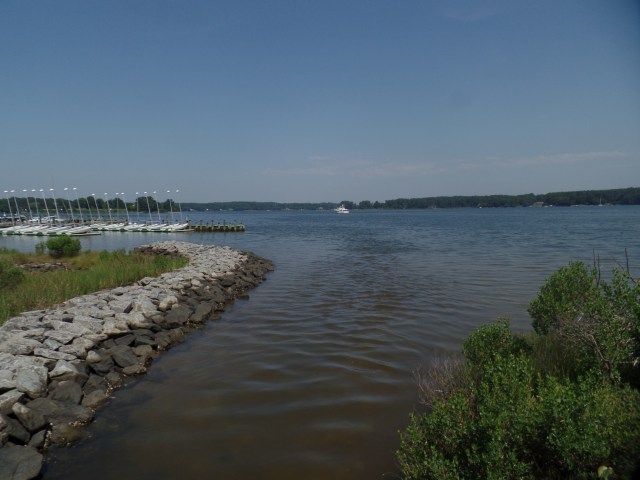
After a lovely visit, yesterday evening, with one of Penny’s second cousins, I meandered through the interior of Maryland’s Western Shore and spent the night in the regional commercial hub of Lexington Park.  This morning, after enjoying a breakfast sandwich at Donut Connection, I headed towards the southern tip of St. Marys County, a spot called Cape Lookout.  It turns out to be a private community, called Scotland Beach. Nevertheless, there was a small turnaround area, where the residents look the other way, while a visitor takes a photo or two.

SAMSUNG CAMERA PICTURES

Point Lookout also has a state park, which I am sure is lovely, but it is cash only, so I headed back towards the town of St. Marys, which was Maryland’s first capital, in provincial days.

Point Lookout was a Prisoner of War camp, for captured Confederate soldiers, between 1862-65.  A memorial to those who died whilst incarcerated, stands just north of the state park. Although I have no sympathy for slaveholders, these were soldiers, and I paid my respects.

SAMSUNG CAMERA PICTURES

St. Marys is a lovely town, along the river of the same name. I stuck to the highway, as a bridge with hideous traffic was between here and Jamestown, and I wanted to get there by 1 PM, at the latest.

These scenes were taken across from the entrance to St. Marys College.

SAMSUNG CAMERA PICTURES

SAMSUNG CAMERA PICTURES

SAMSUNG CAMERA PICTURES

After spending forty minutes on the aforementioned bridge, and nearly being rammed by a vehicle whose driver was busy texting, whilst going 40 miles an hour, in bumper to bumper traffic, I enjoyed a rather pleasant drive through Virginia’s Upper Tidewater, and got to Jamestown around 12:40.

The entrance to Jamestown National Historic Park has 50 plaques, describing how each state came to enter the Union.

SAMSUNG CAMERA PICTURES

The Great Hall has several exhibits that detail Jamestown’s three early communities:  The Powhatan Nation, long-established here, when the settlers arrived; the English settlers, who began to arrive in 1607 and slaves brought from Angola, southern Africa, beginning in 1619.  There are examples of the homes and daily lives of each group, in various sections of the Great Hall.

The first section describes the lives of the Powhatan and their neighbours.  The house below is a typical Powhatan home of that period.

SAMSUNG CAMERA PICTURES

This is the inside of an early English hut in James Fort, as replicated in the Great Hall.

SAMSUNG CAMERA PICTURES

Model of ship used to transport goods and people, along the coast.

SAMSUNG CAMERA PICTURES

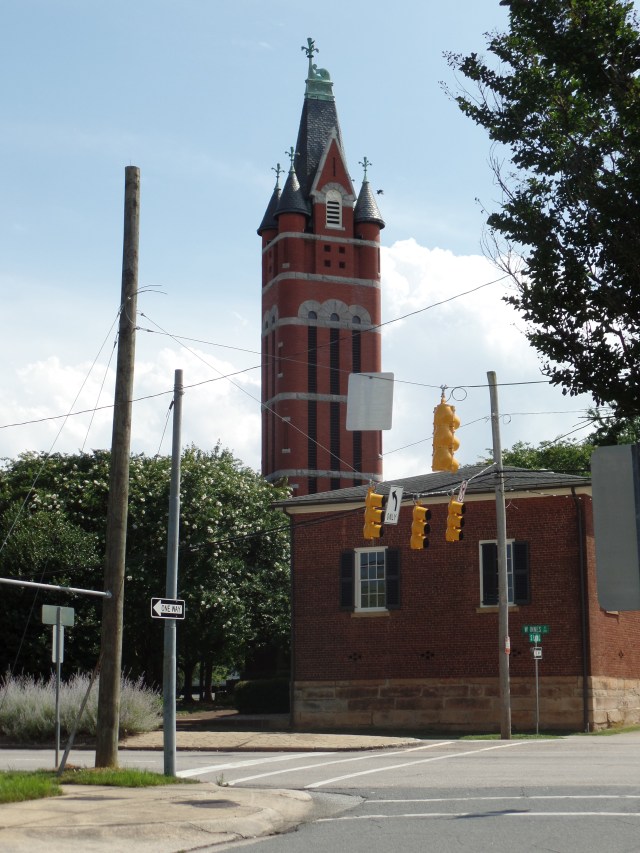
Once outside the Great Hall, it was time to get a sense of how the actual settlement looked.  Discovery Tower is the last remaining structure from the days when Jamestown was Virginia’s capital.   It was a church tower.

SAMSUNG CAMERA PICTURES

Visitors to frontier towns, up and down the North American coast. faced piked fences around the fortified villages.SAMSUNG CAMERA PICTURESCannons were posted at various points along the wall’s mezzanine.  Spanish, as well as Indian, raids were a constant concern at Jamestown, as were attacks by pirates.

SAMSUNG CAMERA PICTURES

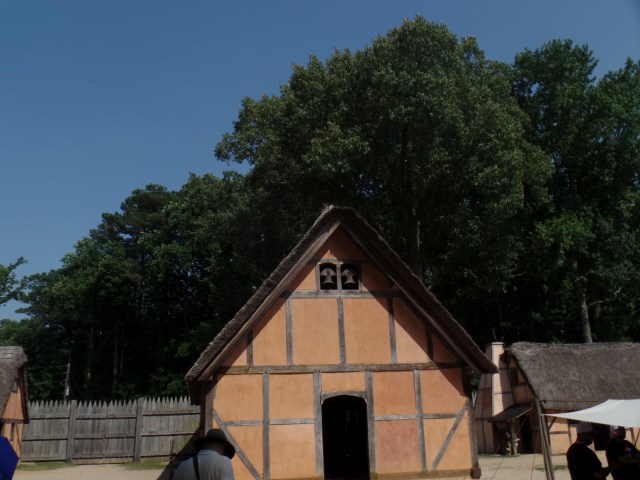
The thatching that was common, across the British Isles, became common in the early English settlements as well.

SAMSUNG CAMERA PICTURES

I visited several of the buildings.  This is the interior of the community church.  Unlike the later colonies in New England, Jamestown pledged fealty to the Anglican Church.

SAMSUNG CAMERA PICTURES

Here is the supply wall of the guard house.  Guards manned this fort, 24/7.

SAMSUNG CAMERA PICTURES

Here is the storehouse for the village.

SAMSUNG CAMERA PICTURES

These bells were rung by the guards, to alert settlers of danger.

SAMSUNG CAMERA PICTURES

In the Governor’s House, the governor’s manservant slept near the front door.

SAMSUNG CAMERA PICTURES

This was the Governor’s home office.

SAMSUNG CAMERA PICTURES

The Governor had some privacy in his sleeping area.

SAMSUNG CAMERA PICTURES

With my self-guided tour of James Fort complete, I walked towards the James River front.  A replica of an early dugout canoe lay above the shore.

SAMSUNG CAMERA PICTURES

The Susan Constant is a replica of the largest of a small fleet  of ships which sailed between Jamestown and England.

SAMSUNG CAMERA PICTURES

Imagine yourself manning this crow’s nest!

SAMSUNG CAMERA PICTURES

Here is a typical bunk for a crew member on any of the fleet’s ships.

SAMSUNG CAMERA PICTURES

As this grate indicates, humans worked in  a hold, under the main deck.

SAMSUNG CAMERA PICTURES

Here is what lies below deck. Yes, it was hot down there.

SAMSUNG CAMERA PICTURES

As it was getting close to closing time, I headed towards Powhatan Village.

SAMSUNG CAMERA PICTURES

Here is the interior of the Council House.

SAMSUNG CAMERA PICTURES

A more typical family house is below.  It appears this dwelling was the home of a prominent village elder.

SAMSUNG CAMERA PICTURES

This is the ceremonial circle. The posts represent the guardian spirits of the village.

SAMSUNG CAMERA PICTURES

The staff was leaving, so I was as well.  I stopped for a view of the James River, just outside the park.

SAMSUNG CAMERA PICTURES

Like any replica of life in the mists of history, Jamestown is constantly evolving as archaeologists unearth more evidence from the dig site, a short distance to the north.

So, I checked off another place missed during our 2007 trip.  I’m sure even more discoveries would await, were I to return some years from now.  For now, I am headed to Williamsburg, for the night, and Yorktown, tomorrow morning.


The 2018 Road, Day 24:Baltimore, Part 2- Proof Through The Night, and the Years

6

June 18, 2018, Baltimore-

Fort McHenry, in Baltimore’s outer Harbor, was one of the places, on our 2007 Virtual Field Trip organizing itinerary, that had to be left off, owing to changes that had to be made in our schedule and due to the rickety old wheelchair needing repair-which was done in New Jersey.

I had a day with which to play here, so even with the aborted visit to Poe House, I stuck with the plan to spend 2-3 hours at Fort McHenry and have lunch at an Inner Harbor eatery.

The Fort is off by itself, at the mouth of the Northwest Branch of the Patapsco River.

SAMSUNG CAMERA PICTURES

My first forty five minutes were spent listening to a docent explain, in detail, the life and contradictions of Francis Scott Key, a slaveowner who taught his charges to read and write;  an opponent of the War of 1812, who was nonetheless moved to commemorate the Battle of Baltimore in the verses which became our National Anthem;  a patriot, who ended up sitting out the battle, on a British sloop, after successfully negotiating the release of an American physician from British military custody.

SAMSUNG CAMERA PICTURES

In the background, during the lecture, were playing diverse versions of “The Star-Spangled Banner”, including Jim Hendrix’s 1969 rendition, from the Woodstock Festival.

The docent then took us outside, for further stories of the fort and its various functions, while we headed to the main ramparts.

SAMSUNG CAMERA PICTURES

After the British successfully sacked and burned Washington, DC and raided Alexandria,  in 1814, they headed towards Baltimore.   Meeting them were these cannons of Fort McHenry and a combined artillery battery at Forts Babcock, Covington and Look-Out, across outer Harbor.  The combined fusillade, witnessed by Key, aboard the sloop, both convinced the British to abandon hope of capturing the “crown jewel” of wealthy, bustling Baltimore and Key to write his stirring verse. It is often overlooked, though, that the song became our National Anthem in 1931.

SAMSUNG CAMERA PICTURES

Below, we see the breastworks, in which ammunition was stored, whilst providing cover for the American forces.

SAMSUNG CAMERA PICTURES

A lone cannon is seen, facing the Patapsco, atop the eastern earthworks.

SAMSUNG CAMERA PICTURES

Here is the  entry to an ammunition depot, showing clearly how vital it was for the earthworks to be properly constructed.

SAMSUNG CAMERA PICTURES

A series of barracks housed American soldiers and Marines, during the War of 1812.  These same buildings housed Confederate prisoners of war, between 1862-65.SAMSUNG CAMERA PICTURES

This dining room and office was used by Major General Samuel Smith, the post commander.

SAMSUNG CAMERA PICTURES

Here is a view of ammunition, stored  in an above-ground safe room.

SAMSUNG CAMERA PICTURES

This artillery park was well-guarded by four breastworks.

SAMSUNG CAMERA PICTURES

The Army Band was an essential morale-booster for troops preparing for battle. The Band’s quarters were on the west end of the barracks.

SAMSUNG CAMERA PICTURES

These shelters were built to safeguard the troops, following the shelling of 1814, but were never needed again, after the British were repulsed.

SAMSUNG CAMERA PICTURES

SAMSUNG CAMERA PICTURES

In this stretch of the Patapsco, Sailing Master Beverly Diggs, USN, had several merchant ships scuttled and sunk, to deter any British ships from closely approaching the Inner Harbor.  The action had its desired effect.

SAMSUNG CAMERA PICTURES

SAMSUNG CAMERA PICTURES

The southwestern corner of the park features this large ammunition magazine, not open to the public.

SAMSUNG CAMERA PICTURES

In 1922, Charles Niehaus, sculptor, completed a statue of Orpheus, the Greek musician of legend, in honour of Francis Scott Key.  It stands, between the Magazine and the Visitors Center.

SAMSUNG CAMERA PICTURES

Thus is the story of one of America’s unfortunate, but perhaps necessary, conflicts very well told, at one of its two most resonant battle sites.

I ended my Baltimore experience, this time, at Iron Rooster, near outer Harbor, in the Canton neighbourhood.

SAMSUNG CAMERA PICTURES

Of course, Inner Harbor and Federal Hill are for another time.  Baltimore ever beckons, and the hostel is always a welcoming haven.

NEXT:  Southwest Maryland and Jamestown


The 2018 Road, Day 24: Baltimore, Part 1- A Shiny Mount Vernon and Poe’s Hardy Neighbours

9

June 18, 2018, Baltimore-

I came to this sometimes struggling, but always fascinating harbour town last night, settling in to Hostels International- Baltimore, in its historic Mount Vernon neighbourhood.  The hostel is clean, comfortable and staffed by friendly folk.  The night manager moved his car over, so that I could fit mine into the relatively safe space, behind the hostel.  This little patio, if a bit cramped looking, was a relaxing spot for breakfast.

SAMSUNG CAMERA PICTURES

I had last stopped and spent time in the city in 1972-what seems like eons ago. Then, it was to visit with an Army buddy and his family, in the suburb of Essex. I had arrived too late at night to call on them , but fortunately found a kind soul who put me up for the night, in Mount Vernon, as luck would have it.  I lost track of my buddy, only knowing that his brother died, three years ago and their parents, who I treasured, sometime back.

Bal’mer, though, has kept on, and keeps itself rather polished.  I took a short walk around Mount Vernon, this morning, taking in The Basilica of Baltimore, its Roman Catholic Cathedral and a few other sites at the northern edge of downtown.  The Basilica of the  National Shrine of the Assumption of the Blessed Virgin Mary, as it is officially known, was completed in 1837, thus its late Federal Period architecture. It is the first Roman Catholic Cathedral built in the  United States, having been built by John Henry Latrobe, the “Father of American Architecture.”

SAMSUNG CAMERA PICTURES

SAMSUNG CAMERA PICTURES

SAMSUNG CAMERA PICTURES

SAMSUNG CAMERA PICTURES

SAMSUNG CAMERA PICTURES

SAMSUNG CAMERA PICTURES

SAMSUNG CAMERA PICTURES

Enoch Pratt, a  local industrialist and philanthropist of the mid- 19th Century, helped establish Baltimore’s Central Public Library, in 1882.  It is another anchor point of Mount Vernon and Cathedral Hill.

SAMSUNG CAMERA PICTURES

The New Unity Church Ministries is a balance to the large presence of the Cathedral.  Beyond, you can see the high rises of downtown’s edge.

SAMSUNG CAMERA PICTURES


I left Mount Vernon, around 10 a.m. and headed off in search of Edgar Allan Poe House. It is in a mixed income neighbourhood, at the edge of a public housing project.  The area residents were a bit surprised at my presence there-mainly because the house is only open from Thursday-Sunday, and then only from 11-4.  Nonetheless, today was when I was here, and so I did get a photo of the exterior.

SAMSUNG CAMERA PICTURES

With this brief, but pleasant, visit to central Baltimore a fait accompli, I headed to this day’s main focus:  Fort Mc Henry.

The 2018 Road, Day 23: A Father’s Greatest Joy

26

June 17, 2018, Philadelphia-

We began the day with what was billed as “A Farewell Brunch”-and it was enough to last me, at least, until late afternoon.

Here are a couple of scenes from the morning.

Son is explaining to his  second cousin about his work on a ship in the Navy, whilst YH and the little guy’s parents look on.

SAMSUNG CAMERA PICTURES

My younger brother, Mom and the lovely bride are enjoying the morning.

SAMSUNG CAMERA PICTURES

Once we had indeed made our farewells to the family, Aram, YH and I headed over to the Korean War Memorial, just inside Penn’s Landing.

SAMSUNG CAMERA PICTURES

SAMSUNG CAMERA PICTURES

SAMSUNG CAMERA PICTURES

SAMSUNG CAMERA PICTURES

SAMSUNG CAMERA PICTURES

We headed back towards the Independence Historic District.   A few late model buildings caught our attention. The Ritz-Carlton is mostly high rise, but uses this domed structure for its lobby, convention center and main dining room.

SAMSUNG CAMERA PICTURES

Here, you get a view of Philadelphia City Hall.

SAMSUNG CAMERA PICTURES

We took in the Alexander Hamilton exhibit at The Constitution Center.

SAMSUNG CAMERA PICTURES

Then came a visit to the Liberty Bell.

SAMSUNG CAMERA PICTURES

I managed a selfie with the former Pennsylvania State House bell, now a national symbol.

SAMSUNG CAMERA PICTURES

We then returned to Independence Hall, checking out the East Wing and courtyard, for a bit.

SAMSUNG CAMERA PICTURES

SAMSUNG CAMERA PICTURES

The last act of the day was to head to Jones Restaurant, on Chestnut Street, and enjoy a Midday repast of  tomato soup with a grilled cheese sandwich, hearkening back to my childhood.          The best present, though, was having Aram here and getting to meet his love.

Leaving the happy couple to enjoy the Philadelphia evening, I headed south, to Baltimore.


The 2018 Road, Day 21: In the Streets of Brotherly Love

4

June 15, 2018, Philadelphia-

Once upon a time, a teenaged girl looked at her uncle, and wondered aloud whether anyone would care to attend her wedding, when the time came.  Uncle said, unequivocally, that he would be there and that anyone who called themselves his family would be there, too.

In reality, there was never any question. Everyone from her youngest cousin (my son) to the family matriarch (Mother) made the wedding, that will take place tomorrow, a top priority.  It’s been a few years since B was a teenager, but there has been no break, whatsoever, in the love I feel for that compassionate and powerful young lady.  She has made a solid life for herself, following her father’s example of being largely self-reliant and choosing the field of education-which probably had little or nothing to do with her uncle and aunt, on the other side of the country, being educators. I’m glad she chose teaching, anyway.  She’s darn good at it.

I arrived in Philadelphia, around 2, by way of Camden.  This was a simple matter of not getting good directions from Google Maps, finding myself on the bridge to New Jersey and turning around to get cash from a bodega, near the Camden side of the bridge.  Once that was done, I picked up my pre-ordered wedding gift and headed to the Alexander Inn, my residence for the next 2 days.

With time to spend, until the Rehearsal Dinner, at 6 p.m., I ventured to check out Philly’s street art.

Here are  a few of those scenes, from the west side of the Independence Historic District.

SAMSUNG CAMERA PICTURES

Here, a father is showing his little girl the power that comes with community working together.  I found this appropriate to the present situation.  My brother has been a guiding light to all three of his children.

SAMSUNG CAMERA PICTURES

SAMSUNG CAMERA PICTURES

SAMSUNG CAMERA PICTURES

The above long mural has a caption that speaks of the eternal juxtaposition of right and wrong.  The young man in the foreground is giving this matter a lot of thought. From the look in his eyes, I would say he will choose right, more often.

Well, the dinner was second to none.  The Panorama Restaurant, right on Front Street, did it up fabulous.  I am admittedly an hors d’oeuvres hound, anyway, and the grilled ahi tuna did not fail to satisfy, either.

Tomorrow, greeting Aram and meeting his sweetheart, then attending the wedding of the year (sorry, Harry and Meghan), will be a most assuredly full day.  Good night, all.


The 2018 Road, Day 20: A Place of Resilience, Part 3- Washington Slept Here

6

June 14, 2018, Valley Forge-

The area on the west side of Valley Forge National Historical Park lies between the village of Valley Forge and the Schuylkill River, with General Washington’s Headquarters and its support buildings dominating the area, during the period of regrouping.

This residence was used by the Quartermaster for the Continental Army at Valley Forge, General Nathaniel Greene.

SAMSUNG CAMERA PICTURES

About a half-mile east, Washington’s main encampment was established, after he moved the Marquee away from the Artillery Park. His personal guardsmen were housed in these cabins, with a spring house immediately below.SAMSUNG CAMERA PICTURES

The building below was a bakery for the Continental Army.

SAMSUNG CAMERA PICTURES

Here is the house that served as General Washington’s Headquarters. The downstairs was office space and a kitchen. All officers, including George Washington, slept on the second floor.

SAMSUNG CAMERA PICTURES

Here is a glimpse of Washington’s office.

SAMSUNG CAMERA PICTURES

Washington slept here.

SAMSUNG CAMERA PICTURES

I grabbed a late lunch and gassed up in Valley Forge Village, with Freedom Deli and Catering being right next to a Sunoco station.  I took a brief look at Freedom’s Foundation’s grounds, which I remember from Frankie Laine’s pitch on the radio, in the late 1950’s.  Funny, what sticks in your head. I didn’t get photos, as the place was closed and I would like to do it justice, on another visit.  Valley Forge left me with a deeper appreciation for the truth of all those stories of hardship and endurance, we heard in my school days.

Back to Oley, I’m headed, and thankfully there is no rain in the forecast.

NEXT:  Brotherly Love and The Wedding of the Year

The 2018 Road, Day 20: A Place of Resilience, Part 2- The Commander’s Chapel

4

June 14, 2018, Valley Forge-

Coming around the bend,as it were, from Varnum’s headquarters, I saw a tall castle-like structure, fronting a sizable cemetery.  This is the first section of Washington Memorial Chapel that greets the visitor, from the north.SAMSUNG CAMERA PICTURES

The Chapel is not part of Valley Forge National Historic Park, but being surrounded by the park, it is well-visited by thousands, in the course of a year.   It was constructed from 1904-1917, at the behest of Dr. W. Herbert Burk, a local Anglican minister, with the blessing of President Theodore Roosevelt.

SAMSUNG CAMERA PICTURES

The design and materials evoke the sturdiness and timeless aura of the enduring stone churches of Europe.

SAMSUNG CAMERA PICTURES

SAMSUNG CAMERA PICTURES

SAMSUNG CAMERA PICTURES

Homages to the power and endurance of history are contained, in the commemorative discs, embedded in both the outside patios and the interior floors.

SAMSUNG CAMERA PICTURES

In the foyer of the chapel, there is this memorial tribute to Dr. Bodo Otto, and his sons, who staffed a combat hospital in nearby Yellow Springs. The Ottos had come to Philadelphia, from Gottingen, in what is now Germany, in the 1750’s.

SAMSUNG CAMERA PICTURES

These views are of the north side of the structure.  Note the Carillon and Bell Tower, in the background.

SAMSUNG CAMERA PICTURES

SAMSUNG CAMERA PICTURES

This is a statue of Rev. William White, Chaplain to the Continental Congress and first Episcopal Bishop of Philadelphia.  It is located in the Chapel’s courtyard.

SAMSUNG CAMERA PICTURES

This Justice Bell hangs in the foyer of the Chapel.

SAMSUNG CAMERA PICTURES

These arches lie on the east entrance to the Chapel.

SAMSUNG CAMERA PICTURES

This Wall of Honor has names of many veterans, from the Revolutionary War to the present day.

SAMSUNG CAMERA PICTURES

Here is  a view of the Chapel’s interior.

SAMSUNG CAMERA PICTURES

This memorial, erected by the Valley Forge Alumnae Chapter, in 1993, represents a concerted national effort to recognize the diversity of our nation’s builders, from the beginning of America’s story.

SAMSUNG CAMERA PICTURES

A small Gift Shop and Cafe is operated by parish volunteers.  The cafe was welcomed by me, after a day of exploration in the heat.

SAMSUNG CAMERA PICTURES

The only identified grave at Valley Forge is that of Lieutenant John Waterman, of Rhode Island, d. April 23, 1778.  This obelisk was erected at his gravesite, in 1901, by the Daughters of the American Revolution, in honour of all those who died at Valley Forge, during the American encampment.

SAMSUNG CAMERA PICTURES

Both the Chapel and the obelisk overlook the Grand Parade, where the Continental Army trained, whilst at Valley Forge.

SAMSUNG CAMERA PICTURES

So, it was with humility that I stood and gave thanks for their long ago sacrifice, which started the process, far from perfect and far from finished, of building our nation.

NEXT:  General Washington’s Headquarters and the western sector of Valley Forge


The 2018 Road, Day 20: A Place of Resilience, Part 1-The Battlefield and Encampments

12

June 14, 2018, Oley, PA-

That moniker above could apply to this little farm, where I am camped, until tomorrow morning.  It more immediately applies, however, to Valley Forge, where I spent most of the day. Like Steamtown and Philadelphia’s Independence Hall, admission to Valley Forge is free of charge.  The value of the stories it tells, though, is priceless, eternal.

The day will be recounted in three parts:  This post will focus, as stated, on the battlefield and the main encampments, which also feature most of the memorials.  Part two will focus on the Washington Chapel.  Part 3 will feature Washington’s Headquarters.

For exploration of the encampments, I chose the Joseph Plumb Martin Trail, named for a private in the Continental Army, who kept a journal of his experiences during the terrible winter of 1777-78.

The first stop along that trail takes in the Muhlenberg Brigade’s encampment and redoubt.   The commander of the Virginia Line, of the 8th Brigade, was Gen. John Peter Muhlenberg.

Several cabins were open for us to check out.

SAMSUNG CAMERA PICTURES

This berm is an example of the cover used by Continental troops, to guard against any British cannon fire.

SAMSUNG CAMERA PICTURES

SAMSUNG CAMERA PICTURES

Inside another cabin, the only source of heat for the people billeted here is shown.  Some cabins had not only the soldiers, but family members who followed the Army on its mission.

SAMSUNG CAMERA PICTURES

Here is a longer view of the encampment.

SAMSUNG CAMERA PICTURES

This signboard explains the situation to which I referred above. Some cabins had not only men, women and children, but household animals, as well.

SAMSUNG CAMERA PICTURES

Here is a glimpse of Washington Memorial Chapel, a mile or so to the east of Muhlenberg encampment and the National Memorial Arch.

Moving further north, I found this memorial to the soldiers from Massachusetts, who served at Valley Forge.

SAMSUNG CAMERA PICTURES

Here is the National Memorial Arch, honouring all who served the cause of independence.

SAMSUNG CAMERA PICTURES

SAMSUNG CAMERA PICTURES

This small encampment, north of the present-day Arch, was commanded by Gen. Enoch Poor, of the New Hampshire Regiment.

SAMSUNG CAMERA PICTURES

Here are the Pennsylvania Columns, which honour American Revolutionary War generals.  At the base of each column are bas-relief busts of Colonel William Irvine and Adjutant General Joseph Reed.

SAMSUNG CAMERA PICTURES

Here’s a glimpse of Wayne’s Woods, named for General Anthony Wayne, who unsuccessfully tried to invade Canada, in 1775.  He didn’t encamp here, but the woods were named for him, anyway. Today, the woods are a popular picnic area.

SAMSUNG CAMERA PICTURES

This marks the site where General Washington pitched his sleeping tent, when he entered Valley Forge, in December, 1777.

SAMSUNG CAMERA PICTURES

The next two photos show Artillery Park, where Continental artillery was stored and repaired.

SAMSUNG CAMERA PICTURES

SAMSUNG CAMERA PICTURES

Here is a statue of the great Prussian general, Baron Wilhelm von Steuben, who instilled unity and discipline in the Continental Army, during its time at Valley Forge.

SAMSUNG CAMERA PICTURES

This house served as the quarters of General James Varnum, commander of the Connecticut and Rhode Island Brigades.  He shared the home with the Stephens family, who owned it-paying rent to David Stephens, during his stay at Valley Forge.

SAMSUNG CAMERA PICTURES


Although my visit took place in the heat of early summer, a sense of what was endured by the  troops and local residents alike was easily conveyed. My tour of the encampments ended here, and the focus now became Washington Memorial Chapel, the subject of Part 2 of this set of posts.


The 2018 Road, Day 19: A Steamtown Experience, Part 2- Turntables and Roundhouses

4

June 13, 2018, Scranton-

I bypassed the Steamtown Shopping District, mostly as I was itching to get to the National Historic Site and was saving my appetite for a stop to see my friends at D’s Diner, in Wilkes-Barre.

The docents at Steamtown National Historic Site are intensely passionate about trains, and rightly so.  Until the advent of mass-produced trucks, in the 1950’s, locomotives were the most efficient way to move goods across country.  They still have staying power, and freight trains, at least, have held their own, over the last forty years.

Here, then, are scenes from Steamtown.  Please note that this site is free of admission charge.

SAMSUNG CAMERA PICTURES

The Visitor Center, above, provides all that one would expect from such a place- knowledgeable docents, memorabilia and a fascinating introductory film.  Below, in the Turntable, is an Illinois Central Railroad engine car.

Below, a Baldwin #26-0-6-0 Switcher Locomotive (right) is activated, once a day, by a trained rail engineer, for the enjoyment of visitors.  A caboose is seen in the middle.  To the left is an observation car.

SAMSUNG CAMERA PICTURES

Below is a depiction of rail setters, doing the backbreaking work of establishing our transcontinental network.

SAMSUNG CAMERA PICTURES

This diorama shows a full-service rail yard, in miniature.  In the middle, is the Roundhouse, with its Turntable at the epicenter.

SAMSUNG CAMERA PICTURES

This caboose, made of wood, served as the train’s office. It is from Rutland (VT) Railroad #28.

SAMSUNG CAMERA PICTURES

This is a Spang, Chalfont & Co. locomotive, where one may peer under the vehicle’s “skin”.

SAMSUNG CAMERA PICTURES

SAMSUNG CAMERA PICTURES

Here, we get a good view of the Roundhouse.

SAMSUNG CAMERA PICTURES

This is a Lackawanna & Western Railroad wooden boxcar.

SAMSUNG CAMERA PICTURES

This is where the coal is shoveled into the engine, thus burning and producing steam.

SAMSUNG CAMERA PICTURES

An engine is, of course, the lead car of any train, thus the yellow bell being attached to this early model.

SAMSUNG CAMERA PICTURES

Here are some views of an early passenger train.  First is a view of the kitchen.

SAMSUNG CAMERA PICTURES

Below, is the dining room.

SAMSUNG CAMERA PICTURES

Here is the business lounge, where smoking could also be done, after a meal.

SAMSUNG CAMERA PICTURES

I spent about an hour, after touring the Roundhouse, visiting the History Museum, which has fine details about all people involved in a railroad operation- including both official (Engineer, Conductor, Railroad Security, Executive, Porter and Ticket Seller) and “unofficial” (Hobo), who actually did some maintenance work, here and there, for the railroad, in return for the security “bulls” looking the other way.  It was, for many years, a FEDERAL crime to be caught on railroad property without authorization.

The History Museum features a postal car, from the Louisville & Nashville Railway. The Pony Express was only around for 18 months.  Before, and after, the rails were the fastest way to move mail.

SAMSUNG CAMERA PICTURES

As with any technological advance, there were those naysayers, who tried to sway the public against railroads.  Here is a 19th Century version of NAMBY propaganda.

SAMSUNG CAMERA PICTURES

Having seen how that DIDN’T work and how well the railroads DID, I headed a bit southeast, towards D’s Diner, to see how my friends have fared in their first full year of business.


The 2018 Road, Day 19: A Steamtown Experience, Part 1- The Hill District

10

June 13, 2018, Scranton-

At least once, during a cross-country sojourn, I like to spend at least a few hours in a city which has contributed to the economic and material well-being of our nation.  In the past, this has led me to Oakland, St. Louis, Des Moines, Kokomo, South Bend and Canton, Ohio, to say nothing of Chicago, Boston, New York, San Francisco and Los Angeles.

Today, this meant several hours in Scranton, northeast Pennsylvania’s commercial and industrial hub, and the center of the steam locomotive industry in the U.S., particularly during the 19th Century.  Prior to locomotives, Scranton and nearby Wilkes-Barre were important centers for coal mining.  Anthracite, or hard coal, was abundant in northeast Pennsylvania, and provided the fuel by which steam could be produced, thus being the impetus for the steam locomotive industry-major to the transcontinental railroads, which have moved a major part of passenger and freight traffic, to this day.

I began my visit with a walk around the Hill neighbourhood, on the west end of downtown.  David Spencer bestowed the moniker, Electric City, upon Scranton, in 1886. Many of the large buildings of this side of downtown were among the first in the nation to rely exclusively on incandescent lighting.

Here are some of those fine structures.  The churches reflect the ethnic diversity of those who came to dig coal and to help build the railroads.

SAMSUNG CAMERA PICTURES

Above is St. Nicholas’ Eastern Orthodox Church, which began serving Russian and Serbian miners, in the latter Nineteenth Century.

SAMSUNG CAMERA PICTURES

Covenant Presbyterian Church was established by Scottish and Scots-Irish immigrants.

SAMSUNG CAMERA PICTURES

Spacious St. Matthew’s United Evangelical Lutheran Church reflects the central European architectural style of its German adherents.

SAMSUNG CAMERA PICTURES

This unmarked building, west of St. Nicholas’ Church, is nonetheless impressive.

SAMSUNG CAMERA PICTURES

Prominent, and well-marked, is St. Peter’s Cathedral, with Scranton City Hall in the background.

SAMSUNG CAMERA PICTURES

This fascinating private home is certainly well-insulated.

SAMSUNG CAMERA PICTURES

This is the Administration Building of Scranton School District.  There is a history of inventive minds coming out of the Lackawanna Valley.  This district’s mission is that this will long continue.

SAMSUNG CAMERA PICTURES

Adjacent to the District Office is Lackawanna County Public Library’s Main Branch, and, to the Library’s right, Scranton City Hall.

SAMSUNG CAMERA PICTURES

Here is a closer view of St. Peter’s Cathedral.  Downtown is bordered, at the east end, by the yards of the Delaware, Lackawanna and Western Railroad.  The regional commuter trains’ main terminus is here:

SAMSUNG CAMERA PICTURES

I hopped the tracks and continued slightly northeast, to the locomotives’ well-deserved resting place.


NEXT: Steamtown National Historic Site