Cost and Effect

2

February 25, 2020-

It is evident that, the more people become accustomed to finery, wealth and relative comfort, the harder it is for many to accept when misfortune hits.  We in the “developed” nations are now being asked to sacrifice a fair amount of our wealth, and possibly some of our comfort, as several countries,  of both advanced and aspiring economies, deal with possibly the worst epidemic of disease since the Influenza of 1918-19.  This is no random panic over who Tweeted what about whom.  This is a phenomenon that is closing factories and schools, and keeping people isolated, in the affected areas.

There is a cost to any progress, to any advance, in any given realm, whether material or spiritual.  This is the latest assessment made on a civilization that has experienced a goodly amount of growth, in the past ten years, but especially in the most recent three.

Yet after the cost is paid, there is a recovery. There will be growth and prosperity again.  The world recovered from the Spanish Influenza, though there was an over-exuberance, coupled with unequal treatment of nations that had been vanquished in World War I, that largely contributed to the Great Depression.  It is well that safeguards implemented, upon the recovery from that Depression, will serve to both temper any rush to exuberance, following the end of the current pandemic and to mitigate any long-term economic ill effects of the phenomenon.  Add to this, the very fresh memory of the economic crisis of 2008-10, and it is likely that many have either set aside a sum of money they could afford to lose, temporarily,  to a Bear Market or have established a network, on which people may tide one another over, in times of sacrifice.

So, we will learn, and re-learn, our true priorities;  refresh our consciences about what truly matters, in a well-lived life.  We will survive and thrive.


Righting the Ship

4

February 23, 2020-

So, I got back to Home Base around 4 a.m., doing what is customary, under such circumstances: Sleeping for three hours.  It was then time to shower and do devotions, as always, and head off to the American Legion, for the last breakfast I will have with the mates, for a month or so-as my final physical Fast is approaching (March 1-19, this year).  A devotional meeting followed, in Prescott Valley, for which I was actually quite mentally present.

More sleep took up early afternoon, thus righting my physical/mental ship.  Among other things, the illness that lingered, for nearly two weeks, is finally gone.  Maybe the exercise, of pushing myself to do the long round trip to/from Indio, was exactly what was needed to push the remnants out.  Sometimes, counter-intuitive is the way to go.

At last night’s concert, Sheryl took a few minutes to engage the audience, as to who in the crowd was in their thirties, forties and fifties, the last being her own age group.  She asked how many were still having fun, in their fifties-as she certainly is.  A goodly number gave a rousing response.   That’s gratifying; people ought to enjoy life, at any age.  She didn’t ask US-those in our sixties and beyond, but I am, my row mates (also in their sixties) and the seventy-somethings, who were seated across the aisle, seemed to be having a great time of it, as well.

So, on we go. This coming week brings Mardi Gras, Ash Wednesday/Lent and, for us Baha’is, Ayyam-i-Ha (the Intercalary Days of feasting and gift-giving, before our Fast begins, a week from today).

May it be a great run-up to Leap Day!


Barriers Are In the Mind

6

February 17, 2020, Yuma-

A commenter on one of my recent posts, on another social media site, took issue with the notion that freedom has a price.  Once, an explanation of that statement was offered, he had a better appreciation o fits meaning.    He did, for his part, also make a valid point:  We can choose not to surrender our freedom to those who would take us down and use us for their own designs. Indeed, I have made several choices, even so far this year, that have not set well with some others.  In the end, though, they can also choose for themselves, as to a best course of action.  The sun should not rise and set, with any other person, when it comes to making choices of one’s own.

After a three-hour visit with some long-time friends, in this bustling border city, I took in two sites that focus on the consequences of discordance and social unrest:  Yuma Territorial Prison State Historic Park and the border wall at San Luis.

The Prison is, of course,defunct as a place of incarceration.  It long ago  gave  way to a more “up-to-date” facility, in Florence, itself now slated for closure, after over 100 years of use.  Yuma Territorial Prison was established in 1875, at the behest of the area’s representative in the Arizona Territorial Legislature:  Jose Maria Redondo.  It served as the Arizona Territory’s place of incarceration, from 1876-1909.

Since that time, Yuma has alternately used the facility as a temporary high school (1910-1914), a homeless shelter (1930-39) and, most recently, as the centerpiece of the city’s historical heritage preservation.

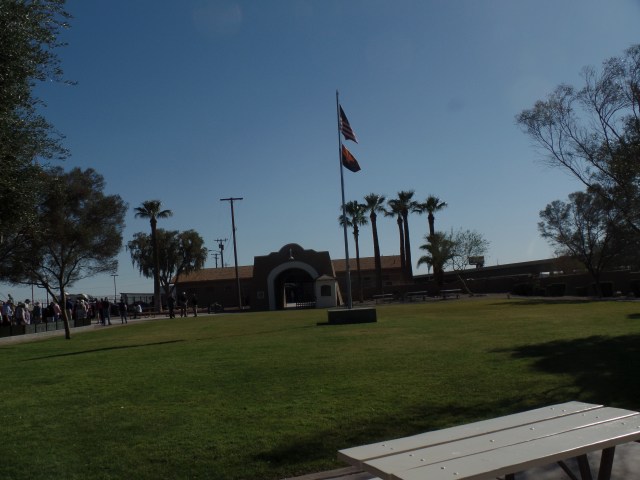
Here are a few scenes of the present State Historical Park. Below, is a view of the Colorado River’s wetlands, below the Park grounds.

SAMSUNG CAMERA PICTURES

Here is the railroad bridge, opposite the Park.  It is still in use.

SAMSUNG CAMERA PICTURES

This was the Parade Ground.

SAMSUNG CAMERA PICTURES

This was the Guard Tower.

SAMSUNG CAMERA PICTURES

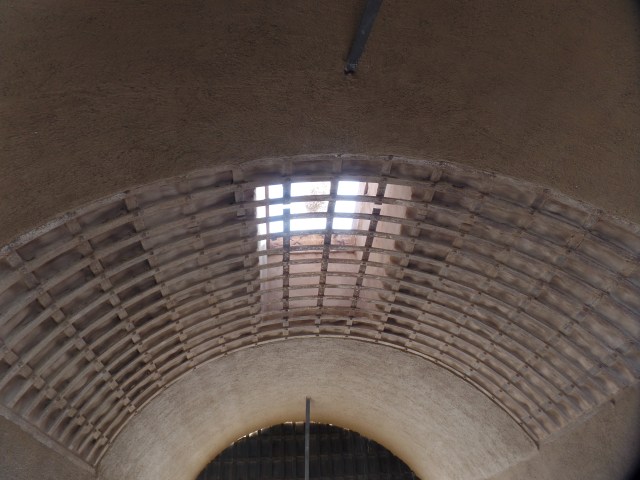
These are two views of the Sally Port  (Puerto de Salir), or main entrance to the enclosed prison.

SAMSUNG CAMERA PICTURES

SAMSUNG CAMERA PICTURES

The present-day Museum is in the site of the Prison Mess Hall.

SAMSUNG CAMERA PICTURES

Men and women, Mormon polygamists and Mexican revolutionaries, white collar thieves and cutthroats-all shared this facility, at one time or another. The most famous of its  prison breaks, the Gates Riot  (October, 1877), saw Superintendent Thomas Gates taken hostage, one of his trusted inmates, Barney Riggs, come to his rescue and killed Gates’ attacker.  The would-be escapees went to the Dark Cell, Gates suffered the ill-effects of the attack for the remaining twenty years of his life and Riggs was eventually set free.

Here is a view of the main cell block.

SAMSUNG CAMERA PICTURES

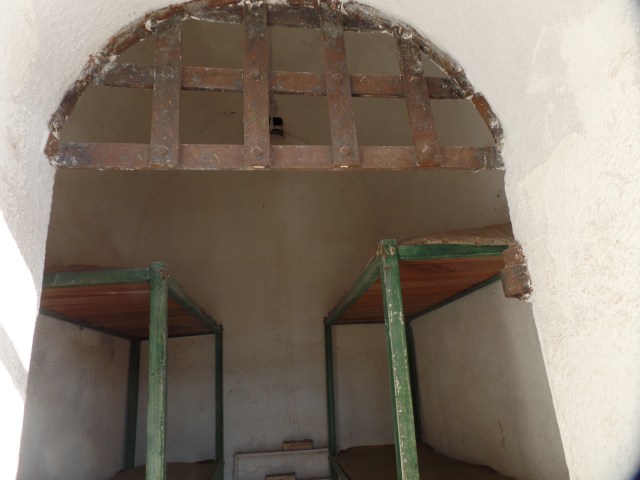
Next, a couple of views of the typical cell.

SAMSUNG CAMERA PICTURES

SAMSUNG CAMERA PICTURES

These were the first bunk beds.

SAMSUNG CAMERA PICTURES

Finally, this is a view of the Dark Cell, the holding place of the most incorrigible prisoners.

SAMSUNG CAMERA PICTURES

In spite of appearances, the Yuma facility was progressive for its time. It had electricity, running water and was mostly operated with a rehabilitative, rather than a punitive, mindset.

I left this city, for a forty-minute ride to San Luis, to take a brief look at the border crossing leading to the large Sonoran community of San Luis Rio Colorado. It was peak crossing time for day labourers, who were returning home.  In fairness, the barrier here looks nothing like the much-photographed Bollock sections, in other areas along the frontier.  I don’t much care for the fortress-like images being promoted as “necessary”, but the real barriers to human progress are in the mind.  This puts the onus for social change and justice squarely on those creating the barriers-both the antisocial elements whose actions generate fear and the reactionaries who fancy that building such structures will obviate any further efforts at rectifying the imbalances present in society.

Most of us, whether “liberal” or “conservative”, actually fall somewhere in the middle on this one.  I wonder how Thomas Gates, the reformer penologist, would have dealt with undocumented immigrants.

SAMSUNG CAMERA PICTURES

SAMSUNG CAMERA PICTURES


Places of Which I Don’t Speak Much

8

February 10, 2020-

I kept myself home today, for good measure.

Yesterday was touch and go,

and I made it to the two obligatory gatherings,

being careful not to get too close to anyone,

lest what I felt was coming on,

was transferable.

I don’t speak of illness, much.

This is because it rarely comes calling.

Oregano, and a day of rest,

have knocked it out of me.

Illness is a state of being,

of which I rarely need speak.

Mount Chocorua was the first real peak,

I ever climbed.

I was grateful to my father,

for taking me there,

a uniquely satisfying climb,

that was distorted by a few moments

of diffuse anger,

back at the tent site.

When I had to deal with the same,

as a father, years later,

I knew what to do,

and let the boy work out his feelings.

Long Binh,

the only place where I ever felt

my life was in danger,

was also where I had to stand up

for myself.

So I did, and no harm came.

I may very well return to Viet Nam,

in a couple of years,

but I will leave Long Binh alone.

Hannibal saw me when I was

in a very raw state.

I was not allowed to write freely.

I was refused use of a computer.

Hannibal did not seem kind,

but someday, I will give

Hannibal a second look.

There are many places,

of which I don’t speak much.


Is It Slumber?

4

February 6, 2020-

What is it, when we watch and listen,

seeing and hearing only what confirms

the sights and sounds of our own private silo?

What is it, when a child cries out for help,

and those around just say,

“That’s the way it’s always been, here”.

What is it, when one follows the path of least resistance,

with a self-directed message,

that comfort has been earned.

Is it living to fight another day?

Is it being prudent?

Is it emotional triage?

Or, is it slumber?

The Ongoing Story

4

February 4, 2020-

As is my wont, I watched the State of the Union Address, and part of the “opposition response”.  I paid close attention to what was said, to the enthusiasm of the speakers’ supporters and to the reactions of the speakers’ critics.

President Trump’s speech was fairly good on specifics, with regard to what he considers his administration’s accomplishments and bullish on what he sees ahead-should he be re-elected.  There were fine moments: Carl and Marsha Mueller, from Prescott, honoured in the sacrifice of their daughter to the IS mayhem; Rush Limbaugh, with whom I often disagree, but who has been generous to the people of the Midwest and who is now in the fight of his life, against cancer, receiving the Presidential Medal of Freedom; the mother and children from North Carolina, re-united with their soldier husband and father; the young man from here in Arizona, honoured for his interest in space exploration, alongside his great grandfather, a Tuskegee Airman,  who himself was promoted to Brigadier General, earlier in the day.  General McGee is 100 years of age.

There was also the hubris, which has been associated with this President, but has also been expressed by several of his predecessors, in their own detailing of accomplishments.  In the end, though, Donald Trump shared a thought with which few can realistically argue:  “America’s best days are yet to come.”  In truth, mankind’s best days are yet to come.

Both speakers, (Governor Whitmer, of Michigan, being the respondent), appealed to our sense of history and to a semblance of decency.  Both expressed pride and confidence in the ability of our nation’s youth.  Both faced rudeness from opponents, and ebullience from supporters.  More’s the pity.

Our best days are yet to come.  This will happen, when we stop seeing our leaders as mere extensions of ourselves; indeed, when we stop seeing other people as mere extensions of ourselves, in terms of what we think they should think, say and do.  When the dreams of each person become worthy of consideration, when they are validated in their goodness, when they are challenged and lovingly corrected in their elements of error or destructiveness, then will Humanity realize its true greatness.  When we truly learn to listen to each other, to link arms and celebrate one another’s humanity, then will our nation,  and our planet, begin to truly shine.

Our best days are yet to come.

Entitled?

6

January 31, 2020-

While covering a class yesterday, I showed the film, “Avatar”.  The point was made that, in the far future, a certain segment of Earth’s populace was bent on colonizing a planet similar to our own.  It involved a colonialist mentality, based on perceived economic benefit.

I read a report, yesterday, about an American woman, missing in the Central American country of Belize.  The report said she was last seen on a beach, late at night.  Several commentators cast aspersions on the safety conditions in that country, as well as those in the Dominican Republic.  The comments included the opinion that Americans are routinely seen as projecting a “rich and entitled” persona, by residents of those countries.

I have never been to either nation.  I have been to the South American nation of Guyana, where similar charges were leveled against the local populace.  I was there, with Penny, for three weeks.  We walked about with humility, and did not find ourselves being menaced or accosted by anyone.  We had escorts and host families, the entire time we were there.  That was 1984, and yet I am certain that similar precautions would bear similar results now.

I have been a number of places, since that year.  I can say that I made some boneheaded judgments, when in Europe, in 2014, but none based on hubris or egoism.  I learned what not to do again.  It is simply best to walk in humility and fair-mindedness, albeit while maintaining a smart sense of safety.  I have plans that will take me far afield, over the next five years-and I don’t rule out any given country.  Most will involve making suitable security arrangements beforehand, in any case-but not because I am “rich and entitled”.  There will be many conversations on the subject, I’m certain-just as I spoke with a few disaffected people in Guyana, 36 years ago, and in Paris, six years ago.

This is perhaps as big a reason for my reaching out, as any.

Mamba

8

January 27, 2020-

The fog that can roll in, off any given coastline, shoreline or river bank, as air temperature changes, can render even the best of navigators helpless.  There have been several times, over the years, when I have arrived safely at a destination only because the car was in good shape and there were no impediments, other than the lack of visibility.

I leave it to the experts, to figure out what went horribly wrong, yesterday, when nine people, including former National Basketball Association player, Kobe Bryant and his 13-year-old daughter, were killed in a helicopter crash, near Calabasas, CA, outside Los Angeles.  Of course, conspiracy theories have already surfaced, but no matter. The bottom line is, a highly-talented and accomplished basketball player and teacher who, like the rest of us, had his flaws, is dead.

His legacy:  Both good-the Mamba Basketball Academy, philanthropy for women’s sports-especially for basketball, and a graceful reconciliation with his beautiful and intelligent wife; and bad- at least one badgered and dishonoured victim of a serious misstep, 17 years ago, is all too common among those who have either worked diligently (as Kobe Bryant certainly did) or have inherited good fortune, in reaching the upper echelons of society.  “Rank has its privileges” has been, thankfully, countered by the #MeToo movement.  Let’s leave that aspect of Mr. Bryant’s life, for a later date. To the degree we come back to it all, it should only be for whatever healing society is willing to afford the savaged victim, especially as he was not the only one who hurt her. Victim blamers have their own burden of guilt.

The improvement, in the conduct of professional basketball, had much to do with Kobe Bryant’s example, on the court-and, in his later years, off court as well.  His “Mamba” ethic, relentless in pursuit of a goal, in a sport at which he excelled, has proven to be well-emulated   He saw competitors as comrades- a fact well-borne out by the torrent of tribute, all quite heart-felt, from NBA players, past and present.  He saw his duty, as a citizen and social icon, as far outweighing any hubris and egoism that may have gotten in his way.  Thus, he made raising strong daughters his mission.  Thus, he maintained a wide variety of friendships, across social strata.  Thus, his last public act was congratulating the man who surpassed him in total league scoring:  LeBron James.

We are, each of us, such works in progress.  I only wish for that progress to continue in the spirit world, for Kobe Bryant, and for all who made great work of their physical lives, even if they stumbled, and fell hard.  Rest in Peace, Mamba.


Gratings, and Sour-utations

8

January 25, 2020-

The comment was unmistakable- I had crossed a line of political correctness, by stating that my colleagues at the school where I worked, the past two weeks, were going to wipe the school’s laptops clean, with a view towards safety.  This struck the commenter as borderline illegal.  Such is not the case:  Those computers are the property of the school district, and by extension, the State of Arizona.  No one advocates state control of personal computers.  It is the duty of educators to safeguard students from identity thieves and predators-period.

This has been the mood today- both online and here in town-sour, formal and hypercritical.  I was raised to walk through such environments and look to a brighter day.  So, here I am, having focused on positive aspects of life.

While it’s true that I am not returning to Peach Springs, next week, that does not mean, as some seem to think, that I dropped the ball, yet again.  My view is always to look for the most competent instructor for a group of children, and she will take the reins on Monday.

While it’s true that I spent two weeks helping that school, it doesn’t mean, as others have suggested, that I ignored the needs of Yavapai County, just to bring in more money. If that were true, I would not have come back here, signed on for more hours and added more schools in the county to my availability list.

While it’s true that I reserve the right to block people who make derogatory remarks about my late wife, and family, on social media, it does not-as one person is telling anyone who will listen, that I care nothing for the welfare of the mentally ill.  It is simply a matter of common decency-and pandering to a person’s baser instincts is doing nothing to help improve their state of being.

So, I hope people in Prescott and vicinity, and readers of this blog, feel better as the days in the northern hemisphere get longer, and as conditions in Australia and elsewhere improve.   May we not grate on one another, or give in to sour moods.

Anarchy

0

January 17, 2020-

This weekend is a respite from the urgent task I’ve accepted, albeit for probably not much more than the coming week, after all.  I spent the morning catching up on what’s happened here and further afield, over the past  several days.  I also spent an hour at Prescott College, reflecting the engaging presence of people who are on the cusp of adulthood.  I was there to offer a view of ordered life, that departs from the draconian and the decrepit.

When the small group of young women had left, I perused some of the literature which they had brought to the table.  Among the tracts was one on anarchy.  I was raised to think of anarchy as synonymous with chaos, and it can indeed be accompanied by such a state of affairs. Then again, chaos can also accompany too strict a social order, much as over-tightening the threads on a screw, or a fitted pipe, can strip the equipment.

Anarchy, as defined in this tract, eschews chaos.  It is, instead, defined as a state of complete internalization of responsibility for one’s actions. The advocates of such a community, while seemingly naive and idealistic, see a place where there is a total absence of egoism.  This is, of course, straight out of Thomas More’s “Utopia”, and would presage a complete transformation of the human spirit.

Baha’u’llah points out that there is no system, in the phenomenal world, where a need for order is obviated.  Order may be internally imposed, or be the result of external codes.  The goal, in any case, must be justice.

The anarchist will, of course, retort that externally-imposed codes fail to secure justice because, in the end, they serve one group of people over others.  Initially, that is difficult to avoid, with a truly equitable society coming only after a process of inclusivity, that requires a level of fairness to self and others, not seen on a wide social basis, as yet.

I’ve seen a few families, where child-rearing practices and relationships between adults are based on the true equitability and high level of personal responsibility advocated by the authors of this tract on anarchy.  These qualities are goals on which, I believe, anarchists of this school of thought and Baha’is can agree.  It will be a process that will take far longer to establish, however, than the time any of us now alive have left.  The initial steps, though, are well worth taking.  Internal codes of fairness, also known as conscientious mindsets, can be established.

“Be fair to yourself, and others”-Baha’u’llah