Home Base

7

June 12, 2019-

Tomorrow, I will head up for a few days in another of my heart homes – Dineh/Hopi.  Yes, there are many of those, and this Home Base is one.  The road will then curve eastward.

In the meantime, life goes on here in Prescott-with a vengeance.  Many of you may be taking journeys of your own, over the next few months, and I can say time spent in this area is well worth the drive, or flight (Ernest A. Love Regional Airport is expanding its own “wings”, with more destinations offered by its tenant carriers).  So, let me go all Chamber of Commerce on you.

I’d offer my own Home Base on Airbnb, but it’s a tiny place and the landlord would not be happy.  So, I recommend either of two hostels:  Prescott International, on McCormick Street. (https://www.tripadvisor.com/Hotel_Review-g31323-d4309329-Reviews-Prescott_International_Travelers_Hostel-Prescott_Arizona.html) or House in the Pines Hostel, on Virginia Street, two blocks west of my place, actually(https://www.hiphostelaz.com/).  There are a couple of great boutique hotels:  The Grand Highland, right smack downtown, on Whiskey Row (https://www.grandhighlandhotel.com) and Hotel Vendome, one block south of downtown, on Cortez Street (https://www.vendomehotel.com/).  There are two grand hotels:  Hassayampa Inn, on the corner of Gurley and Marina, is a premier spot for jazz in the courtyard (https://www.hassayampainn.com/) and Hotel St. Michael, on the north end of Whiskey Row, at the corner of Montezuma and Gurley, is a prime meeting place for locals and visitors alike. (http://www.stmichaelhotel.com/).  The chains have fine reps here, as well:  Hampton Inn, Marriott and Spring Hill Suites are either downtown, or within a short drive.  An independent hotel, Forest Hills Suites, is near the Marriott, east of town.

Now, the entertainment part:  Nature calls, pretty loudly, here, if you’ve seen my earlier posts.  The man-made lakes- Goldwater, Lynx, Watson, Willow and Granite Basin are all great for fishing, kayaking, canoeing and picnicking.  Lynx Lake has a paddle boat concession, as well.  Each of these has good trail systems, so the hiker is bound to feel happy.  Speaking of which, mountain trails abound, at all levels of difficulty, from Peavine Trail (easy) to Granite Mountain and Mt. Union (strenuous).  In between, are Thumb Butte, Prescott’s signature landmark, west of downtown and Granite Dells, a warren of trails, north of town, and mostly on private land, but generously shared with the public.  I have enjoyed most of the trails available here, over the past eight years.

Indoors?  Lots of good stuff here, too.  We have Elks Theater, in a restored grand opera house and Prescott Center for the Arts, in a restored church.  Both are downtown.  The Courthouse Plaza has many evening concerts, during the warmer months and street festivals abound, particularly on weekends.  Yavapai College, on the east side of town, and Prescott College, slightly northwest of downtown, offer many artistic events, as well.  YC hosts Prescott Farmers Market, on Saturday mornings (7:30-12).  Embry Riddle Aeronautical University, 5 miles north of downtown, has an Observatory open to the public.  Sharlot Hall Museum is a must, for anyone seeking to understand Prescott’s history.

Now for the  brew.  I don’t imbibe alcohol, but there are more places to sit and hoist a few than this post has space.  A  few, for which I can vouch:  Matt’s, The Bird Cage, Rickety Cricket and Lil’s are all on Whiskey Row.  The Raven Cafe, one of my favourite restaurants and music venues, also has a full bar.  Brewery/Restaurants also are in no short supply:  Prescott Brewing Company, Granite Mountain Brewing, Coppertop Alehouse, Barley Hound-you get the picture.  Coffee is also in plethora:  Wild Iris, Ms. Natural’s (my absolute fave restaurant, as well), The Porch, Frannie’s (also has great frozen yogurt and pastries), Cupper’s, Firehouse Coffee, McQueen/Rustic Pie (also a  food fave), Method (on the north side of town) and Third Shot (in Gateway Mall, three miles east of town) are a few who come to mind.

Prescott’s Eats?- I mentioned Ms. Natural’s (The owner and a couple of the servers are personal friends and the name says it all, with regard to the fare).  Rustic Pie, Shannon’s Gourmet Deli, Dinner Bell Cafe, El Gato Azul, Rosati’s, Two Mamas Pizzeria, Chi’s Cuisine and Bill’s Pizza are all relatively small venues, but well worth a try.  So, too, are the larger places- Murphy’s, Gurley Street Grill, The Office, Rosa’s Pizzeria, Lone Spur, Bill’s Grill, Zeke’s Eatin’ Place (in Frontier Village, east of town), Park Plaza Liquor/Deli.  Other spots abound, so have fun exploring.

Finally, a few words about the periphery.  Prescott Valley, our sister town, is worthy of a day or two of exploration all its own.  It’s a lot of strip malls to take in, but they have a warm feel about them.  Rafter Eleven is a superb place for wine, coffee and dipping oils, located a block north of Highway 69, off Glassford Hill Road.  Backburner Cafe is on the north side of town, at the corner of Robert Road and Spouse.  Further east are:  Dewey-Humboldt, with Leff-T’s Steak House and Casa Perez Family Restaurant, plus a cute “Main Street”, at Humboldt; Mayer, with Flourstone Bakery and Arcosanti, a fascinating eco-architectural establishment.  Northwards is Chino Valley, with Danny B’s Seafood Cafe and the fascinating  Garchen Buddhist Institute, about seven miles east on Perkinsville Road (The access road is narrow, windy and steep in places).  Westward lie Kirkland, with its own steakhouse, replete with sawdust on the floor and bowls of unshelled peanuts on the table and Yarnell, with some interesting antique shops, Shrine of St. Joseph and, south of town, Granite Mountain Hotshots Memorial State Park, where one may hike five miles or so, to the site of the tragic 2013 fire, which claimed the lives of 19 Wildland Fire Fighters, paying respects along the way. Nichols West Restaurant, in Congress, at the base of Yarnell Hill, is a fine place to replenish oneself, after such an outing.  Finally, fifteen miles northeast, on Highway 89A, is the mountain town of Jerome, with Haunted Hamburger, Mile Hi Grill, Bobby D’s BBQ, Flatiron Coffee House, Jerome State Park and an inn that was once a brothel. The road, both east and west of town, is not for the faint of heart-yet the streets are routinely packed with visitors from Phoenix, Scottsdale and all over.  Get there early.

This is my longest post ever, I know, but Home Base is worth every word.


Cave Creek’s Story

7

May 26, 2019, Cave Creek-

(This is a bit of recent history-mine, about some earlier history-Cave Creek’s.  I stopped in this fun-loving town, this evening, after having made my graveside visit.  Cave Creek is the sort of town that Penny and I enjoyed together, much like her pre-marital abode:  Julian, CA.)

I had ninety minutes to spend, prior to having dinner at Big Earl’s, so where better to go than Cave Creek Museum- a small, but well-appointed repository of the frontier town’s historical record.

First, I spent about a half hour reconnecting several of the dots.  The area, being near the Verde River, as well as its namesake creek, was a crossroads for trade between the Sinagua and Hohokam peoples.  Thus, artifacts from all over the Southwest found their way here.  The Pima, or Akiel O’odham, were living in the area, in more modern times.

Following European settlement, and further upon the opening of the Southwest to settlement from the Eastern U.S., gold and gem mines popped up around Cave Creek, in the late Nineteenth and early Twentieth centuries.  The Mormon Girl and Golden Reef Mines were the largest in the area.

After World War II, the dry climate and relatively warm temperatures drew people seeking relief from tuberculosis and other pulmonary ailments.  A cabin that had been used to house t.b. patients is preserved, on the museum grounds.

Any frontier town has its characters.  Cave Creek’s included Honky Tonk Jack, who played music in several of Cave Creek’s saloons and “Dirty Al” Rance, a popular but somewhat unsavory cow puncher, who was often afoul of the law.

Here are some scenes of the museum’s outdoor exhibits.

20190526_154611[1]

A prospector like this gentleman could be found outside mines like the Mormon Girl, which still exists on the side of nearby Black Mountain.

20190526_154757[1]

Here’s lookin’ at ya!

20190526_155824[1]

Driftwood art is natural, for a town close to waterways which rage, during monsoon rains.

20190526_155844[1]

This stamp is from Golden Reef Mine.  It is the only ten-stamp ore-grinding mill still in operation in Arizona-at selected times. The tramway tower, of course, is off-limits.

20190526_155914[1]

Here is a replica of what the ore yard looked like at the height  of Golden Reef’s operations.

20190526_155920[1]

This windmill graced a nearby ranch.  The name of the operator, David Bradley, is shared by many, including a personal friend.

20190526_155946[1]

Here’s more ore yard equipment.

20190526_160018[1]

20190526_160047[1]

I don’t think this ore cart would be a very comfortable ride.

20190526_160116[1]

Extracting ore requires lots of water and gas.

20190526_160131[1]

Every western town had a gazebo, or bandshell, similar to those of the Midwest and South.

20190526_160158[1]

This is the Cave Creek Community Chapel, still offering Sunday services.

20190526_160309[1]

20190526_160351[1]

The church bell still works.

20190526_160320[1]

Here is a look at the off-limits Tuberculosis Cabin.

20190526_160609[1]

20190526_160659[1]

Finally, this critter draws many children to ask their parents for a visit to the museum.

20190526_161315[1]

So went the saga of one of my favourite central Arizona towns.

Altogether Fitting and Proper

7

May 27, 2019-

The morning dawned,

and all were present.

The rain was here,

to bless the events of the day ahead.

The clouds lingered overhead,

to offer the promise

of further blessings.

The Sun peeked,

to let us know

that there is

always hope.

The politicians are here,

to show that they

at least appreciate

our right to be freely represented.

Friends are here,

to remind me

that I’m not alone.

Foes and naysayers are here,

to remind me

that no one

can meet everyone

else’s expectations

and wants.

Conservatives are here,

to maintain the best

of what we have.

Liberals are here,

to ensure that society

does not remain

uniformly static.

Children are here,

because mankind has

a bright future.

Seniors are here,

to share the better part

of our immediate past.

The choirs, male and female,

are here,

because everyone has

a voice that is

worth hearing.

My mind is here,

to keep a lid

on the whimsies

that sometimes

threaten

to carry me off.

Memories and appreciation

will remain.

Thank you, for having been, my grandparents,

my father, little brother,

departed aunts, uncles, cousins and friends.

Thank  you for your service,

Uncles Carl, Ernie, Charlesie, Jimmy,Eddie, Tom, Bob , Sonny, Al and John;

Aunt Toddy; Cousins Gordon Spousta and Mike Madigan;  friends Stan Egan, Dicky

Devine,”Little” Charlie Stack, Mike Kmita, Paul Smith, Lori Ann Piestewa.

On this day, all who served with honour are to be honoured themselves,

for having given the supreme sacrifice-either dying in combat,

or later, from its effects.

Mr. Lincoln had it right:  It is altogether fitting and proper, that we give such remembrance.


Another Distant Mirror

2

May 9, 2019-

I have spent much of the past several days, sequestered in my house, waiting for the corporate entity which employs substitute teachers in our county to finish its processing of my papers.  I am sticking close to home, mainly to stretch my dollars as, while I have a sufficient income, it will still be an involved summer and economy is critical.  The activities that occupy me are sorting out unneeded possessions, exercising, reading- and Netflix.

I have taken to a series, called “The Last Kingdom”, an historical fiction loosely based on the life and times of Alfred the Great, who began the process of unifying the regions of what is now England, in the 9th Century.  It is similar to Barbara Tuchman’s  “A Distant Mirror”, in tone and scope.  Many of the themes with which we are familiar today, occurred in both long-ago times, and most likely have appeared in every era of human endeavour.

I focus here on two recurrent themes in human history:  The tendency to gloss over a person’s achievements, whilst calling excess attention to the same person’s failures; the dichotomy in the level of treatment of women and girls, between those interested in maintaining authority and those living a simpler life, closer to the soil.

In “Kingdom”, Alfred is depicted as one more concerned with maintaining the primacy of the rich and powerful, including himself, than with dispensing true justice.  It is noted, as we know about the Dark Ages, and on into the Renaissance/Reformation, that alliances rose and fell on a whim.  It is noted that manipulative figures operated with impunity, and those who challenged them were either killed or banished-as the central character in “Kingdom”, Uhtred Ragnarsson, experiences banishment and redemption, several times.  It is shown that women had to assert themselves, fiercely, if they were to avoid battering and a life of humiliation.

Of course, as in any depiction of events not occurring in real time, there is undoubtedly a fair amount of amplification and embellishment in the series, based in turn on Bernard Cornwell’s  “Saxon Tales”.    The human struggle will long be what it has been, as man deals with the issues of justice, equity and the balance of power in society.

I have my sense as to how the series will pan out.  I also have a sense as to how the human race will continue to evolve-and the ebb/flow inserted into both processes.

The Ties That Bind

5

April 25, 2019-

I spent Tuesday honouring a longtime friend, who had passed on about ten days earlier.  As many of you know, Penny, Aram and I lived for seven years, on the Navajo Nation, working and living life among the Dineh and Hopi people.  Previous to that, Penny and I spent our first years as a couple in another Navajo community, where we similarly enjoyed life with both nations.

Dinnebito is a small, isolated Dineh community, between the two areas where we lived.  It was, at the time we lived there, included in a disputed land area- and the people found themselves hogtied, I daresay, by a Federally-mandated freeze on any improvements to land or property.  That merciless, unnecessary interference in relations between Dineh and Hopi has now gone away.  The pain it caused, however, has left a lasting scar in the lives of many.  That’s the way it is, with “Divide and conquer”.

I have friends, people I regard as family, in both nations.  One of them was KJ Manybeads, in whose honour I prayed and whose remains I helped inter on Tuesday.  John’s family welcomed me, at the service and afterwards, as we celebrated his life, the way we celebrated so many things in the years gone by- gathering at long tables or around in a circle of chairs, primarily outside.

When I drove back to Prescott, Tuesday evening, I took the long way around, driving on a back road, from the Hopi tribal seat, Kykotsmovi, to the Dineh town of Leupp. It gave me a long time, to recall what blessings and timeless character lessons are afforded those who honour the First Nations.  Yes, indigenous people are just humans, but those who are deeply connected to the Earth, to all Creation, have much to offer the wider community.

When I reconnected with “the world”, on Tuesday evening, I found time conflicts were causing me problems I had not fully processed.  That brought me to these conclusions:

  1.  In scheduling myself, while at Home Base, here on out, the priorities will be- a. Faith Community; b. this immediate area (Prescott and Yavapai County); c. everyplace else.
  2.  If it is someone’s sincere understanding that I have promised my time and energy, I will honour that, (even if I did not, in fact, make that promise),  for the sake of unity.

That  has been my standard, more or less, all along, and it just needed to be refreshed.


Ms. Colter’s Long View

2

April 22,2019, Grand Canyon National Park-

No visit to this most spectacular of Mother Nature’s North American wonders is complete, without due honour being paid to the incomparable figure of Mary Elizabeth Jane Colter.  One of the few female architects of her time, Ms. Colter was a driving force in the building of structures that well served the U.S. National Park Service, the Santa Fe Railroad and the Fred Harvey Company-which was a major concessionaire to both entities.  Her buildings have withstood the test of time and uniformly add luster to the communities in which they are, or were, found:  Winslow, AZ (La Posada Hotel), Harvey House (now Imperial Western Beer Company), in Los Angeles’ Union Station, La Fonda Hotel, in Santa Fe and the majestic, but now defunct, El Navajo Hotel, in Gallup, NM.

Mary Elizabeth’s most enduring body of work, now listed as a National Historic District, lies in the magnificent buildings which she designed and built, along the Grand Canyon’s South Rim and at the bottom of the Canyon itself.  These include Bright Angel Lodge (in which Penny and I stayed, in 1983); Hopi House,Hermit’s Rest and the arresting Desert View Watchtower.

SAMSUNG CAMERA PICTURES

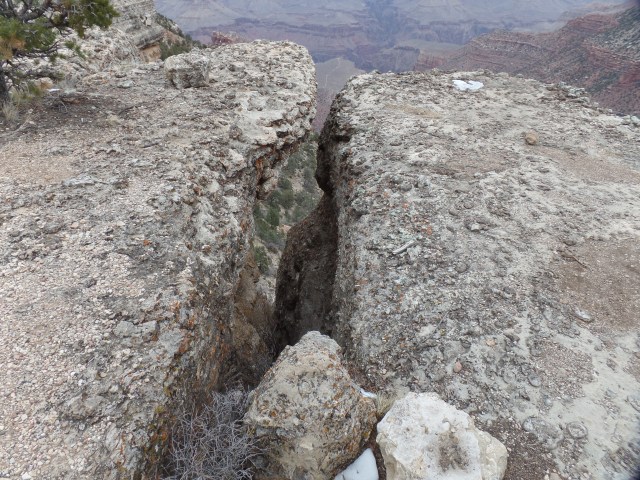
There are cracks and breaks actually included in Ms. Colter’s design.  She also placed a seemingly demolished brick wall, on the Tower’s south side- perhaps as a wind break.

SAMSUNG CAMERA PICTURES

The views from each level of the Tower are second to none. Below is a view of Venus Temple.

SAMSUNG CAMERA PICTURES

The area west of Desert View constitutes the Inner Gorge of the Grand Canyon, and features many of the “Eastern” and “Egyptian” formations, named for Indian and Egyptian mystical figures.  The Colorado River itself, though, is never far from focus.

SAMSUNG CAMERA PICTURES

For that matter, neither is the North Rim, which will be the focus of a second Grand Canyon visit, in late summer, in this year of the Park’s centenary.

SAMSUNG CAMERA PICTURES

Temple Butte, seen below, marks the eastern end of the Canyon’s rim.  From that point, eastward, lie the Navajo Nation and the Painted Desert, itself a defining feature of the Little Colorado/Puerco River Basin.

SAMSUNG CAMERA PICTURES

The interior of the Watchtower is no less captivating. Ms. Colter was enthralled from childhood with Native American art and lore, starting with Lakota Sioux drawings which she obtained from a friend, whilst living in St. Paul.  After goong to work fro Fred Harvey Company, that interest quickly extended to the art of the Dineh, Zuni and Hopi.

The panels below illustrate some Hopi spiritual concepts, painted by master artist Fred Kabotie, a key collaborator with Ms. Colter, in the course of her building decoration.

SAMSUNG CAMERA PICTURES

SAMSUNG CAMERA PICTURES

These stairs were likely used by Mr. Kabotie, during his time as the Watchtower’s caretaker.  Now, they are a simple decoration.

SAMSUNG CAMERA PICTURES

Animals being a major element of Hopi and Dineh culture, figurines have been carved and left in conspicuous places.

SAMSUNG CAMERA PICTURES

SAMSUNG CAMERA PICTURES

So, too, are pictographs, drawn here by Fred Kabotie  and his associates, but found in many places in the Southwest-and around the globe, as remnants of  ancient cultures. Pictographs are drawn rock art, as opposed to petroglyphs, which are carved into the stone.

SAMSUNG CAMERA PICTURES

The ceiling of the Watchtower is the one place where Ms. Colter let her associates run riot with colour painting.  The idea was to represent the fullness of the Universe.

SAMSUNG CAMERA PICTURES

It is from the third floor of the Watchtower, that images such as this may be gleaned.

SAMSUNG CAMERA PICTURES

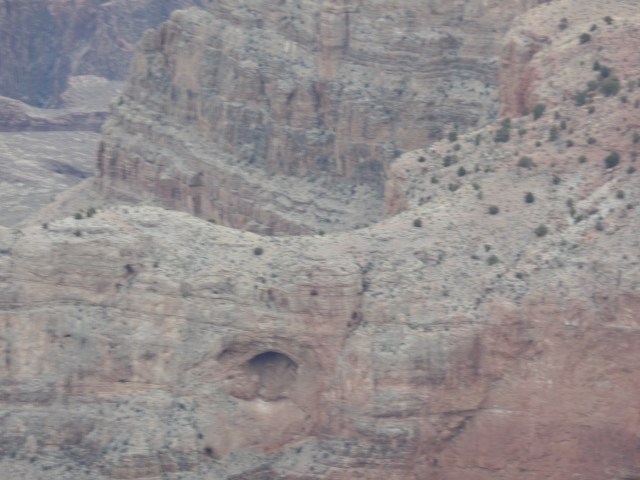
From here, I headed a bit further west, to Navajo and Lipan Points, getting further perspective on the Inner Gorge. The formations in the foreground are of Redwall Limestone and Supai Group of sandstone deposits, from the Pennsylvanian Period (332.2-289.9 million years ago).  This scene is from Navajo Point.

SAMSUNG CAMERA PICTURES

Redwall Limestone, (340 million years ago), is prominent, as the Canyon rises up to its Inner Gorge temples.

SAMSUNG CAMERA PICTURES

Here is a zoomed view of the Watchtower, from Navajo Point.

SAMSUNG CAMERA PICTURES

Also from Navajo Point, is a glimpse of what makes rafting the Colorado such an enticing experience for many.

SAMSUNG CAMERA PICTURES

As I reached Lipan Point, I found this to be the last scene from my present SIM card on the Samsung.

SAMSUNG CAMERA PICTURES

So, my trusty cellular was pressed into service.  Lipan Point, which juts headlong into the Inner Gorge, gives the area a compressed quality.  Don’t let the appearance of compactness deceive you.  The Inner Gorge is 18 miles across, at its widest point.

20190422_140711[1]

20190422_140715[1]

20190422_140718[1]

Here one sees the Kaibab Formation, the present “top” of the Grand Canyon, at the North Rim. 22 miles from Lipan Point, as the condor flies.

20190422_140820[1]

From Lipan, I drove into the forest a bit, for a look at Tusayan Ruin, a Pueblo II ( 900-1150) settlement which appears to have lasted well into the 13th Century, in the midst of Pueblo III cultures.

20190422_142401[1]

20190422_142516[1]

Here is a communal gathering place, perhaps for spiritual activities.

20190422_142523[1]

This  space appears to have served as an apartment for one of the larger families.

20190422_142707[1]

The people who lived at Tusayan likely intermarried with those of the Pueblo III culture, who had moved into the area, from the northeast, towards the end of the 12th Century.

My daylong venture along the two great gorges of the Colorado River system came to an end, but not my appreciation for one of the finest talents, of the Twentieth Century,  in southwestern architecture.  Mary Elizabeth Jane Colter surely rates on par with Paolo Soleri and Frank Lloyd Wright, in terms of contribution to the public square.


The Carving of A Confluence

6

April 22, 2019, Cameron, AZ-

I set out from Flagstaff, around 9: 30 this morning, heading to the western edge of this once sleepy sheep-ranching community, which is now tapping into the growing number of people who want to visit the Dineh (Navajo) people, see their starkly beautiful land and learn of their culture.

Here, at the foot of Gray Mountain, on the way to Grand Canyon National Park, lie two overlooks which capture that stark beauty and share an area regarded by the Dineh people as their point of emergence from the underground, following a long ago calamity, and thus a sacred site.

It is the last segment of the Little Colorado River, approaching and reaching its confluence with the Colorado River, after a 338 mile journey, from the White Mountains of eastern Arizona, through the Painted Desert and Coconino Plateau.

A two-hour exploration of the twin overlooks offered these scenes.  Whilst some will say, “Well, what is so special about black and brown stone?” , the geological story told by the three main layers of limestone (top), granite (middle) and shale (bottom) is, like that of the Grand Canyon itself, a classic account of wind and water working together, with a fair amount of help from volcanic and seismic activity.

SAMSUNG CAMERA PICTURES

In the far background, please note Navajo Mountain (Naatsis’aan), an igneous rock peak, the rises 10,387 feet, towering over Lake Powell, and like the lake, straddling the line between Arizona and Utah.

SAMSUNG CAMERA PICTURES

The layers of sedimentary deposit are quite visible, as one scans the rock, from top to bottom.

SAMSUNG CAMERA PICTURES

The water, whilst uniformly scant, looked clearer from the first overlook than from its western counterpart.

SAMSUNG CAMERA PICTURES

You may not that there is considerably more silt being washed into the river, as it moves closer to the confluence.

SAMSUNG CAMERA PICTURES

SAMSUNG CAMERA PICTURES

Looking closely, it might seem as if the granite canyon fascia resembles petrified warriors.

SAMSUNG CAMERA PICTURES

The algae working this limestone bench seems to show everything from a man with outstretched arms (foreground) to pictographs.

SAMSUNG CAMERA PICTURES

On the right hand side, below, the tall shafts of sandstone appear to be standing guard over the shallows of the Little Colorado.

SAMSUNG CAMERA PICTURES

In all the bareness, sage, a medicinal staple of the Dineh and Hopi, alike, grows in abundance. Desert bottlebrush is its accompanist.

SAMSUNG CAMERA PICTURES

The relatively wet winter has produced an effusion of greenery in the Gorge.

SAMSUNG CAMERA PICTURES

SAMSUNG CAMERA PICTURES

This struggling, but intrepid, river and its gorge, lead to the most spectacular sight on the North American continent.  In the next post, I will focus on the Grand Canyon of the Colorado River, at its east end, and the Desert Tower that overlooks the beginning of its Inner Gorge.


One Good Loop Deserves Another

2

April 7, 2019-

A week or so ago, one of Arizona’s premier hiking columnists, Mare Czinar, wrote of a new trail, branching in elliptical fashion off the Prescott Circle Trail, which I have hiked and chronicled, in the past three years.

A group called “The Over-The-Hill Gang”, loosely named for a Western movie set of characters, has taken it upon themselves to build this, and other new trails, as well as maintain older trails in the area.  I value their efforts.

The West Loop Trail begins at a large, new parking area:  White Rock.  Prior to this, those who wanted to hike in the region west of Thumb Butte had to leave their cars parked just off the road, or into the brush.  White Rock is a decent compromise, between “no footprint” activists and those who object to cars clogging the side of the well-traveled recreational road.SAMSUNG CAMERA PICTURES

The West Trail’s initial segment is .5 mile in length.  It features several granite and limestone boulder formations, so despite its brevity and flatness, this small sector is worthy of keeping one’s eyes open.  I reassured a tired little guy, doing the home stretch with his parents, that he was almost done.  It was nice to see that kept him going, instead of having Mom or Dad carry him.

The boulder fields are off-trail, thus making for a quick, easy start.

SAMSUNG CAMERA PICTURES

As with any large number of rocks, the imagination can show a given boulder to have a human or animal likeness.  I see the boulder in the background as George Washington.

SAMSUNG CAMERA PICTURES

Poking out from between two boulders is a charred tree limb, with the likeness of an angry snake.

SAMSUNG CAMERA PICTURES

These sandstone boulders are laid out, almost looking like segments of a large worm.  It was about here, that I turned left, onto the Javelina Trail, a part of Prescott Circle.

SAMSUNG CAMERA PICTURES

I took a brief rest at this spot, writing in my hiking journal, as to the ambiance of the place. I had the trail to myself, much of the time, with the preponderance of other users being bicyclists, whose presence is most always fleeting.  I step to the side for them, as downhill and flatland find cyclists going at a fast clip and uphill involves their huffing and puffing.

SAMSUNG CAMERA PICTURES

Here, I see another giant watchman, in the center of this scene.

SAMSUNG CAMERA PICTURES

This clump of boulders is another fine spot for sitting and meditating.

SAMSUNG CAMERA PICTURES

“Little Italy” is a side trail, which I will investigate on another hike.

SAMSUNG CAMERA PICTURES

This abandoned corral was part of a small ranch in the area, prior to the National Forest being established.  The rancher moved away, before the Forest took over.

SAMSUNG CAMERA PICTURES

All that is left of his home is this chimney.  It seems to have been used as an outdoor oven.

SAMSUNG CAMERA PICTURES

The reason for his choice of home is simple:  Here is the South Fork of Willow Creek.

SAMSUNG CAMERA PICTURES

From the creek, the path becomes Firewater Trail.  A brief climb takes us past this stern eagle-like formation.

SAMSUNG CAMERA PICTURES

Back on the flat trail, a dead alligator juniper resembles a welcoming totem pole.

SAMSUNG CAMERA PICTURES

At the junction of Firewater Trail and the homestretch of West Trail, a clever OTHG member placed this trail marker.

SAMSUNG CAMERA PICTURES

Surrounding peaks make their presence known, along the West Trail.  To the southeast, is Thumb Butte.

SAMSUNG CAMERA PICTURES

To the north is majestic Granite Mountain.

SAMSUNG CAMERA PICTURES

Working around a family who had come to this panoramic viewpoint for photos, I got this shot of the San Francisco Peaks.  SAMSUNG CAMERA PICTURES

After taking a photo of the three family members together, I headed down the last half mile.  Just before the parking lot, I came upon this little “critter”.

SAMSUNG CAMERA PICTURES

My left knee and cardiopulmonary system thank me for this afternoon- and I extend that thanks to the Over-The-Hill-Gang and the U.S. Forest Service.  It’s good to feel like old times.

Busan’s Magnetic Side

2

March 16, 2019, Busan-

SAMSUNG CAMERA PICTURES

This ancient port has become, like many large cities across the globe, a place of high rise, high density apartment buildings and intense, often grid-locked, traffic.  Nowhere is this more clear than in the area called Marine City, close to the popular Haeundae Beach and Strip.

We used our God-given feet today, the final day of my entry into a Korean family.  Our foci were two:  Dongbaek,  site of the 2005 Convocation of the Asia-Pacific Economic Council and Haeundae itself.

The night before, shortly after our arrival back in Busan, we headed directly over to an older section of the city, to patronize a restaurant owned and operated by family friends, the Paks.

SAMSUNG CAMERA PICTURES

As the sign implies  it is a place for people to get a dose of quality American-style food.  The father and son also serve what I regard as the best coffee in Busan, if not in all Korea.  I was fortunate to have been given some, to bring back with me to the U.S.

SAMSUNG CAMERA PICTURES

Here is a view of Dongbaek, from Gwangan Pier, near Marine City.  Conversely, once at Dongbaek, we had a fine view of Gwanggalli Bridge. It is said to rival the Golden Gate and George Washington Bridges, when lit up at night.

SAMSUNG CAMERA PICTURES

We spent several minutes looking at the APEC House, site of the aforementioned conference.  We joined a group of visitors from west Africa, on this fine morning.

SAMSUNG CAMERA PICTURES

Miniature pines abound, on this small headland.

SAMSUNG CAMERA PICTURES

Below is a fine view of the traditional pavilion and of Dongbaek Lighthouse.

SAMSUNG CAMERA PICTURES

This mural of a Korean country scene greets visitors to APEC House.  I refrained from photographing the auditorium, to protect the privacy of a young Korean family, who were making a detailed visit to the conference center.

SAMSUNG CAMERA PICTURES

SAMSUNG CAMERA PICTURES

Above, is a statue of Choi Chi-won, regarded as the first great Korean advocate of Confucian teachings and etiquette.  He lived during the Silla Dynasty, in the Tenth Century A.D.  Below, is a shrine to the great teacher.  At the summit of Dongbaek, it is a serene place, most of the time. We were there only briefly, as an older man started to pester us.

SAMSUNG CAMERA PICTURES

Here is a view of Dongbaek’s southern tip.

SAMSUNG CAMERA PICTURES

This Mermaid Statue commemorates the legend of a princess from a foreign land, who pined away for her homeland, day and night.

SAMSUNG CAMERA PICTURES

Haeundae Beach Park includes this shady, forested area. We walked there, easily, from Dongbaek.

SAMSUNG CAMERA PICTURES

Modern Korean etiquette eschews photography of people, without their consent.  I was able to catch a glimpse of Haeunedae Beach, sans bathers.

SAMSUNG CAMERA PICTURES

Rabbits are seen as good fortune, as well as being symbols of fecundity.

SAMSUNG CAMERA PICTURES

Here is the southeastern edge of Haeundae Strip, a bustling commercial tourist area, where we had lunch.  Looking for a chicken restaurant, we found they open at 2 p.m., which is averse to my schedule. So, we settled for more burgers-at one of  the ubiquitous Hello, Patty cafes.  The people in this photo shrugged their shoulders at being photographed, so no harm, no foul.

SAMSUNG CAMERA PICTURES

With that my time in Korea is drawing to a close.  My time as a member of a gregarious extended family is, however, just beginning.

NEXT:  Further reflections on Korea-and the trip back to Arizona


Jeju, Part 4: When Jeju Was Tamna

14

March 14, 2019, Song-eup, Jeju-

Korea abounds in traditional folk villages, as do many nations who seek to preserve their traditional culture-in the face on onrushing development and prosperity.  Jeju’s premier folk village, which I have visited on three other occasions, is Song-eup, not far from Songsan, in the eastern part of the island.

By chance, when Aram, Yoonhee and I arrived here, we were introduced to the same woman who had,as a newly-wed, told Penny and me about the way of life here, some thirty-two years ago.  I recognized her, though she didn’t remember me.  A good-natured, saucy young woman had matured into a dedicated advocated for preservation, with an encyclopedic knowledge of her subject.

These poles served as a gate.  If they were on the ground, this meant the residents were home and ready to receive guests.  If one pole was mounted, call out before entering.  If two poles were mounted, the residents were at home and did not wish to be disturbed.  If three poles were up, no one was at home.

SAMSUNG CAMERA PICTURES

Song-eup proper was, and is, a walled community.  Pirates from Japan were known to occasionally stage raids on towns, in the eastern and southern coastal areas of Korea.  This was enough of a problem that Korean Admiral Yi Sun-shin, one of history’s greatest military commanders, led his sailors to victory over both the pirates and their imperial enablers, in the Imjin War of 1592-98.  The walls helped stem the pirate attacks, in the short term.

SAMSUNG CAMERA PICTURES

This system of roof thatching was used by high and low alike, across Jeju.  The villagers on the west of the island used different material, but the system was the same.

SAMSUNG CAMERA PICTURES

Stone guardians, nowadays called dolharubang, or “stone grandfathers”, graced the entrance to every village in Jeju.  They are now symbols of the island’s culture.  The one on the right is an example of  Koreans’ playful spirit.

SAMSUNG CAMERA PICTURES

The black pig is one of Jeju’s primary domesticated animals-sometimes used as a watch animal, but more commonly raised as livestock.

SAMSUNG CAMERA PICTURES

This house, with its foreroof, is an example of a wealthier person’s residence,as it has an up-step.

SAMSUNG CAMERA PICTURES

Street art here is used mainly to depict animal figures prominent in Jeju lore- especially the dragon- here accompanied by snails.

SAMSUNG CAMERA PICTURES

Here is an example of a more humble person’s residence,with no up-step.

SAMSUNG CAMERA PICTURES

Roof thatch is replaced every five years.  These grubs are found, in the hundreds, thriving in the thatch.

SAMSUNG CAMERA PICTURES

Usually, grinding stones in Korea were pulled by oxen.  On Jeju, horses pulled stones like this one.

SAMSUNG CAMERA PICTURES

Masks were mounted as a defense against harm, in the days of shamanist Korea. Back then, Jeju was called Tamna.  Legend has Tamna established by three men, Go, Yang and Bu, who emerged from three holes-in an area, called Samseonghyol, that is still preserved in Jeju-shi.  Tamna simply means “island nation”, in Jeju’s indigenous language.  There are still a small number of indigenous Jejuans, living in the foothills of Halla-san.SAMSUNG CAMERA PICTURES

After thanking the docent for her time and sharing, we spent a few minutes in an educational institute, on the outskirts of Song-eup.  Here, another docent showed us more mock-ups of early village life.  Here is a display of an outdoor kitchen.

SAMSUNG CAMERA PICTURES

As we walked towards the walled, main section of the village, we spotted a fuller example of a long cottage, with an up-step.

SAMSUNG CAMERA PICTURES

This house was called the “House of Two Dragons”, by its early owner.  Thus, here is a sculpture of  the double threat.

SAMSUNG CAMERA PICTURES

Stone guardians can reflect a wide variety of expressions.  Most are serious; some can be mirthful.  These are definitely not in a good mood.

SAMSUNG CAMERA PICTURES

Here is the West Gate, through which we entered Song-eup proper.

SAMSUNG CAMERA PICTURES

Here is  a full view of a Song-eup street.

SAMSUNG CAMERA PICTURES

Large Korean cabbage, a primary ingredient in much kimchi, is a key crop of Jeju. It is related to the Chinese bok choi.SAMSUNG CAMERA PICTURES

Han Bong-il, a wealthy farmer of old Jeju, left this farmstead to the government, which now preserves it as an historic home.

SAMSUNG CAMERA PICTURES

This is the Peddler’s Inn, located in front of the main Guest House. The former housed people wishing to sell items to or supplicate the magistrate and other officials, who themselves stayed in the Guest House.

SAMSUNG CAMERA PICTURES

Here is the main Guest House.

SAMSUNG CAMERA PICTURES

This is the entrance to the  old seat of government in Song-eup.

SAMSUNG CAMERA PICTURES

This is Mokgwana, the actual office of the magistrate.

SAMSUNG CAMERA PICTURES

Large. old hackberry trees are often top heavy,with age.  This tree needed to be shored up by a system of cables and metal stands.

SAMSUNG CAMERA PICTURES

At this Confucian school, another docent guided us around the areas that are open to the public, whilst explaining that the main courtyard was off-limits, due to an earlier high volume of traffic, detracting from the serenity of the place.

SAMSUNG CAMERA PICTURES

Here is a fuller view of the school and courtyard.

SAMSUNG CAMERA PICTURES

We left Song-eup, in a tranquil mood. Headed westward, we stopped at a rest area, to get this view of Halla-san, rising proudly in the background.

SAMSUNG CAMERA PICTURES

The day was only half over!

NEXT:  Jusangjeoli and Jeongmyon- Two Wonders of Wind and Water