April 9, 2016, Prescott- Last Sunday, I threw in a 1-mile round trip side trail, to my Prescott Circle jaunt. Quartz Mountain is a unique promontory, in the mostly pine-clad, dry-soil terrain that is prominent in the western half of Prescott Circle. It appears to be the remnant of a volcano, which also makes sense, given that quartz is scattered from White Spar to an area just west of Thumb Butte.
I had the brief company of two men and three children, who had been atop the mountain for an hour or so, studying the quartz and learning of the different colour blends. Most, as you will see, are white quartz, though there is a fair amount of pink, and some two-tone.
East side of Quartz Mountain
I checked out this area, just below the summit, before heading up.
View from east slope of Quartz Mountain
Granite outcropping, north slope of Quartz Mountain
The views from any point near the summit are thrilling.
San Francisco Peaks, from Quartz Mountain
Now, here are several scenes of the summit.
Iron-tinged white and gray quartz, Quartz Mountain summit
Southwestward, from Quartz Mountain, towards Sierra Prieta
View of Quartz Mountain summit crest, from just underneath
Agave and prickly pear cacti, Quartz Mountain summit
As you can see, the desert aspects of Prescott’s status as a transition zone are quite prolific, even at 6,000 feet.
This little gem is one of several good reasons for side hikes, off the main Circle Trail system.
As it happened, today (April 9), was a good day for Segment 3 of the Circle. It’ll be featured in the next post.
April 6, 2016, Prescott- While we were living in Phoenix, in 2002, news came of a horrific wildfire, that was bearing down on Prescott: The Indian Fire. It could easily have swept through Thumb Butte and down Copper Basin, slamming full force into downtown Prescott. That didn’t happen, thanks to the Forest Service, and the fates of Nature. As it was, though, the Indian Fire seared a large area between White Spar and Copper Basin, leaving several square miles of sticks in its wake.
On Sunday afternoon, I walked in some of the same areas affected by the Indian Fire. Wolverton Mountain rises above the trail, though no family named Clowers lives there. Quartz Mountain is reached by a side trail, about 1/2 mile south of Wolverton. Both peaks were singed in 2002.
I began at the Copper Basin end of the segment, starting out on the Aspen Creek Trail. The creek comes down, from the western base of Wolverton Mountain, and flows down towards Granite Creek and downtown Prescott. The creek is barely flowing, and indeed, the ground in this area is badly in need of a soaking.
Trailhead, Aspen Creek Trail
Gray granite, Aspen Creek Trail
I came soon enough to the upper reach of Aspen Creek Canyon.
Aspen Creek Canyon
Aspen Creek Canyon, Prescott
Aspen Creek Canyon, Prescott
As the sun was getting a bit lower, I came to the junction with Wolverton Mountain Trail and Quartz Mountain side trail. Walking along the Wolverton, I had several fine views of the high ridge of the Sierra Prieta Range, of which these peaks are an eastern offshoot.
Sierra Prieta Range
Junction of three trails
Sierra Prieta Range, from Wolverton Mountain Trail
A glimpse of Wolverton Mountain’s practical use was visible from the trail, though the summit itself will be the focus of a future hike.
Summit of Wolverton Mountain, from trail.
Shortly after passing Wolverton’s eastern edge, I came to Quartz Mountain Trail. This unique promontory will be the topic of the next post.
April 5, 2016, Prescott- This past weekend, I was able to break this 6-mile section of juniper pine forest, quartz and gray granite into two hikes. It was prudent, due to a commitment here in town, each day. It also gave me more time to focus on the features of each part of the segment.
Saturday’s jaunt began at White Spar North Trailhead, going 3.5 miles to the junction with Quartz Mountain Trail. The entire segment is Wolverton Mountain Trail, about which more later.
Trailhead, north of White Spar Road.
Pink quartz arrangement, near White Spar
Gray granite outcropping, 1/4 mile northeast of White Spar
Above, are three scenes at the south end of the trail. Even this close to White Spar, there are many small fragments of pink quartz. The trail is rather flat, for the first 2 miles or so, until past this magnificent view of a local observatory, privately-run, and of the majestic San Francisco Peaks, seventy miles northeast, as the hawk flies. The Granite Dells may be seen, holistically, in the midground.
Northeastward view, from Wolverton Mountain Trail, Prescott
The East Peak of Quartz Mountain, seen in the next two frames, signals a slightly more rugged terrain.
East Peak, Quartz Mountain
East Peak, Quartz Mountain
I noticed small wonders along the way, as well, including this white quartz(below) and the upper jaw bone of a hapless raccoon, which I have left out of this gallery.
White quartz, at foot of East Peak, Quartz Mountain
This area was filled with blooming manzanita, another special treat.
Manzanita in bloom, near Quartz Mountain
The stopping point gave me incentive for a Sunday completion of the segment, starting then from Aspen Creek Trailhead, off Copper Basin Road. As this was done after a Sunday brunch, I was grateful for a somewhat more strenuous trail.
March 20, 2016, Prescott- I had the good fortune, this weekend, of being in two amazing places, locally. The first was Chapel Rock Conference Center, of which more in a coming post.
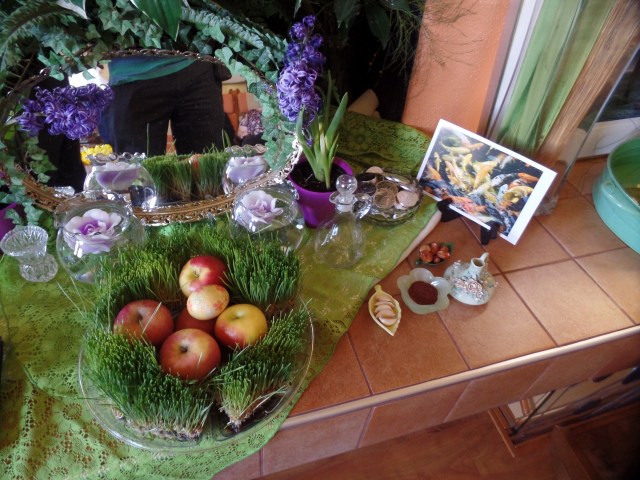
Today being Naw-Ruz, the first day of the Baha’i calendar, as well as an ancient Persian cultural festival (which used to last twelve days, I’m told, in the time of Zoroastrianism), I focus now on our community’s local celebration.
It was held, on this glorious afternoon, at the self-built home of two amazingly inventive and eclectic people, who I have been honoured to call friends, for over twenty years. Each time I visit here, there are new items either added to the house, inside or out, or in the works, in one studio or another.
When we sat for the devotional part of our celebration, the hostess was asked whether recorded music would be part of the program. She said “No”, and at that moment, the house itself began its music- in the form of three sets of wind chimes taking turns.
The chimes were not overly clangy, which would have not set a good mood, but gently interspersed our readings. Afterwards, we had a light meal, which sufficed this one’s appetite for the rest of the day. Some days are just meant for one meal, supported by snacks.
Here are some scenes of this lovely home, atop a bucolic hill.
Yard art, Prescott
The Seven “S’es” of Naw-Ruz
(See my next post, for a detailed description of this elegant holiday arrangement.)
The Iron Ring of Frontier Crag
Frontier Crag
Here are a couple of the reasons my friends were drawn here, in the first place. Note the embedded iron ring, atop the crag.
So, another fine year has begun for us Baha’is. I wish all my friends north of the Equator a lovely Spring, and all to the south, a bountiful Fall.
March 13, 2016, Prescott- “It is not yours to keep, this ever-changing trail”- Laura and the Killed Men, “The Ever-Changing Trail” (All rights reserved, Laura Kepner- Adney and Sam Golden, 2015).
I sat, joyfully, in one of my favourite evening live music venues, The Raven Cafe, and listened to this Tucson country-folk band’s first set. The line above is from their a capella set closer.
They excel with instruments, also.
Include the video, as it happened that the evening was a fine counterpoint to two hikes I took this weekend, on Prescott Circle Trail. Yesterday afternoon, the spontaneity of which I wrote, a few posts ago, kicked in. I accepted the urge to do a “fill-in-the blank” hike, to the top of Badger Peak, which is circumnavigated by Section 7 of the Circle. The peak is also called “P” Mountain, owing to the large white first letter of my adopted town’s name.
Here are some scenes. The first two were taken from the access road, to which I transferred from Prescott Circle, at the half-way mark to the summit.
View from road leading to Badger Peak summit
View of Government Canyon spur, from Badger Peak access road
Communications Towers, Badger Peak summit
P is for Prescott, Badger Peak summit
View of Watson Lake, from Badger Peak summit
The third photo shows a communications station, atop the peak. The white circular arrangement is the top of the P. There is no access to the arrangement, in its entirety, without permission of the Yavapai Nation, which owns the mountain. The final photo shows Watson Lake and the Granite Dells, from the summit. This hike was four miles, round trip.
This afternoon, a friend, who had wanted my help with a remodeling project, postponed it until next week. This gave rise to spontaneous hike # 2: Segment 5 of the Circle. It is a ten-mile round trip, something I’ve not done during the Fast.until today. I was inspired in this by another friend, who is both older and physically smaller than I am, and who hikes and runs during this time period. So, out of my comfort zone I went- with enough water on which to fall back, in the event I felt weak. As it happened, that was not a problem, as the air was cool this afternoon, and the Sun was hidden by clouds, most of the time.
This segment goes from a point south of Upper Goldwater Lake, around the south and west shores of that body of water, above the west shore of Lower Goldwater Lake, which is closed to the public and through Prescott National Forest, to White Spar Campground. This hike was ten miles, round trip. Sitting here tonight, I feel refreshed and focused.
Here are some scenes of Segment 5.
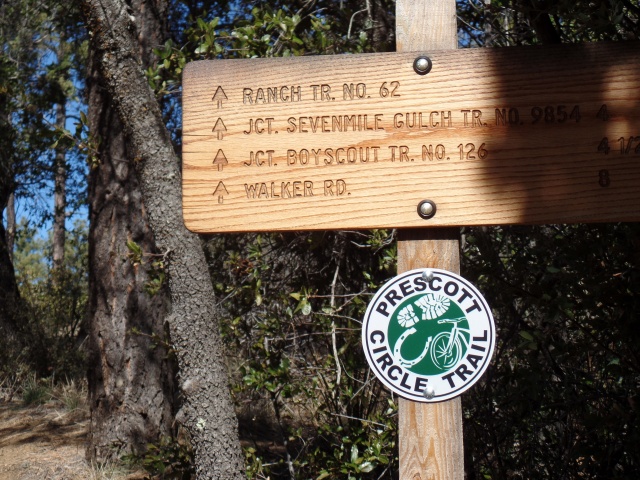
Trailhead sign, Prescott Circle Segment 5
“Tree-pod”, south of Goldwater Lake
Note the “Tree-Pod”, on the right.
Gray granite boulders, south of Goldwater Lake
South shore, Upper Goldwater Lake
Pair of daisies, Prescott Circle Trail
Memorial to Yarnell Hill Firefighters
On the left are a pair of daisies, seen along the way, above Lower Goldwater Lake. The heart-shaped stone memorial, on the right, is dedicated to the 19 firefighters who died at Yarnell Hill, in June, 2013. It is atop a ridge, 1 1/4 miles southeast of White Spar campground.
View from Monument Ridge, south of White Spar
Trailhead, White Spar Campground
The Sierra Prieta range can be seen from Monument Ridge. On the right, is the trailhead at White Spar Campground. I spent only ten minutes, resting, at this very full facility. There were 2 hours’ back journey left.
On the way back, I stopped for several minutes at this lovely nook, Banning Creek.
Small pond, Banning Creek
Small pond, Banning Creek
There had been a fair crowd here, when I was headed towards White Spar. When I returned, only one lone bicyclist and I had the place to ourselves- and he was about to leave. I saw very few other people, the rest of the way, until I got back to Upper Goldwater.
Now, with the next two weekends booked, I will wait until April to take on the next segments of Prescott Circle- unless things get canceled and spontaneity calls.
March 7, 2016, Prescott- This past weekend featured my shortest visit to southern California, since July 3, 2013. It was truncated by the intense storms hitting the region- with rare Winter electrical elements, and hail, in the mix.
My visit with my son, Aram, was the main reason for the journey. It is indicative of how much of me he has absorbed, that he asked whether I was just “swinging by” on the way to see friends. It is true that, in the past, I have combined a visit with him and those with friends in Orange County and Los Angeles. That was not the case this time, as both weather and fiscal prudence put the latter two segments on hold, until early June.
One of the things I enjoy doing is connecting people with places in the area where I happen to be, that they enjoy or find useful. I do this here in Home Base, and I was able to do so with Aram, in Chula Vista. I introduced him to a small Thai restaurant, near his home, on Saturday night. Yesterday afternoon, we discovered Rice Canyon, a lovely trail just ten minutes’ walk from his apartment. This trail system, a feature of the City of Chula Vista, gives area residents a lovely venue for hiking, biking and jogging.
Here are some scenes of this floral, riparian preserve.
Palms, Rice Canyon, Chula Vista
Copse, Rice Canyon, Chula Vista
North Trailhead, Rice Canyon, Chula Vista
There is a pleasant mix of desert and subtropical flora here, as elsewhere in the San Diego area. Palm trees abound, though they are in a state of drought-induced duress right now.
Here is a steep side trail, leading to a housing area just west of Rice Canyon.
Lemonade Berry shrub “forest”, Rice Canyon, Chula Vista
Hidden creek, Rice Canyon, Chula Vista
Erosion, mostly man-made, is a concern for the friends of Rice Canyon. Aram was underwhelmed at the notion of “side trails”, in the preserve. Lemonade berry shrubs(above/upper right) provided the Kumayaay people with a sour beverage. A small creek, (above, lower right) peeked out at the discerning walker. Myrtillocacti (below) are also common in the South Bay of San Diego and the Tijuana Estuary.
Myrtillocacti, Rice Canyon, Chula Vista
We had a fine introduction to the canyon, during a seven-hour respite from the rain that graced southern California with its presence. This morning, no sooner had I left the city, than the rain resumed, with a vengeance.
February 28, 2016, Rimrock, AZ- I spent yesterday, it seemed, with fork or spoon in my hand, from 2-6 P.M. There were three gatherings: The first, a lovely afternoon tea, was the big meal of the day, it turned out. Then, there was a small gathering at a local bakery (I had a cup of soup),followed by an appearance at a chili cook-off. The last one only had smatterings left, so the meal ended up being, thankfully, paltry- though, being chili, it was full-on tasty.
So, today, I headed off to visit some long-time friends near Montzeuma Well, a beautiful and refreshing extension of Montezuma Castle National Monument, on the northeast end of the town of Rimrock. Further northeast, still, lies Bell Trail, which sometimes parallels the Verde River tributary of Beaver Creek, and sometimes follows a path down to the creek.
So, after a light lunch, and visiting with the family as a group, while they put together a rabbit hutch, for Hako,
Hako
I headed out, with one of the family members, to explore Bell Trail. The various stops,along the trail, gave much time for meditation, even as I listened to my friend’s stories of adventure, both home and in far off lands. I shared a few of my own, along the same lines.
Beaver Creek
Mogollon Rim, southeast of Bell Trail
Beaver Creek, off Bell Trail
Near Beaver Creek
Sandstone formations, off Bell Trail
Sandstone “fortress”, off Bell Trail.
Sandstone “castle”, Bell Trail
“Tree Arch”, framing cinder cone, Bell Trail
Beaver Creek, viewed from “The Crack”, Bell Trail
Small hideaway, Bell Trail
The trail ended at “The Crack”, an overlook and creek access point that is popular with students from Northern Arizona University, as well as local youth. The whitewater of a currently deep Beaver Creek is visible above, at lower left. While we we there, about a dozen youth were there, and several more were en route, as we took the return trail. It was tempting to get in the water, with temperatures in the upper 70’s, though when we stuck our hands in the creek, it felt like the water was about 55. That didn’t stop some of the younger folks from jumping in, though!
The afternoon was another well-spent day on the trail. I also thoroughly enjoyed my hiking companion’s stories of time spent in China, Tibet, and the Navajo Nation. Many of the latter experiences I shared, having been among the Navajo and Hopi, for 11 years.
February 15, 2016, Prescott- I spent yesterday afternoon not being a nuisance to anyone, and finishing my walkabout of Segment 6, on the Prescott Circle Trail. Long segments, such as this, can be broken into two manageable hikes. Today, I started at the trailhead that lies across a narrow, but busy, highway from Goldwater Lake. There was plenty of parking in the dirt lot, so by 1 PM, I was bound for the point at which I stopped on my last visit to this route.
The first part of the trail was dry, which was fine by me, as it was also the closest thing the trail offered to being steep. Mud, and snowpack, came a bit later, and were a constant, for the length of the trail. There are seven “fingers” of Government Canyon that impact this section of trail, but not as much up and down, as in the eastern part of the canyon.
Two hours after I started, the segment’s end came, at the three-way junction of Prescott Circle, Boy Scout Trail and Turley Trail. Boy Scout leads to Walker Road, near Lynx Lake. Turley, whose trailhead is a mile east of my house, brings one back towards downtown.
With my car back near Goldwater Lake, I tooled around the back country of Government Canyon, for about an hour, then headed in reverse.
Here are a few scenes from this workout, which resulted in 10 miles, altogether.
Western end of Segment 6, Prescott Circle Trail
SAMSUNG CAMERA PICTURES
SAMSUNG CAMERA PICTURES
Above, are two views of Goldwater Lake, which has upper(left) and lower (right) halves.
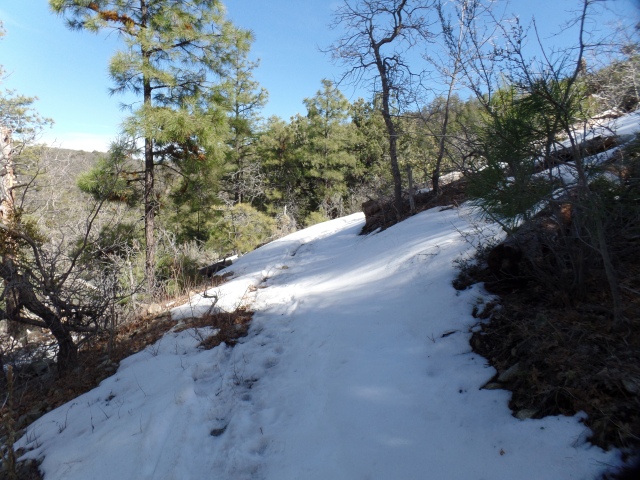
Snow appeared frequently, along the north side of the canyon, as one might expect.
Snowfield, on east side of “finger” Number 3, Government Canyon.
Junction with Boy Scout Trail
Limestone field, Seven Mile Gulch, Prescott National Forest
I reached my turn-around point (left), and felt the urge to look around. So, I did an extra loop, including this limestone outcropping, on Seven-Mile Gulch Trail. This became a two-mile loop.
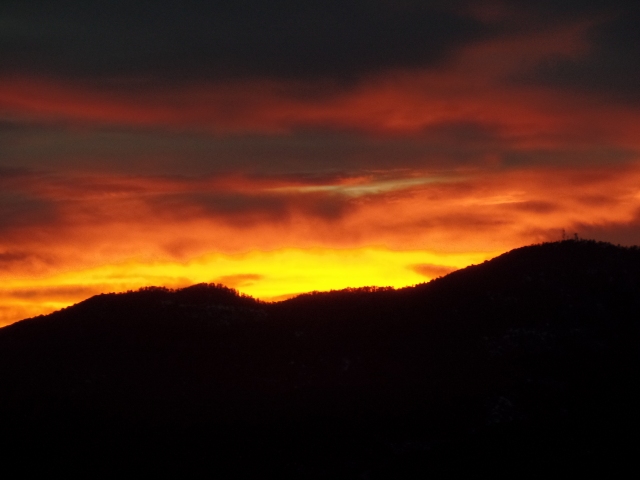
The return hike was not strenuous, and I made it back to the west-facing section of trail, in time for a glorious sunset.
Sunset near Goldwater Lake, Prescott, February 14, 2016.
So it is that I have completed half of the Prescott Circle Trail. In truth, though, with trails, one is never “done”. The stunning scenery is here for anyone who needs a lift.
January 31, 2016, Albuquerque- One of the places Penny and I liked in the Duke City was Rio Grande Nature Center. As the name implies, it celebrates the great river that plies Albuquerque’s west side, on its way to becoming the Rio Bravo and a feeder for the Gulf of Mexico.
The last time I was here, it was summer, my wife was alive and well, and our son was about 8. Now, it’s winter, Penny has been at rest for nearly five years and Aram is pushing 28, doing just fine on his own.
I’m good, though, because of places like this. These refuges, with their waterfowl and raptors, tangled trees of the bosques and True Believer hikers and bicyclists, work their magic, regardless of how bare the trees are, or how turgid the river tends to be. The majesty of the place lies in the comfort it gives to the birds, and to those, like me, who can sit and watch their antics, for hours on end.
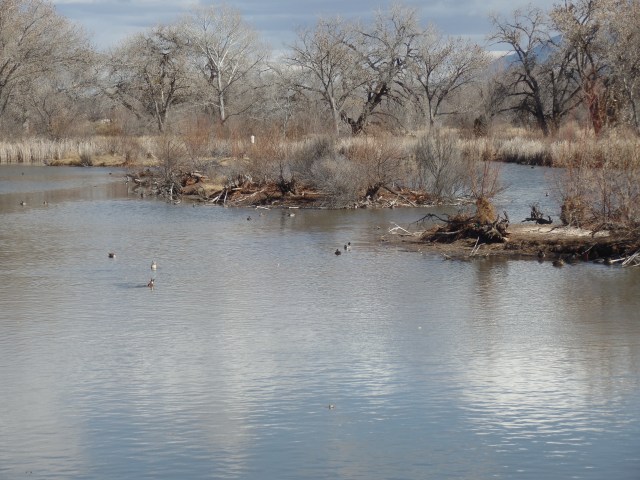
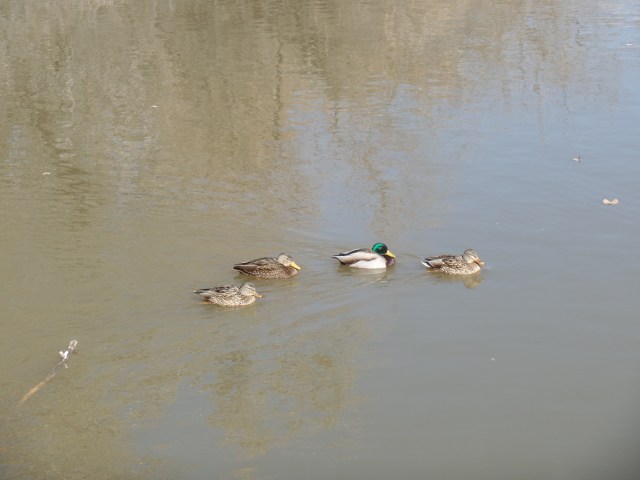
I didn’t have, nor take, those hours, today. There was a storm to outpace: One that the locals here were expecting, but which was still churning from California to western Colorado. Nonetheless, this visit gave me a bench by the river, a picnic lunch at that bench, and the joy of watching the ducks, Canadian geese and lesser sandhill cranes compete for the silver minnows and other fish that Rio Grande serves up.
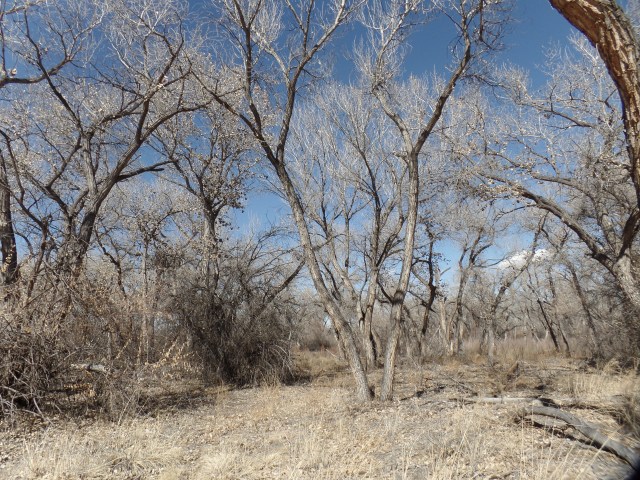
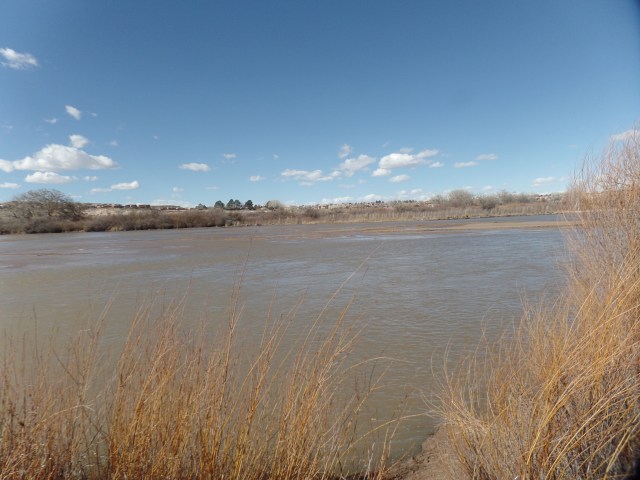
Without further ado, here are a few scenes of the Rio, its feeder Silver Minnow Channel and the bosque, in its own state of repose.
Entrance to Visitors’ Center, Rio Grande Nature Center
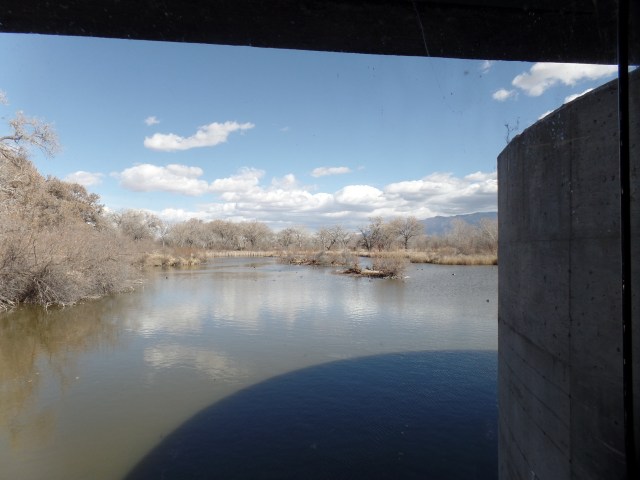
View of Silver Minnow Channel, from Rio Grande Visitors’ Center
Rio Grande, Albuquerque, NM
Ducks, trying to stay warm, Rio Grande Nature Center, Albuquerque
Sand bar, Rio Grande, Albuquerque. These spots are good places for insects, and other food sources for the birds, to hunker down and wait out the cold.
Somnolent trees, along Bosque Loop Trail, Rio Grande Nature Center
Rio Grande, Albuquerque
Rio Grande, Albuquerque
Jetty jacks, salvaged from Silver Minnow Channel, Albuquerque
Rubber heart, Aldo Leopold Trail, Rio Grande Nature Center
I have seen this river run higher, and have seen it at a trickle. I have stood on its banks near Brownsville, TX and near its headwaters, in the mountains known as Sangre de Cristo. Nowhere does the Rio Grande reach out to comfort its patrons more than it does here, at the western edge of a bustling, but heritage-laden metropolis.
January 24, 2016, Black Canyon City- I returned to the Black Canyon National Recreation Trail, this afternoon, with a long-time family friend and her dog in tow. This hike was 5.5 miles round trip, not as intense as last week’s jaunt, but exactly what I had in mind.
We parked in the spacious Trailhead Lot, just north of Black Canyon City, and were treated to a taste of the lushness this section of the Sonora Desert offers.
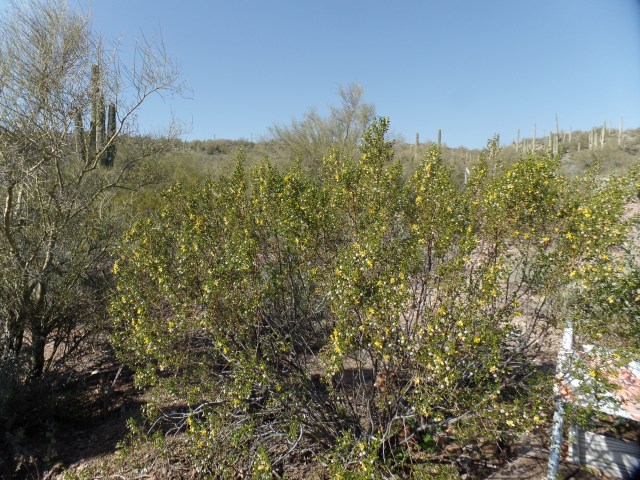
Blooming creosote, Black Canyon City Trailhead
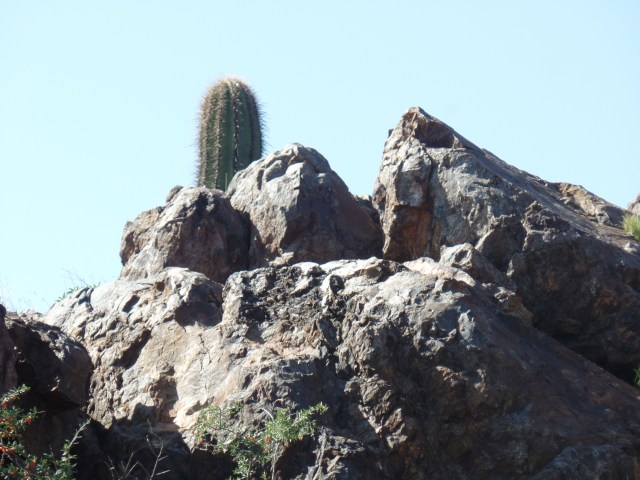
Ocotillo and sahuaro cacti, Black Canyon City Trailhead
We headed out, up a 1.1 section of trail called Horseshoe Bend, being on the south side of the feature of the same name, which was my stopping point last week. It is not a strenuous trail section, and offers a few anomalies, such as the Pharaoh’s Face. At the 1.1 mile point, Horseshoe Bend meets two other segments: K-Mine and Skyline. We took the K-Mine Trail, which took us close to the spot where I stopped last week.
Pharaoh’s Face, with a barrel cactus keeping watch, Horseshoe Bend segment, BCT
Friends along for the afternoon, junction of Horseshoe Bend and K-Mine Trails
The K-Mine Trail features mild switchbacks, down into a vast valley, outside Black Canyon (the natural feature). The cacti and succulents here take full advantage of the water wealth proferred by the Agua Fria and its tributary streams.
K-Mine Trail, west of Black Canyon City
K-Mine Trail, west of Black Canyon City
Desert valley, west of K-Mine Trail
The K-Mine Trail offered striking vistas, before taking us down to the Agua Fria, southwest of last week’s fording spot.
K-Mine Trail, at dry tributary of Agua Fria
Heart-shaped rock and others in stone field, K-Mine Trail
View of north Black Canyon City, from upper K-Mine Trail.
We explored a bit along the Agua Fria, but my intuition said it would be best for the three of us, that we turn back. This did not happen, though, before we checked out a small cataract, a bit upstream from the K-Mine Trail.
Edge of box canyon, along Agua Fria, near the K-Mine Trail
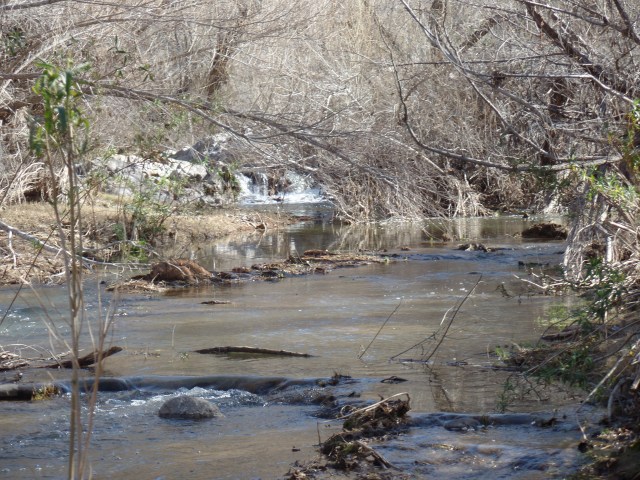
Agua Fria River, north of Black Canyon City, with small cataract in the background.
We met three young ladies, riding a quad and a small motorcycle, and watched as they gingerly negotiated the river. After returning to the trail proper, we found yet another crossing place, but again I had a feeling in my gut to turn back. So, up the K-Mine Trail we went again. The short section of trail to my last stopping place can wait for another day. Everyone’s well-being mattered more.
On the way up, we spotted a couple of cactus wren nests. One was wedged in between the arms of a sahuaro.
Cactus wren nest, K-Mine Trail
With such confirmations as these, and several heart-shaped rocks along the way, we called the day a success. More exploration of the Black Canyon Trail, and other such routes in Arizona, await, over the next several months.






















 A Sagittarian Seeker