On April 26, 1777, Sybil Ludington, 16-years -old, rode from outside Carmel, NY to Danbury, CT, warning all who would listen that the British were moving up the Still River Valley to Danbury, where British General William Tryon was leading a force which intended to burn the community, as it had been a key provisions site, for the Continental Army.
Her warnings aroused enough resistance and emergency evacuation, that the Continentals’ losses were significantly limited. Sybil’s ride, over 40 miles, was longer than that of Paul Revere, and over rougher terrain. Hers was thus the second clarion call of the American Revolution.
Danbury preserves much of the heritage of the Revolutionary War Era, including a Freedom Trail, somewhat shorter than its counterpart in Boston, but a vital record of out nation’s beginnings, regardless.
Downtown Danbury’s centerpiece is Elmwood Park, a median with a fountain, that attracts many families throughout the day.
It was already getting hot, when I happened by here, and small children were making the most of the dripping water.
Below, is a row of early Nineteenth Century buildings along the Main Street Historic District.
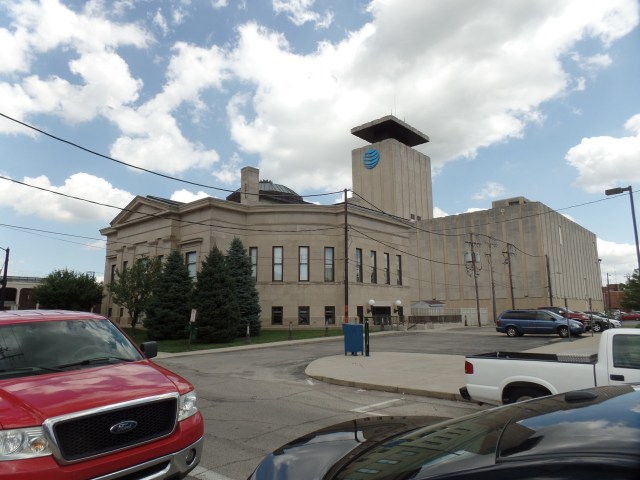
Of more recent vintage is this branch County Courthouse.
From the era of Sybil Ludington is Rider House, one of the few remaining colonial-style houses in downtown Danbury.
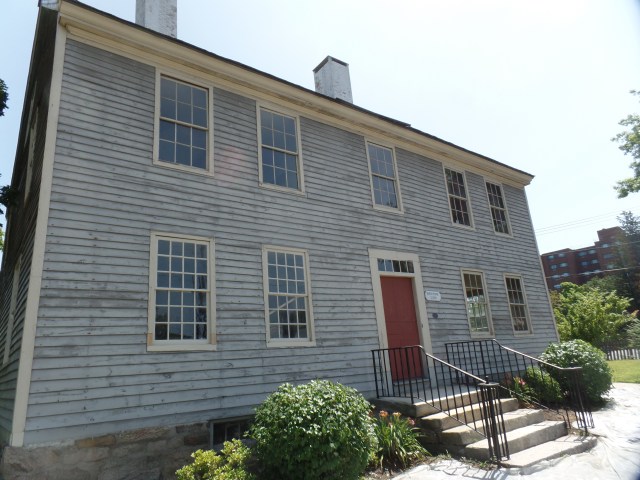
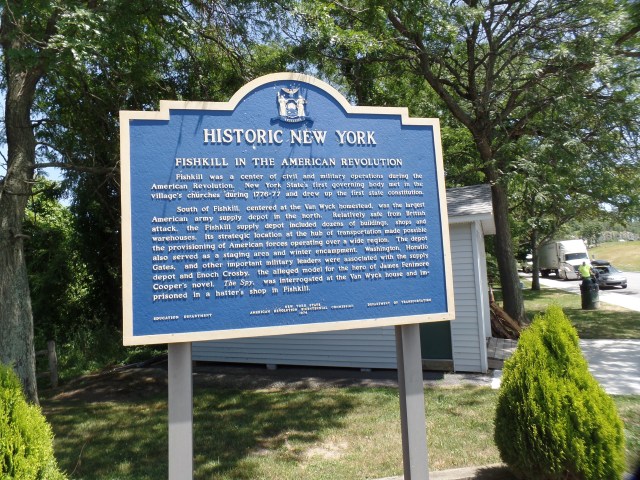
Fishkill, west of Danbury, was likely on Sybil’s route and was a center of resistance to the British advance up the Hudson Valley.
Danbury has much more to be seen than I took in, this morning, I did find a gem on Main Street: Padamina’s NY Bakery, which offers Brazilian cuisine. Having never enjoyed the fare of the South American giant, I took in a plentiful buffet plate of large chicken croques, marinated salad and grilled plantains. Padamina’s is well worth the stop.
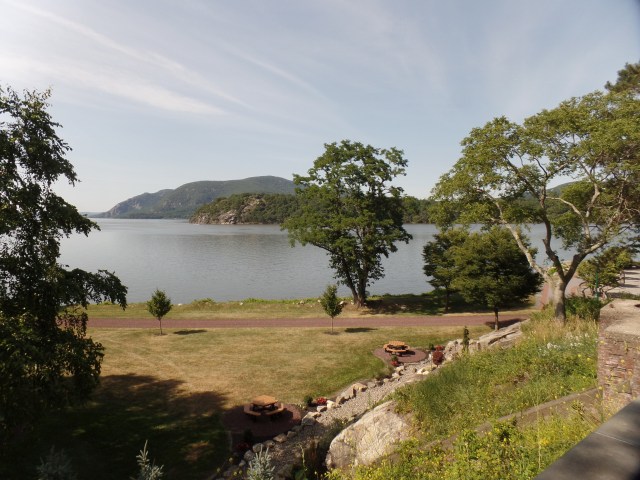
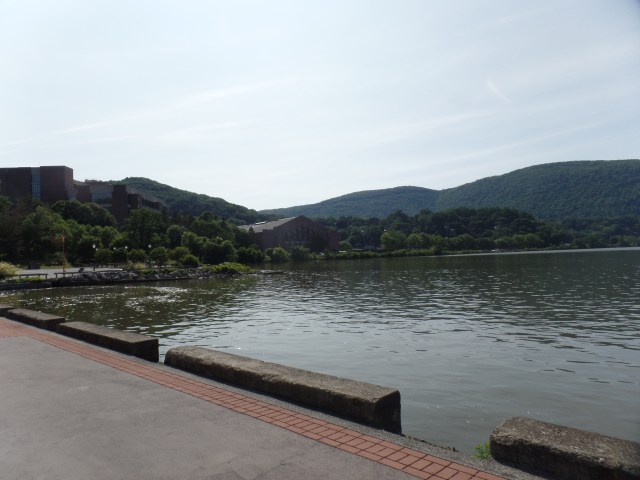
I will be glad to return to Danbury on a future jaunt, but now it’s time to head to West Point and the United States Military Academy.
I learned much from my growing-up years in Saugus-certainly a lot more than some people, who knew me when, ever suspected. Some, especially in my family, still wonder how I’ve made it this far, ever managing to get out of my own way. Truth be known, what I learned as a child and teen determined what I retained from my college and university days, and from many experiences thereafter. I learned to survive in Saugus and how to thrive in Amherst.
Amherst both sheltered me from the real world and engaged the stretching of my comfort zone. I came to this place of five institutions of higher learning, at a time when the women’s movement was coming into full flower (no pun intended) and when the residue of the anti- war movement was settling into an ennui of apathy. Watergate rekindled a sense of outrage, for a time, but with Richard Nixon gone, by the Fall of 1974, many were back to focusing on I, Me and Mine.
I returned here today, for the first time since graduating in 1976, to see what, if anything, had really changed. Amherst College is still the centerpiece of downtown. The University of Massachusetts is the town’s largest employer. Mount Holyoke College, Smith College, and Hampshire College lie in a semi-circle to the south of Amherst, I took a stroll around Amherst College and downtown Amherst, before heading up to the University campus.
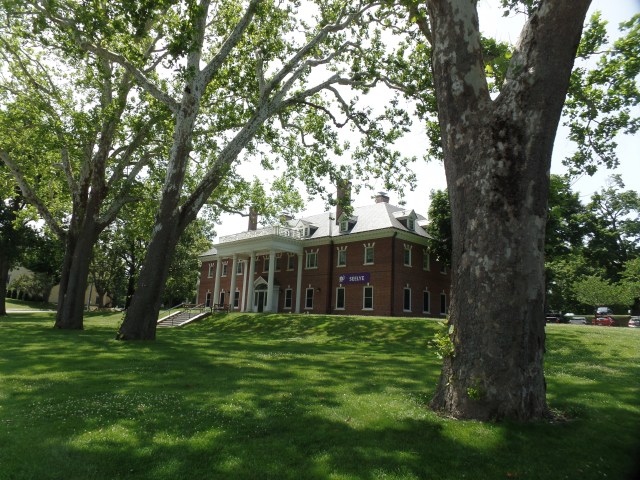
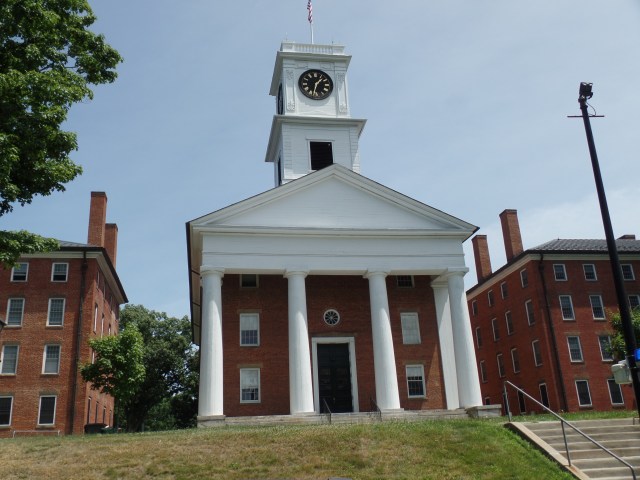
Here a few views of Amherst College.
The Loeb Center is a job placement hub for Amherst graduates.
Bassett is one of two planetariums in Amherst. Orchard Hill, on the University of Massachusetts campus, is the other.
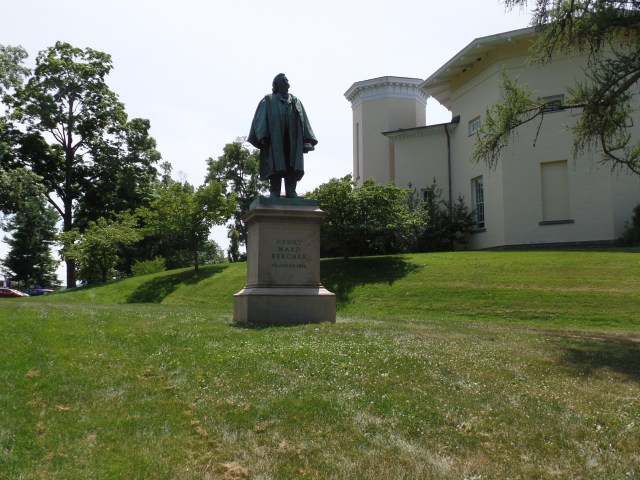
Henry Ward Beecher was a pioneer in the abolitionist movement, but was later the focus of scandal, showing the two sides of even the most ardent of social reformers. Nonetheless, he is honoured by Amherst College as one of its most prominent alumni.
Lawrence Observatory, to which Bassett Planetarium is attached, is one of the first astronomical observatories in the United States, having been built in 1847.
My walk around Amherst town began with lunch. Fresh Side is a lovely Asian fusion cafe.
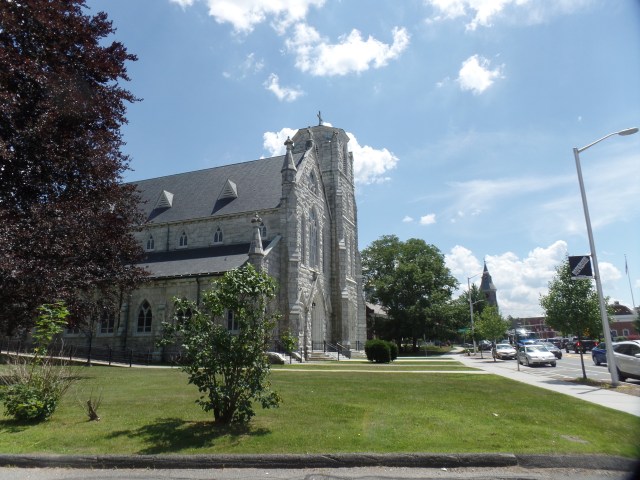
St. Brigid’s Roman Catholic Church is one of the most prominent non-college edifices in town.
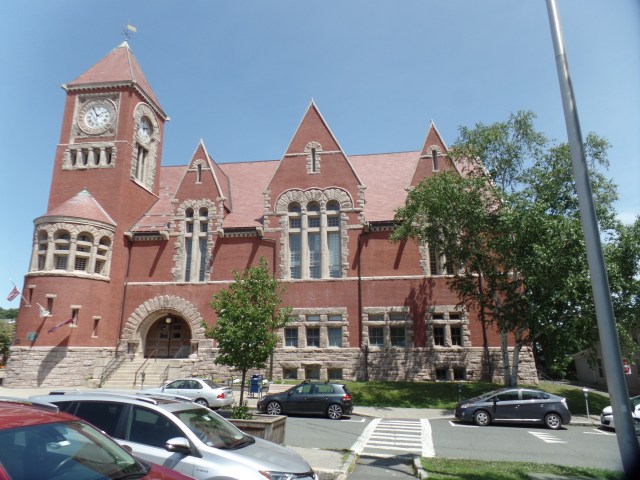
Amherst Town Hall, though, is the signature Town Center building, across from the Town Green.
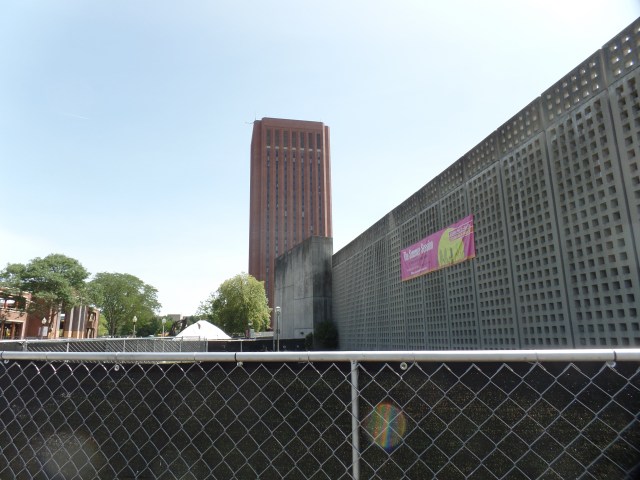
Fast forward a bit and I found myself gazing at the High Rise Dormitory, completed just before I attended the University.
Here is the Sciences Complex.
This scene appealed to me, as a fusion of two starkly different architectural styles.
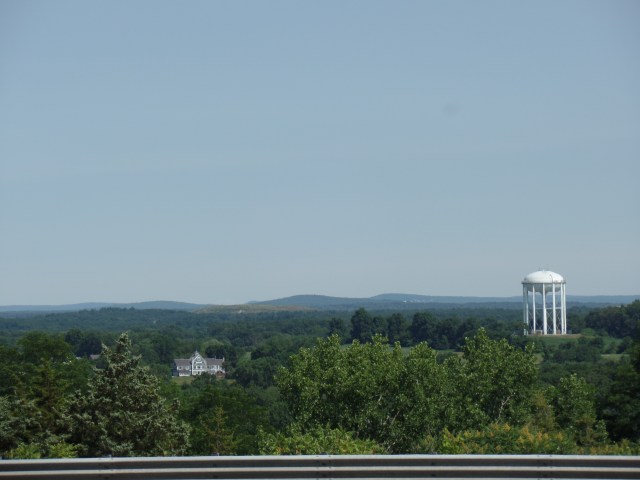
I headed south, after a brief visit to the University Commons, and gazed towards Mt. Holyoke, from a highway rest stop. The Five Colleges were a solid unit in the 1970’s and are even more vital an educational force now. The concept of a unified and diverse educational consortium has only gained traction, in the decades since.
NEXT: Danbury, The Second Clarion of the American Revolution
The fine North Carolina author, Thomas Wolfe, famously used, “You can’t go home again.”as the title of a novel, which he never lived to publish. His associates took care of that, sometime after his death in 1938, and we have the title as one of the more memorable things with which he is associated. The quote, though, originated with an Australian writer, Ella Winter, who gave Wolfe permission to use it in his writing.
I’ve been going back to Saugus, continuously, since I left here at age 18. Service in the Army, college, a quixotic two years getting my bearings in Maine, and then Arizona, South Korea and back to Arizona, all have had a common denominator: Hometown has never gone away.
There have been changes: The population has grown, from 25,000 to about 38,000; traffic has increased accordingly; the once lily-white community has opened its doors to people of colour; Hilltop Steak House has given way to Restaurant 110; most of the neighbours have died or moved away.
There are, though, things which endure: My mother is still living, quite well; two boyhood friends still live in the neighbourhood-one in his childhood home; Adams Avenue, the street of my youth, is still within walking distance of both Saugus Center and Cliftondale Square-as well as the West Side’s large shopping mall, Square One; traffic on U.S. Route One can still be daunting at times, though after dealing for so long with traffic in much larger cities, I know not to cringe.
We had the usual family gathering, this time at a niece’s large, beautiful new home, about 1 1/2 hours west of here and dropped in on a nephew and his family, in a town twenty minutes south of Saugus. These visits are fleeting, but far better than not seeing these gracious, beloved people at all. There was a visit to the aforementioned 110, where I got my fix of fried clams, a boyhood staple. There were the customary Hallmark movies and binge watching of old episodes of “Blue Bloods”, one of Mom’s favourites. There was a surprise, when Mom decided to check out a couple of Marvel films, on SyFy. She had enough, after “Iron Man”, but “Spider Man” was a hit.
I come from large families, on both sides. There are many cousins, some I haven’t seen in years, and a few aunts and uncles still living. The group will hopefully get together in late August. Though I won’t be there, people have to start with what they have available. I have been able to connect with a cousin in the Midwest, as you know, and will hopefully make more connections, in future visits. Gradually, the in-gathering progresses-with social media at least keeping the ties from fraying.
So, not to judge Ella Winter, for the circumstances of her life, but I CAN, and do, go home again. If nothing else, home remains in the heart. We four, and our extended family, want Mom to keep on, so long as life offers her a measure of blessing. May she keep the flame, until it’s time to pass the torch on.
In all the years I lived in the Bay State, even when I was in attendance at the University of Massachusetts-Amherst, there were areas to which I never quite made it for a visit. One is the region of the Berkshire Hills that lies south of the Massachusetts Turnpike.
This morning, as I drove from Poughkeepsie, through Connecticut’s Taconic Hills and into the state of my birth, the opportunity to spend a bit of time in the southern Berkshires, entering at Sheffield and stopping for lunch at Egremont Market/Mom’s Cafe.
I enjoyed half of my sandwich at a picnic table, outside by Hubbard Brook, which is hidden by a lush forest. The New England and Mid-Atlantic states have a fabulous forest cover, surprising to some-given the density of population between Boston and Richmond, or Charlotte, for that matter. I never once, growing up in the Boston area, felt at a loss, when I needed a forest break.
As I was finishing my meal, a man who was through-hiking a section of the Appalachian Trail, that he had previously missed, sat briefly at the next table. As we conversed, he mentioned needing a ride to the Post Office in Great Barrington, the largest town in the southern Berkshires, so as to pick up his mail from General Delivery. Samuel seemed a pleasant sort, hailing from Houston, so I agreed to take him up to GB.
His tips could be useful, should I ever follow the long-distance hiking option, one of three post-retirement routes I’m considering. Certainly, a series of General Delivery boxes eliminates a major impediment to such travel.
After dropping Samuel off near the Post Office, I took a few minutes to pick up a replacement for an implement that had broken, earlier this journey, and took a few photos of Great Barrington’s downtown.
Here is St. Peter’s Roman Catholic Church. Up the street, in the background, is First Congregational Church.
First Congregational is better seen below.
There is much that would lend itself to a longer stay in the southern Berkshires, but for now, I must head to the town of my childhood and youth. Besides, it’s hot and my passenger side window is not working right.
NEXT: Reflections on A Holiday Weekend, “Back Home”
In 1971, I viewed a film called “The French Connection”, a fictionalized account of New York Police Detective Eddie Egan and his work on a case involving a French heroin smuggling syndicate, and their New York associates. Gene Hackman played Egan, using the pseudonym, “Popeye Doyle”. In one scene, Popeye interrogates a suspect in a routine case, asking him “Do you ever pick your feet in Poughkeepsie?” The suspect is sor attled by Popeye’s pushing the issue that he confesses to the actual crime of which he is accused.
That put Poughkeepsie on the map for me. About a year later, I was given a ride to the town, by some frat boys from New Paltz State University, which lies northwest,across the Hudson River. Poughkeepsie didn’t impress me as a place where people would travel, to engage in weird behaviour, but one never knows.
I stopped here to get a glimpse of how the town was faring now, after reading how it is being compared with Newburgh, a few dozen miles to the south. Both are viewed by some New Yorkers as down-at-the-heels, miniature versions of the city’s own crime-ridden neighbourhoods.
I found Poughkeepsie to be in a slightly better state, right now, than Newburgh-at least with respect to its downtown area. It is a somewhat bigger city, and serves as the commercial hub of the Mid-Hudson Valley.
As in Newburgh,I focused on the architecture and the city’s relationship with the river.
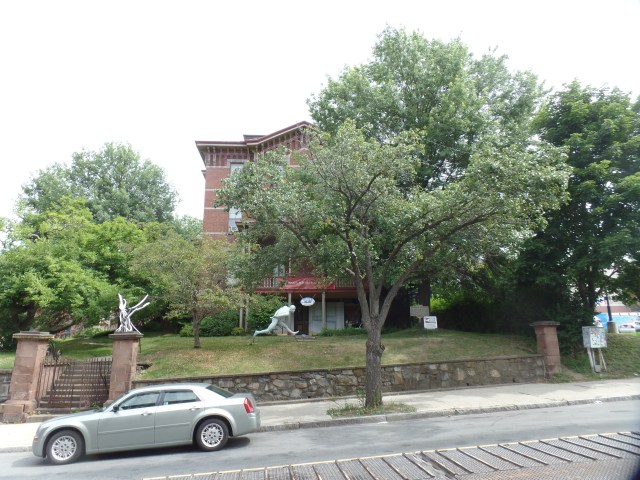
The first two photos below show a Nineteenth Century building, which may have been originally used as a mental hospital. It is now a Seventh Day Adventist church- a far cry from its original use. It still left me with an eerie feeling.
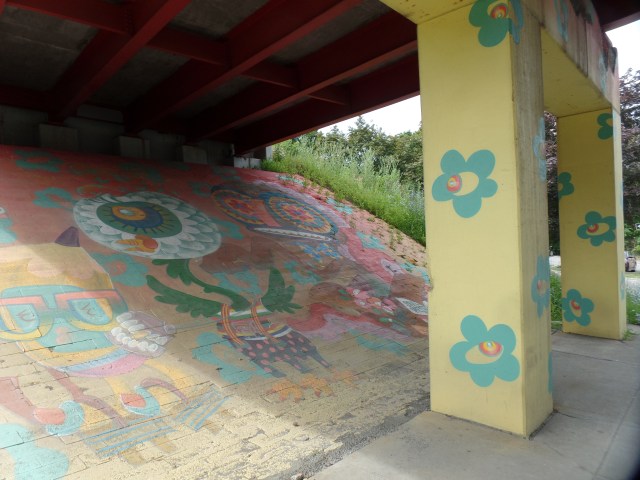
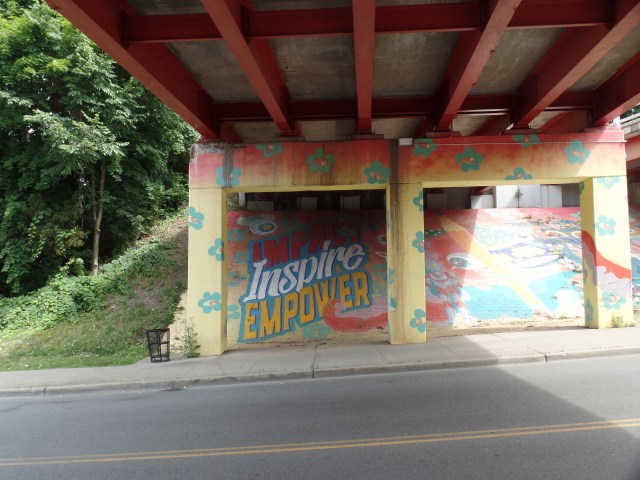
Walking downhill, towards the Hudson, my attention was grabbed by two things: This mural which occupied both sides of the street, under an overpass and a rough-looking man, struggling with his equally rough-looking dog, which wanted to walk in the middle of the busy street. Twice, both man and beast were almost done in by cars which were not going all that fast. Somehow, the approach of a police car empowered the man to get control of his pet. My attention went back to the mural.
That is what I wish to see in the struggling towns of the Mid-Hudson-and in all struggling communities. The talent and drive are here. They have, for some reason, not been tapped.
The future doesn’t necessarily need to look like this Victorian-era resort, across the river in Highland, but it starts with bright minds etching their dreams, the way the muralists did in the above scenes.
This bridge takes people to and from Highland, eight miles southwest of New Paltz and its university. That is a short distance that, for people like the young man I met in the Waterfront Park, seems like a million miles. He wasn’t happy standing and staring at the cement whale that lies near the playground, but it seemed to him to be safer than being downtown.
There is, for those who see a way to self-expression, a vibrant drama and dance scene, based in Cunneen-Hackett Arts Center.
Making beautiful noise, and painting in bright colours, are what get a community started in building a mindset of recovery and moving towards prosperity. Handouts, which the young man in the park most certainly did NOT want, will only extend the misery. I have hope for Poughkeepsie.
One of the things I often find myself doing, when going back and forth across the continent, is spending at least a few hours in a town or city that is struggling with a variety of social ills, yet still manages to keep a semblance of what made it tick. Newburgh, in the middle Hudson Valley, is one such place.
I spent last night, and this morning, in Oley, PA, at the home of friends who operate Glick’s Greenhouse. It’s always a pleasure to stop there, with a house full of people and one sometimes grouchy greenhouse dog. When I was about to leave, after breakfast and lunch served up by a budding eight-year-old chef, the proprietor of the Greenhouse showed me some of his nephew’s latest blossoms.
The evening brought me to the Hudson Valley, and Newburgh. I made the choice to focus on the Inner City, thus spending the night at Imperial Motel, which has seen better days, though still home to some of the most regal people on Earth. A wander about the downtown area showed both early 20th and contemporary 21st Century architecture.
The City Courthouse is a busy place. Newburgh is said to be the murder capital of New York State, so it isn’t a place for the distracted or the unwary.
There are plenty of safe havens, though. These two churches signify the legacy, and the promise, that exists in places like Newburgh, and its upriver cousin, Poughkeepsie (more on it, in the next post).
I spent a little time, here and there, along Newburgh’s Riverfront, with plenty of locals celebrating the majesty of the Hudson-and a few signs of decay in spots.
Here is a view of a crossing, from south of Newburgh.
Looks like the boat might need some work.
Nonetheless, there is an enduring charm about the great river and its banks.
From this area of Newburgh’s waterfront, several ferries take people across the Hudson, to Beacon.
I took a walk, from Imperial to a small “spa”, which is another term in the Northeast for a convenience store. The dour South Asian proprietor took no crap from any of the young men who cam in and out, basically trying one scam or another. I got my coffee, treated everyone politely, while walking with confidence and had no trouble. Then again, it was broad daylight. Most trouble here seems to come from domestic disputes, and in a city where too many men have lost hope, that violence comes all too easily.
Up on the bluffs heading out of town, there is a far different ambiance. This Korean-American establishment offers one mindset that is the basis for solving many social ills: “We are one family.”
The one thing about this trip that went begging was time in the Maryland portion of the peninsula. That will bring me back, at some future point. This afternoon, though, I chose to satisfy my curiosity about Dover. It is inland, and so not directly part of Delaware’s thriving beach tourism-though it strikes me that a room here would be a fine base from which to visit Rehoboth, Lewes and Bethany.
Dover’s lure is history. It was the first place in the Original 13 to see the ratification of the U.S. Constitution. It is a clean, though not sanitized, place, with an orderly street grid and more civilized drivers than those further north in the state. (One would go into full road rage when I made a right turn ahead of him, instead of going straight, as HE thought I should, but that’s a tale for another day.)
That said, I will let the photos tell Dover’s story.
One view of the Legislative Building.
Any state that prominently honours its women has my heart.
A more complete view of Delaware’s State Capitol.
Note the weather vane-a Northeast tradition.
Another fine feature of Delaware-It supports its First Responders.
Here is one of Dover’s oldest homes, the John Bell House, circa 1743. John Bell did not live there. The structure was actually a workshop. This serves now as the starting point for a walking tour of Dover Green.
One more view of the State Capitol, in its entirety.
Lastly, here is a view of the place where the U.S. Constitution was first ratified: The Golden Fleece Tavern.
On the way back to my car, I chatted up a local resident who told of recently helping a young boy who’d been struck by a hit and run driver. who got off in court. Even in civilized Dover, there are miscreants at all levels. Life plods on.
The fitful man stood with his fists clenched and his body rigid, as I glanced over his son’s shoulder, for a split-second, whilst the boy was reading from a placard about flounder. It occurred to me, momentarily, that a flounder was my my first caught fish, all those years ago, in Lynn Harbor. I kept walking and found my own space, without any reaction to the father, who didn’t bother me further.
Such is Cape Charles, a magnet for tourists such as the above-mentioned, and a serene place for year-round residents. I came here, over the long bridge/tunnel from Hampton Roads, on the Virginia mainland. This southern segment of the Delmarva region, more commonly called the Eastern Shore of Chesapeake Bay, is a mix of long peninsula and a myriad of islands. Tangier, on the western (Chesapeake Bay) side, and Chincoteague/Assateague, on the eastern (Atlantic) side are the best known islands.
Cape Charles, at the tip of the peninsula, is the first place visitors see, once off the bridge. It is, thankfully, not as commercialized as I had thought it would be, and great care has been taken to safeguard the “land’s end” area. This, and Hampton Roads, are the only places in Virginia where one can witness both sunrise and sunset, over open water.
The dunes are largely protected from foot traffic. There is but one trail, along the periphery of the dunes and one trail over the mounds.
Bird nesting is encouraged, with the placement of platform buoys around the Bay. Both piping plovers and gulls nest in the area. Plovers, though, are ground nesters, and are endangered, so protective caging is placed around the nests, while the young are maturing. Below, is a gull nest.
Marsh grasses help filter runoff from creeks which empty into the Bay.
This resort hotel is one of three in Cape Charles.
Cape Charles’ downtown did bustle, especially around the ice cream shops, on this sultry Sunday evening.
I found a comfortable, quiet little motel in the commercial center of Onley, in the middle of Virginia’s portion of Delmarva. A bit north of Onley is Accomack, one of the oldest settlements on the Eastern Shore. Here is a view of the historic Court House.
I topped off the eastern Virginia excursion, with a visit to Assateague Island, part of Chincoteague National Seashore. Chincoteague, in the language of the Delawarean (Lenape) First Nations people who lived on the adjacent mainland, means “large stream” or “inlet”. Assateague, in the same language, means “a river beyond” or “a running stream between”. The two words were also used by Europeans to refer to two closely-related groups of Delawarean peoples. The descendants of these nations are today living in the area of Snow Hill, Maryland and in southern Delaware.
Two areas of interest on Assateague are the Lighthouse, which can accommodate groups of ten people at a time, and the Chincoteague Pony viewing stations.
Here are a few scenes of, and from, Assateague Light House. It is maintained by the U.S. Coast Guard, two members of which greet visitors, at the entrance and on the top viewing area.
Chincoteague ponies (feral horses) are well-known, around the world, in particular for their annual channel swims. This year’s is to take place on July 24.
Although it is now a human-coordinated event, the ponies probably swam without human encouragement, when the need arose for going between grazing areas on different parts of the island. Humans may have contributed to the feral horses’ swimming behaviour, by erecting a fence between the Maryland and Virginia sections of Assateague.
Here are two scenes of the horses at the viewing point, early this afternoon.
What appears to be a lone pony is actually a member of a group whose other members were on the move, when this was taken.
Finally, no visit to a resort in summer is complete without a visit to an ice cream parlour. So, I stopped for a bit at Mister Whippy!
Perhaps in a moment of selfishness, I chose to head to North Carolina’s Triad region, specifically to the Capitol, rather than to the west central area, north of Charlotte. This, though, is what my spirit guides were telling me was in order.
I found Raleigh in a quiet and pensive collective mood, whilst walking about the Capitol District on this morning, when many were engaged in acts of worship. I pretty much had the area to myself.
The great museums would not open until noon, by which time I was getting my laundry done, in south Raleigh’s International Market, a haven for the area’s Hispanic community.
Part of the Tar Heel story is told on the Museum of History’s grounds. The frame of a Catawba home is here, surrounded by the lushness of the Piedmont.
North Carolina Museum of Natural Sciences takes up the right flank of the Museum Quarter.
The North Carolina Museum of History occupies the left hand side.
Three figures greet the visitor to the Museum of History: A woman of Sauratown, Thomas Day and Frederick Augustus Olds. Sauratown is an isolated mountain region, northwest of Winston-Salem. The independence of area residents is commemorated by this statue of an unidentified woman. Thomas Day is celebrated as an example of how much a free Black man could achieve. He was a skilled cabinetmaker, of the Antebellum period. Frederick Augustus Olds, a journalist, was a relentless advocate of telling North Carolina’s story, especally of “human history” and of the advancement of both Boy and Girl Scouts.
Here is the Promenade, in its fullness.
North Carolina is the birthplace of three U.S. Presidents: Andrew Jackson, James Knox Polk and Andrew Johnson. They may not be the favourites of many people, but each pursued and achieved his goals. The State Capitol looms in the background.
Here are more complete views of the State Capitol.
This statue depicts a naval cadet, of the late Nineteenth Century. A woman passing by with her young daughter remarked to the child that it must have been most uncomfortable to have to wear such garb, in the heat of a Carolina summer.
This bell tower, of First Presbyterian church, is framed by the Memorial Garden of the Harden family.
At the opposite end of the Promenade, near the Natural Sciences Museum, is this statue depicting the naturalist Rachel Carson, listening to a story being told by a young boy. She was passionate about educating the young, as to the dangers posed by excessive chemical use, in the mid-Twentieth Century.
My time with the Hispanic people showed that the Tar Heel tradition continues to promote the achievements of the individual, over a mass ideological swell. May that ethic long continue.
It was a still, warm day, even on the water, as the Noon ferry headed out of Charleston Harbor, towards Fort Sumter. The hundred or so tourists and Park Service staff who were aboard were a far cry from the angry men who stormed Fort Sumter, after firing on the supposedly impregnable island fort, on April 12, 1861- the opening shots of the American Civil War.
The fort was one of those which had been built as a response to the glaring lack of coastal defense, during the War of 1812. Thus, it is ironic that Fort Sumter should have been the symbol of oppression, to many in South Carolina, and that it would change hands three times, during the Civil War’s progression. Built with three stories, to convey the image of indestructible fortress, it was leveled by bombardment and was turned into an earthwork, by Confederate defenders, between 1861-63.
I have had Fort Sumter on my to-go list, since 2007, when we made a family “virtual field trip” journey, for Penny’s University studies. We never made it to Charleston, among other places. Now, though, the scintillating city. and Fort Sumter, were on my blog-topic itinerary..
Here are some scenes of the ferry route and of the Fort. The park’s office and waiting area are adjacent to the South Carolina Aquarium, just north of downtown Charleston.
Whilst waiting for the Noon ferry, I happened upon East Bay Deli, on a row of eateries, three blocks south of the Aquarium. It is a perfect spot for a full line of made-to-order delicatessen foods.
Below is a scene of Castle Pinckney, a small fortress from which Confederate forces harassed Union Naval vessels.
This sand spit is used by Charlestonians as a private beach, and is not part of Fort Sumter.
The first sight we saw, after the Ranger Talk, was of these cannon portholes.
Here is one of the entrances to the lower breastworks.
A full view of the cannon ports faces east.
Sea shells were used to reinforce the mortar, during the fort’s repairs in 1862.
The cannon portholes are sometimes shut
and sometimes open.
The cannon was always at the ready.
The supports of the upper stories still remain, in several parts of the fort.
For the person who has done everything, there is this:
My money still needs to go elsewhere, but there it is. This is one such cannon that has been adopted.
Finally, here is a Howitzer, used by the Confederates, during their defense of the fort, in 1863. The Union forces won that battle and retained control of the island, thereafter.
Fort Sumter reinforced my view of the folly of war, when pursued as a means to safeguard ideology or narrow self-interest. We have far more in common, as human beings, and thankfully have come a fair distance in viewing others in a positive light, since the Nineteenth Century.
Welcome to Stories From Tina- A tapestry of life woven with words. Here, every post is a heartbeat, every story a step on the path of extraordinary journey. Join Tina as she unfolds chapters of her life, sharing raw, honest experiences and the pearls of triumph to the valleys of challenge, Tina's tales are more than just personal anecdotes; they're beacons of inspiration and understanding, igniting conversations and community. Whether you're seeking solace in shared struggles or celebrating the quirks of daily life, Tina's reflections offer a comforting shoulder, a knowing smile, and a guiding light. Dive into a world where every story matters, and find a friend in Tina - because her story is, in many ways, everyone's story. Subscribe to Stories From Tina, and transform the ordinary into extraordinary, one post at a time.