The Road to 65, Mile 213: Manzanar

8

June 29, 2015, Lone Pine-   Today is the last day of my second long road journey of this year.   Like all trips, it has been less of a “vacation”, (though to some, any time spent away from one’s home town is a vacation), and more of a time of self-discovery.  I learned that I could handle the worst of circumstances, with help from the spirit realm and logistical support from steadfast friends.  I learned that there are those who will love me, regardless of what condition I am in and that there are those who will despise and avoid me, no matter how humbly I approach them.  I learned, again, that there is no Final Destination, and that, no matter how far one goes, there is that one step beyond.061

My last key destination on this road trip is a place of national shame, and of continuous soul-searching.  Fear itself drove Franklin D. Roosevelt to order the removal of Japanese-Americans from the immediate Pacific Coast and of smaller numbers of German-, Italian- and Romanian-Americans from the Atlantic and Gulf Coasts, from 1942-1945.  These American citizens were interned in what the President himself called “Concentration Camps”, though there were no pogroms planned or carried out against any of the interned.

Manzanar was the largest of the camps, with the Sierra Nevada serving as a wall between its Great Basin location and the western 2/3 of California.  People were rounded up, without explanation, by the FBI and the military, early in 1942, from places like San Diego, Long Beach, Los Angeles, San Francisco, Sacramento, Portland and Seattle, and transported in buses and trains to this desert camp, and several others, such as Poston, AZ and Tule Lake, CA.  There are two ironies here:  The camps were often close to, or on, Native American reservations, though Manzanar was not- as the reservations in this part of California are on the outskirts of small Great Basin towns.  Manzanar was a small collection of farms and ranches, such as Wilder Farm and Shepherd Ranch.  These had been abandoned, before the U.S. government took over the area.  The second irony is that, in 1944-45, internes were recruited into the U.S. military, for service in the European theatre.  Many Japanese-Americans distinguished themselves in military service, including the late Daniel Inouye, who later served several decades as a U. S. Senator from Hawaii.

The Visitor Center at Manzanar National Historical Site has elaborate displays of both the Internment Period and of the history of the region.  The other big conflict between ordinary citizens and the governments, both state and Federal, involved water rights in this region, the Owens Valley.  The City of Los Angeles has bought up the lion’s share of water rights and built a pipeline, to meet much of its water needs.  There is ongoing discussion with Owens Valley residents, from Bridgeport and Bishop, in the north, to Lone Pine and Lee Vining, in the south, about how to strike a balance with the City of Angels.

062

Here is a scale model of the Internment Camp, at its peak.063

Some dormitories are maintained, by the National Park Service, to show just what living conditions were for the detainees.  Remember, in 1942, there was no air conditioning, such as we know today.

064

068

The dining halls were crowded, and there were few safeguards against infestations by vermin and scavenging insects.

078

Ruins of several areas are accessible.  Here is what’s left of the house at Shepherd Ranch.

093

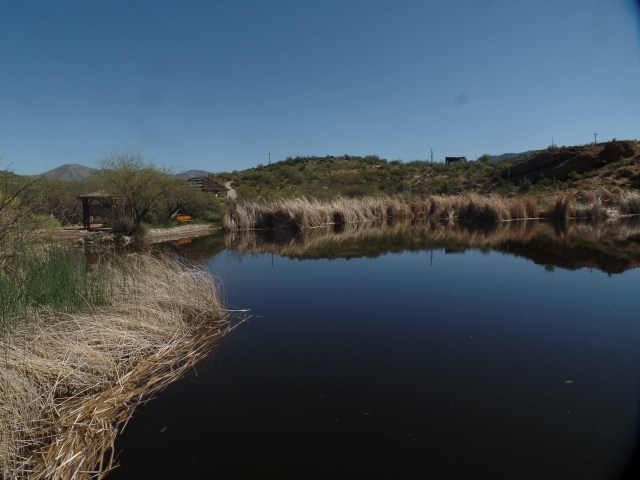
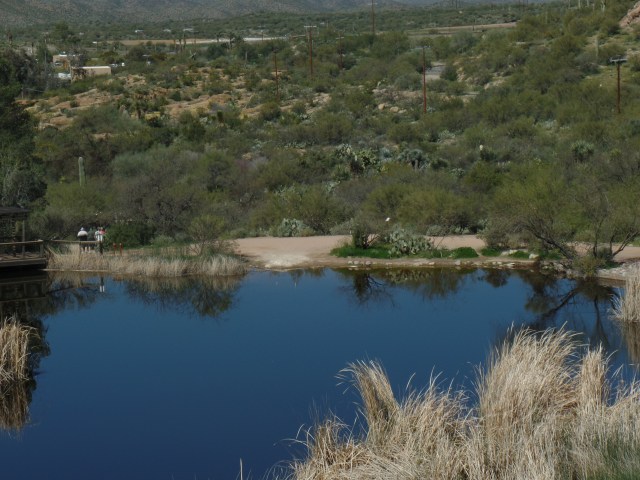
This was once a koi pond, maintained by the internes.

100

They kept up a splendid “city park”, on the north side of the camp.

103

Yes, it was called Pleasure Park.

107

This part of the park is sealed off, to prevent injuries to the public, and defacing of sacred inscriptions.

114

These are scenes of the hospital zone.  There was a full medical facility, separate doctors’ and nurses’ facilities, and as was the wont of the internes, a garden.

119

There was also a cemetery, and this cenotaph stands today, in honour of those who died during internment.

129

At the southeast corner of Manzanar, there is this slab, the remnant of a camouflage tent factory, where many internes worked, “for the war effort.”

136

This time in an American government internment camp was nearly as jarring, and as thought-provoking, for me, as my visit, about this time last year, to Berga, Germany, where Jewish-American and Hispanic-American POW’s were kept, in slave labour conditions, during the last months of World War II.  The difference was that the U.S. was, and is, a representative democracy, and Germany knelt to the whims of a few. The similarity:  Bigotry called the shots.

In 1988, President Ronald Reagan formally apologized to those interned, and to their families, and signed legislation which authorized $20,000 to be paid to each surviving victim.  This was the Civil Liberties Act of 1988.

I drove, purposely, with the windows rolled down and no AC, from Manzanar to Prescott.  Stopping for lunch and a copious amount of iced tea, at Totem Cafe, Lone Pine, set the stage for this.  I came in to the pleasant establishment alone, but was followed by 28 other people, within ten minutes.  The couple running the place managed to keep everyone pleased, but I had some concern fro the wife, who had to brace herself on the back cabinet and apply a wet towel to her forehead, for several minutes.

140

My heart goes out to all those who work in the hospitality industry, during these days of triple digit temperatures, in so many places, around the globe.  I also stopped at Juicy’s Famous Riverfront Cafe, Needles, for an early supper, before heading on across the Colorado and back to base.  Juicy was a stray dog, who attached herself to the fire company in Needles, and to the hearts of the entire town.  That, alone, made it worth the stop.  The service is excellent and the food fine and dandy.

I got back to Prescott at 9:40 P.M., exulting in the drizzle and cooling temperatures, no worse off, for the heat, having plied myself with lots of iced tea and cool water, along the way. Oh, yes, and plenty of sunscreen was applied.

The Road to 65, Mile 212: The Sierra’s Back Door

5

June 28, 2015, Big Pine, CA-  I got my Nissan back in shape again, with a morning visit to Jiffy Lube.  Friends Wendy & Steve hosted a brunch, which was a group effort, and thoroughly enjoyed by all.  Then, I bid farewell to my Reno family.

Little did we know that, a scant thirty miles away, above Gardnerville, three vehicles, including an RV, had collided.  One of those involved was killed.  I was in the southbound five-mile line of cars.  Two hours later, I was in Topaz Lake.  While in the intermittently-moving line, I took these shots of the area.

034

035

The scene at Topaz Lake was rather quiet, away from the bordertown casino anyway.

036

Off to the west, the Sierra Nevada showed just a smidgen of snow, where there are normally several feet, even in late June.

037

The first town I entered in California was Bridgeport, already set for Independence Day.

040

I had a pleasant break and supper, at the lively Rhino’s Grill.  “Rhino” is the owner, not an item on the bill of fare.  Seeing so many families and couples enjoying the nation’s back roads does my heart good, as does being served by congenial folks, of all ages.

The last time I visited Mono Lake was in 1980.  It is about 1/3 smaller now.

041

This saline lake is still a gem, but an endangered one.

044

As I drove towards Big Pine, and my stop for the night, I caught a glimpse of a superb California sunset.

049

Then, as is its wont, the sky went to bed.

051

After all that waiting, and switchback-negotiating, the Nissan was just fine.  So was I, settled in at Bristlecone Motel, run by one of the town’s two mechanics.

The Road to 65, Mile 210: Oregon’s Multivariate “Big East”

5

June 26, 2015, Lakeview, OR- This day started in the sere brownness of Ontario, in the heart of the Great Basin, above the Snake River.  It was not too hot, as I made my way over to Gandolfi’s New York-style Deli, the closest thing in the Riverside area of Ontario, to a coffee shop.  The fare was satisfying, though the atmosphere was more motel breakfast room than comfy cafe.

This is an irrigated agricultural area, and the landscape thus shows a striking contrast of colours.003 004

The small village of Vale, southwest of Ontario, is the seat of Malheur County, of which Ontario is the commercial hub.  Vale has a small historical museum, which was not open when I passed through, but was worth a look at the exterior. Eastern Oregon still has an Old West ambiance, in many places.

006

The Malheur River waters the area, gathering its tributaries, west of Vale, then heading towards the Snake River, south of Ontario.

009

After going through a barren section, once past the Malheur, there is a scrub pine forest that leads the way south, towards Burns.  This area reminded me a lot of central Arizona, just as the Snake River near Ontario resembles the Colorado, in western Arizona.014

Burns, named for the great Scottish poet, Robert Burns, is a quiet, but charming little town, about two hours east of Bend. I was warmly welcomed at Broadway Deli, a bustling local hangout with freshly-made soups and sandwiches.  The ranchers also say it has great breakfasts.  All I know is, I could have stayed all day.

016

017

Once south of Burns, and its smaller sister city, Hines, the desert takes over again.  Ninety minutes later, I was in awe of the sere beauty of shrinking Lake Abert.  This alkaline lake is inhabited mostly by brine shrimp.

019

025

026

There are numerous iron-oxide infused basalt boulders on its eastern shore, which the Oregon Outback Highway passes.

022

Just as Oregon and California meet, the Warner Mountains look over Lakeview.  As I was coming into town, I spotted an Arabian horse, at the roadside fence, nervously shuffling on his back right haunch. Fearing he might be stuck, I went back to the driveway, where the owner went with me over to the pasture, and determined it was the beast’s arthritis acting up.  He was grateful for my concern, and hopefully tended to the poor creature.

027

A section of California took me through the rest of the afternoon.  Alturas is a small gateway community, with an Ag-Inspection Station, a dusty main street and Hotel Niles, an early 20th Century railroad stop.

030

I continued on, getting gas at the village of Standish and settling in for the night in Susanville, so named for the nearby Susan River.  Both are named for Susan Roop, the daughter of an early settler.  “Susan” was fairly lively when I first got there, as there was a country music festival at Lassen County Fairgrounds.  It wrapped up at 9 P.M., though, and most of the people there were my age or older.  It had been a lengthy drive today, and the car needed a good rest, so before checking out the tail-end of the hoedown, I had some fish fry at Kopper Kettle and took a room at nearby Frontier Inn.  Tomorrow, I will head over to Reno, for a day or so, and catch up with the Nevada Family.

The Road to 65, Mile 209: A Triangle of Towns, Part 3- Lewiston and Its Two Rivers

0

June 25, 2015, Lewiston, ID- This eastern half of the Lewis and Clark twin cities announces itself from a place at the foot of winding path, coming down a steep desert hillside.

357

359

Like so many Inland Northwest towns, Lewiston presents a charming and arts-oriented downtown.  Named for Meriwether Lewis, it has, as a centerpiece, Lewis and Clark State College’s Center for Arts and History361

Revolving art exhibits take center stage, on the first floor.  On the day I visited, the Sandpoint-based artist, Kelly Price, offered an astonishing array of Sacred Circles, making a very strong case for the interconnectedness of all things in the Universe and the security which may be found within an orb. Ms. Price’s exhibit clearly shows the universality of the notion that the circle, symbol of completion, is universally held sacred.  (As is my practice, no photos were taken of her exhibit, nor of the presentation of Scott Kirby.)

Price_WEB_475x226

Scott Kirby, a pianist based in Boulder, CO, transitioned into painting scenes of the Great Plains, after an afternoon of drawing and painting with his daughter.  The flow of his art work certainly evoked a vibrant musical background.

KIRBY_WEB_463x220

On the second floor of the Center, lies a tribute to suffering and perseverance:  Beuk Aie (“Buckeye”) Temple.

363

The Temple was built by immigrants from Guangdong, China, who practiced a particular blend of animism and Buddhism, which called for this sort of temple to be used in worship.  It was housed in two consecutive structures, until 1959, when the second structure fell into disuse.  The sacred altar and relics were preserved by Mr. Ted Loy, a Lewiston businessman, until his death in 1981. They were then curated by his family and transferred to Lewis and Clark Community College, for safekeeping.

The Beuk Aie Temple also serves as a memorial to the 34 victims of one of the many shameful incidents of persecution aimed at Chinese residents in the Pacific Northwest:  The Deep Creek Massacre.  In May, 1887, the victims, all miners from Guangdong, were slaughtered by White miners in Wallowa County, OR, who then took the gold that the Chinese men had mined.  While the identities of those involved were determined by investigators from Lewiston, the State of Oregon, which had jurisdiction in the case, found no one guilty.  There is a memorial plaque on the Oregon side of Hells Canyon, but there the matter has rested.

368

In fairness, the people of the Pacific Northwest have made enormous strides in White-Asian relations, and the major source of friction in the Nineteenth and early Twentieth Centuries was mainly economic.  Then again, isn’t it always?  Fighting over crumbs seems to be our wont, as a species.

My thoughts turned to the indigenous residents of this area:  The Nez Perce Nation, symbolized by their leader, Chief Joseph (“I will fight no more, forever”) and the Shoshone, symbolized by Sacagawea, the woman who guided Lewis and Clark through this then rough wilderness.

The confluence of the Snake and Clearwater Rivers has been a key resting and gathering place for humanity, for thousands of years.  Now, a bridge connects Lewiston with Clarkston, WA, which I did not visit this time, as a walk along the Idaho side’s Riverwalk captivated me for nearly an hour, before it seemed time to head down to Lapwai, Nez Perce Nation and further south.

373

383

The people of this area feel a great connection to the Pacific, which both feeds, and receives from,these great rivers.

378

The Lewis and Clark Pavilion, at the northwest corner of the Riverwalk, honours the explorers and Sacagawea.  A sculpture with her likeness graces the entrance to the small kiosk.

381

I will come back through here, and spend more time in both Lewiston and Clarkston, as well as connecting with a Baha’i friend who I did not realize lives in Lewiston.

After having dinner at Donald’s Restaurant, in Lapwai, it was time to move through the salubrious mountains and canyons of western Idaho.  Hell’s Canyon would have made for some fine photos, but the traffic was horrible, so I went further, to Salmon River Canyon.

388

This trestle is one of seven built between Lewiston and Grangeville, to help move gold and other goods.

385

The area is among the most rugged parts of Idaho, which is saying quite alot.

390

The rest of the day’s drive was through more sanguine territory, from Grangeville to Payette, then east to Ontario, OR, and a rest at the Oregon Trail Motel.  The Beaver State’s Big East awaited.

The Road to 65, Mile 209: A Triangle of Towns, Part 2- Pullman, WA and ITS University

0

June 25, 2015, Pullman-  It’s hard to not crisscross between Idaho and Washington, when in this part of the Palouse.  Pullman, a scant eight miles from the University of Idaho, at Moscow, has the equally estimable Washington State University.  I parked in a two-hour spot, downtown, and used these steps to visit the University.

325

The school was begun about the time that Washington became  a state, in 1889.  The Palouse was already drawing farmers from the Great Plains, and the small Midwestern colleges were models for the initial Normal School.

With many of the settlers being of Germanic or Scandinavian ancestry, the turreted structures found in universities in northern Europe found emulation here.

326

The Clock Tower, a nearly-universal feature of institutions of higher learning, was also one of WSU’s early structures.

329

The university library was quite busy, as summer session was still in full swing.  I noted that was true at UI, and, a year ago, at the University of Heidelberg, Germany.

331

This touching memorial met me, along the South Fork Palouse Riverwalk, as I returned downtown from the hilltop University.

333

Cities worldwide are embracing outdoor murals, and Pullman’s celebrates its railroad past.

334

The town has a smaller art scene than Moscow, but young people here are every bit as proud of their joyful noises, as their counterparts to the east319

South Fork Palouse Riverwalk is heavily used by locals, though in the lunch hour, I had the path virtually to myself.

320

322

324

The Nez Perce influence is still felt here, at the western edge of that great nation’s rangelands.323

I enjoyed a hearty lunch at Heroes and Sports, in the building on whose exterior the railroad mural is shown, above.  Two WSU ladies cheerfully welcomed about twelve of us in from the increasing heat, and I relished a Philly steak, before heading off, towards Lewiston, and points further south.

The Road to 65, Mile 209: A Triangle of Towns, Part One- Moscow, Idaho, and Its University

3

June 25, 2015, Moscow, ID –  I have been intrigued by the Palouse region for quite some time now.  So, it was quite a treat to have ended up in Moscow,last night.  I had woken the owner-operator, at Royal Motor Lodge, so my reception  there was not the warmest.  This morning, though, she was a bit sad to see me check out so quickly- at 10 A.M.

I spent about an hour, walking about Moscow’s downtown area, and stopped in at the salubrious One World Coffee House, at the outset of that little jaunt.  With so many people, in and around the place, the only unobtrusive photo of One World was this coffee bean puzzle.300

Downtown and Fort Russell, about six blocks east, are Moscow’s two historical districts.  I found Fort Russell would be interesting for a post on historical houses, but this was the Palouse in June, after all, and it was already getting hot, at 9 AM. So, I kept myself downtown.

Moscow, rightfully, prides itself on being a premier arts venue.

303

John’s Alley looks like it’d be a great place to sit and jam.

315

Moscow does not ignore its Idaho-ness.  Hyperspuds is the local sporting goods and outfitting spot.

306

This message, at the northern edge of downtown, evoked images of The Avengers.

307

The McConnell Mansion was built in 1886, by Idaho Governor William J.McConnell.  It’s now the historical museum of Moscow, and Latah County.

308

Stone is put to good use, in the Palouse Valley, as evidenced here, at the United Methodist Church.

311

Moscow is hip, but that doesn’t mean it ignores its roots.  Farming here does not take a back seat.

317

I spent about an hour at the University of Idaho, largely in its cool and impressive Charles E. Shattuck Arboretum.338

341

Here is the Red Oak that is the centerpiece of the World War I Memorial Grove.

342

340

The interior of the Arboretum offers trails that could keep one content for a few hours.

344

As with other universities, this would mean buying a Parking Pass, as established by the Administration, housed here.

336

The university has the good fortune to have a School of Music named for one of the greats.  Mr. Hampton worked with the University, from 1980, until the end of his life, to establish a home for jazz, in its School of Music.  in 1987, he had the honour of seeing the School bear his name.  A Jazz Festival has graced UI, since 1985.  Lionel Hampton is the only jazz musician, thus far, to be so honoured by a University.

335

The University’s mascots are the Germanic tribe, the Vandals.

346

Their facility is impressive in its length and utility.

347

Moscow is a welcoming, and very comfortable town, and I would not be surprised to find myself passing through there, time and again.

The Road to 65, Mile 208: Queen of the Inland Northwest, Day 2

3

June 24, 2015, Spokane-   I was intrigued by the chocolatier’s use of Rocket Bakery as his sandwich purveyor, so this morning, Rocket was my first stop, after getting cash from the ATM.  What a fine place!  Like so many coffee houses in the Northwest, and our own Wild Iris, in Prescott, Rocket Bakery has a Steam Punk ambiance.  Two lovely and effusive young ladies were the baristas, and sang along with each song that came on the house’s Sirius channel, as I savoured my drip coffee and scone.  Rocket is a very happy place.  It also has a bookshelf, a surprisingly rare feature among coffee houses, and one that is most welcome.  The piano is also there, for anyone who can play decently.

278

After the wonderful interlude, I headed back to Downtowner Motel, checked out and made a beeline back to Riverview Park.  One of my friends in Spokane recommended taking the gondola, over the Falls.  This I did, to the amusement of four high schoolers who were in line ahead of me.  “Like, why is the old dude going up by himself?”  Well, because it’s there.  There are some decent views to be had, from the nosebleed level.

281280

283

284

285

Once back down, I headed to the southern, less frenetic part of Riverside.  I found the Clock Tower, Vietnam Veterans’ Memorial and World’s Fair Pavilion to be restful places for meditation.

288

287

291

290

A flock of Canadian geese, lined up at the river’s edge, was an unusual sight. It almost seemed like the Bird Olympics was set to begin.

292

A unique feature, for kids and adults alike, was this set of giant blocks.

295

Lunch was from a hot dog vendor, in front of Atticus.  As he advertised “all beef, no additives”, I was game.  The coffee and gift shop was worth another visit, after lunch, for some chai and a few gift items.  After an hour or so longer at the library, I called my local friend, and ascertained we weren’t going to meet, due to a sudden emergency.

So, it was off to the south side, and dinner at Chalet Restaurant, near a retirement community.  I was received a bit cautiously by the waitstaff, but the salmon and side dishes were fine.  Sometimes, it is a good idea to greet “outsiders”; like me, who tips 20 % to anyone who gives at least adequate service.

After attending a Baha’i worship service and social, nearby, and briefly connecting with an old friend from Arizona, now living in Spokane, (pictures didn’t come out), I headed east, then south.  it was dark, so no photos of beautiful Coeur d’Alene.  The night came to an end in Moscow, ID, at Royal Motor Lodge.  I woke up the night clerk, who groggily lined me up with a room, and settled in for another comfortable night.

The Road to 65, Mile 207: Queen of the Inland Northwest, Day 1

4

June 23, Spokane- I woke up from a night of roughing it, on the ground at Country Corners RV Park, in Wilbur, WA, about ninety-minutes west of Spokane. I got dressed and off to breakfast, at Doxie’s Diner, one of those places where the cook is the waitress, and the regulars address her as “Mom”.  The coffee was on the main table, and I was invited to make myself at home.  Great place, Doxie’s, and I could easily have whiled away a good morning there, especially listening to everyone’s stories of the previous night’s aurora borealis, through which I slept, of course. It had appeared around 2 AM.

I had a feeling it was about time I got over to Spokane, to see what had changed since I was last there, in 1995. I stopped for a bit of reflection, at a Rest Area, off US 2. Greeting me was this intrepid little critter, who might be a tad uncomfortable on a leash.

230

I got to Spokane, around 9 AM, and headed straight for Riverside Park, which was one of my fondest memories from 20 years ago.  The first sight was the salmon ladder.

232

The Spokane Falls, though, are quite prominent, both at the north end of the park and towards the middle.

236

240

245

250

After a couple hours of meandering around the park, I headed east a bit, to the old Flour Mill, now home to about a dozen shops.  One of these is Chocolate Apothecary, whose proprietor had sandwiches advertised, along with his main line of delectable chocolate.

251

Alas, his sandwiches, prepared by Rocket Bakery, had not arrived.  At his suggestion, I headed across the parking lot, and up the street, to Stella’s Cafe. The Northwest is a fabulous place for cavernous, Steam Punk cafes and restaurants.

255

Stella’s offered a lovely Roast Beef, au jus  and had some intriguing art work.  This woman had tied up her demon and her ego, and was ready to take on the world.

256

After lunch, I checked out Spokane’s near north side, and its majestic County Courthouse.  This neo-Renaissance classic was built by W. A. Ritchie, and was open for business in November, 1895.  It is, arguably, one of Washington State’s finest buildings.

258

262

Returning to Riverside Park, I found quite a flock of gulls, feasting on whatever they could find in the Spokane River.269

Anthony’s at Spokane Falls is another member, in that great chain of West Coast seafood establishments.  It is across the bridge from the hydroelectric power station.  It is notable that Spokane, using the force of its cascades, was the second community in the U.S., after New York City, to become electrified.271

It was starting to get pretty hot, in mid-afternoon, so this fountain was a big treat for the children who were at Riverside for the day.

274

As for me, I went over to Atticus,  a lovely coffee, book and gift shop, across Spokane Falls Drive from Riverside Park, and got a refreshing, cool beverage.  After being there for an hour, catching up on my e-mails and correspondence, I noted the barrista’s consternation, and vowed to come back the next morning, sans laptop, and just savour the coffee.

296

The evening was spent, between Downtowner Lodge, which at the time was the only motel in downtown Spokane with no WiFi, Spokane Public Library, and the Food Court in River Park Square, which offered connections to anyone eating supper there.  After satisfying myself that my friends and family were safe and well, I went back to the room and watched a bit of nondescript TV, then read for a while.  Day two would feature a gondola ride, more walking around Riverside Park, perhaps a visit with an online friend and an evening with some of the Baha’is of Spokane.

The Road to 65, Mile 206: Evergreen Crossings, Day 4- Cascades and Coulees

4

June 22, 2015, Wilbur, WA- The day started with getting laundry done, in Monroe, at one of the more expensive laundromats I’ve seen in a while.  It uses an Easy Card, so the fare is purchased in advance, for  laundry supplies, washer and dryer.  I did everything in one load,as is my wont, when on the road.

I passed Travelers Park, before turning right onto Highway 2 East.

163

On the way out of town, I gave a short ride to three people, who my intuition said, correctly, were good risks.  They had no interest in me, other than to know why I was here, from Arizona- a reasonable query of a stranger.  Eight miles further, I let them off, at a place called Gold Bar.

My next stop, however, was a tough little town called Skykomish, which has about 500 people who still support a weekly bus service to Monroe and have their own school district.  It was founded as a rail stop, by routing engineer John Stevens, for whom nearby Stevens Pass is named. This old building used to be Skykomish Hotel.

164

The rest of the town also has a frontier air about it, still.

166

I had lunch (leftover lasagna) at a picnic table facing the main street. Then, it was on to Deception Falls.

169

This popular trail, at the foot of Stevens Pass, offers the three cascades of Deception Creek.

187

Note the relative purity of the water.

189

The trees provide variety in the scenery, especially as they lean,

170

serve as springboard stumps,

176

or act as nesting pots for new trees.

177

or, still as a place to drive piles.

183

Meanwhile,back at the falls:

191

192

200

203

205

There was a plenitude of visitors, yet much of the time, I found myself alone, as most people gathered at two overlooks.

The road led next to Leavenworth, not the Federal prison, but the touristy mountain community, about forty minutes from Wenatchee.  The Wenatchee River is a major comfort, for locals and visitors alike.

209

I stopped just long enough to walk along the river a bit, and to buy some coffee from a local grinder, Square 15.  It was to be a gift for my friends in Reno. The faux Bavarian scene can be taken in small doses.

215

I stopped in Wenatchee,for about two hours, long enough to marvel at the clear air (compared to the smoke which brought me here in prayerful service, three years ago) and to enjoy a fine Hispanic-fusion meal, courtesy of two friends.

219

I shall send them some Arizona treats, very soon.

The rest of the evening entailed driving down from the central Cascades, and into the western edge of the Great Basin.  Some outlying areas reminded me of the Great Plains.  There are patches of desolation.

225

There is a worrisome dryness.

226

The coulees of the Columbia River, and its tributaries, provide irrigation water, regulated by a series of dams.

227

One of these is Dry Falls Dam, about a mile south of Grand Coulee.

228

No, that’s not a fresh-water dolphin, in the river above.

I settled in on a grassy patch, at a little RV park called Country Corners, and slept fairly well, except there was this event called Aurora Borealis, and my tired self couldn’t leap out of the sleeping bag and take a shot or two.  Perhaps one or two of you saw it.

The Road to 65, Mile 205: Father’s Day

3

June 21, 2015, Monroe, WA- I woke , to a bit late today, around 7:15, to speak with my son on this Hallmark morning.  It’s always good to hear his voice, contrived occasion or not.  I was in the suburban clime of Mount Vernon, had been wished “Happy Father’s Day” by the waitress at Farm House Restaurant, in this city’s La Conner neighbourhood, after getting off the ferry last night, and got a somewhat more subdued greeting from the server at Riverside Cafe, near the motel, during breakfast this morning.  Racial politics, Hispanic vs. Anglo, seems to be playing out a bit in this community, which is always a hard thing.  I was given my breakfast, and two cups of coffee, then expected to leave.  Riverside will not see me again., though Farm House would be a pleasure.

I was in a funk, not knowing which direction to head, yet after reclaiming some items I had left at Holiday Motel, the day before, and enjoying some coffee and a treat at Johnny Picasso’s, in Anacortes, I had an idea.  Heading to Arlington, and Oso, the site of a horrible mudslide in March, 2014, I took some time for prayer towards racial healing, as several people back in Arizona were gathering to pray for the same, with the Charleston Massacre as their focal point.  There is no one group that does not need a healing balm.

The message was clearer to me after that, and I drove east on Highway 2, finding the small town of Monroe to be a good place to rest.  The Monroe Motel lies alongside Woods Creek, so there was no finer place for me to observe today, thinking of fatherhood-how it affected me as a son, as a son-in-law, as a spouse and as a parent. 158

I was not an easy son.  My happy-go-lucky, but hard-working father did not know what to make of me, half the time.  I did not know what to make of me, half the time.  I wonder if he knew how much he was loved, back then.  He knows now.

157

My role with my father-in-law was part good-natured foil for his jokes, and part guarantor of his family line’s continuing on in safety.  We gave him his only grandson, and that guaranteed my safety. He knows now, how important it was to me that Aram actively knew his grandfather.  Both of mine were dead before I emerged from toddlerhood.

159

Penny and I were close to nature, as individuals and as a pair.  She would sometimes, in the throes of her progressive decline, say that she felt she was in my way.  In truth, she WAS my way.  She knows that now.

160

I have gone through a fair number of personal struggles, in my late teens, in my twenties, and in the buffeting called my fifties.  Somehow, I have emerged.  Fatherhood happened for me, in the best way I knew at the time.  There was a lot more I could have provided, for my son’s stability.  I realize that now.

He’s okay, thanks to the discipline of the Navy, and his grandfather’s guiding hands of steel and velvet.  I am here for him, and can finally show a solid example of how to move through life, come hell or high water.  Aram knows that now.

155

I went into this lovely, if cavernous, establishment in downtown Monroe.  A Caesar salad, meat lasagna and a bowl of spumoni were my Father’s Day meal.  Half the lasagna was saved for tomorrow, and my drive to Wenatchee, where I will reconnect with friends from three  years ago.

I end this with Monroe’s comment on the whole race issue.

161

My spirit guides are with me, still.