This weekend, Prescott hosted the annual Chalk It Up Art Festival. I first attended this enthralling event, two years ago, and found this year’s version even more fascinating than that of 2012. Kids of all ages put some amazing images together, such as the one which heads my previous post, “The Others”.
Here are nineteen of the images.
,
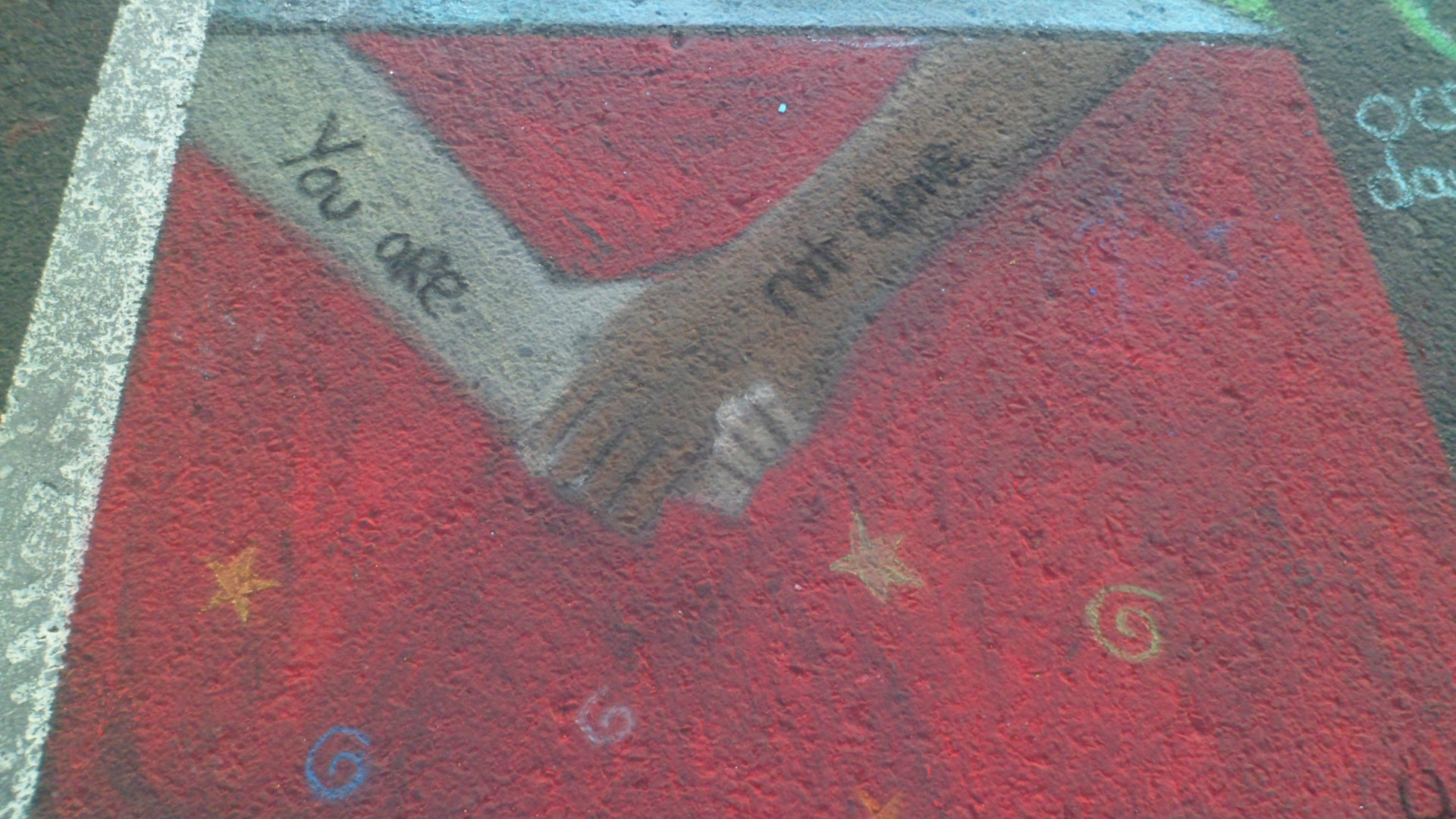
This next piece was photographed while the artist was present. She was delighted that I shot the full rectangular outline, without prompting. Others had taken shots from a trapezoidal angle, which bothered her.
That’s a matter of judgment. Whatever colours your eyes and heart bring into your life though, the message is clear:
Later this evening, I will post about the Prescott Historic House Tour, part of our city’s Sesquicentennial Celebration, and Chalk It Up, an annual chalk-art festival. Both took place this past weekend, as did a Cinco de Mayo Block Party, in Courthouse Square.
First, though, a bit of seriousness. Let me go further with what I wrote yesterday about the journeys on which each of us is embarked.
Human beings, alone among species, sort those they see as strangers into categories of “race”, skin tone, ethnicity, Faith, gender and sexual orientation( of course, we are the only species which experiences the latter as a life condition). To be sure, other animals, from ants to prairie dogs to wolves and dolphins, sort by family group and/or territory. This is all part of territoriality and population control.
Our extra selection processes, really, don’t make much sense. There is no qualitative difference between me and any of my friends who happen to be Black, but in the 1960’s, there was no way any of them would have been able to live in a family home in the town where I came of age, outside of a small designated area on the south side of town. That’s changed now, of course, and it was with great personal satisfaction that I learned, in 1996, that my maternal grandmother’s house was purchased by an accomplished attorney of African-American descent.
I thought of all this, while taking in the various events of Cinco de Mayo weekend, in downtown Prescott. People of all backgrounds are welcome here. Although Prescott has a tendency towards political conservatism, there seems little bigotry. Those of us who indulge in politics at all, tend to be of Libertarian bent.
I’ve always had a hard time understanding prejudice, and while working to rid myself of my own pre-conceived notions, which I found confusing, the whole concept of “Other” had to be allowed to surface, and float away. Young Black men, when I was in my twenties, did me the honour of challenging me to show that I was recognizing, and casting aside, the subtleties which I had picked up in childhood. I was hurt and angered by my white peers’ callous reaction to the killing of Martin Luther King, Jr., in 1968. He hurt no one, and helped as many of us as would listen to what he had to say.
Still and all, I have had to recognize my own sense of “Other”. This separation is a worldwide thing, though. Many East Asians have trouble with Whites and Blacks being in their midst. Africans separate by tribe; West Asians, by Faith; Russians, by language. Some of this “otherness” is rooted in hurt; some of it stems from fear.
The fact remains, however, that we are all connected. I see this sense of connectedness increasing, incrementally, among Millennials and the current generation of children. It’s definitely a process, not an event. Racist teens and twenty-somethings, though, are regarded by the majority of their peers as having mental problems. This cuts across all racial and ethnic groups, and political affiliations.
The kids are onto something. “Otherness” is a learned paradigm. Then again, so is helplessness.
I’ve had a lot of thoughts and a few conversations, over the past month or so, as to what sort of person always seems to be on the move, and what exactly is it that such a person is seeking. I can only speak for myself. I have been peripatetic from Day 1, it seems, and not just in the sense of exploring new physical locations or different scenes. My nose has been in a book, far more often than my feet have been moving forward. Ironically, though I love to be walking here and there, when the occasion requires, I can sit still for hours on end, patiently reading, watching the most inane TV shows or just letting my mind wander. This last characteristic served me well during my Penny’s final year- much of which I spent at her bedside- because there was no place I wanted to be more.
Whether one is engaged in a building project, sitting at dockside with a fishing pole in hand, coaching a soccer team, designing jewelry, doing one’s taxes or climbing Sagarmatha, a journey is a journey. There may be miscalculations and setbacks along the way, and re-dos are the task of the lucky. The rest end up in one abyss or another.
This brings me to relationships. I was more fortunate than I can ever express outwardly, that I had the companionship of a blithe spirit and keen intellect for thirty years. I will have a spiritual bond with Penny for all eternity, and there will never be a time when I don’t feel her presence. I am fortunate to be surrounded by family, in an ever-distant outward ring, which is nevertheless always pulsating. I am fortunate, too, to have friends both near and far- those who understand me, and still refrain from judging.
Some ask, why do you not want another companion? The quick answer is, I am a self-contained unit, and always have been. Penny drew me out and aided me to build on what my parents instilled in each of us- to be urgently aware of our surroundings, and BE HELPFUL. I’m far from dead, emotionally, and see women I consider attractive, in one way or another, every day. The most important thing, though, is that I have finally learned that it is the friendship, not the attraction, that sets us free. I would rather have a hundred good friends, or a thousand, than be in any relationship where one of us is feeling like “Damn it, I can do better.”
So, I am happy to have the friends in my life, female and male, young and old, on whom I can count and who can count on me, with no ulterior motives. We are each on a journey, every minute of every day, and it is a fine thing to see a traveler smile along the way.
Last Thursday was an exquisitely beautiful day, and I sensed it would be not good for my spirit to just sit inside and ruminate. There was one walking path I had not established as yet- a pedestrian route to Yavapai College and the VA Hospital. So, there was my Thursday afternoon plan!
The “single-step” in this jaunt was a walk along North Arizona Avenue, past the Arizona Softball Hall of Fame, and the Smoki Museum, which has, as its mission, the preservation of Native American culture. As such, the buildings are constructed of native stone, with extended beams, in the Pueblo style of construction.
The first photo is of the Smoki; the second, of the Hall of Fame.
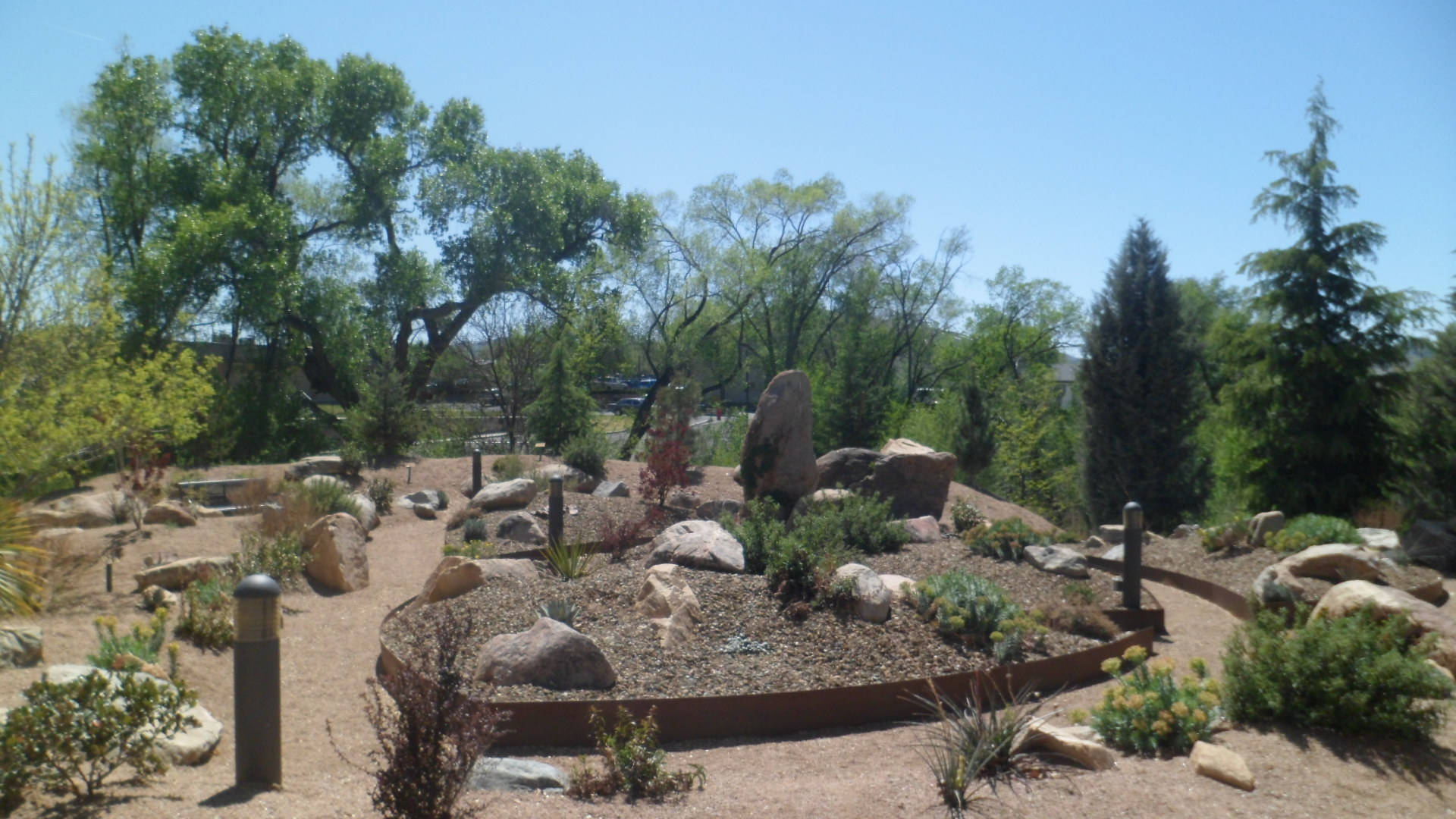
I crossed Sheldon Street a few minutes later, and entered the Yavapai College Sculpture Garden. The community college has grown mightily over the past several years, but the Garden remains a focal point for meditation and serenity.
Here is “Community Gothic”, by Richard Marcusen.
Water is a key element in the garden’s central piece, “The Gathering”, by Gary Slater.
Alternative energy gets a pitch here, with these avant-garde windmills.
The north side of the college Library has been tapped for this interesting panel.
Across the dry creek bed, the roof tops of old Fort Whipple peek out.
Having reached the northern edge of the College grounds, I continued on into Rough Rider Park, where there is a short bike and hike trail, leading to the grounds of Prescott Veterans Administration Hospital. This is a good trail for me, as I visit the patients of the Community Living Center there, once a month. Now, I won’t need to drive there every time.
On the way, an old rail bridge caught my eye, at the edge of Prescott-Yavapai Indian Reservation.
An extra feature of the Hospital is the preservation of Fort Whipple, an old Army post of Prescott’s formative years. I first went in the Museum, which is open Thursday, Friday and Saturday, from 10-4.
Below, is the chair used by General George Crook, one of the more successful commanders at maintaining a semblance of peace in the Southwest, during the period of unrest among the Apache.
After looking about the museum for about an hour, I walked past the preserved old barracks. The row of old houses, some still occupied by VA workers, cries out for restoration.
Having come full circle, I walked back to Yavapai College, which along with some parts of the Yavapai Reservation, and Rough Rider Park, was taken from land occupied by Fort Whipple. The trailhead to Rough Rider greeted me, as I walked through the gate.
So, knowing three or four more spots to walk and meditate on a slow day- or a rough one, I am that much more settled into my near-downtown neighbourhood.
Park Jee-yung dropped out of college, and went to work on a Korean domestic ferry, when her father passed on, two years ago. It’s what Korean children do for their families, in the Confucian tradition of filial piety. Two weeks ago, Miss Park found herself, along with nearly 400 other young people and 75 elders, on an ill-fated journey to Jeju, Korea’s holiday mecca, some 60 miles off the southwest tip of the Korean Peninsula. This journey entailed sailing from a port in the Seoul area, and thus a potentially treacherous voyage through countless areas of rock and reef. The story of how the journey ended is gradually unfolding: Essentially, an inexperienced and unconfident helmsman, scarcely more than a child herself, lost her way and the ship foundered into a mess of rocks. It’s not certain where the ship’s captain was during this time, but it is notable that he left the ship while most of his passengers remained aboard, and the ship was going inexorably down.
Park Jee-yung stayed with the teenagers, going as many places on board as time allowed, finding life vests for her younger charges and trying to get as many on board life rafts as she could. Survivors reported that Miss Park repeatedly refused to leave the ship, saying it was the crew’s duty, and thus hers, to be the last to leave. So it went- for her, and possibly other crewmates, though not for the senior ship officials. This has become de rigeur, in recent years, for the crews of troubled vessels, but I digress.
I lived in Korea, on Jeju, for 5 1/2 years. The vast majority of the people I met were like Park Jee-yung- bright, organized, and self-effacing. I can only imagine the horror that has engulfed this blessed nation, whose traditions dictate that a people move forward together, that the needs of the whole trump the whims of the parts, that children mind their elders, without question.
So it went, that horrific day. The aging ship’s captain issued an order to the students on board to stay in their cabins. A few rowdy boys chose to challenge that order and went on deck, saw what was happening and, rallying some of their schoolmates, managed to get on board the life vessels and to safety. One of them was the first to issue a distress call to the mainland. These were among the people helped by Park Jee-yun.
There is much to admire about Korean society. Few nations could have risen out of the ashes of war, largely on their own, as South Korea has. Shoulder to shoulder, Koreans have seen what was needed, and brought it about. Now it is time to take stock of the price of fragmentation- nearly 160 dead, as I write this, and hundreds more still missing. I sit here, in the comfort of an American home, and feel only grief and sorrow. So many beautiful souls, who could have only elevated life in their city of Ansan, and beyond, now sit at the Throne of the God of us all, and wait to see just how they might comfort those who miss them so grievously.
Let Korea continue to move forward as an entity, with the caveat that sometimes, many times, the voices of the rambunctious need to be heard. The gadflies among us frequently see things the masses overlook, and their warnings, however irritating at the get-go, turn out to be what save the day. Cassandra was not altogether insane.
Rest in peace, beautiful friends, and may the nation you left too soon regroup, restore its sense of balance and move forward, in unison.
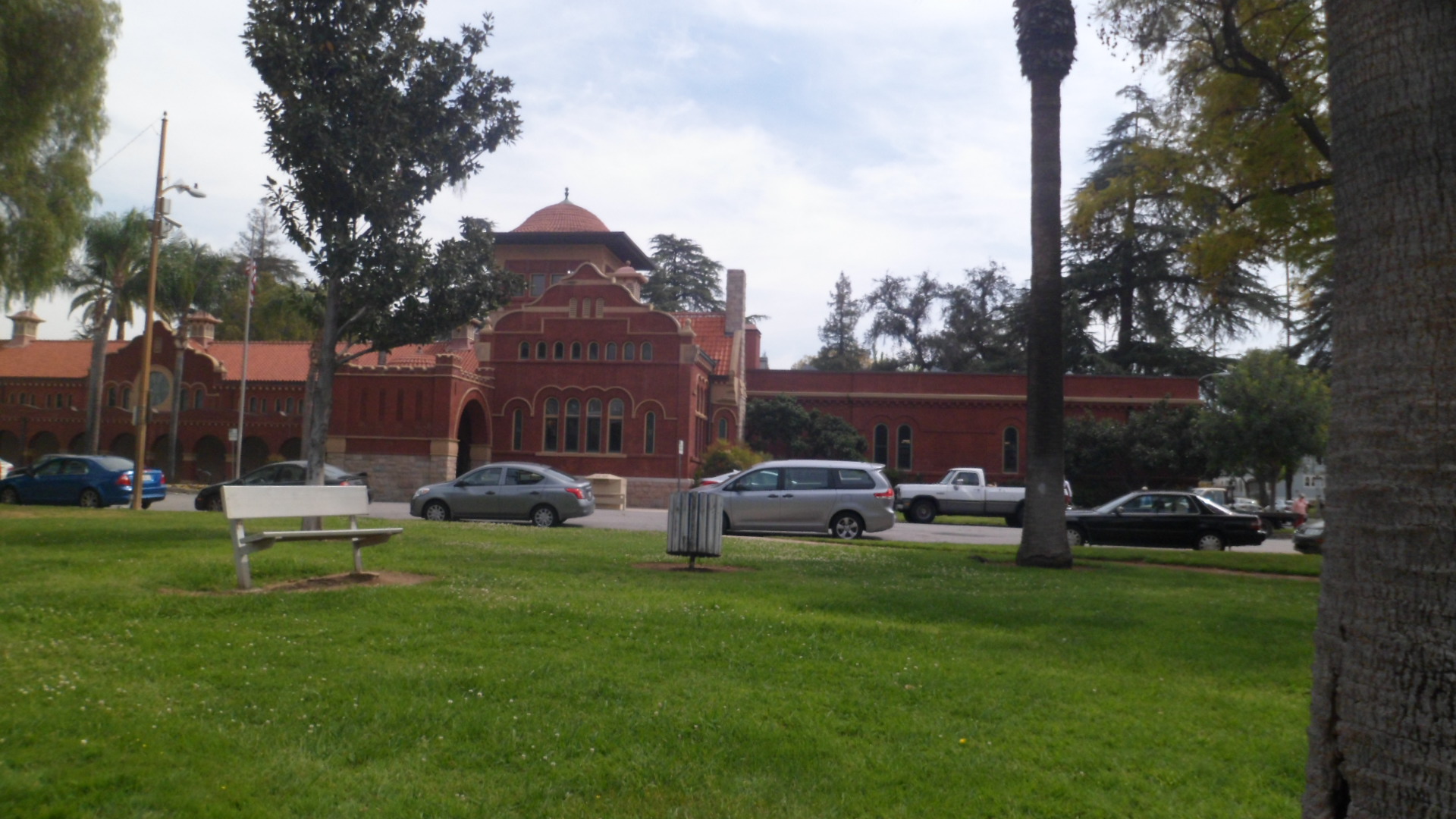
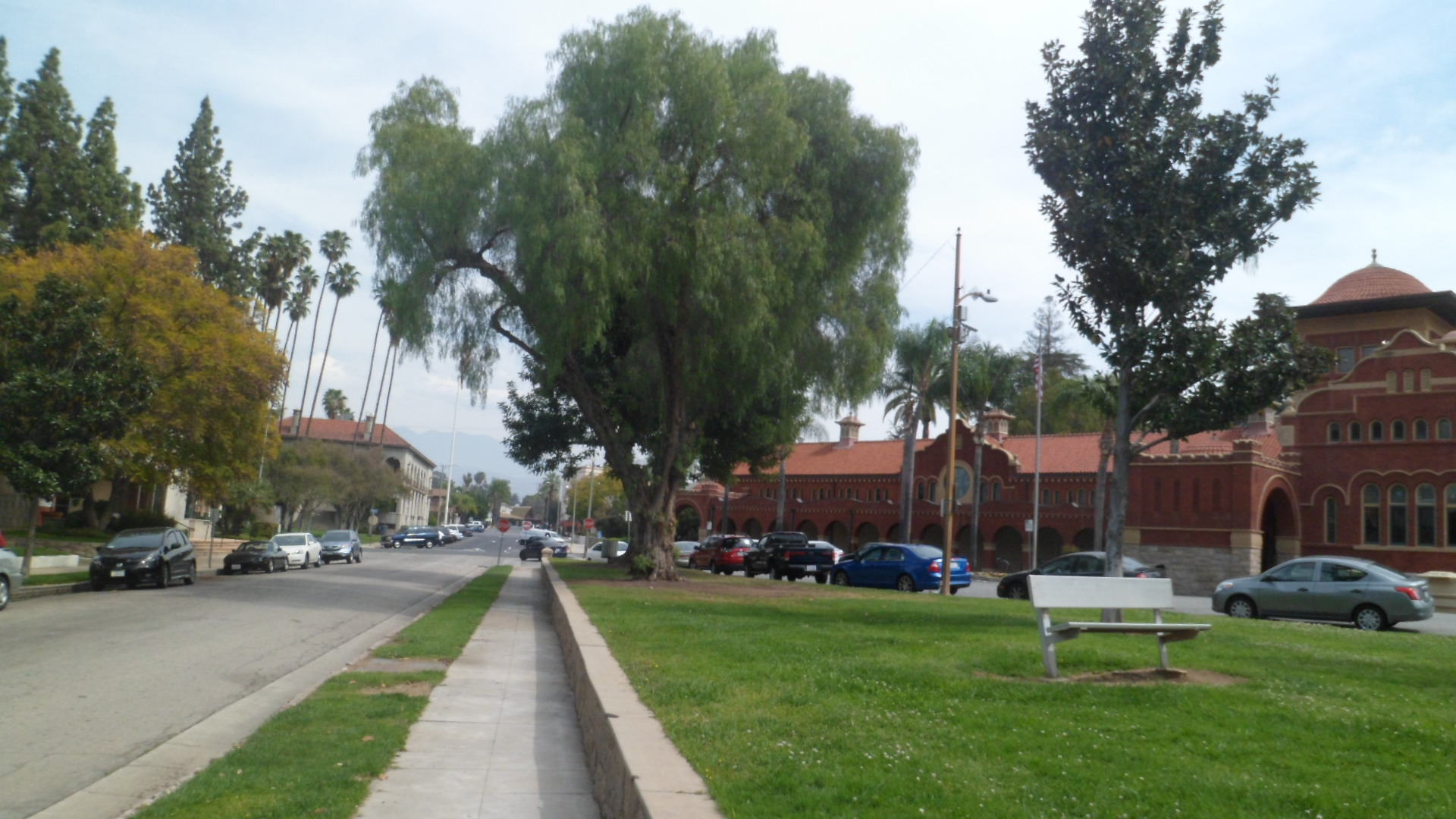
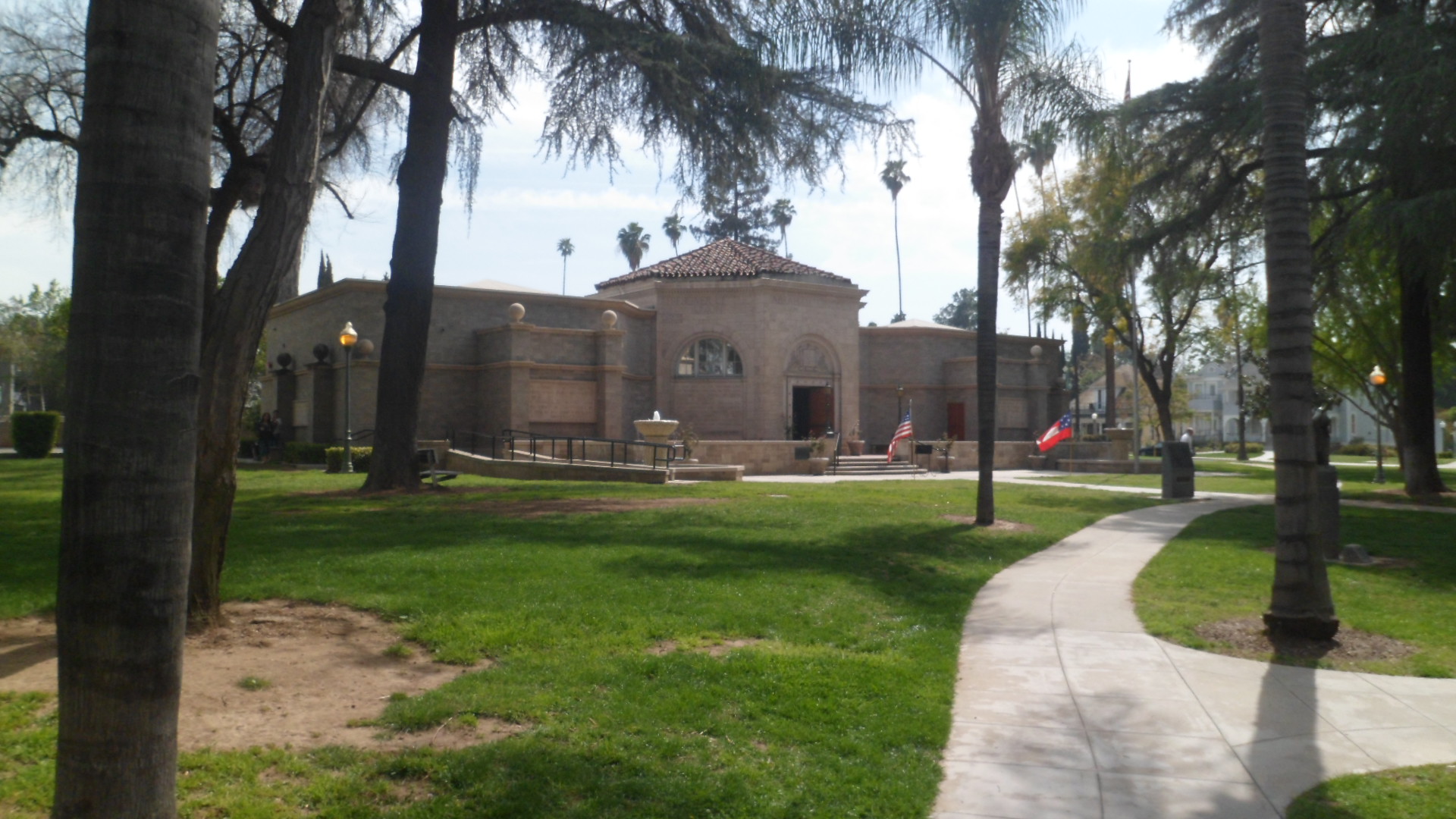
Redlands, CA is one of those towns one could zip past, on the freeway, and totally miss out on one of life’s grander moments. The town’s whole raison d’etre is the advancement of learning- from its university, established by the Seventh Day Adventists, who were the community’s prime movers, to the Lincoln Shrine, which honours our 16th President, while promoting the study of civics and, of course, A.K. Smiley Public Library, established for the people of Redlands in 1894.
I first became familiar with Redlands, and nearby Loma Linda, when I first dated Penny, in 1981. We visited her Seventh Day Adventist relatives here a few times, but I never really took photographs of the area, until Sunday, March 23, as the last leg of my most recent SoCal adventure.
Here are some views of the mountainside, and of downtown Redlands.
The Post Office set the tone for my expectations of Redlands architecture.
The movie theater, just north of Redlands Mall, didn’t disappoint, either.
It was the Smiley, however, which really stood out and dominates the scene, from its place on the mountainside. Two of Redlands more prominent early citizens greet the visitor. They are, of course, Albert K. Smiley, and his brother, Alfred. Each year, green hats are placed on the two, in honour of their March birthdays.
The next two shots give an idea as to the size of this edifice.
Below, the main entrance is given some justice.
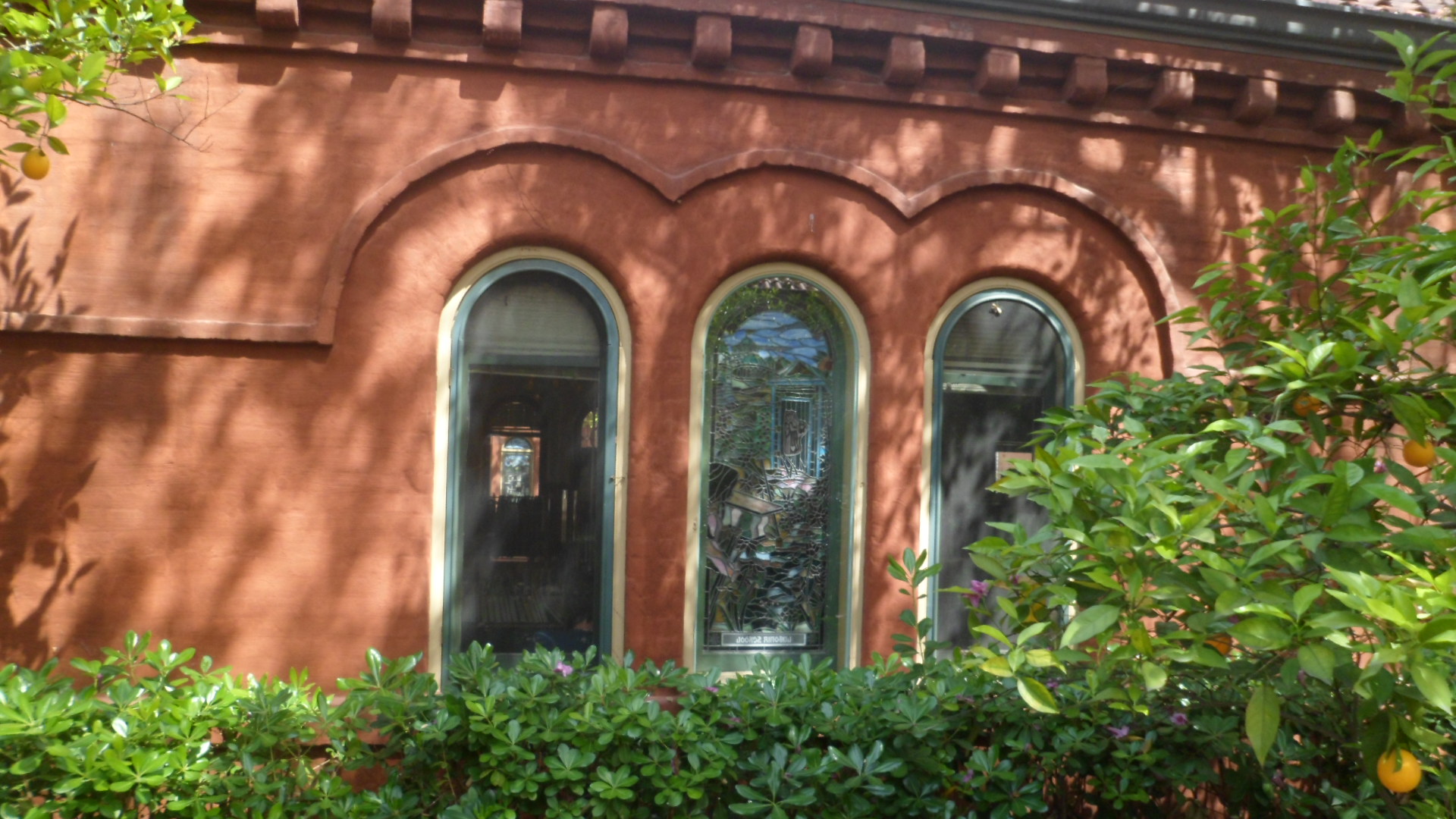
Stained glass adorns most of the windows.
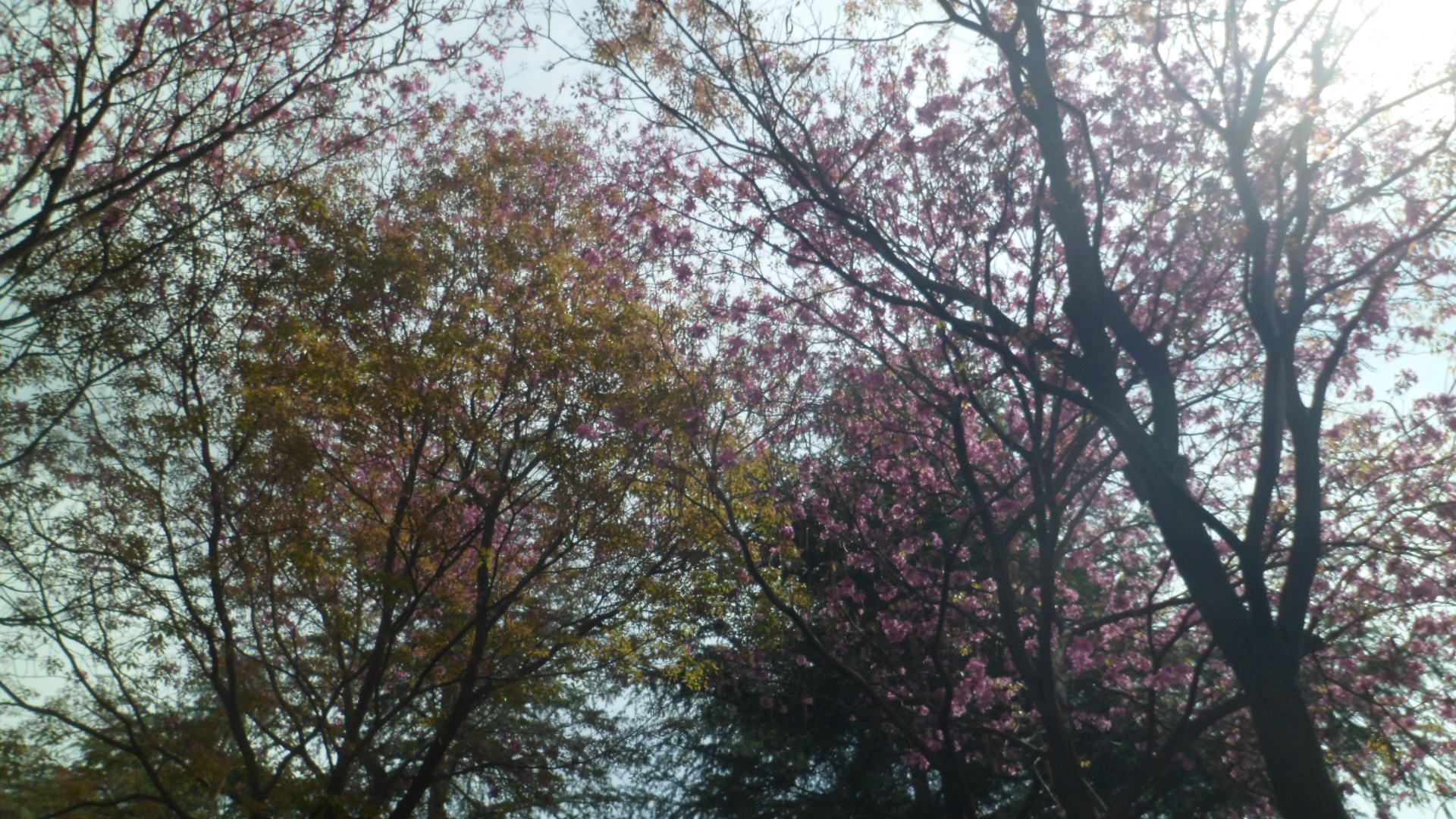
As is the case in most buildings of the time, garden courtyards may be found on either side of the main corridor. Cherry blossoms are as prolific here, as anywhere in southern California.
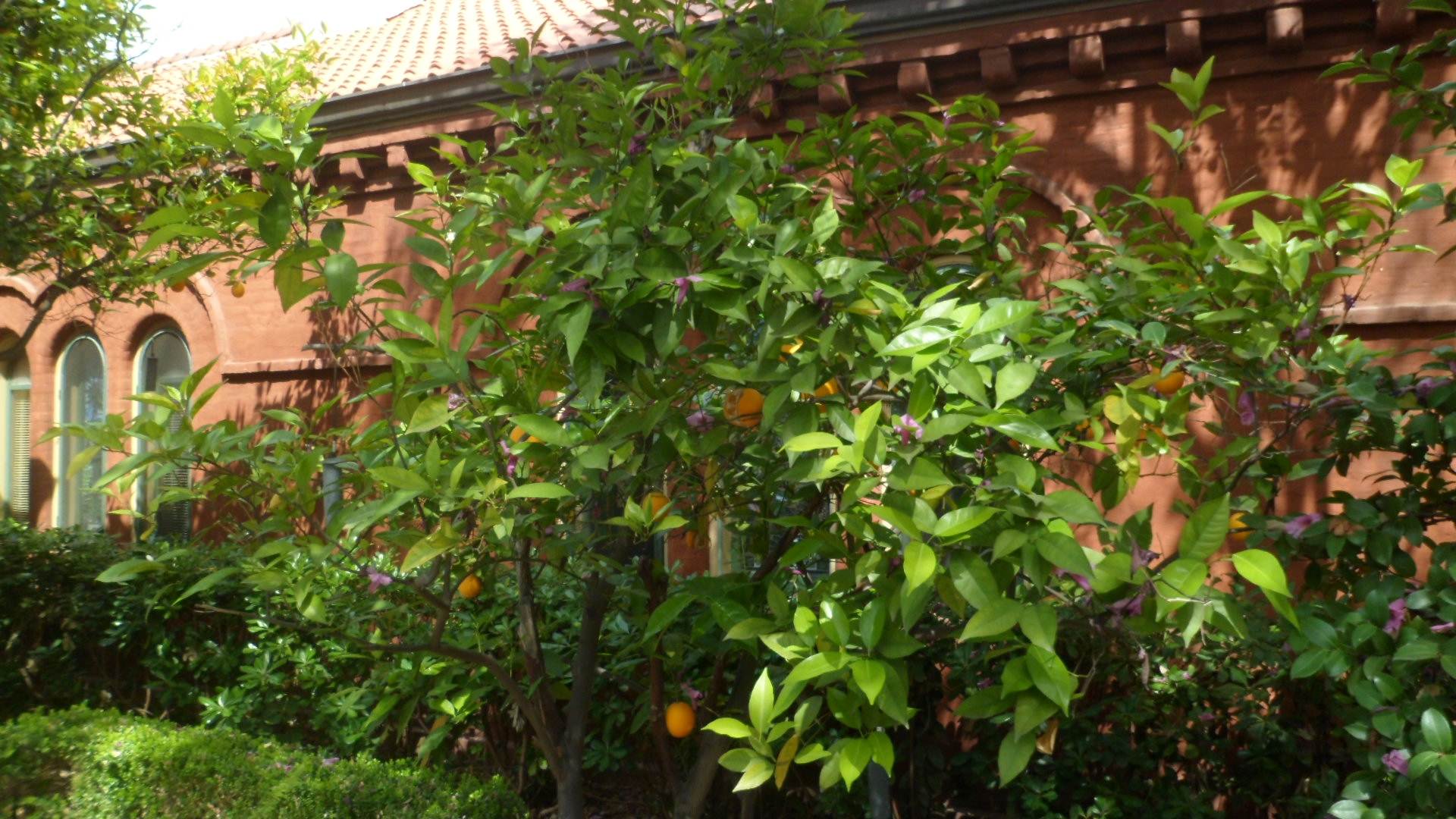
Orange trees symbolize what brought material prosperity to San Bernardino County, as well as nearby areas of the Los Angeles Basin, pre-suburbia.
As devout as SDA people are, they also have a playful side. Here are a couple of signs of Spring, topiary-style.
The cavernous Main Reading Room lends gravitas to the Smiley, as well.
Immediately to the south of the Library is the Lincoln Pavilion.
Honest Abe, and an impressive collection of Lincoln memorabilia, are on display within.
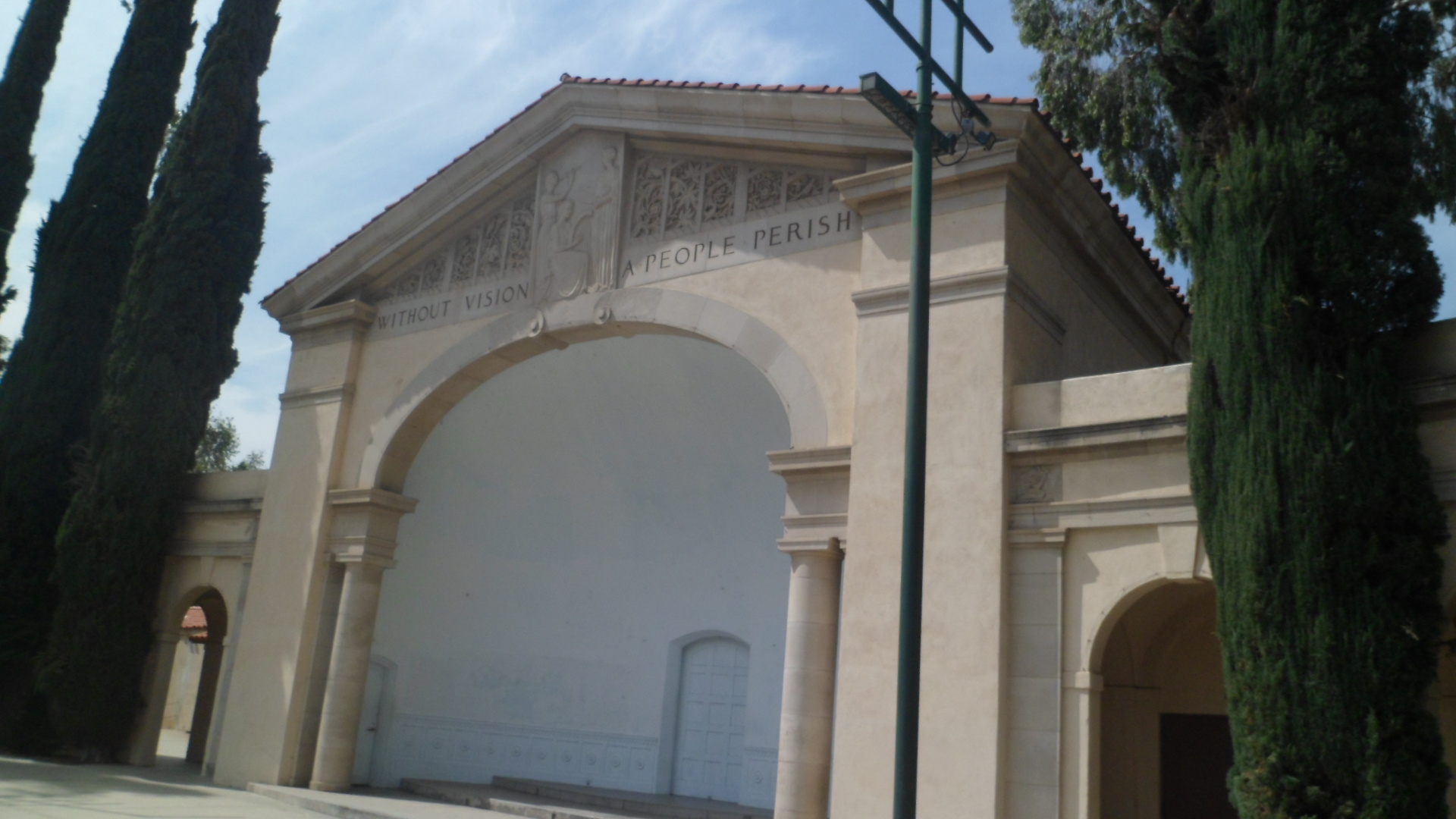
I spent about 30 minutes inside, then went across the street, for a look at Redlands Bowl, the municipal amphitheater. A photo shoot, featuring a fashion model, was in progress when I made my visit. Without disturbing the young lady in her work, I got a few shots of the venue. Note the many Italian Cypress planted here.
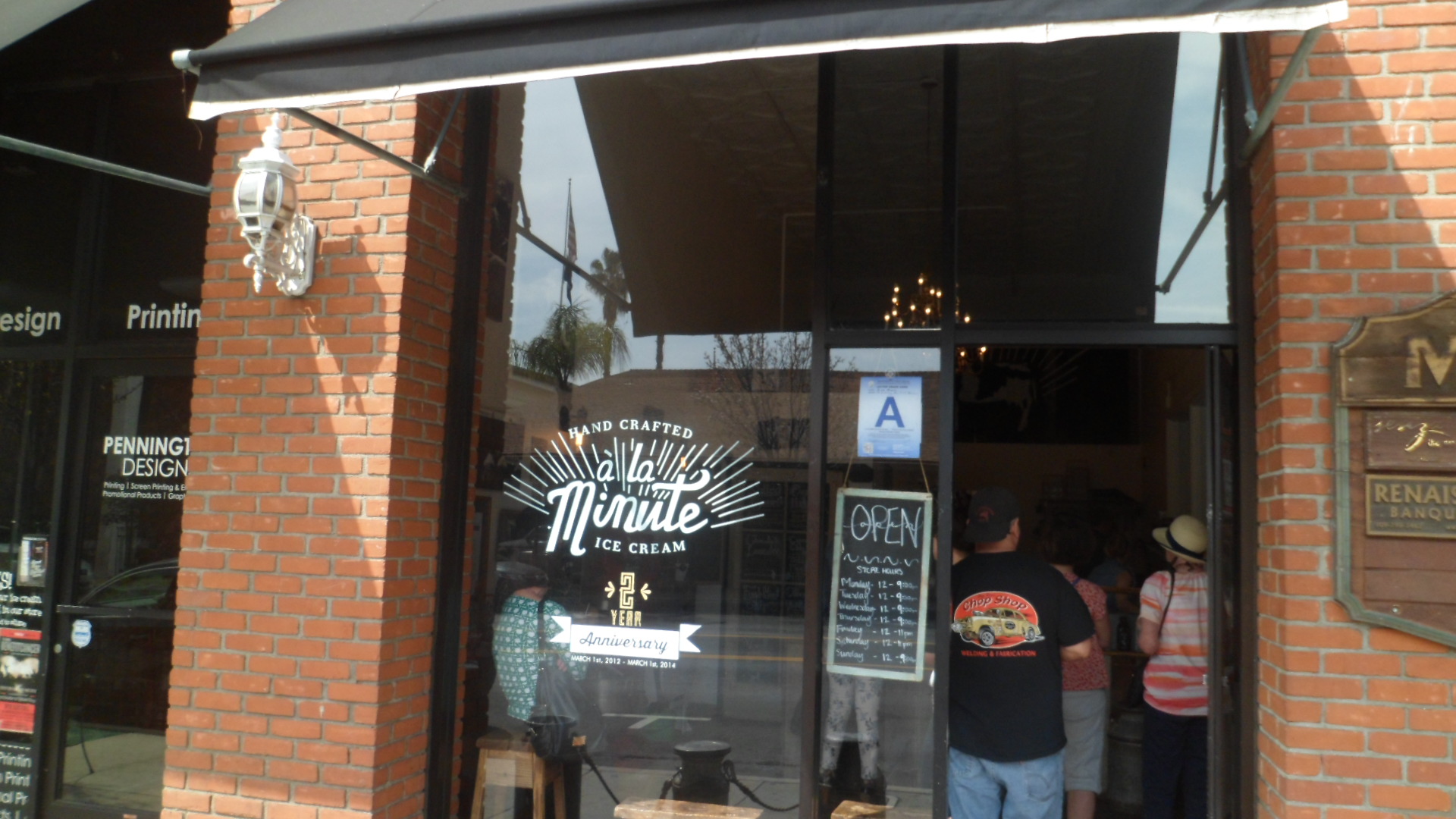
After this, it was time for a stroll downtown. I was delighted to find an ice-cream shop, which features made-to-order, nitrogen-infused delicacies.
After enjoying some salted caramel ice cream, I noticed that Mom and Pop are working hard for local children.
Downtown Redlands, on a Sunday afternoon, was serene, even with a modest crowd meandering the streets, including some local teens, who were shadowing me from a safe distance, while giggling and goofing around.
Redlands homes are mostly well-kept, and surrounded by greenery.
So, another lovely trip to the Golden State came to a sweet end, courtesy of yet another fine locale, in the underrated Inland Empire.
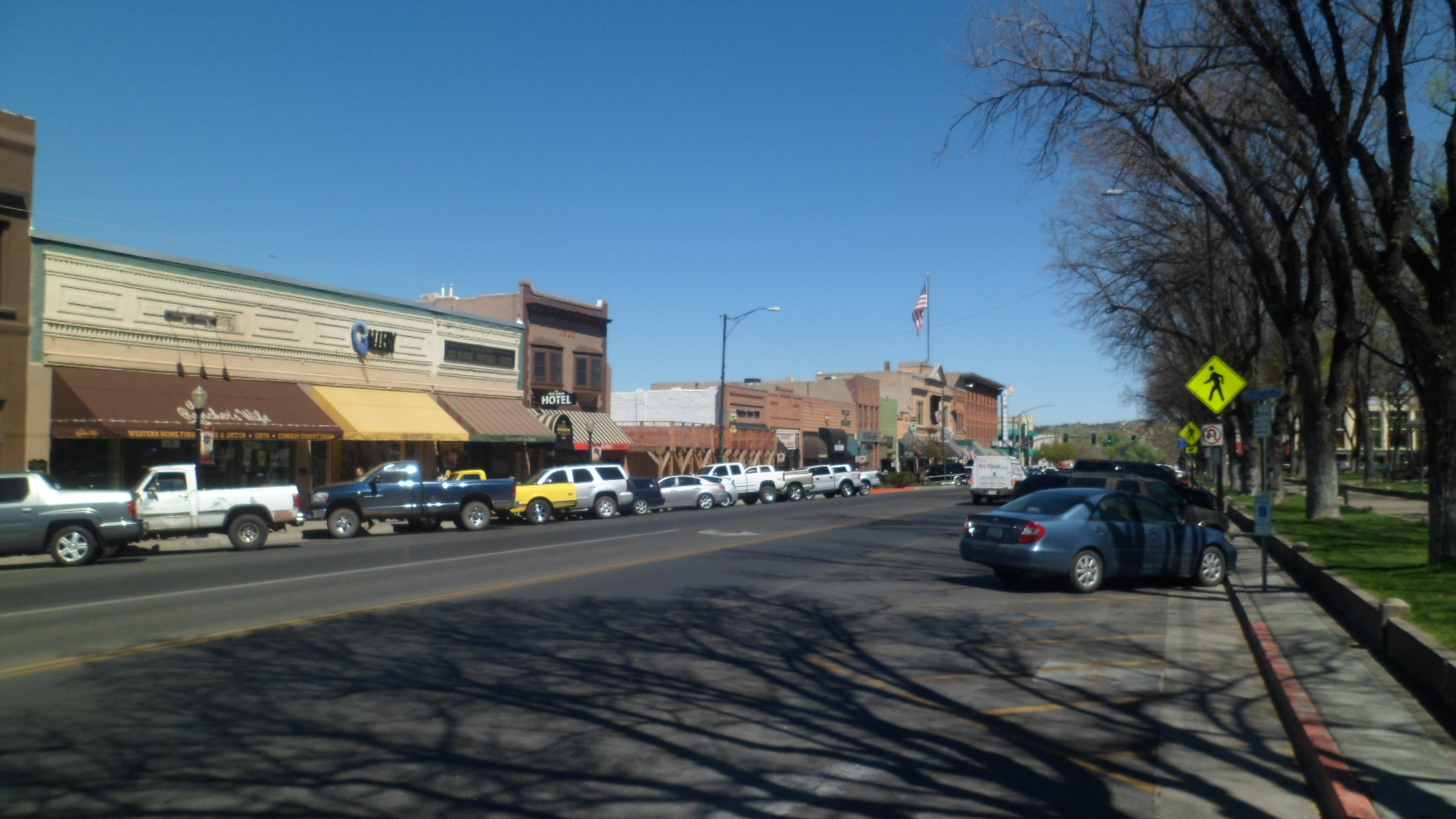
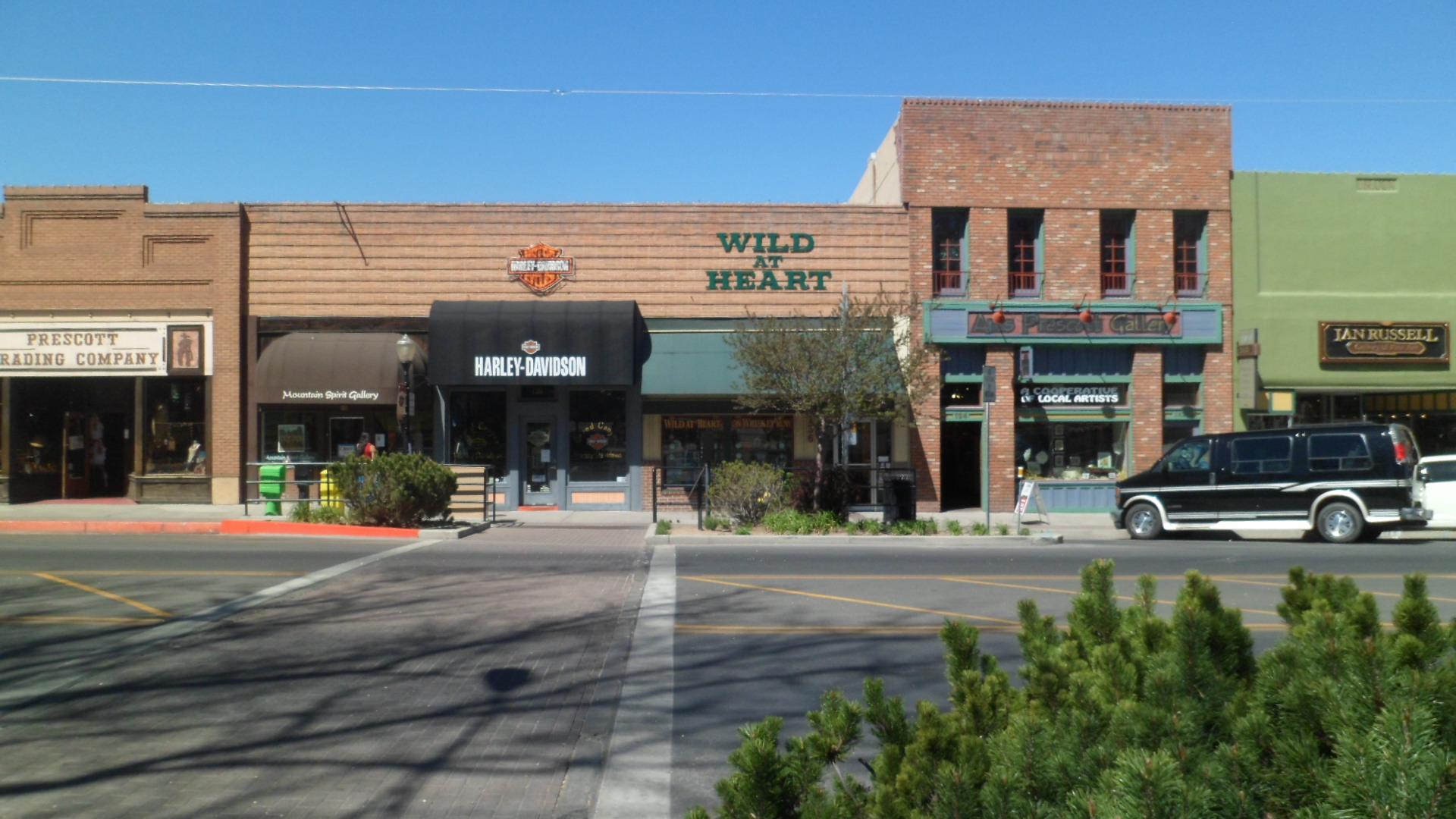
Prescott will observe the 150th anniversary of its founding, at the end of May. This afternoon, about 1,000 people gathered on the east side of the Courthouse, to take part in a group photo. Since I won’t be in town during the actual celebrations, I decided to be in the group photo. It’ll be ready for distribution, on a poster, in a few weeks. I will keep checking Prescott’s Facebook page for group photos, in the meantime. While contemplating the arrival of this anniversary, I realized that my photo shoots have been achieved far and wide, across the country, yet I had not recorded some of my adopted home town’s most salient features. Downtown is therefore presented here. First, at City Hall, citizen and visitor alike are greeted by this imposing figure.
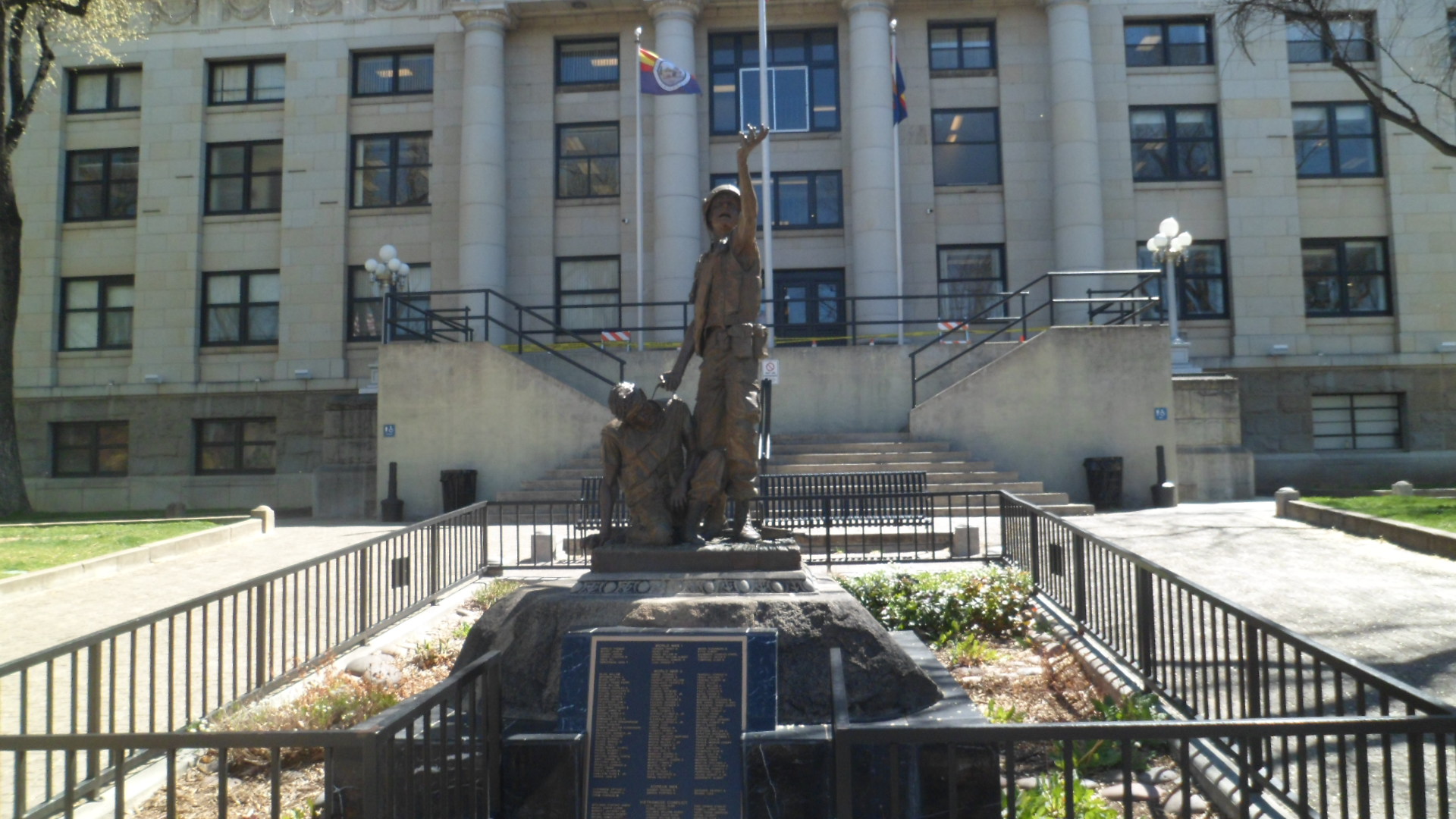
Two other statues occupy the edges of Courthouse Square. The warp and weft of this fabulous little town is the ranching West, followed closely by a fierce defense of individual freedom. There is, in this day’s economy, not that much left of the Cowboy Culture, but we have the Fourth of July Rodeo, the Cowboy Poets gathering, these statues, and what follows- Whiskey Row, Prescott’s legendary answer to Tombstone.
The northern cornerstone of Whiskey Row is the oldest of Prescott’s three iconic hotels: The St. Michaels.
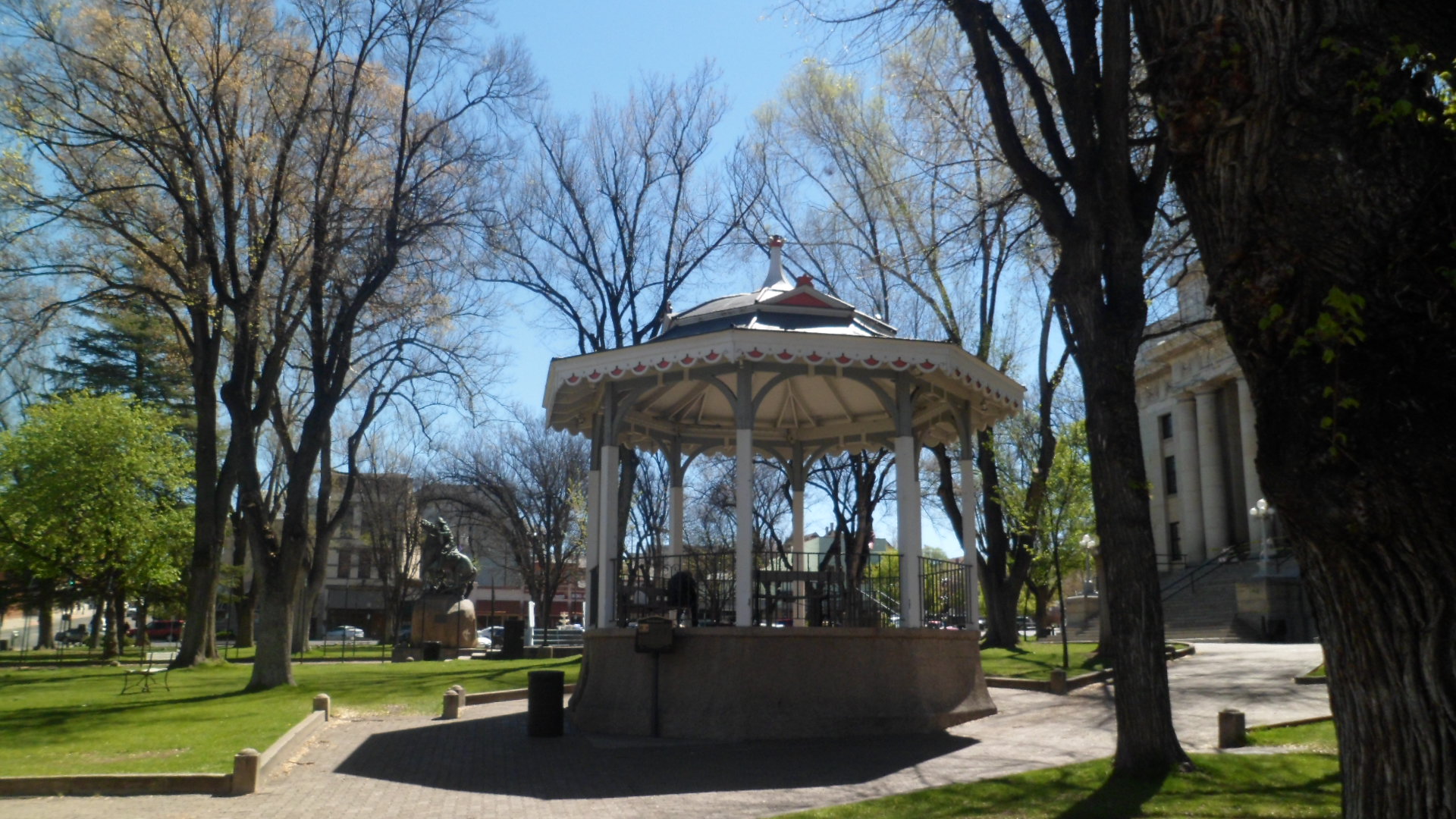
At this point, I rounded the corner of Courthouse Square, past the Gazebo, where Penny, Aram and I used to sit and listen to the Friday evening concerts, in the early 2000’s,
and found the Centennial Tree, offered by the people of Prescott to the State of Arizona, on February 14, 2012, our state’s Centenary.
Prescott was founded for the sake of the cattle industry, as well as for mining. Yet, when the horse became a secondary means of transportation, Prescottonians took easily to the automobile. Antique car shows are held here, once or twice each year.
In front of this fine vintage vehicle, I found a palatable and filling lunch at one of Prescott’s many dining establishments,
On the way home, I passed Prescott’s newer downtown Grand Hotel: The Hassayampa. born of the Edwardian Era.
I can’t leave mention of hotels, though, without a glance at our lovely boutique establishment: The Vendome.
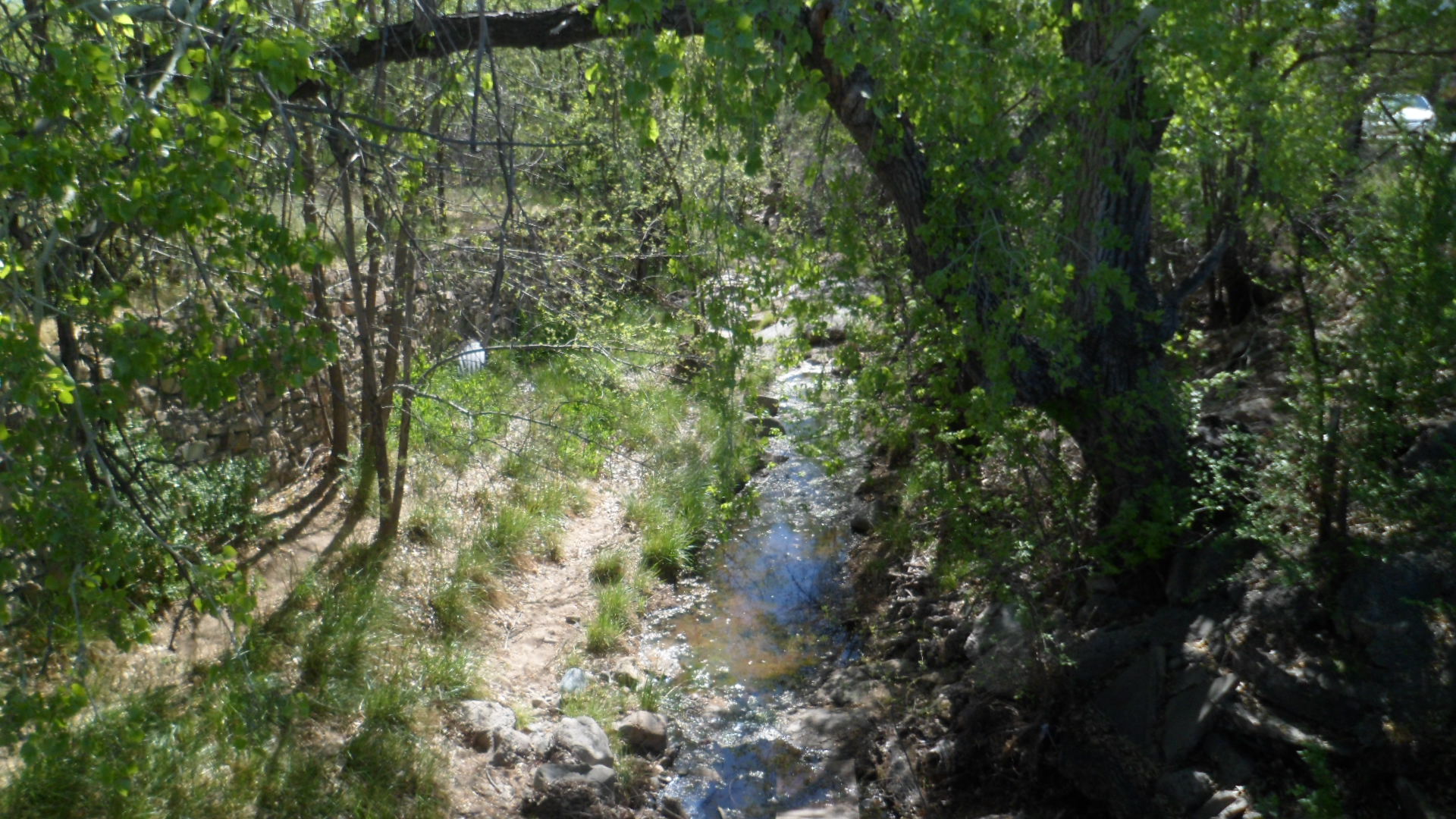
Prescott still has plenty of serene, natural settings, including some not far from downtown. Here is Miller Creek.
We are, after all,
Here is an example of why Prescott has survived three downtown fires, a few floods and the devastation of last year’s loss of one of our primary Fire Crews. A real community is never totally rent asunder, and this town, like Tombstone, is too tough to die.
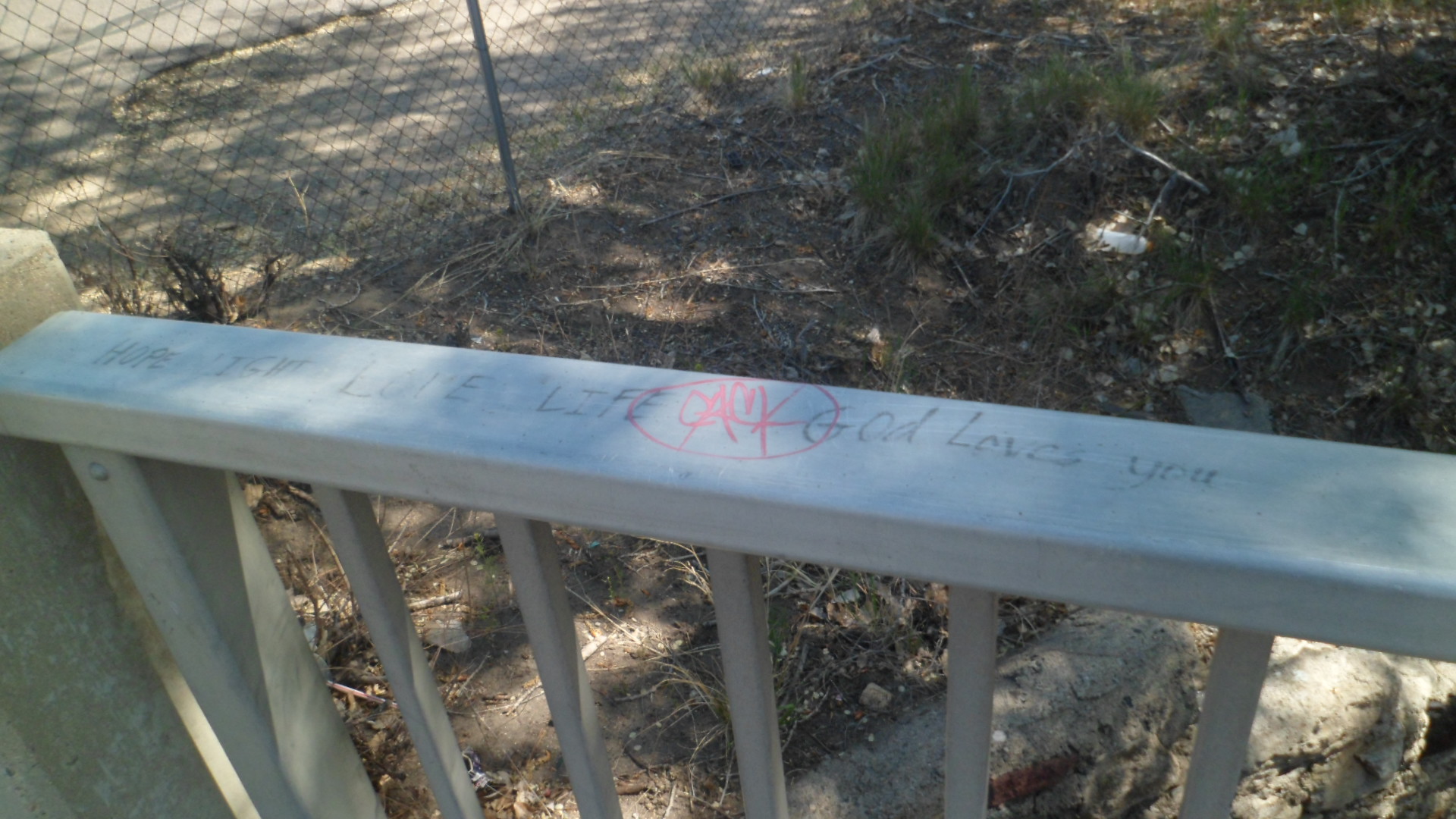
Long after the scrawler of the red graffiti has come to his senses, there will be love and life, and God will love us.
The serene inner garden of Mission San Gabriel Arcangel exists in four parts. There are indeed four points in this lovely arrangement: The Grape Arbor; the manufactory; the Peace Garden; the Tongva display.
When entering the garden, through the Mission’s Museum Store, one encounters an area that links the four points of this amazing island of serenity. Here, it is explained how the big picture of Spanish settlement fit the work of the monks and friars into its warp and weft.
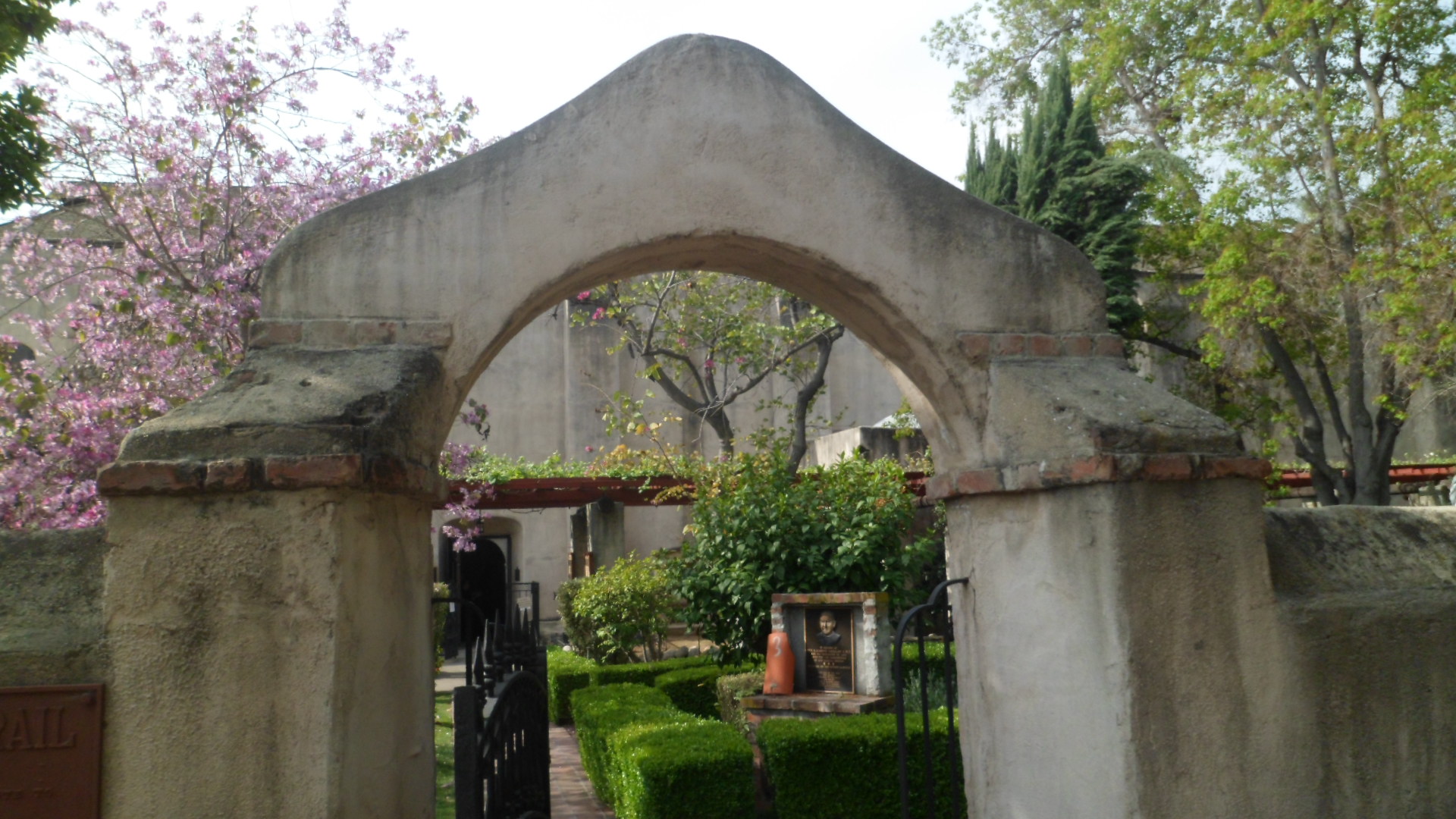
An archway brings the traveler into the Peace Garden.
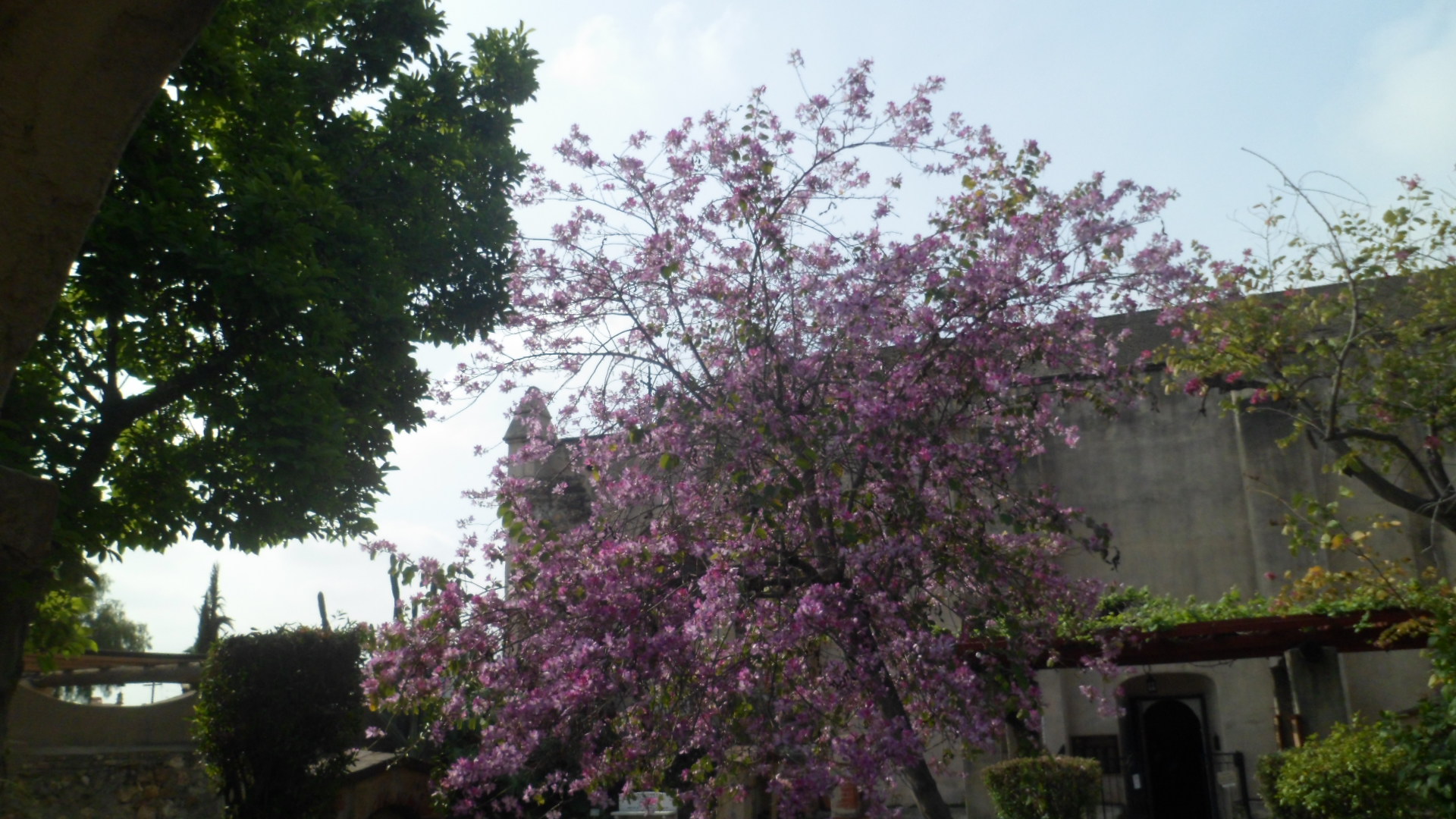
From here, it is wise to listen for any signs that there might be a Mass, or other worship activity, going on, as the Mission Church is immediately ahead, to the south. As Mass was in progress when I walked through the Archway, I contented myself with walking about in the Tongva quadrant. Cherry blossoms were abundant.
A lion glared out from the fountain.
As was the case at the Playhouse, there is a full set of miniatures of the California missions, in this section of the garden. Here is a miniature of Mission San Gabriel Arcangel.
The garden path weaves in and out, through the various sectors. This area, for some reason, invoked Gethsemane, for me.
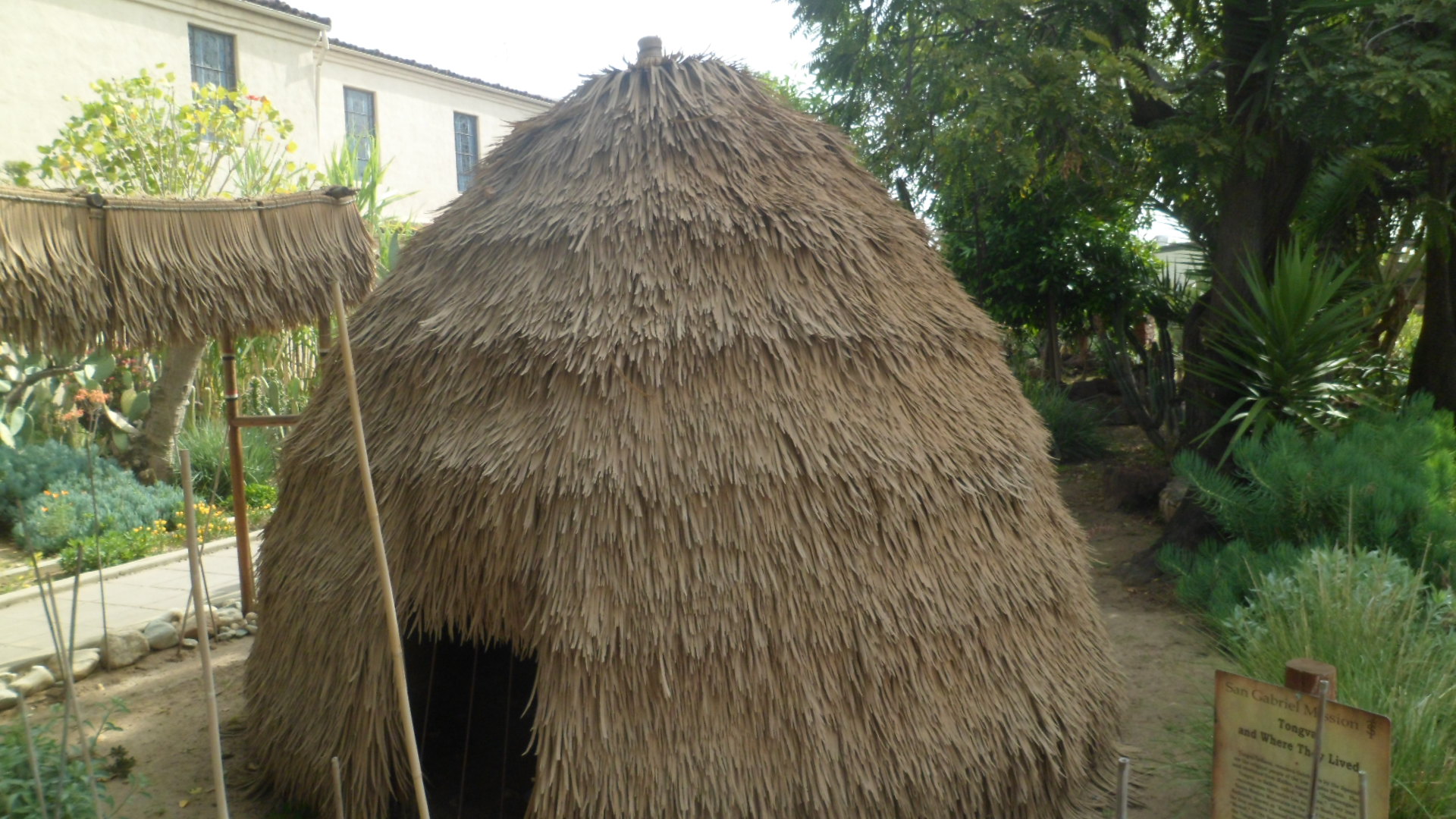
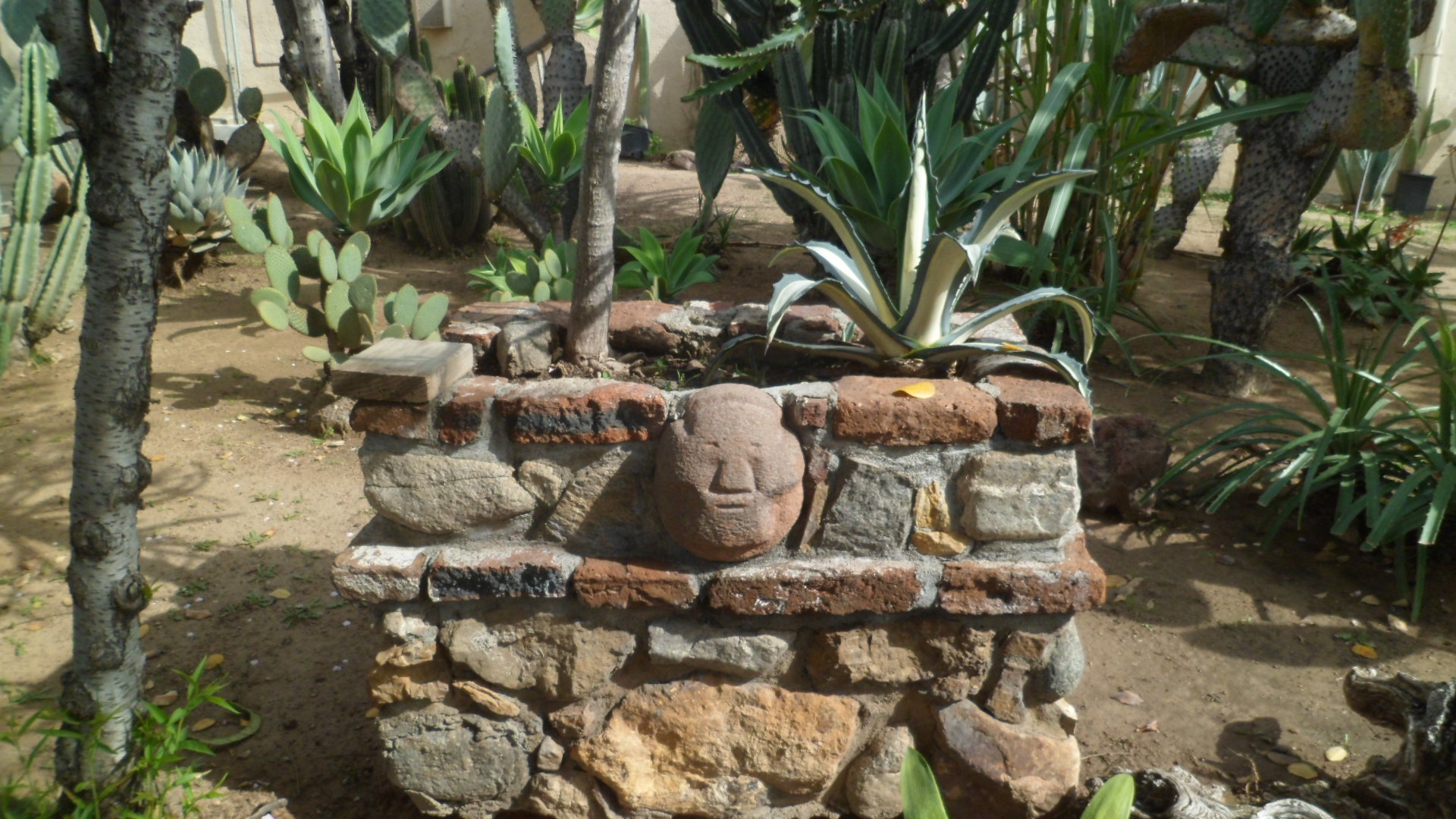
Around this corner, next to the bust of an unknown Spaniard, is the replica of a traditional home of the Tongva, or Gabrieleno, people. These indigenous folk dominated the Los Angeles Basin, from Malibu and Santa Monica to the area now called the Inland Empire. A band of Tongva still lives in San Gabriel, and shares the traditional culture with interested friends and neighbours.
A Tongva image is featured on this nearby stone wall.
From the northwest, or Tongva, quadrant, I moved into the comforting realm of Peace Garden.
The Blessed Mother, Christ and His Stations are here, bringing into focus the closeness that God and His Messengers are always willing to have with each of us, provided we open the channel.
Mary’s countenance gives solace in two places within the Peace Garden. Here, she is addressed as Our Lady of Guadalupe.
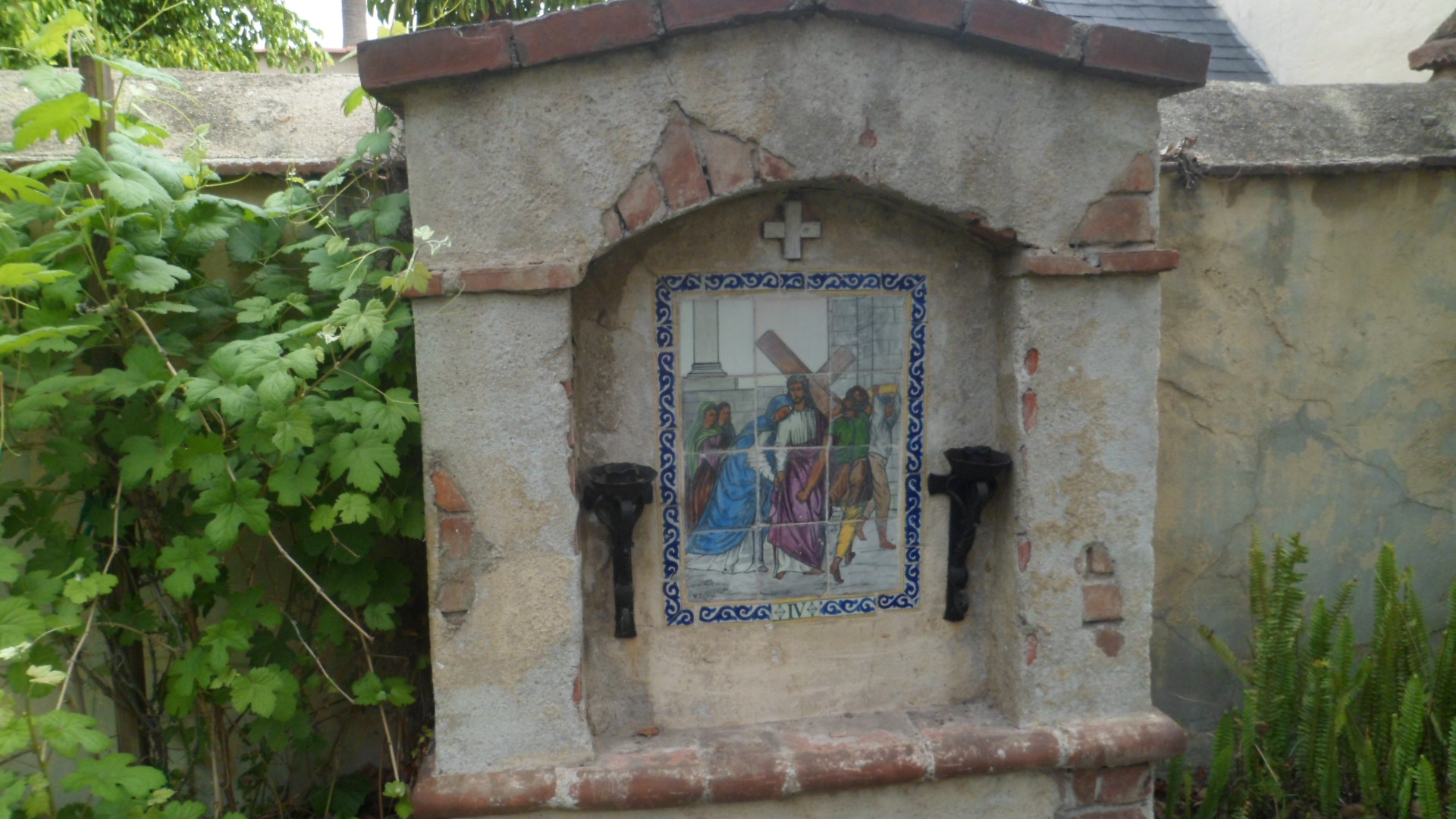
The Passion of Christ is reflected in the illustrations of His Stations, such as that below.
All the more so, Christ’s Presence is felt, in this depiction of the Crucifixion.
There is a very quick transition from the Crucifix to the Grape Arbor. This small area represents the first winery in the Los Angeles Basin. The monks initiated grape cultivation, at first to provide ceremonial wine to be used at Mass. As with all such libations, however, pleasurable uses soon proved an incentive for wider cultivation.
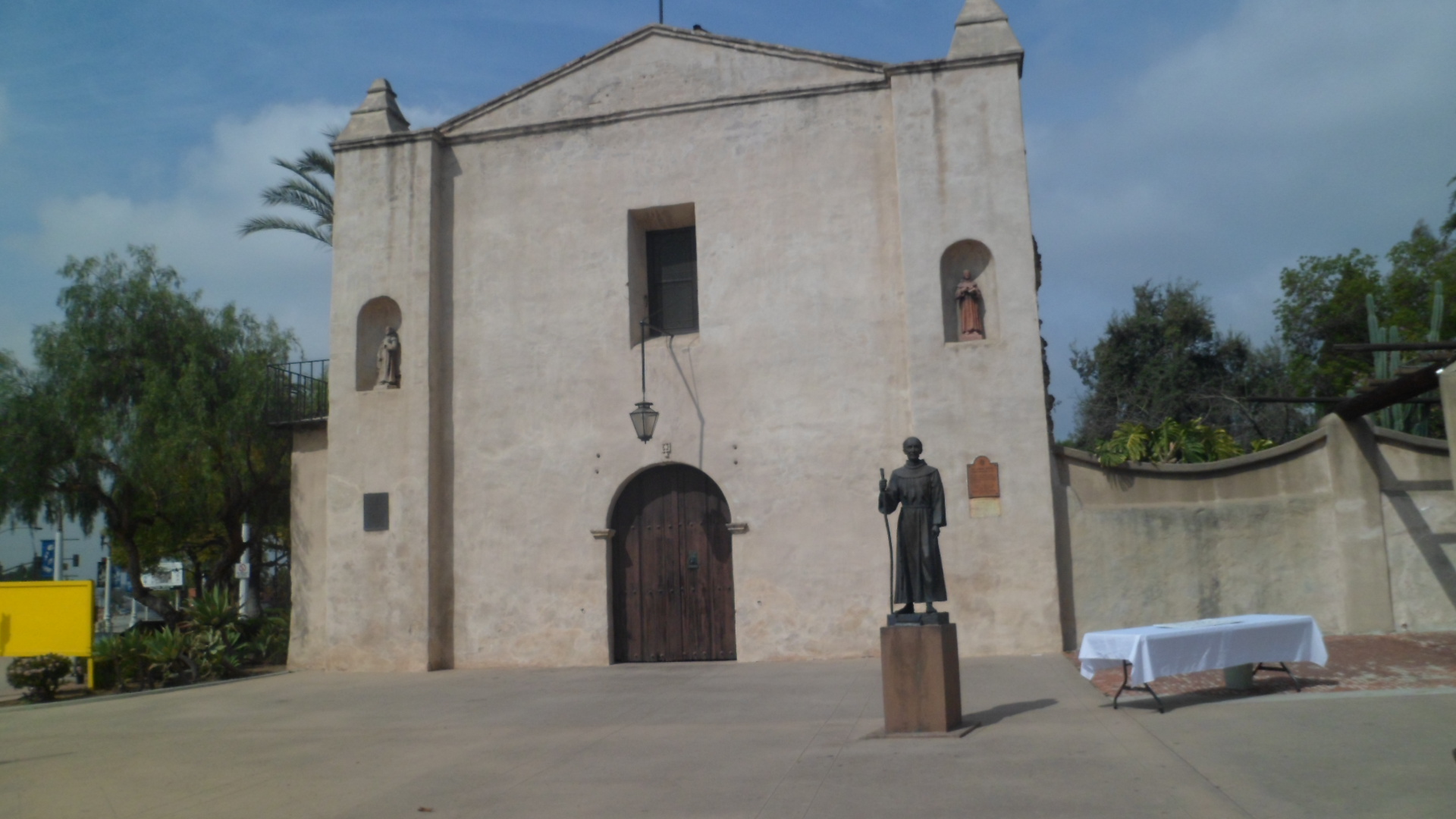
Padre Junipero Serra’s statue greets us here as well.
Through the Cypress Arch, one is escorted into the workaday realm of the Manufactory, the northeast quadrant.
Here, tallow soap, candles and everyday implements needed by the Mission were crafted, as well as all cooked food prepared.
Below, here is a view of the outdoor ovens.
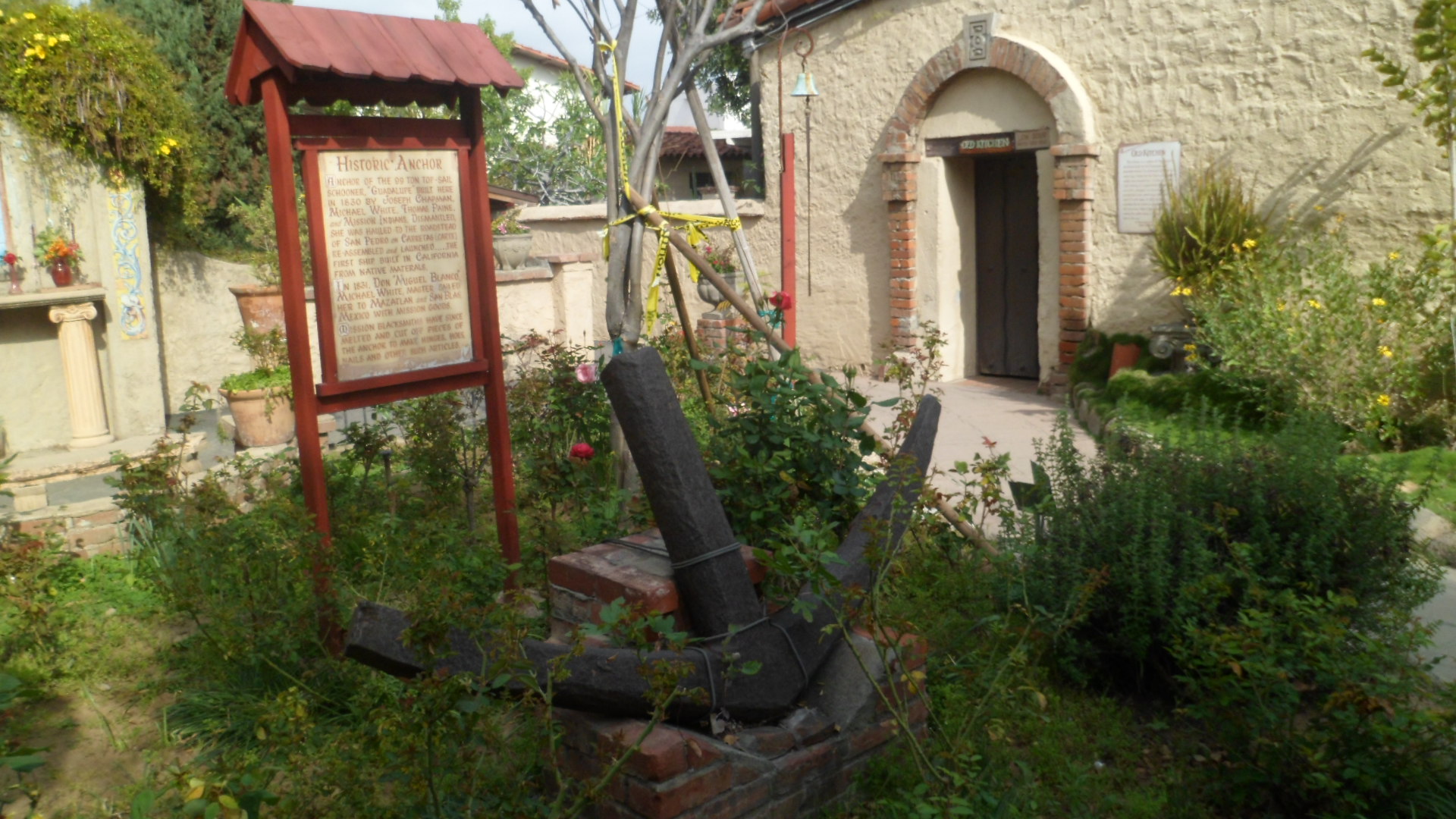
The aqueduct was fashioned from similar brick and mortar.
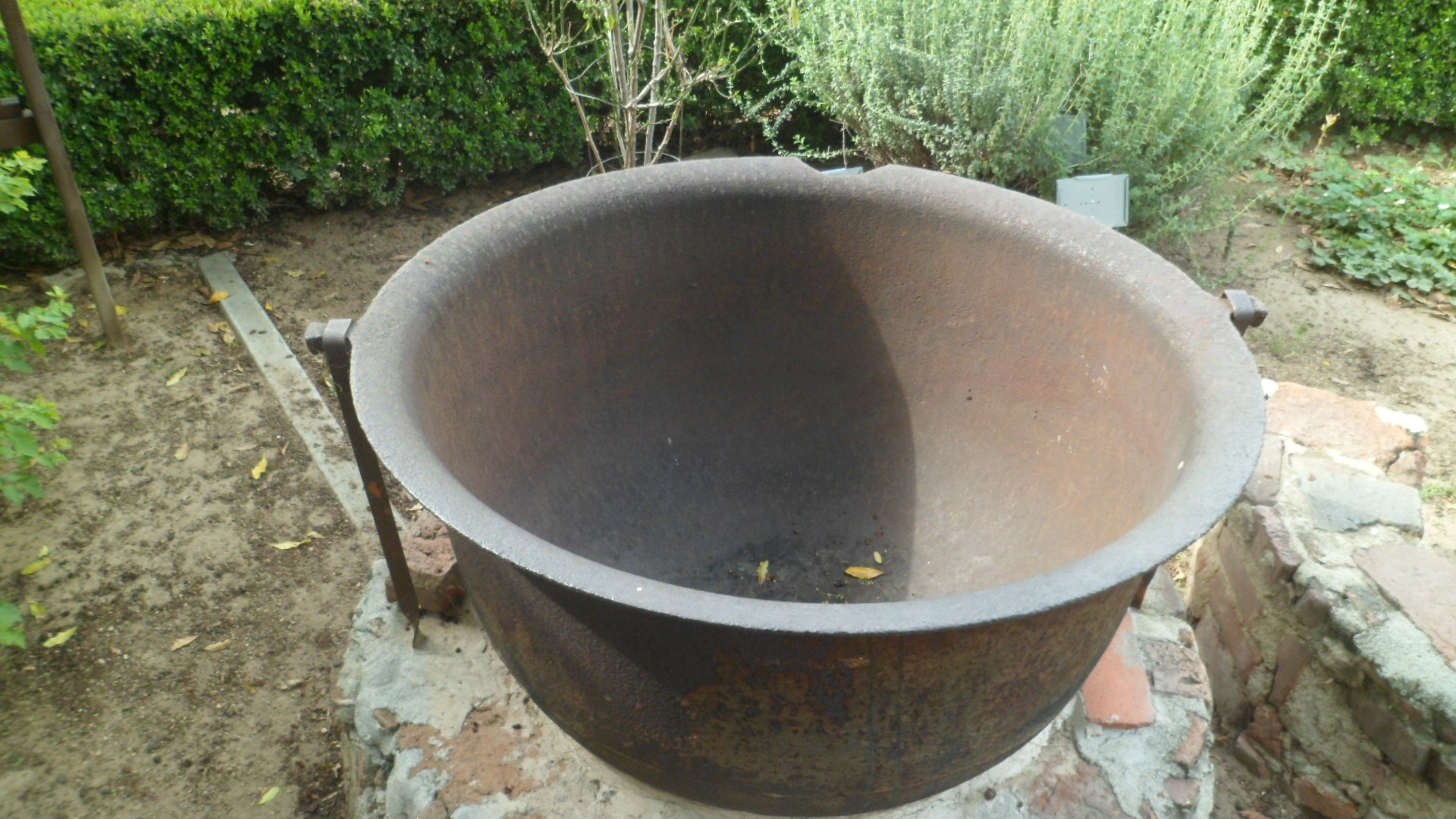
This iron cauldron was essential to the life of the community.
So, of course, were soap and candles, fashioned from animal tallow, in vats such as this one.
With the heat inside close to 450F, woe betided the careless and unwary of those venturing into the Manufactory. Making the necessities of life was quite hazardous.
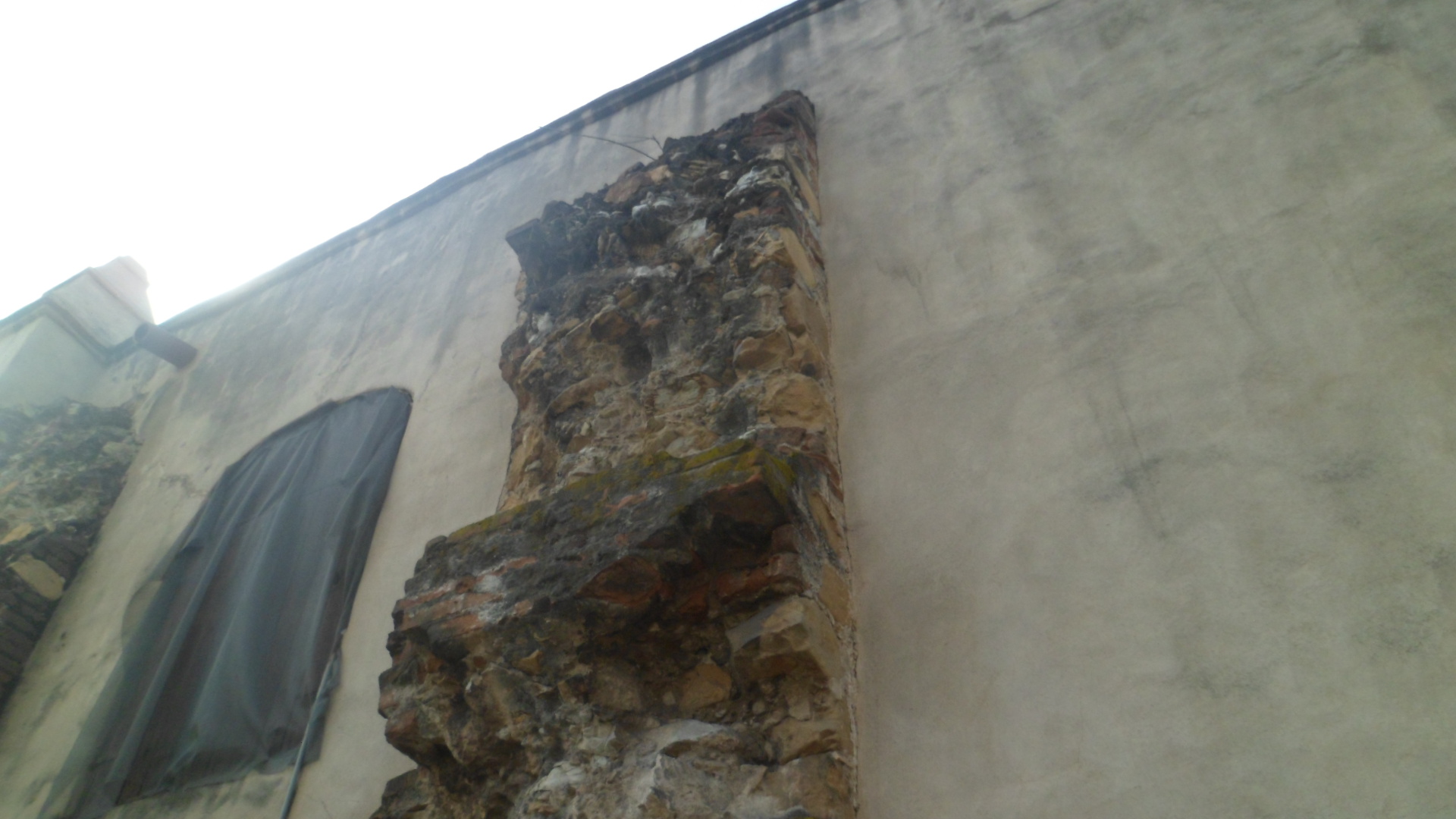
Life in this mission, as in other such communities, was however, generally rewarding for those of good heart. Control of the property was batted back and forth, especially after California’s admission into the Union, in 1850. By 183, however, the Federal government had restored control of the Mission to the Claretian Order.
On Easter, I will post scenes of the Mission Church, the Parish Church and Mission School buildings.
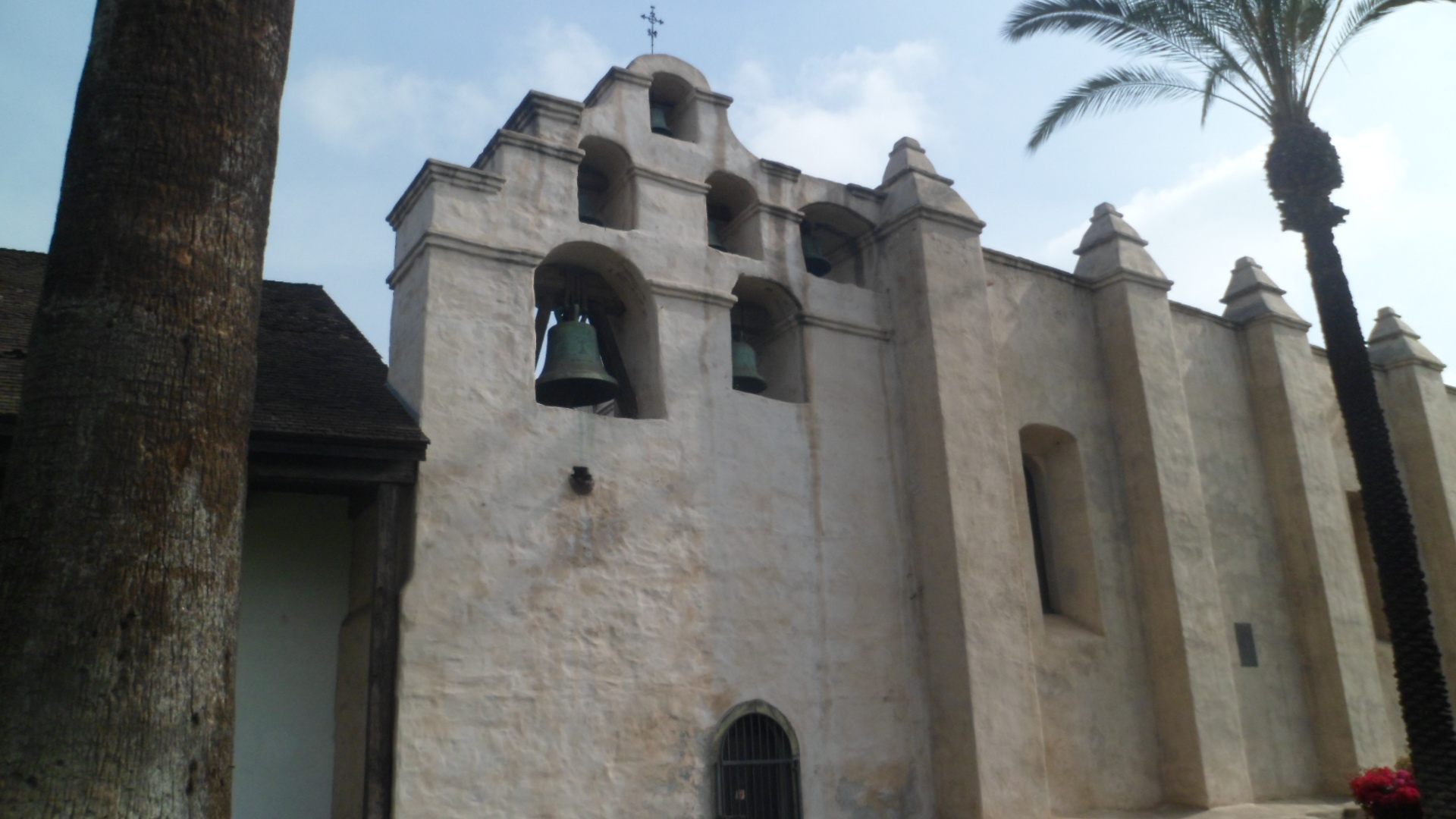
San Gabriel, in its heyday, was one of the most important settlements in the Los Angeles Basin, both to the Tongva people who dominated the area from Malibu to San Bernardino, and to the Spanish interlopers who saw Alta California as the next Golden Paradise. Mission San Gabriel Arcangel was the most important way station between San Diego de Alcala and Santa Barbara.
I spent about three hours on Sunday, March 23, in the Mission District of this still fascinating town on the eastern edge of Los Angeles County. The arts have become full partners with the lovely and still vibrant Mission, in calling attention to San Gabriel.
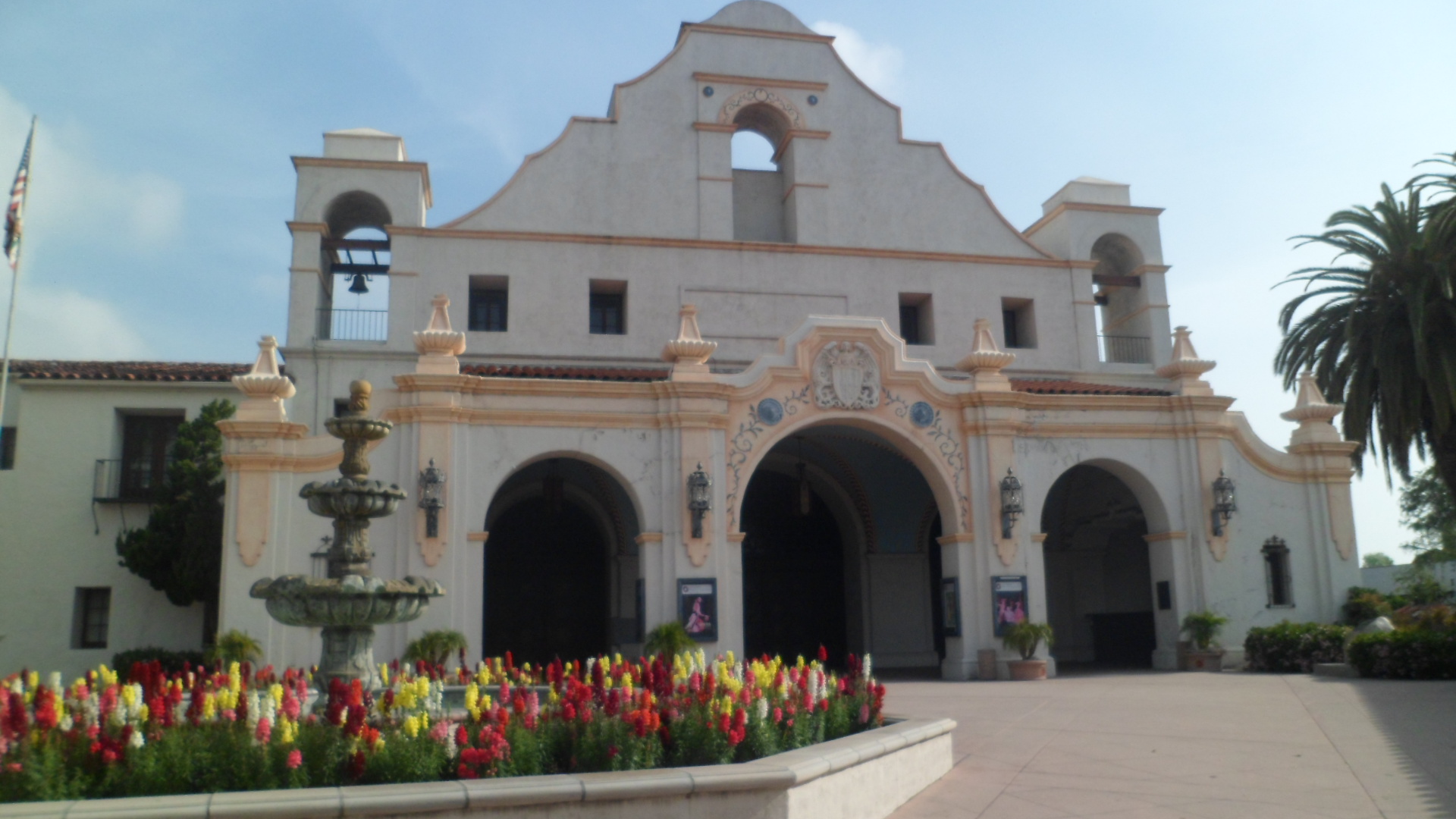
This post focuses on the Mission Playhouse, now San Gabriel Civic Auditorium, and the other buildings immediately to the west of the Mission itself. I arrived here about 10 A.M., after a brisk stretch-walk from El Monte to Rosemead and back, about a two-mile rounder. Not much was happening there, but San Gabriel was my goal for the morning, anyway.
The Playhouse itself was closed, of course. Who goes to plays on Sunday morning, even if they are about Padre Eusebio Kino?
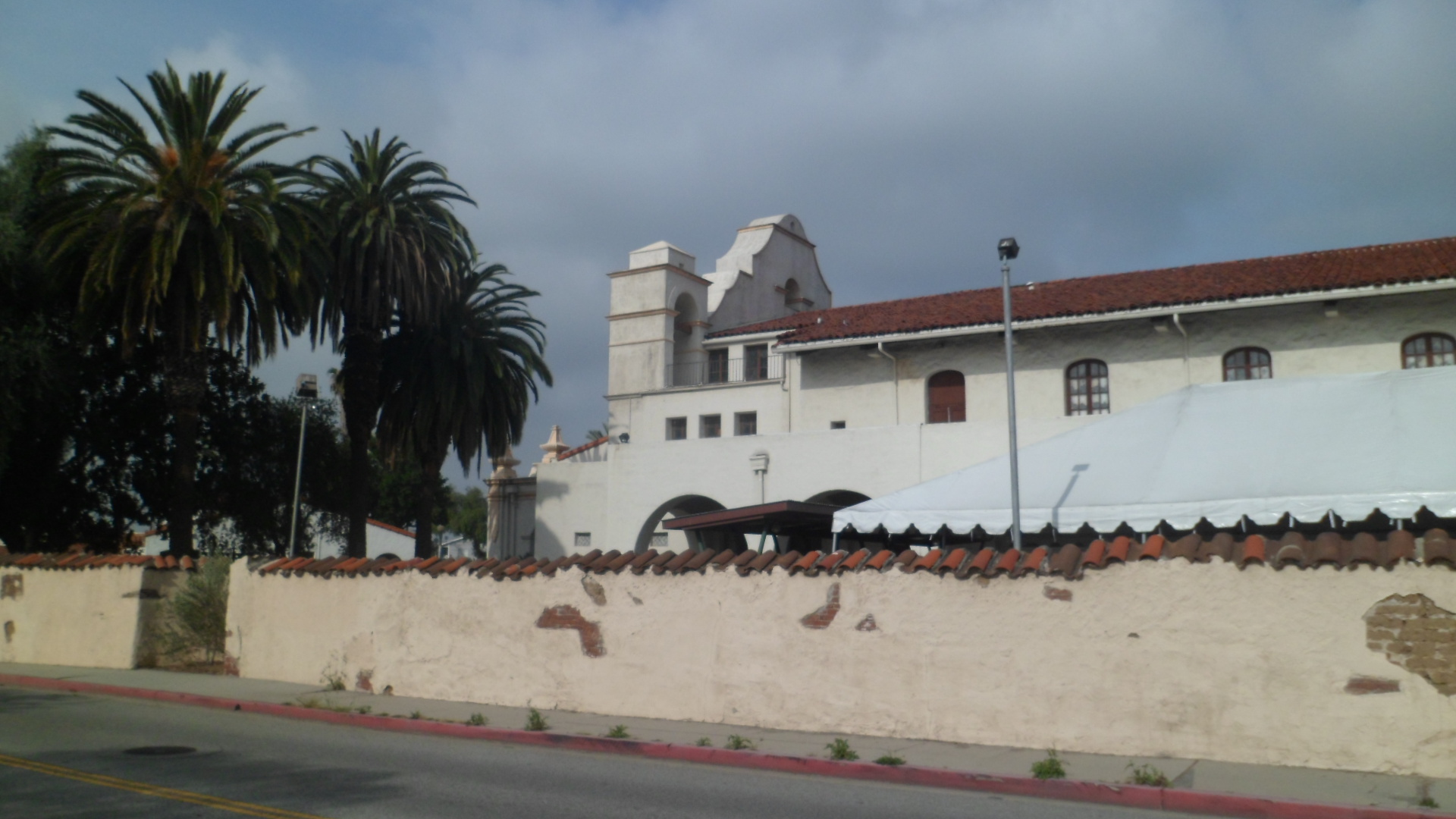
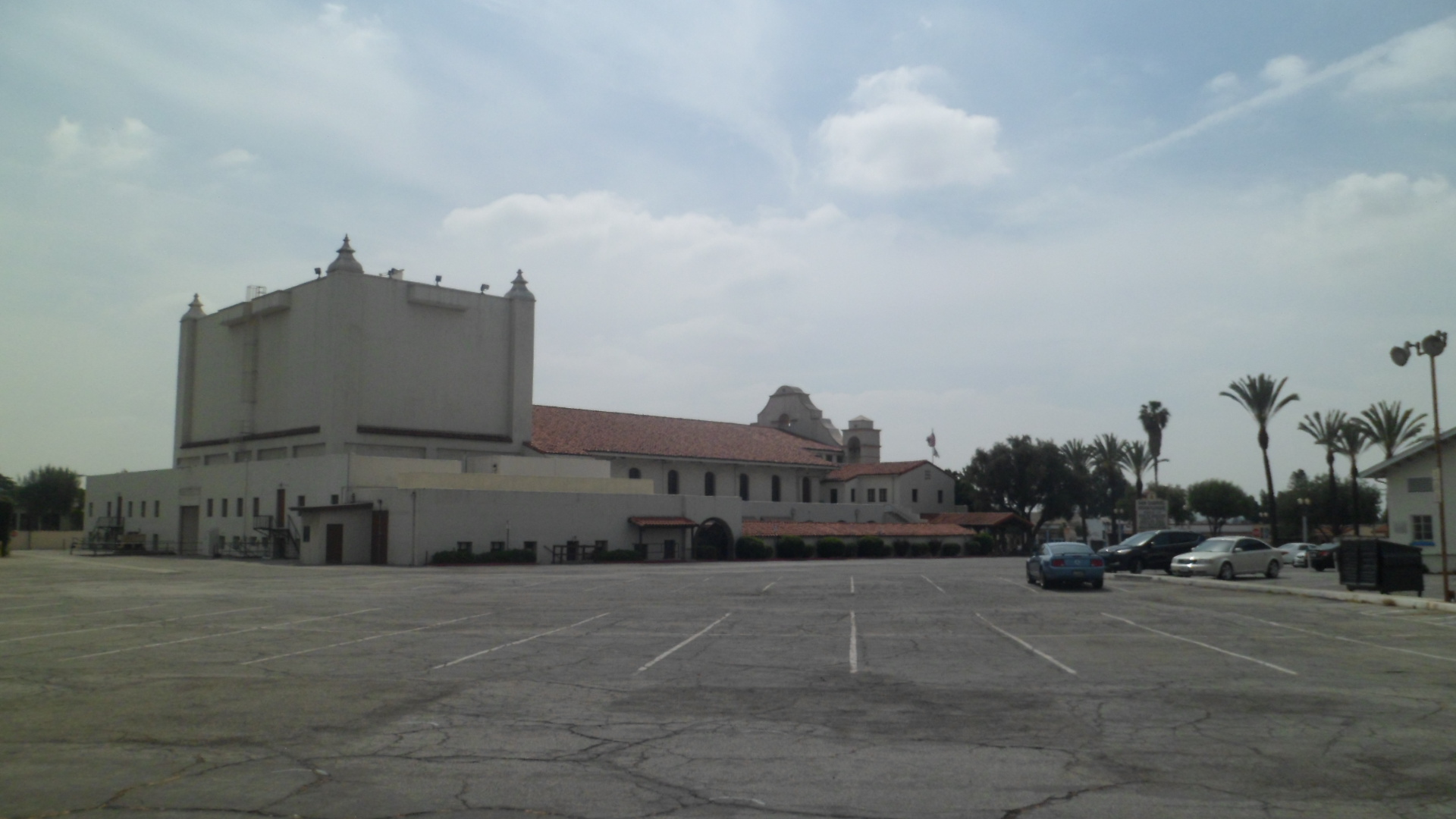
I was treated to some lovely scenes, though. Here are views of the grounds, and of the imposing edifice.
Both the Civic Auditorium and Mission San Gabriel itself have miniature exhibits of all the coastal missions in Alta California.
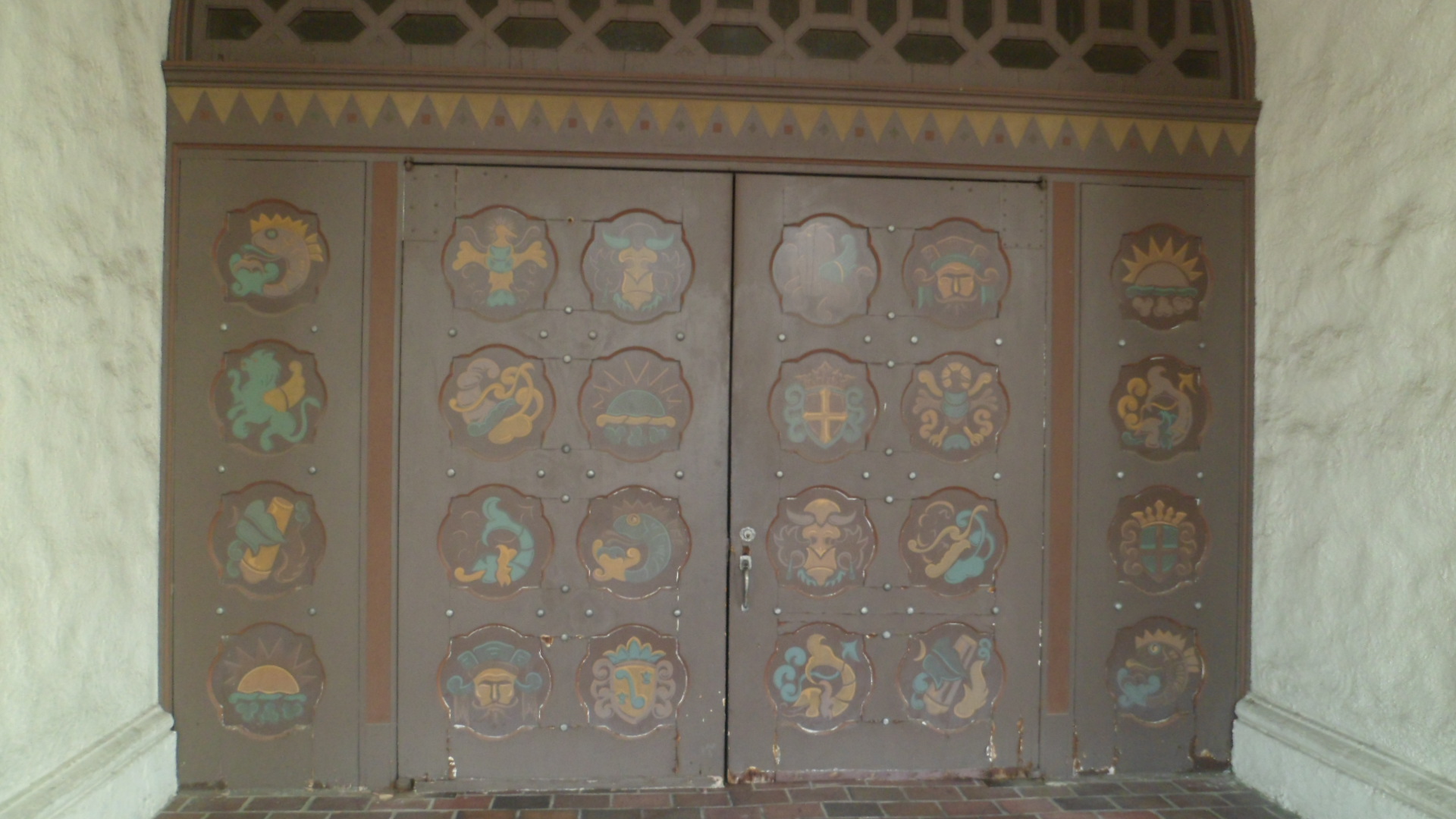
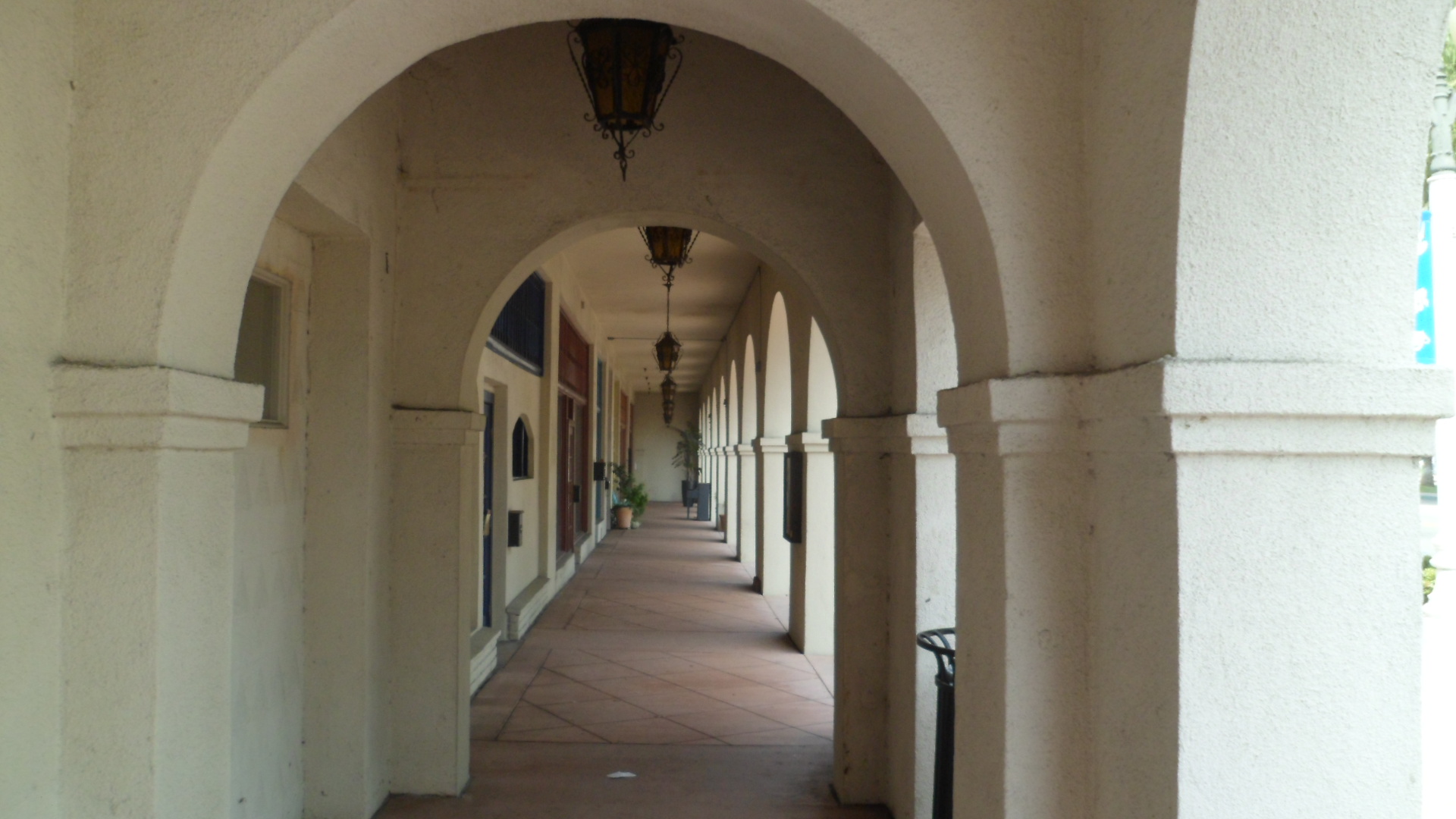
As with so much decorative art, one must never neglect a view of the doors. Those found here, are second to none.
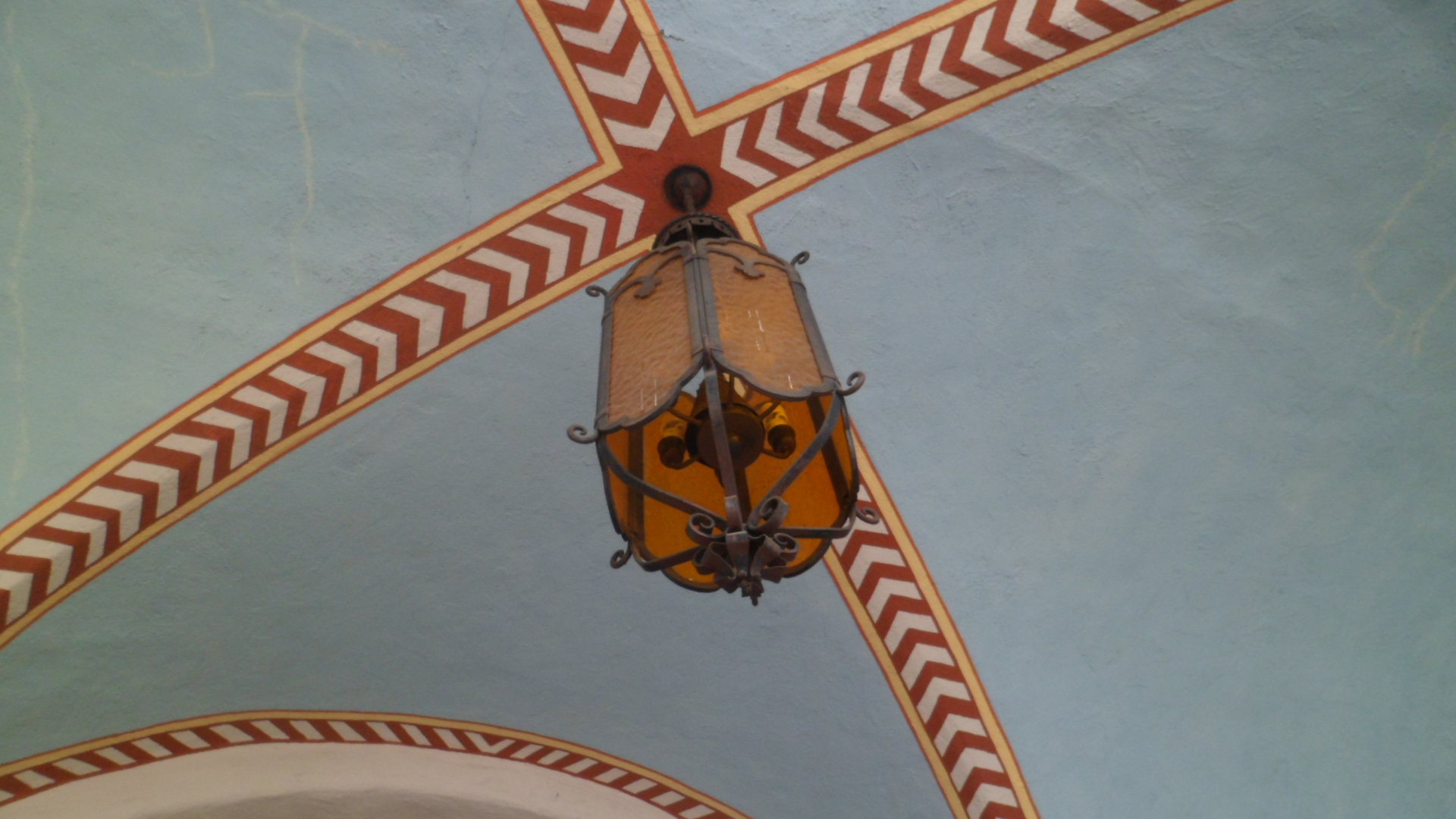
Nor should we overlook the ceiling! This painted design is more modern, of course. The Spaniards opted for wooden beams and other, more simple fare.
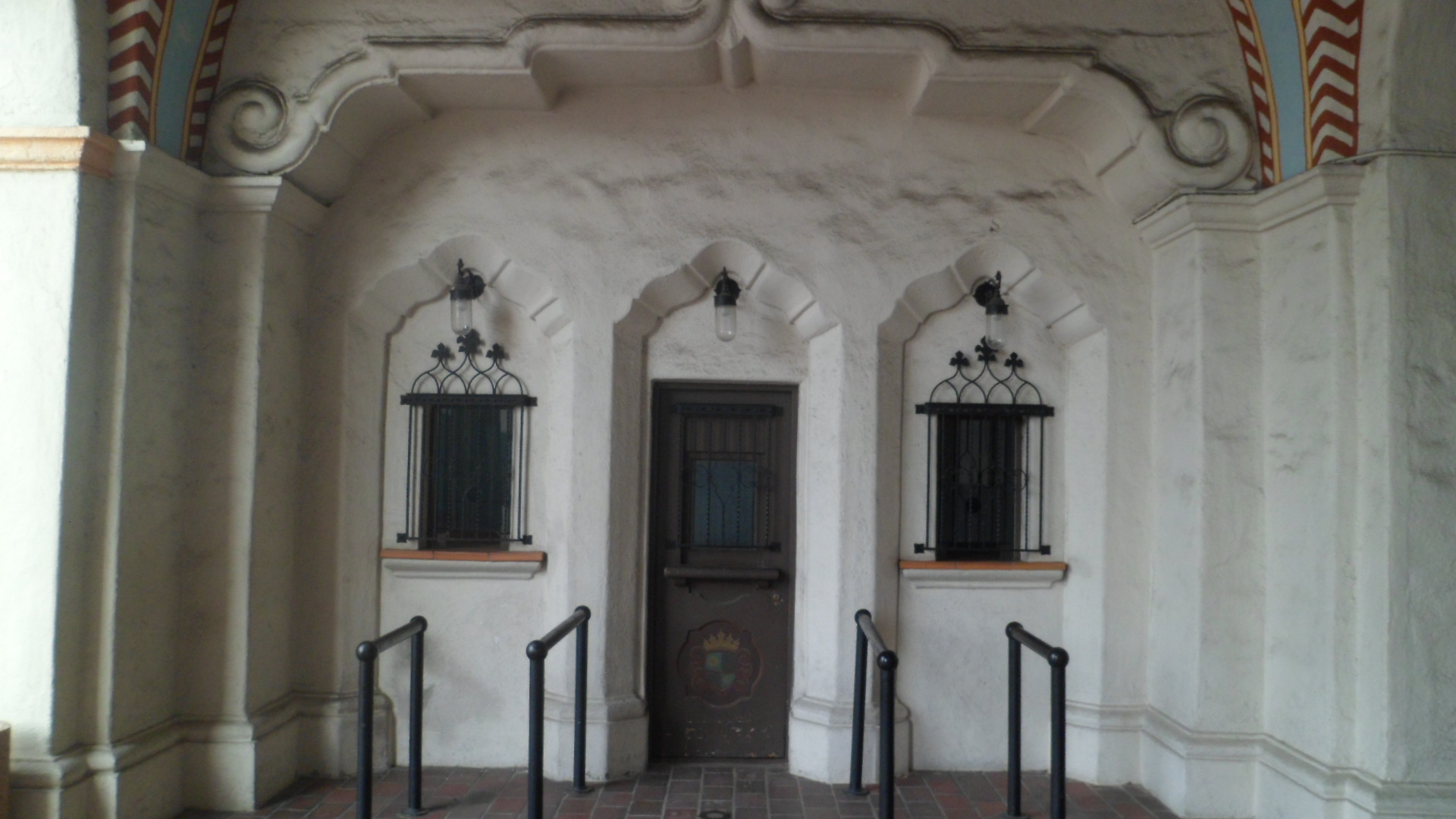
The alcoves are among my favourite parts of the missions.
The full story of the Playhouse, and its transfer to the City of San Gabriel, is told here.
Grapevine Park is part of San Gabriel Senior Center now, and as such is only open during the week. It has one of the original grapevines which helped defray the costs of the Mission.
The walls protected the privacy of the friars, back when this was part of the mission proper. Today, they keep Mom and Pop safe from prying eyes.
There is a spot, though, where one is able to get a good view of the California Live Oak, on the Playhouse grounds.
Here is one last view of San Gabriel Civic Auditorium, from the northwest.
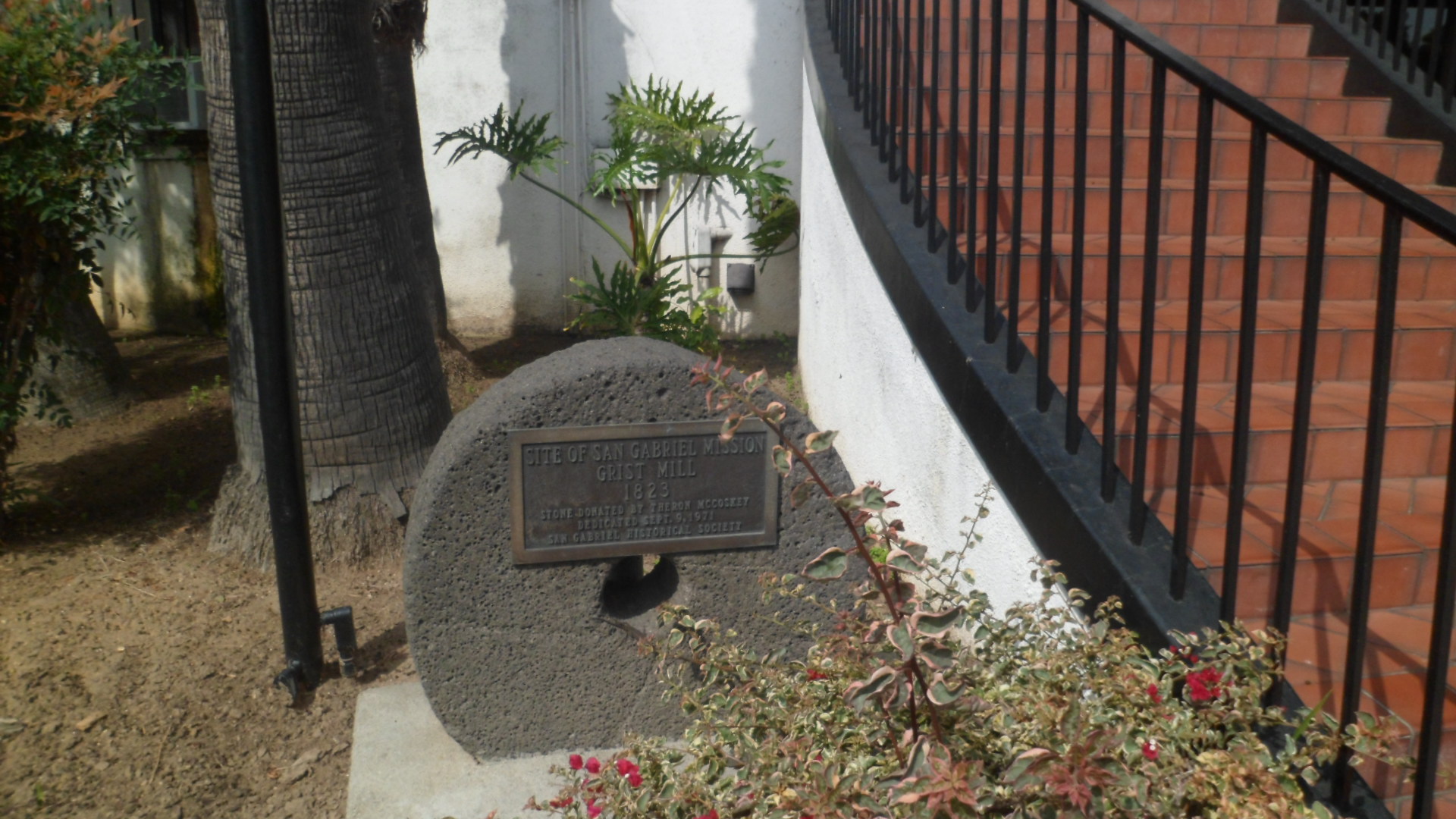
Across the street from the old playhouse lies San Gabriel City Hall, built in 1914, in the Spanish Colonial style, on the grounds of the area’s Grist Mill.
Adjacent to City Hall is the Ramona Museum of California History. It’s open from 1-4 PM on Saturdays, but the mural is there, 24/7.
North of the Civic Auditorium lies Bovard-Wilson-Hayes House, home to the area’s first Anglo-Californian settlers. Reverend George Bovard, the first resident of this 1887 Victorian, was the fourth President of the University of Southern California. When he moved to Pasadena, Judge Milton S. Wilson purchased this house. Judge Wilson’s granddaughter, Mary Ruth Hayes, inherited the home and served as a school teacher in San Gabriel, for many years. When she passed on, in 1990, her will deeded the house to the San Gabriel Historical Association. The house is open to the public on the first Saturday of each month, from 1-4 PM.
So, it looks like I will need to pencil in a First Saturday afternoon in San Gabriel, at some point.
NEXT: Mission San Gabriel Arcangel- The Quadrangle and Peace Garden


 ,