To look more carefully at a life of seemingly endless re-invention and resilience is something I’ve been meaning to do for a long time.
I was never a particularly strong fan of Richard Milhous Nixon. A lot of that antipathy has melted away over the years. His achievements as President have largely withstood the test of time- the EPA, pulling a kicking and screaming Communist China, and Russia, into the world family, further advances in Civil Rights, much-needed reforms in government policy towards Native Americans, and slow movement out of Viet Nam- all were overshadowed by the dour countenance, the air of callowness , and the climate of secrecy and distrust.
A visit to the Nixon Presidential Library paints a far more complete picture. Watergate and the resignation are not swept under the carpet. Indeed, the first thing one sees, upon pulling into the parking lot off Yorba Linda Boulevard, is Marine One.
The Library itself is majestic, but in the spare way a man with Quaker roots would be expected to approve.
I entered the welcoming hall, which immediately takes the visitor through the bookstore/gift shop. I would later pick up lunch here, but out of prudence, I bought nothing else.
After looking around a bit, and reading the timeline of Nixon’s life, from birth to Congress, I headed outside to absorb the garden, which featured many of Pat Nixon’s ideas about how a Presidential Garden should look. She was arguably the finest presence in his often tortured life. This year marks the Centenary of her birth.
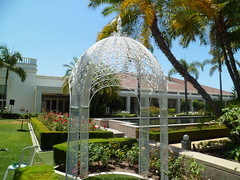
This is the bower used by Tricia Nixon and Ed Cox. I always thought she was cute, though it was Julie’s stunning countenance which made my adolescent jaw drop.
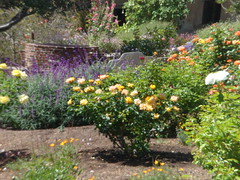
On with the flower show:
Here is Richard Nixon’s birthplace, still sitting on the same ground on which it was built. The spare Quaker -style home looks comfortable enough on the inside, though.
Hauntingly, the replica of the East Room of the White House is kept dark and remains spare, except for a set of four portraits of presidents and first ladies.
With this, and a viewing of the video of President and Mrs. Nixon’s respective funerals, my visit ended. I came away with a much fuller appreciation of how fully he lived, how much he suffered- especially with the loss of his wife, and how greatly he valued persistence and resilience. These two, regardless of one’s politics, are traits he recommended to everyone who espouses meaningful goals.
My commemorative southern California journey would end, later that night, with dinner at Panda Garden, in Needles- a surprisingly good Chinese establishment, which was packed.
My weekend took me to one more place- the Native American Baha’i Institute, for a 50th Anniversary celebration.
Down the street from Mission San Juan Capistrano and a block to the west, across the Coastliner train tracks, lies Old Capistrano- aka Los Rios Historic District. This reminds me of old sections of other cities founded by the Spaniards in the Southwest- a mini- La Villita or Viejo San Diego.
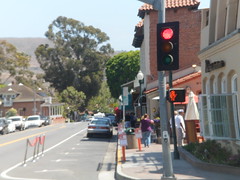
I spent about an hour walking about the shops and back streets of this comfortable town. First, it’s necessary to cross at a five corners.
We entered Los Rios, just across the tracks and near the train station.
Then, we were welcomed into the historic district.
My first stop was the coffee house.
The house was originally that of this lady, who worked hard to preserve Los Rios.
I walked a bit further around the plaza, after savouring a cup of white chocolate mocha.
Walking a bit north from the plaza, I came upon a bric-a-brac shop. These seem to be all over the old Spanish towns. I saw several in Laredo, and three in Mesilla. SJC had just one.
Coming back onto the plaza, I saw the house of Lupe Coombs, who helped Mrs. Olivares in the preservation efforts.
I ended my visit to Los Rios Historic District by checking out Casa Montanez, a California adobe home.
It was time for me to depart the 18th Century, and head into the ebb and flow of the LA Basin.
I got as far as Placentia, and the relative luxury of a Marriott Residence Inn. Tomorrow would belong to the 20th Century, and the story of Richard M. Nixon.
In all southern California, there are three iconic features which draw visitors: Beaches, mountains and missions. The oldest standing buildings in the state are found on the grounds of Mission San Juan Capistrano. People of a certain age know Capistrano from a song of the 1930’s, which mentions cliff swallows.
“When the swallows come back to Capistrano
That’s the day you promised to come back to me
When you whispered, “Farewell,” in Capistrano
’twas the day the swallows flew out to sea”
—excerpt from “When the Swallows Come Back to Capistrano” by Leon René
Today, though, the Mission is awe-inspiring through the beauty of its gardens and the durability of its structures. These rival the edifices I found in St. Augustine, San Antonio and San Diego.
The mission’s rector at the time, Father O’Sullivan, wisely cultivated the idea of the Mission as a refuge for the birds, who were regarded as pests by area shopkeepers.
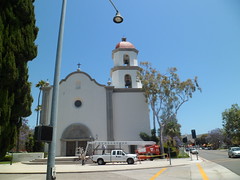
This is the basilica, on the north side of the Mission grounds.
The flora quickly take over as our gracious hosts.
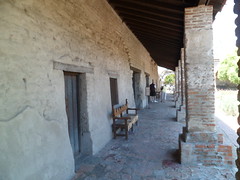
Walking along the northern quarters of the Mission, one finds rooms which housed vintners and penitents alike.
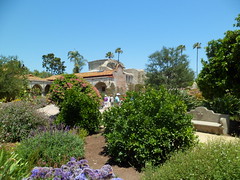
This garden graces the northwest corner of the Mission grounds.
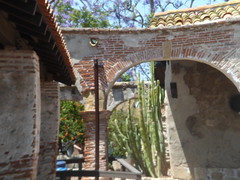
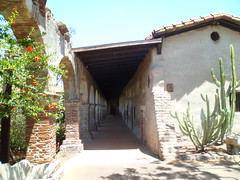
Archways are crucial to the Mission’s style.
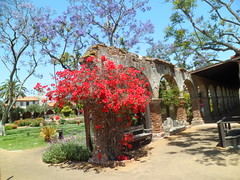
Both red and pink bougainvillea abound at the Mission.
This is a long view of the southern buildings of the Mission. These are where the kitchen was found, and where young women lodged.
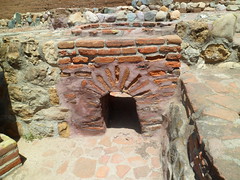
Here is an outdoor bread oven, on the west side of the Mission. There are several industrial areas and ancient archaeological digs on this side of the grounds.
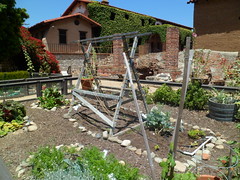
The Mission is still a working farm. This kale gives new emphasis on “Eat your veggies!”
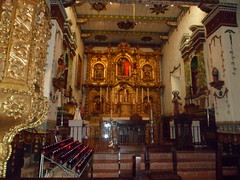
Thursday afternoon (6/7) saw about two dozen Filipino pilgrims visit the chapel that was established here in 1776, by Father Junipero Serra. This is the last remaining church where Father Serra was known to have celebrated Mass.
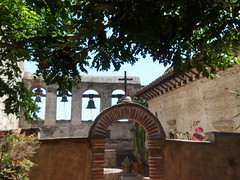
Outside Serra Chapel, there is a large courtyard, where the bells may still be rung to call worshipers to Mass.
The priest St. John O’Sullivan’s remains lie here. St. John was his given name, and he has not been canonized. Nonetheless, he was largely responsible for renovating the ruins that he found here in 1910 and re-establishing San Juan Capistrano as a working parish.
Just past Father O’Sullivan’s grave lies the southeast corner of the Mission, its tallest standing structure.
Here is a view of a grotto, on the exterior of the southeast corner of the Mission.
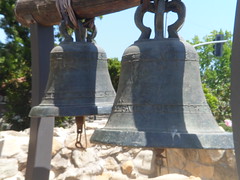
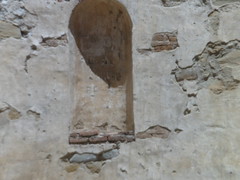
These bells are close to the southeast edge of the Mission grounds. Below is another window apse, at the southwest corner of the Mission.
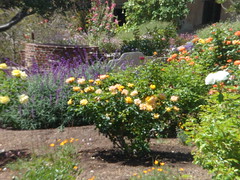
It means a lot to me to part with an ancient structure by getting one more view of its botanical splendors.
Appropriately, this garden, at the southwest corner of the Mission grounds, served as the escort to the exit from this extraordinary site. I next headed to San Juan Capistrano’s version of La Villita- the district known as Los Rios.
Before diving into my recent visit to San Juan Capistrano, I need to reflect a bit on my blessings at this stage of life. A few days ago, I met a few people whom I will henceforth regard as dear friends. I left at least one of them with a sense of puzzlement, as to what sort of person I am, and for what I stand in life. So, for her, and anyone else who is a bit uncertain, these are nine things that mean everything to me.
1. No one can know the true nature of God. I just know He is in all things, yet above all things.
2. Every person has value, and that value is unique to that person.
3. I had thirty beautiful years with the person who gave me the best of everything in her life.
4. I have the honour of calling a fine young man “son”.
5. I am blessed with so many loving family members and friends, I could not possibly dwell on the negative.
6. Marriage is among the most sacred of bonds. Unless that sacred nature is fully understood and respected by one and all, there can be no real bond between people.
7. I am far from perfect. Some people, right up through last night, have seen my flaws. My flaws, though, do not define me. My task is to transcend them.
8. I love all people, and while I am, at present, “in love with” no one, I will always work towards the best interests that I perceive for each person in my life.
9. I am on a journey of discovery. Sometimes that involves physical travel. Other times, as at this moment, my discoveries may be done by reflection.
So, to all my dear family and friends, know that you are, each and all, among the greatest blessings God could ever bestow on me. I think of my friend Andreas, in London; of Ruth and TD in Washington State; of two dear young ladies, both named Chelsea, who are like daughters to me; of my spirit brother Ted, on his own road of discovery; of my brother Glenn, who just celebrated the 52nd anniversary of the start of his amazing life, and his dear wife and wonderful family; of my siblings Cheryl and Dave, and their beautiful families; of my mother, keeping a distant watch over me, after giving my upbringing the best anyone could ask; of my own beloved son, now serving our country and humanity; of my forever in-laws; of all my Baha’i family here in the Prescott area, in Phoenix, in Dinetah and the world over; of my online family, in Xanga, Facebook and WordPress and of those new friends I met this weekend- Mike B., Jeff, Ed W., Bijan, Amy H., Marta (and Peter, who I know was with us in spirit).
I can’t promise that I will be on top of the world, financially or in public esteem, but Ican assure one and all that my life will never be for naught.
I made my second visit of this year to an old favorite- Laguna Beach, on Thursday morning (6/7), at the behest of my OC friend, J. In truth, it doesn’t take much to get me to stop somewhere on the coast between San Diego and Los Angeles; there is so much to be savored.
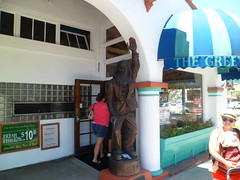
We enjoyed a fine brunch at The Cottage, near Laguna Five Points- just north of Laguna Art Museum. This was one of the haunts of the well-known actor Eiler Larsen, who was a fixture in Laguna Beach for several decades. “The Greeter”, as Eiler was known, graced the beach town with his presence and his various guises.
This statue of Eiler is several blocks south of The Cottage, which goes to show that he just loved Laguna, wherever he was in town.
We walked along Main Beach, southward as far as the private resorts.
There is a Bird Rock here, as there is at Dana Point.
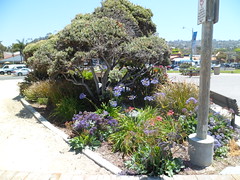
While Heisler Park, which I featured in my last Laguna Beach post this past March, is LB’s premier botanical spot, Main Beach has its mini-Heislers.
This Life Guard Station was salvaged from an inland site that was being demolished.
Back in 1979, a local prankster tried to tell me this was Laguna Beach’s Spanish mission. I already knew that to be balderdash- LOL. Still, it’s a fine resort hotel.
Beyond Hotel Laguna Beach, the rocks and private resorts modify a walker’s regimen.
Halfway up the walk to streetside, there is an urgent message for us all.
On this overlook, we met a delightful newlywed couple. J took a couple of photos for them here and along the street.
A few minutes later, J and I parted company and I headed for another of my OC favorites- San Juan Capistrano. That fascinating town will be the subject of the next two posts- one on the Mission and the other on Los Rios.
My first two days, in San Diego and Julian, were commemorative of our 30th wedding anniversary, which fell on June 6. I devoted my last post to those years so central to my life and my heart. When Thursday rolled around, and it was time to move on, I started the day in South Carlsbad Beach, then moved on to Oceanside and Dana Point.
Yes, I can’t seem to get enough of ocean beaches lately. I walked near the Main Pier at Oceanside, near the south side of the Rock Walk.
Dana Point, as scenic beaches go, is serious business. The Promontory has at least two miles of nature trails, of which, given my morning’s agenda, I walked one.
The town is named for Richard Henry Dana, who wrote an account of his experiences as a young Cape Horn-rounder in “Two Years Before The Mast”. Richard described this area as “the most beautiful section of the entire coast.” It certainly is scenic enough. Richard’s statue welcomes us to the waterfront.
Before going up onto the Promontory, I looked around the harborside park. Boats sat safely in the estuary, while California Ground Squirrels quibbled over scraps.
The Promontory delivers a fine view of town and beach- and a small bird rock.
As you can see, there was a minimum of June Gloom last Thursday.
In this case, it was San Diego, June 6, 1982. Our wedding photos were taken in the garden of the San Diego Baha’i Center, while the usual Sunday morning faith activities were conducted. At 1 P.M., I was allowed in, to set up for the beginning of Penny’s and my life together. At 2 P.M., my mother-in-law sang a wedding song, while Penny and her dad walked down the rose-petal strewn aisle. She wore white and I, a black tuxedo. That was about as traditional as it got. My father read a selection from the Baha’i Writings and my mother, from the New Testament. We exchanged the simple vow “We will all, verily, abide by the Will of God.”, and our rings. The Secretary of the Spiritual Assembly of the Baha’is of San Diego certified our marriage, and we began the real business of growth into a unit.
After a Persian musician played a lovely piece on a santour, we welcomed our 50 or so guests into the reception hall, and all enjoyed a buffet meal. Around 3:30, a couple of men walked in, looking for the regular Sunday afternoon meeting. They received a warm welcome, a free meal and some explanation of Baha’i marriage. Then, my siblings-in-law tied tin cans to the back of our car, we had some confetti thrown at us, and our parents shooed us along on our honeymoon. I think I drove about 50 yards or so, then stopped and removed the trail of cans- to a chorus of groans.
This, my friends, remains true, 30 years later- and will be true for all eternity.
I visited the San Diego Baha’i Center last Wednesday, as part of a thirtieth anniversary. It was closed, but I contented myself with meditating on the quotations such as the one above, which are mounted at the garden’s entrance.
The previous night, I went with Aram to Filippi’s Pizza Grotto, which was the first place I ever ate in San Diego, in March, 1979. Now, as then, la cucina si bellissima! The family has now established a chain, along the California coast- at least there are “branches” in South Beach, in Jacumba and in Napa Valley- probably elsewhere in the Golden State. Anyway, Penny and I had a nice meal there in January, 1982, when we went whale watching. I had to throw that in, now back to the narrative.
Penny had yearning for beach camping, our first night, so we headed to South Carlsbad State Beach- in time to meet a crowd of beach regulars who were gathering grunion. We were given about a dozen to put in our cooler, and we prepared them two days later, as Penny had to return to work for the last three days of school.
Beach camping offers a special form of camaraderie, and all get enthralled by sundown and sunup, alike.
We spent our second night together at Julian Hotel. The honeymoon suite is a cozy affair. I lit a nice fire in the fireplace that night. The Julian is still very much a presence downtown, and now has a Bed and Breakfast aspect, as well as the traditional overnight stay.
The last day before we left, we walked around town during the morning, enjoying lunch around noon at Julian Pie Company.
After one last long look at the mountain scenery, we left for Tuba City, AZ, and our first four years together in service to the Navajo and Hopi children.
Tuba, as those who knew us when will attest, was our laboratory for marital and personal growth. Penny learned delayed gratification about some things and I learned that not every mistake I made was the end of life as I knew it. I also learned that being a man did NOT mean fixing every problem that arose, but processing together, so we could get a better solution. That last one took me until our son was born, to really figure out.
Does the high desert look like a good place to grow together? For us, it was. (NOTE: These photos are file photos, from the Navajo Times.)
A late night phone call, answered by a tired yours truly and confirmed by my equally tired wife, led to first her getting a job at Cheju National University, in South Korea’s island southwest, in Fall, 1986. I got my job there, after a fashion, in March, 1987. Our son, Aram, began his life there, in July, 1988. We stayed, in a struggling, but exquisite, semitropical environment, until March, 1992. (Photos below are file photos, from Google Earth and the Korea Ministry of Tourism. The last photo is a self-portrait by Imstress.)
Cheju has all the things that make Korea great, and beautiful: Shoreline, mountain, ancient culture- and vibrant, beautiful people.
Volcanic beach on west side of Cheju.
Summit of Halla-san, the highest peak in South Korea.
Hand-carved ceramic warriors at Mok-sook-wan.
Imstress, with a Dol-harubang (“Stone Grandfather”).
Penny’s folks knew us well enough to realize that we might well have stayed in Korea until Aram’s maturity. He is their only grandson, and thus the pleading and their emotional stress brought us back to Arizona. We spent the next seven years in and around Jeddito, a small Navajo hamlet that provided a school for rural Navajos and Hopis, replacing an older school in nearby Keams Canyon, where Penny had taught in 1980-81. Aram was friends with a fair number of Native children, but on terms dictated by their emotionally hurt, and sometimes angry, elders and older siblings. There is where he got a sense of the cost of Man’s inhumanity to Man. There is where it was made clear why we need the unification of the human race.
(These photos are also file photos of the Navajo Times.)
Sunday church service.
A meadow near Jeddito. Pongsikvi (“Keams Canyon”)
As Aram grew into middle-school age and Penny started to show health problems, we moved closer to the metro area of Phoenix. I served three years as a school principal, in three different locations. In the end, Money-Politics was on the mound, and I struck out. Penny and Aram learned Tae-kwon-do, she began a series of naturopathic treatments, primarily with a traditional Chinese acupuncturist and herbalist, who doggedly kept her alert and productive until 2010, when the neurological ravage known as Polyglucosan Body Disease began to get the upper hand and she had to be placed in a rehabilitation hospital.
From 2001- 2006, she was able to work a fair amount of wonder, with her students in the West Valley town of El Mirage.
I was pretty much on call, working as a substitute teacher in a couple of school districts, but mainly being ready in case Penny had an emergency. When she was no longer able to work, she reverted to working on yet another Master’s Degree- this one in Educational Technology. She never did get to put it to direct use, but it kept her on track for another four years- and she mentored younger women at Arizona State University- West Campus. Here, I must thank Dr. Michael Desvigne and the staff of Trillium Specialty Hospital, for their gargantuan efforts at largely overcoming the ill effects of Penny’s four years in a wheelchair.
She was released from Trillium, largely healed of her pressure wounds, in November, 2010. Other infections took root, though, and by February, 2011, she went to her last place of residence- Odyssey Hospice. On March 5, 2011, her spirit contacted me at 6 A.M., saying it was time. As Aram and I pulled into the Odyssey parking lot, a small gust of wind blew upwards from the ground, in a spiraling motion. I found her physical frame, lifeless for about three minutes and still warm, waiting in her bed, for a dignified burial. This we, her loved ones, did for her on March 9. As she was the spouse of a veteran, her body went to its final rest in Arizona Memorial Cemetery.
We traveled alot together, as this 1984 photo of Penny in Guyana will attest. So, it’s no wonder her spirit has set me on several journeys, last year and this.
We were a hard-working, struggling and sold little family. In many ways, Penny beat her demons-especially the external ones. She helped me greatly in confronting and beating mine- especially the internal ones.
I have been moving on, outwardly alone, but knowing she’s right alongside, 24/7. I’ve made many friends since last Spring, and am glad for being able to give and receive friendships with people of both genders, all ages and a wide variety of backgrounds. As I mentioned in my last post, if and when I meet another special person, it’ll seem, the way it did with Penny, to happen out of the blue. There was no force or contrivance, either way, between us- it just was. So, too, will it be next time. I am not afraid of either being “just friends” with women, nor of meeting someone with whom I can share the rest of my life- but it has to be a mutual feeling. I am, solidly, for the time being, on Square One.
I recovered nicely from the long drive yesterday, thanks to the restful night I had at Town & Country Motel, in Fort Stockton.
The Chihuahuan Desert region supplants the Permian Basin around these parts, and is just as arid. Yucca is a dominant succulent here, and many of the same cacti as are in the Sonoran Desert, further west, have found their way here also.
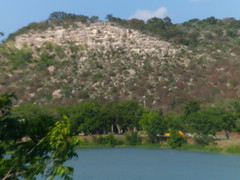
The sere beauty of the Davis Mountains cannot be overlooked.
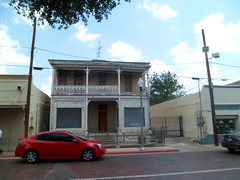
I also stopped briefly in two Chihuahuan Desert outposts: Van Horn and Sierra Blanca. Both are friendly and architecturally- rich communities.
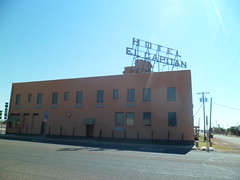
Here are Van Horn’s El Capitan Hotel and an old school, which houses the town’s historical museum.
The town is named for an Army lieutenant, James Van Horn, who fought the Confederates in 1861.
I continued, after about a half hour, to Sierra Blanca, which is named for a local mountain range.
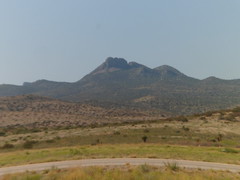
Here is the mountain range, Sierra Blanca.
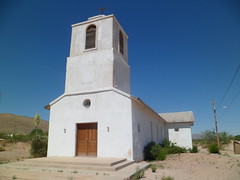
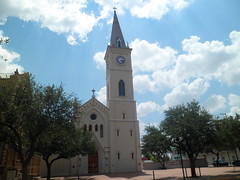
Our Lady of Miracles Mission graces Sierra Blanca, the town.
The last metro area on my itinerary was El Paso- Las Cruces. Despite it being a Sunday (5/27), I found El Paso relatively busy, streetside. I did not remain in this anchor of West Texas for very long, as Phoenix was in my sights for the evening.
Still, here are a couple of scenes of this interesting city, worth 1-2 days’ visit, by itself.
Here is Mt. Franklin, “The Southernmost of the Rockies”.
As one heads towards downtown, St. Patrick’s Cathedral presents itself.
El Paso has a couple of Spanish missions that invite visits, but for now, I will be content with a view of downtown.
I needed a place to indulge in the last of my summer sausage and fruit, so I stopped about an hour west of El Paso, in the old Spanish market town of Mesilla, just south of La Cruces, NM.
Mesilla remains a popular market for Las Cruces area residents. Its centerpiece, though, is the Church of San Albino.
Across from the church, there is a gazebo, where an older couple was singing traditional northern Mexican songs.
The original architecture of Mesilla still enchants.
Whatever your needs, though, there is something colourful in a traditional New Mexican market town, for everyone.
The long, sweet Texas journey was over. I drove over the mountains of western New Mexico/eastern Arizona to Phoenix, enjoyed a hearty meal and camaraderie at Texas Roadhouse, in the Metrocenter area, and rested comfortably at Premier Inn. Memorial Day found me at Penny’s grave site and then heading back to Prescott, for a “don’t blink” week or so, before my second Southern California trip of the year.
Those who think Texas is uniformly flat, are in for a reality check at both the north and south ends of the Hill Country. The southern segment throws the landscape into even higher relief. It looks like the water has had longer to erode the surrounding terrain more deeply here.
I started the afternoon buzzing through Carrizo Springs, an oil boom town northwest of Laredo. The area is quite arid, but riparian enough to support a great deal of greenery.
This was taken just west of the Border Patrol check station, just outside Carrizo.
Crystal Springs is a funky little town about forty minutes west of Carrizo Springs. It has an artistic flair, as one might gather from the following four photos.
Above is a shrine to unborn children.
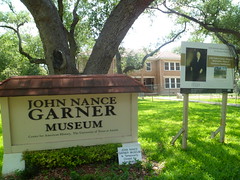
Uvalde, about twenty miles further west, has wide streets and very stately architecture downtown. It was also home to U.S. Vice President John Nance Garner, who served during FDR’s third term.
Near the Garner House is Uvalde Grand Opera House. Country folk provided their own refinement, by and large.
Once outside Uvalde, the Hill Country’s rugged character takes back over. One may either head north, towards Junction or west, towards Del Rio. I chose north, this time.
This is a view from the Frio Canyon overlook off Hwy. 281. I encountered a couple whose car was overheating. They had a family member coming from Junction, about forty minutes away from the overlook, so I enjoyed the view and moved on.
I pulled into Junction, TX, which brought me to I-10, around 6 P.M. Junction has several amenities for hunters and fishermen, and is generally a pleasant-looking town. The South Llano River runs through Junction.
Junction’s Chamber of Commerce has a good sense of humour.
I continued on, into the Chihuahuan Desert, spending the night at the very pleasant Town & Country Motel, in Fort Stockton.
Next: Day 10- Chihuahuan Desert scenes, El Paso and a New Mexico Driving Break.
She was stunning. The young girl glanced up at me, doe-eyed and with a deceptive air of innocence. As I went about my business, the head-over-heels-in-love 14-year-old boy excitedly leapt for joy; then they embraced. They were still in lip-lock when I came back around, with another load of stuff for my night’s stay.
I have often wondered about the real state of Texas border towns. Horror stories sometimes make their way onto my news feed. While I was in Austin recently, a young man told me he was from Laredo, and that many of the stories were true.
Naturally, within the reasonable bounds of caution, I decided to check out Laredo for myself- during the day. I did stay the night at a raucous and down-at-the-heels place called Monterey Inn, but the characters were just partying, and posed no threat to me. The police sirens were constant, but also distant.
Laredo, by day, at least on Saturday morning (5/26), is as vibrant and happy a place as I’ve seen anywhere. When I first parked at the Public Library, so as to check my e-mails (Wi-fi at places like the Monterey is nonexistent.), two men across the street made note of my presence. When I left and put the laptop back in the trunk, they stood and watched as I briefly pondered walking downtown from there. Seeing their interest, I decided to drive off and park closer to the Plaza San Agustin.
St. Augustine is the patron of Laredo, and his cathedral stands vibrantly on the east end of the Plaza.
La Posada Hotel sits on the south end of the Plaza. It is Laredo’s grand hotel, and is on the site where the Republic of Rio Grande was declared, briefly, in January, 1840, by opponents of Mexican President Antonio de Santa Anna. They did not meet a good end.
Now, as then, there are many jockeying for position along the border, and in Mexico itself. I chose not to approach the river area this time, having satisfied my curiosity on Friday (5/25), at Boca Chica.
Here a few other shots around downtown and midtown Laredo.
This is the County Courthouse, in midtown.
Here is some of Laredo’s lovely tile and wrought iron work. Below are a couple of other samples of the city’s exquisite Castilian architecture.
I headed northwest, towards the southern edge of Texas Hill Country, and briefly said farewell to Laredo at the Texas Visitors’ Center, a grand place by itself.
There are several gardens- and koi.
So it is that life on the mid-border is not as sketchy as some see it- but as with anywhere there is conflict, prudence works.
Next: Day 9, Part 2- Carrizo Springs to the Southern Hill Country












 Sunday church service.