This being a post about our nation’s 36th President, there are lots of photos. For the same reason, there are no photos of the interior of the Ranch House. Lyndon Baines Johnson had his public side, and his private side. He made it very clear, very fast, which was which. I never heard of anyone back-talking the man who once said: “In this White House, there’s elephants and there’s ants. Right now, I’m the only elephant.”; no one that is, except Lady Bird- the only human being who ever terrified him, once his Grandma passed on.
LBJ enjoyed inviting people to come to the Texas White House, telling them to “take the first left across the bridge, when you see the Ranch House.” It was the original Bridge to Nowhere, and many a chagrined visitor ended up in the Pedernales, with Lyndon standing on the north bank, laughing his head off. Word is, he invited the Reverend Billy Graham to the ranch once, and Reverend Graham said, “I’d like the REAL directions to the house.” You can’t fool a man of the cloth.
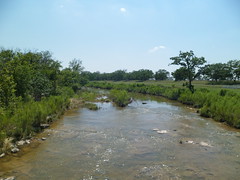
Today, thousands of people make their way here. There were 65 of us, in three tour groups, when I showed up.
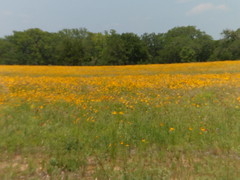
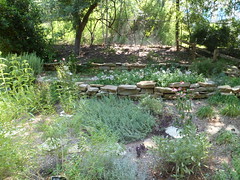
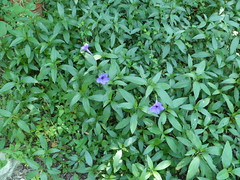
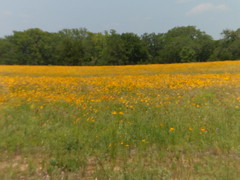
This was Lady Bird’s home, first and foremost, so there were lots of coreopsis, and a myriad of other kinds of wildflowers.
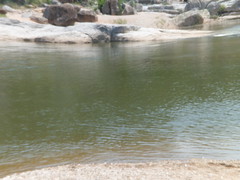
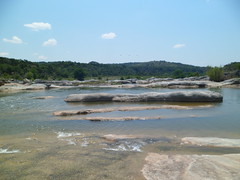
This is the spot where LBJ had his prank foils try and cross the Pedernales.

Before touring the Ranch, I spent about thirty minutes at the Visitors’ Center, near the Living History Farm.
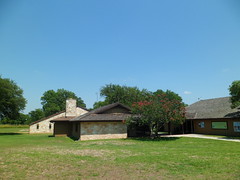
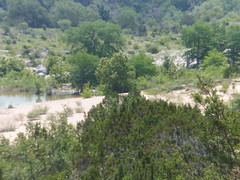
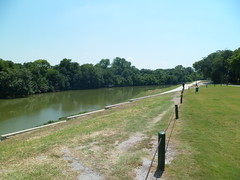
This is the Pedernales River, near where Billy Graham, and those of us visiting presently, crossed to get to the Ranch.

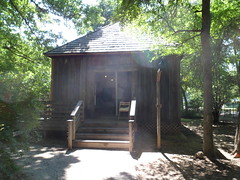
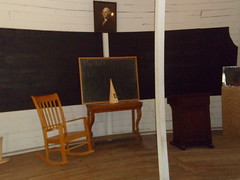
In this schoolhouse, a four-year-old Lyndon insisted on attending, so that he might make friends, being an only child at the time. (Sam Houston Johnson came a bit later.) He also developed a thirst for knowledge, and eventually became a teacher, prior to entering politics.
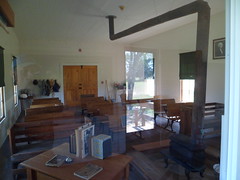
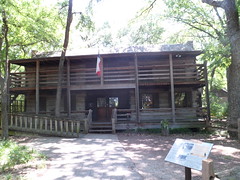
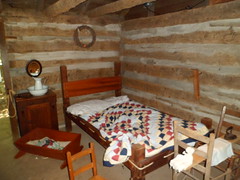
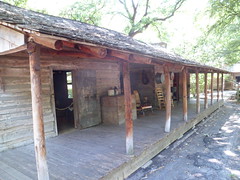
This was the dog trot house where LBJ lived as a small boy. Remember the dog trot houses from Log Cabin Village, in Fort Worth? They were all over the Hill Country, also.

This view is of Stonewall Lutheran Church, which the Johnsons sometimes attended.

These are the final resting places of President and Mrs. Johnson. Luci and Lynda ask that people not enter the cemetery. Photos may be taken from outside the fence.

I’ve seldom met a horse I didn’t like. LBJ felt the same way. His horses stayed here, in the Show Barn.

Every plane a president of the United States uses is dubbed “Air Force One”. This was one of LBJ’s favourites, and now sits next to the Hangar Visitor Center, from whence tours of the Texas White House begin.

LBJ loved to amuse his grandson, Patrick Lyndon Nugent, by singing along with his dog. Mr. Nugent is today the principal manager of LBJ Ranch.

Here is a car which LBJ himself liked to drive into the Pedernales. Often, Robert McNamara, his Secretary of Defense, would come along for the soaking.

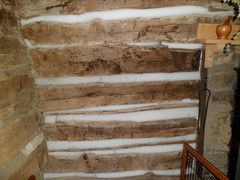
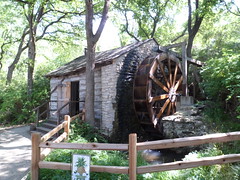
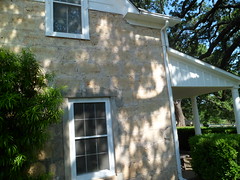
Here is the fine native stone that was used to build the Ranch House, by LBJ’s uncle, Judge Martin.
.
The interior of the Ranch House carries its share of stories. As a Southern man of the Fifties and Sixties, LBJ made sure there was an ashtray in every room, beer in all seven refrigerators, and that all fifteen televisions were on, continuously. He had another motive for the last one, though. In his bedroom, there were three TV’s. As back then, we only had three major networks and PBS, he had one TV set to each commercial network. He kept an eye on what was being broadcast , and would call the head honcho of any network that was critical of his policies, and browbeat the hapless exec, on the subject of patriotism. Some of these calls were made in the middle of the night, and LBJ made no note of time zones. He didn’t worry about PBS, since he was technically its boss.
When a person was invited to the Ranch, and was escorted, upon arrival, into the Living Room, he knew a tongue-lashing was coming. George McGovern was brought to the Living Room. Richard Nixon wasn’t.
Lyndon and Miss Claudia Alta maintained separate, but adjoining, bedrooms. This was done so that she could get some sleep. The President was a night hawk, and lay his head down around 3 A.M., many nights. Of course, he’d be up by 7.
He died here in January, 1973, at age 64. A lifetime of smoking, drinking, and all-around rough living took Lyndon Johnson out, probably far sooner than he might have left. What really did him in, though, was feeling tossed aside. His decisions with regard to Viet Nam made him a pariah to many Democrats. So, he fell to depression, and the broken heart gave out.
Nonetheless, Mr. Johnson’s considerable legacy transcended the Viet Nam War, and the man whom the children of Stonewall, Texas called “Mister Jellybean”, for his gifts to them of candy, lived a life worthy of study.